Meditation on a poetic meditation: To Duration by Peter Handke

In a month during which reading proved to be a slow, at times disjointed enterprise, I feel it would be shortsighted to let January come to a close without calling attention to one of the simplest, most precious reading experiences I enjoyed over the past 31 days. It arrived, courtesy of the translator, on a morning when I was rushing out of the house on my way to an appointment across town. A slender, pocket sized volume, it proved perfect company for a busy day. Only 40 pages long I read it several times before the week was out. I am speaking of Peter Handke’s poetic meditation To Duration, translated from the German by Scott Abbott.

The author tells us in the opening stanza, that he has long wished to engage in the following personal quest, the exploration of a topic that he feels is best suited to the poetic medium. Perhaps it is only with a poem that language can circle around and come close to touching on a subject that is, by its very nature, difficult to pin down and describe. Words are almost too solid to capture an experience that dissolves as quickly as it arrives:

Time and again I have experienced duration,
in early spring at Fontaine Sainte-Marie,
in the night wind at the Porte d’Auteuil,
in the summer sun of the Karst,
on the way home before dawn after love.

This duration, what was it?
Was it an interval of time?
Something measurable? A certitude?
No duration was a feeling, the most fleeting of all feelings,
more swiftly past than the blink of an eye,
unpredictable, uncontrollable,
impalpable, immeasurable.

Duration, Handke tells us, is not fixed or prescribed; it cannot be scheduled or delayed. It can be approached, but it cannot be forced or guaranteed. I would wager that as our lives grow more stretched, weary, and fraught with the disillusion of time, duration becomes ever more elusive. I also wonder if, when we try to grasp at it through our memory of those moments when it seems we once met duration in passing, the more impossible it seems. And then, one day, when we are not expecting it, the feeling taps us on the shoulder, washes over us and moves on but leaves its trace, like frost on a bare branch or the hint of dew on the grass. One of the true gifts of this book, is that it inspires the reader to explore his or her own experience of duration. What is it for me,when is it, when was it, where? These are the questions that the reader is encouraged to meditate upon, as Handke reflects back upon his relationship with duration in his own life. His calm, measured, and sensitive introspection invites you to engage in the same.

At one point he talks about travel and journey as opportunities to open oneself to encounters with this feeling. There was a time when I was able to regularly visit certain parks and pathways in my hometown, typically with my camera in hand, focused on nature framed through the lens – a dried leaf here, a glimpse of a meandering stream there, the shifting pattern of clouds in the wide blue sky. At home, processing the files, I could almost revisit the moment – it was not the photograph that fixed the moment, in and of itself, it was rather an ability of the image to contain, for me alone, the experience of being in the moment. Is that duration? A variation on the theme? And why don’t I visit local parks as much as I used to?

In truth, I need a greater distance, at least right now.

23823656024_da6c196a78_b
Sea Point Promenade at sunset, July 2015 – Copyright JM Schreiber

Last summer I spent three weeks in South Africa. After a visit with a close friend in the Eastern Cape, I returned to Cape Town for a week on my own. I traveled on foot and by city bus, eschewing most of the tourist sites. I wanted to be in the city. I stayed in a small B&B in Sea Point and every day I walked the Promenade along the Atlantic. A popular pathway, no doubt, but there was, for me, an essential necessity to be close to the ocean. Sometimes I would stand at the salt-corroded railings and look out over the waves and find a deep peace at being so far from home and all of the complications left behind there. I could turn around and ground myself with the unmistakable landmarks of Signal Hill and Lion’s Head. It was the moment experienced and re-experienced each day that became the fulcrum of my stay in the city. No day was complete without it. If I lived in Cape Town I don’t think I could have touched duration like that, so intentionally. The measure of seven short days, coloured by an intention to be less a tourist than a presence in a city, not having to actually attempt to fit in like I do at home, I touched a peace of place I rarely experience. Travel can do that.

But physical travel,
the annual journeying and pilgrimages
for the jolt of duration,
the thrilling supplement,
is that really still necessary for me?

Handke acknowledges increasingly finding more instances of duration closer to home, even in his own garden. Restless as I am in my house and home, I likely frighten off duration, so fragile and fleeting a guest. Yet just the other night it caught me unaware. My elderly father, still seriously weakened and disoriented following his stroke, insisted on returning home from the hospital on Thursday against the recommendations of his doctors and the wishes of his family. I quickly gathered some clothing and personal items in one bag and tossed a handful of books from my priority pile into another and headed out the door for the two hour drive to the remote location where they live. That first evening, once my exhausted parents were safely tucked into bed, I sat in the delicious silence with my collection of books. I wasn’t actually expecting to have time to even start reading any of them – I just wanted to spend time with these relatively new acquisitions. Get to know them a little. Read a few pages. This unexpected moment, borne of a collision of unwelcome circumstances, opened the door to duration, inviting that unpredictable, immeasurable sensation, to wash over me, leaving a sense of contentment I hardly imagined I would encounter when I had headed for the highway only a few short hours earlier.

Perhaps then, if you watch for it, open yourself to it, maybe duration is not quite as elusive as it may seem.

scan-2


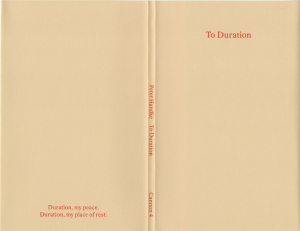
To Duration, Cannon Magazine No. 4, is published by The Last Books.

With infinite thanks to Scott Abbot.

The dying gold of ruined stars – Poems: Book One of Our Trakl by Georg Trakl

“Sun, autumnal, thin and shy,
And the fruit falls from the trees.
Stillness dwells within its blue rooms
During a long afternoon.”

– from “Whispered during the Afternoon”, Georg Trakl, translation by James Reidel

Many years ago when I was in school, poetry, in so far as we were introduced to it, was almost exclusively the works of English language poets. In high school I fell under the spell of the English Romantic writers and that was the beginning. Over the years though, I would be inclined to think that most of the poets I have become obsessed with wrote in English, that is, until I began to read more translated fiction. With that my attention shifted, or to be more precise, my horizons became broader.

TraklThis year, a German book enthusiast I have come to know through the “internet of book discussions”, the corner of the web I inhabit, introduced me to Austrian poet Georg Trakl. Somehow he had escaped my attention before. Of course, when you come to read poetry in translation, the question of the translation itself becomes critical. Typically, when more than one translation of a poet’s work exists I try to access and compare a few. But when Seagull Books released the first installment of a three part series of Trakl’s poetry, I did not hesitate to order a copy, sight unseen.

Poems: Book One of Our Trakl is a new translation, by American poet and translator James Reidel, of the poet’s first collection, simply titled Poems (Gedichte), which was originally published in 1913. In his note at the opening of this volume, Reidel recounts that he has endeavoured to preserve the same concentrated mania that marks the works of the 19th century poets Trakl would have read: Baudelaire, Rimbaud, Verlaine, Hölderlin and Poe. He says:

“I want to actually channel Trakl, his craft (with its implicit painterliness) and work ethic, to have him, so to speak, absorbed in the right dosages he – as a poet, pharmacist and addict – intended.”

Reidel does go on to add that to emulate Trakl’s delivery in English, the rhyme scheme of the original poems is often necessarily sacrificed, but the contortions required to retain  rhyme can trivialize a poet’s spirit and tone.

In an essay in the online poetry journal Mudlark, Reidel expands on his Trakl translation project. He provides an overview of Trakl’s short and tragic life, as well a discussion of his approach to the translation, and a selection of his translations presented with the original German. A poet himself, Reidel brings a sensitivity and insight to his reading and approach that I, as reader, value:

“I have found that when you read Trakl in the original German, you get a snapshot of what is there. When you go back, you get another view. It may be sharper or less so, and with the feeling that it is intentionally less so. This can be frustrating for those who speak and think in English, that lawyer of languages. There is no fixed point to reading him or rendering him. This makes any book of translations simply a collection of snapshots of a particular reading at any point in time. Another way of rendering/reading a Trakl poem is through the barrel of a kaleidoscope, where one can only fix on a view when one stops or when the glass bits sometimes jam. I do this.”

Born in 1887, into a prosperous Salzburg family, Trakl was a precocious child, creative and intelligent – by his early teens he was experimenting with lyric verse that showed great promise. He could, however, be withdrawn and prone to depression. He was exceptionally close to his sister Margarete (Grete), a musical prodigy with whom he is thought to have engaged in an incestuous relationship. He began publishing poems in 1908, in Vienna where he had gone to study pharmacology, a tempting profession for one who already had a tendency towards addiction. As a budding poet, he enjoyed early success and mentorship during the following years, ultimately attracting the discreet patronage of Ludwig Wittgenstein. But the outbreak of war forced him into military service. Relying on his training as a pharmacist he hoped to avoid direct combat, but the trauma of trying to attend to desperately wounded troops without adequate supplies would drive him to attempt suicide. He was sent to a military hospital in Kraków for observation, but suffered a relapse and was found dead of a cocaine overdose on November 3, 1914. He was 27 years old.

                Patterns of Decay  (c) JM Schreiber, 2011
Patterns of Decay , Copyright JM Schreiber, 2011

This first volume of Trackl’s poetry, beautifully bound and presented by Seagull books, readily lends itself to an immersive reading from beginning to end. The autumnal themes that feature so strongly make it an even more evocative read for someone like myself at this time – that is, in November in the northern hemisphere – but autumn is rendered almost metaphorical in his verses. Nature figures in his work, rendered through rural and religious imagery; however nature, for Trakl, is one which couches death and decay as an intrinsic element of its stark beauty and haunting appeal:

In the evening, when the bells toll of peace,
I follow the birds in their glorious flights,
Long multitudes, like pious trains of pilgrims,
Disappearing into autumn’s clear breadths.

Wandering through the twilight-filled garden
I dream following their brighter destinies
And feel the sundials barely move any more.
So I follow their journeys above the clouds.

There a blast of decay makes me start to tremble.
The blackbird laments in the leafless branches.
The red vine totters on rusting trellises.

While like a dance of death of pale children
Around the dark weathered rim of the fountain
The blue asters toss shivering in the wind.

– “Decay”

These are quiet, brooding poems that show a clear obsession with decline. They speak to a young poet struggling to capture the gloom in his own soul, consequently the poems have a very immediate and personal feel. Are they depressing? As someone who has had his own lifelong challenges with mood dysregulation, I find his words oddly comforting. I am not equipped to offer a critique of poetry, I am afraid I can, in this case, only speak to what I feel. And I don’t believe I am alone in registering a profound personal response to Trackl’s poetry. In his short life he produced a small, but vital, body of work that would have an important influence on other German language poets including Paul Celan, Thomas Bernhard and Peter Handke; and draw the ongoing interest of poets, translators and readers outside of German speaking countries that continues to this day, just over one hundred years after his death.

For my part, I can only eagerly look forward to the upcoming additions to Our Trakl.

Listening to the voices of Afghan women: I am the Beggar of the World

“In my dream, I am the president,
When I awake, I am the beggar of the world.”

With a long history, passed down through generations, landays are traditional two line poems recited or sung by the mostly illiterate Pashtun people who live along the border region between Pakistan and Afghanistan. They are composed of twenty-two syllables – nine in the first line and thirteen in the second. For the women in this area who face social and cultural restraints that define and restrict their lives, these anonymous couplets have become an important medium for self expression. Sometimes they gather to share or perform the landays they have learned, updated or re-invented; but radio and the ubiquitous social media and cell phones have also been worked into a new modern network for sharing.

beggarI Am the Beggar of the World: Landays from Contemporary Afghanistan, a collaboration between translator and poet Eliza Griswold and photographer Seamus Murphy, is a sensitive and moving collection of landays, brief essays, and photographs. Upon hearing of the death of a teenaged poet who had been forbidden by her family to write poems and burned herself in protest, Griswold was inspired to journey to Afghanistan to explore the role of landays in the lives of Pashtun women. She returned to collect some of these poems, assisted by native speakers and a Pashta translator, Asma Safi, who sadly died of a heart condition before the project was complete. Arranging meetings as an American was not always easy – being under occupation is a difficult, deadly environment – but along the way she collected the words and stories of some very strong, fascinating women.

Divided into three sections, the first is dedicated to Love. Many of the couplets are brazenly racy, teasing and modern. Yet because landays are by their nature anonymous, no woman can be held responsible for sharing them or for the contemporary imagery has been worked into the more traditional versions:

“Embrace me in your suicide vest
but don’t say I won’t give you a kiss.”

“Your eyes aren’t eyes. They’re bees.
I can find no cure for their sting.”

“”How much simpler can love be?
Let’s get engaged. Text me.”

The second section is dedictated to the themes of Grief and Separation. Suffering and servitude are enduring features of the lives of Pashtun women. Marriage implies both. Curiously love also features throughout the poems in this section because romantic love is forbidden. If a young woman is discovered to be in love with a man she can be killed or driven to take her own life to preserve her family’s honour.

“Our secret love has been discovered.
You run one way and I’ll flee the other.”

Once married, having one’s husband take another wife is emotionally painful, but being passed over altogether or married off to an old man can be worse.

“Listen, friends, and share my despair
My cruel father is selling me to an old goat.”

The final section explores War and Homeland. Complex, mixed emotions, anger and sorrow rise up here in poems that are moving and, again, shockingly modern. A long legacy of occupation under British, Russian, and American forces has placed the women of Afghanistan in a difficult position, torn between the brutality of American protection and the combined threat and promise of the Taliban. The landays and the images in this section are especially powerful and represent sentiments that women would not be able to express so readily in any other forum:

“Be black with gunpowder or bloodred
but don’t come home whole and disgrace my bed.”

“Beneath her scarf, her honor was pure.
Now she flees Kabul bareheaded and poor.”

“May God destroy your tank and your drone,
you who’ve destroyed my village, my home.”

This slim volume is a testament to the resilience of the Pashtun women in the face of the violence, threats and restraints they live with every day. These traditional two-line poems provide a framework for illiterate women to express themselves and share their sorrows, joys and wisdom with their sisters. In Afghanistan they still face risks in committing their own poetry to paper when they are able, so this oral tradition remains important, even if modern devices like cell phones have expanded their network. This beautiful book which pairs the simple landays with muted black and white photographs documenting the people of Afghanistan, the sparse landscape and the violence of war, provides a rare opportunity to hear the intimate voices of women that might otherwise be silenced.

Releasing words from the page

In the opening pages of Teju Cole’s Open City, his narrator, the young medical resident Julius, introduces the reader to his own reading habits, setting perhaps the tone and frame of mind for the recollections and encounters that will unfold over the following pages. He explains his fondness for internet classical music stations, commercial free broadcasts from countries where the foreign languages of the announcers blend into, rather than distract from the musical tapestry. Settled with a book on the sofa he confesses that:

“Sometimes, I even spoke the words in the book out loud to myself, and doing so I noticed the odd way my voice mingled with the murmur of the French, German, or Dutch radio announcers, or with the thin texture of the violin strings of the orchestras, all of this intensified by the fact that whatever I was reading had likely been translated out of one of the European languages.”

Assuming I am not in a public space where others would likely look on in askance I am likewise inclined to read aloud to myself at times. Meditative, less conventional, writing forms itself especially to this practice, not only obvious writers like Cole or WG Sebald, but wonderfully spare and introspective works like Damon Galgut’s In a Strange Room or the experimental The Absent Therapist by Will Eaves. And Thomas Bernhard, even though I cannot read him in the original German, flows with energy and intensity against JS Bach. I often stop and read a few pages out loud when I feel that I may be losing my moorings in the book long paragraph structure of his novels. Similarly José Saramago and Javier Marías are authors that more people might be able to connect with by inhabiting the language through reading portions out loud.

I have also had the experience of coming to appreciate a piece of literature in an entirely new way through hearing an author’s reading. Last year I read All My Puny Sorrows by Canadian author Miriam Toews, the story of two sisters, one deeply depressed and suicidal, and the other faced with the dilemma of if and how to assist her beloved sister in achieving her goal. Being much closer to my own recent breakdown and knowing that Toews had drawn on the tragic history of suicidal depression in her own family, I read it seeking insight into the suicidal sister’s perspective. I was disappointed. But hearing Miriam read from her work and having the opportunity to meet her last fall, I suddenly realized that I was expecting something the story could not deliver and had, consequently, missed the self-deprecating black humour in this challenging, compassionate tale of unconditional sibling love.

Cliche shot of a favourite poem, WH Auden's "As I Walked Out One Evening"
Cliche shot of a favourite poem, WH Auden’s “As I Walked Out One Evening”

So if the experience of prose can, at times, be enriched by being read out loud, poetry would seem to be an obvious aural experience. Poetry readings have a long standing literary history, joined now with the likes of slam poetry and rap. What a surprise then to have someone on another readerly space I frequent declare that he is against reading poetry aloud. Assuming he was not typing with tongue in cheek, for who can tell, my immediate response was one of disbelief. Excuse me? I cannot imagine not reading poetry out loud. I even make an effort to commit the poems that I find especially powerful to memory, to recite them, to myself and, on occasion, to others. Hearing authors read their own work has a special value and impact. Listening to a poem shared aloud by a passionate reader can allow the words to be transformed and re-interpreted in a new and personal context.

Have you ever encountered a piece of prose or a poetry so breath taking that you had to stop and re-read it, mark or circle it in the text if you are so inclined, copy it into a journal or print it out to keep close at hand? Do you feel compelled to repeat the words out loud to yourself, inspired to share them with others? For me that is the beauty of being in love with language. Sometimes words just have to spill out beyond the confines of the printed page and be granted a full existence in the world.

A love-hate relationship with a city

The City
         C. P. Cavafy (1910)

You said: “I’ll go to another country, go to another shore,
find another city better than this one.
Whatever I try to do is fated to turn out wrong
and my heart lies buried as though it were something dead.
How long can I let my mind moulder in this place?
Wherever I turn, wherever I happen to look,
I see the black ruins of my life, here,
where I’ve spent so many years, wasted them, destroyed them totally.”
 
You won’t find a new country, won’t find another shore.
This city will always pursue you. You will walk
the same streets, grow old in the same neighborhoods,
will turn gray in these same houses.
You will always end up in this city. Don’t hope for things elsewhere:
there is no ship for you, there is no road.
As you’ve wasted your life here, in this small corner,
you’ve destroyed it everywhere else in the world.
                   (Translated by Edmund Keeley/Philip Sherrard)

My city was new when Alexandria which inspired these words was old but the sentiment  rings across the century, speaking to me.

Copyright JM Schreiber, 2013

I live in a glass and rock cast stucco bungalow, the kind of finish that will slice your palm if you lose your balance and put a hand out to stop your fall. It sits on a 6500 square foot lot overgrown with 60 foot spruce and spiky hawthorns. The garage stands, roof sagging, without a foundation and no more than a scratch coat for stucco that was never applied, at best a large shed. It is only a matter of time before the sewer line to the street which is already oval shaped, collapses in on itself. After a few years of eager redecorating, projects remain incomplete, even though all the paint and supplies were purchased long ago.

This year my house will be 62 years old, I have lived here for 20 of those years. Due to the location, the lot size and the high property values in this city, it is assessed at a value that shocks me. I have ample equity in this house I own, but no secure income. And you can’t eat equity.

More and more the house is closing in on me. It is filled with the artifacts of 20 years of raising children. And a 25 year-old alcoholic son who seems to have taken root in the basement. After being a single parent for so long, I am done. My career prospects hanging on a thread frayed by mental illness; I feel haunted by the house, the responsibilities that weigh on me, and the fatigue of facing it alone.

And this city is no more a home than it has ever been. Without my job it holds nothing and never has. I love the pathways and wild areas, I love the wide open skies and the mountains on the horizon, the rolling foothills stretching to the west. But the city has no soul, or at least not for me. My relationship with this city, one to which I chose to return at one time, is fraught with complicated anxieties.

It may be my fault. Perhaps I am the one who failed to open up and build connections. But that has never been easy and the more I go out to meet people or attend events, the deeper the loneliness settles in on me the next day. Like it or not, there is a fundamental disconnect between me and this city of glass towers and oil executives.

As I walk these streets I am haunted by the sense that I have wasted so many years here, not certain what I have to show for it, feeling all is lost, fearing that I am, as the intended recipient of Cavafy’s advice, destined grow old in the same neighbourhood, turn grey(er) in the same house.

When even a sibling’s love is not enough – All My Puny Sorrows by Miriam Toews

The title and binding imagery that fuses the latest novel from Canadian author Miriam Toews comes from a poem by Samuel Taylor Coleridge to his friend, the poet Charles Lamb. Both men had their own struggles with mental illness but Lamb’s beloved sister Mary had an especially prolonged and devastating battle. Coleridge commiserates with his friend’s tireless care for his sister, reflecting that he, Coleridge had had a dear sister upon whom he “pour’d forth all his puny sorrows”. Elfreida (Elf) the suicidally depressed character at the centre of this novel drew her signature theme from this line , but it is her sister Yolandi (Yoli) who brings her to life and devotes herself to trying to keep her alive as she narrates this funny, heartbreaking tale. As such, All My Puny Sorrows is well named.

all my puny sorrowsColeridge was the first poet who caught my adolescent attention, much to the shock of my high school English teacher. However I confess it was the rugged adventure of “The Rime of the Ancient Mariner” and “Kubla Khan” that sparked my enthusiasm. The Romantic poets, so many of whom seem to have suffered from mental illnesses seemed kindred spirits ( although this would have been long before my own diagnosis). They loved passionately, often tragically, and became addicted to opiates. For the teenager falling well short of cool, the appeal is not hard to imagine.

SamuelTaylorColeridgeFor Elf and her sister growing up in the confines of a small Mennonite town, the arts were an acceptable outlet. Elfreida channels her energy into the piano eventually taking to concert stages around the world and winning the love of a man so patient he’s surely destined for sainthood. Yolandi opts for a less glamorous route, including a couple of failed marriages, children, meaningless affairs and a career pumping out rodeo themed YA novels.

I was attracted to this book when I heard Toews on the radio explaining that this novel began from a deeply personal space. Her father, a respected teacher despite a lifelong battle with depression, took his own life in 1998. Almost 12 years to the day later, her only sister followed suit in the same very way and location. Having already memorialized her father in non-fiction, Toews felt that fiction would free her up to address this very real and difficult subject more openly. But that is also where it falls apart for this reader.

She is able to make some very astute observations about the failings of the mental health system and sadly demonstrates that, in the end, there is no way that anyone or any system can ever do more than delay the efforts of someone truly committed to stepping off this mortal coil. However I never felt that Elf was more than a tragic figure in a hospital bed. Yoli’s childhood memories and the accounts of her sister’s glorious career rang hollow. The real strength of this book for me lies in the the indomitable spirit of the characters who survive against all the odds and resist the despair that mounts around them.

And maybe that is the point. It is not for us – friends, family, observers or readers to judge. In a few weeks I will be able to see Miriam Toews take part in a panel exploring the ability – or limitations – in being able to make sense of the darkness in life through literature. I will be interested to hear what she has to say.

Some ghosts have rougher journeys than others

- Copyright JM Schreiber 2012
– Copyright JM Schreiber 2012

O! WHY was I born with a different face?
Why was I not born like the rest of my race?
When I look, each one starts; when I speak, I offend;
Then I’m silent and passive, and lose every friend.

Then my verse I dishonour, my pictures despised,
My person degrade, and my temper chastise;
And the pen is my terror, the pencil my shame;
All my talents I bury, and dead is my fame.

I am either too low, or too highly priz’d;
When elate I’m envied; when meek I’m despis’d.
-William Blake, from a letter to his patron Thomas Butts, 1803

I first encountered these words in the months following my first manic breakdown in the late 1990s. With a diagnosis at hand I needed to understand its meaning so I read  the standard popular memoirs of the time. But I found myself drawn into the work of William Blake. Although many readers reject the notion that madness may have fueled his tireless creative energies, his hours conversing with angels and his periods of darkness – I found comfort in his artistic conviction even if he was destined to die without ever receiving the recognition of understanding he deserved.

For every person who successfully rises above the challenges of mental illness and negotiates the pitfalls of drugs and alcohol, there are those who spend their lives living rough. And others who lose the battle altogether. But Blake drew inspiration from his angels and demons with his loving wife by his side until the end.

Today is my birthday, and having found myself back trying to figure out what I am supposed to learn from this second mania and unexpected fall from grace, Blake’s lament has a special resonance once again.

But this time I am reflecting on a very different face than that which I confronted 17 years ago. From the time I was very young I could not make sense of the face with which I was born. The eyes that looked out from within that visage threatened to give me away. The body I struggled to feel at home in never felt like mine. The girls I befriended seemed like aliens and, with no other explanation for my discomfort I assumed that I had never learned the tricks, never tried hard enough.

The idea that gender or identity could be misaligned never occurred to me when I was growing up. At least not in the context I needed to hear. And when It did start to seep into my awareness I was already well into marriage and motherhood. It was a complicated comfort to realize that there was an explanation for my feelings. It was even more terrifying to know what to do with this information.

I know well that my mood disorder runs back through my family, that it has a genetic basis somewhere. I have no idea what course it might have followed without this added sense of being out of step with rest of humanity. But my hospital psychiatrists were certain that my apparent gender dysphoria was simply a psychotic symptom that would resolve itself with the right dose of lithium.

They were wrong of course. Now, 17 years later, the average looking middle aged man who confronts me from the mirror is not special, but he is one I feel at home with. For many years I thought that was enough, as if I had found the magic bullet, the key to moving forward on all fronts. My family have been supportive, I recreated my identity and built a new career.

But I still found that the manic-depressive monster has followed me all along. Making sense of recovery this time around, I find myself doubly invisible. Behind a face that accurately reflects my sense of self identity, is a whole life I cannot fully share. Talking about being bipolar has been the easy part.

But moving forward from this birthday, I want to find a way to be whole.

Shame, guilt and absolution

Shame: A painful emotion caused by a strong sense of guilt, embarrassment, unworthiness, or disgrace.
Copyright JM Schreiber 2014
Copyright  JM Schreiber 2014

A severe manic episode leaves a residue of shame that no magic formula can resolve or wash away. Your behaviour, actions, words and deeds – no matter how out of character – are remembered by others while you, yourself, have only the foggiest sense of a hellish few days or weeks.

As the weeks pass I find myself unable to shake thoughts of my workplace, the environment in which my manic drama played out. I don’t think about returning to work and I know that at this point I could not even mentally or emotionally entertain that notion even if they would accept me. I realized today that it is the unbearable shame I feel for actions and words I could not control and can never properly apologize for that is eating me up inside.

A post on a blog I follow inadvertently put me in mind of a poem I discovered in the wreckage of my first manic psychosis many years ago. The poem, “Deceptions”, by Philip Larkin was inspired by an account from Henry Mayhew’s London Labour and the London Poor of a young girl who was drugged and raped by her master.

The poem is exacting in its depiction of her grief and the poet admits, unapologetically, that there is no consolation he can give her; recognizing that both victim and perpetrator were deceived in the violent act. I think it is this very measured recognition that there is nothing that he can offer to absolve grief and shame in the sufferer whether the event is recent or buried by the sands of time that gives the poem its power. The following lines struck me when I first encountered them and this time around, perhaps because my manic episode was a much more public event, they clearly articulate the feelings with which I am currently trying to come to terms.

… light, unanswerable and tall and wide,
Forbids the scar to heal, and drives
Shame out of hiding.  All the unhurried day,
Your mind lay open like a drawer of knives.

This too shall pass, I know, and I will ease the drawer closed and the emotional scars will fade with time.

Absolution is not the issue. Mental illness is not a sin.

Leaving the Atocha Station – The neurotic American poet in Spain

I recently read Ben Lerner’s acclaimed first novel Leaving the Atocha Station. I bought the book in 2012 but had put it aside, uncertain I wanted to spend time with a narrator I expected to be a misanthropic American slacker poet slouching his way through the streets of Madrid. When I happened to catch the replay of a CBC radio interview with the author my interest was rekindled, especially in light of my recent breakdown and the therapeutic comfort I have been finding in poetry.

indexSure enough our narrator Adam Gordon is an ambivalent and emotionally insecure young poet who has chosen to spend a fellowship year in Madrid. Ostensibly his aim is to explore, in verse, the impact of the Civil War on Spanish society although he seems to have precious little direction or inclination of how to begin his project beyond attempting to improve his comfort with the Spanish language. He seems to have a cultured skepticism in the value of art and the validity of the artistic experience which in turn causes him a healthy dose of self loathing. He passes his days smoking hash and cigarettes, while relying on the security of tranquilizers and mood stabilizers. He reads Tolstoy, Cervantes, and John Ashbery. Beyond that he parties and awkwardly attempts to conduct love affairs with two Spanish women.

The resulting novel is a surprisingly humourous and engaging exploration of the struggling artist who refuses to struggle. Adam spends much time trying to make sense of what his new Spanish friends are saying and attempting to compose the facial expressions that he assumes will be appropriate for the circumstances. If in doubt he hides behind the prop of a cigarette. Yet it is not only the dislocation of being in a foreign country that accounts for Adam’s feeling of always being one step out of sync. He also believes himself to have bipolar disorder although it is never entirely clear that this is a confirmed diagnosis or a justification for the little yellow and white pills that he relies on. I’m not certain if Lerner, himself an established poet, is playing with the idea that neurosis is an essential element of the artistic process. Nonetheless Adam embraces it fully, manipulating his medication to ramp up the production of poems for a Spanish translation without any real sense if he is producing anything of worth.

Ultimately he crowns this phase of intense creative production with a grand manic splurge, thanks to his parents’ credit card, to impress one of the women he imagines himself in love with. An insanely expensive dinner and a night at the Ritz Carlton coincides with a tragic early morning blast at the busy Atocha Train Station, the 2004 attack by Islamic militants that killed 191 commuters. The street protests and the involvement of Adam’s wealthy young Spanish friends in the demonstrations and elections that follow this terrorist attack serve to force him to ground himself, even just a little.

The most engaging aspect of this book for me was the continual sense of self consciousness that pervadesAdam’s thoughts, plays with his confidence and keeps him from ever feeling that he is at home in any setting. His anxiety causes him to sabotage his potential relationships (or at least believe he is sabotaging them). He is alternately cocky and absolutely certain everyone else is humouring him. He spends time composing his face, adopting poses and pulling himself together in public settings. If you have never lived with a mood or anxiety disorder such obsessing might seem like poetic license. I found it uncomfortably familiar.

And those little pills Adam keeps reaching for… I have had to rely a lot on those myself lately.

For the love of gravy

Today I am thinking about gravy.

There is a dish which has become ubiquitous in Canada – fries smothered with gravy and cheese curds – the French Canadian artery clogging delight called poutine. Many years ago when I lived in Ottawa it was a treat to cross into Québec, follow some back road instructions to a truck, seemingly parked in the middle of nowhere and order the authentic dish complete with cardboard container and plastic fork. Personally my tastes have changed in 30 years, so while some version resembling poutine can be found at most of your favourite fast food haunts, but I will leave you to it. My kids, on the other hand, love gravy – with or without the cheese curds.

poutineToday my wish for my son is gravy. At 24 he has been struggling with an addiction to alcohol for several years. He is aware that underlying the addiction is the mood disorder that knits so much of our family together. Yet his experiences in anything resembling conventional mental health care have been quite horrific for an intelligent, gifted child. As far as he is concerned, alcohol is preferable to medication or therapy. I can appreciate where he is coming from but I chose to take my risks with the prescribed meds and I have been spared the temptation to turn to alcohol that has marked many other family members over the years. Not that it has prevented me from falling ill again but life has no guarantees.

Living with mental illness is not easy. Addiction adds to the burden. But I love my son unconditionally and understand that, in the end, his life is his own and he is the only one who can really come to terms with his own blessings and curses.

Lately we have been fooling ourselves with the idea that he can maintain a minimal alcohol intake and get by. However, this morning after a night of heavier drinking and the inevitable conflict such situations evoke, he finally admitted that he cannot live without alcohol and that it is interfering with everything he wants in life. He poured out every remaining drop and gathered all the empty cans and bottles to return.

Will it hold? It is a critical start, as close to bottom as I have seen him reach to date. So I want to offer him gravy. Poets, artists, musicians and writers who nursed their muse with alcohol or drugs are well known and a tragic number paid a steep price. But I want to offer my son Gravy, a poem composed by the incomparable Raymond Carver after a diagnosis of cancer. Although illness took him early it was not for alcohol – that was a battle he won and was rewarded with the time to create a body of poems and short stories that have inspired and moved so many. And that is a victory he celebrated as, of all things, gravy:

No other word will do. For that’s what it was.
Gravy.
Gravy, these past ten years.
Alive, sober, working, loving, and
being loved by a good woman. Eleven years
ago he was told he had six months to live
at the rate he was going. And he was going
nowhere but down. So he changed his ways
somehow. He quit drinking! And the rest?
After that it was all gravy, every minute
of it…

Excerpt from Gravy by Raymond Carver,                                                                         All of Us: The Collected Poems, edited  by Tess Gallagher, Vintage (1996)