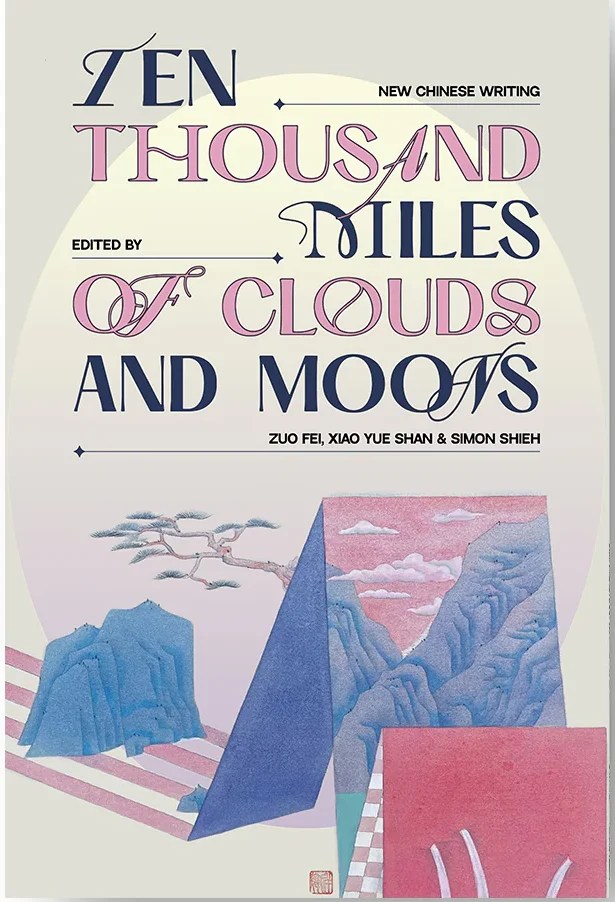
To go where the language goes: Ten Thousand Miles of Clouds and Moons – New Chinese Writing, edited by Zuo Fei, Xiao Yue Shan and Simon Shieh

Grey cloud grasping light,
unrolling the softness of another world
towards the wobbling plane wing; its folds ripple,
someone has scattered seeds in each furrow.

Who’s thinking, underneath the clouds,
how hard it is to restore the life of a flower,
when rain never coincides with favorable winds.

But we have a shred of light.
Today, passing through a mid-gate
as if remembering.

(from “Introspection on a Cloud” by Du Lulu, translated by Dave Haysom)

What exactly does it mean to enter into another world, to open oneself to a landscape at once familiar and strange? That is, one might suggest, one of the functions of literature. But if the map that grants access to that other world with its many artistic and cultural riches is in another language, translation is the key. For the editors of Ten Thousand Miles of Clouds and Moons, a collaboration between Beijing-based Spittoon Literary Magazine, a dual-language journal of contemporary Chinese literature, and Honford Star, the guiding inspiration for this first anthology project is, in keeping with that of the magazine, to seek out and bring into English translation, some of the most original, exquisite, and daring voices—new and established—contributing to the present literary landscape in China.

The introduction lays out the vision that guided their selection of pieces

The work had to be excellent; the writer had to have a point of view that is under-explored in the Anglosphere; there had to be a balance of genders; and the language had to be so special that it has the potential to torture translators. This final aspect came only from our love for the Chinese language—which, like all languages, has a singular soul, a force drawn from its age and its malleability throughout time. The more a writer is able to tap into that soul, the more difficult the piece would inevitably be to translate.

Thus sixteen contributors—eight writers of fiction, six poets, and two essayists—were paired with eighteen translators, to offer readers a journey that covers a wide literary terrain. You will find yourself in a world with a long rich cultural history and traditions, and you will find stories that depict a modern society that Western, English language readers will instantly recognize, with influences drawn from an international well of literary sources. You will find work that pays homage to the China’s past and tales that turn on distinctly futuristic, apocalyptic visions. And surreal, experimental tones alongside traditional Chinese poetic form.

The opening story in the compilation sets the mood perfectly. A piece of dystopian science fiction that  revolves around the fate of the 18th century work considered the greatest of all Chinese novels, “Mass in Dream of the Red Chamber” by Chen Chuncheng (translated by Xiao Yue Shan) is set in the far future—the 4800s—at a time when this great work of literature is not only lost, but any effort to retrieve its contents or storyline are strictly forbidden. There is, at this time, a belief that the text was completed at the peak of the universe’s development, and that all had begun to decline and dissipate since that time. The narrative follows the recorded account of a prisoner, a man born in 1982, who fell into a deep coma for several thousand years, only to miraculously awake and find himself as a specimen in a museum exhibit. He becomes a kind of missing link to the lost masterpiece for a clandestine organization desperate to recreate, as much as possible, the original; its preservation being essential to the continued existence of the universe itself. But that also makes him, and those who come to hear him access his memories of the text, the target of murderous government forces. It is a wonderful meeting of the glory of past achievements and the horrors of a post-apocalyptic totalitarian future, connected with an out-of-time protagonist’s personal recollections of life in the 1990s and 2000s.

The settings of the tales that follow vary, from a contemporary urban environment where bored youth hang out and make trouble, to the account of family history, to a mystical encounter on a mountainside. The energy shifts from story to story, often turning to the unexpected, cracking the fragile veneer of reality. Particularly delightful is the excerpt from Lu Yuan’s novella The Large Moon and Other Affairs (translated by Ana Padilla Fornieles), a piece of weird fiction that reflects, perhaps, in its magical strangeness, the influence of Bruno Schulz whose work the author has translated. As the moon, being pulled toward the earth, grows larger and larger in the sky, the eccentric Mr. Lu struggles with insomnia and troubled dreams. One night, having taken a concoction to aid his sleep, he finds himself carried off on a nocturnal adventure through the skies:

Mr. Lu rose from the valley of dreams and rowed out the window, picturing himself an unthinking mycoplankton or a sea cow, heading back to the Amazon River Delta. Riding upon the clouds and the wind with neither a northeastern wife nor a Vietnamese mistress at his side, the invoices seeking his death yet to arrive, and the murderous plots working their shapeless, invisible night shifts had been temporarily put on hold. There were no cold, mechanical alarms, no greasy company breakfasts, and definitely no covetous relatives, neighbours, acquaintances, or colleagues. The naked Mr. Lu, wearing only a heavy pair of  plastic slippers, flew over the sparse suburban streetlights, bounding towards the corridors of stars spiraling in a snail-shell pattern along the horizon’s towers. A thin sheet of air gently caressed his bulging beer belly, and the city was as far away as a firefly, succumbing to the hallucinatory bird’s eye view of inebriated men.

The two nonfiction pieces add a welcome new dimension to the collection. Hei Tao’s “Three Essays” (translated by Simon Shieh and Irene Chen) paint delicate portraits of southern China, and a lifestyle that is gradually disappearing, while Mao Jian’s “No One Sees the Grasses Growing” is a relatable, and humorous, memoir of her years as a student at East China Normal University in Shanghai in the 1980s and 90s. She recalls a time when students paid less attention to their studies than might have been wise. They were young and in love with a certain literary coolness. Her first degree was in Foreign Languages, but she found it hard to resist the allure of another course of study:

The truth is, in the eighties, it was impossible to resist the passions of the Chinese Department. The notice boards were plastered with adverts promoting literary lectures, and all sorts of clubs and societies adopted the grandiose affectations of belles-lettres, prancing about the center of campus. If someone were to ask you about going corporate after graduation, you’d have to self-reflect on the unrefined impression you must have been giving off. Those years were the golden age of Casanovas, who made names for themselves by proclaiming their undying love for poetry, and any girl who could be moved by Rilke would inevitably enter into a spontaneous fling with one of these campus poets.

It was an era of living away from home, first trips to KFC, young love, and inspiring and unconventional professors. But looking back decades later, now a professor herself at the same institution, she realizes that that time is past, in so many different ways.

Spread out among the prose pieces, are the contributions of the poets, three poems each. This arrangement works very well, offering a change of pace and granting each poet the space to have their unique voice heard. As with the fiction and nonfiction, there is both variety and, of course, precise, evocative imagery that is at once modern, yet with an echo of the long-standing traditions of Chinese verse.

Anthologies can be uneven projects, but this selection of new Chinese writing is strong, varied, and continually fresh and surprising from beginning to end. The contributors range in age, with the youngest in his mid-twenties, the oldest in his mid-sixties. Their work is consistently fresh and vibrant, and the translators all appear to have produced results that feel effortless. It should also be noted that this volume is beautifully presented, with a simple, yet elegant design. This is an endlessly engaging collection for anyone with an interest in contemporary Chinese literature, especially if you are seeking work that challenges expectations.

Ten Thousand Miles of Clouds and Moons: New Chinese Writing is edited by Zuo Fei, Xiao Yue Shan and Simon Shieh, and published by Spittoon Literary Magazine in collaboration with Honford Star

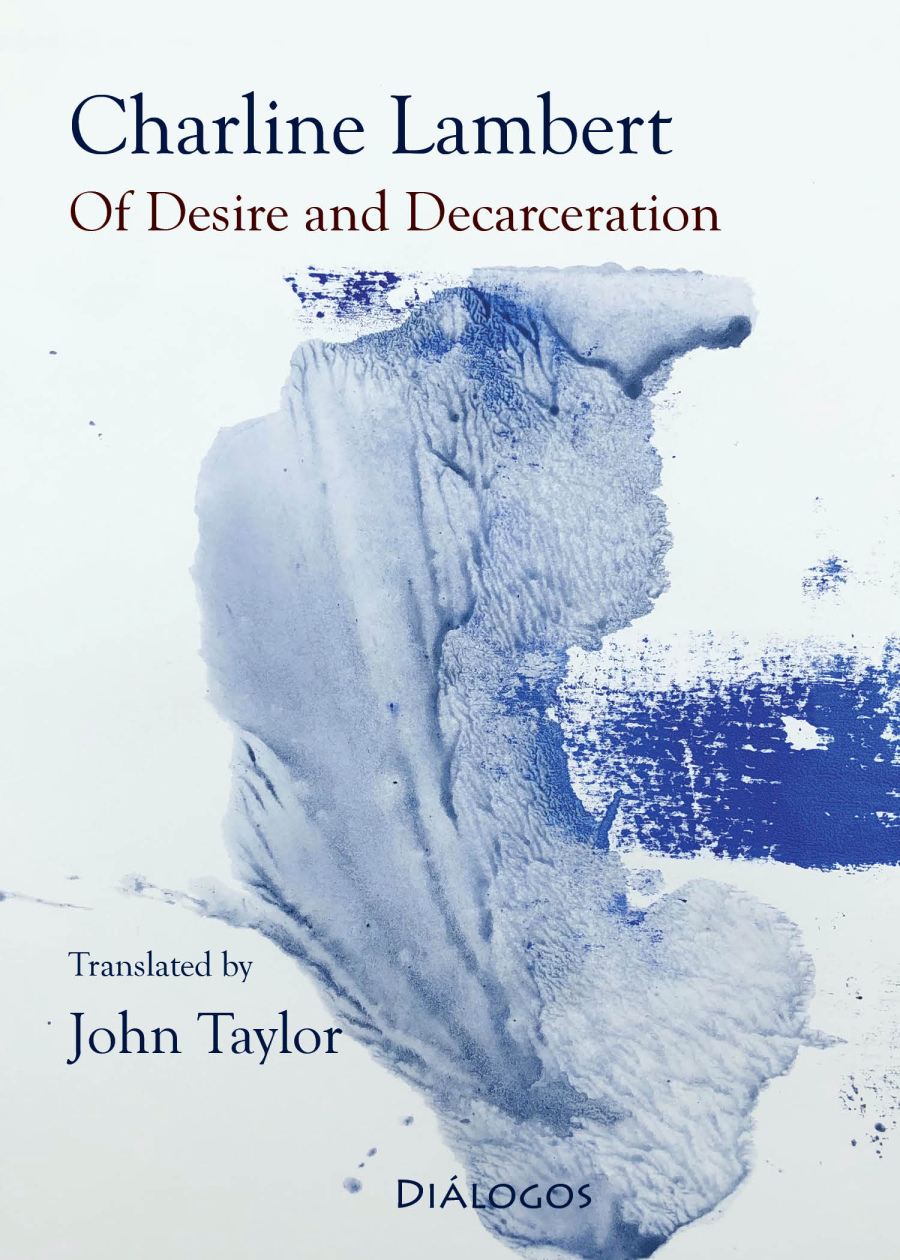
“and every day / you elucidate a knot”: Of Desire and Decarceration by Charline Lambert

When a poet’s work first appears in translation, it is rarely more than a single volume or an edited selection. Even then, it can take decades for a prominent foreign language poet to be finally be translated and published in English. But for young Belgian-Francophone poet Charline Lambert (b. 1989), the situation is quite different—her first four books of poetry (originally published between 2016 and 2020) have recently been released in one single, dual-language volume titled Of Desire and Decarceration. As her translator, John Taylor, explains in his Introduction (an earlier version can be found online here):

The motivation for bringing forth this substantial corpus is that the four books respond to each other, grow out of each other. They are like stages—beginning with the evocations of bewitchment, temptation, restraint, and detention besetting Ulysses, Circe, and Penelope in the poet’s first book, Hemp and Ivy—of an ongoing quest to grasp the mysteries of desire and gain insight into its innermost relationship, not only with the body, but also with language.

Her work is vibrant, ecstatic, alive—rich with imagery drawn from mythology, philosophy, nature, science and physiology. As someone very familiar with Taylor as a translator and a poet, I can see why he was so immediately captivated by her emotionally and linguistically inventive poetry which he has brought into English with such care and attention.

To read Lambert’s first four books—each an extended sequence of verse and poetic prose pieces—in sequence is to experience the poet’s deepening exploration into questions of identity, where an embodied self-expression is examined at the minute, physiological level in concert with an expansive metaphysical self-realization within an external world of earth, wind and water. Although subject, voice, and form shift as one moves from volume to volume, her writing is typically spare, and the same essential human forces—desire, solitude, spirit, joy—are present, even if they may be the source (or the outcome) of struggle and pain, while her occasional use of uncommon, even esoteric, words reflects the limits and the potential of language to capture complex states of being—in the body, the mind, and the world. There is a tension in the interplay of all these elements that courses through her work, finding new expression with each successive book.

Her first book, Hemp and Ivy (Chanvre et Lierre), as noted above, reimagines Ulysses’ encounter with Circe and brings Penelope in to the drama. All three characters struggle with desire and temptation in their own ways. For Ulysses, bound to his mast, his desire and the lengths he must go to avoid a tragic fate is depicted with vivid intensity:

    A desire swarms, coming from even farther
than the esophagus, a desire rounder than the
navel, more burning than the urethra. A resonant
canalizing desire, which widens the dikes of the
arteries and erodes the epidermis. It will later
become a song, if it is not hemp.

.     Circe’s fate is a patient fate.

*

   Naked ivy on the mast, a column of climbing
vertebrae.
   In volutes of breath and nervous arabesques,
he hoists himself into the sky.
.    He unfurls his great back muscles of wing or
verve.

From this mythologically themed excursion, Lambert’s work turns towards a more abstracted poetic examination of the themes and questions that inspire her. Her second book, Dialyzing (Sous Dialyses) turns on her idiosyncratic approach to language. As Taylor indicates: “Lambert’s writing, which often appeals to scientific and medical terminology, also sets into motion a poetic and self-analyzing process of ‘dialysis.’” Akin to the medical functions and procedures associated with the term, her subject here is removing an element from her body—physical, emotional, or mental—examining, processing, purifying it through the act of writing and returning it to the embodied form in which she exists. “She is ‘dialyzing’,” hence the title as Taylor has chosen for his translation. This sequence of poems also begins to hint at the struggle to break down the boundaries between the body and the self, a theme that will be explored more directly in her next book.

Lambert’s poetry is perhaps at its most explicitly scientific here, witnessed in the incorporation of unexpected  natural and physiological terminology in striking ways as her subject explores the intricacies of her own desires in a manner that blurs or escapes the limitations of the physical form and merges with a natural environment:

.    At the edge of a cliff, potent dialysis, she
fights over the infinite with the ocean. But they
breathe at the same gill.

.    Their breath escapes, enters through a crack,
dashes to lose itself in the volutes of her pleura-
colored dress.

There is a breathless intensity to her verse that is especially evident in this sequence as her subject repeatedly loses, dissembles, and reconstructs herself in a windy, watery, earthy space:

    She unstitches each vertebra from her
spine, carries out the denuding of her neck, her
windpipe, her thighbone.
    Erects them into a new nudity of columns.
.     Anchors it in soil, and watches herself grow.

But in the end, she is enveloped once more.

With her third book, Decarceration (Désincarceration), Lambert seeks to redefine identity and existence beyond the prison of embodied existence. The idea of breaking free from an incarcerated state of being (incarnation) is openly explored now in succinct, precise verse, addressed to “You”—a movement, at least in the progressive reading experience, closer to the speaker’s own self. The fleshy matter of the body has a limit that can seem impossible to override, so the first step is to free the language you employ to define your being:

You are a countable solitude.

You are a light shattered
into beams.

You are
A barely recognized fire.

*

You want to decarcerate the language from you,
decar–

cerate these words from your plexus
and every day
you elucidate a knot.

The struggle to emerge is a tension between solitude and longing as a path to both self-identification and transcendence. It is critical to be free to form and shape yourself before being named, defined by a  body and a pronoun.

Before evaluating
the situation,

draw up an inhuman
report

*

Re-forming oneself as meander, winding
into the maze before
the accident,

before having to be called
something.

This poetic invocation is open and affirming, and can be understood in more than one sense. In his introduction, Taylor speaks of the many challenges he encountered in his attempt to preserve or replicate the distinct word choices, puns, and double entendres that Lambert revels in. I would suggest that, as a primarily but not entirely unilingual Anglophone reader, one’s appreciation of her poetry is not dimmed for the inevitable loss of some of the allusions and word play. As for her fondness for unfamiliar words and scientific terms, many are essentially the same in both the French and English versions, and my dictionary did see considerable use, something which only served to enhance my reading experience (and vocabulary).

Finally, with A Salvo (Une salve), Lambert’s fourth—and in this context, final—volume, her poetic quest reaches a certain degree of resolution, and an understanding of Taylor’s impulse to translate and present these works together as one becomes clear. Again the voice shifts, as the poet’s speaker adopts an imperative tone, addressing the sensual and physical experience in relation to a natural and cosmic reality. An intense, incantatory rhythm propels this relatively short sequence, with its recurring double-stranded refrain “Inhabit the night / Enter the sea.” This is established in the opening pages as a rejection of the soul crushing cage of darkness:

Never again sight, its eyes aborting the horizon,
   that rude roughness in the psalms of the hand
.    from which the song of the clouds is removed.

And an invitation to a kind of whole body rebirth in the water:

Washing oneself–while seeking a flesh in which
  to be, a skin to embody oneself in. A swim.
.   A lapse of time. A parturient’s dawn. Then,
  nothing will better express thickness than
  fraying and fleetingness.

The strength of A Salvo lies, not only in its sustained energy—as befits its title—and in Lambert’s own maturity as a poet, but, in the deep satisfaction that arises from reading it as the culmination of the existential quest that unites her first four books of poetry. What a joy it is to have them together in one volume.

Inhabit the night—and these crystals of being,
.   emaciated out of deterioration, become meteors.
Enter the sea—and what you have already
.   experienced, decimated into a thousand
.   scintillations, becomes a sparkling splinter.

Of Desire and Decarceration by Charline Lambert is translated from the French by John Taylor and published by Diálogos.


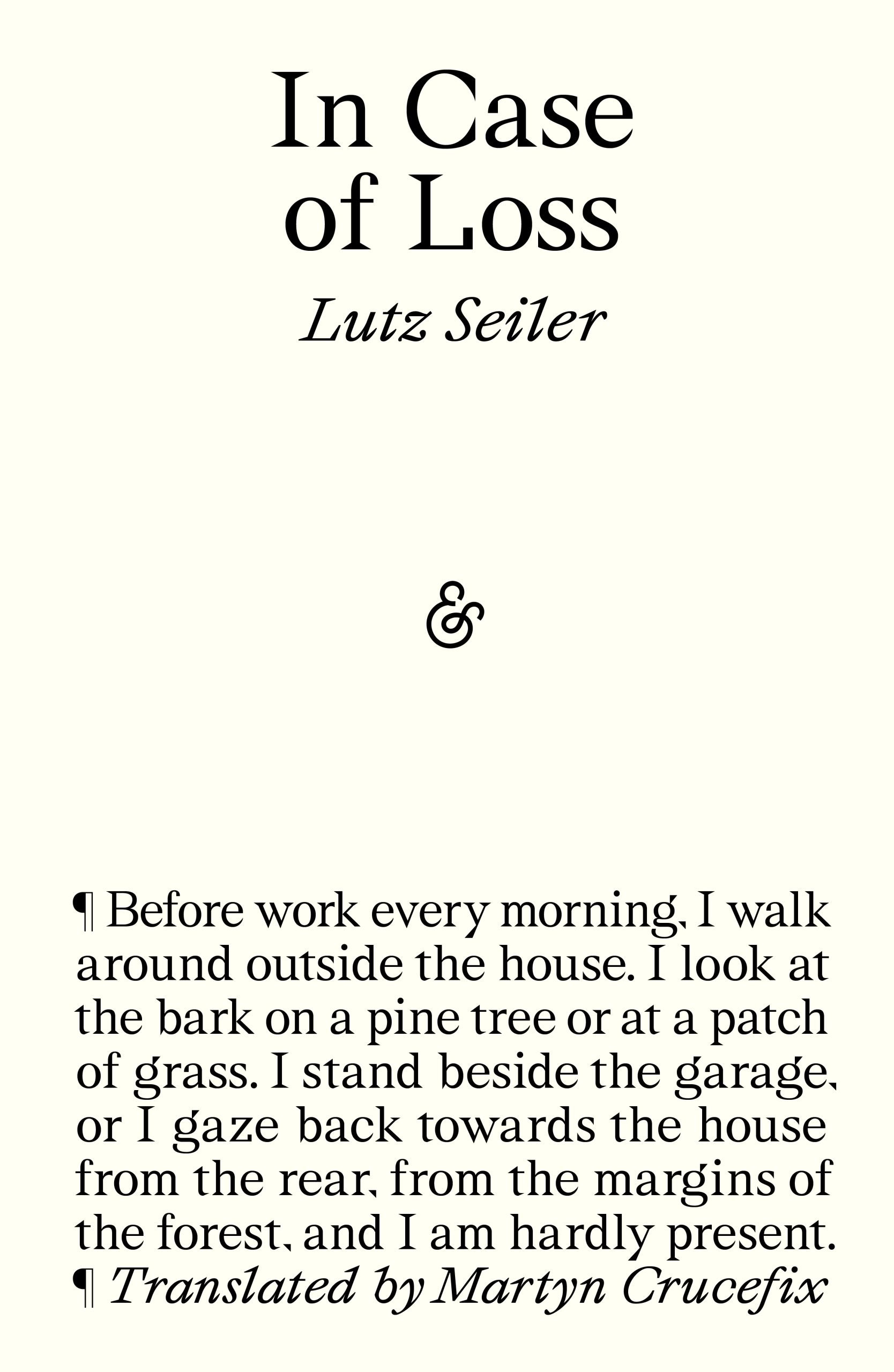
The only possible way: from In Case of Loss to Pitch & Glint by Lutz Seiler (and much more)

Some writers pass through your reading life and move on, perhaps appearing by chance now and then over the years, others ignite a clear desire to read more, if not all, that you can get hold of. That might be a small library of volumes to collect, but for those of us drawn to writers in translation—writers we often discover as a direct result of following a known or trusted translator—it can mean watching and waiting for more work to slowly emerge in English.

For me, one such writer is German poet, essayist and novelist Lutz Seiler. I first encountered his poetry about two and half years ago through Alexander Booth’s translation of his 2010 collection in field latin. At the time, the only other title available was his first novel Kruso which was, when I first checked, out of stock. Yet, when UK publisher And Other Stories announced they would be publishing Seiler’s debut poetry collection, Pitch & Glint, his second novel, Star 111, and a collection of essays, In Case of Loss, in late 2023, I took note. Then, when I had the opportunity to read Star 111 this year in advance of its North American release from NYRB in October, I quickly set about acquiring his other work. And, as these things go, while reading the poetry and the essays, I was inspired to add work by two of the poets Seiler writes about or honours—but more about that later.

Born in the Thuringia region of the GDR in 1963, Seiler’s poetry is rooted in the rural landscape of his childhood, scarred by years of uranium mining, sensitive to place and relationship to family, as child and as a parent. However, unlike many writers, he had no interest in books or literature when he himself was young. He did not start reading poetry until he was completing his mandatory military service in his early twenties, having already trained as a bricklayer and carpenter. He was certainly not writing, not even jotting the odd observation down, but something was brewing. As he says in his essay “Aurora: An Attempt to Answer the Question ‘Where is the Poem Going Today?’”:

Yet a good ten years later, I wrote poems that had been, in that earlier period, when poetry did not feature in my life, gathering and storing their subject matter, their materials. Doubly hidden from me at the time, clearly the poems had been, even then, making their way towards me. What is different these days is that I have become more conscious of the signs of a poem being on its way. I am aware of what situations, materials and substances it might respond to, what it is likely to ingest—for later use.

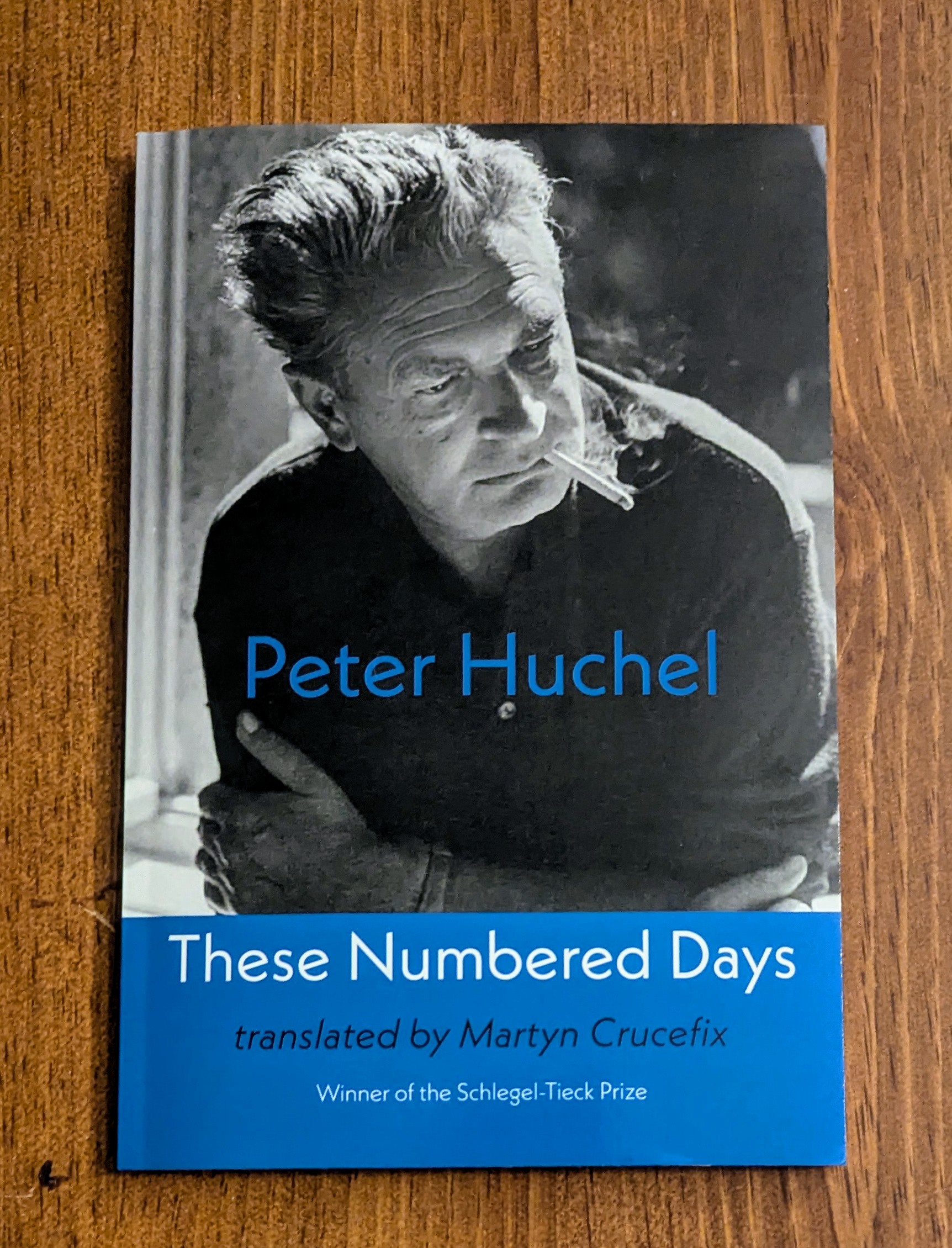
For a poet who came to literature somewhat unexpectedly, Seiler’s writing about writing, and about the poetic art and process is excellent, presumably of interest to other poets, but also, and perhaps more critically, for those of us who enjoy poetry but sometimes feel inadequate to examine a poem without a strong literary vocabulary and the requisite coursework (assumed to be) required to read and write it. In Case of Loss contains several essays about the work of other poets. One, Peter Huchel (1903–1981), was new to me. I was aware that Seiler is the custodian of the Huchel House in Wilhelmhorst near Berlin, but knew nothing of Huchel himself, one of the most an important German poets of the post-war era who ended up running afoul of the government of the GDR and was eventually allowed to migrate to the West. The title essay is an account of Seiler’s first impressions of the house itself after breaking in with Huchel’s widow’s blessing and his coming into possession of a notebook the poet kept all his life in which he recorded images, metaphors, lines, and tentative sketches, all categorized by theme. The manner in which Seiler traces some of the formative elements that will, often years later, appear as shadows or echoes in a finished piece is fascinating and a testament to the gestation period a poem can have. Of course, I wanted to read more, so I sought out These Numbered Days, Huchel’s 1972 collection, released in 2019 in an award winning English translation by Martin Crucefix (who is also the translator of In Case of Loss). His poetry often draws on the landscape of his youth for atmosphere frequently in concert with mythological, historical, and Biblical images to create crisp, even chilling poems. Although they are generally spare, one can sense that they have been carefully shaped and honed over time, each word or phrase carrying much weight, very often political—something confirmed by both Seiler’s insights, Crucefix’s notes, and Karen Leeder’s Introduction.

At the edge of the village the wind
flung its ton of frost
against the wall.
The moon lowered a fibrous gauze
on the wounds of the rooftops.

Slowly the emptiness of night descended,
filled with the howling of dogs.
Defeat sank
into the frozen veins of the country,
into the leather-upholstered seats
of old Kresmers in the coach sheds,
between the horse tack and grey straw
where children slept.

(Peter Huchel — from “Defeat”)

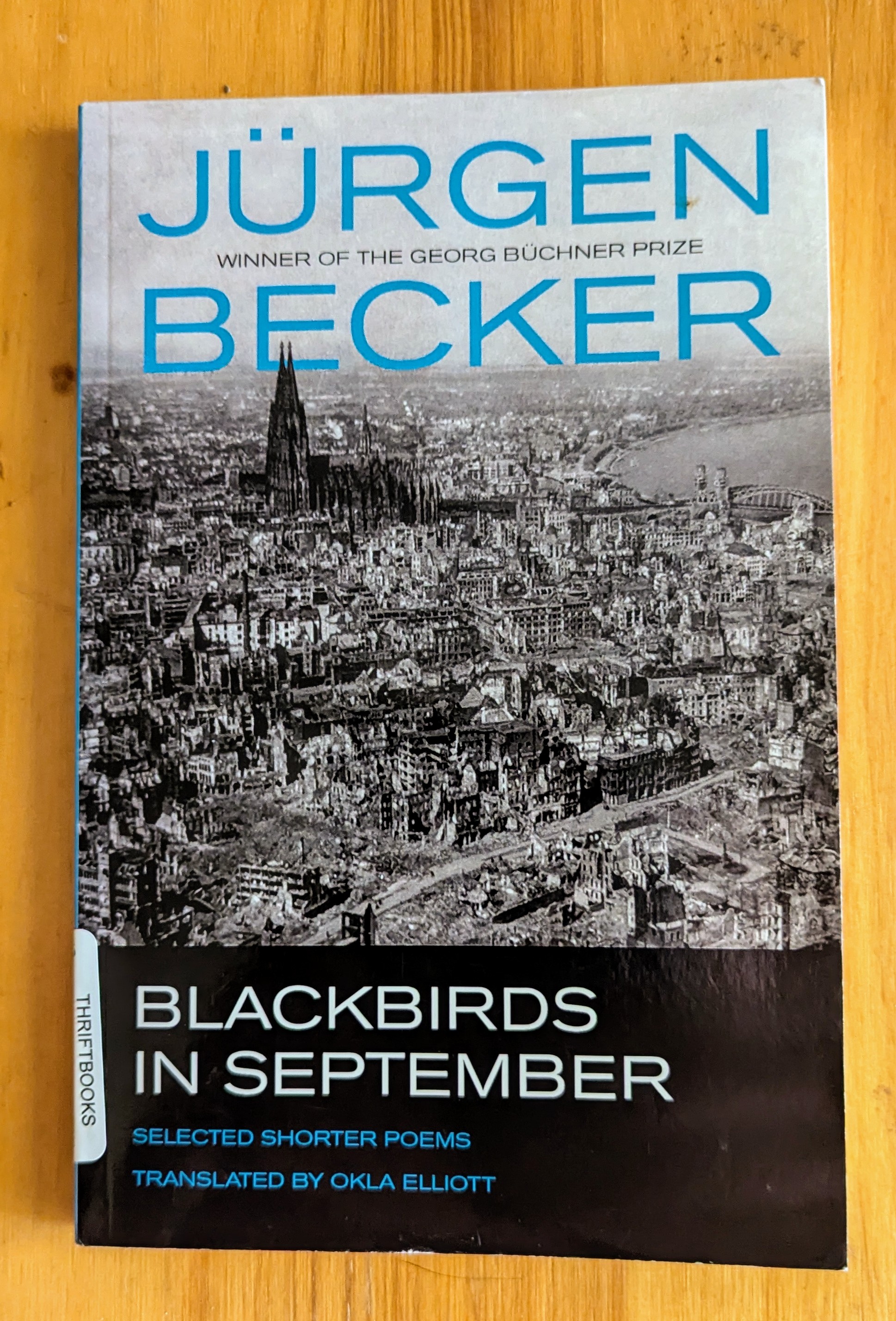
In addition to an unusual back to front reading of a book by Ernst Meister, the other poet Seiler devotes an essay to is Jürgen Becker. I had already read Becker’s fragmentary poetic novel, The Sea in the Radio, but a dedication to the poet (who very recently passed away) in Seiler’s collection Pitch & Glint, called to mind a collection of selected shorter poems, Blackbirds in September, which I was able to track down and read alongside the essay “’The Post-War Era Never Ends’: On Jürgen Becker.” Here Seiler takes a more personal approach acknowledging Becker’s influence and his own friendship with the older established poet. He traces his own process of learning to read and appreciate Becker’s poetry. Born in Cologne in 1932, Becker was a member of Group 47, the organization formed to promote young German writers after the war. He employed an experimental, open form of writing with an emphasis on landscape and the persistence of memories of the war in German land and history. His language tends to be spare and his poems have a calm, light feel, but that is only the surface.

But the landscape is rather quiet.
Invisible the destruction, if in fact
there is destruction.

And the time is passed
which the subsequent, the subsequent time produced.

But you never speak of Now.

Probably in the summer. At that time of year
we remember. Fence posts follow the paths,
or turned around, all of it belonging
to the landscape . . . who owns it? The landscape
leads into landscapes, from the visible ones
to the invisible ones which await us.

(Jürgen Becker — from “A Provisional Topography”/translated by Okla Elliott)

Other essays of particular interest in this collection (which gathers a selection of Seiler’s nonfiction from across twenty-five years) include “Illegal Exit, Gera (East),” a return in memory and in more recent years to a landscape that is being transformed and remediated, and “The Tired Territory” which begins as an exploration of the history of uranium mining in his home state, but turns into a meditation on the distinct poetic sensibilities that he had to define for himself after what he describes as the difficulties encountered in his “brief  career as a doctoral student in literary studies.” The categories that hold his fascination are intangible: heaviness, absence, tiredness. Understanding this for himself is essential:

Writing poetry: a difficult way to live and, at the same time, the only possible way.

One aspect of all this is that the poem engages specifically with what cannot be verbalised. The mute and non-paraphrasable and its unique, existential origin: the particular qualities of any poem arise from these two subtly interwoven elements. The poem travels towards the unsayable, yet this is a movement without an end.

It is not only the reading and writing of poetry that slips into Seiler’s essays—to a greater or lesser extent—but the final piece tackles his slow transition to prose. “The Soggy Hems of His Soviet Trousers: Image as a Way into the Narration of the Past” chronicles the year he moved with his wife and children to Rome for a period of dedicated novel writing. He dragged along boxes and boxes of books, research and paraphernalia he had gathered in preparation for the writing of his first novel. He’d planned to draw heavily on his own experiences moving to Berlin in the aftermath of the fall of the Wall and the more he describes his intentions, the more it sounds like what would eventually become his second novel, Star 111. But it’s only 2011 and our would-be novelist is staring at an empty page day after day. It is not until he finally gets out of his room, into the city, that everything changes. A suggestion that he write a short story set in a location he had not previously considered soon conjures forth an image so strong that ten pages become 500 and he has what will ultimately become his first novel Kruso.

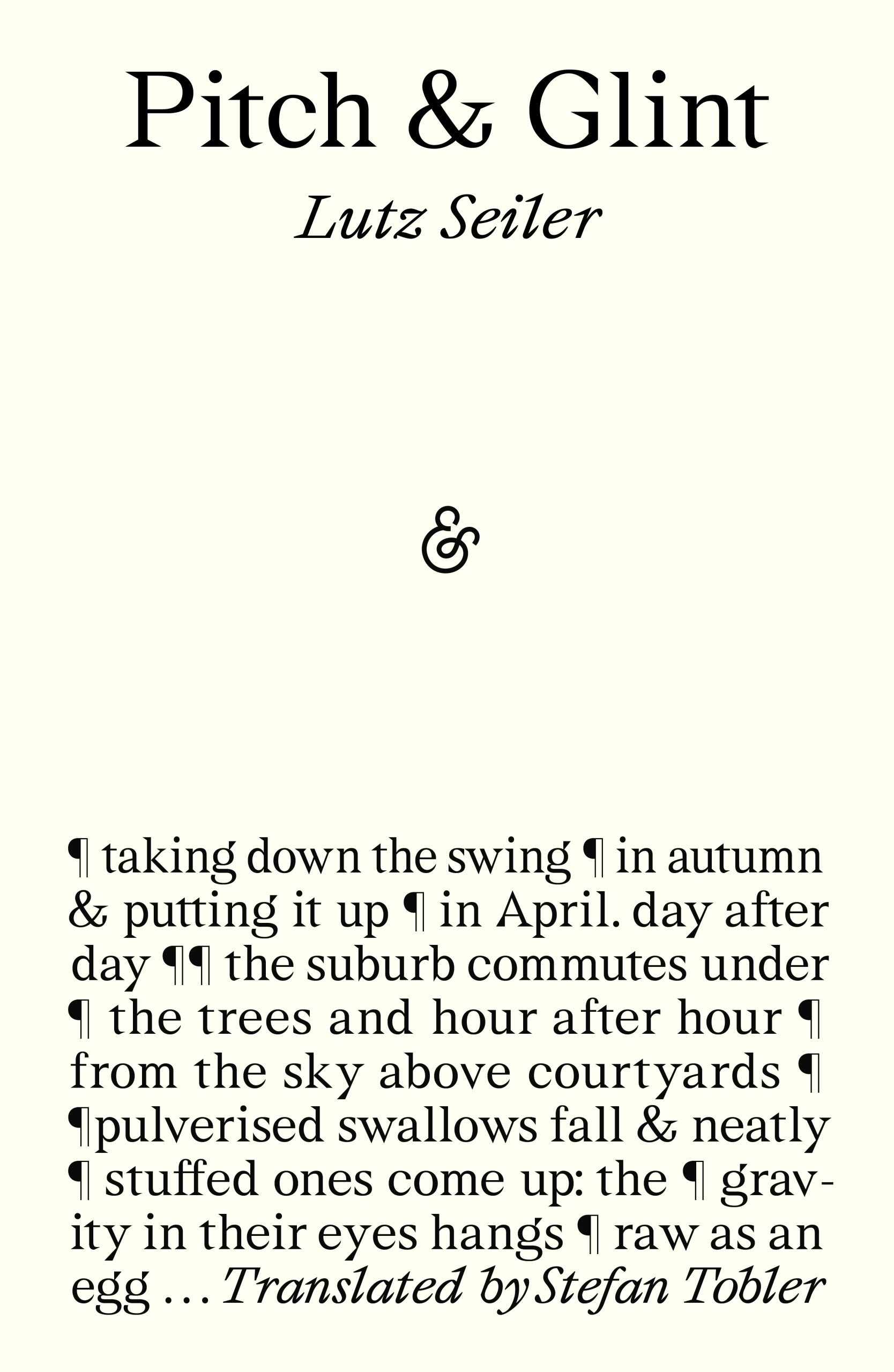
Finally, if I return now to own Seiler’s poetry, in field latin and his debut collection from 2000, Pitch & Glint, more recently released in Stefan Tobler’s translation, many of the allusions in individual poems become clearer in light of having read his essays and the autobiographically influenced novel Star 111. But neither is necessary. Seiler’s poetry has a natural appeal. I wrote about in field latin here, and this earlier work (ten years separate the two volumes) is likewise rooted in the East Germany of the poet’s youth—the wildness, the strict schools, the land with its slag heaps and detritus of mining. Yet, for Seiler, the sound and rhythm are critical, as is the construction of images that move beyond the mere biographical. Darkness, frost, echoing footsteps recur. You can feel the chill:

wind came up the border
.   dogs were rising on
their delicate branching skeletons

whistled a bewitching witless
wanderlied. the snow came in
& tore the iron

curtain of their eyes, a
blunted gaze towards the hinterland
and made plain that we do.

(— from “in the east of the land”)

Seiler’s characteristic use of lower case letters and ampersands (especially striking in German where nouns are capitalized) adds to the mood and intensity of his poetry. One of the blurbs on the back of Pitch & Glint describes it as “a real-world Stalker with line breaks.” That captures the feel well.

The beauty of reading a number of works—nonfiction, fiction and poetry— that intersect like this is that each individual experience is heightened. Seiler’s poetry and fiction easily stand on their own, but the essays add an extra dimension. To be fair, one’s enjoyment of this collection may depend on whether one is a poet, or interested in poetry and the process of poetic inspiration/creation, or familiar with his other work. Nonetheless, his essays are thoughtful with a very strong personal flow and reflect the mind and experiences of a man for whom poetry is central to his very existence—in his memories, in his specific creative pursuits, and even in the everyday act of taking his daughter to dance lessons or son to football practice.

In Case of Loss and Pitch & Glint by Lutz Seiler are translated from the German by Martin Crucefix and Stefan Tobler respectively and published by And Other Stories. These Numbered Days by Peter Huchel is translated from the German by Martin Crucefix with and Introduction by Karen Leeder and published by Shearsman Books, and Blackbirds in September by Jürgen Becker is translated from the German by Okla Elliott and published by Black Lawrence Press.

Other titles mentioned and reviewed earlier on this site are Star 111 (And Other Stories/NYRB Imprints) and in field latin (Seagull Books), both by Lutz Seiler, translated from the German by Tess Lewis and Alexander Booth respectively.

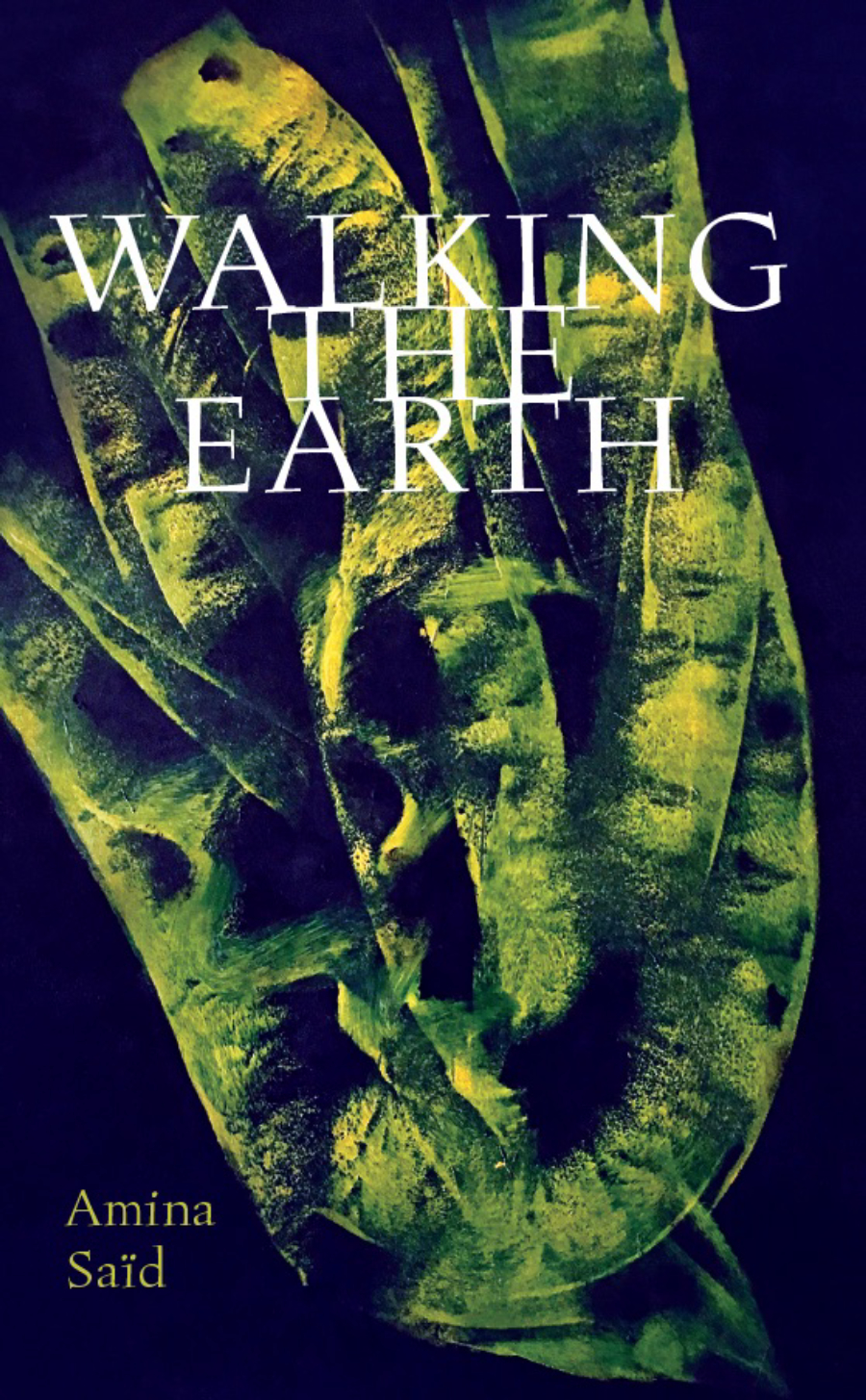
“in the nostalgia of a world / from before this world”:  Walking the Earth by Amina Saïd

all paths
lead to the same place
journey is illusion’s horseback

the world’s embers
blacken its wanton footstep

they burn
our anxious tongues

within its form
the poem seeks itself

Poems for wanderers, or the poem as a series of wandering, emergent forces, Walking the Earth by Amina Saïd hums with an intoxicating, primal energy that speaks to something fundamentally vital and human, in a sense that is too easily buried in the noise and chaos of our constantly plugged-in contemporary reality. Born in Tunisia in 1953, to a French mother and Tunisian father, Saïd was raised in both Arabic and French. At the age of sixteen she moved to Paris with her family where, when she entered university, she decided to study English literature so not to have to choose between her two native languages. Her poetic vision, however, draws on French and Arabic sources and the sunlit Mediterranean landscapes of her birthplace.

Today, Saïd can be considered, according to Hédi Abdel Jaouad, the author of the Preface present text, as the “most potent—and prolific—poetic voice in Tunisia today, if not in the whole of Francophone Africa.” Yet, until this point, no complete, single volume of her work has been made available in English. Now, thirty years after its original 1994 release, Walking the Earth (Marche sur la terre), in Peter Thompson’s translation, finally corrects this oversight.

This haunting sequence of poems, untitled and distinguished only occasionally by dedications, or by shifts in format or theme, has a hushed meditative quality reinforced by the poet’s spare, concise language, subdued and mystical tone, and the recurrence of common motifs. The world her speakers evoke is shaped by primordial elements in concert with journeys across a vast unformed terrain:

earth is this round dream

in its heart
stones fusing

their fire tongues
gouge the pathways of blood
where another fire burns

In her prefatory Note, Saïd writes that this, her seventh book, can be understood as a search for “place”—one that moves from the intimate to the universal—her own journey and that of many who pass through spaces “as much geographical as mental.” She is thinking of the displaced, those driven to move by war or disaster, but also the wanderer and traveller. Wandering is a theme of particular importance in Maghrebi (Northwest African) literature, and one that touches the poet, as someone who writes to hold an intermediary space between the Orient and the Occident, deeply:

My belonging to these two worlds both legitimizes the quest for place and generates a proliferation of doubles: shadows, voices, witnesses, angels, those who keep vigil. . .

This quest for place is born of a profound feeling of exile. Isn’t any creative person “exiled,” a nomad, an eternal wanderer seeking a place—a utopia, a place imaginary, impossible, dreamed of—which poetry can, with a sudden flaring, show in an unforeseeable image?

The quest that stretches across the pages of Walking the Earth is rich in mythological and archetypal images. The recurrence of specific motifs—light, darkness, stones, deserts, shorelines, blood, fire, tongues, voices, screams, silence—contributes to the cyclical feel of the work. Walking is an existential act while language and words are formative elements:

a voice recites
a voice despairs
the choir takes heart

a hand inscribes
ancient alphabets

the light awakens

As the sequence progresses, it becomes clear that the search for “place” is ultimately a search for meaning. The poem itself is the journey, even if the end is but another beginning. It is a path a reader can walk over and over again, and arrive at a different “place” each time.

the poem scents itself
with deepest night

I inscribe myself with sand and dust
in the nostalgia of a world
from before this world

I’m absent
from the mirror of the tribe

Walking the Earth by Amina Saïd is translated from the French by Peter Thompson with a Preface by Hédi Abdel Jaouad and published by Contra Mundum Press.

Poetry as an act of resistance: A River Dies of Thirst by Mahmoud Darwish

A great poet is one who makes me small when I write, and great when I read.

A River Dies of Thirst, the last volume of Mahmoud Darwish’s work to be released in Arabic, just eight months before his death in 2008, offers a precious opportunity to spend a little more time with a great poet as he casts a sorrowful eye at his beloved Palestine, and reflects on love, life, time, and memory. But more than anything this collection of poems, reflections, and journal fragments is a meditation on what it means to be a poet. And for him that is a distinctive vision, for Darwish was not only one of the most remarkable and humane poets of our time, but he gave  voice to the Palestinian consciousness and was someone who believed that “every beautiful poem is an act of resistance.”

To read this final collection now, more than eleven months into the longest, deadliest sustained attack on Palestinian citizens since the creation of the Israeli state, is to hear that voice of resistance resounding so clearly that it is almost unsettling. So many of the pieces here feel as if they could have been written yesterday, beginning with the opening poem “The girl/The scream”:

On the seashore is a girl, and the girl has a family
and the family has a house. And the house has two windows
      and a door.
And in the sea is a warship having fun
catching promenaders on the seashore:
Four, five, seven
fall down on the sand. And the girl is saved for a while
because a hazy hand
a divine hand of some sort helps her, so she calls out: ‘Father
Father! Let’s go home, the sea is not for people like us!’
Her father doesn’t answer, laid out on his shadow
windward of the sunset
blood in the palm trees, blood in the clouds

The girl becomes the endless scream, echoing without echo across the land, as an aircraft returns to bomb the house with two windows and a door, silencing her family’s story.

This heartbreaking  image is followed by a series of poems and short prose pieces that speak to war and Palestinian suffering in Lebanon, Gaza, and the West Bank. The uncanny timelessness of his poetry betrays the truth: there is nothing new about what we are witnessing today save for the intensity. And as Darwish reminds it, the violence is not just directed at people—it is an attack on the land, on nature, and the memory held in the soil. Consider the olive tree, the venerable grandmother-like figure, “modest mistress of the hillside.” She is spoken of with reverence: “In her restrained silvery greenness is a colour too shy to declare itself openly, a glance toward something beyond description, for she is neither green nor silver. She is the colour of peace, if peace needs a colour to distinguish it.” It is message lost on the occupying forces:

But these soldiers, these new soldiers, surround her with bulldozers and uproot her. They crush our grandmother, so that now her branches are in the earth and her roots in the air. She did not weep or shout, but one of her grandsons who witnessed the execution, threw a stone at a soldier and was martyred alongside her. When the soldiers left triumphantly, we buried him there, in the deep hole, our grandmother’s cradle. For some reason we were convinced that after a while he would become an olive tree, spiky and – green!

(from “The second olive tree”)

As a late work by a poet who is simultaneously conscious of his timelessness and his mortality, it feels as if Darwish is allowing himself to focus his attention on what is most important to him as he knows, not necessarily that his own end is as near as it would happen to be, but that time, and the heart, has its limits. As such, the themes that recur throughout these pieces reflect elements common to all his work, but are tinged with the melancholy that comes with age and a long life marked by exile and the ongoing occupation of his homeland.

Amid the poems that reference war and occupation directly—the more political pieces—are quieter reflections on the poetic existence, that is, on poetry as a way of being and engaging with world. Darwish is a poet immersed in his environment, the sights, scents and sounds all echoing longing and loss, but now the atmosphere evoked is more ephemeral, his awareness more attuned to the spaces between sleep and waking, in the flickering shadows where words might be found:

Leaves in summer whisper modestly, call out shyly, as if to me alone, stealing me away from the burden of material existence to a place of delicate radiance: there, behind the hills, and beyond the imagination, where the visible equals the invisible, I float outside myself in sunless light. After a short sleep like an awakening, or an awakening like a short sleep, the rustling of the trees restores me to myself, cleansed of misgivings and apprehensions.

(from “Rustling”)

There is also a more direct engagement with the idea of writing  poetry and recollections of his past encounters with other prominent poets, their conversations and interactions. And the two sections of fragments that round out this collection contain many wise observations about the  life, identity, perception and, of course, poetry.

With a total of 127 short pieces—including fully finished poems (both prose poems and verse), commentaries, and assorted observations and aphorisms—A River Dies of Thirst is a collection that may be best read slowly, taking in a little at a time. There is so much beauty in the language and so much to reflect on. It might also serve as a good introduction for those who have yet to hear Darwish’s masterful voice. And this certainly is the time to listen.

A River Dies of Thirst by Mahmoud Darwish is translated from the Arabic by Catherine Cobham and published by Archipelago Books.

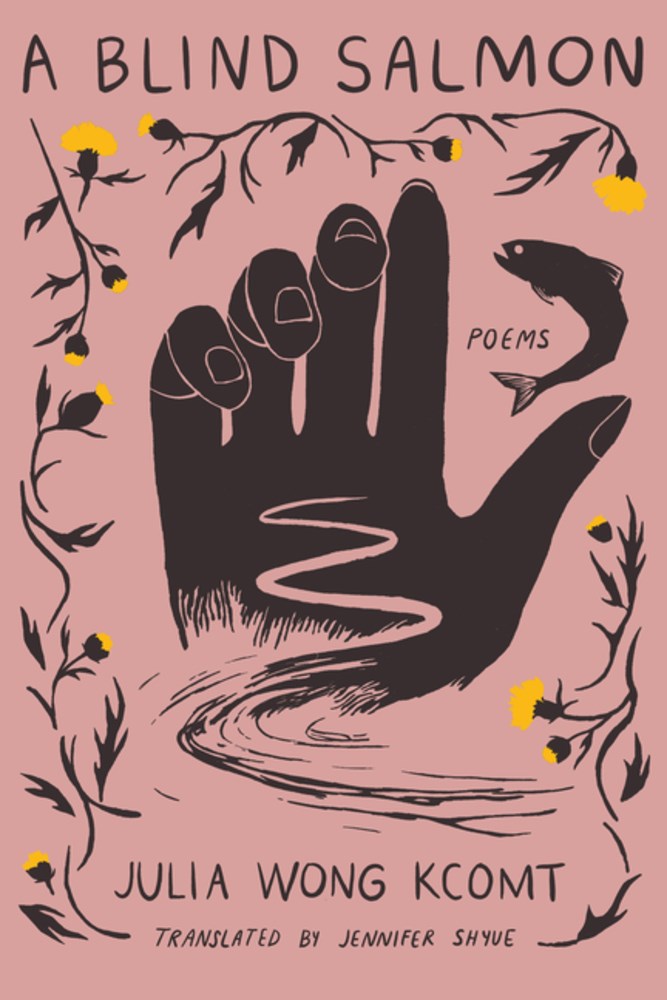
It’s so hard to be a stranger: A Blind Salmon by Julia Wong Kcomt

i looked into his low eyes
black, tired
i looked into his heart
and that splotch of vigor
made me
ephemeral, tardy, rancid, and fleeting

we arrive at the altar
in a state of absorption
i request a living offering
start to cough, phlegmy
till i’ve nearly smashed to pieces
at his feet

– from “opium weddings”

The poetry of Julia Wong Kcomt turns on the unexpected, crosses cultures, languages and borders, reflecting who she is, where she comes from and where she has travelled to and lived. Born into a Chinese-Peruvian (tusán) family in the desert city of Chépen, Peru, in 1965, she was a prolific writer whose work included eighteen books of poetry, along with a number books of fiction and hybrid prose. Questions of identity and belonging are central to her writing, as are themes of migration, motherhood, and the body.

A Blind Salmon, her sixth collection, originally published in 2008, is her first full-length work to be published in English translation. Translator Jennifer Shyue who has a particular interest in Asian-Peruvian writers, has been engaged with her and her poetry for several years making this volume a welcome introduction to an intriguing and important poetic voice. Sadly, however,  Kcomt did not live to see its release; she died in March of this year at the age of 59.

Composed while she was living in Buenos Aries, the poems in this dual-language collection, often involve a shift between languages—Kcomt was multilingual, speaking Spanish, English, German, and Portuguese—creating a challenge of sorts for Shyue, especially when the original contains English. This is handled with the use of an alternate sans serif typeface when appropriate, or by bringing Spanish into her English translation for the words or lines in English in the original, as in the poem “tijuana big margarita.” When German arises, it is left as is. This shifting linguistic terrain, like the sands of the region she comes from, adds texture and variation when they appear.

The poem “on sameness” which is repeated or echoed in the collection, is another wonderful example of the multilingual dynamic at play. The first appearance features Kcomt’s own English version of her poem “sobre la igualdad,” presented in two different typefaces on facing pages (the regular typeface and that which is used to denote English in the original). The wording is, naturally, identical. It opens:

in the circle, sweet circle
of intense immortality

where is my china?
the land with no owners
the face is not repeating itself

Later, when the poem is revisited, Kcomt’s Spanish original faces Shyue’s translation, which she made before reading the poet’s own translation (or at least refreshing her memory of a more distant encounter). The similarities and differences shine a light on the perspective a translator brings to her reading of another’s work—line by line and as a whole:

in the circle, sweet circle
of intense immortality

where my faraway chinese country stayed
the great country of all
where no faces repeat

This collection contains a mix of verse and narrative prose poems, the latter sometimes stretching on for three or more pages and offering a broader canvas for the exploration of identity and belonging, in some instances twice removed when set in Germany where Kcomt studied for a time. They address trying to find a home of some sort, balancing relationships, and finding invisible lines can be crossed in an instant as in “aunt emma doesn’t want to die” where the Asian-Latin American speaker, a foreign student, offends her elderly employer with her attraction to a man in a photo (“no looking, margarita. he’s not for you.”) and is forced to leave her home:

when i was moving out, you wouldn’t look at me. at  the geographic latitudes i’m from, we’re unfamiliar with that feeling, is it called ethnic guilt? perpetuation of folklore.

reiner was the forbidden fruit next to that tiger from kenya and you hated me because I took a bite that full-moon night as the children danced in costumes in the square.

[. . .]

and though i thought reiner would come looking for me or call me, that didn’t happen. not that it would have been necessary. his torso had imprinted on my groin. sometimes skin serves as a sort of reproduction.

in student housing i was once again surrounded by people like me. foreigners. it’s so hard to be stranger, to come from elsewhere, to fight, to steal, to do anything to get inside and the insiders throw you bait only to take it away.

The poems in A Blind Salmon seem to become increasingly charged with life and energy each time they are revisited. Kcomt’s speakers are bold and unapologetic, reaching out with language that is sensual, unexpected, unsettling. Her images are often startlingly corporeal, yet always touching the tender complexities of being in the world, a world that does not always no how to understand you, or you it, but one that is fully alive.

A Blind Salmon by Julia Wong Kcomt is translated from the Spanish by Jennifer Shyue and published by Deep Vellum/Phoneme Media.

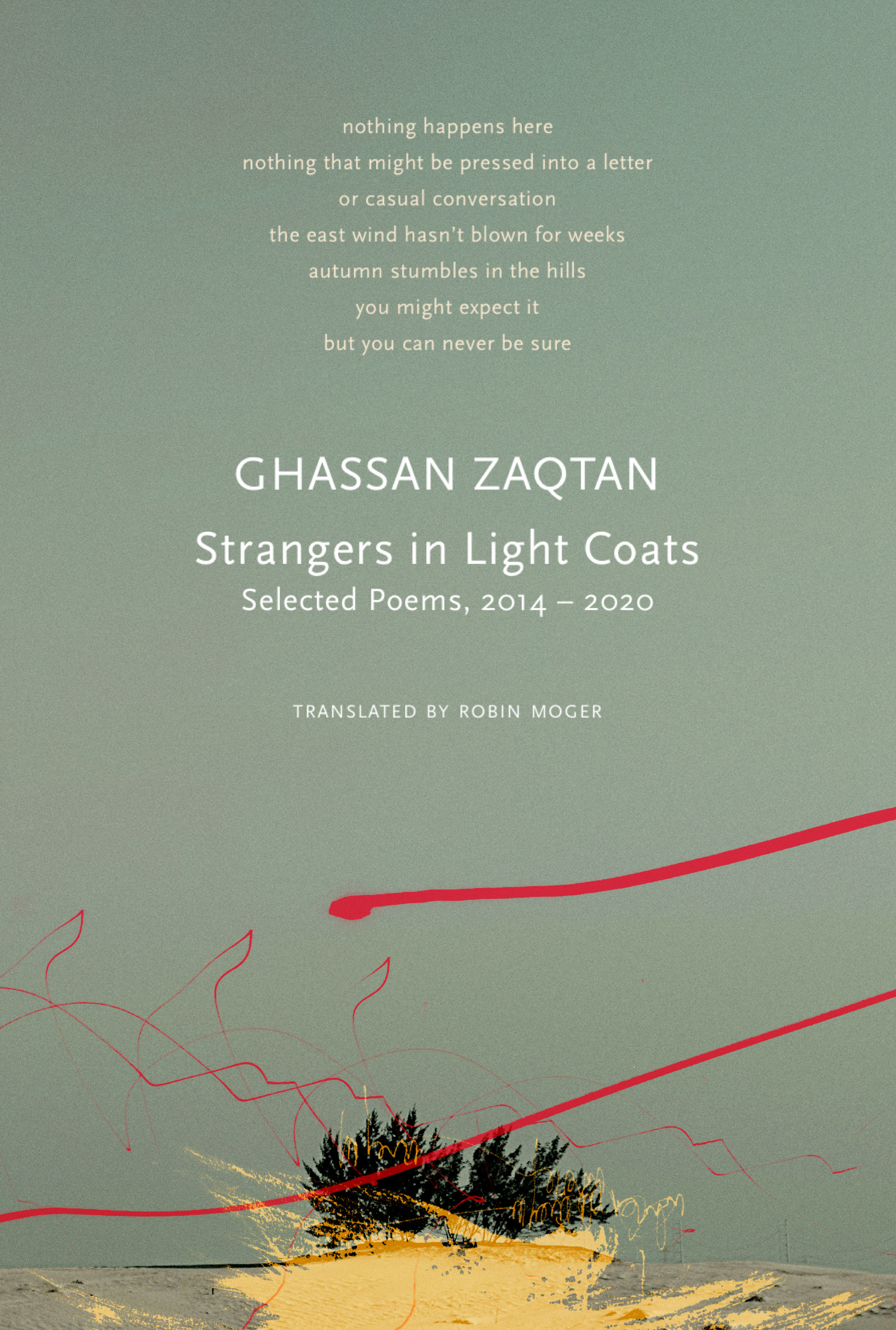
“There is something priming itself in these shadows” Strangers in Light Coats: Selected Poems, 2014 – 2020 by Ghassan Zaqtan

The wooden bell that hangs in the dark is struck.
Is struck.
No one sees it
but it is struck.
No one is there
and the bell is struck.

It is struck on the front porch of the dream and in its shadowed corridors.

There is something priming itself in these shadows.

There is someone waiting.

Natures that never made it past the line are being shaped in vain.

A blind creature walks on air and collides with butterflies.

(from “The wooden bell”)

The poetry of Ghassan Zaqtan elicits images that seem to emerge, take shape, shift, and evaporate on the page. As if deeply rooted in the soil, yet present only in passing, and in the memories they inspire.  His poems are home to rivers, birds, strangers, and ghosts of the dead. A chorus of voices rise and fall away. The Palestinian poet bears witness. To the spirit of his people, the beauty of his homeland, and the long history of displacement and conflict. But he does so with the same folkloric melancholy that characterizes his prose, the novellas that address political and personal loss through characters and settings that blur, to a greater or lesser extent, the boundary between fact and fable, myth and materiality.

Strangers in Light Coats, his latest collection to be published in English, gathers a selection of poems written between 2014 and 2020. Although drawn from work originally published in four volumes, Robin Moger’s sensitive translation presents the selected poems as a cohesive work divided into six sections. Together, they unfold against a backdrop of mountains and valleys, in a melancholic world shaped by memories, dreams, and the painful reality of occupation and war. His poems speak to lost lovers, reimagine a collective history that is fading, wonder about the fate of exiles, conjure up djinns, and call out to the forces of nature:

River, river,
soften your breeze
as the daughters wade the fords into the twin darknesses
of temptation and patience;
be still as the muezzin’s daughter crosses at the ford, be
as a carpet laid out for her by the birds
.  as she steps down, out of his voice,
    into the prayers and the dawn.

(from “The river hymn”)   (30)

War is an ever present motif, both as a remembered event, and as a possibility that is never far away. In the lull there is an abiding unease, the silence of waiting for something to happen or the inability to find silence at all, as in “It happened during the mountain war,” which tells of a man who is haunted by a memory that carries with it sounds, smells, and the sensation of the weight on his shoulders of “the body of a young man heavy with death”:

This happened in autumn,
during the mountain war that no one wants to remember,
the war in which many were killed
before it was covered over by other, more senseless wars,
the war which they, whenever they dug to bury it,
would find another war down there taking shape,
the war which was dropped from memories
like an eighth daughter who should have been a son.
In his solitude, even he would forget those weeks and push them aside.

This is a strangely beautiful and deeply unsettling collection. One that raises questions about what history and territoriality mean under occupation, in migration, in exile. Memory, imagined and reimagined through a mythic and elegiac landscape reaches for possible answers at a time when Palestine and the Palestinian people are facing ever increasing uncertainty.

Strangers in Light Coats: Selected Poems, 2014 – 2020 by Ghassan Zaqtan is translated from the Arabic by Robin Moger and published by Seagull Books.

“keep turning forever, circling round”: Shining Sheep by Ulrike Almut Sandig

.   i have the same number of words inside me
as all of you have words, the exact same number

but how many times can they be combined? you
keep finding words that no one sang before you.

.  your godhead made you after his own image
.   stark naked, blind—wild things that you are.

– from “The Silent Songs of the Walls: l”

German poet Ulrike Almut Sandig’s latest poetry collection, recently released in Karen Leeder’s translation, is the modestly titled Shining Sheep—modest, that is after her 2016 offering, which appeared in English in 2020 as I Am A Field Full of Rapeseed, Give Cover to Deer and Shine Like Thirteen Oil Paintings Laid One on Top of the Other— but it is by no means a more restrained effort. Rather, this new collection, originally published in German in 2022, is an especially dynamic, ambitious affair.

Several of the pieces here were commissioned for performances, films, or arose out of collaborations with fellow artists and musicians. This has been a hallmark of Sandig’s approach to poetry ever since her early days posting poems to lampposts and handing them out as flyers. But that collaborative, multi-instrumental quality is now more pronounced, not only through the visual presentation of the poems, often incorporating shaped or concrete poetry, but with the inclusion of links, where appropriate, to recordings and video performances that bring her poems to life off the page.

Opening with a single word, alone on a black page—“Lumière!”—Sandig’s poetry is a call to light, but one that resonates with a dark exuberance. She draws on a wide range of influences—German folk songs, writers, and history—to address political and social issues, never turning away from difficult subjects, like maternal depression and alcoholism, living with Covid, migration, and climate change.

just let that melt on your tongue:
shining sheep, genetically modified
as night storage for the dark hours

visible in satellite images as little ghosts
their delicate shimmer on the radar
seems to be made to lull

the oppressive darkness between
the great golden bulls of the cities
into a comforting gleam. 

– from “Climate change is here, now. But we are also here, now. And if we don’t act, who will?”

Along with poems that arise out of commissions and direct collaborations with other artists, Sandig is also at times writing in response to, or in conversation with the work of late German authors, filmmakers and poets, including Friedrich Hölderlin’s “Wie wenn am Feiertage” (“As When on Holidays,” 1800). Other pieces have their genesis in more immediate encounters outside the artistic community, past or present.

A particularly moving sequence, “Lamentations in VI Rounds,” arose, poet tells us, out of a chance connection with a young man from Afghanistan who contacted her after she accidentally left her bank card in a ticket machine on the Berlin underground. He and his large family were living in the city as failed asylum seekers. She stayed in contact with them and, from their stories, wrote a piece she called “Five Lamentations,” adding a sixth round for this final version after the Taliban took control of Kabul in 2021.

the little man inside my head, he had
a daughter. he loved the way she boiled
minced beef, the way she answered back.
he loved the wonder of her eftertherain in Omid.

Omid sold his daughter in exchange for the value
of a ticket to Germany. today she called him up.
she sounded like she was sitting in his ear.
the pear tree in the yard was doing fine.

Shining Sheep is Sandig’s third poetry collection to be released in English, and the most inventive and experimental to date. Her long-time translator, Karen Leeder, is well attuned to the nuances of her uniquely playful, yet melancholic verse, bringing this energy and adventurousness to the forefront here. For a taste Sandig’s poetry and performances(with Leeder’s subtitles where available), her YouTube channel is well worth a visit.

Shining Sheep by Ulrike Almut Sandig is translated from the German by Karen Leeder and published by Seagull Books.

After the night, day breaks: The Brush by Eliana Hernández-Pachón

Pablo and Ester live in the hills. Their children are grown. Their lives are simple, bound to the land, but lately there have been signs, omens. Pablo is concerned:

For some time now
he’s felt a heavy change pressing the air,
and can’t explain it.
Like when
he walks through town at night,
and when he hears the animals
can’t sleep.

Sensing danger, he gathers some papers and items in a box and goes out to bury it while Ester sleeps. And then they come.

Between the 16th and the 21st of February, 2000, members of the United Self-Defense Forces of Colombia descended upon the Montes de Maria region and attacked the people:

During this incident, known as the Massacre of El Salado, paramilitary forces tortured, slashed, decapitated, and sexually assaulted the defenseless population, forcing their relatives and neighbors to watch the executions. Throughout, the militiamen played drums they found in the village cultural center and blasted music on speakers they took from people’s homes.

Sixty people were killed. The Colombian Marine Corps battalion charged with protecting the area was nowhere in sight—they had withdrawn the day before the massacre began. With The Brush, a taut work of narrative poetry, Colombian poet and educator Eliana Hernández-Pachón draws on the official 2009 report on the massacre to bring the story of this brutal event into focus in an unusual and affecting manner.

The tragedy of this horror exists on many levels—the unimaginable terror of the attack itself which was not an isolated event, the lingering trauma of the survivors, and the years of fighting for a formal apology and reparations from the government. As a story well-known within Colombia, the poet says in an interview that “if I was going to tell it anew, then I would need a new form.” Her approach is to pass the account on to several distinct characters or voices and allow these diverse perspectives to carry the varied layers of this tragedy.

The first of three sections belongs to Pablo who has reason to be worried about the growing tensions. He will not survive the attack. The second part belongs to the thoughts of Ester, his wife, in the days that follow. She wonders where Pablo is, what might have happened, heading out into the brush to try to find him. And then…

Crossing the glade, she sees
a shadow vanish
in a glimmer of undergrowth.
Hey! she shouts.
And the woman approaches warily
leading a little girl by the hand.
A whisper first, and now her clearer voice:
They did it to me with a knife, the woman says
and points to a mark on her arm.
They also did things
I can’t talk about.

Knowing it is unsafe to return, the two women and child are now forced to keep moving through the brush.

In the third section, the Brush—the dense, living forest vegetation—is granted it own direct, poetic voice. It is The Brush that stands as witness, to sights, sounds and sensations, from the crushing footfalls of the approaching militants and falling bodies in the town square, to the careful movement through the forest of survivors, and, finally, to the blossoms and blooms that will welcome those who eventually return.

In conversation with The Brush’s testimony, Hernández-Pachón engages input from The Investigators and The Witnesses. These perspectives, drawn from official sources, define and correct one another, while the Brush adds its own comments and clarifications. The human choruses are presented in prose, but even if the Witnesses’ offerings are more poetic in tone, both stand in sharp tonal contrast with the lyrical, omniscient voice of the Brush. The Brush, it turns out, can tell a tale of horror and grief that people, especially those who have been victimized, are often unable to fully articulate.

The questions still survive:
what does it think about, the brush, somnambulist,
after it’s seen it all?
The day that follows night returns
its artifice, the well-known
interlocking of the hours:
how is it that time didn’t stop,
why do the grain’s unopened eyes
keep growing?

A disconcerting calmness rests over this book-length sequence of poems that, in a mere 57 pages, manages to capture the contradictions and harmonies that arise in response to acts of extreme violence. That calmness serves to unsettle the reader and honour the survivors, while placing this event within a wider ecosystem and granting a voice to nature, the one force, perhaps, that can truly offer both understanding and healing.

The Brush by Eliana Hernández-Pachón with an Afterword by Héctor Abad is translated from the Spanish by Robin Myers and published by Archipelago Books.

When no words can be found: [. . .] by Fady Joudah

How will I go on living
with orchestras that conduct my thirst?
It’s been done before.
There are precedents, always will be,
and there will be Gaza after the dark times.
There will be gauze. And we will stand
indicted for not standing against the word
and our studies of the word
that dissect what ceases to be water.

– from “[. . .]” p. 16

When we talk about a literary work being timely, it often means that a piece from the past holds a new relevance in our current world. [. . .], Fady Joudah’s sixth poetry collection, is not simply timely in that sense, it is of this exact moment as it is occurring. Most of the poems here were written between October and December of 2023, during the first three months of Israel’s war against the Palestinians in Gaza. The grief, the anger, and the defiance is palpable. But so is faith in the persistence of love. And, in keeping with the explicitly wordless title of this volume, more than half of the poems share the same title—[. . .]—an expression, as Joudah indicates in an interview with Boris Dralyuk in The New Inquiry, of silence, silencing, and an invitation to listen “in silence to the Palestinian in their silence.”

Joudah is a Palestinian American poet, translator, and physician who lives in Houston, Texas. He draws on all of the facets of his identity, personal and professional, in his poetry, but from the earliest days of the current assault in Gaza he has also been called upon by certain American media outlets to provide the “Palestinian perspective,” even as many of his own family were being killed. Now that this new collection has been released, he continues to respond to interview requests, but the focus has shifted (and if not, he changes the venue).  One senses that it is important that he continually protect his very human ordinariness from a culture that wants “to hear and read me only as a voice in the aftermath of disaster and as a wound at that, not much more.” (Yale Review)

The poems in [. . .], composed, for the most part, during a condensed period of great political and emotional distress, carry an urgency that commands attention. Palestinians have long responded to the ongoing attacks and displacement they’ve endured for the past seventy-five years through poetry and prose, with the recurrence of the same images, themes and situations affecting a sort of echoing tradition. A piece written decades ago, feels like it was written yesterday. But over the last six months, as we’ve witnessed the intentional destruction of universities and libraries, and the targeted killing of potential record keepers—poets and journalists. Joudah’s response, to this intensified attempt at erasure is, like that of his contemporaries, to keep talking about what is happening, as it is happening.

When did the new war begin?

Whoever gets to write it most
Gets to erase it best.

The new war has been coming for a long time.
The old war has been going for a long time.

Coming to a body near me, and going on in my body.

– from “I Seem As If I Am: Ten Maqams, # 6”

Is it possible, then, to effectively answer genocide? The International Courts and a steady stream of horrifying images delivered straight to our phones do not seem to be making a significant difference. It seems that any formal declaration will only be made, as we’ve seen too many times before, long after the fact. But that is no reason to stop writing—and not just to document, but to be able to acknowledge the small moments of truth and beauty that keep hope alive:

In Gaza, a girl and her brother
rescued their fish
from the rubble of airstrikes. A miracle

its tiny bowl
didn’t shatter.

– from “[. . .]” p. 33

A review, especially of an important collection like this one, can only go so far. Joudah offers very interesting insights into his work that are worth seeking out. I have linked two interviews above, but others can be found, including a free online event as part of the Transnational Literature Series that I’m looking forward to on April 11, 2024.

[. . .] by Fady Joudah is published by Milkweed Editions.