As boundaries blur: A few words and a link to my response to Decima by Eben Venter

A few months ago, I was invited to write a response to a new novel by South African author Eben Venter for knaap.brief, a weekly queer newsletter that publishes work in Afrikaans and English. I have been sticking to my own private corner of the literary universe for the past few years, so this invitation was both unexpected and welcome. There was a time when I read a lot of South African literature—and I still have shelves full of books waiting—so I was familiar with the author and had heard some very good things about his latest work. This seemed a good opportunity to read the novel and write for an editor again. However, since the request was for a response rather than a formal review (though the approach was left to me), I allowed myself to bring the personal into my essay as this book, which is set primarily in the  Eastern Cape Province, inevitably brought back both good and painful memories of time spent in the same region with a very dear friend who has been gone now for more than seven years (remembered here).
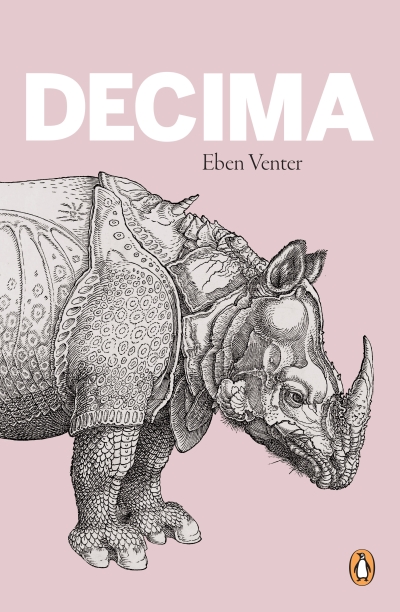
The novel, Decima, revolves around the disturbing historical and contemporary conditions threatening rhinoceros in general, and one aging female black rhino in particular. It is also the story of the love between a son and his mother, and about loss and grief. Skillfully balancing memoir, fiction, history, and natural science, Venter creates a story that lingers long in the imagination—and one that refuses to prioritize the human experience of the world. The perspective of Decima, the rhino cow at the centre of this tale, is essential and effectively evoked.

The animal is, as Venter imagines her, intelligent, sensitive, and alert. Solitary but not isolated from either her own kin or the other creatures with whom she shares her environment, she moves her massive bulk through the veld, seeking food, water, and shade. Decima’s reality is gently anthropomorphized, or rather, translated for a human audience.

My full response to this singular novel can be found here. (Also reproduced below if you’re unable to read it on the site.)

Decima by Eben Venter is published by Penguin Random House South Africa. An Afrikaans edition, translated by the author, is also available and both can be obtained outside South Africa as e-books.

As Boundaries Blur  (published at Knaap.brief, 02/18/24)

Dear Wemar

Facing the empty page, I have been wondering for words for more than a week now.

I have been invited to respond to Decima, the latest novel by Eben Venter. Respond. I was told that it does not have to be in the form of a conventional review which, in a way, would be much easier. Reviews have an internal logic and form; reviews, at least in my practice, require a certain neutrality in language and tone. Ideally, a review is about the book, not the reviewer. I respond when I cannot help but stand in my own way and make “I” statements, and when it comes to this inventive and deeply affecting novel, I have a lot I want to try to say.

First off, I am not South African, but a number of years ago I did spend a few weeks in the country, primarily in the Eastern Cape, with one of the best friends I have ever been blessed to know—an incredibly gifted super-butch dyke who has been gone now for over seven years. It was Ulla who first introduced me to Eben Venter’s Trencherman. She would have just loved this book; she would have related to Decima. So this review is for Ulla. After all, it is a book about love, and a book about loss. I loved her like a sister, but I couldn’t save her life.

Decima is a slippery text. Memoir, fiction, metafiction, natural science, history and social commentary all fall into place in a fragmented yet fluid narrative. Fragmentary works are somewhat fashionable, but too often they are forced, as an author tries to shoehorn so many clever facts and ideas into some kind of cohesive whole. However, when they flow effortlessly, the writer in me gets excited—at once caught up in the story and marvelling at how the pieces fit together so naturally. Decima works because the author allows himself, or a faintly fictionalized version of himself, to hold the continuity of the narrative. He lives in Australia but is back in his native South Africa, staying with his aging mother at her home in a Port Elizabeth seniors complex, while he conducts research for the novel he intends to write about the fate of the rhinoceros. As he gathers information he travels to townships and nature reserves and national parks. His memories regularly take him back to his rural childhood, and briefly, in more recent years, to New York and Belgium. His historical inquiries take him to Nepal and to a shipwreck off the coast of Europe, and cast a harsh light on the colonial exploits of King Leopold II of Belgium and the big game expeditions of Theodore Roosevelt. Along the way, he steps aside as needed to invite fictional characters—researchers, natural medicine practitioners, kingpins and middlemen—to expose the network and the demand that fuels the trafficking of rhino horn.

That is just a very rough sketch of the kind of web Venter weaves, moving continuously from place to place, across time, from fiction to fact and back again. But central to it all is a rhinoceros cow, the eponymous Decima, orphaned as a young calf when her mother was killed, and now the aging matriarch of her own crash—her decedents—who live amid the rolling hills of the Eastern Cape’s Great Fish Nature Reserve. One of a dwindling number of critically endangered black rhinos, Diceros bicornis, she passes her time eating, sleeping, watching and waiting.

But we do not simply observe her, we inhabit her world. From the inside. And this is the true magic that sets this novel apart from any other eco-fiction I’ve read.

I will admit I was cautious when I learned that this was a narrative that slipped into the mind of a rhino. It’s always a dangerous game to attempt to adopt an animal-eye view (and Venter does focus on the rhino’s eye early on in his detailed imagining of the drowning of a frightened captive rhino torn from its Himalayan home, meant to be delivered as gift for Pope Leo X) but without Decima’s perspective we would really only have half of what is a very complex story. The animal is, as Venter imagines her, intelligent, sensitive, and alert. Solitary but not isolated from either her own kin or the other creatures with whom she shares her environment, she moves her massive bulk through the veld, seeking food, water, and shade. Decima’s reality is gently anthropomorphized, or rather, translated for a human audience. Her awareness of her surroundings, her ability to gather information from the scents she picks up in the breeze or left in the dung deposited by other members of her crash, and her attention to the shifting angle of the sun and the cycles of the moon reveal a rich inner existence. As the full moon nears, her anxiety grows. She knows that the greatest threat she and her kind face is from a kind of creature that is not native to her space and that the moon’s full force will leave no place to hide.

The complexity, the shades of grey, that emerge in this multifaceted tale lie, of course, entirely on the human side of the equation and the reach is wide, across continents and centuries. Venter wisely lets these factors arise without resorting to obvious moralizing. Some villains are clear, some well-meaning folk might risk being overzealous, and those tasked with the direct protection of threatened species know the obstacles they are up against. However, if it is somewhat daring to attempt to take a reader inside a wild animal’s mind, Venter also opens up the thoughts and motivations of two poachers, both from economically deprived backgrounds, who have their own reservations and fears about the dangerous task they agree to perform.

As the novel progresses, the boundaries between the author’s research, his memories, his relationship with his mother, the facts he has gathered and the fictional characters he has met or imagined into being, including Decima herself, blur. Tension builds as the events leading up to the inevitable encounter between poachers and rhino take centre stage. In the aftermath, the narrative falls back into the realm of what feels more solidly memoirish. That is, we return to the story of the narrator as author and son with a mother who is aging and alone.

On its own, Decima is an exceptionally impressive novel, one that is very difficult to let go of even weeks after one is finished. I hope it gets more attention outside South Africa—here in Canada it is only available as an e-book—but, at the same time, as a work that Venter composed in English (and self-translated into Afrikaans), it reads with a rich South African tone and flavour. Usually, a South African book written in or translated into English, then edited for publication in an international market can be linguistically neutered to the point where there’s not even a bakkie in sight. This is not the case here. And, on a more personal level, my reading experience, and my response the this book, has unleashed a flood of memories: the long bus trip from Cape Town to East London and back, an afternoon at Addo Elephant National Park where we were the object of fascination for a juvenile rooikat, and watching the sun burst into flame over the sour veld, night after night, with a friend who, in the end, could not outrun the black clouds that chased her. So, even if there is a qualitative difference between what I might call a response and a review, sometimes the boundaries between the two are not that clear after all.

Oh, and having had a glimpse of the world through Decima’s eyes, I’ll never think of the full moon the same way again.


The ties that bind: The Promise by Damon Galgut

Apartheid has fallen now, see, we die right next to each other now, in intimate proximity. It’s just the living part we still have to work out.

South African author Damon Galgut is back. It has been a long seven years since the release of Arctic Summer, his fictionalized imagining of the creative block that filled the space between EM Forester’s conception of an “Indian novel” and the publication of A Passage to India eleven years later. It is a tale of unrequited love, rich with historical detail and Edwardian literary flavour. With The Promise, Galgut has returned to his native soil with a work that traces the cumulative misfortunes of an Afrikaner family across three decades of national transition and turmoil. Thematically and stylistically this novel echoes his earlier work, but this ambitious, original effort rises to another level, casting a critical eye at his nation’s troubled history with the insight, confidence and sly humour of a seasoned writer.

Central to The Promise are the Swarts—mother Rachel, father Manie, daughters Astrid and Amor and son Anton—their small farm outside of Pretoria, and a shifting assortment of relatives, partners and community members who come and go along the way. The first section opens with a death, Rachel has lost her battle with cancer, and the family gathers. Astrid, the middle child, is living at home, but her thirteen year-old sister Amor has been sent away to lodge at her school and nineteen year-old Anton is doing his military service. The year is 1986. Rachel’s recent return to her Jewish faith complicates the funeral proceedings and stokes existing tensions between both sides of the deceased woman’s family. But there is something more. Two weeks earlier, Amor had been present in her mother’s room when she begged Manie to promise that he would give Salome, their housekeeper, the small house that she lived in. Reluctantly he agreed. Of course Amor’s parents did not remember she was present at the time; she was, as she puts it, as invisible as a black woman to them. As invisible as Salome herself. Within her family Amor is the odd one—injured as a in a lightning strike as a child, she is seen as slow and plain and, as such, set apart from her older siblings, the golden ones.

Across the years, the members of the Swart family drift apart, each following their own path, to be pulled together only by a sequence of funerals, each separated by roughly a decade. It is by no means a spoiler to reveal that every gathering reduces the Swart clan by one. The section titles even give the victim away, but in itself that tells you little because as life and death takes its toll on the family, the children grow up and South Africa changes, for better and for worse. The promise of Independence, the strangeness of seeing racial boundaries bend, even blur, the rising crime, and the ultimate political disillusion colour the world within which the primary characters fall in and out of love, succeed and fail, and meet their ends. Guiding the entire drama is a rambling omniscient (mostly) third person narrator who is, by turns, playful, sarcastic, critical, and compassionate.

The narrative voice is exceptional, orchestrating a drama which is at once far reaching and intimate. James Wood in his review for The New Yorker says:

Technically, it’s a combination of free indirect style (third-person narration pegged to a specific character) and what might be called unidentified free indirect style (third-person narration pegged to a shadowy narrator, or a vague village chorus).

This is a helpful way to describe what Galgut is doing, but it doesn’t begin to capture what it feels like to ride the narrative wave, or the skillful way that the narrator engages with his audience echoing views of an extended cast of characters, some almost incidental, others central to the story, to call moments of historical value into relief and to further personality development with passing commentary and sideways glances. The line between the narrator and the characters is porous; it is, at times, impossible to tell if we are hearing a character’s thoughts or words, or if we are hearing the narrator’s direct response to that individual, an editorial aside, or the reflection of a group or societal opinion. One also finds moments where names are forgotten, mistakes are made and quickly corrected, and where metafictional observations step out to question the logic of novel writing/storytelling in process. However, these are not mere gimmicks, rather they underscore the willful blindness that so many of the characters, and by extension, white South Africans, cling to as their reality is challenged. And, of course, the promise at the heart of the novel, unkept and as such symbolic of this shifting terrain, is a constant stumbling block:

Not even Salome is around as she normally would be. You might have expected to see her at the funeral, but Tannie Marina told her in no uncertain terms that she would not be allowed to attend. Why not? Ag, don’t be stupid. So Salome has gone back to her own house, beg your pardon, to the Lombard Place, and changed into her church clothes, which she would have worn to the service, a black dress, patched and darned, and a black shawl, and her only good pair of shoes, and a handbag and a hat, and like that she sits out in front of her house, sorry, the Lombard Place, on a second-hand armchair from which the stuffing is bursting out, and says a prayer for Rachel.

The Promise is, all told, a rather bleak novel, though the boisterous narrator keeps it afloat. As the family falls apart, so does the farm. Everyone seems to have an interest in the house, or its presumed value, but no one is prepared to maintain it and, as we reach the closing section, it’s 2017, and there are competing claims on the land. The only person to keep a degree of distance is Amor, the youngest. At first she travels, returning home transformed, no longer the ugly duckling. She goes on to become a nurse and remains in touch with Salome while avoiding the rest of her family. If she is the Swarts’ moral compass, the price she pays is perhaps no less than that of her siblings, Astrid who marries young and has twins, and Anton who also marries but remains recklessly without a rudder. Religion, or lack thereof, a necessary feature of a tale built around four funerals, proves insufficient to hold anyone’s life intact, yet in various incarnations faith forms an important thread running through this book. But on an individual and a national level there are no easy answers and, true to form, Galgut offers no absolutes. The promise to Salome that goes unfulfilled is not the only unmet expectation—the promise of a new South Africa blooms and gradually falls apart as the book progresses. In the end, only one promise will finally be honoured, at the risk that it is, like so many things in life, too little, too late. One can only hope that for the two main characters remaining it will be enough.

The Promise by Damon Galgut is published in North America by Europa Editions.

Standing witness to the “ordinariness” of prejudice and violence: Unearthed by Yvette Greslé

I am, I confess, a sucker for a beautiful cover. I first encountered Yvette Greslé’s Unearthed on Instagram while I was in India last fall, looked it up, was intrigued, and ordered it as soon as I got home. Greslé is a London-based art historian and writer, born in South Africa, who spent her childhood in Seychelles, an archipelago nation in the Indian Ocean off the east coast of Africa, before being sent to boarding school in Johannesburg as a teenager. Moving between time and place, she explores the “ordinariness of the colonial order,” and the ongoing normalization, the very mundanity, of racism, intolerance, and violence. She stands witness, ever conscious of the advantages afforded her as white. And of the complicity she bears.

Greslé is, as she describes herself, a sensitive child. She is aware of ghosts. Her dreams are suffused with quiet symbolism. Her mother tells her she is a hypochondriac. It is not good to be too sensitive. Yet, it is this sensitivity, a certain pensiveness, that makes Unearthed such a compelling and thought-provoking read. Spare and elegiac, this short work occupies a liminal space between memoir and social discourse. As the author draws on personal experience and a wide selection of readings to trouble uncomfortable questions of privilege and prejudice, she offers an unflinchingly honest assessment of the society that formed her.

Memories layered on memories create an essay that is beautiful, painful, and wise.

The early island years have a magical tropical glow—white sand beaches, cinnamon, bananas and pineapples—but with distinctly colonial manners, and a sharp divide between the French and English residents and the Creole population. Greslé’s father was born in Seychelles , a descendant of French settlers. He had moved back from Johannesburg with his South African wife and young family in 1974, only two years before the country achieved independence from Britain, which led, by the late seventies, to a period of great political unrest. This in turn heightened tensions at home that the author, still a child, finds herself caught in:

My mother wanted to leave the island but my father wanted to stay. Sometimes, in the middle of the night, crockery would fly around the house and I would hear my parents shouting. My father couldn’t let go of the land and when he asked me if I wanted to leave the island, I shook my head and said no and this ‘no’ was without ambiguity. From childhood, I was conscious of an emotional bond to my home on the mountain and the land that surrounded it and, as I grew older, I was conscious of not wanting to give it up. Now I can see that my identity and sense of self were wound up in my father’s name and the possession of this land. It was only later that I would come to fully grasp and develop a language for what was truly at stake and for whom. I would come to see how I was positioned within a history embedded in a racial violence and white entitlement.

In 1984, Greslé will be sent to boarding school in Johannesburg and her experiences in South Africa, through her teens and into her adult years would deepen her understanding of, as she puts it, “the logic of white supremacy” and the “human capacity for brutality.” It is not a pretty picture, nor is the violence always obvious—it can be inflicted on the soul as readily as the body. At times, Greslé herself will experience othering, at times when her own ethnic origin is questioned, or just because a capacity to scapegoat exists even within groups that are otherwise (presumably) alike.

This is a memoir that, more than tracing the events of a life lived, traces an evolution of thought. It simmers with controlled emotional tension, and while moving back and forth in time, a frequent use of the present tense creates a sense of immediacy. Greslé shares moments of pain and loss without self-pity or sentimentality. Her reading and her experiences in post-Apartheid South Africa and, currently, in London, reinforce her impatience with the insistence that we have moved beyond the divisions of old—that they are of another era, or rendered no more severe than the disadvantages we each can catalog in our own lives. Or, if these intolerances still exist or may in some places be rising again, it has nothing to do with us as individuals. I’m not like that. Its time to move on.

But there is no line to be drawn between the past and the present. The past cannot simply be buried and forgotten about. The past lives on in the lives of the descendants of those who have suffered the kinds of things that don’t just go away, the kinds of things that inhabit bodies and memories. Racism, xenophobia and prejudice in all of their iterations are not simply historical artefacts, inanimate objects.

 This is one of the most deeply affecting essays I’ve encountered—an example of the way our own stories can be told to tell stories that are larger and more important than we are. The kind of stories that are difficult but need to be told. It feels as if Greslé has wrung each sentence from her heart; toward the end she admits that she is restless, that these swirling memories and images, all the concerns unanswered, are taking an emotional toll. So many critical questions. So few answers. But this thoughtful meditation, this personal story, rich with passages from writers and thinkers and an accompanying reading list, and that’s a good a place to start as any.

Unearthed by Yvette Greslé is published by Copy Press. It is no. 13 in their Common Intellectual Series of 100-page paperbacks. Each title makes a proposition for living, thinking and enjoyment.

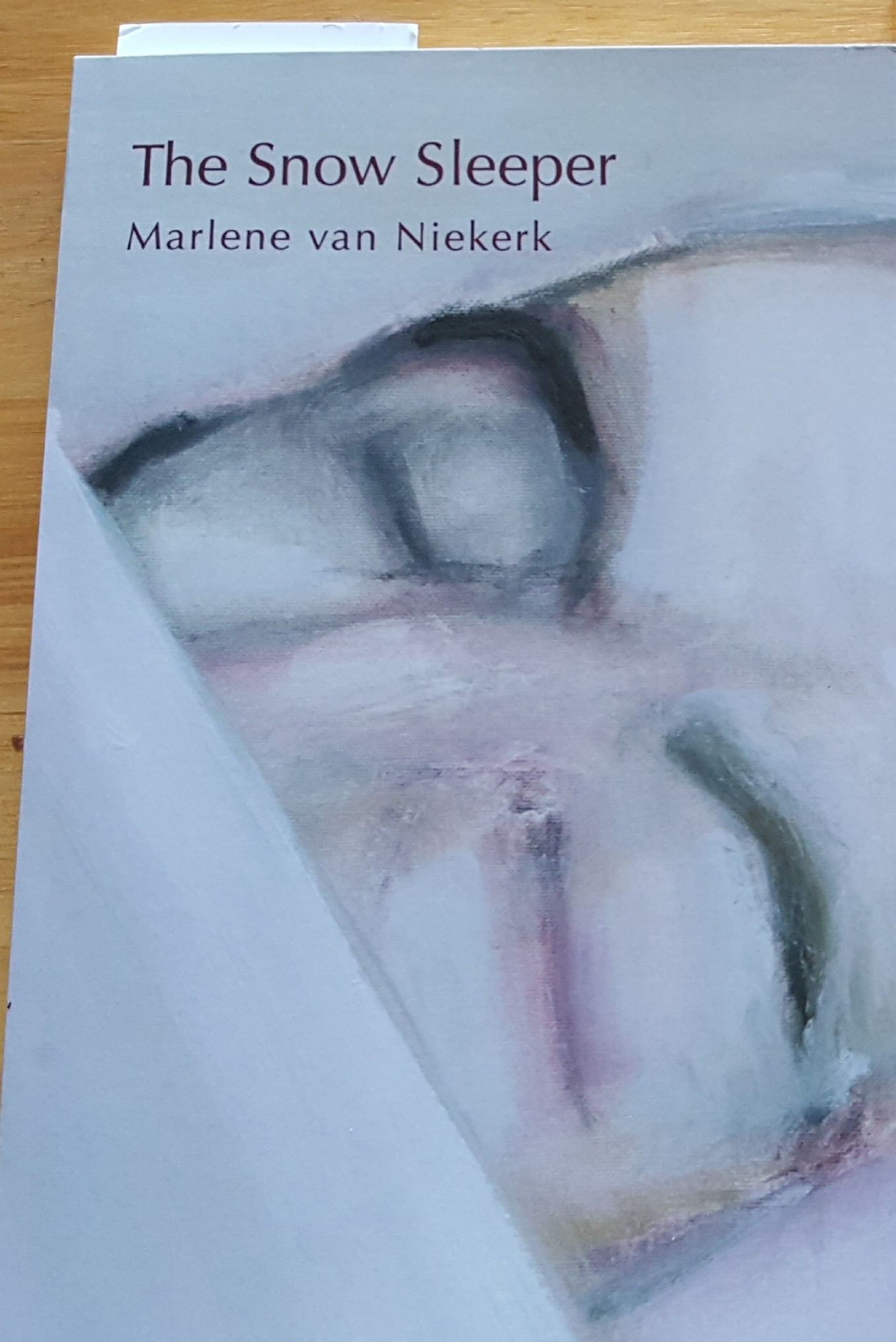
Tales within tales: The Snow Sleeper by Marlene van Niekerk

Oh, she serenades me so lovingly in the crepuscule of the park, the last lark. Does she really want to fraternise with this fluorescent shade? You are from the social services, Mevrouw? What? Come closer chincherinchee, I’m hard of hearing. You’re from the service that does the annual census of rough sleepers? She looks at me! Oh what an expert gaze rests upon me! Diva of the indolents in the catacombs of Krijtberg, sleep-counter of the stone-broke in the Heiligeweg!

At the end of July I shared a few thoughts about translation, arguing that a translated text need not be cleansed of all the linguistic flavour of the source language, especially slang, vernacular or wordplay woven into the original narrative. It may not always be possible or desirable to maintain certain elements, and sometimes transferring the rhythm and feel of an idiosyncratic expression may require the creation of a new word or the unconventional use of English, but it’s a balancing act. Strip away too much and, unbeknownst to the reader, the smooth sounding rendition they hold in their hands may have come at the cost of much of the energy and charm of the original. It might arrive prechewed, if you like, as if to make it more digestible. And unless you know the source material and language, who’s the wiser?

With Marlene van Niekerk’s The Snow Sleeper, you will have no doubt that you are dipping into the slippery terrain between languages. Originally published in Afrikaans, and translated into Dutch and English, it almost feels as if more than one language is meant to interact on the page at times. As a collection of four longer short stories—two set in Amsterdam, and two in South Africa but with a significant connection to the Dutch capital—there is room for a little playful linguistic overlap. And English language translator Marius Swart is quite comfortable allowing that to happen, when appropriate.

Of course, this approach is entirely in keeping with the text at hand. This set of loosely intertwined tales is concerned with storytelling—with language, translation, sound, and images. With what can be told and what cannot. With what should be said—that is, the storyteller’s social obligation—and what should not. And with how to open oneself up to what is being shared.

The opening story “The Swan Whisperer” will be familiar to anyone who chanced to read it in a slightly different form in The Cahier Series edition which featured the striking images of William Kentridge. Rereading it again I was as captivated as ever. Presented in the form of a lecture by a South African teacher of Creative Writing who shares the author’s name; it is an account of Kasper, a misfit student who unexpectedly sends her a long missive from Amsterdam where she had secured him a writing bursary. He is in the hospital, but wishes to explain why he is dropping out of his degree, and recount the most unusual and transformative occurrences which he has experienced. She is not impressed. No, she is even a bit angered. Reads a little and tucks his letter away. When a second package arrives, this one filled with cassette tapes and a so-called Log Book of a Swan Whisperer, she retrieves the letter, reads further and learns about her student’s infatuation with a drifter who appears to be able to communicate with swans. Reluctantly she finds herself drawn into the strange and compelling mystery her former student represents, and caught up in the project captured on his tapes—one where translation leads beyond the structure of ordinary language, grammar and meaning.

The second tale, set in Amsterdam, takes the form of a lengthy, rambling eulogy for Willem,  a writer of some renown. Jacob, his best and perhaps only friend, is a clockmaker who sets out to describe the last day of Willem’s life, one they spent together. The writer had been seeking feedback on his latest story, “The Percussionist,” and now Jacob has brought the unfinished manuscript along. It forms the unlikely backbone to his address to the gathered mourners. He reads from it, imploring the restless assemblage to help him complete the tale. As with all of Willem’s stories it was inspired by someone he had become fixated on and studied through his binoculars:

I would always know when he was having a crush on someone new, and that he’d write it up as soon as it was over, and that I’d once again be called as his witness. Not to witness the infatuation, but to attest to the fantasy. Because nothing meaningful ever came from these so-called great loves of Willem’s. The stories were all he retained. He held on to them for dear life. They were his real lovers, I only realise this now.

Their final day together ended in a riotous, childlike trashing of Willem’s apartment, as if he somehow sensed it was his last, but his friend, left to gather up all the pieces is the one who now has nothing to hold on to. Even as much as he resists it, the funeral also has to come to end and he must go home in his aloneness.

The title story “The Snow Sleeper” is the point at which the threads that tie the stories together intersect, though, the way they actually connect, or the extent to which the narratives and characters can be trusted, is not entirely certain. Here Willem’s younger sister Mevrouw, with both her father and her brother dead, is engaged in a study of Amsterdam’s homeless for her thesis. She finds herself under the spell of a “radiant vagrant,” an enigmatic and articulate jester holding court on a bench in a city park. Unfolding as a series of transcriptions from her interview with him, interspersed with memos that record her reaction to her curious subject along with memories of her own father who had similarly wandered in his later years, lost and restless until he was contained in a nursing home. She is, in guilt and grief, vulnerable to the strange charm of an eccentric drifter determined to tell her a story about a snow sleeper while she is intent on recording responses to the questions on her questionnaire.

Where I’m from, that’s what you want to know Mevrouw? Don’t they teach the art of the diplomatic approach any more, there in your lieweherehogerschool? “Where” is a vagrant “from”, did you hear that, dear listeners? Where from!

Fromness is for someone with a bed in one place, dear lady, but I sleep outside, I come from a cucumber and blow where I will, I know all the spots, the summer houses and the short stays, this park bench is my Xanadu, but I’m actually a man of snow, I drink my own thirst, with a horseradish for a nose and three chestnut buttons on my stomach, a cruel infestations of imaginings in my breast.

Among the tales he spins for his interviewer, is one of a doleful young man whom he tricked into believing he had the power to call swans, and a photographer for whom he performs the construction of a winter bed of cardboard and plastic. He has been, he implies, the ultimate jack of all trades—reciting poetry for a few coins in the park, seducing the lonely souls out of their own security and onto the streets. And for Mevrouw? He haunts and disturbs her thoughts as they share that park bench and day fades to evening:

If you’re going to split your fire for me, I wanted to tell the drifter, if that’s what your story is about, about how you consume people by whom you feel threatened, then I will burn like the wood of a plum tree, you will see all your language burn, soaked into my fibres, you will hear the echo of your impossible tale, a suitcase full of popping coals.

The interview ends when her tapes run out, but she is altered. Not even certain how. His stories nested within her own memos is a searching for answers.

The closing story, “The Friend,” returns to South Africa. The narrator is again named van Niekerk, caustic like the first one, but different in nature. She tells of a friend from school to whom she was unnecessarily cool when she was a young politically engaged activist and he was an awkward character with a stutter and an interest in photography. She encourages him to turn his lens to the injustices of the day at their country’s critical turning point. And he does, becoming a famous documentarian—then going a step too far. Does he perchance end up in Amsterdam one winter? Paths cross, but this is a softly tragic tale about a different kind of storytelling. One with images instead of words. One that ends, like the first, beyond words altogether.

Marlene van Niekerk, known for large novels like Triomf and the monumental Agaat, is equally mesmerizing in a smaller format. The stories in this collection are dense with emotion, ideas, and textual cross references, yet each one feels like magic—sad and wonderful at once.

The Snow Sleeper by Marlene van Niekerk is translated by Marius Swart and published by Human & Rousseau. It is my final Women in Translation Month read for 2019.

To sing the song unsung: A personal answer to Singed by Daniela Cascella

The voice soundless and then, records unheard, song unsung, voice also unsung
dipped enshrouded ensheathed enlandscaped tongueless tongueless tied no story no record.

Daniela Cascella is a literary ecstatic. She engages with the word—written, spoken, sung, depicted—at an essential point of being, at that place where the spirit, soul, or daimon resides.

She listens into the silences, to the whispers and echoes, to the frayed edges of meaning. As a native Italian who writes in English, she attends to the spaces between languages, bending and folding her adopted tongue to affect fractured layers of intent. To open yourself to reading her is to be challenged to read and write with a new sensitivity to sound, voice and significance.

If I sound like an enthusiast, I am. Daniela (if this was a review rather than an answer I would refer to her by her last name—I will honour her instead, as Brazil honours Clarice) has been a vital friend and mentor over the past year and half since I first came to know her. As an essayist, my primary goal is to reach toward an articulation of the ineffable, to give voice to an existence, not between languages, but between gendered experience in a way that gets closer to an expression of being as I understand it than the common dialogue surrounding trans identity allows. I have no idea if that is an attainable goal, but Daniela’s essays and meditations thrill, inspire and ignite me.

Inspire and ignite me.

Ignite.

Her latest book, Singed, takes its title from permutations of sing: sing, singed, sung. It opens with the account of a fire. A few months ago the room at the top of our house caught fire. A large number of books and cds were lost to the flames. I first read of these burned books from a PDF of the text. I responded with horror; I felt wrenched with every title. Returning to this accounting on the printed page a few weeks later, I sensed an exaltation, a calling forth, a rising to a challenge, a refrain to be reclaimed amidst the losses. And that is what Singed is. As Daniela sifts through the ashes and embers, sings through the ashes and embers, she calls forward precious voices—Clarice Lispector, Teresa of Ávila, Laura (Riding) Jackson, Elfriede Jelinek, Marlene van Niekerk, Isak Dinesen, Fleur Jaeggy, Ingeborg Bachmann and more—chanelling their words and their attempts to speak to otherness. Hers is a reading as inhabiting the spaces between words.  The observations she makes and questions she asks, hang in the air, inviting her reader to ponder the unspeakable and challenge the constraints placed on how we’ve been taught to read and to write.

Woven through her literary explorations, are reflections on music and art. These excursions help frame, and reframe, a multi-dimensional engagement with the written word. Hearing, seeing, and speaking are essential activities, as are silence, emptiness, and unfinished forms. A sigh, for example, Clarice’s in particular, which Cascella (at this moment, this feels like a review) first encounters listening to Lispector’s last recorded interview, inspires an intuitive and rhythmic engagement with the works of other writers, a series of echo and dub sessions on the page. The experience of reading and writing a review of Marlene van Niekerk’s The Swan Whisperer, a short tale in which a young student loses himself in his endeavour to transcribe the language of swans, leaves her spellbound, speechless and wordless, unable to write for months. Of that interlude she says:

Today I know that the silence I experienced was a deep working of the stuff that makes writing be. It was the encounter with the substance that eludes you and that causes such physical turmoil when you grasp it in other words, in words you read in a poem or hear in a song, and you recognize their subject as yours.

And the connections she draws when writing across languages are illuminating, especially for those of us who are unilingual. In an essay about Fleur Jaeggy’s as yet untranslated novel, Le statue d’acqua, Cascella writes:

Where did the spirit of the world hide that night its reservoir of dreamers?

The porous blank portions between the words in The Water Statues soak up Jaeggy’s discomfortable writing. They enfold the space of space, or as Gass wrote of Rilke’s Innerweltraum, the space made by Being’s breathing… Not just the space we call consciousness, but the space where we retire in order to avoid a feeling… These spaces are always palpable as though space were smoke, or the mountains of the heart where the last of the hamlet of feeling may be discerned. The blank spaces host echoes, speech where speech ends, the voices of ancestors. Jaeggy herself has acknowledged, in discussing herself hearing writing in between German and Italian, that German is the language of her dreams…

Voices and echoes, and echoes of voices.

Repetition of a refrain.

Call and answer.

If reading Daniela Cascella’s work—including her earlier books, En Abîme and F.M.R.L.— has nurtured in me an alertness to sound in language and imagery, and an awareness of voice, more explicitly a desire to voice what is known without words, Daniela, as a friend and fellow writer, has personally encouraged me to incorporate more photographs (or a photographic sensibility?) into the presentation of my writing—a process I am still just beginning to explore.

But take this image:

July, 2015, mid-winter in Cape Town. This is the Company’s Garden, with the iconic façade of Table Mountain looming in the background. On that white columned building in the distance, if you could see it, is a poster advertising William Kentridge’s multi-media installation, The Refusal of Time. That is the South African National Gallery and this is my last full day in the city. I made my way through the gallery in near isolation and as I passed into the room containing the Kentridge exhibit, the recorded rhythms of metronomes and bellows were triggered and seemed, in the moment, to be contained within this dark space where I experienced the entire presentation alone, surrounded by noise and images, free to wander and absorb the full sensory explosion unhindered. Later, as I explored the rest of the gallery, I realized that the sounds and rhythms of the exhibit resounded and echoed through the entire building, enhancing my sensory appreciation of every photograph, painting and artwork I saw. I cannot think back on that visit to the gallery without hearing and feeling, the steady cadence, the heartbeat, of The Refusal of Time.

But that’s not all, and this where I answer Daniela Cascella and Singed. When we first connected, we shared our mutual appreciation of Marlene van Niekerk—The Swan Whisperer and her monumental novel, Agaat. It is a trace of the latter work I carried with me during my stay in Cape Town. Every time I came into the bowl from my B&B in Sea Point and saw Table Mountain stretching out before me, I could not help but hear the awed voice of the young Agaat after a trip to the cape with her mistress: “I saw Table Mountain.”

I saw Table Mountain.

 That young girl’s voice echoed in my head. Agaat’s voice became my voice. The voice of a past part of myself.

I saw Table Mountain.

 That afternoon, I sat in the café in the Garden, with Kentridge’s metronomes and Agaat’s wonder punctuating every breath, and started to write. I was, I believed, at the beginning of a process of writing my way back through the year that had just passed, from the breaking point of a serious manic episode to the renewal of a sense of self identity and an clear understanding of the unfinished business of being differently gendered in the world. A neat, circular journey  that would, in the writing, lead to healing.

As if.

Life (and death) still held lessons I could not, in that moment, anticipate.

Today, the pen still hesitates on the page. Small forays have been made, but I am only beginning to learn to listen to the voices I am trying to transcribe, the voices of the selves I am and used to be—girl, woman, man.

Somewhere, in the distance, I am calling back the beat of the metronome and a child’s voice: I saw Table Mountain. That child is me. In Cape Town I believed I could rewind time, solstice to solstice, one year back to the day I left my job,  and move on from there.

No.

I need to go back farther. Back into my past and listen for that child’s voice, the child who had a feeling, but no words to express it. To gather what one can know in absence of language, to salvage words from the margins of memories. Attend to that distant silence.

So much has passed in the two and a half years since I took this photograph. I almost died, then both of my parents faded rapidly and were suddenly gone, and the friend who drew me to South Africa committed suicide.

Just when I thought I was ready to write, my life caught fire and burned for over a year. Now it is time to sift through the ashes and embers, re-enter the remembering, and embrace the discomfortable, pen to paper.

Singed by Daniela Cascella is published by Equus Press.

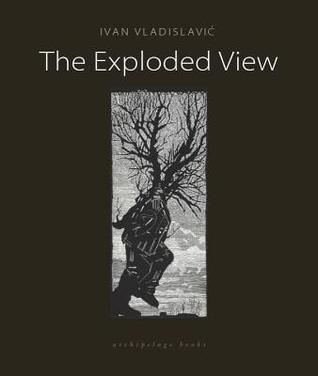
Out of place in a half-made world: The Exploded View by Ivan Vladislavić

Egan always found it strange to set foot for the first time in a place he knew from the plans. It was like folding out of two dimensions into three. You could almost hear the creases popping as you broke through the barrier. Sometimes it was disenchanting. You had convinced yourself, looking at the neatly inked blocks on the paper, at the street names, the community facilities, the cookie-cutter trees, that the place was rather pleasant. You imagined gardens, shady avenues and parks. And then you got there and found rows of impossibly small houses, not a leaf in sight, dust everywhere, shadowless walls, and the immense blue well of the sky, which reduced the world to sediment.

The end of Apartheid and the process of reconciliation offered great hope to the people of South Africa. It was, and still is, held up as a major achievement, a model to other nations, even if the dream has become tarnished in the realization. The plans always look better, more achievable, on paper. The Exploded View by Ivan Vladislavić, newly released by Archipelago, was originally published in South Africa in 2004, one decade after the first free elections. This collection of four loosely interlinked stories examines the uneasy space in which individuals living in and around Johannesburg find themselves as they try to adjust to—or exploit—a new social order where the shifting dynamics are not clearly defined. Too many loose edges exist, lines blur.

Vladislavić’s protagonists are ordinary men: a statistician, a sanitation engineer, a conceptual artist, and a contractor. Each one is a little neurotic, bearing hints of a vague identity crisis—the doubts of early mid-life in a world where the rules are changing. Their stories overlap with respect to place, a gated suburban development and a restaurant figure more than once, but each of the main characters is marked by particular degree of isolation.

“Villa Toscana” follows the misadventures of Les Budlender, a statistician seconded to help redraft the first non-racial census questionnaire that, in 1996, had caused great confusion. Shuttling between a diverse group of volunteers, and the Development Committee, his job is to help fine-tune a new form. And that brings him to a gated, faux Italian residential complex on the outskirts of the city where he meets a young Afrikaner named Iris. He is smitten; she is oblivious and eventually irritated by his increasingly odd behavior. Awkward, obsessive about detail, he tries to quantify everything as if comfort can only be found in numbers. He demonstrates a hyper sensitivity to his surroundings that, in the presence of Iris, is magnified and, in the end, unlikely to serve him well. But it allows for some striking descriptive passages:

She seated him in the lounge and went to make coffee. The rooms in Villa Toscana were small, square and white. The furniture, sparse and spindly though it was, seemed too large. He had the unsettling impression that he had strayed onto a page in a book, one of those picture books that were more interesting to adults than the children they had apparently been written for. He had lost all sense of proportion. He stood up, half expecting that he would have to stoop, and raised his hand above his head, measuring the distance between his outstretched fingertips and the ceiling. At least a metre. Probably, there were municipal regulations. Why did it seem so low?

The second and, for my money, standout piece in the book, “Afritude Sauce,” features Egan, a sanitation engineer on a business trip. He is out to visit a new RDP (low-cost subsidy) housing project called Hani View where there have been problems with the water and sewage system. He begins to sense that he is a prop in some sort of municipal drama. It begins with a seemingly staged (and photographed) demonstration of the inadequacy of the construction and, quite comically, the toilet facilities in one of the houses, and continues later that evening at dinner with a group of local business and council men at Bra Zama’s African Eatery. He tries to pride himself in being progressive, as a white man with a group of black men—the only racially mixed group in the room:

Mazibuko was right, Egan thought, it was going to be an experience. And he had an odd sense that it would be a significant experience too, that he would remember this evening, that he would look back on it. He could already see himself looking back on it, from a tremendous distance, and understanding, at last, what it was all about. He wishes he was there now, at that reassuring remove, on a height, filled with the wisdom of hindsight.

However, as the night progresses, he is increasingly at a loss to decipher how he fits into the political posturing that gradually leaves him sidelined as the conversation shifts into Sotho and he drinks too much for his own good. Later, back at his hotel, his embarrassment and irritation builds to a level of frustrated paranoia.

“Curiouser,” is the sole story with a black protagonist, in this instance an educated, middle-class artist, who has made his name with installation art pieces. Simeon also faces questions of identity, albeit from another angle. Questions about what is, or is not, appropriate for him to present in his art take on a different tone because of his colour. His own sense of himself is, to a significant extent, a private performance. Yet, when forced to consider the possibly illegal source of a large quantity of masks and curios he has purchased, it is clear that he, too, has an uncertain sense of how, or where, he fits in.

Finally, the collection closes with “Crocodile Lodge,” where the elements of the “new South Africa” meet with a devastating and brutal intensity. A contractor who specializes in erecting billboards for construction sites, caught in congested traffic reflects on his childhood love of Popular Mechanics, as he makes his way back to the location where he had been working earlier to try to find his missing cellphone. He remembers how the plans he absorbed from the magazine had shaped his idea of America and his ability to imagine the diagrams into virtual three-dimensional structures, from the smallest detail of a house, to the landscape outside:

Even the pines on the shore he exploded into their parts, so that each needle quivered beside a sheath in a stalk, each cone burst into separate scales, and each trunk shucked its bark like a coat. The world, disassembled as precisely as a diagram in a biology textbook, sucked in bracing breath and expanded. The universe was expanding, we were causing it to expand, by analyzing it.

This affinity for seeing how things fit together, for appreciating the “exploded view” had never left him though he wondered about its value in the modern world. Indeed, a new kind of awareness, alertness is required, when the world is in flux. Each of the protagonists in this collection find themselves out of step to a greater or lesser extent.

These stories, which could well be considered a novel in four parts, showcase Vladislavić’s great strength—an ability to burrow into the very human idiosyncrasies of the ordinary man. His attention to thoughts, mannerisms, and subtle details allow him to create, even in relatively confined spaces, characters that are honest, and slightly flawed, in a way that one can easily recognize and relate to. And his power of description applied to settings—interior, exterior, or imagined—carries an almost photographic quality. Well demonstrated in longer works like The Folly or Double Negative, this uncanny ability is likewise evident in his short fiction. The Exploded View is a welcome addition to the growing body of Vladislavić’s work to be made available outside South Africa, and, if you have yet to encounter his writings, is as good a place to start as any.

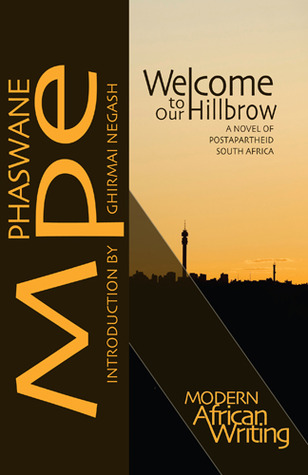
You do not own life: Welcome to Our Hillbrow by Phaswane Mpe

The first thing you notice from the opening words of Phaswane Mpe’s only novel, Welcome to Our Hillbrow, is an unusual, and to Western readers, unconventional narrative voice:

If you were still live, Refentše, child of Tiragalong, you would be glad that Bafana Bafana lost to France in the 1998 Soccer World Cup fiasco. Of course you supported the squad. But at least now, you would experience no hardships walking to your flat through the streets of Hillbrow—that locality of just over one square kilometre, according to official records; and according to its inhabitants, at least twice as big and teeming with countless people.

This is not, as some mistakenly assume, a second person perspective, but rather a communal first person plural voice, speaking from a universal omniscient viewpoint to a character who is dead. It is a narrative form that freely moves from the physical to the metaphysical and back again. By drawing on traditional storytelling techniques, language, and expressions to tell a story that is rooted in one of the most crowded, disadvantaged, and violent inner-city neighbourhoods of post-Apartheid Johannesburg, Mpe is able to explore the intersection of complex issues—linguistic and literary marginalization, xenophobia, suicide, AIDS, and rural superstition—with a dazzling immediacy and intensity.

mpeMpe (1970-2004) was born in Limpopopo Province (formerly Pietersburg) in northeastern South Africa and, like his main character, Refentše, he moved to Johannesburg at the age of nineteen to attend the University of Witwatersrand, which had recently opened its doors to black students. Unable to afford accommodation on campus, he lived in Hillbrow. He would go on to complete an MA in publishing at Oxford Brookes in the UK—an experience that he would, in his novel, grant Refilwe, the female character whose life crosses and parallels that of Refentše. Thus, Mpe’s urban and rural experiences, informed by his modern liberal arts education, contributed to the development of a distinctive new literary voice, one which would be cruelly silenced all too early when he died suddenly at the age of thirty-four.

The voice that carries the narrative directly addresses the primary character throughout the course of this short novel, and is at once challenging and understanding. The voice recounts Refentše’s actions and emotions for him, reminding or reinforcing a memory of his experiences because he and  most of the primary characters have met untimely or unfortunate fates by end of the book (or, if you would rather, before the account even begins). This is a narrative to the dead from the dead. This unusual approach not only allows for a surprisingly effective engagement with a tragic tale of unfortunate coincidences, misunderstandings, and consequences, but it also creates a unique dialectical context for the exploration of the deep and critical issues that lie at the core of the story.

In simple terms, although it does not unfold in a straightforward manner, Welcome to Our Hillbrow, follows two main characters: Refentše, who comes to the city to study, and settles in Hillbrow, becoming a sensitive observer of the community; and Refilwe, his childhood friend and former girlfriend, who arrives in the city shortly before his death. He falls in love with Lerato, the “Bone of his Heart,” who is also an academic. But his mother and fellow villagers are not happy to see him with a city woman—urban/rural prejudices are acute. When a couple of unfortunate moments of infidelity “shatter” his enthusiasm for life and lead to his suicide, Refilwe exasperates the situation by implying that Lerato is the daughter of a Nigerian man, a curse that plays into a deep-seated xenophobia toward African migrants that still exists in some black South African communities today. Tribal justice, more suicide, and madness follow in the wake of Refentše’s death. Yet the narrator continues to address him in Heaven, where he is able to observe the action that ensues but is, of course, powerless to intervene.

I do not own life, you often said when you tried to laugh your difficulties away.

Many people could not see that you were not merely throwing jokes around. You did not own your life when you were alive. Now that you are alive in a different realm, you know for sure that you do not own life. You have watched God and Devil, gods and Ancestors, wondering whether *they* owned it, this thing called life. As far as you could see no one seemed to own it, judging by the way they too cast their eyes in the directions of our Hillbrow, Alexandra, and Tiragalong, clicking their tongues in deep sadness or grim amusement as people devoured one another. You were right there with them, still on your way to finding out whether any of them owned life.

The novel opens with a vivid evocation of the riotous atmosphere of Hillbrow, an area populated primarily by migrants from the townships, rural areas, and from beyond the borders of South Africa. Unemployment and poverty prevail. Those who have arrived from other countries, especially Nigeria, are rudely referred to as Makwerekwere, and are accused of bringing drugs, crime, and prostitution. AIDS is also beginning to take a toll, but the disease is poorly understood and also seen as imported by the outsiders. Rural residents, like the villagers of Refentše’s hometown, Tiragalong, believe they are protected from this mysterious ailment because they don’t eat Green Monkey meat as some West Africans are rumoured to do, and they don’t engage in anal sex. Xenophobia and ignorance in the face of the rising AIDS epidemic are two of the key concerns that Mpe sets out to address. The distrust of immigrants is both timeless and exceptionally timely. Refentše often debates the matter with his cousin, who claims that the neighbourhood had been fine before the arrival of the Nigerians with all their drug dealing:

You, Refentše, child of Tiragalong (and, as you insisted in the days just before your death, also of Hillbrow), had never shared such sentiments. It was your opinion that the moral decay of Hillbrow, so often talked about, was in fact no worse than that of Tiragalong.

Think about it, Cousin, you would challenge. How many people are here in Hillbrow? How many of them are criminals? If you consider that the concentration of people in Hillbrow is dense, and work out the number of crimes in relation to the number of people, I tell you, you will find Tiragalong to be just as bad…. And while we’re so busy blaming [the Makwerekwere] for all our sins, hadn’t we better also admit that quite a large percentage of our home relatives who get killed in Hillbrow are in fact killed by other relatives who bring their home grudges with them to Jo’burg. That’s what makes Hillbrow so corrupt…

Refentše tries to remind his cousin that many of those coming into the country are fleeing violence and deprivation elsewhere—they are driven into exile. Yet his cousin’s response echoes that which so often meets refugees, no matter the time or place:

Cousin insisted that people should remain in their own countries and try to sort out the problems of those respective countries, rather than fleeing them; South Africa had too many problems of its own.

During his years in Hillbrow, Refentše completes his studies and becomes a lecturer at the university. He dreams of writing a novel about his neighbourhood, believing it to be the kind of place underrepresented in literature. He only manages to publish one short story, one that explores, through the fate of its female protagonist, the limitations of writing in traditional tongues in a country with eleven official languages, but where only two dominate to the practical exclusion of the others. Mpe quite effectively works his arguments into and against the prevailing dynamics in South African literature: his main character reads Coetzee (Waiting for the Barbarians), while later, in Oxford, Refilwe introduces an Irish barman to Zakes Mda (Ways of Dying). He can be seen as attempting to build a bridge between established authors—with novels that reflect themes in his own work—and a vision of a literature that could be more inclusive of other languages, such as his native Sepedi.

Toward the end of the novel, the narrative zeroes in on Refilwe as she finally has the opportunity to pursue her MA at Oxford, but the narrator(s) will not actually address her directly until the closing passages of the book. Several years have passed since Refentše’s death, and guilt over her treatment of Lerato, plus her experiences living and working in Johannesburg, have softened her own xenophobic tendencies. While she is overseas she meets and falls in love with a Nigerian man. However, their bliss is cut short when they learn they both have AIDS, and would have in fact been HIV positive for many years. Her fate will serve to challenge the prejudices of Tiragalong when she returns home. Subtle shifts in the narrative voice through the final chapter, serve to add power to its heartbreaking conclusion.

The critical examination of contemporary themes, within a narrative shaped by the rhythms and poetry of an African oral tradition, offers readers an experience that is both fresh and deeply moving. Echoes of Mpe’s work, together with that of K. Sello Duiker, another young and tragically short-lived black writer who emerged in the early post-Apartheid years, has continued to resonate through an entire generation of young South African writers who are producing vital and original literature today.

Welcome to Our Hillbrow: A Novel of Postapartheid South Africa, by Phaswane Mpe is available from Ohio University Press, with an excellent introduction by Ghirmai Negash.

2017 Africa Reading Challenge.

Beginning to write through grief: A reflection & link to my poem at the Sultan’s Seal

I am, as many know, dealing with a multi-layered, complex grief—my mother, my father, and one of my closest friends—all lost within the last six months. When my parents died in July, I entertained an immediate grief project, my own mourning diary, an echo of Roland Barthes. I started with a subdued passion, an ache as intellectual as emotional. In truth, my emotions were, I can now see, constrained and intellectualized.

I was numb.

Others reached out to me in those early weeks, sharing their own stories. The terrain of grief is rocky, I was warned. The journey long. The pain uneven. But, although I am in mid-life, a loss of this nature—doubled and complicated—was something I had never faced.

Then my friend took her own life sometime on September 1st. Even though I knew, in my heart, that such an event was almost inevitable, the pain and anger tore me apart. I knew she had tried every available option she could afford to fight an erratic and devastating variation of bipolar disorder, and I fully respected her decision and her right to make it. But suddenly my world was a darker, lonelier place.

And she had lived half a world away.

Again, the first thing I thought of was to write. This time, my distance from her demanded and informed my need to write—and I knew exactly what I wanted to do. I wanted to gather words and sentences from her writing and our communications, and together with some photographs from my trip to visit her in South Africa, create an elegy.

An offering.beach

Drawing inspiration from a prose piece by Breyten Breytenbach, and the sound driven writings of my friend, Daniela Cascella, I set to work. And I knew exactly where I wanted to publish this memorial if I was able to realize my vision—The Sultan’s Seal, a most wonderful space created and curated by Egyptian writer, Youssef Rakha.

The result, “And I will Tell You Something,” was published this past weekend. Three hundred words, five images and almost three months shaping, reshaping, listening and accepting the silence that emerged. This is perhaps the most emotionally demanding piece I have ever written. Yet, now five days after my words were finally set free in the world, I feel a tremendous sense of rightness. An element of peace. I still ache, but, with this prose poem, I feel I can begin to heal.

And I hope that others may find something in it too.

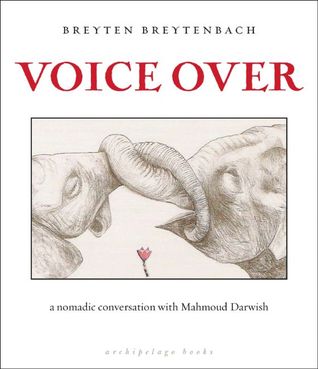
Conversing in verse: Voice Over by Breyten Breytenbach

when you die, Mahmoud
when your aorta thrashing
all sluggish and crinkled
like a purple snake bursts
because the lines can no longer
slither the perfect metaphor.

A selection of stunning new translations of the poems of Mahmoud Darwish posted today, March 13, on the blog Arabic Literature (in English) marking the late Palestinian poet’s birthday inspired me to take a little time to re-read Voice Over by Breyten Breytenbach. The South African writer and painter had last seen his friend and fellow poet in France only a few weeks prior to learning of Darwish’s death during open heart surgery in Houston, Texas, on August 9, 2008. He was on Gorée Island off the coast of Dakar in Senegal at the time and, as he travelled from there through Catalonia to Friesland to attend a literary festival, Breytenbach took the time to meditate on his friend’s passing and engage with his work reporting that it was “refreshing to be bathing in Mahmoud’s verses.” The twelve poems in this slender volume are a reflection on this time in the form of a poetic communion. As he notes in an afterword:

“MD had always been a prolific poet. One could interact with him forever. The present ‘collage’ touches upon transformed ‘variations’ of his work, at times plucked from different poems and then again by way of approaching a specific verse, with my own voice woven into the process. The images, and to an extent even the rhythms and the shaping, are his.”

voiceoverThe first poems play with images of death, burial and moving on, but the tone is not sombre. There is a distinct sense of a conversation not ended but continued beyond the grave, a call for a celebration of life – music, not weeping, and a glass raised high. Midway through the journey, the verses take a turn to the political with the plaintive call “we shall be a people” that echoes throughout the 6th piece and continues in the 7th where Breytenbach tells his friend:

identity is gospel talk. Mahmoud
when as in a dream you hear
what others tell
and imagine you understand/exist

to be is to move
through a spectrum of volcanoes
and the spectacle of wars
              and poetry in catastrophic times

blood
              and blood
                            and blood
in your homeland

Small but powerfully affecting, this collection of poetic engagements acts as a kindling of the spirit of a voice silenced too soon. My favourite piece in this collage, to use Breytenbach’s term, is the 8th and longest entry. Here the question of the possibility and validity of this communication across the boundaries of language, and of death itself, is explored. Here, for me, lies the heart of the grief and the expression of fellowship:

who is writing this poem face
by face      in black blood
neither raven’s ink nor voice
pressed from an errant tongue?
luck’s hand snatches everything from night

Mirage leads the wanderer through the wasting
so that he may continue hailing the holy crocodiles
Mirage seduces him with sweet words read
if you can       write if you can
read       water / water / water

and write this one line in the sand
that if it weren’t for Mirage
I’d long since have died    for it is
the traveler’s talisman that hope and despair
be twinned in the blood of poetry

Ah yes, twinned in the blood of poetry. A gift, verse to verse, this heartfelt collection is a treasure.

darwish1Voice Over: a nomadic conversation with Mahmoud Darwish by Breyten Breytenbach is published by Archipelago Books.


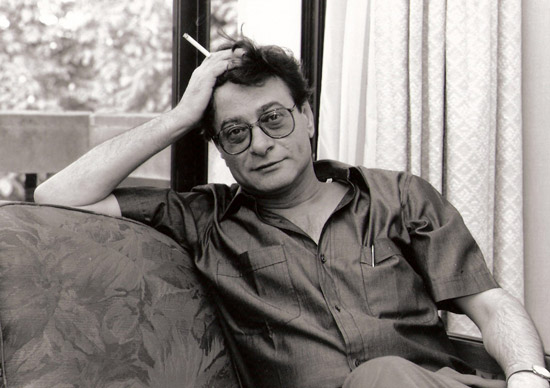
Mahmoud Darwish, March 13, 1941 – August 9, 2008

Honouring the unwritten: The Loss Library and Other Unfinished Stories by Ivan Vladislavić

“Not writing is always a relief and sometimes a pleasure. Writing about what cannot be written, by contrast, is the devil’s own job. Yet words on a page make all things possible.”

Central to this collection of brief odes to the fictional inspirations that once planted, failed to germinate, refused to take root and grow, or died off before even hitting the soil; is one full and essentially complete story – the magical titular “The Loss Library”. Surrounding this tale, to either side on the book shelf of South African author Ivan Vladislavić’s imagination lie a selection of meditations on the curious nature of the creative process and the many ways that an intriguing idea can lose its way on the path to realization, finding itself shelved in the place of the might-have-been, filed away in a writer’s own personal loss library. Looking back at the notes and outlines he explored during the late 1980’s and early 1990’s, the unsettling years of transition from apartheid to a democratic state, Vladislavić notes that his inspirations tended to arise from documentary sources – the past perhaps seeming more sound than the bloody history being made on the streets of his country at the time. Moving forward, within the scope of the “case studies” selected for this book, the pieces and fragments he gathers turn to dictionaries, reference materials and the “means to read and write – or not read and not write – books.”

2015-12-09 15.08.34But let us begin in the middle, at “The Loss Library”. With a clear nod to Borges, the master of the library of the imagination, a young man arrives at a most unusual archive, a repository of the all of the unfinished works, possible and impossible of all the writers who have ever lived. He is greeted by an attractive librarian. Fit and tanned she is the antitheses of what he expects. As she guides him into the library she first steps into slippers and advises him to do the same. They literally glide across the polished floors of the rooms and corridors as she directs his personal tour of the premises. The first room contains a single glassed in cabinet containing the books that would have been written had their would-be authors not chanced to die young:

“‘Arranged alphabetically and classified by cause of death.’ A wave of her slender hand. ‘Accidental death. Booze, of course. Disease – those old standbys, consumption and syphilis, and the new one, AIDS, a growing collection. Duels – little sign of growth there. Motor accidents. Murder. Suicide. A disproportionate number of Russians and Japanese, as you’d expect, and quite a few of your countrymen and women too.’”

As our protagonist leans in for a closer look, he can recognize no words on the spines. He tells the librarian he is looking for Bruno Schulz. Filed down with the war dead, six little volumes are found but he is not allowed to see them… after all, opening such a book could have consequences in all the others, in essence I suppose, the way fiddling with the future given access to a time machine might. In this library of potential works, one can’t risk having people “talk them into being.”

2015-12-09 15.02.54Together they encounter a room filled with books that remain unwritten because their authors lost faith in them, and he is shown a collection of the books that lost their way or were talked out of existence before they had a chance to be realized. They pass through a room containing books that were destroyed, stop at a shelf of books that comes into being by evocation of the proper author’s name (any guesses?) and, finally, enter a room of floating, ghostly, ethereal books – those that presented themselves to their would-be writers in dreams. In the end, is this excursion through the Loss Library a fantasy, the beginning of book that the young man himself will write into being, or another story that might have been, relegated to the back of a notebook, the bottom of a drawer or, in this day and age, lost somewhere on a hard drive?

Returning now to the startling opening essay, Vladislavić describes his attraction to the famous photograph of Robert Walser lying dead in the snow on Christmas Day, 1956, and reflects upon the way that the isolated image fueled his imagination before had even read any of Walser’s work. He contemplates writing a story about the writer’s last days, about that fateful final walk, the curious absence of footsteps or bystanders around the body, the precision the photographer must have employed to capture this solemn record, and with particular fascination, the dead man’s hat lying in the snow. However, before he sits down to write, Vladislavić engages in a little research and finds another photograph, taken from a different angle. From this vantage point he can now see many footprints in the snow, two men off to the side, and realizes that even the hat has fallen differently than he imagined. The curious, romantic and uncomfortable questions – the necessary elements of the creative process – are shattered.

As he continues to rifle through the pages of his notebooks, Vladislavić explores a variety of mislaid ventures, the inspiration or ideas behind them and the reasons they fell off the rails or, perhaps, only flickered for a moment or two. “Gross”, an intended venture into the land of the OuLiPo in which he set for himself a series mathematical constraints within which he would construct a novel, proves unsuccessful. Along the way, the character he was creating to take centre stage, morphed into someone else who would, ultimately wander off to join the cast of another novel,The Restless Supermarket, but more critically, he found himself completely overwhelmed by the prospect of the challenge he had set and decided that this type of approach was best left to Perec, et al.

In a later example, he describes his fascination with an unassuming sign on the side of a building in his Johannesburg neighbourhood that simply reads “Gravity Addict” with a phone number. He begins to wonder what a gravity addict is and how that might be imagined in a story. He thinks about the post 9/11 performance artist in Don Delillo’s The Falling Man, contemplates the structural format of that novel, and eventually imagines a woman, an aspiring writer, sitting on her sofa watching endless episodes of old cartoons – the ones where characters repeatedly chase each other off the edge of cliffs – and then, when one day the innocuous meaning behind the mysterious appellation “gravity artist” is revealed to him, his interest in the story instantly dissolves and he can go no further.

Finally, in light of the recent re-release of Vladislavić’s first novel, The Folly, the story “The Acrobats” special attention. In this outline for a story we see a man in a library reading a book. At some point he closes that book and retrieves a copy of Tristram Shandy from the stacks. He seeks out a particular passage which in turn, is a lengthy quotation from Gragntua and Pantagruel by Rabelais, so he stops and wanders off to fetch that text and goes on to read from the original, or rather a translation of the original, the same quoted passage describing the wild acrobatic exploits of Gymnaste, performed on horseback, as he faces down an enemy combatant. As such, Vladislavić envisions a post-modern inversion of a book within a book within a book, the initial level being, of course, at once the book that both the man and his reader are reading. However, the idea is set aside, in part due to the complication of modern versus contemporary translations of the nested passages.

Several years later, in the writing of The Folly, Vladislavić sees his character Nieuwenhuizen, the eccentric stranger who arrives out of nowhere to take ownership of and build a house on a vacant lot, as a direct descendant of Gymnaste. As he marks out the foundation of the ephemeral house that he will ultimately construct out of imagination and thin air, Nieuwenhuizen engages in his own acrobatic measurements, leaping, somersaulting, and throwing himself around the lot. Could the earlier story now be revived, with The Folly as the third book in the line, he wonders, could he develop the idea that his “ostensibly post-modern novel stood in a pre-modern tradition”? Ah, but for the paradox that his outline for “The Acrobats” was written three to four years before The Folly, how could a story refer to a book that had yet to be written?

Yet Vladislavić was, it would seem, not quite done with his potential story. Several years later he encountered the 18th century French writer, Diderot, who was a contemporary of and acquainted with Laurence Sterne. Although the publication of Rameau’s Nephew would arise through a circuitous route, there was an indication apparently, that Diderot’s initial sketches for the eccentric, rambling character who engages the narrator of his novel could have roughly coincided with the publication of Tristram Shandy. Now he wants to fictionally trace the lineage of Nieuwenhuizen from Sterne via Rameau… except for a new paradox that arises. The Folly was written before his discovery of Rameau’s Nephew. How could his own novel be influenced by a work he had not read?

In his note at the end of this account of the stubborn death of a story idea, Vladislavić can look back and recognize that, as a young writer, he demonstrated too great a concern with precedent. Wiser now, he remarks:

“Every writer belongs to one bastard bloodline or another, and laying claim to one can be a liberating lesson in perspective. But standing on the shoulders of giants is a skill that comes from long practice. When you start out, you are more likely to get under their feet. Don’t be surprised if the giants – or their legitimate progeny – come stomping after you in the playground: ‘We walk straight so you better get out of the way!’”

And herein lies the true gift of this slender collection of artistic musings,and inspirational dead ends – the insertion throughout of the author’s updated reflections on his varied false starts. There is no writer or would-be writer who does not have an accumulated hoard of ideas, outlines and abandoned projects. If they don’t, one ought to be suspicious.

Wandering through The Loss Library and Other Unfinished Stories is a rare privilege to spend time in the company of a thoughtful, gifted writer who truly appears to be without pretensions. This journey, contained within the covers of a finely crafted hardcover from the singular Seagull Books and accompanied by the original collages of Sunandini Banerjee, is a wonderful way to spend an afternoon, and treasure to return to time and again. After all, there may well be, within these pages, the inspirational seeds of other stories just waiting for the right gardener to plant them and bring them to fruition.