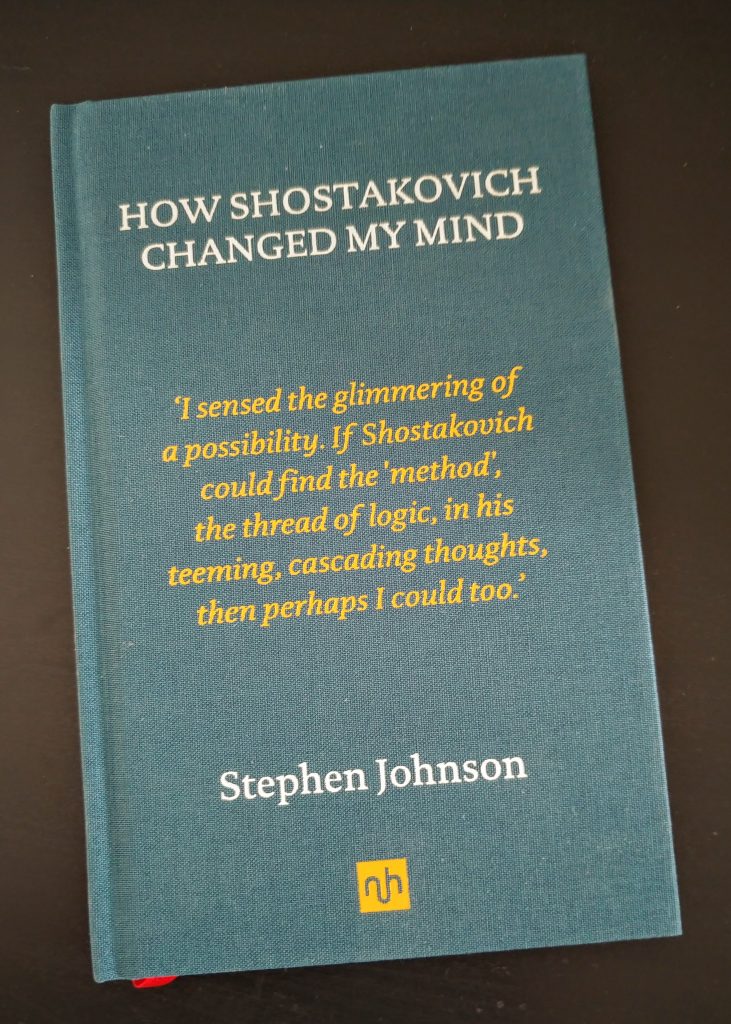
Ropes across the abyss: How Shostakovich Changed My Mind by Stephen Johnson

The opening pages of music broadcaster and composer Stephen Johnson’s How Shostakovich Changed My Mind detail what is clearly one of the most moving interview experiences of his career. He is in the St Petersburg apartment of Viktor Kozlov, one of the few surviving members of the orchestra that performed the triumphant debut of Shostakovich’s Seventh Symphony in 1942. He describes, with the clarinetist’s assistance,  how that performance was pulled together against all odds. Leningrad, as it was known at the time, was under siege, and Stalin not only wanted an opportunity to galvanize the beleaguered citizens, he wanted to send a message to Hitler who was waiting within earshot to celebrate victory. As an artist within a system that could turn against him in a heartbeat, the burden on Shostakovich to deliver a suitable masterpiece was immense. In the end, it was a rousing success. He managed to speak directly to the people’s emotions, and give them a reason to feel united in a time of war. The invigorated audience responded with an ovation reported to have lasted over an hour.

But here was something else too: that puzzling conundrum I had noted so often when pondering the appeal of Shostakovich’s music, but which now struck me with heightened force. In the Leningrad Symphony, Shostakovich had held a mirror up to horror, and reflected that horror back to those whom it had all but destroyed—and in response they had roared their approval, their delight, their gratitude to the composer for giving form to their feelings.

When Kozlov’s account of the event was complete, Johnson asked him a most formulaic question. He wanted to know how that same music made him feel when he heard it today, completely unprepared for the response. Both the elderly musician and his wife burst into tears—it was a question beyond any possible answer.
It is this ineffable power of music to reach into the deep emotional spaces in our lives where words often prove ineffectual, to give voice to that which we ourselves cannot express—especially in times of anxiety and distress—that becomes the very personal focus of this most fascinating book. Part musical biography, part memoir, part psychology and philosophy, this book-length essay draws its greatest strength from Johnson’s passionate affection for and deep connection to the music of Dimitri Shostakovich. His association with the composer’s repertoire reaches back to his own difficult adolescence when, ignorant of the world of rock ’n roll, he sought comfort in the Shostakovich’s thundering chords. Blessed with an acute musical memory, he was able to carry fully orchestrated movements in his mind in a manner he compares to a romantic teenage infatuation, during the times when his mercurial and unstable mother’s volatile behaviour made life otherwise unbearable. This uncanny musical aptitude serves him well as a writer. His ability to breathe life into complex orchestrated passages and open up the key elements at play in major works, is likely to inspire readers to download or stream the pieces under discussion, or pull dusty records or CDs from their shelves. It is not necessary to engage an aural experience in the reading, but it does tend to be difficult to resist the inclination to do so.

As one might imagine, given the unusual title, How Shostakovich Changed My Mind is an intimate account of the intersection of music with the personal drama, and trauma, of life lived. Johnson draws on literary, philosophical, neurological and psychological resources as he explores the connection between music and the brain, an area of growing interest and investigation, but he anchors his inquiry in the story of Shostakovich’s life and work during some of the most tumultuous events of the twentieth century—a thoroughly fascinating account in its own right—while tracing out his own particular relationship to this music and the role it played , not only in adolescence, but in his own adult challenges with bipolar disorder.

Shostakovich’s music can be wildly moody, shifting abruptly from lighthearted to savage to slow and achingly sombre. But it is not without structure. In listening carefully, Johnson became attuned, early on, to the thematic connections that he describes as ropes stretched across the composer’s own abyss, a bridge of sorts. It is a fundamentally important discovery for someone with a mood disorder—a condition I also understand too well:

As a bipolar sufferer, I know what it is to experience manic flight. At its worst it has been truly frightening, like a bad, drug-induced trip. Even when I’m not manic, I’m aware of how my conversation can go off on sudden tangents. Some of my friends have found it entertaining; others have found it bewildering, even alarming. It certainly alarmed my mother although she could be as dizzyingly tangential as anyone I’ve ever known. It was another aspect of my behaviour that provoked my father into panic-stricken attempts to close me down. I became seriously concerned about my own ‘intoxicating and leapfrogging’ thought processes—until, that is, I came to know Shostakovich’s Fourth Symphony. As I found Shostakovich’s connecting ropes and pulled them taut, it was though he personally was reassuring me. The exhilaration I felt was not dangerous; it was controlled, expertly rounded off by this extraordinary music.

If Shostakovich reached one troubled and alienated youth, it is not this particular music alone that holds the key. Johnson muses if he had been exposed to rock music he might well have found similar comforts and a peer group to share it with as well. But it matters not. The magic, if you like, lies in a link between music and listener, through a mechanism folded into the evolutionary structure of our brains. One that has the power to ease isolation, to unify, and to move both the individual and the crowd from “the ‘I’ to the ‘we’” as witnessed on that August night in Leningrad in 1942.

Moving deftly between the artistic, the scientific, and the autobiographical, this extended essay, never gets bogged down or off track. It makes no effort to be exhaustive, after all, at the core of the book is the relationship between the music of one very enigmatic Russian composer and the author whose life has been influenced, possibly even saved by it. Johnson’s own story unfolds like a well-crafted symphony itself, building through layers, in and out of the various streams of his narrative, to reach the point at which he was caught at the opposite end of the bipolar dance—in such an agonizing state of despair that suicide seemed the only way out. Again, he captures well the reaction of others to this side of the manic-depressive experience. In his darkened, unreliable state of mind, he came to believe that ending his life would not only ease what had somehow become an unbearable emotional pain, but would free up his wife Kate to get on with her life without the burden he felt he was invariably placing on her:

Depressives can be immensely frustrating for those who live with them. They tend to go around in the same anxious, obsessive circles endlessly; to the worried onlooker, it can seem that they actually don’t want to be helped; and they can be horribly irritable. For my part, I had still to learn that exasperation is more often a sign of love than its absence.

It was, ultimately, a fortuitous sequence of events that led him to his therapist’s office when he had intended to cancel; a lucky mistake that enabled an emotional breakthrough—or breakdown—that would turn the tide. However, Johnson can’t help but wonder if Shostakovich’s Eighth String Quartet had played even a small role on his road to recovery.

A year earlier, he had been given an assignment to prepare liner notes for a new recording of the popular Quartet, a task that had necessitated close engagement with a work composed when Shostakovich himself had been suicidal. He wonders if the writing and playing of the piece in which the composer famously places himself—or notes corresponding to his initials—as the central motif, had made him change his mind about killing himself, or whether it was simply the fact that a friend had intervened and removed the vial of sleeping pills he’d had on hand. And there’s the challenge: Music can do many things in times of emotional distress—reaching us in our darkened state with an image that is more accurate than the bleak self-portrait we cling to. However:

it cannot, in the broader sense, ‘see’ us. It can prepare us for the moment when we are seen; it can function as a life-raft in the most terrifying seas—for years, if necessary. But the moment of salvage needs a real living other, to see us and to know us, to signal to us that we are still worthy of rescue. Music could not do that for me, not quite—but it brought me very close.

How Shostakovich Changed My Mind is a rich account of the life and work of one of the most important composers of the twentieth century, a wide ranging discussion of the ability of music to provide expression and meaning in times of joy and sorrow, and, most importantly, a personal memoir of how music can serve as a means to navigate madness, especially in those times when, from inside, all one knows is that something is not right. This is a book for a wide audience, but for myself, as someone who also suffers from bipolar disorder, it has given me a lot to think about and reflect on looking back at my own relationship to music—and this illness—over the years.

How Shostakovich Changed My Mind by Stephen Johnson is published by Nottinghill Editions in the UK and distributed by NYRB in North America. Shostakovich: A Journey Into the Light, the 2011 BBC radio documentary that sets the groundwork for this book can be found online here.


Cloaked in Literature: Clone by Priya Sarukkai Chabria

In the years that I have been maintaining this blog, I don’t believe that have written about any book that might fall into the category of science or speculative fiction. I probably haven’t read much in recent years. As my attention has shifted to translated and more unconventional literature, I have set aside less time for the type of books I used to pick up as what I might have considered casual or escapist reading. Which sounds, I’m aware, like a little snobbishness and a lot of equivocating. But I don’t intend it that way, however, if one is not well read within a particular arena, writing about or reviewing a book becomes more difficult. The inclination is to simply read for pleasure, as if that is somehow a bad thing. Is literature supposed to hurt? Of course not. By this point in my life I like to think I’ve earned the right to read—or not read—whatever I want. Jump ship after 30 or 50 pages if I the book’s not working for me. Or to be surprised by a book I was less certain about.

In recent years there has been, it seems, a rush of speculative and apocalyptic themed fiction, drawing authors and readers from across the literary spectrum. I have tended to avoid it. I came to this book, Clone, almost by chance, when I was in Mumbai earlier this year and made plans to meet up with the author, poet and translator Priya Sarukkai Chabria at the Kala Ghoda Festival. Neither of us knew much about the other beforehand. A few hours over coffee and cake later and I’ve come to consider her a good friend. So although we have not discussed this book at all (I actually went to hear her lead a panel discussion on translating ancient literature), it is only fair that I consider this post a response rather than a formal review. As I’ve already indicated, I’m not sufficiently well-read in dystopian fiction anyhow. However, it’s also fair to say I was completely captivated by the scope and passion of this tale of an engineered clone “evolving” within a rigid, dispassionate world that is as fantastic as it is terrifyingly plausible.

The novel is set in a highly stratified twenty-fourth century India, where a select group of Originals lead a protected life of privilege and guarded luxury serviced by a vast array of clones bred from their own DNA, often mixed with or fortified by genetic material derived from animals. Divisions between classes of beings, or life forms, are strictly controlled. Museums exist to guard art and history from curious visitors and elaborate blood sports are a popular entertainment. It is, from the outside looking in, a world order long since divorced from the very qualities that faith, philosophy, and literature would have associated with humanity. In fact it would seem that the stirrings of these forgotten ideals, filtered through a vestigial genetic legacy that has resisted attempts to contain it, is the greatest threat to those in power. However, mutations keep arising.

Our narrator, Clone 14/54/G is, she insists, not a mutant. What sets her apart is something more unsettling. Her consciousness is changing. She remembers. The memories she seems to be accessing are desired by some and dangerous to others. Her Original, Aa-Aa was a writer living in the late twenty-first century, now being made manifest in her fourteenth generation likeness, cloaking her in Literature, so to speak. But Aa-Aa was a controversial figure who met an untimely end mid-way through an important public address. Her intended message died with her and Clone 14/54/G is seen a potential conduit to that message, for good or ill.

In a society dependent on unquestioned obedience and compliance, and designed to enforce it, poetry and stories are subversive elements. For our Clone, an early sign that something is amiss comes when she begins to experience unexplained compulsions and strange “visitations.” Like inhabiting a dreamscape although clones are not supposed to be able to dream, she finds herself caught up in stories—sometimes as a human, sometimes as an animal—reliving a life from a long lost time. These visitations which will later comprise a significant portion of the book, echo historical and mythological themes reaching far back into Indian history. They not only threaten the rigid consistency of the narrator’s programmed existence, they speak to the ineffable power of stories, to the poetry of our DNA.

Clone 14/54/G’s initial response is to wish these unwelcome intrusions away. Her sense of her place in the “Global Community’s” order of reality has been challenged. Originals alone have life, Firehearts who were created to play an empathic role have presence, and Superior Zombies claim existence, but Clones simply “exhibit actuality.” However, as words and ideas begin to come to her, to make their way into her experience of this actuality, her sense of her own reality is altered, or less certain. She responds whenever feasible by reducing her mode of function. But this strangeness does not simply affect her feelings. Her body is also responding:

Beneath my overalls I grew hair. At work, I made no error. I was allowed full rations. I was living in two worlds. Is this what is meant by loneliness? That you don’t belong to any world. Not the old one. Not the new. You don’t even seem to belong to yourself.

But as her awareness continues to evolve, she is relieved of her former worker role, and removed to a holding facility where she is afforded certain luxuries and encouraged to foster a connection with her Original. Her adjustment is not without reservations as the routines she knew are pulled away. And she is subjected to real pain, frequently pushed to her physical limits as the months pass. For support she has the Fireheart clone Couplet, an attentive almost insect like-creature assigned to assist in her recovery of Aa-Aa’s memories. Meanwhile, a handsome Original known only as The Leader, takes a particular interest in her progress and soon they become lovers. Her situation becomes at once more tenuous and more exciting. To what extent is she being played? By whom? To what ends? And is there anyone or anything she can trust, especially her own increasingly volatile and passionate heart? For example, after making love one day, she is haunted by questions that never would have troubled her before. What does it mean, for example, to be aware of the fact that she is alone?

Who is now speaking—Aa-Aa or me? Why do I wish it not be her?

“Clone 14/54/G” is no longer enough. I am more—and less—than I was. Less sure, less safe, less isolated. More curious, more in pain, more resolute about my uncertainties. With more words at my command.

The strengths of Clone lie in the strong voice of the narrator who comes to be known as Aa-Aa Clone 14/54/G and the realization of a multi-faceted, artificially manipulated society without laborious details or explanations. Aa-Aa Clone 14/54/G can only tell the story as she knows and understands it, nothing more. Her narrative moves from the focused and contained, yet conforming perspective of being whose entire world has been formed along established lines, to one whose humanity, if you will, starts to break through in fits and starts. The passion and spirit of her Original, and the characters whose stories she carries, simmers slowly, gradually building steam, but is never an entirely natural fit. This is not a Cinderella story. Too many horrors await, too many questions remain unanswered. Finally, the form, incorporating tales drawn from the accumulated memories of a distant past—the storyteller’s true legacy—is unexpected and effective; the language poetic and powerful.

Clone by Priya Sarukkai Chabria is published by New Delhi-based Zubaan Books, and distributed outside India by University of Chicago Press.

The book that comes after the book is done: Appendix Project by Kate Zambreno

An odd thing happened when I was reading Kate Zambreno’s remarkable Book of Mutter, her fragmented meditation on grief and loss—a mix of memoir and literary and artistic criticism—that took her more than a decade to write. I sensed a strain in her relationship with her mother, reading it against my own circumstances. Of course there were huge differences between our lives and the ages at which we lost our mothers, but it seemed that even after such a long gestation period, her effort to work through her complicated emotions was still uncertain and unresolved. And, why not? Is grief ever really resolved?

Appendix Project, the unintentional follow up or companion piece to Book of Mutter, is a collection of lectures and essays composed during the year following the original book’s publication. It offers Zambreno a unique opportunity to continue a process that, to her surprise, was not put to rest with the final edits and release of a text she had already dedicated so much of her writing energy to. What more could be said? A lot it turns out. And the result is a more intimate, thoroughly engaging meditation on the impossibility of ever fully writing through grief, the limits of language, and the intensified emotional connection to her mother that she discovers through her own experience of motherhood. The entries gathered into Appendix Project trace the first year of Zambreno’s daughter’s life, and as such, her mother’s absence is filtered, re-imagined and given greater dimension through the presence of her child. In becoming a parent herself, her understanding of her mother as a mother has been altered.

What I never anticipated is how much being pregnant, and having a baby, would change the nature of time for me, and how that would interfere with the mourning of my mother, which I thought was finished, since the book I wrote about her was finished… My baby is almost four months old, but I feel she was just born, and that she’s been alive forever. I am 39 years old, but I have never felt more the past year like I was a child, have never felt more strongly the absence of being a daughter, of having a mother.

More haphazard, natural and organic than the book that proceeds it, this series of talks and reflections is not simply an addendum to Book of Mutter, or an alternative to reading from the book at public events, rather it grows over the course of its evolution into an intimate investigation into the act of remembering and attempting to put into words that which cannot be readily defined, confined, contained and released. There are many spaces where language is inadequate, where writing to process experience is not only irresistible but often  impossible. Drawing on—that is, thinking and writing through—the work of artists and writers like Barthes, W.G. Sebald, On Kawara, Anne Carson, Bhanu Kapil, Marguerite Duras, Louise Bourgeois, Peter Handke and many more, Zambreno is not just continuing to think and re-think her own work, she is opening up avenues of inquiry and contemplation for any intuitive reader or writer to follow to their own ends. To read Appendix Project is akin to listening to its author thinking aloud as she reads the works others, reflects on motherhood, and returns to reconsider the elements of Book of Mutter that, over its long journey to a finished form, were either abandoned or edited out.

During the course of preparing the pieces that come to comprise Appendix Project, Zambreno resists the idea that they will be published as a book, knowing at the same time that she is engaged in a project. Others suggest that she should just repeat her these lectures, considering the time it takes to put them together, but there is an important temporal element at play, an ongoingness that is essential:

It feels like a necessary act, at this point where I am as a writer, and also as a published author, to re-engage in a passionate way in the ephemeral and daily practice of the writer, a way of returning back to the semi-privacy of writing—the different forms this might take—the letter, the notebook, and the talk. A talk however, Barthes notes, is not quite a performance. A talk is an outline for writing and speaking, a means to prepare and vocalize one’s thoughts.

Herein lies the key, at least for me, to the success of this project.  As Zambreno sorts her thoughts out in the course of these lectures and essays, an attentive reader/writer can  find their own launching points to questions that they may be dealing with. Reading Book of Mutter set me off on long stretches of  writing in my notebook as passages I encountered facilitated unlikely connections I might not have made otherwise. It was often less what was said than the way something was said that caused me to think: how is that different for me? The fruits of my very idiosyncratic reading led to an understanding of my own queered relationship with my mother that I had never appreciated. I have since written about that in an essay posted here on my blog on Mother’s Day. My reading of Appendix Project, which I had little desire to rush, has likewise opened up further channels of exploration for my own writing—this time broader because the scope is broader—and some of this meandering has become key to another piece I have recently written for publication next year.

My point in bringing in my own reactions here, without fleshing out any of the details of the connections I made because they are relevant only to me, is by way of saying that this is not a book I can stand back from and review with the critical displacement required. Well I could, but that is not what excites me about this work. What makes this form of intelligent, personalized critical essay writing so powerful when it works (and it does not always work, especially when it slides into the overly self-indulgent and solipsistic) is that it can send readers (or listeners when presented as a lecture) to consider their own intersection with the topics discussed. Certainly grief and addressing the loss of a mother are central themes, but other losses—childhood, language, land, even sanity—can be subject to the same challenges of understanding and expression. My copy of Appendix Project is decorated in marginalia spinning off in a multitude of directions. And I have a stack of books Zambreno dips into—some old favourites, others yet unread—now sitting close at hand, not to mention a few more titles added to my wish list.

Finally, it’s worth asking whether familiarity with Book of Mutter will provide context for this collection of lectures and essays, and of course it won’t hurt, but this really more a book about everything that book (or perhaps any book) does not contain—what was removed, what was never there, what may never adequately be captured in any written text. They are really very different works, in form and intention. Book of Mutter, if unconventional, is still a highly structured  work of mourning that, in the end, left me feeling a little disconnected. Appendix Project fills in those gaps and much more. And as such it is an exceptionally original, intelligent, and generous work in its own right.

Appendix Project by Kate Zambreno is published by Semiotext(e).

Where There Are Monsters by Breanne McIvor: Some thoughts and a link to my review at 3:AM

With my editing responsibilities at 3:AM Magazine occupying more of my time in recent months, I have not been able to find the time or energy to pitch or submit reviews to publications, preferring to rely on my blog for critical writing. However, this past week saw the publication of an off-site review at—of all places—3:AM. We have collaborated with the Republic of Consciousness Prize to publish a monthly review of their corresponding Book of the Month Club. I was invited to contribute a review for the May title.

Where There Are Monsters, the debut collection of short stories by Trinidadian writer Breanne McIvor was a very pleasant surprise that I might not have heard of save for this opportunity. Published by UK-based Peepal Tree Press, who specialize in promoting the work of Caribbean and Black British writers, McIvor presents a bold contemporary vision of her native country where wealth and poverty co-exist; crafting memorable tales that feature characters from both sides of the social and economic divide.  However, woven into this modern landscape are myths and monsters drawn from traditional folklore—often where one least expects them—lending her stories a distinctly gothic feel.

The opening passage of my review is reproduced below. You can read the rest of it here:

In an era when the happy ending may seem elusive, naive or, at the very least, ill-suited to the realm of serious literature, it is natural to long for a conclusion that, if not exactly happily-ever-after, is happier than expected. To that end, perhaps the most memorable feature of Breanne McIvor’s debut collection of short stories Where There Are Monsters is that, even if a shadowy quality simmers throughout, so many of her stories feature characters who are intrinsically kind and good, or capable of rising above the difficulties or legacies bequeathed them. Those who cannot are most often quite literally, well, monsters — beings possessed by a darkness deeply rooted in the folklore of Trinidad — and even then, the desire to override the evil impulses buried inside flickers with a desperate, if inadequate, humanity.

From both sides now: A History of Clouds: 99 Meditations by Hans Magnus Enzensberger

There is a glow, a particular confidence that emanates from the poetry of German essayist and writer, Hans Mangus Enzensberger. It is manifested in his uncanny ability to take the smallest, even mundane, observations and transform them into poems that catch one unaware. I want to call it an earnestness, but it is more than that, it is the  capacity to reflect with equal humility and humour on both the simple and the profound  moments, an ability  that can only come with time and a long, full life. The second of the ninety-nine poems or meditations that comprise his collection, A History of Clouds, is an early example. “Sins of Omission” is a confession of sorts—a list of presumed shortcomings that begins with the aging narrator admitting to being absent, not hurrying over “when the need was greatest,” but closes with a wide range of “sins”:

Forgot to confess,
shied away
from improving the world,
never dropped out or in at the right time,
failed to take my pills
three times a day.

Yes, I abstained from
killing people. Yes,
I didn’t call.
For the time being I have even
refrained from dying.
Forgive me, if you can.

Or just let it be.

(trans. by Martin Chalmers)

From the outset then, the appeal of his clear uncomplicated verse and his gently sarcastic tone is clearly evident; making it easy to see why he is generally considered to be Germany’s most important living poet.

Born in Bavaria in 1929, Enzensberger’s poetry covers a vast range of subject matter, and he is also an editor, translator, and  a vital, often controversial, essayist. This collection was published in its original German in 2003, in the early years of a new century, when the poet was in his seventies. The opening section frequently touches on private moments and emotion, and includes some wonderful images of the simple intimacies of long-term relationships, of shared beds and lives—the wonder of a breath, a touch, proximity—while the second turns its attention to the lives of others, conjuring portraits that are historical, political or literary.  A particularly poignant piece is the haunting elegy to fellow countryman WG Sebald “Who touched us, / who seemed to have come from afar / to the sinister, unhomely homeland. / Little kept him here. / Nothing but the search for traces / with a divining rod of words / which twitched in his hand.” (From “For Max Sebald”, trans. by Martin Chalmers)

Enzensberger’s curiosity for the world, his far flung interests and experiences provide fertile backdrops for his wry commentaries on life. In later sections, he often appeals to science, philosophy and cosmology to illustrate an idea, making his poems them feel at once timely and out of time. One of my favourite pieces is the rather beautifully blunt “At Times” which begins:

When you meet someone
who is smarter or more stupid than you—
don’t make too much of it.
The ants and the gods,
believe me, feel just the same.

And goes on to remind us of our humble place in nature, insisting we are all relatively average in the grand scheme of things, insisting that is good, because:

Somewhere or other you’re always discovering
an even more radiant beauty,
someone even more worse off.
You’re mediocre,
luckily. Accept it!
Seven degrees centigrade more
or less on the thermometer—
and you would be beyond saving.

(trans. by Martin Chalmers)

Unassuming, but delightfully perceptive, it is possibly the single entry I return to more than any other. But this book is filled with many such everyday wisdoms. An appreciation of irony is, perhaps essential for the full impact of Enzensberger’s poetry, however, I have come, over the years, to believe such an appreciation is almost a basic life skill.

And then there are, of course, the clouds. In various of incarnations, clouds pass through many of these poems, often unexpected, but in the twelve-part title piece that closes out the collection, their presence is rendered more explicit:

Their wanderings high up
are quiet and inexorable.
Nothing bothers them.
Probably they believe
in resurrection, thoughtlessly
happy like me,
lying on my back and
watching them for a while.

(trans. by Esther Kinsky)

This meditation on clouds, or an “Archaeology of clouds—a science for the angels,” explores the wonder, the wanderings, and human response these meteorological phenomenon, cursed and loved for both their presence and their absence, one that is ultimately “A separate species, transient, but older than our kind.” A fitting end to a book that begins with the most essential and down-to earth aspects of life, and through ninety-nine short poems, reminds us that we are bound to this planet, and then leaves us, in the end, quite literally  hanging in the air.

A History of Clouds: 99 Meditations by Hans Magnus Enzensberger is translated by Martin Chalmers and Esther Kinsky, and published by Seagull Books.

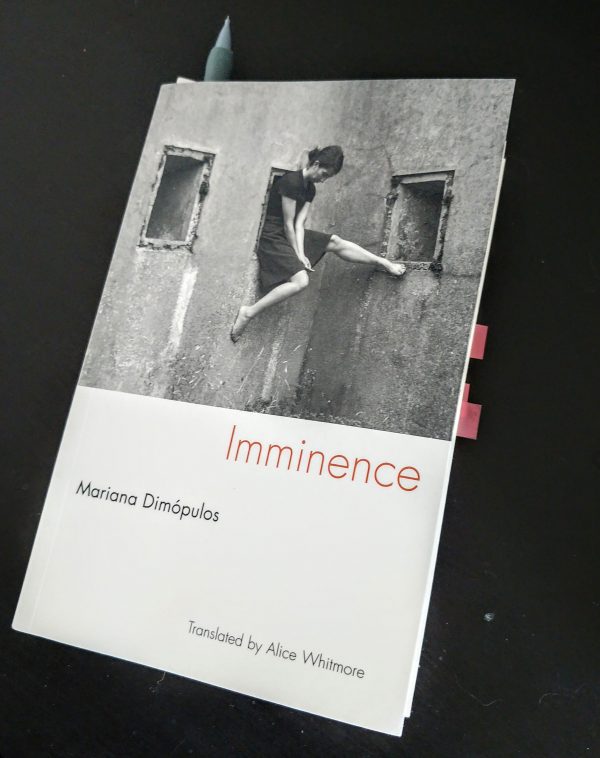
A second-hand melancholy: Imminence by Mariana Dimópulos

At the beginning of Argentinian writer Mariana Dimópulos’ unsettling novel Imminence, it is immediately evident that there is something oddly off-balance here—a softly-hued disconnect that instantly sets the tone for one of the most finely realized representations of what it feels like to be oddly out of step with the world around you. The narrator, alone for the first time with her infant son awkwardly reaches out to touch him. She strokes a foot and waits for something to stir inside her chest as she had been assured it would. Nothing. Her partner Ivan comes into the room and, for the moment, rescues her from any further responsibility. Relief.

She was, we soon learn, hospitalized for a month with a serious infection following the baby’s birth, so young Isaac has been attended to by Ivan, her sister, and the nurses up until this point when she is deemed well enough to venture home. She does not even know her child has been named until that first night in the apartment.  His Russian father has chosen his own grandfather’s name, an appellation sadly devoid of Spanish musicality. But that’s okay.

The story that unfolds—or to be more precise, unwinds—belongs to that first evening home from the hospital, and to another evening with strong and increasingly ominous echoes—the last with her pervious lover, Pedro. Woven in and out of her careful accounts of those two evenings, are a flow of memories tied to her past and a number of key people in her life. There is Celeste, the relative she comes to stay with when she moves into Buenos Aires from the smaller rural community of Los Flores in her teens, and her friends, Mara the actress, and Ludmilla who was tragically killed young. These are the women she tries to measure her own insecure sense of womanhood against. And then there are the men: Ivan and Pedro, of course, and the Cousin, a mysterious distant relative with whom she has an occasional sexual relationship—a manipulative, distasteful character with an uncanny sense of timing.

Her account is not chronological, she foreshadows and repeats herself as if slowly filling in a fluid, watery tapestry. There is a dreamlike quality to her stories that bounce off one another, gradually taking on greater shape and form. Her observations are strange, often almost mechanical as if existing in the world is not something that comes naturally. She tries to take her cues from others. Mara and Ludmilla are especially important as early role models:

They were masters of subtlety, and both possessed a scathing wit. And as the stars of the night I would feel a great admiration for the two of them, and I would swear alongside them the sacred oaths of their master plan: I would never get married; I would never cry a single tear over a man who didn’t deserve it; I would never have children, nor would I attend to any other such calls of nature, if indeed nature were ever to call.

As her story is gradually fleshed out, her differences become more explicit, and more intriguing. Socially she struggles. She is, it appears, truly unable to interact with reality, if there is such a thing, with the same ease others seem to demonstrate. Aware of this shortcoming, she has learned, as she puts it, to disappear “inside the parenthesis”. She cannot even recall when it first happened—as a child or as an adult in response to loss perhaps—but either way she has found a refuge, first in the comfort of numbers and if that fails, in a private ritual:

In order to pull off the trick, all I had to do was imagine a beautiful derivative. If that didn’t work, I would make a little ball out of a stocking or a scarf and place it where I imagined my stomach to be, then spin around on the floor or the bed and wait for a few seconds, and soon enough it would start working, and any feeling remotely like an emotion was swiftly eliminated.

This ability to push emotion aside, one that could well be deeply embedded in the narrator’s personality, is a double-edged sword. If it eased the trauma of Ludmilla’s death, or Celeste’s difficult final years; it impairs her resistance to the Cousin’s inappropriate attentions, and undoes her relationship with Pedro, an academic who had visions of a future she could not share. In close proximity to others, her capacity to “perform herself” tends to fall apart and she becomes the architect and the audience of her own misfortune, watching from the impassive default position she continues to fall back into.

But when Ivan unexpectedly comes into her life, the ground suddenly shits beneath her feet. She feels. Unprepared, she is secretly pleased at this thing stirring inside. However, he is a doctor, called back to Minsk at least temporarily, and she has to act fast on this rising tide:

I was triumphant: I made promises, I sent signals, I invested all my energy into calculating what Ivan was really trying to tell me, rummaging for the hidden meaning beneath every sentence, in a feverish kind of hermeneutics, trying to enthrall him, letting myself become enthralled.

Ivan does return, their relationship blossoms, and ultimately they are sitting over soup on this first night together as a family while their child sleeps in his cot. She and Pedro likewise had had soup for dinner on the night their relationship ended. Is the stage set for another repetition, like the many coincidental duplications our number-obsessed narrator has previously noted? As the trajectories of the two accounts at the core of this tale threaten to converge, the tone becomes increasingly measured, disturbed. Tensions rise.

Imminence is an exceptionally well crafted novel. The narrative winds forward and back in time, but never loses its focus. The compelling voice of the narrator is the key, the magic that pulls this work together. Translator Alice Whitmore allows the full beauty and the strangeness of her reminisces and reflections to come through. Lyrical, but odd, the narrative strikies a tone somewhere between that of  Fleur Jaeggy’s SS Prolterka and Max Frisch’s Homo Faber. Some may find her detachment difficult to forgive, but she herself is aware of a lack, a disconnect—a something that sets her apart from other people, especially women. She will frequently assert that she is not a woman, but this is not an indication of an inherent gender insecurity, so much as a failure to play by the normal rules of human engagement which, because she is female, she assumes are those of a woman. Yet, with less of a record to set straight than Jaeggy or Frisch’s protagonists, her story is one with many more undefined edges. This is not just a confession, but a sombre self-examination, a mess of complicated emotions muted, repressed and viewed through a haze of time and physical fatigue. And it is a narrative that holds you in its spell until the very end.

Imminence by Mariana Dimópulos is translated from the Spanish by Alice Whitmore, is published by Giramondo.

Chanelling memories through verse: Edwardsville by Heart by Kólá Túbòsún

So memory returns
of the many demons from
which hope had sprung
that brought me here,
for which the journey
into this promise of a life
was some act of fleeing,
to which America
was both a saving grace
and distance a respite
in shawl and shield.

— from “Stepping Out: at Cougar Village”

When a Fulbright Scholarship brought a young Nigerian student to the American Midwest in 2009, the culture (not to mention climate) shock must have been considerable. But linguist and writer Kólá Túbòsún survived his first winter and returned to the University of Southern Illinois Edwardsville to complete graduate studies between 2010 and 2012. The town, as he advises in the Preface to his first collection of poetry, was a place which was, in the time he lived there, an open and tolerant community, welcoming to refugees and immigrants from distant shores. However, the scars of colonial expansion and the after-effects of slavery were not that far behind, and, now, with a mistrust of the other on the rise, one can only wonder how that mood is shifting. But that is not the immediate concern of Edwardsville by Heart. This book is one man’s poetic journey back through a particular period in place and time, mediated by memory.

Although Túbòsún does describe his process of composition in the introduction, in the reading I had the impression that the experiences he recounts in this memoir/travelogue were recorded during his time Stateside. The poems, which cover early encounters with a strange environment, visits to local historical sites, and tales of friends, lovers and mentors all have the feel of a diary, a recording of events as they happened. But in truth only one or two were actually composed in America although the idea of somehow capturing his time there did percolate. These poems were written over a six-week period in 2017, while the poet’s wife was away and he was at home chasing after their toddler.  At last the memories he had carried with him could be sorted, developed, and given voice.

There is a sense in which this collection speaks to a very specific place, experienced with an outsider’s eye, and a student’s youthful enthusiasm. The image of America that comes through is a remarkably positive one. Did Túbòsún arrive at a sweet point, or is this an effect of the nostalgia of youth? The poems of the first section, “The Visitor” capture a sense of wide-eyed openness to a new environment and, as the quote above suggests, to the freedom—romantic and academic—that distance from home affords. But as the poet recalls his first months in the US, and his first encounters with winter cold (recalling practicing with a freezer back home in Nigeria) he does not shy away from the reality of the racial profiling he encounters, accepting it with a disarmingly casual tone.

When his circle of experience widens to encompass cities like St. Louis (the first visit being a visit to a hospital ER as unlicensed driver transporting an injured friend) the tension and threats of violence become more of a concern. Friends warn him to avoid the city, but it is difficult to deny a peculiar pull:

But E.B.R. lived there,
I thought. Redmond the poet
shuttled poetry from here,
black as Ethiopian coffee beans,
to Lagos and Ìbàdàn
in my undergraduate days, with
a smile on his oak-hued face,
a deep crack in the velvet
voice in which his verses rolled
into colours that rhymed
with grace, Civil Rights lore
in quartets of memory.

—from “East St. Louis”

Moving through poems that recall his times in the classroom, at house parties, on road trips with friends, Túbòsún negotiates a balance between African and American classmates and friends and there is a sharp sense that being away from home is part of a necessary process of coming into an ability to understand and articulate his own language and identity. As a student of linguistics it is only natural that this otherness shapes and informs his academic experiences. This process colours the third section “Teacher, Student,” witnessed for instance in a poem like “Being Yorùbá”:

How do you teach a state of being?
You don’t. You teach instead tone,
do-re-mi like music on the tongue,
and greetings and norms; clothing,
and where caps bend on the head;
dance moves to restless beats that
skilled bàtá drummers replay
when you taunt them with
a semblance of competence.

Later, as his travels and adventures take him further from his temporary American home, he finds that his Nigerianness not only informs his encounters, but cannot be escaped. He is always a visitor.

Edwardsville by Heart is a quiet, reflective book. The fact that this collection was, for the most part, birthed through the filter of temporal and geographic distance, the clarity of the memories preserved and presented is remarkable. Rather than muted details or blurred recollections, we are offered an uncluttered vision—emotionally contained and all the more powerful as a consequence. Strongly grounded in place, time and experience, these poems do not shy away from the brewing politics and social dynamics at play in the part of the American Midwest where the poet found himself. But above all it is, as Túbòsún himself admits, his Edwardsville. And he freely opens it to us with this, his first book.

Edwardsville by Heart by Kólá Túbòsún is published by Wisdom’s Bottom Press. 

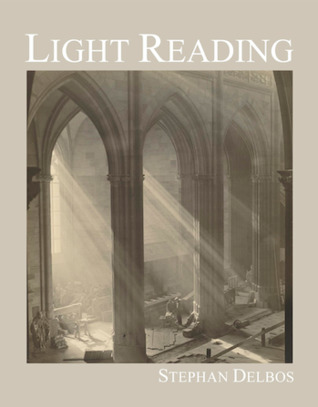
Opening space: Light Reading by Stephan Delbos

One of the pleasures of reading contemporary poetry is, for me, the varieties of experience allowed, and the ways each poet and each collection is unique. Most of the poets I read have come to my attention through social media, either via direct interaction, contact with translators, or as publications of publishers I trust. It is not that I don’t have time for classic poets, I have shelves full of poetry collections, but I’m most interested in calling attention, in my own modest way, to newer, short, single author volumes.

I came to know of Prague-based writer, Stephan Delbos several years ago when I read his co- translation of Czech surrealist poet Vítěslav Nezval’s The Absolute Gravedigger. But his first full-length collection, Light Reading is my first introduction to his own distinctive verse.

Delbos is a minimalist. Upon opening this handsomely presented volume, the first thing you notice is that placement is critical; words seem hang suspended in empty space. The word “light” in the title of the book and its first section, refers to both tone and openness. The poems are spare, often exceptionally so. One is simply a semi-colon, some a word or two, others a few scant stanzas, but in each instance, the words act in concert with a title set at the lower righthand corner of the page. It is the title that completes the image, renders the impact—offering insight, or humour, or both. Notes at the back of the book illuminate the sources of many of these pieces, adding another level of meaning. But to attempt reproduce any of these fleeting poems can be no more than an approximation given the limitations of  online space. Here are three:


.                                                                                 if only
.                                                                                 all life
.                                                                                 were so
.                                                                                 simple
                                                                               here
.                                                                                 hang
.                                                                                 your
                                                                               shells
                                                                               shadows
.                                                                                 shame


§.                                                                  §On Coatracks

*

.                                    impossibly

.                                                             yes


.                                                                                       §Luck

*

.                                                                              in tiny pieces
                                                                            tiny parts

.                                                                               i whose
.                                                                               bruises

.                                                                               broke pillows

.                                                                               sleep under
.                                                                               paper sheets


.                                                             §Fragments (Keepsake)

*

The poems of the second section, “Bagatelles for Typewriter,” take the form of poetic riffs on the French term meaning a “trifle,” typically associated with short musical compositions. Dedicated to a variety of figures—political, literary, philosophical, musical—paired with an instrument or two, these poems have the widest sweep, but the imagery is still spare, restrained, and carefully modulated. Here the poet pays tribute to Václav Havel, slips through the streets of Prague, and explores avenues filled with memories, sounds and language. These are the longest pieces in the collection, and yet few fill more than a single page and physical arrangement and space—or silence—is, as in the earlier section, an essential element, imbuing each composition with its own volume and rhythmic energy. Delbos, who has written plays about jazz trumpeter Chet Baker and Czech composer Bedřich Smetana, demonstrates an inherent musicality in these poetic bagatelles. Take, for example, the opening of “Bagatelle for Throat Singers, Baton & Player Piano”:

I am a terrible Buddhist
.                                                  my love you are a magnificent adversary
on the anniversary of
.                                                   our first nervous kiss on a sidewalk where
garbage cans held fish
                                                 -bones, failed ficuses, Orangina bottles,
our alcohol the pilot
                                                  light of love; this was supposed to be
about enlightenment,
.                                                    the impossible tightrope possibility.

The third and final part of Light Reading, “Arrangements,” consists of a series of ten sets of ten poetry prompts. The first of these begins:

      1. A poem in terza rima
      2. A poem of 18 lines
      3. A poem containing the phrase coin slot
      4. A poem rhyming beguile and tinfoil
      5. A poem with two mirrored meanings

while another (<V>) prescribes:

      1. A poem that cannot hear itself think
      2. A poem getting on my last nerve
      3. A poem huffing oxygen
      4. A poem title is the last line
      5. A poem with seven monorhymed lines
      6. A poem curing emphysema

In reading this collection I had the feeling that these poems, these condensed, precise evocations of the possibilities—and limitations of language—seemed to be coming into being on the page, speaking to ghosts, alluding to the unutterable, to the moment captured in the empty spaces. Unconfined, open-ended and illuminating, Light Reading is a work that leaves plenty of room for exploration. And enjoyment.

Light Reading by Stephan Delbos is published by Blaze Vox Books.

For whom do we hold our memories? Singer in the Night by Olja Savičević

Early in the wonderfully original Singer in the Night, the narrator asks:

And what’s left for death if you forget everything before it? Is there anything left to die? When things turn the wrong way round and oblivion precedes death instead of death oblivion?

Although the protagonist is under forty, such oblivion is a serious concern, one that plagues her daily. But it fails to dampen her spirit or her resolve to complete the mission she has set for herself as her brain becomes increasingly clouded.

And what a story she has to share while she still can!

If Olja Savičević’s debut novel, Farewell Cowboy combined an effervescent protagonist, spaghetti Westerns, and an unresolved adolescent suicide to create a powerful portrait of a contemporary reality in her native Split not featured in tourist brochures, her most recent effort, newly released from Istros Books, is even more eccentric—with a wider, more devastating aim. Born in 1974, Savičević  is seen to be part of what is often called, in the region, a “lost generation.” Growing up in Yugoslavia, she was part of a cohort taught to believe they belonged to one united country that was theirs to live in and love, that war was something consigned to history lessons. The notion they would ever see such conditions in their own lifetimes was unimaginable. But by the time these children of the 1970s reached early adulthood they had witnessed the brutal destruction of their nation through years of bloody conflict. Many had fought, willingly or otherwise, lost friends, deserted, or ended up migrating in search of better fortunes abroad. As they waited for life to return to some kind of fabled normalcy, they would live and love and try to build lives in the newly defined, divided and demoralized reality unfolding around them.

Singer in the Night opens with a letter from a certain Nightingale, an open missive addressed to all of his neighbours. It is a passionate evocation of the wonders of the street, city and country they share—Dinko Šimunović Street in Split, Croatia—and in it he indicates that he will be leaving.  The narrative that follows begins in a rather disoriented fashion, it will take a little while to get your bearings, but what is even more evident from the outset, is that the narrator herself is having difficulty keeping track of events, of past and present, and of the passage of time. She is given to more than a little dramatic recapitulation and ever seems to be backtracking to catch up with her own story. But it’s best to just sit back and see where the ride takes you. As reader you are in the hands of—or rather in the passenger seat of a gold Mazda convertible with—the gloriously eccentric Clementine, who is, she will tell you, an orange blonde, all glamour on the outside, but, “a black orange, inside. Full of hell.” And the letter writer named Nightingale, commonly known as Gale, is the object of her pursuit.

Clementine’s search for this man—her former husband—begins properly on Šimunović, a street located in district 3, a borough of high rises raised and designed under socialism, as yet  untouched in a city that presents itself to the world as a commercial seaside holiday resort. She herself had been lured away from that place and her first marriage years earlier by the promise of a more exciting life in Zagreb. She was already becoming known as a soap opera scriptwriter and, although her reputation grew in the capital, a comradely second marriage failed to kindle the sparks of romance of the unrivaled youthful passion she had once experienced with Gale. They had kept in touch, but over time, their contact had been reduced to the occasional text message and then, finally, silence. Returning now after experiencing a serious physical trauma, with an urgent desire to try to track him down, she finds that he has been gone for over a year. Apparently he had attempted to address a period of loud lovemaking that was disturbing his nighttime work on a commissioned cartoon strip with a comic campaign of letters. His neighbours, however, were not amused. They gathered the offending materials and called the police. There was no charge that could be laid, but it seems that a defeated Gale had decided to retreat. But to where?

While Clementine had achieved fame and fortune in the unlikely career of soap opera scriptwriter, providing distraction for the masses if you like, Gale had chosen a more political and far less lucrative artistic avenue for personal expression. He was in his ex-wife’s view, a “street poet,” a lyricist who started in a fairly conventional manner but craved a broader canvas for his verse:

They were interesting poems, authentic, but he felt that he needed a new means of expression, for him paper was slow, dull and uncommunicative, while the Internet is garrulous, polluted and cacophonous, those are places that don’t offer space for development, that’s what he thought. He wrote poems with a felt-tip on walls, by night, on peeling façades, in lifts, toilets, on rubbish skips, in subways. He drew. He discovered spray paint. An excellent concept, always fashionable, he liked spray.

Her Nightingale had become a graffiti artist.

Still moored at the marina in Split, Clementine finds the boat they had shared when they were together, and inside, a box containing copies of Gale’s letters. Each penned under a different, sometimes outrageous, identity, these missives will form the skeletal structure of the narrative that follows. They provide a series of cues to keep a narrator who is losing her memory on track. More or less. What is allowed to unfold is an unusual account of love, friendship and adventure that speaks volumes to the complicated dynamics of life in the former Yugoslavia. Savičević knows exactly what she is doing.

The former soap opera script writer records—and she is literally recording for fear of forgetting—her experiences and recollections in an idiosyncratic retrospective style, with frequent parenthetical asides and clarifications. The tone is quirky, conversational, and entertaining. After a brief stop at Gale’s mother’s home, Clementine’s journey into her uncertain future (and fading past) takes her to rural Bosnia, toward the home of Helanka, the striking completely hairless woman who was, for a time in youth, a close friend. They had met toward the end of the war when young people would gather, as young people do even in uneasy times, seeking fun and possible romance (or at least sex):

Today (twenty years ago) everyone is on the Quay and the Quay is everything. This is the first sun after the winter and every one avoids staying inside the town walls – the best cafés inside the walls are run by dykes, they hang together and get each other jobs – that’s the theory. They’ve found some way of coping with the half-people involved in protection rackets round the cafés. They are the only ones who can do that, survive, and they are probably used to everything in order to subsist, so thought Helanka, my friend who knew everything. (Everyone was a bit crazy for her and her freedom, and she also had an appearance that opened the doors of the marginalised and marginal groups to her.)

It through Helanka that she first meets Gale and, these two decades later, it is her hope that he may have passed by on his way to wherever he has gone.

When she arrives, it turns out that Helanka is away. Her daughters, nicknamed Billy Goat and Arrow, and the odd elderly couple keeping an eye on them, welcome her into their weird world while she waits for her friend’s return. As time goes on, it becomes unclear if our poor narrator has dropped the threads of her own story altogether.

The strength of this inventive novel lies its extraordinary characters and the opportunities they and their stories offer to speak to greater realities in the former Yugoslavia, sharply, but with wit and humour. Clementine sees her professional success against the issues of ethnic and cultural diversity. She notes the surprising benefit of soap operas to Croatian language preservation and promotion:

Without any ambition, we had achieved more for Croatian culture than the Ministry of Culture had over the previous twenty or so years. [Her producer] was truly triumphant. I was awarded a medal, the president presented it to me, there’s a photo. A critic in one of the daily newspapers, the same one who had coined ‘orangeade’, compared me to the great Croatian writer, Marija Jurić Zagorka, – he called me the serial Zagorka of our times. My saccharine passages became sentimental journeys, and pathos became the new emotionality.

Speaking through the characters—including a dog, God, and a ghost—to whom his letters are attributed, Gale is given the freedom to talk directly and bluntly. The lovers keeping the street awake at night are never his real target. They are his excuse. As a young man he fought in the war for a time and then, after a break to complete his schooling, deserted. Through the voice of  a veteran who remembers the ignominy of the war experience and vows to desert if another battle comes while he is still young enough to serve, he poetically sets forth a hope for the future:

At some stage, when school text books will contain the words There is nothing heroic about war, when newspapers publish headlines saying There is nothing heroic about war, when television announcers say There is nothing heroic about war, when generals come out in public with the military secret There is nothing heroic about war, when people proclaim from pulpits and minarets There is nothing heroic about war, when a war veteran whispers to his beloved as they lie naked as children There is nothing heroic, or romantic, about war, when directors produce a Hollywood film entitled There is nothing heroic about war (because a troop of fools in a real war come off better than a troop of wise men), then it really will be, after such a long time, important news.

And the soldiers will, willy-nilly, take off their boots and emerge from war, to carry on constructing a civilian life. Wherever they are.

The unusual occurrences that mark this journey toward oblivion, whether drawn from Clementine’s past or her slowly dissolving present, play out very different kind of drama on the page, one with echoes, often disturbing and surreal, of a past that can’t be buried or neatly laid to rest. By turns strange and exhilarating, tender and ultimately very sad, Singer in the Night is much more than an absurd adventure with a larger-than-life heroine desperately seeking her first husband as her memory is slipping into the distance behind her; it is a sharp, multi-faceted commentary on the world Olja Savičević and her contemporaries inherited. While the tale becomes increasingly distorted on one level, in Clementine’s account of the war, its immediate aftermath, and the confusions and divisions that persisted, a much deeper, darker reality sits. And the fact that she is losing her memory is more than a personal tragedy, it is symptomatic of a larger national and regional tragedy. For, in the words of George Santayana, so frequently paraphrased, Those who cannot remember the past are condemned to repeat it.

 Singer in the Night by Olja Savičević is translated by Celia Hawkesworth, and published by Istros Books.

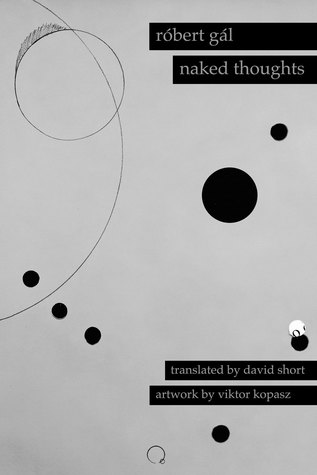
Given to thinking: Naked Thoughts by Róbert Gál

The impossible, until it proves possible, will always appear for a time to be wrong or inappropriate . The inappropriate, until it proves wrong, will always appear for a time to be possible. (XXII)

The aphorism is a literary form with a long history, reaching back to Classical philosophy. Over the centuries, the form—a sharp, memorable image speaking to some broader facticity—has appeared in literature, folklore, and scientific and political discourse. It is not enough to be witty and concise, an aphorism must also contain a truth, insight, or a piece of wisdom. It is much easier to describe than to create. But, for many, the aphorism, with a risk of appearing too clever or cliché, has no place in serious writing. What, then, is serious writing? Aphorisms, when well-crafted, hold a lasting appeal and, I would argue, that in a day when truths are suspect, the form is perhaps even more essential as an accessible opening for melancholy reflection.

And so, to my friend Róbert Gál. The Slovak writer has been proclaimed a modern master of the aphorism, a rather heavy mantle that he has worn with modesty for more than a decade. The form finds its way into all of his work, often providing more than a little poetic heavy lifting along the way. Now, with the release of Naked Thoughts from Black Sun Lit, Gál’s unadorned—yes, naked—gift for the form is on full display, presented against some of his idiosyncratic poetic prose.

Divided into five short sections, or three sets of numbered aphorisms set apart by two stylistically distinct interludes, Naked Thoughts begins, not unlike Gál’s recently released fictional work Agnomia, with the question of beginnings and endings. He appears to be setting a grounding principle—Life is a book of record, the first page of which is a stigma—and offering unsettling images of pathways, progress and temporal relativity. Toward the end of the long first entry he says: “To travel in time is pure recreation; to travel through space is an instinct born of a neurotic imbalance.” Where one finds oneself in the process of tracing the thoughts to follow, if in fact one finds oneself anywhere at all, is not prescribed.

While some of his ponderings in the “naked thoughts” segments are slightly longer, slipping into expected philosophical terrain, the brief—frequently sarcastic, wise, even beautiful—entries are, as one might expect, the ones that tend to stand out. These are aphorisms, after all:

He who seeks solutions has knots on his mind. (X)

The best school of life is a life misspent. (XXXIII)

To give life meaning means to make something of it deliberately—and thereby go against it. (XXXVIII)

Unspeaking silence supplies an act with its substance. (XLV)

or

Love is like scales at rest. It weighs nothing, but it carries weight. (LVIII)

The second and fourth sections, in contrast to the numbered aphorisms, are more poetic in form—in the first instance fragmentary, the latter primarily as a set of very short prose pieces—and yet, similar themes and ideas continue to percolate in these breaks. The first of these interludes, titled “in the bosom of indifferent virtues” which features an epigraph from Antonin Artaud, is perhaps the more curiously intriguing. It consists of three sets of fragments, some complete aphorisms, others incomplete thoughts, that have a subtle theatrical resonance. One begins:

She takes her dreams as the one thing that’s sure. And even though this certainty is not of negation, she does occasionally shake her head in doubt.

Within breaks in happiness.

Tacit contiguity.

He writes the terrible out of his system, she the beautiful out of hers.

The pros and cons of one con.

A failure is a first draft. And a first draft needs no motives.

This is a small book, a slender, pocket-sized volume, but it is not insubstantial. A thoughtfulness, an attentive sense of thinking out loud welcomes the reader into the meditative experience. Rhetorical inquiries, lexical truisms, wry musings, pointed barbs, and sly juxtapositions play out across the pages. Originally published in Slovak in 2014, translated by David Short, and featuring with the spare designs of Viktor Kopasz, this is the type of book that welcomes rereading, opening up fresh insights with each visit. Sometimes serious, sometimes light, Róbert Gál has the right feel and touch for this type of writing. His experience and comfort with the form is fully evident here in these “naked thoughts.” And, what is the harm in encouraging a little thinking? After all:

The only fear of one who is given to thinking is that he will see the light. (III)