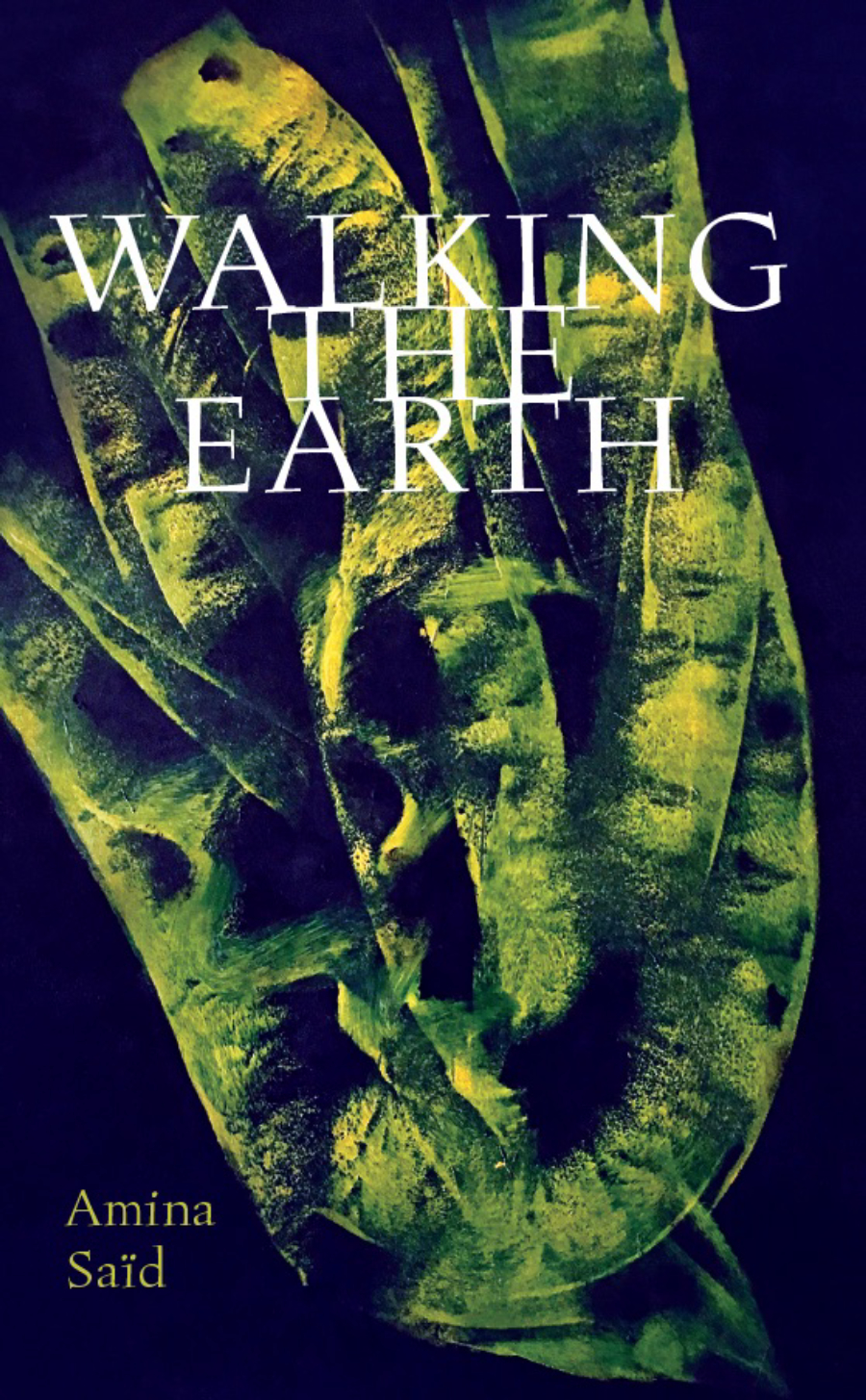
“in the nostalgia of a world / from before this world”:  Walking the Earth by Amina Saïd

all paths
lead to the same place
journey is illusion’s horseback

the world’s embers
blacken its wanton footstep

they burn
our anxious tongues

within its form
the poem seeks itself

Poems for wanderers, or the poem as a series of wandering, emergent forces, Walking the Earth by Amina Saïd hums with an intoxicating, primal energy that speaks to something fundamentally vital and human, in a sense that is too easily buried in the noise and chaos of our constantly plugged-in contemporary reality. Born in Tunisia in 1953, to a French mother and Tunisian father, Saïd was raised in both Arabic and French. At the age of sixteen she moved to Paris with her family where, when she entered university, she decided to study English literature so not to have to choose between her two native languages. Her poetic vision, however, draws on French and Arabic sources and the sunlit Mediterranean landscapes of her birthplace.

Today, Saïd can be considered, according to Hédi Abdel Jaouad, the author of the Preface present text, as the “most potent—and prolific—poetic voice in Tunisia today, if not in the whole of Francophone Africa.” Yet, until this point, no complete, single volume of her work has been made available in English. Now, thirty years after its original 1994 release, Walking the Earth (Marche sur la terre), in Peter Thompson’s translation, finally corrects this oversight.

This haunting sequence of poems, untitled and distinguished only occasionally by dedications, or by shifts in format or theme, has a hushed meditative quality reinforced by the poet’s spare, concise language, subdued and mystical tone, and the recurrence of common motifs. The world her speakers evoke is shaped by primordial elements in concert with journeys across a vast unformed terrain:

earth is this round dream

in its heart
stones fusing

their fire tongues
gouge the pathways of blood
where another fire burns

In her prefatory Note, Saïd writes that this, her seventh book, can be understood as a search for “place”—one that moves from the intimate to the universal—her own journey and that of many who pass through spaces “as much geographical as mental.” She is thinking of the displaced, those driven to move by war or disaster, but also the wanderer and traveller. Wandering is a theme of particular importance in Maghrebi (Northwest African) literature, and one that touches the poet, as someone who writes to hold an intermediary space between the Orient and the Occident, deeply:

My belonging to these two worlds both legitimizes the quest for place and generates a proliferation of doubles: shadows, voices, witnesses, angels, those who keep vigil. . .

This quest for place is born of a profound feeling of exile. Isn’t any creative person “exiled,” a nomad, an eternal wanderer seeking a place—a utopia, a place imaginary, impossible, dreamed of—which poetry can, with a sudden flaring, show in an unforeseeable image?

The quest that stretches across the pages of Walking the Earth is rich in mythological and archetypal images. The recurrence of specific motifs—light, darkness, stones, deserts, shorelines, blood, fire, tongues, voices, screams, silence—contributes to the cyclical feel of the work. Walking is an existential act while language and words are formative elements:

a voice recites
a voice despairs
the choir takes heart

a hand inscribes
ancient alphabets

the light awakens

As the sequence progresses, it becomes clear that the search for “place” is ultimately a search for meaning. The poem itself is the journey, even if the end is but another beginning. It is a path a reader can walk over and over again, and arrive at a different “place” each time.

the poem scents itself
with deepest night

I inscribe myself with sand and dust
in the nostalgia of a world
from before this world

I’m absent
from the mirror of the tribe

Walking the Earth by Amina Saïd is translated from the French by Peter Thompson with a Preface by Hédi Abdel Jaouad and published by Contra Mundum Press.

Poetry as an act of resistance: A River Dies of Thirst by Mahmoud Darwish

A great poet is one who makes me small when I write, and great when I read.

A River Dies of Thirst, the last volume of Mahmoud Darwish’s work to be released in Arabic, just eight months before his death in 2008, offers a precious opportunity to spend a little more time with a great poet as he casts a sorrowful eye at his beloved Palestine, and reflects on love, life, time, and memory. But more than anything this collection of poems, reflections, and journal fragments is a meditation on what it means to be a poet. And for him that is a distinctive vision, for Darwish was not only one of the most remarkable and humane poets of our time, but he gave  voice to the Palestinian consciousness and was someone who believed that “every beautiful poem is an act of resistance.”

To read this final collection now, more than eleven months into the longest, deadliest sustained attack on Palestinian citizens since the creation of the Israeli state, is to hear that voice of resistance resounding so clearly that it is almost unsettling. So many of the pieces here feel as if they could have been written yesterday, beginning with the opening poem “The girl/The scream”:

On the seashore is a girl, and the girl has a family
and the family has a house. And the house has two windows
      and a door.
And in the sea is a warship having fun
catching promenaders on the seashore:
Four, five, seven
fall down on the sand. And the girl is saved for a while
because a hazy hand
a divine hand of some sort helps her, so she calls out: ‘Father
Father! Let’s go home, the sea is not for people like us!’
Her father doesn’t answer, laid out on his shadow
windward of the sunset
blood in the palm trees, blood in the clouds

The girl becomes the endless scream, echoing without echo across the land, as an aircraft returns to bomb the house with two windows and a door, silencing her family’s story.

This heartbreaking  image is followed by a series of poems and short prose pieces that speak to war and Palestinian suffering in Lebanon, Gaza, and the West Bank. The uncanny timelessness of his poetry betrays the truth: there is nothing new about what we are witnessing today save for the intensity. And as Darwish reminds it, the violence is not just directed at people—it is an attack on the land, on nature, and the memory held in the soil. Consider the olive tree, the venerable grandmother-like figure, “modest mistress of the hillside.” She is spoken of with reverence: “In her restrained silvery greenness is a colour too shy to declare itself openly, a glance toward something beyond description, for she is neither green nor silver. She is the colour of peace, if peace needs a colour to distinguish it.” It is message lost on the occupying forces:

But these soldiers, these new soldiers, surround her with bulldozers and uproot her. They crush our grandmother, so that now her branches are in the earth and her roots in the air. She did not weep or shout, but one of her grandsons who witnessed the execution, threw a stone at a soldier and was martyred alongside her. When the soldiers left triumphantly, we buried him there, in the deep hole, our grandmother’s cradle. For some reason we were convinced that after a while he would become an olive tree, spiky and – green!

(from “The second olive tree”)

As a late work by a poet who is simultaneously conscious of his timelessness and his mortality, it feels as if Darwish is allowing himself to focus his attention on what is most important to him as he knows, not necessarily that his own end is as near as it would happen to be, but that time, and the heart, has its limits. As such, the themes that recur throughout these pieces reflect elements common to all his work, but are tinged with the melancholy that comes with age and a long life marked by exile and the ongoing occupation of his homeland.

Amid the poems that reference war and occupation directly—the more political pieces—are quieter reflections on the poetic existence, that is, on poetry as a way of being and engaging with world. Darwish is a poet immersed in his environment, the sights, scents and sounds all echoing longing and loss, but now the atmosphere evoked is more ephemeral, his awareness more attuned to the spaces between sleep and waking, in the flickering shadows where words might be found:

Leaves in summer whisper modestly, call out shyly, as if to me alone, stealing me away from the burden of material existence to a place of delicate radiance: there, behind the hills, and beyond the imagination, where the visible equals the invisible, I float outside myself in sunless light. After a short sleep like an awakening, or an awakening like a short sleep, the rustling of the trees restores me to myself, cleansed of misgivings and apprehensions.

(from “Rustling”)

There is also a more direct engagement with the idea of writing  poetry and recollections of his past encounters with other prominent poets, their conversations and interactions. And the two sections of fragments that round out this collection contain many wise observations about the  life, identity, perception and, of course, poetry.

With a total of 127 short pieces—including fully finished poems (both prose poems and verse), commentaries, and assorted observations and aphorisms—A River Dies of Thirst is a collection that may be best read slowly, taking in a little at a time. There is so much beauty in the language and so much to reflect on. It might also serve as a good introduction for those who have yet to hear Darwish’s masterful voice. And this certainly is the time to listen.

A River Dies of Thirst by Mahmoud Darwish is translated from the Arabic by Catherine Cobham and published by Archipelago Books.

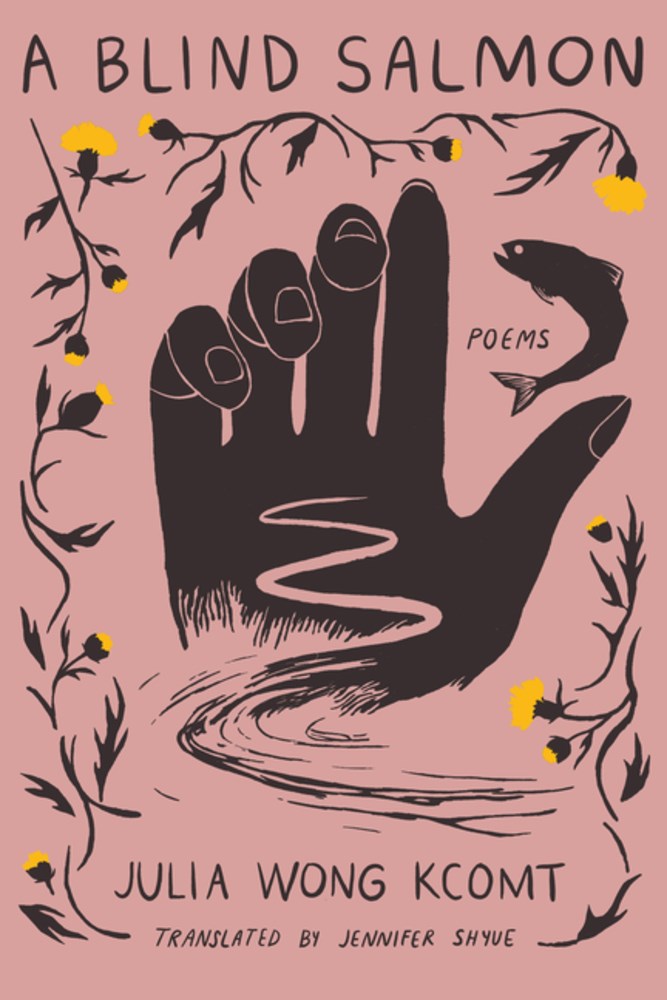
It’s so hard to be a stranger: A Blind Salmon by Julia Wong Kcomt

i looked into his low eyes
black, tired
i looked into his heart
and that splotch of vigor
made me
ephemeral, tardy, rancid, and fleeting

we arrive at the altar
in a state of absorption
i request a living offering
start to cough, phlegmy
till i’ve nearly smashed to pieces
at his feet

– from “opium weddings”

The poetry of Julia Wong Kcomt turns on the unexpected, crosses cultures, languages and borders, reflecting who she is, where she comes from and where she has travelled to and lived. Born into a Chinese-Peruvian (tusán) family in the desert city of Chépen, Peru, in 1965, she was a prolific writer whose work included eighteen books of poetry, along with a number books of fiction and hybrid prose. Questions of identity and belonging are central to her writing, as are themes of migration, motherhood, and the body.

A Blind Salmon, her sixth collection, originally published in 2008, is her first full-length work to be published in English translation. Translator Jennifer Shyue who has a particular interest in Asian-Peruvian writers, has been engaged with her and her poetry for several years making this volume a welcome introduction to an intriguing and important poetic voice. Sadly, however,  Kcomt did not live to see its release; she died in March of this year at the age of 59.

Composed while she was living in Buenos Aries, the poems in this dual-language collection, often involve a shift between languages—Kcomt was multilingual, speaking Spanish, English, German, and Portuguese—creating a challenge of sorts for Shyue, especially when the original contains English. This is handled with the use of an alternate sans serif typeface when appropriate, or by bringing Spanish into her English translation for the words or lines in English in the original, as in the poem “tijuana big margarita.” When German arises, it is left as is. This shifting linguistic terrain, like the sands of the region she comes from, adds texture and variation when they appear.

The poem “on sameness” which is repeated or echoed in the collection, is another wonderful example of the multilingual dynamic at play. The first appearance features Kcomt’s own English version of her poem “sobre la igualdad,” presented in two different typefaces on facing pages (the regular typeface and that which is used to denote English in the original). The wording is, naturally, identical. It opens:

in the circle, sweet circle
of intense immortality

where is my china?
the land with no owners
the face is not repeating itself

Later, when the poem is revisited, Kcomt’s Spanish original faces Shyue’s translation, which she made before reading the poet’s own translation (or at least refreshing her memory of a more distant encounter). The similarities and differences shine a light on the perspective a translator brings to her reading of another’s work—line by line and as a whole:

in the circle, sweet circle
of intense immortality

where my faraway chinese country stayed
the great country of all
where no faces repeat

This collection contains a mix of verse and narrative prose poems, the latter sometimes stretching on for three or more pages and offering a broader canvas for the exploration of identity and belonging, in some instances twice removed when set in Germany where Kcomt studied for a time. They address trying to find a home of some sort, balancing relationships, and finding invisible lines can be crossed in an instant as in “aunt emma doesn’t want to die” where the Asian-Latin American speaker, a foreign student, offends her elderly employer with her attraction to a man in a photo (“no looking, margarita. he’s not for you.”) and is forced to leave her home:

when i was moving out, you wouldn’t look at me. at  the geographic latitudes i’m from, we’re unfamiliar with that feeling, is it called ethnic guilt? perpetuation of folklore.

reiner was the forbidden fruit next to that tiger from kenya and you hated me because I took a bite that full-moon night as the children danced in costumes in the square.

[. . .]

and though i thought reiner would come looking for me or call me, that didn’t happen. not that it would have been necessary. his torso had imprinted on my groin. sometimes skin serves as a sort of reproduction.

in student housing i was once again surrounded by people like me. foreigners. it’s so hard to be stranger, to come from elsewhere, to fight, to steal, to do anything to get inside and the insiders throw you bait only to take it away.

The poems in A Blind Salmon seem to become increasingly charged with life and energy each time they are revisited. Kcomt’s speakers are bold and unapologetic, reaching out with language that is sensual, unexpected, unsettling. Her images are often startlingly corporeal, yet always touching the tender complexities of being in the world, a world that does not always no how to understand you, or you it, but one that is fully alive.

A Blind Salmon by Julia Wong Kcomt is translated from the Spanish by Jennifer Shyue and published by Deep Vellum/Phoneme Media.

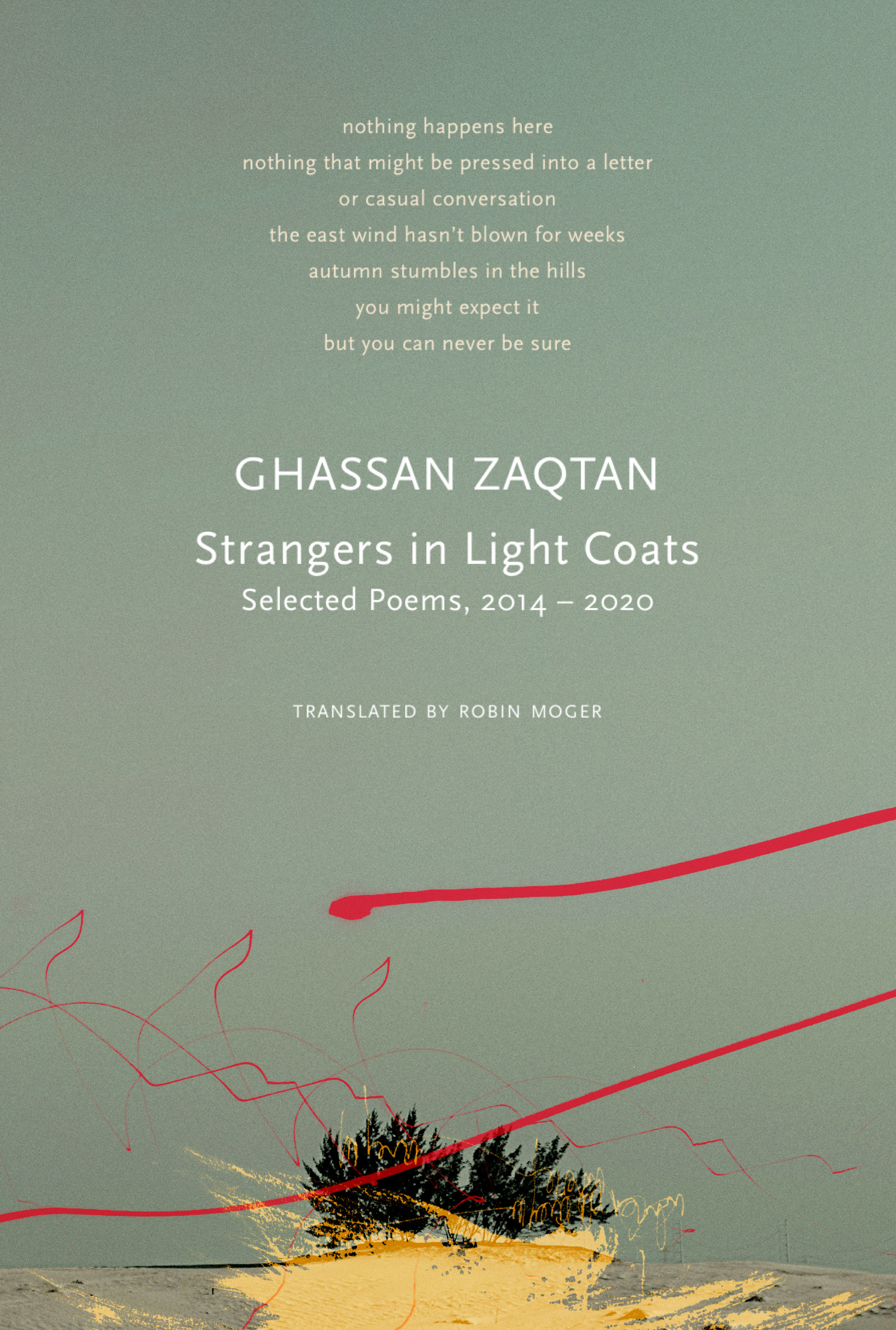
“There is something priming itself in these shadows” Strangers in Light Coats: Selected Poems, 2014 – 2020 by Ghassan Zaqtan

The wooden bell that hangs in the dark is struck.
Is struck.
No one sees it
but it is struck.
No one is there
and the bell is struck.

It is struck on the front porch of the dream and in its shadowed corridors.

There is something priming itself in these shadows.

There is someone waiting.

Natures that never made it past the line are being shaped in vain.

A blind creature walks on air and collides with butterflies.

(from “The wooden bell”)

The poetry of Ghassan Zaqtan elicits images that seem to emerge, take shape, shift, and evaporate on the page. As if deeply rooted in the soil, yet present only in passing, and in the memories they inspire.  His poems are home to rivers, birds, strangers, and ghosts of the dead. A chorus of voices rise and fall away. The Palestinian poet bears witness. To the spirit of his people, the beauty of his homeland, and the long history of displacement and conflict. But he does so with the same folkloric melancholy that characterizes his prose, the novellas that address political and personal loss through characters and settings that blur, to a greater or lesser extent, the boundary between fact and fable, myth and materiality.

Strangers in Light Coats, his latest collection to be published in English, gathers a selection of poems written between 2014 and 2020. Although drawn from work originally published in four volumes, Robin Moger’s sensitive translation presents the selected poems as a cohesive work divided into six sections. Together, they unfold against a backdrop of mountains and valleys, in a melancholic world shaped by memories, dreams, and the painful reality of occupation and war. His poems speak to lost lovers, reimagine a collective history that is fading, wonder about the fate of exiles, conjure up djinns, and call out to the forces of nature:

River, river,
soften your breeze
as the daughters wade the fords into the twin darknesses
of temptation and patience;
be still as the muezzin’s daughter crosses at the ford, be
as a carpet laid out for her by the birds
.  as she steps down, out of his voice,
    into the prayers and the dawn.

(from “The river hymn”)   (30)

War is an ever present motif, both as a remembered event, and as a possibility that is never far away. In the lull there is an abiding unease, the silence of waiting for something to happen or the inability to find silence at all, as in “It happened during the mountain war,” which tells of a man who is haunted by a memory that carries with it sounds, smells, and the sensation of the weight on his shoulders of “the body of a young man heavy with death”:

This happened in autumn,
during the mountain war that no one wants to remember,
the war in which many were killed
before it was covered over by other, more senseless wars,
the war which they, whenever they dug to bury it,
would find another war down there taking shape,
the war which was dropped from memories
like an eighth daughter who should have been a son.
In his solitude, even he would forget those weeks and push them aside.

This is a strangely beautiful and deeply unsettling collection. One that raises questions about what history and territoriality mean under occupation, in migration, in exile. Memory, imagined and reimagined through a mythic and elegiac landscape reaches for possible answers at a time when Palestine and the Palestinian people are facing ever increasing uncertainty.

Strangers in Light Coats: Selected Poems, 2014 – 2020 by Ghassan Zaqtan is translated from the Arabic by Robin Moger and published by Seagull Books.

“keep turning forever, circling round”: Shining Sheep by Ulrike Almut Sandig

.   i have the same number of words inside me
as all of you have words, the exact same number

but how many times can they be combined? you
keep finding words that no one sang before you.

.  your godhead made you after his own image
.   stark naked, blind—wild things that you are.

– from “The Silent Songs of the Walls: l”

German poet Ulrike Almut Sandig’s latest poetry collection, recently released in Karen Leeder’s translation, is the modestly titled Shining Sheep—modest, that is after her 2016 offering, which appeared in English in 2020 as I Am A Field Full of Rapeseed, Give Cover to Deer and Shine Like Thirteen Oil Paintings Laid One on Top of the Other— but it is by no means a more restrained effort. Rather, this new collection, originally published in German in 2022, is an especially dynamic, ambitious affair.

Several of the pieces here were commissioned for performances, films, or arose out of collaborations with fellow artists and musicians. This has been a hallmark of Sandig’s approach to poetry ever since her early days posting poems to lampposts and handing them out as flyers. But that collaborative, multi-instrumental quality is now more pronounced, not only through the visual presentation of the poems, often incorporating shaped or concrete poetry, but with the inclusion of links, where appropriate, to recordings and video performances that bring her poems to life off the page.

Opening with a single word, alone on a black page—“Lumière!”—Sandig’s poetry is a call to light, but one that resonates with a dark exuberance. She draws on a wide range of influences—German folk songs, writers, and history—to address political and social issues, never turning away from difficult subjects, like maternal depression and alcoholism, living with Covid, migration, and climate change.

just let that melt on your tongue:
shining sheep, genetically modified
as night storage for the dark hours

visible in satellite images as little ghosts
their delicate shimmer on the radar
seems to be made to lull

the oppressive darkness between
the great golden bulls of the cities
into a comforting gleam. 

– from “Climate change is here, now. But we are also here, now. And if we don’t act, who will?”

Along with poems that arise out of commissions and direct collaborations with other artists, Sandig is also at times writing in response to, or in conversation with the work of late German authors, filmmakers and poets, including Friedrich Hölderlin’s “Wie wenn am Feiertage” (“As When on Holidays,” 1800). Other pieces have their genesis in more immediate encounters outside the artistic community, past or present.

A particularly moving sequence, “Lamentations in VI Rounds,” arose, poet tells us, out of a chance connection with a young man from Afghanistan who contacted her after she accidentally left her bank card in a ticket machine on the Berlin underground. He and his large family were living in the city as failed asylum seekers. She stayed in contact with them and, from their stories, wrote a piece she called “Five Lamentations,” adding a sixth round for this final version after the Taliban took control of Kabul in 2021.

the little man inside my head, he had
a daughter. he loved the way she boiled
minced beef, the way she answered back.
he loved the wonder of her eftertherain in Omid.

Omid sold his daughter in exchange for the value
of a ticket to Germany. today she called him up.
she sounded like she was sitting in his ear.
the pear tree in the yard was doing fine.

Shining Sheep is Sandig’s third poetry collection to be released in English, and the most inventive and experimental to date. Her long-time translator, Karen Leeder, is well attuned to the nuances of her uniquely playful, yet melancholic verse, bringing this energy and adventurousness to the forefront here. For a taste Sandig’s poetry and performances(with Leeder’s subtitles where available), her YouTube channel is well worth a visit.

Shining Sheep by Ulrike Almut Sandig is translated from the German by Karen Leeder and published by Seagull Books.

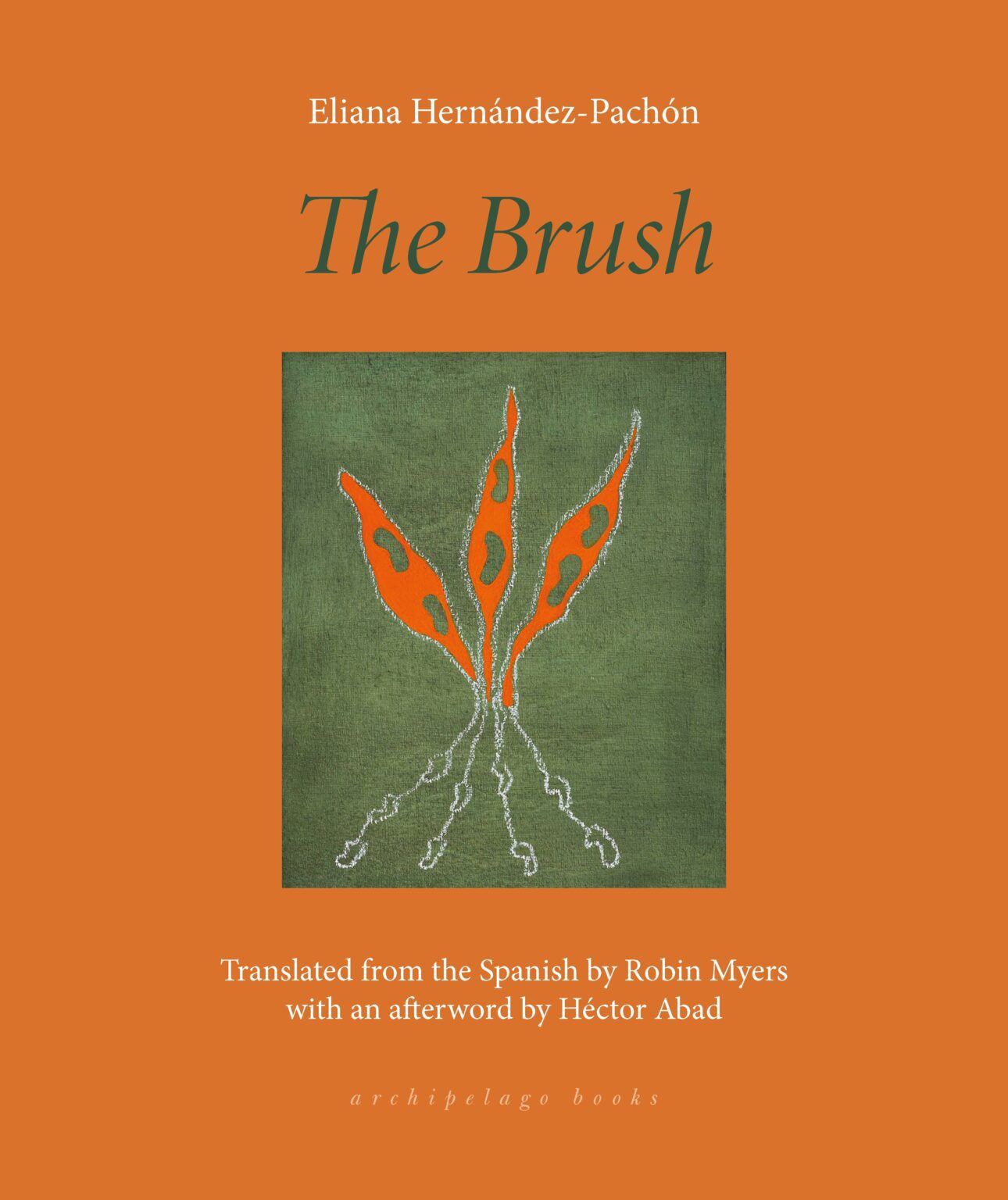
After the night, day breaks: The Brush by Eliana Hernández-Pachón

Pablo and Ester live in the hills. Their children are grown. Their lives are simple, bound to the land, but lately there have been signs, omens. Pablo is concerned:

For some time now
he’s felt a heavy change pressing the air,
and can’t explain it.
Like when
he walks through town at night,
and when he hears the animals
can’t sleep.

Sensing danger, he gathers some papers and items in a box and goes out to bury it while Ester sleeps. And then they come.

Between the 16th and the 21st of February, 2000, members of the United Self-Defense Forces of Colombia descended upon the Montes de Maria region and attacked the people:

During this incident, known as the Massacre of El Salado, paramilitary forces tortured, slashed, decapitated, and sexually assaulted the defenseless population, forcing their relatives and neighbors to watch the executions. Throughout, the militiamen played drums they found in the village cultural center and blasted music on speakers they took from people’s homes.

Sixty people were killed. The Colombian Marine Corps battalion charged with protecting the area was nowhere in sight—they had withdrawn the day before the massacre began. With The Brush, a taut work of narrative poetry, Colombian poet and educator Eliana Hernández-Pachón draws on the official 2009 report on the massacre to bring the story of this brutal event into focus in an unusual and affecting manner.

The tragedy of this horror exists on many levels—the unimaginable terror of the attack itself which was not an isolated event, the lingering trauma of the survivors, and the years of fighting for a formal apology and reparations from the government. As a story well-known within Colombia, the poet says in an interview that “if I was going to tell it anew, then I would need a new form.” Her approach is to pass the account on to several distinct characters or voices and allow these diverse perspectives to carry the varied layers of this tragedy.

The first of three sections belongs to Pablo who has reason to be worried about the growing tensions. He will not survive the attack. The second part belongs to the thoughts of Ester, his wife, in the days that follow. She wonders where Pablo is, what might have happened, heading out into the brush to try to find him. And then…

Crossing the glade, she sees
a shadow vanish
in a glimmer of undergrowth.
Hey! she shouts.
And the woman approaches warily
leading a little girl by the hand.
A whisper first, and now her clearer voice:
They did it to me with a knife, the woman says
and points to a mark on her arm.
They also did things
I can’t talk about.

Knowing it is unsafe to return, the two women and child are now forced to keep moving through the brush.

In the third section, the Brush—the dense, living forest vegetation—is granted it own direct, poetic voice. It is The Brush that stands as witness, to sights, sounds and sensations, from the crushing footfalls of the approaching militants and falling bodies in the town square, to the careful movement through the forest of survivors, and, finally, to the blossoms and blooms that will welcome those who eventually return.

In conversation with The Brush’s testimony, Hernández-Pachón engages input from The Investigators and The Witnesses. These perspectives, drawn from official sources, define and correct one another, while the Brush adds its own comments and clarifications. The human choruses are presented in prose, but even if the Witnesses’ offerings are more poetic in tone, both stand in sharp tonal contrast with the lyrical, omniscient voice of the Brush. The Brush, it turns out, can tell a tale of horror and grief that people, especially those who have been victimized, are often unable to fully articulate.

The questions still survive:
what does it think about, the brush, somnambulist,
after it’s seen it all?
The day that follows night returns
its artifice, the well-known
interlocking of the hours:
how is it that time didn’t stop,
why do the grain’s unopened eyes
keep growing?

A disconcerting calmness rests over this book-length sequence of poems that, in a mere 57 pages, manages to capture the contradictions and harmonies that arise in response to acts of extreme violence. That calmness serves to unsettle the reader and honour the survivors, while placing this event within a wider ecosystem and granting a voice to nature, the one force, perhaps, that can truly offer both understanding and healing.

The Brush by Eliana Hernández-Pachón with an Afterword by Héctor Abad is translated from the Spanish by Robin Myers and published by Archipelago Books.

When no words can be found: [. . .] by Fady Joudah

How will I go on living
with orchestras that conduct my thirst?
It’s been done before.
There are precedents, always will be,
and there will be Gaza after the dark times.
There will be gauze. And we will stand
indicted for not standing against the word
and our studies of the word
that dissect what ceases to be water.

– from “[. . .]” p. 16

When we talk about a literary work being timely, it often means that a piece from the past holds a new relevance in our current world. [. . .], Fady Joudah’s sixth poetry collection, is not simply timely in that sense, it is of this exact moment as it is occurring. Most of the poems here were written between October and December of 2023, during the first three months of Israel’s war against the Palestinians in Gaza. The grief, the anger, and the defiance is palpable. But so is faith in the persistence of love. And, in keeping with the explicitly wordless title of this volume, more than half of the poems share the same title—[. . .]—an expression, as Joudah indicates in an interview with Boris Dralyuk in The New Inquiry, of silence, silencing, and an invitation to listen “in silence to the Palestinian in their silence.”

Joudah is a Palestinian American poet, translator, and physician who lives in Houston, Texas. He draws on all of the facets of his identity, personal and professional, in his poetry, but from the earliest days of the current assault in Gaza he has also been called upon by certain American media outlets to provide the “Palestinian perspective,” even as many of his own family were being killed. Now that this new collection has been released, he continues to respond to interview requests, but the focus has shifted (and if not, he changes the venue).  One senses that it is important that he continually protect his very human ordinariness from a culture that wants “to hear and read me only as a voice in the aftermath of disaster and as a wound at that, not much more.” (Yale Review)

The poems in [. . .], composed, for the most part, during a condensed period of great political and emotional distress, carry an urgency that commands attention. Palestinians have long responded to the ongoing attacks and displacement they’ve endured for the past seventy-five years through poetry and prose, with the recurrence of the same images, themes and situations affecting a sort of echoing tradition. A piece written decades ago, feels like it was written yesterday. But over the last six months, as we’ve witnessed the intentional destruction of universities and libraries, and the targeted killing of potential record keepers—poets and journalists. Joudah’s response, to this intensified attempt at erasure is, like that of his contemporaries, to keep talking about what is happening, as it is happening.

When did the new war begin?

Whoever gets to write it most
Gets to erase it best.

The new war has been coming for a long time.
The old war has been going for a long time.

Coming to a body near me, and going on in my body.

– from “I Seem As If I Am: Ten Maqams, # 6”

Is it possible, then, to effectively answer genocide? The International Courts and a steady stream of horrifying images delivered straight to our phones do not seem to be making a significant difference. It seems that any formal declaration will only be made, as we’ve seen too many times before, long after the fact. But that is no reason to stop writing—and not just to document, but to be able to acknowledge the small moments of truth and beauty that keep hope alive:

In Gaza, a girl and her brother
rescued their fish
from the rubble of airstrikes. A miracle

its tiny bowl
didn’t shatter.

– from “[. . .]” p. 33

A review, especially of an important collection like this one, can only go so far. Joudah offers very interesting insights into his work that are worth seeking out. I have linked two interviews above, but others can be found, including a free online event as part of the Transnational Literature Series that I’m looking forward to on April 11, 2024.

[. . .] by Fady Joudah is published by Milkweed Editions.

Only in a poem can you bring back the dead: My Rivers by Faruk Šehić

On a windy August day, a poet walks a stretch of the French Atlantic shore. It’s Liberation Day and his thoughts turn to foreign troops landing on these beaches, in two World Wars, but he thinks especially of the frightened young American marines bound for Normandy:

Such men I would like to lead
into the ultimate battle, into the resurrection
of green grass beneath clear skies
without the salvos of heavy naval guns
without the screech of aeroplanes
or the confusion of anti-aircraft fire
without those shadowy submarines
like long Antarctic whales
seen from high flying planes
Fragile dandelion parachutes
would be all that would fall

This passage, from the long poem “Liberation Day” that opens Faruk Šehić’s four-part poetic cycle My Rivers, is more than one man’s musing on distant wars—Šehić has a much more immediate and lingering association with combat and its aftermath. He was born in Behić in 1970, and when war was declared in the newly independent Bosnia and Herzegovina in 1992, the then twenty-two year-old veterinary medicine student left his studies and volunteered for the army. He would end up leading a 130-man unit, an experience that has informed his novels and short stories, but in this collection of poetry Šehić turns his attention to the post-war condition, to the scars that don’t heal and the remembrances that are always incomplete.

The first two sections, “The Loire” and “The Spree,” find the poet/speaker in France and Germany. He seems to be looking to find—or perhaps lose—himself in the winds and the waves, in mythology and history, on the streets of Paris or Berlin, and in the arms of lovers. In France, Šehić often appeals to nature and to a larger cosmic sense of eternity, while in Berlin the mood is more claustrophobic and ultimately disheartening. He cannot find the escape he seeks, so his wandering takes him back home to Sarajevo, where the bones and ghosts of the dead cannot rest, where the long shadow of war is hard to avoid and must be confronted.

It is in the third part of My Rivers, “The Drina,” that any attempts at distraction or escape fall away. A sharp bitterness can no longer be hidden, as the poet admits that the bloody histories lurking within cannot be washed away by clinging to “literary reminiscences / with which  I stubbornly defend myself / with which we all stubbornly defend ourselves / from a non-metaphorical Bosnia / which gently murders us.” Gently murders us. The poems in this and the final section, “Beyond the Rivers,” are stark and powerful, shot through with flashes of anger and grief as the Šehić tries to find some understanding and relief from the burden he carries as a former soldier and survivor of war and genocide. Speaking for himself and his people, he recognizes the crippling human cost of conflict and dehumanization, but wonders how it can and should be remembered as evidence, even of a relatively recent past, seems to disappear under the façade of a return to “normal.” In several pieces he turns to the example of Buchenwald, questioning if it is even possible to honour the voices of the dead:

But yet again, nothing happens
The grass is worldly indifference
combed over their eyes
like holy green hair
A victim is a victim
with no language, forever
dead, the same body killed several times
with heavy machines, heavy
oblivion in primary, secondary, tertiary
mass graves and a dayless abyss

– from “A Glass Marble from Potočari”

Šehić’s verse is unadorned and direct. His message is not obtuse. In fact, in one piece, he openly questions the value of poetry and metaphor altogether. A weariness and despair is sometimes evident, as is a hope that in nature a certain redemption may be achieved, but the most powerful poems in this collection are fueled by honesty and anger. And, of course, it is impossible to read this work at this moment in time, when we are watching as the value of “Never Again” is once again being eroded, without remembering the many times that promise has been forsaken in the nearly eighty years since it was first proclaimed. 1995, as Šehić well knows, saw one of those incidents of genocide.

When I first went to Srebrenica
piercing  air thick as gelatine
I walked through a town that had moved
underground, with more stray dogs than people
on the streets, everything I saw
transformed into something else
A house here is not like other houses, here
the landlord is Death

This poem, “A Walk through Srebrenica,” chronicles the speaker’s encounters with a place silenced under the burden of history, yet offering some hope that it will not be forgotten:

The weight of my body carried here was a punishment
Yes, guilt is the air we exhale
No poem about Srebrenica will ever end, infinite
sadness is its subterranean hum
The heritage of our souls

First published in 2014 as Moje Rijeke, this is a profoundly moving and, so it would appear, timely collection. My Rivers by Faruk Šehić is translated from the Bosnian by S.D. Curtis and published by Istros Books.

Even the birds have gone away: Nostalgia Doesn’t Flow Away Like Riverwater by Irma Pineda

A drop of salt on paper
is silence killing us
Where have your footsteps taken you?
In what corner of the world
.                                  do they hear your laughter?
What shard of earth drinks your tears?

– from “A drop of salt on paper”

****

I traveled the path from the south
my feet blistered with memories
so tired from dragging
all my people’s dreams

– from “I travelled the path from the south”

The migration conversation, in various formulations, is occurring in countries and communities around the globe. Migrant workers are needed to do jobs no one else wants, but the migrants themselves are viewed with suspicion and worse; foreign students and the higher tuitions they can be charged are courted, but when they arrive they are blamed for housing shortages; and refugees fleeing war, famine and persecution—well, nobody really wants them at all it seems. But what about those who see no other option for themselves and their families than to seek opportunities abroad even if it means facing precarious, illegal conditions, torn from the land that they love, fueled by the hope that they will someday be able to go home again? And what about those who stay behind, holding onto tradition, waiting for the absent worker to return?

Nostalgia Doesn’t Flow Away Like Riverwater, a three-part sequence of poems by Indigenous Latin American poet Irma Pineda, breathes life into the painful situation in which many people in her own hometown of Juchitán, Oaxaca, have found themselves over the years. Pineda publishes her poems bilingually, in Didxazá, the language of the Binnizá (Isthmus Zapotec) people, and Spanish. She describes these two versions as “mirror poems.” In this collection, translator Wendy Call who has been translating Pineda’s work for many years, draws from both languages, with the close support of the poet herself, to create English translations. As she describes in her introductory essay, there are certain features of English that are closer to Didxazá than Spanish is, allowing her to reflect some qualities that cannot be maintained between the two original versions. The result is a simmering trilingual collection that offers even an unilingual Anglophone reader the opportunity explore and compare the very different appearance and tones of the poems as they appear in the three languages.

The poems in Nostalgia Doesn’t Flow Away Like River Water are divided into three sections of twelve poems each. They are “persona poems,” carrying the voices of two fictional characters from the poet’s hometown of Juchitán—one who has travelled north to the United States looking for work as an undocumented labourer, and their partner who has stayed behind. The poems speak to the impact of ecological pressures, climate change and pollution on the local fishing industry, as a main driver of migrants, men and youth, out of the community, leaving those who stay to try to hold on to their traditions for future generations and for those they hope might return. As Pineda explained to Call, “I create poetry as a way to keep collective memory of my culture alive and to reflect on what is happening to our culture. When I say ‘our culture,’ of course I’m also referring to the earth and the sea.” The river, the sea and the soil all feature in these poems, as do references to Isthmus Zapotec legends and stories.

The first part of this work, MY HEART IN TWO / Chupa ladzidua’ / Dos mi corazon, chronicles the migrating partner’s decision to leave. The reluctance to leave and sadness of those who must let a loved one go is palpable. The inevitability of homesickness is understood from the first poem onward:

Pack your suitcase well
leave the pain here
.                I will take good care of it
leave the nostalgia
.                so it won’t make you sick once you are there

– from “The Suitcase”

At the same time, the uncertainty of the fate that lies ahead of the departing partner weighs heavily:

Doubt wounds me
not knowing which rocks
I must stumble over
not knowing which paths lead
to my destiny
no way to stare
my future in the face

– from “Doubt”

The closing poems of the first section see the migrant departing before daybreak to make it easier on themselves and those who must stay behind. Part II, ON THE PATH / Lu neza / Sobre el camino chronicles the journey north while the character remaining behind speaks of the forces that have led so many to leave and the changed face of the village:

Where did its lifeblood go?
Did its unbearable silence scare away
the dogs?
There are no children in the street,
not even the robbers prowling the roofs
Even the birds have gone away…

– from “The houses of your village have eyes”

In the pieces in this central sequence the sense of absence and distance becomes increasingly evident. Far away from all they have known and loved, the feeling of homelessness and alienation settles on the migrant:

I don’t know which hurts us more
the misfortunes we left behind
or those we find here
becoming invisible
no one looks into my black eyes
no one hears the songs on my tongue
is my brown skin transparent?

– from “Many full moons have passed”

If the second part is transitional in relationship to place and form—somewhat direct and contained—the third, THE DAY WILL COME / Zedandá tí dxi / Un dia llegará, is intense in emotion and energy, similar to the first but more so. The longing is more desperate, tears flow freely, at home and abroad, and the migrant worries that if they are ever able to return will they be forever ruined by their experience in the north. Yet, for the partner waiting back home in southern Mexico, there is no question that welcome awaits no matter the circumstances. Nostalgia is a force pulling on both sides, a desire to be together where they belong is strong:

             You will return to me
lugging your heavy bags
in clothes woven of pain
and words carried from the other side
You will return with strange rhythms
unrecognizable thoughts
I won’t hold fear in my hands
but rather my heart’s song

– from “The days won’t end”

Nostalgia Doesn’t Flow Away Like Riverwater is a very special collection that lays bare the painful decisions that migrants face and the risks they take to provide a better future for their families, while exposing the sacrifices made by those who stay behind. By publishing her poetry in her native tongue, Didxazá, and in Spanish, Pineda is not only writing of and for the Binnizá (Isthmus Zapotec) people, but inviting others to hear their stories. Now with this trilingual edition, English language readers have the ability to appreciate this vital poetic conversation at a time when we need to be listening to the voices of others more than ever.

Nostalgia Doesn’t Flow Away Like Riverwater / Xilase qui rié di’ sicasi rié nisa guiigu’ / La nostalgia no se marcha como el agua de los ríos by Irma Pineda in Didxazá (Isthmus Zapotec) and Spanish with English translations by Wendy Call is published by Deep Vellum & Phoneme Media.

My laughter doesn’t go unvoiced: Like to the Lark by Stuart Barnes

It has been six years since I first read Australian poet Stuart Barnes’ debut poetry collection, Glasshouses. I don’t know how many times I have recommended the book in the meantime—whenever someone asks for suggestions of contemporary poets doing original work with form, or someone inspired by pop music, his is the first name that comes to mind. And now, with his second collection, Like to the Lark, he is continuing to expand the idea of form, exploring what it can do and where it can carry him. Ever open to queering the expectations of rhythm and rhyme, it is always exhilarating to engage with his poems—so much so, in fact, that one might not immediately appreciate just how much sorrow, grief and anger has led to the shaping of some of these words.

As with Glasshouses, Barnes is generous with notes acknowledging the poets, artists and resources with which he is in conversation in particular poems, but in this new collection he has also included a very informative section titled “Notes on Form” within which he talks about the forms he employs, including two of his own creation, and some of the relevant context and inspiration guiding his work. He opens by addressing what form means for him:

Like to the Lark’s working title was ‘Form & Function’, after Photek’s drum & bass record of the same name. Music and sound, form and transformation underpin the collection; its cornerstone is the sonnet (‘from Italian sonetto, “little song,” from Latin sonus “sound”’). ‘Form’, writes Felicity Plunkett, ‘is concerned with de- and re-arranging, working between what has gone and what is to come. It is about connection and generation.’ Form is Gwen Harwood’s ‘trellis’ and ‘fine pumpkins’. It is stave and symphony, wooden last and Ferragamo Rainbow Sandal, scaffold and Golden Gate Bridge. Every form flaunts its uniform, kaleidoscopic or otherwise.

Form, then, is not simply looking back to classic constructions. Even though Barnes’ first love and trusted space is the sonnet, he enthusiastically embraces both traditional and recent structural creations to erect the scaffolding within which he can seek to find expression.

Like to the Lark, which takes its name from Shakespeare’s “Sonnet 29,” opens and closes with ghazals that speak to the state of the world, in politics and nature. The poems in between often draw heavily on ecological imagery, but this is not imply that he believes poetry, especially in its formal variants, is necessarily bound to lofty romantic or natural themes. By contrast, he often delights in unlikely sources for his most traditional offerings. For example, he salvages material from consumer information for migraine and depression medication to craft sonnets (something he has done before) and engages in vigorous wordplay to create prose poems. Inspiration can be found in gritty pop culture motifs or a scroll through GRINDR. But such playful exercises mix with pieces that are, in turn, serious, bold, sentimental and vulnerable. As ever, the true power of Barnes’ poetry lies in the way form, subject matter and the influence of musicians and other poets intersect in his work.

Barnes has addressed life as a gay man and the reality of homophobia before, but Like to the Lark directly confronts issues that are not always welcome, even in queer poetry, such as the stigma of HIV/AIDS, grief and loss, and his personal experiences of rape. “Sestina: Rape” (which dispenses with the sestina’s traditional six end-words in favour of one word—rape—and words that are its true rhyme) is honest and angry: “No such thing as male rape / flared. No rape report, no rape / kit. When I spilt the pith of this rape / three sweethearts laughed in my face.” He admits that he bent the sestina’s strict six-word repetition pattern in an effort to try to desensitize himself to one especially painful word. It’s a practice he repeats with “Pain” and “Love” in a couple of other sestinas.

Given the intensity of emotion he wishes to express with respect to these difficult subjects, it is no surprise that the two original forms Barnes introduces in this collection, also appear in gay themed poems. The terse-set, a pun on the tercet, is composed of at least three tercets with a strict ABC rhyme, but each line is restricted to three syllables. The forced precision is playful but intense, ideal for the poems “Sketching Aids” and “Dinner with S. M. at Tandoori Den.” Both involve the same man, an ex-boyfriend, the first inspired by memories of their relationship in high school, the latter recounting a dinner years later, prior to his death from AIDS. The other new form, he calls a flashbang. This explosive, disorienting form appears in a poem called “Killing Bill or Whatever the Hell His Name Is (Battle Without Honour or Humanity),” that depicts the cruel reaction an HIV+ man receives from a lover. The first half erupts on the page (as best it can be reproduced here):

No one expected the second coming
out

—a burst rubber, a premature
BOOM!

PEP, you echoed. I’ll drive you to the local
clinic

first thing in the
morning.

His speechlessness a stun
grenade,

ignored calls
blast

mines. Minutes
later,

GRINDR’s miss-
iles.

Barnes writes that he was encouraged to invent new forms of his own through the experience of working with the duplex form created by American poet Jericho Brown. Described by Brown as “a ghazal that is also a sonnet that is also a blues poem,” the duplex seems a perfect fit for Barnes’ natural energies, allowing him plenty of room to riff on meanings and engage in punning and wordplay. Like to The Lark includes eight duplexes, with serious, fanciful and ecological themes. Four are voiced by native Australian plants such as Eremophila ‘Blue Horizon’ which opens:

I’ve always adored the deft desert,
its transformative blues and solitude.

I transform the bluesy solitude
of winter—I polish small gold trumpets

—gold tinted blue tongues polish off my trumpets
I raise my hands—lanceolate and blue.

New to the duplex myself, I really enjoyed these pieces. The other form that I particularly love in Barnes’ hands, is the terminal, an invention of Australian poet John Tranter that takes the end word of each line of a source poem to generate a new poetic creation. Here Barnes’ love for one of his key muses, Sylvia Plath, is reflected in two of his terminals. “The Pardoner” which borrows end-words and inspiration from her “The Jailer” is another poem addressing the poet’s experience with date rape, while the vivid “From the Morning” takes its end-words from Plath’s “The Swarm” and its title from a song by Nick Drake. Along with Plath and Drake, Barnes is, as usual, engaged in conversation with other poets including Shakespeare, Yeats, Auden and Gwen Harwood, and musicians including The Smiths, Kate Bush and, another important muse, The Cure’s Robert Smith.

The work of a mature and confident poet, Like to the Lark has me, as someone with little formal understanding of poetry, excited about the possibilities of—and less intimidated by—form. To the untrained reader and casual poet, it is easy to feel anxious about what makes a poem good, especially when caught between those who embrace and those disparage strict adherence to classical forms. But reading Stuart Barnes is proof that a poem can follow (or invent) rules without being unnecessarily opaque. Rather, poetry can be both fun and profound and, even better, inspire one to acquaint or reacquaint oneself with the inspirations that surface between (or at the end of) the lines.

Like to the Lark by Stuart Barnes is published by Upswell Publishing.