Looking back at a year of reading: 2024 edition

Each year when I review the list of books that I have read, I face the same challenge deciding what to include and what to leave out of a final accounting. As usual there are the books that I know, even as I am reading them, will be among my favourites for the year. Just as I know the ones I don’t like, the ones I won’t even mention or take the time to review. Basically, everything else that I have reviewed, was a good book.

This year, my count far exceeds a respectable “top ten” or “baker’s dozen” and there are some striking factors at play. One is that the ongoing  violence in Gaza has heightened my focus on Palestinian and Arabic language literature—long an area of interest and concern. Five of the Palestinian themed books I read made my year end list. As well, I have paired several titles, typically by the same author or otherwise connected, because the reading of one inspired and was enhanced by the reading of the other (not to mention that such pairings allow me to expand my list). Finally, as reflected by my top books, I read and loved more longer works of fiction this year than usual (for me). No 1000 page tomes yet, but perhaps I’m overcoming some of my long book anxiety.

And so on to the books.

Poetry:
I read far more poetry than I review, but this year I wanted to call attention to four titles.
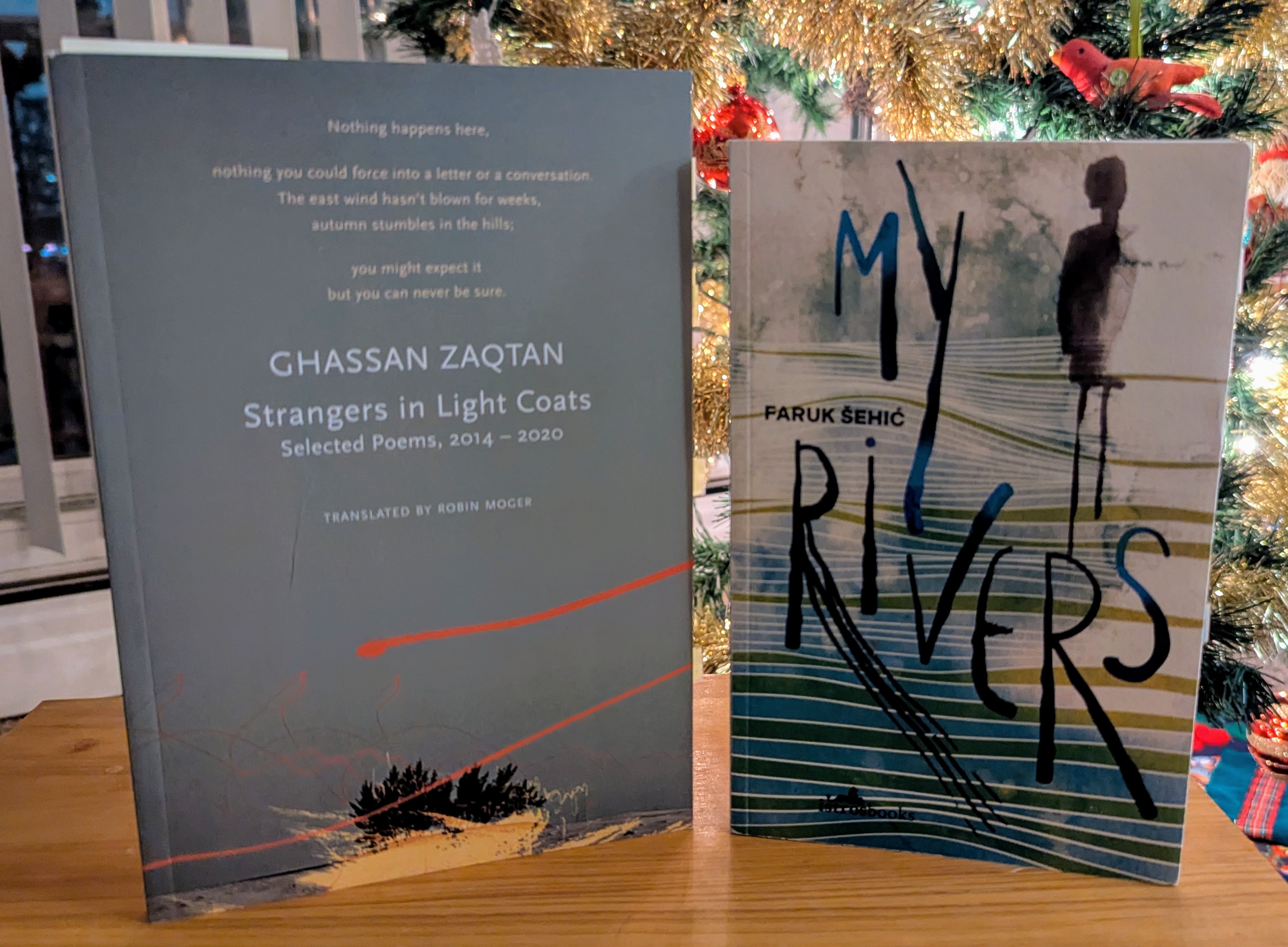
Strangers in Light Coatsevokes by Palestinian poet Ghassan Zaqtan (Arabic, translated by Robin Moger/Seagull Books) is, perhaps, a darker than his earlier collections. Comprised as it is, of poems from recent releases, it actively portrays a world shaped by the reality of decades of occupation and war.

My Rivers by Faruk Šehić (Bosnian, translated by S.D. Curtis/Istros Books) is a collection particularly powerful for its depiction of a legacy of wars in Bosnia/Herzegovina including the genocide in Srebrenica. His speakers carry the burden of history.
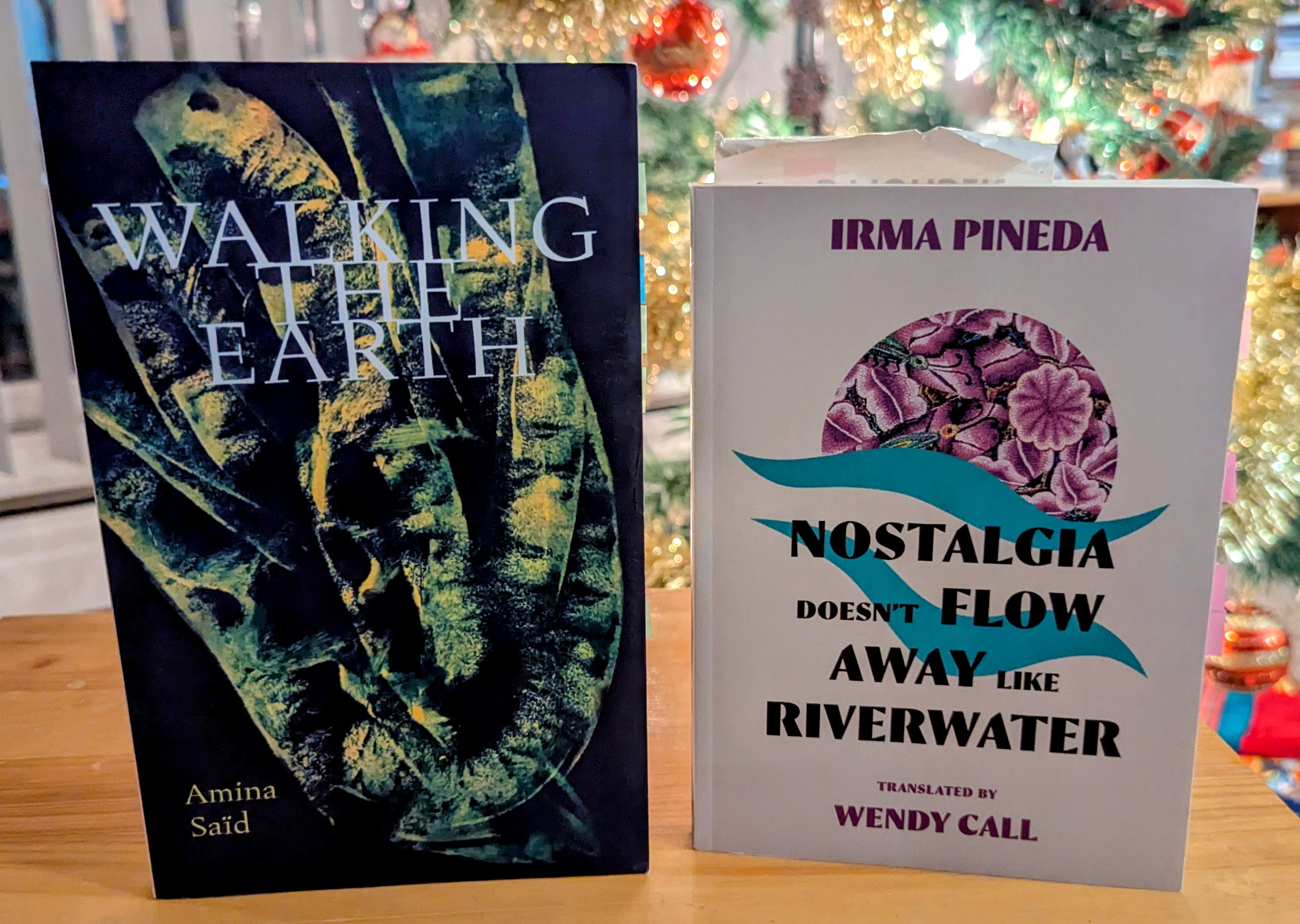
Walking the Earth by Tunisian-French poet Amina Saïd (French, translated by Peter Thompson/Contra Mundum) is such a haunting work of primal beauty that I can’t understand why more of her poetry has not been published in English. Perhaps that will change.

Nostalgia Doesn’t Flow Away Like Rainwater by Irma Pineda is one of a number of small Latin American poetry collection from poets and communities that have not been published in English before. This book, a trilingual collection in Didxazá (Isthmus Zapotec) and Spanish with English translations by Wendy Call (Deep Vellum & Phoneme Media) was particularly special.


Nonfiction:
This year, my favourites include a mix of memoir and essay and a couple of works that defy simple classification.
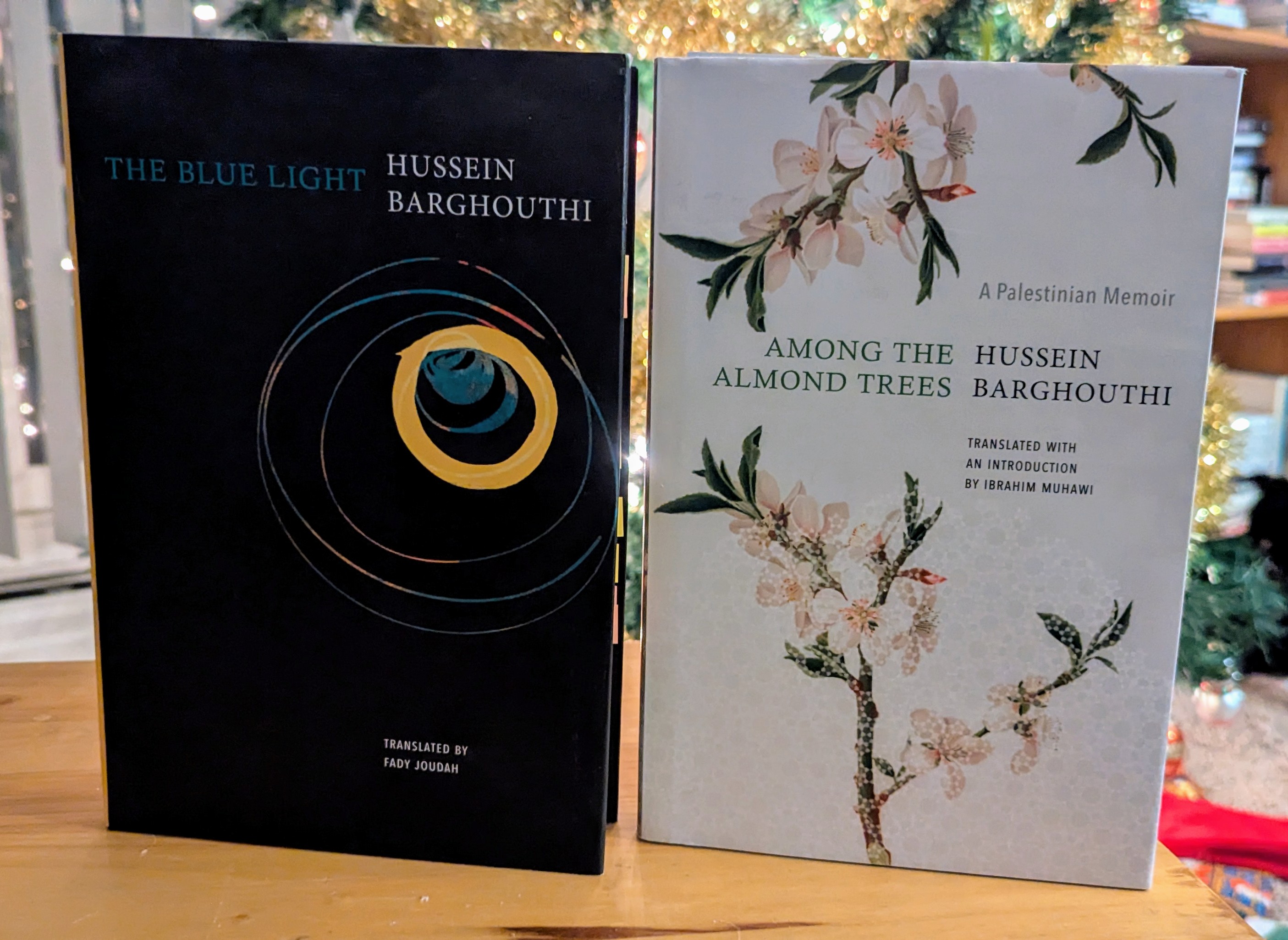
The Blue Light / Among the Almond Trees by Palestinian writer Hussein Barghouthi (Arabic, translated by Fady Joudah and Ibrahim Muhawi respectively/Seagull). Blue Light chronicles Barghouthi’s years in Seattle as a grad student and the eccentric circles he travelled in, whereas Among the Almond Trees is a much more sombre work written when he knew he was dying of cancer. The two books complement each other beautifully.
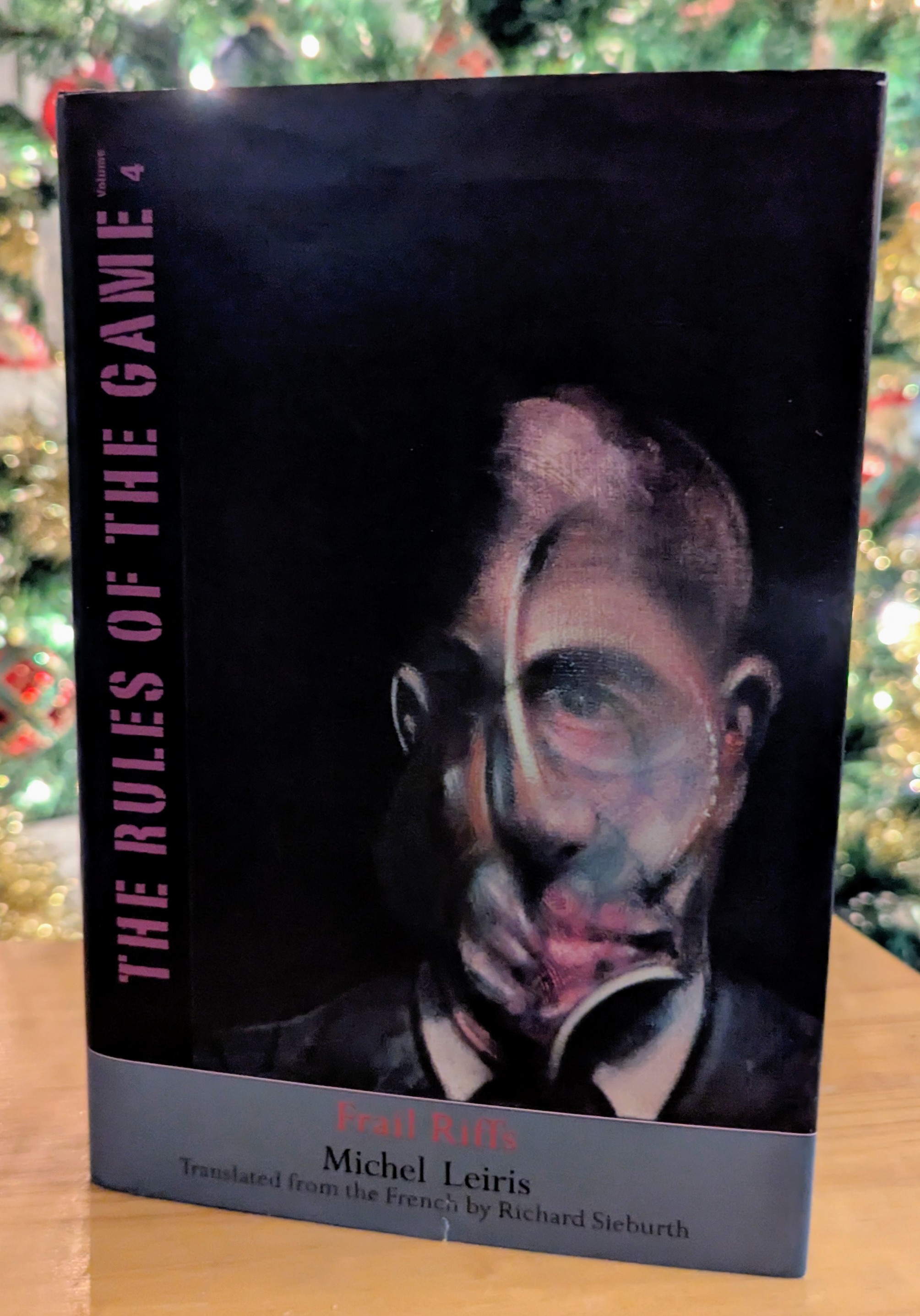
French intellectual, critic, ethnographer and autobiographical essayist Michel Leiris is a writer who means so much to me that the occasion of the release of Frail Riffs (Yale University), the fourth and final volume of his Rules of the Game in Richard Sieburth‘s translation, was not only an excuse to pitch a review but an invitation to revisit the earlier volumes. Definitely a highlight.
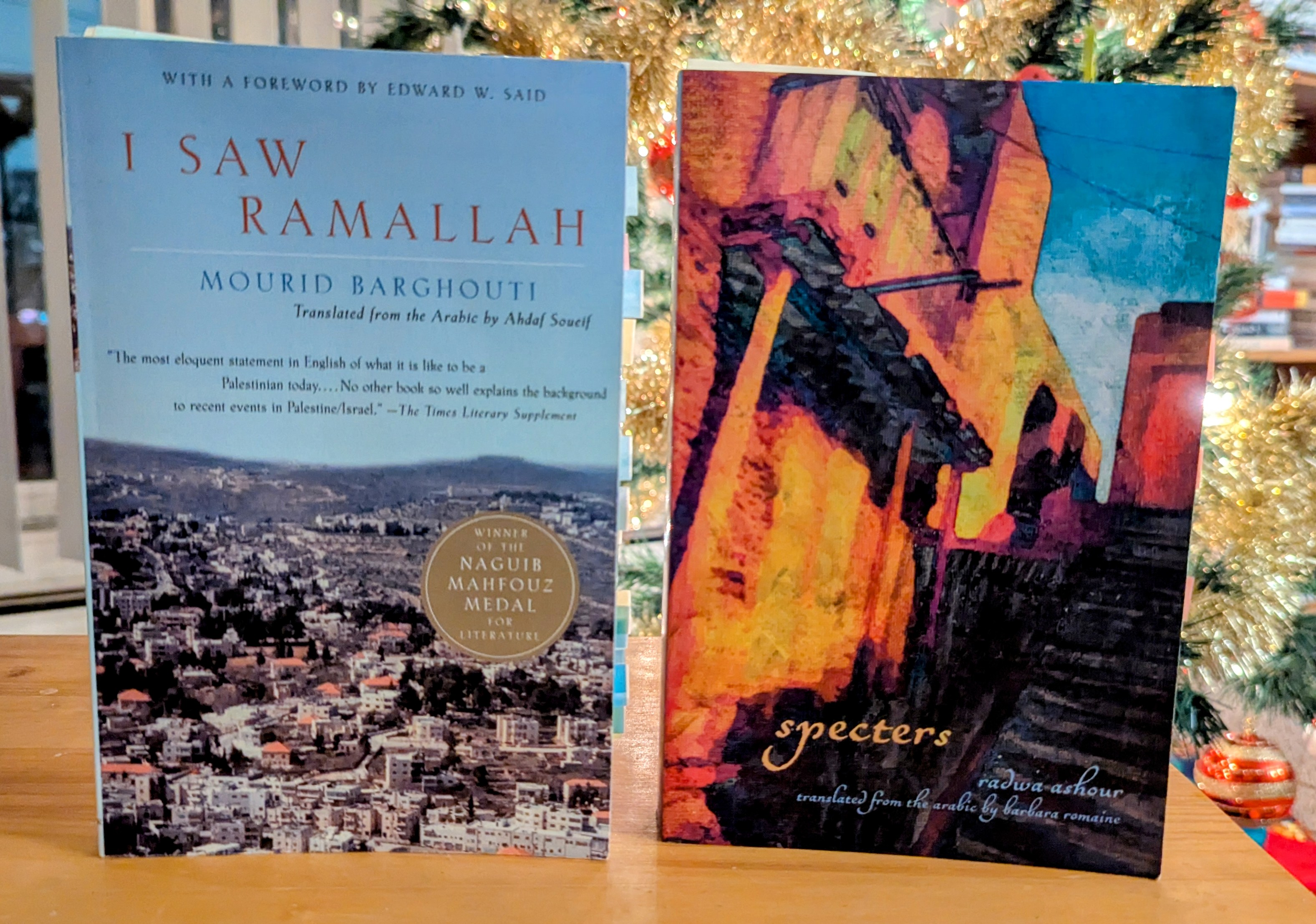
I Saw Ramallah by Mourid Barghouti (Palestinian/Arabic, translated by Ahdaf Soueif/Anchor Books) is a moving memoir detailing the author’s return to his homeland after thirty years of exile. Reading it reminded me that I had a copy of Scepters by his wife, Egyptian novelist Radwa Ashour (Arabic, translated by Barbara Romaine/Interlink Books). This ambitious work blends fiction, history, memoir, and metafiction and I absolutely loved it, but my decision to include it here, like this, rests on the memoir element which complements her husband’s in its account of the many years he was exiled from Egypt—a double exile for him—especially the years in which she travelled back and forth with their young son to visit him while he was living in Hungary.
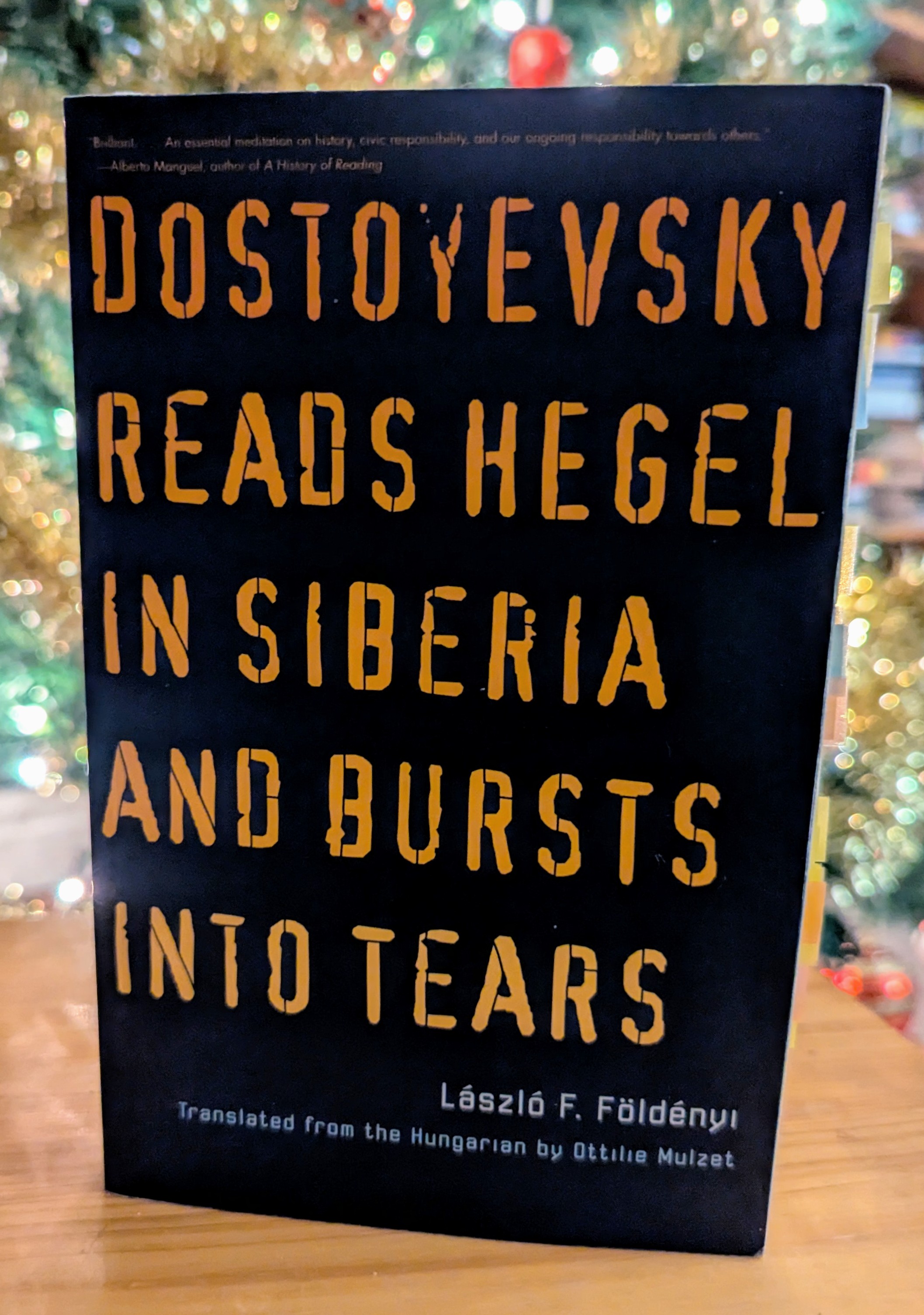
Candidate for the book with the best title, perhaps ever, Dostoyevsky Reads Hegel in Siberia and Bursts into Tears by Hungarian scholar  László Földényi (translated by Ottilie Mulzet/Yale University) was an endlessly fascinating collection of essays exploring the relationship between darkness and light (and similar dichotomies) through the ideas of a variety of writers, thinkers and artists.


Fiction:
As usual, fiction comprised the largest component of my reading and, as I’ve said, I read more relatively longer works than in the past. Normally I have a special fondness for the very spare novella and, of course, my list would not be complete without a few shorter works, including one more pair.
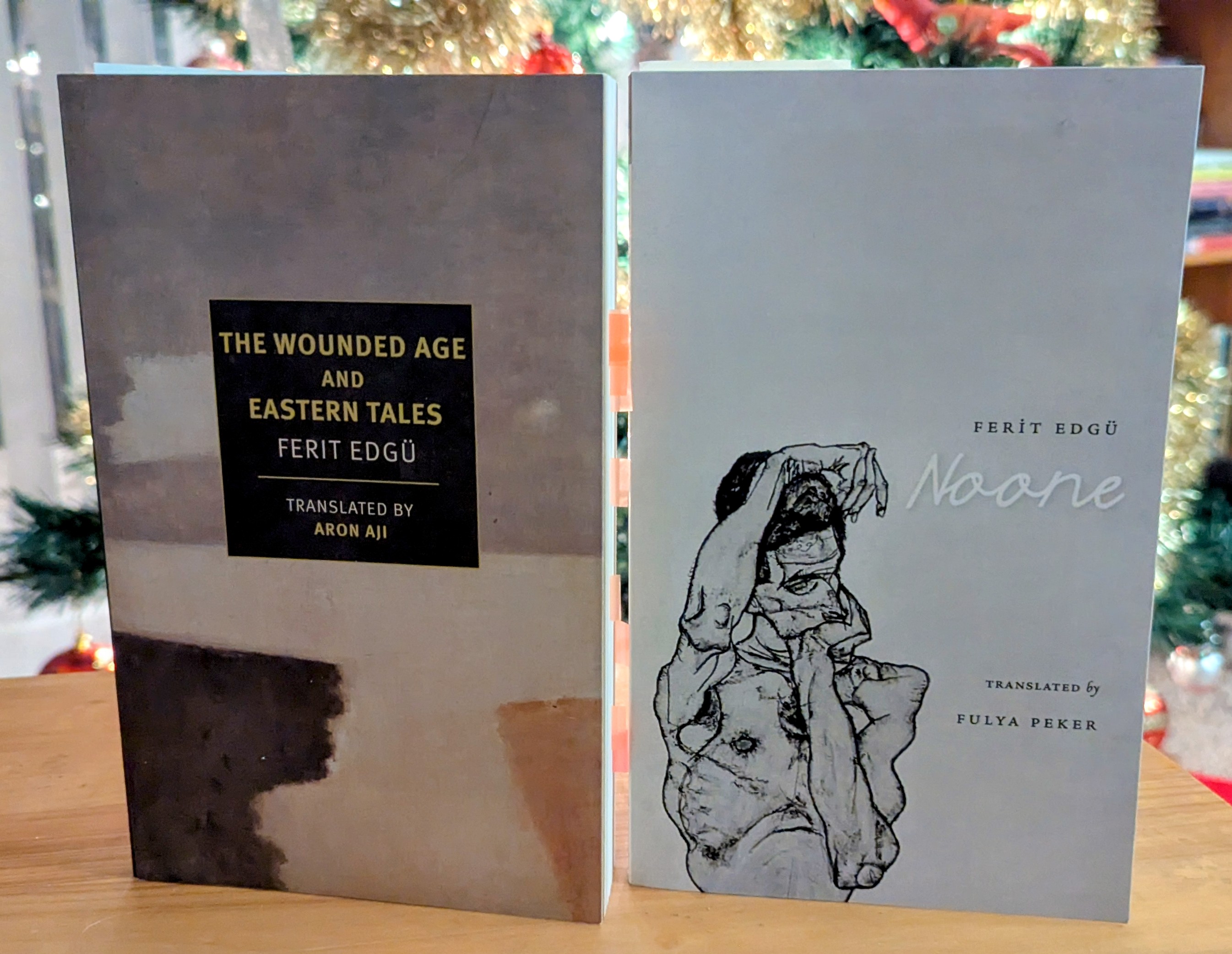
The Wounded Age and Eastern Tales  / Noone by Turkish writer Ferit Edgü—translated by Aron Aji (NYRB Classics) and Fulya Peker Cotra Mundum) respectively—who is sadly one of the writers we lost this year. His work, which draws on the time he spent teaching in the impoverished southeastern region of Turkey in lieu of military service, is filled with great compassion for the people of this troubled area. But his prose is stripped clean, bare, and remarkably powerful.
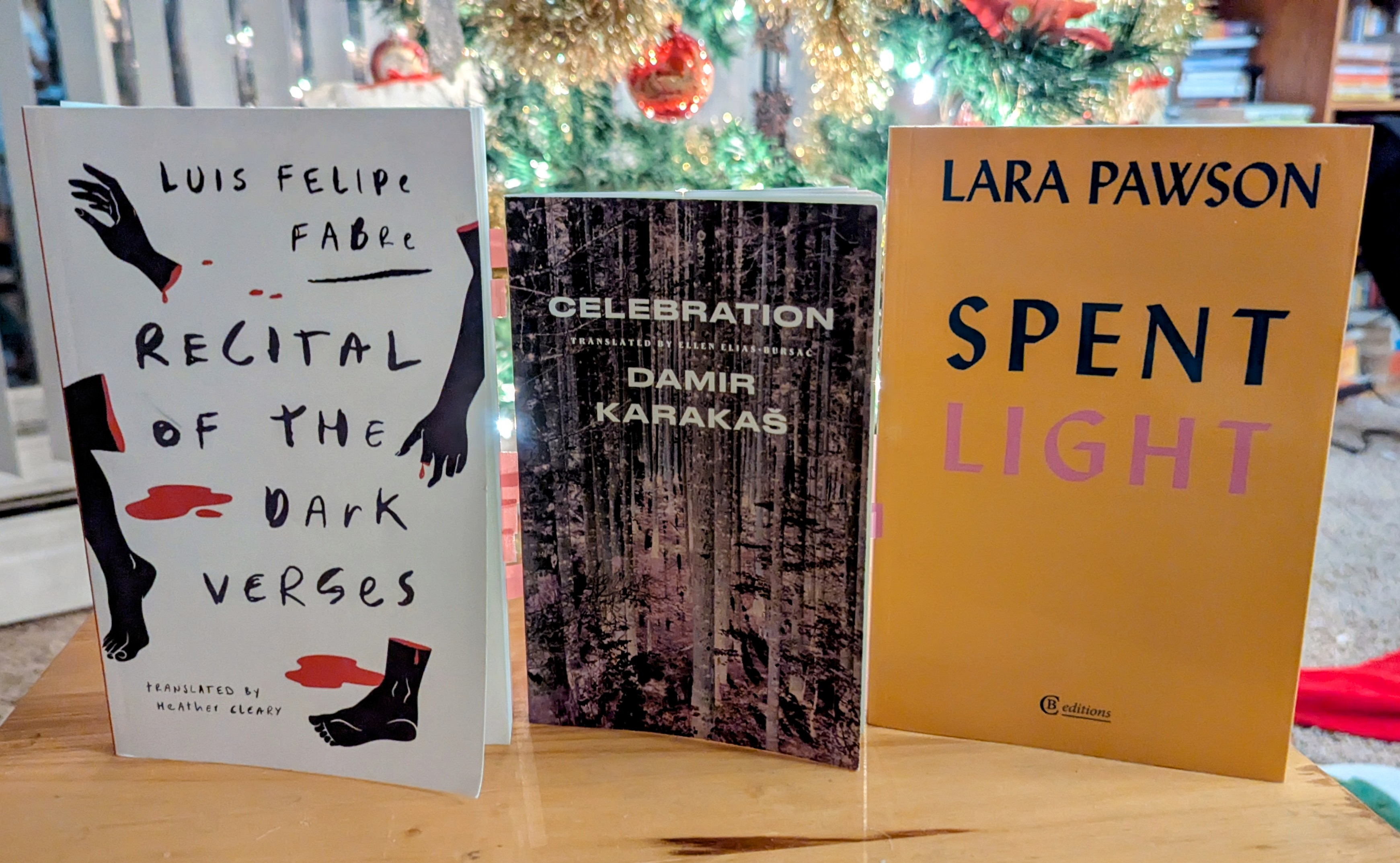
Recital of the Dark Verses by Luis Felipe Fabre (Mexico/Spanish, translated by Heather Cleary/Deep Vellum) is an award wining translation that seems to have garnered less attention than it deserves. This comic Golden Age road trip follows the misadventures of the body of John of the Cross on its clandestine voyage to Seville. Brilliant.

Celebration by Damir Karakaš (Croatian, translated by Ellen Elias-Bursać/ Two Lines Press) is an exceptionally spare, unsentimental novella about the historical forces that pulled the residents of Lika in central Croatia into World War II.

Spent Light by Lara Pawson (CB Editions) is a book I’d been anticipating since reading her This Is the Place to Be. Strange, at times disturbing, often hilarious and always thoughtful, this is one of those books that (thankfully) defies description.
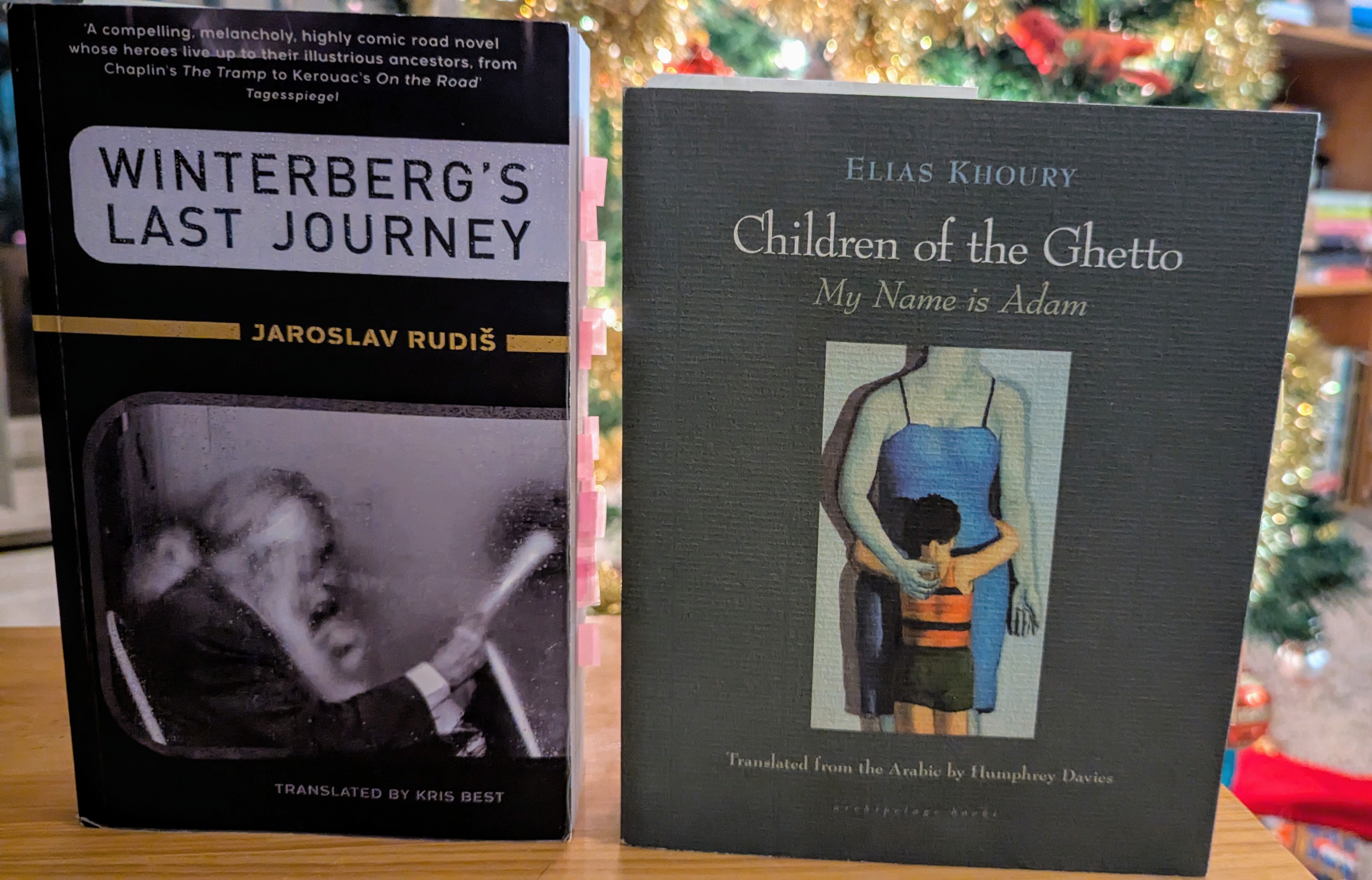
If Celebration is historical fiction at its most spare, Winterberg’s Last Journey by Czech writer Jaroslav Rudiš (German, translated by Kris Best/Jantar Publishing) is the exact opposite. Ambitious, eccentric, and filled with detail, it follows a 99 year-old man and his male nurse as they travel the railways with the aid of 1913 railway guide. What could possibly go wrong?

Children of the Ghetto I: My Name is Adam by Lebanese author Elias Khoury who also died this year (translated by Humphrey Davies/Archipelago Books) is the final Palestinian themed work on my list. This is a challenging and rewarding novel about a man born in the ghetto of Lydda during the Nakba that examines complex questions of identity.
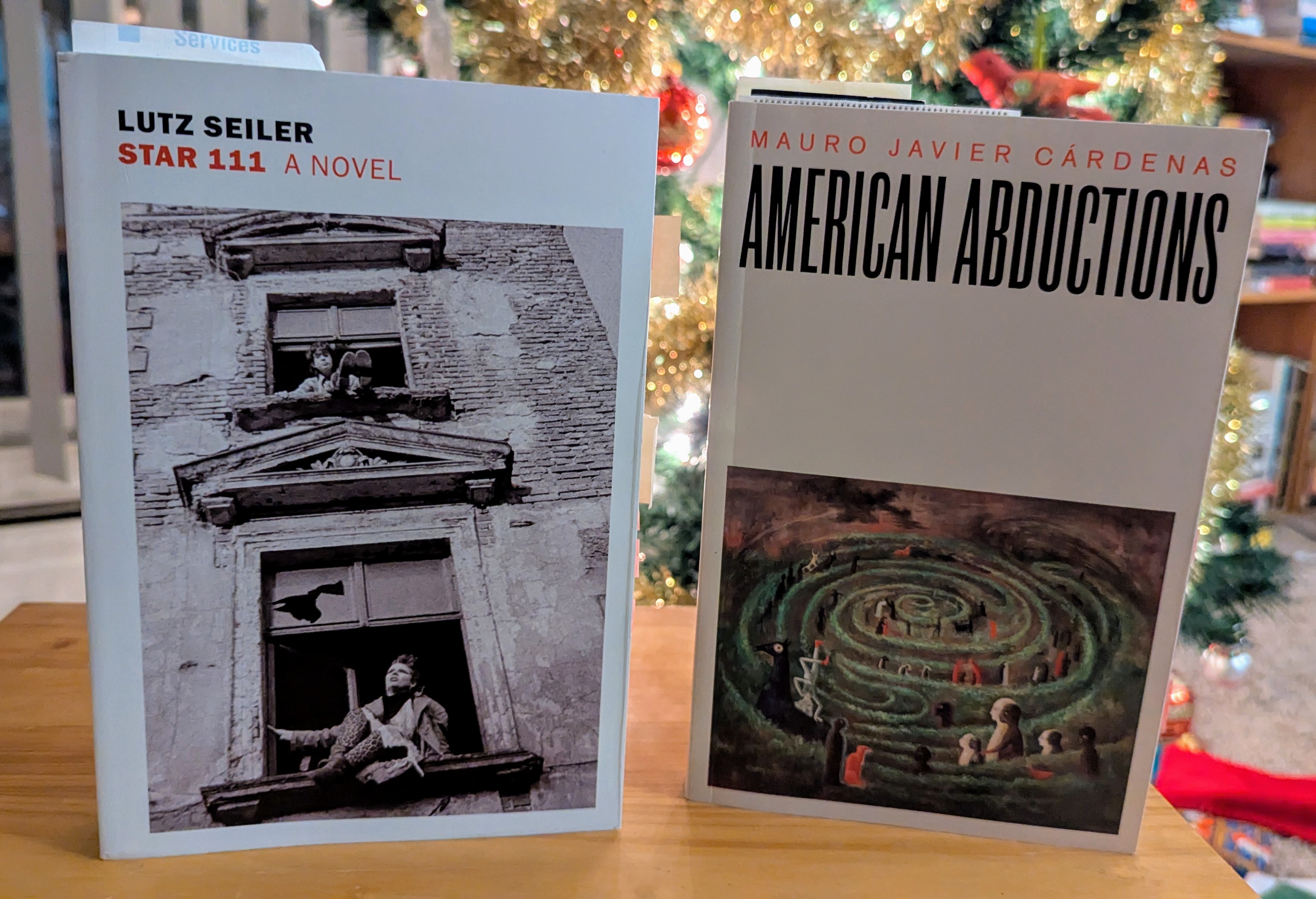
Star 111 by Lutz Seiler (German, translated by Tess Lewis/NYRB Imprints)is the autobiographically inspired story of a young East German would-be poet’s experiences among an eccentric group of idealists in Berlin in the immediate aftermath of the fall of the Wall. I was familiar with Seiler’s poetry before reading this, but I liked this novel so much that it lead me to follow up with his essays and the work of other poets important to him—the best kind of expanding reading experience.

Mauro Javier Cárdenas’ third novel American Abductions (Dalkey Archive) imagines the latest iteration of his hero Antonio in a future in which Latin American migrants are systematically sought out, separated from the children and deported. With a stream of single sentence chapters, he creates a tale that is both fun and uncomfortably too close for comfort. Quite an achievement!

Last but not least, my two favourite books this year are Hungarian:
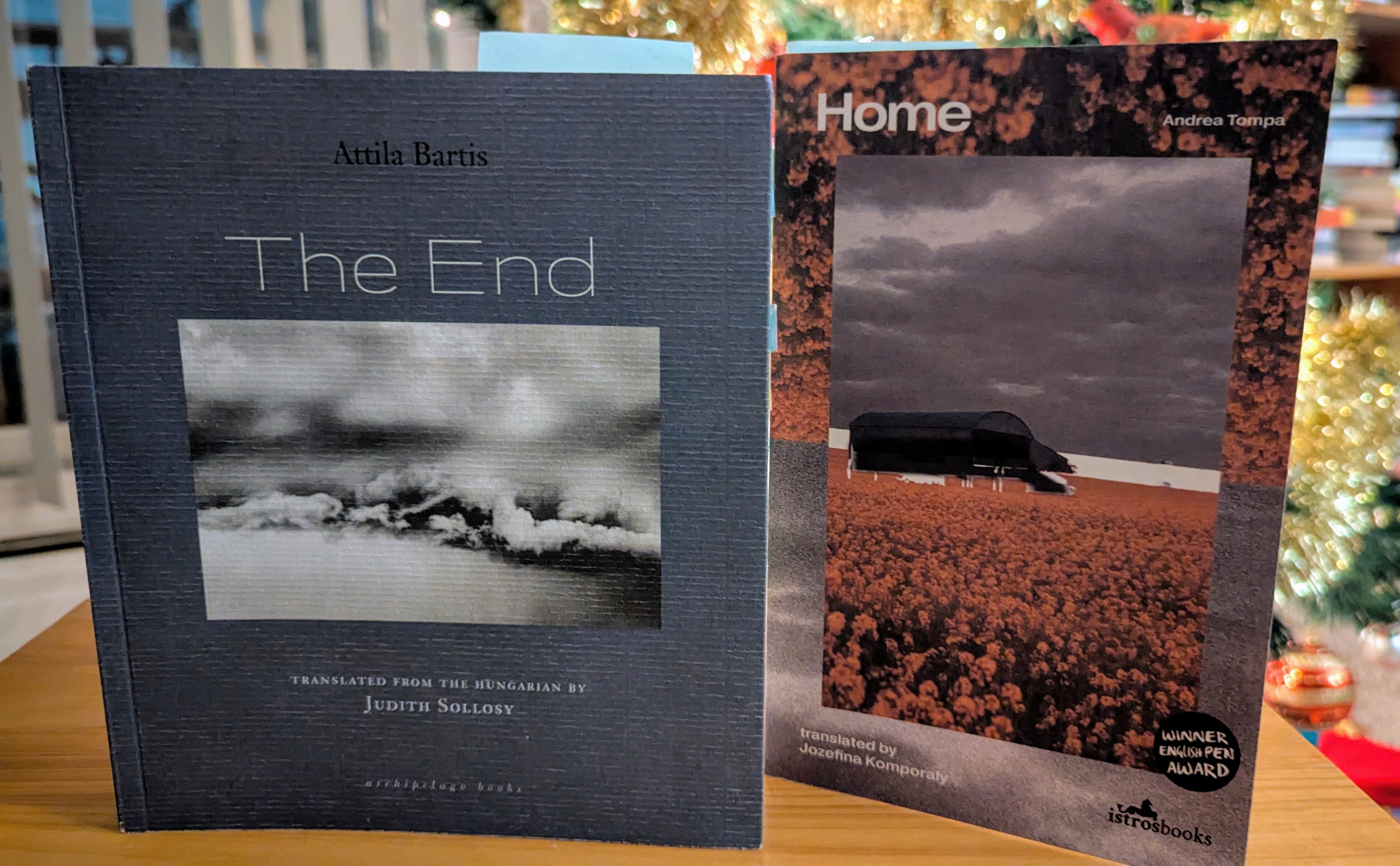
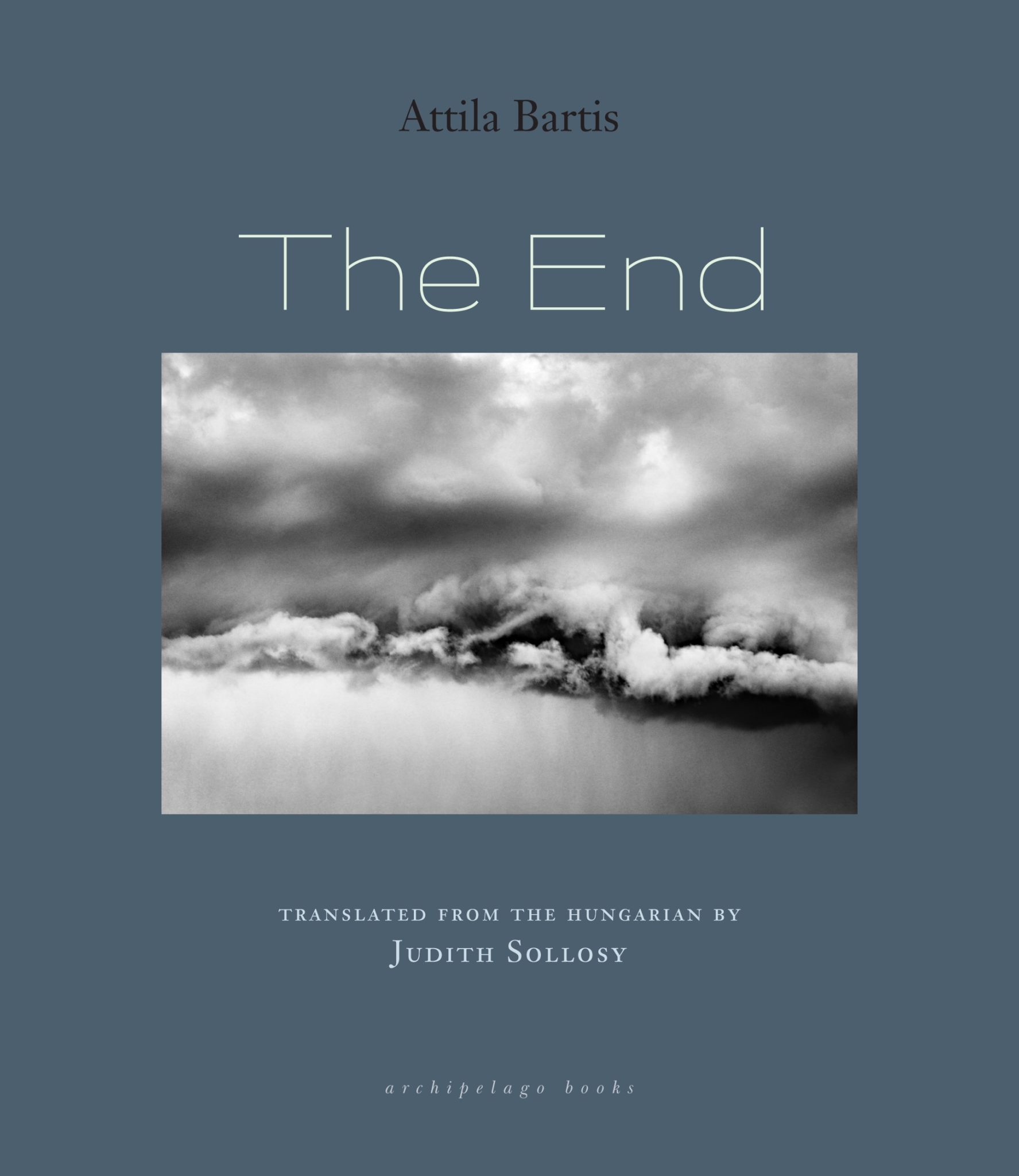
In The End by Attila Bartis (translated by Judith Sollosy/Archipelago Books), a fifty-two year old photographer looks back on his life—his successes and his failures. He reflects on his relationship with his mother, his move to Budapest with his father in the early 1960s following her death, life under Communism and the secrets held by those around him, and the role the camera played in his life. Presented in short chapters, like photographs in prose each with its “punctum,” the 600+ pages of this book just fly by.

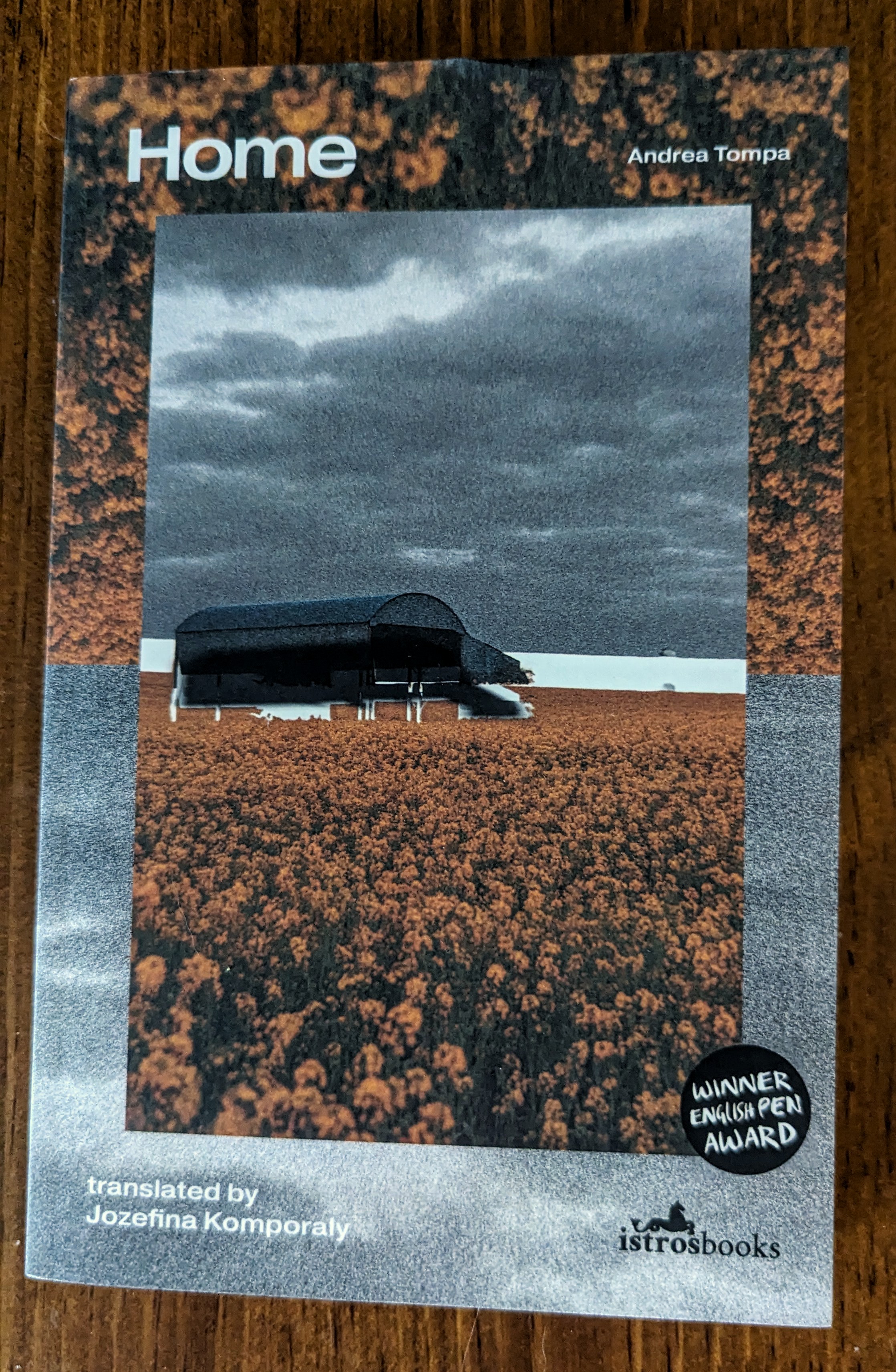
Like Attila Bartis, Andrea Tompa also comes from the ethnically Hungarian community of Romania’s Transylvania region and now lives in Budapest. Her novel Home (translated by Jozefina Komporaly/Istros Books) follows a woman travelling to a school reunion, but it is much more. It is a novel about language, about what it means to belong, to have a home and a mother tongue. It’s probably not surprising that my two favourite novels involve protagonists in mid-life, looking at where they are and how they got there. As to why they’re both Hungarian—I suppose I’ll have to read more Hungarian literature in the new year to answer that.

So that is my 2024 wrap up. I’d like to think 2025 will be better than I fear it will, but at least I know there are countless good books to look forward to.

Happy New Year!
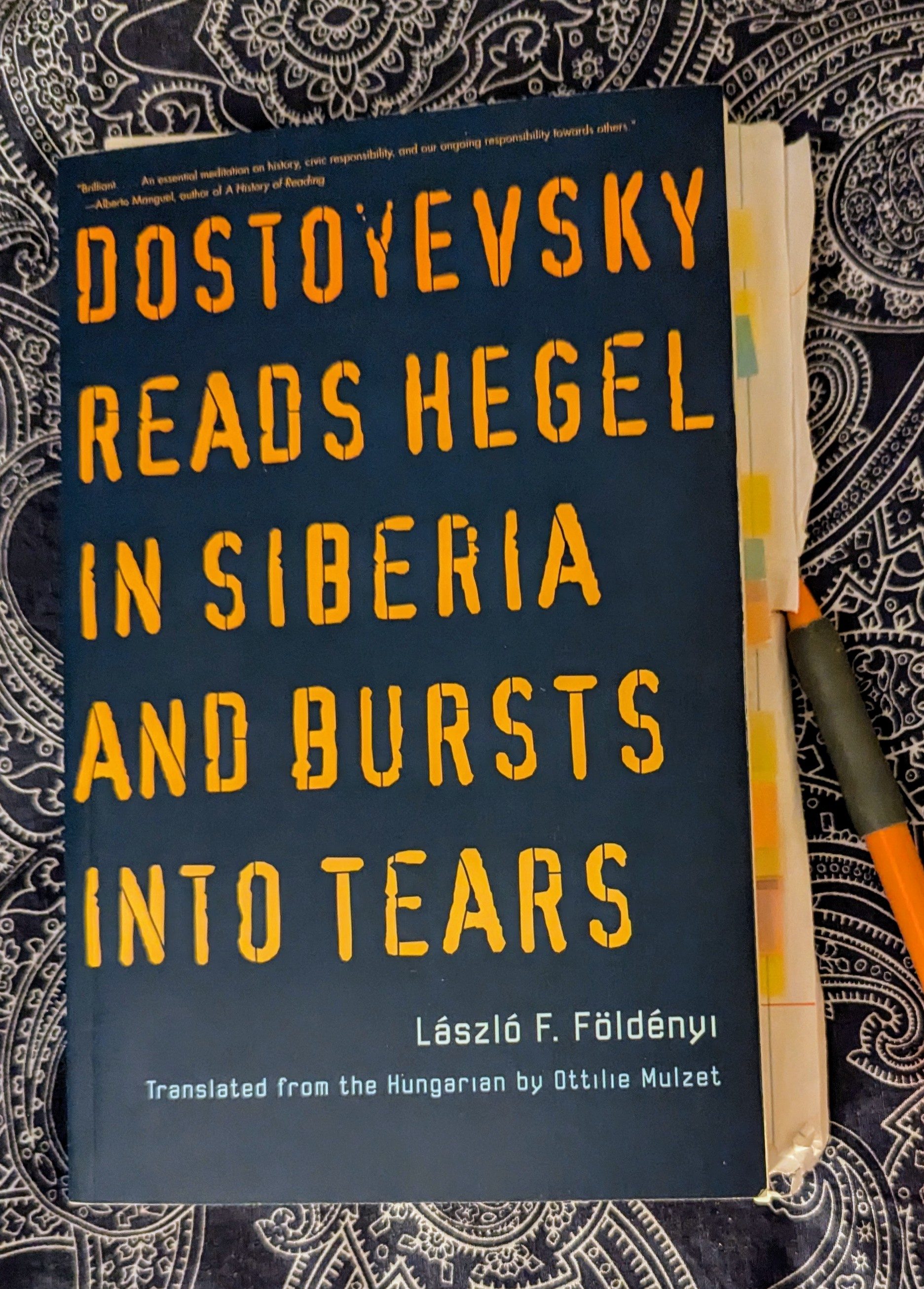
There be monsters: Dostoyevsky Reads Hegel in Siberia and Bursts into Tears by László Földényi

Humans have become alienated from their own history, as they are from their own cosmic nature.
– “Mass and Spirit”

The title is irresistible. It is impossible to read it and not wonder: what is this book about? In truth, it is about many things, or rather, many ideas, but in essence they can all be understood as variations on a dichotomous theme: darkness and light. Pivotal to these inquiries is the lasting impact of post-Enlightenment thinking on a traditional understanding of metaphysics, that is, questions of being and the nature of reality. Where once religion, or belief in God, gods, or some transcendent quality of existence could be turned to in times of darkness, the Enlightenment heralded a belief in “the omnipotence of reason that illuminates all phenomena.” Yet, as László Földenyi posits in this wide-ranging collection of essays, adroitly translated by Ottilie Muzlet, darkness and light (or other similar opposites or variants) are inextricably linked—one cannot be imagined or understood without the other—but in our secularized modern age, we, in our restricted, nondivine omnipotence can find ourselves confronting our own fragility in situations where reason alone may not seem like enough to fall back on. What then?

In his explorations of this conundrum, Földenyi, a Hungarian critic, essayist and professor of art based in Budapest, entertains the ideas, experiences and tribulations of a broad cast of thinkers, writers, poets, artists, and literary figures including Elias Canetti, Heinrich von Kleist, Caspar David Friedrich, Nietzsche, Novalis, Marquis de Sade, Antonin Artaud, and many more. And, of course, the protagonists of the evocatively titled eponymous essay: Dostoyevsky and Hegel. As he examines the manner in which rationalism, and within it a constrained idea of freedom and existence, has been met by those who chafed against its confines to a greater or lesser extent, Hegel is often assigned to the role of advocate for the primacy of logic and reason—not necessarily always fairly—so he makes a regular appearance in a number of pieces. But his main starring role is as philosophical foil to a certain Russian writer exiled to Siberia.

“Dostoyevsky Reads Hegel in Siberia and Bursts in Tears” is a vivid exercise in imagination which takes us to Semipalatinsk in southern Siberia where Dostoyevsky was sent in 1854, to serve a period of military service following four years of forced labour. In this barren, desert environment, he lived in a sparely furnished room and made friends with the young local prosecutor, Aleksander Yegorovich Vrangel, with whom he recited poetry, discussed religion, most critically, studied the books that Vrangel was able to secure for him. There is some reason to believe that one of the authors they read together was Hegel, possibly his lectures on the philosophy of world history, either ordered from Germany or in the form of the book in which they had been gathered and published. Földényi enthusiastically admits that he is taking liberties with his assumptions, but the notion is too tempting to resist.

Dostoyevsky emerged from his years of imprisonment and exile, as a man and writer whose experience with hardship and isolation had ignited a metaphysical drive that he would go on to channel against nineteenth century Europe’s adherence to utilitarianism and rationality through his protagonists. For Hegel, history, despite its messiness and violence,  could only be properly understood as the logical, progressive march of reason. That which fails to conform—at least in terms a European mind might understand, as such Africa and Siberia—is relegated to stand outside of the historical process and to be worth no further consideration.

If the infinite and the transcendent become lost behind the finite things, then it is no longer possible to speak of freedom. God, subjugated to rationality, is not the God of freedom, but of politics, conquest, and colonization. This is the secular religion of the God of the modern age. And history—looking at it from a Hegelian point of view—is the history of secularization. Dostoyevsky might have justifiably felt that Hegel was not just ushering Siberia (and himself with it) out the door; he was trying to convince, in missionary-like fashion, all humanity to accept as historical only that which the censorship of rationality admitted as such.

In envisioning an intellectual clash between the ideals represented by Hegel, and Dostoyevsky’s own experience of life in a place deemed separate from history, under conditions he would never have known had he not been forced to leave Europe, Földényi sees the ground for the openly acknowledged spiritual transformation that the Russian underwent in Siberia, and the writer he would become.

This may be the most passionate essay in the collection, but many of the smaller, quieter pieces turn on equally intriguing ideas in an open, speculative manner. He writes, for example, about happiness and melancholy, fear and freedom, sleep and dreams. Often his intention is to push beyond a simple dichotomy, at other times he wishes to dig down into an idea through the examination of the lives and ideas of one or more individual who found themselves confronting the limitations imposed by a society dedicated to the furthering of rational ideals. Case in point, in the also cleverly titled “Kleist Dies and Dies and Dies,” Földényi unwinds Kleist’s trajectory from an enthusiastic supporter of Enlightenment ideas through an early “Kantian crisis” which shattered his faith that Truth was knowable, to an act—possibly inspired in part by Goethe’s Werther—that eclipsed any of his writing: his carefully orchestrated double suicide with Henriette Vogel on November 21, 1811.

It bears repeating: the death of Kleist is the most thoroughly documented event of his entire life. The French-Romanian philosopher Emil Cioran justifiably states that it is impossible to read even one line of Kleist without thinking of how he put an end to his own life. His suicide preceded, as it were, his life’s work.

It is tempting to consider, and Földényi obliges, how Kleist’s embrace of death, or the act of dying, might be an answer to the loss he felt in an uncertain world.

The pieces in this collection were published in their original form (some have been substantially revised) between 1990 and 2015. They are not presented chronologically, nor can they be read as one cohesive argument, not least due to the fact that times, and presumably their author’s views, change. But it is telling that the volume opens and closes with essays addressed to Elias Canetti: the first, “Mass and Spirit” written in honour of his ninetieth birth anniversary, the latter, “A Capacity for Amazement,” an examination of his seminal Crowds and Power, fifty years after its original publication in 1960. His examination of Canetti’s exploration of the universal crowd and its ambiguous role in human history is measured, at least for Földényi, against Hegel’s understanding of universal freedom as a rational ideal. For Canetti, the crowd is more than a gathering of humans, it transcends that simple notion to incorporate all natural phenomena, it is cosmic and inherently irrational. Although he may or may not be onside with all the implications of Canetti’s singular arguments, Földényi clearly admires his metaphysical energy and, as the title suggests, his capacity for amazement.

The best essays wrestle with ideas, challenge assumptions, and invite the reader to entertain possibilities, debate with them or, even better, be inspired to read further. Dostoyevsky Reads Hegel is filled with references to so many writers and works that it is impossible not to stop to look someone or something up, or pull a volume off one’s shelves. It encourages side trips down rabbit holes. And that is what is so rewarding about spending time with László Földényi and the fascinating company he keeps.

Dostoyevsky Reads Hegel in Siberia and Bursts into Tears by László Földényi is translated from the Hungarian by Ottilie Mulzet and published by Yale University Press.

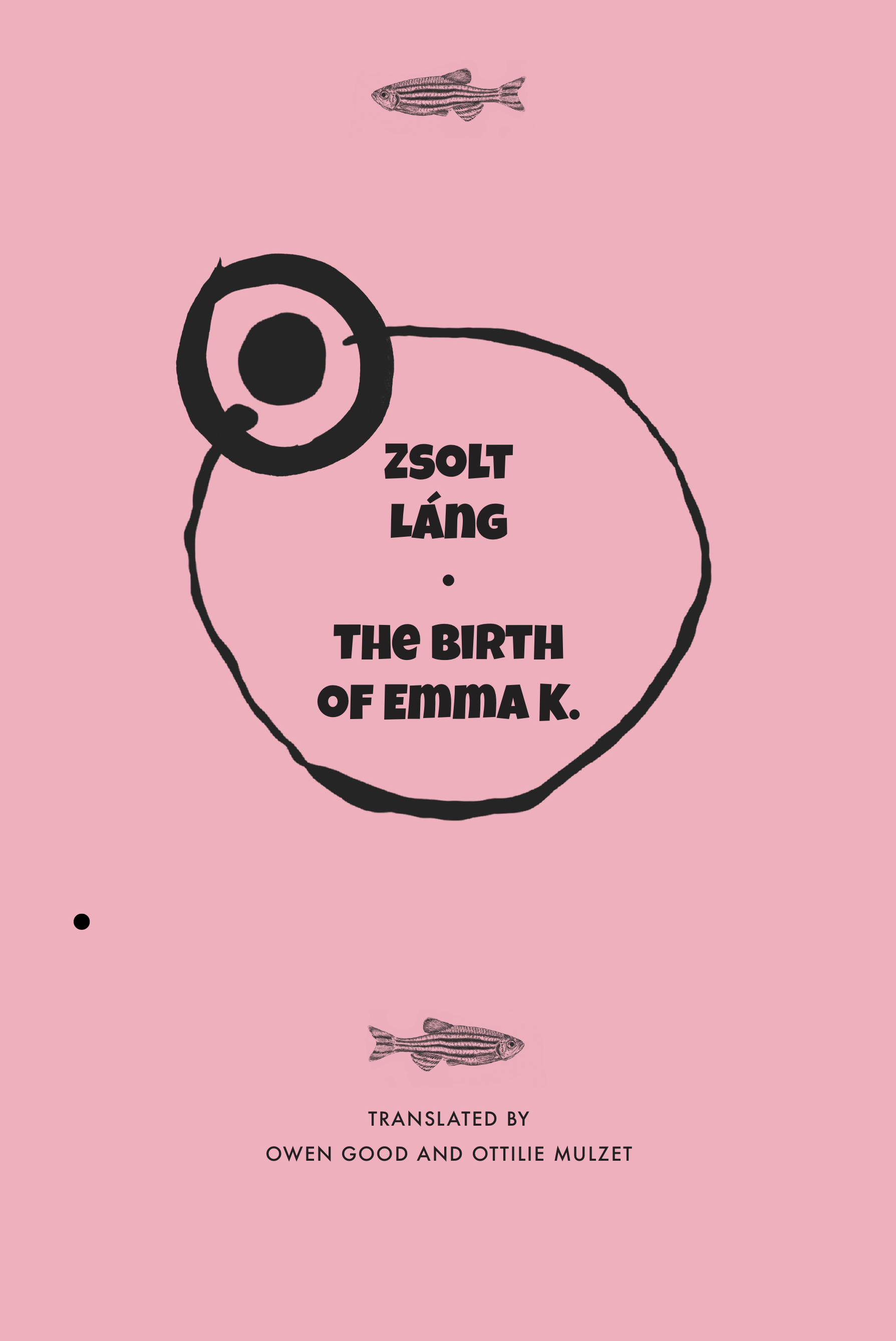
Exploring the uncomfortable corners of human existence: The Birth of Emma K. and Other Stories by Zsolt Láng

The fiction of Zsolt Láng inhabits a slippery space where time, genre, and realities shift and bend, where history shapes and distorts the landscape, and where characters are driven by conflicted passions and paranoias. Think of Flann O’Brien with a side order of Beckett, born and raised in Transylvania, charting his own course to become one of the premier postmodernist Hungarian language writers of our time and you have a hint of what you might find in Láng. And now, for the first time, we can sample that strange brew in English through the stories collected in The Birth of Emma K., translated by Owen Good and Ottilie Mulzet, but, be prepared, it is a delightfully odd journey during which one can lose one’s bearings from time to time.

The collection opens with “God on Gellért Hill,” set in Budapest, which finds “Our Lord” standing or floating above the city, intent on setting right the fragmenting relationship between two rather unattractive lovers. But to His dismay, God—and here the narrator reasons that we are witnessing neither the Father nor the Holy Spirit, but the Son—has been blessed with all kinds of powers, none of which are absolute. And, of course, under the often muddled efforts of their heavenly benefactor, the former lovers, Ida and Tamás, experience intensely swinging emotions that they are each at a loss to understand.

Our Lord followed them, as long as he’s here, he wants to see it through to the end. There’s still no guarantee he’ll intervene. Creation is like throwing a stone: There’s that ballistic arc from taking aim until reaching the target, and then there are the changes caused by gravity and wind; to intervene meant to retroactively meddle with time, at least that’s what a philosopher claimed with whom Our Lord didn’t agree (hence he never read the philosopher’s thoughts, though he could see into them). Our Lord is Our Lord because he sees things differently, his reasoning is different from man’s. But let’s not get mixed up in the difficulties of creation. (Good)

Determined as he is to try grant his subjects a happy ending they may not even want and are bound to undo, the burden of not-quite-absolute power weighs heavily on our heavenly hero, but in this clever opening piece there is a hint of the author’s own inability (or rather, wilful unwillingness) to exercise absolute control over his own characters—he’s happy to let them, and their stories, slip into strange territories, sometimes dark, sometimes light, and, more often than not, somewhere in between.

Láng , born in 1958, studied engineering at university in Cluj. Since 1990 he has lived in Marosvásárhely / Târgu Mureș, Romania, where he is an editor of the literary journal Látó. He has published close twenty volumes including short stories, novels, essays and plays. His work is deeply rooted in his Transylvanian homeland with its complex historical, multicultural, and multilinguistic  dynamics, but also reaches beyond to other European settings. His stories not only exhibit a broad range of characters and conundrums, they have a tendency to transform in style and form as they unfold. As translator Owen Good describes in an informative essay for Hungarian Literature Online:

Zsolt Láng’s is a nonconformist oeuvre. A story turns on a dime from a jovial satire to a poignant coming-of-age tale, from autofiction to metanovel to crime, leaving the reader forever playing catchup. Worlds blur and fantasy simmers to the surface.

If Láng is happy to allow his stories change without warning, he is also content to allow the reader to fumble their way into a tale for a while, or craft anachronistic realities in which, say, a preference for horse and buggy transportation exists alongside an internet café. Likewise, he does not feel inclined to bring all of his stories to a clear and defined conclusion, nor does he need sympathetic characters—some of his most unfortunate protagonists are driven by their own selfish or self-destructive motivations.

Consider “Like a Shaggy Ink-Cap Mushroom,” the tale of a depressed Inspector obsessed with death—his own. He sits at his desk surrounded by, but estranged from, the Beat Cops and the File Desk Girls, and feeling pressure from the powers above. He visits a gravestone with his own name on it, drinking in the sense of relief that comes with the thought of lying beneath it. And, when his former partner reaches out to him for personal assistance, a request that will begin to initiate a change in the Inspector’s sorry trajectory, his initial reaction is rather comically tragic:

He was surprised when his partner called. He didn’t recognize his voice. Hence, maybe, he was filled with the cool, soft promise of the hope for happiness. The tranquility of promise. A deep and hoarse voice. Slowly pronounced sounds. Containing an impossible amount of pain. He shuddered. Furthermore, the ring of the phone had electrified him. He jumped up and almost fell on the handset. The voice’s lumpy sadness. A fine, floury, lumpy sadness. Immediately he thought of Death. Death was calling. Or he was about to hear news of someone else’s death. He wouldn’t be surprised if it was his own. There could be no greater gift. Inspector, sir, I have to relay some really sad news. You’ve passed away, sir . . .  (Good)

In many stories Láng drills directly into his protagonists’ deep (and often dark) desires and fixations—two homeopathic doctors that each share a visceral hatred of the other, a lonely actress past her prime, or an inmate in an asylum conducting his own “research” and engaging the resident intern with his experimental theories. In others, like the longest piece, “The Cloister of Sanctuary” set in a monastery in Moldova, he works across wider canvas to craft an horrific folktale of mystery, manipulation, and cruelty. And then there is the final piece, the title story, which follows the metaphysical musings of an embryo, not exactly desired by her young would-be parents, from conception through a vigorous campaign to dislodge her from her watery accommodation, to her defiant arrival months later. It offers a fresh, insightful embryo-eyed perspective on the world she imagines versus the one she’s potentially heading towards.

With a touch of magic  and a measure of absurdity, the stories collected in The Birth of Emma K. offer an entertaining exploration of the virtues and foibles of human nature and an excellent introduction to another fine Hungarian language writer.

The Birth of Emma K. and Other Stories by Zsolt Láng is translated by Owen Good and Ottilie Mulzet and published by Seagull Books.

The only liveable space is language: Home by Andrea Tompa

On the surface, Andrea Tompa’s Home is, like its name implies, a story about home, or, rather, a journey from one home to another. Although it is never explicitly specified, her unnamed protagonist is, like the author, a writer born into an ethnically Hungarian community in Romania who moved to Hungary to study Russian literature. As the novel opens, its heroine, a successful novelist nearing fifty, is waiting at the airport to pick up a long-time friend and the adult daughter of one of their classmates who are both arriving on a flight from the US. Together they will make their way across the border to their hometown for a class reunion that has been years in the making. For the driver, still nervous at the wheel having acquired her license fairly recently, the journey will also be an opportunity to try to understand something about herself and where she truly belongs. As someone who makes magic with words for a living, she is aware that articulating truth is an act that often seems to escape the limitations of language, and that even a concept like “home” can be slippery:

Stuck between two worlds, no longer at home but not yet back at home either, overwhelmed with fear because something has definitely come to an end, at least temporarily, while something else cannot yet commence. In other words, this place called home and obtained at the cost of tremendous effort, has to be left behind in order to depart from home to (another) home, the latter without loved ones or  a house to call ones own, only with some sort of a shared past, yet still experiencing the sensation that there must be something there for the articulation of which she is unsuitable.

Over the thirty years since she first left her hometown to study, the protagonist has returned frequently, at first every summer and for holiday gatherings, and then more sporadically, but it will be the first time that all of her surviving classmates, at least those who agree to come, will be together for an entire weekend. Many will be coming from around the globe having found careers and a new lives abroad, others will have stayed close by, aging and changing along with the town. As she anticipates this reunion, she will think back on her own life experiences, in contrast with the varied paths others have happened upon, in this wide ranging meditation on the meaning of home. Three decades is, after all, a long time.

Intrinsic to the question of home is the matter of language. The main character does not have to give up her mother tongue when she leaves migrates, but she thinks often of the Russian writers who were forced into exile and the ways they adapted, or failed to adapt, to a new literary voice. When encountering friends who are living away from where their shared native language is spoken, questions often arise about how one might translate one word or another. During a six-month student residency in Saint Petersburg she gathers Russian vocabulary and expressions that appear and reappear within the text in Cyrillic script. Borders and, for better or worse, identities blur. And this groundlessness is not exclusively limited to language either. The paintings of an artist from her hometown whom she happens to meet and befriend toward the end of his life, has style that “balances the boundaries of different worlds, a sort of homeless landscape.” Her own life seems to navigate a similarly homeless landscape, one she wants to pass on to her son who is, for all intents and purposes far more grounded and unambiguous in his own identity and sense of belonging than she ever will be.

With the looming class reunion, Home is also very much a novel about the way our view of the world and our place in it changes as we age. Once excited with all the trappings of travel, the protagonist is now uncomfortable with the idea of flying and disenchanted after years of book tours, factors that likely enhance her uncertain appreciation of middle age existence:

In her, several ages coexist at once, she often scrutinizes her mirror image with some consternation because she feels so much younger within, as if she was glowing like a child, if not a little girl. This is what she sees.  Not the mature face, never, the fine yet clearly visible wrinkles, the creases and treacherous spots appearing on the skin. Countless ages coexist within her side by side, a multitude of figures are sitting on the barge of the past, trying to make peace with one another and the world, it seems as if the fifty springs, summers, hard-working autumns and increasingly faster-thawing winters had gathered together a proper crowd. Yet many more have sunk without a trace, people she would find it hard to remember.

Of course, once she and her classmates are finally together, all decidedly slower, heavier and more subdued than their younger selves, she is far from the only one with ambivalent feelings about what it means to be “home.”

The narrative traverses the distance between the airport and the reunion, and the space of at least thirty years, at a pace that is negotiated with confidence and skill. Tompa not only refers to her lead as “our protagonist”—especially in the early chapters—but other key figures are similarly unnamed. Her son is simply “the Son,” her father, whose police surveillance file is, she hopes, a key to his troubled life, is called “the Father” as distinct from the man who becomes her husband and the father of their child who is referred to at one point as “the Other.” Likewise, there is “the Professor,” “the Teacher,” and “the Painter.” By contrast, her peers from school and college, form a varied, distinctive, and named cast of characters. In the hands of a less experienced author, this could feel performative, but here it works very effectively. It is, in a sense, a means of keeping a level of anonymity and displacement in what is a story about identity and what it means to have a home, and a mother tongue. A third person perspective that is at once close, yet held at a certain distance from its subject, mirrors the privacy one senses the professional writer values in her public life, while permitting certain insights that she might not actually be able to find words for herself. We learn about her, and her life, gradually, in relation to those around her, while certain aspects—the details of her literary career and her marriage—remain largely in the shadows. Language conceals as much as it reveals.

First published in Hungarian in 2020, Home is not only a novel rich in literary references, from Homer to Shakespeare to Nabakov, but a very contemporary tale wherein characters often search desired quotes on their phones during conversations and the children who have accompanied their parents to the reunion try to teach the adults TikTok dance routines. With humour and intelligence, Tompa has crafted a compelling tale that explores the complicated question of the nature of belonging through and beyond language, while Jozefina Komporaly’s translation deftly carries the magic and wisdom into English.

Home by Andrea Tompa is translated from the Hungarian by Jozefina Komporaly and published by Istros Books.

Am I really me? Barcode: Fifteen Stories by Krisztina Tóth

When one speaks of a short story collection as “loosely linked” there is often the implication that some kind of continuous theme, or even set of characters, connecting the individual pieces to a greater or lesser extent. Krisztina Tóth’s debut collection, Barcode, originally published in Hungary in 2006, is a little different in this respect. The narrators or protagonists are all Hungarian, and timewise, their settings are in keeping with the age of the author who was born in 1970, but, even if some stories may contain possible biographical elements, the voices and circumstances do not suggest that all, or even any of the fifteen feature the same character. Rather, what connects the stories of these girls and women is a motif—all contain reference to a “line” or “lines” of some kind as noted in the story’s subtitle. We find borderlines, blood lines, grid lines, baseline, the line’s busy, and so on. It is a interesting way of providing continuity to a varied collection of tales. In fact, in her introduction, Tímea Turi tells us that the first element of the Hungarian word for “barcode” translates as “line.” Thus, each piece has something to say about the lines that define, restrict, or even scar us.

One can also say that the collection of stories in Barcode cross the “line” marking the end of Communism in Eastern Europe and its replacement with democratically elected governments— a line that corresponds with, as it would for Tóth herself, the end of adolescence and the beginning of early adulthood. The harbinger of that transition in Hungary is observed in “Outline Map (Life Line)” as a young university student on a fateful visit to a summer cottage with her first boyfriend remarks:

It was 32 degrees; we slathered each other with suntan lotion as we watched the TV. The General Secretary of the Hungarian Socialist Workers’ Party János Kádár has died. Actually, I felt rather sorry for him. Sorry that I would no longer be hearing his name in the news bulletins, sorry that the landscape of our childhood would soon disappear, that the crêperie shack on Kálvin Square had been demolished and that entire blocks of houses were disappearing, that the streets twisted and turned in odd directions, that in the sequence of events some kind of curious, unbridgeable gap was being created.

The stories set in childhood reflect Hungary of the 1970s and 80s—contaminated housing estates, a military style summer camp, an idealized fascination with “the West”—whereas the stories with adult protagonists deal with the demands of career, relationships, and motherhood, sometimes even venturing beyond Hungary, to Japan and Paris, for instance, where, if anything, the characters’ Hungarian identities are even more evident in contrast to their foreign surroundings.

The majority of the stories in Barcode are first person monologues with unnamed narrators, who have strong, distinctive voices. They are often seeking to understand and define themselves within their families, their romantic relationships (and infatuations) and within their communities. They may be speaking to immediate events or looking back at their younger, more naïve selves, sometimes with considerable insight. In one of my favourite stories, “The Pencil Case (Guidelines),” a girl recounts her primary school experiences at a time when “the colour both of our gowns and our copy books was indigo.” The narrative cleverly captures a shift in self awareness that occurs when she is wrongly accused of tripping a classmate, but allows herself to take the blame—in her retelling there is suddenly both an “I” and a “she” who becomes separated from her own name and identity and remains that way:

Later, too, the body belonging to the name continued to say nothing, responding with an obstinate silence and a blank, unflinching stare to the teacher’s interrogation, and as for the name, she began to hear it as casually and forgetfully as her cardigan and  the PE kit she invariably left behind somewhere or other. She became an actor in that weird film witnessed in the schoolyard, which the I had seen and in which she had been found guilty and which from this day on I, the name, had consistently to bear through all the indigo days that followed.

Her circumstances so clearly reflect the way many a shy child manages to navigate a system—grade school—in which they are out of place and unable to speak for themselves.

Although the stories are not organized in a strictly chronological fashion in this volume, they generally move from childhood through adolescence to adulthood, the latter stories tending to feature the more mature protagonists. Here strained romances, pregnancy, miscarriage, and self-image  take the place of childhood joys and fears. As in “What’s this Mark Here? (Bikini Line),” where a woman traces the history of her relationship to her body from her first bathing suit through to childbirth via caesarean section. The pictures she draws along the way are vivid:

My first swimsuit isn’t a swimsuit. It’s a pair of trunks. At that age there’s no big difference between boys and girls: it’s just chubby, flat-footed kids’ bodies running about on the sands. The sun shines. I’m crouched down by a wooden tub, blinking into the camera. It must have been lovely in the hot sand. I show the photo to my son. Mum, he says, that isn’t you, that’s a little girl. Indeed: am I really me? In the background a fleshy female leg in slippers consisting of two blue crossed strips of rubber: beach slippers. The legs belong to my grandmother, who would soon take a step or two into the water, pulling a rubber dinghy. We are sailing.

Fifteen stories, fifteen girls and women, each growing up and finding their way. Tóth’s poetic background (she was a well-established poet when this book first came out) serves her well as she crafts memorable portraits of female life in Hungary and beyond. More than a decade and a half after first publication, they speak to timeless aspects of female experience. And, no review would be complete without mentioning the striking presentation of this volume with barcode-like like lines across the top and bottom of each page and unique designs setting off each tale.

Barcode: Fifteen Stories by Krisztina Tóth is translated from the Hungarian by Peter Sherwood and published by Jantar Publishing.

Behind the lens and beyond the darkroom: The End by Attila Bartis

When I take stock of my life, I see no reason to launch into some big family history. I haven’t got what it takes, nor do I have the means. I can’t very well ask Mother and I can’t ask Father, and as for my grandparents, I never knew them. Besides, the story of my family is nothing out of the ordinary. One might even say that along with all its uniqueness, it could just as easily serve as the prototype of the history of the Hungarian family. Or even the history of a Middle-European, middle-class, non-Jewish family. Though, come to think of it, they are pretty similar to Jewish histories. Discounting, of course, what cannot be discounted.

The End, the latest novel by Hungarian writer Attila Bartis to be released in English translation, begins, as its title implies, at the end. We meet András Szabad, aged fifty-two, enroute to the airport to catch a flight to Stockholm for a medical examination. He tells us he is a photographer, very well-known in fact, but admits he has not touched his camera in two years, ever since a woman named Éva died. And, for some reason, he feels it is important to let us know, off the top, that he does not believe in God. He lacks faith. But his feelings about God or not-God seem less than certain. Questions remain. To that end, a friend has suggested that he get his life down on paper as a means of resolving this unfinished business, whatever it might be.

As a photographer, someone who frames the world as he sees it through pictures, moments preserved and observed with a certain distance—a practice he first engaged in as a child, observing a woman through a window from a gap in a fence, long before he ever held a camera—András approaches this project as one might lay out a series snapshots, each catching an image or memory from his past. He begins in the fall of 1960 when he and his father arrive in Budapest, following his mother’s sudden death and his father’s release from prison after serving three years for alleged anti-government activities. They take up residence in a small apartment, awkwardly sharing the space, continuing the same pattern of father-son avoidance passed down through four generations, each man sharing exactly the same name: András Szabad. The youngest András is seventeen when he moves to the city, a transition that marks an abrupt end to his childhood. But it is on his first Christmas there that he receives his first camera, his father’s Zorki, and that changes everything.

András chronicles his experiences finding his way around Pest, his father’s trouble finding work and meeting the young man, Kornél, who will become his life-long friend, sounding board and often frustrated better angel. He describes growing up in the rural town of Mélyvár, his beloved mother, and the difficult, lonely years of his father’s imprisonment when even a friendly neighbour could secretly be an informer. Now settled in Budapest, he drops out of school after an affair with his Hungarian teacher, listens in as his father is visited by his former collaborators, and befriends the eccentric countess, now reduced to a simpler life, who lives in apartment under the back stairs of his building with her elderly lady-in-waiting. There is no shortage of interesting characters peopling András’ otherwise ordinary world. On a larger stage, he is rather obsessed with Yuri Gagarin, the first human in space who reported that he saw no God up there, and feels defined by the seemingly endless reign of Communist leader, János Kádár. And then, there are the women.

His affairs with women are typically sexually intense and strange. He seems attracted to hopelessly inappropriate women—his high school teacher, an older woman he meets at the pool, and, of course, Éva, the concert pianist who András first sees, in the park, making out with her ex-husband, but looking directly at him over the man’s shoulder. Their torrid, yet dysfunctional, relationship lasts seven years, but she always holds him at arm’s length, across a space he can never breach. Most of his lovers end up before the lens of his camera, Éva included, as do many of the female customers he encounters once he begins taking photo ID pictures for a living. The camera—the Zorki now replaced with a Leica—becomes, for András, both an invitation to women and a shield to protect himself against them.

The strength of this nearly 600-page novel rests on the sometimes uncertain, often funny, well-paced narrative. The short, focused chapters titled in parentheses by a single feature—the punctum in Barthes’ terms—gradually unveil a portrait of a vulnerable, often stubborn, flawed man who is not sure where he stands in the world, even after achieving enviable fame. What he wants the most, Éva’s love, is the one thing that eludes his grasp, even if it is she who, after she has left him and Hungary altogether, mounts his first exhibition using “stolen” negatives. He professes an unwavering allegiance to the truth, at least as he sees it, with the wisdom, on occasion, to refrain from saying what he is thinking. And the smooth integration of dialogue—much of András’ account could be described as “verbal snapshots”—advances the flow of memories and reveals more about his nature, and that of those around him, than a more ego-driven fifty-two year-old would ever dare disclose in a formal written exercise.

For instance, when his father dies and he needs more than the part-time overnight job he has had at a print shop, András presents himself to József Reisz, the ID photographer who will teach him more about taking pictures than anyone else, and explains that he needs a job. Even though Reisz is not looking for an assistant, he is hired. The older man is a crusty, no-nonsense character with an uncanny attention to detail when it comes to people and to photography. When András serves his first client, he is fumbling with the unfamiliar folding bellows camera and, as he pushes the shutter release cable, Reisz calls out from the lab. Plate!

I pulled out the plate, I took the two required pictures, and wrote out the receipt. I was drenched in sweat. Soon as the man left, Reisz came out.

Thank you, I said.

You’ll get the hang of it, he said.

I’d have never thought that taking an ID photo was hell.

You’ll get the hang of it no time.

How did you know in there that I forgot to pull out the plate?

From the sound. There was no twang, and the shutter clicked.

You hear that from in there?

Yes. And at such times, don’t advance the film. Or if you’ve advanced it, take another picture of the client, so you’ll end up with a pair. As it is, you’ve got an empty frame now.

Fine. In the future, I’ll do that I said.

And don’t ask what the picture is for. It’s none of our business. If the client wants to tell us, he’ll tell us. If not, not.

Fine. But he looked like a lizard. He didn’t blink. Not once. He’s some sort of hunter.

He’s not a hunter.

He said he needed it for a license to carry arms.

He’s not a hunter. He’s a member of the Worker’s Militia. Hunters never stop talking.

The restrictions and ever-present threats and uncertainties of life in Communist Hungary, especially in the light of his father’s entanglements, shadow András from his early years, right through to middle age. Yet, many pieces of his life fit together seemingly by chance rather than by desire or design. He is strangely lacking in direction, even after he begins to have gallery showings. Left to his own devices, he might have been content taking ID photos or photographing the women who happened to cross his path indefinitely, enlarging some images leaving others untouched. But, flawed and frustrating as he may be, he is wonderful at isolating and narrating distinct moments of his life, slowly making his way to the memories and fears that he is continually trying to avoid. And what is life anyhow, but a series of negatives, some developed and returned to endlessly, others lying dormant until retrieved from the mists of time by accident or circumstance?

The End by Attila Bartis is translated from the Hungarian by Judith Sollosy and published by Archipelago Books.

Farewell to 2023 with the annual list of favourite reads

In my small corner of the world, away from forest fires raging, earthquakes and wars continuing and erupting anew, I read some very good books. 2023 was, world events aside, a complicated year, which is to say, a very human one. Within my extended family there were life-changing diagnoses and surgeries, but all in all, we’ve been fortunate to access care within a health system buckling under the strain that is far from unique. And I finally returned to India for a visit, my first trip anywhere in four years, which was a much-needed opportunity to connect and re-connect with many friends, and even take a little time to explore on my own. But travel did cut into my reading, as one often imagines that with all that time spent flying and waiting for flights, books will be avidly consumed, but that’s not always the case. And then, when I returned home, just days after the events of October 7, a renewed politically motivated awareness started to influence my reading choices and appreciation, something that will no doubt continue into 2024. If one sets out, as I do, to read with a special interest in works and authors from outside my own experience, especially in translation, reading widely and intentionally should ideally be a guiding factor.

So what of 2023’s reading? I read just over 60 books, a number I’m satisfied with. I wrote reviews or responses to 48 of them. The majority of the books I chose not to review are books of poetry, in large part because I do not always feel confident that I can add something meaningful to the conversation about such works no matter how much I might enjoy them and return to them often. (Perhaps this year I can gather some of my favourite “unreviewed” collections into  a special post.) Nonetheless, for the purposes of this annual exercise, I selected 14 books  that I particularly enjoyed or wanted to call extra attention to.  It includes four nonfiction works, nine fiction and one poetry collection. Ten books are translated literature, while four are written English, although one of those is a book about translation.

Listed chronologically according to date read, I’ve divided my 2023 favourites into two categories—books I particularly enjoyed and, then,  my top five:

Journey to the South – Michal Ajvaz (Czechia) translated from the Czech by Andrew Oakland
This wild murder mystery/adventure that begins with a murder during a performance of a ballet based on Kant’s Critique of Pure Reason was my first introduction to Ajvaz’s idiosyncratic story with a story within a story narrative form. I definitely want to read more.

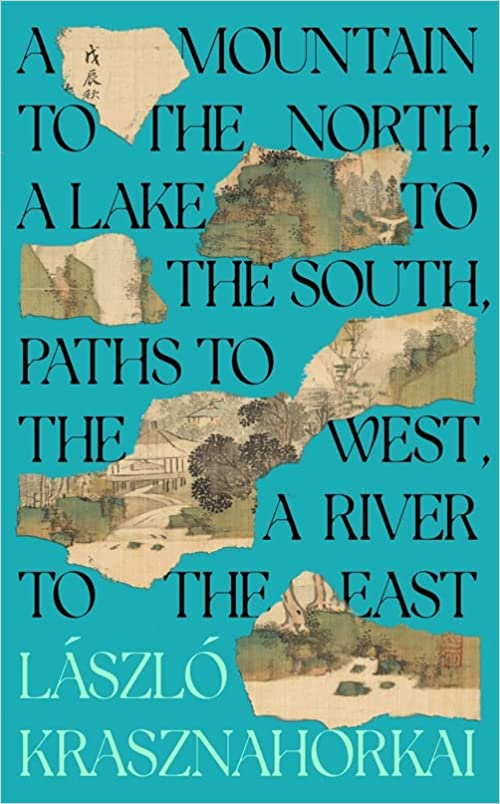
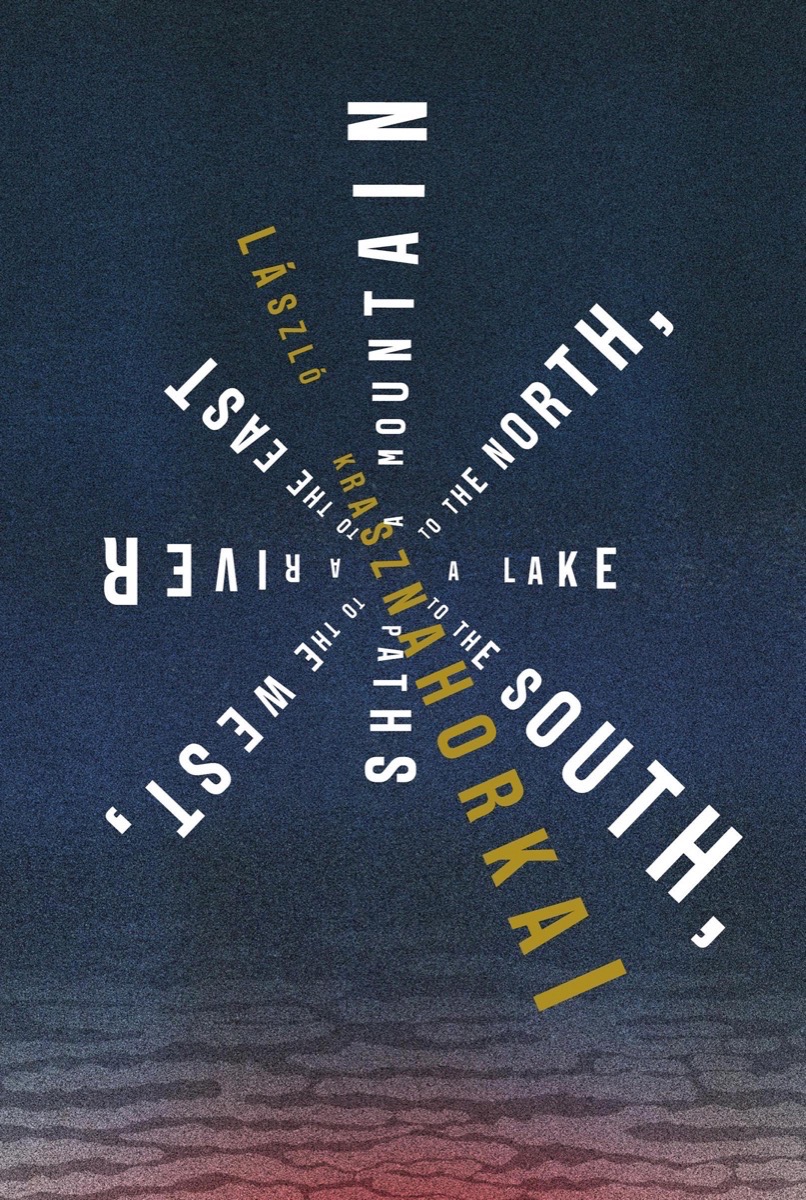
A Mountain to the North, A Lake to the South, Paths to the West, A River to the East
– László Krasznahorkai (Hungary) translated from the Hungarian by Ottilie Mulzet
The historical details that emerge in this dream-like journey in search of a mystical Buddhist monastery have lingered with me with all the misty beauty of the initial reading experience.

 Falling Hour – Geoffrey D. Morrison (Canada)
This strange and wonderful tale of a man trapped within an urban park is both smart and funny in just the right measure.

The Postman of Abruzzo – Vénus Khoury-Ghata (Lebanese-French) translated from the French by Teresa Lavender Fagan
As one of my favourite writers, it is difficult to imagine compiling a list like this without including Khoury-Ghata. This sharp, spare tale of a French woman who finds herself in a community of displaced Albanians in southern Italy in search of a connection with the work of her dead geneticist husband so that she may heal, is charming and profound.

All The Eyes That I Have Opened – Franca Mancinelli (Italy) translated from the Italian by John Taylor
Another favourite, a poet whose works always seems to speak directly to me, I would be hard pressed not to include her at year end, but this collection with its central image inspired by the eye-shaped scars on the trunks of trees continues to haunt me every day as I pass aspen trees on my walk.

river in an ocean: essays on translation – (Canada) Various authors, Nuzhat Abbas (ed)
The importance of this feminist decolonial project—a rich collection of essays on translation by writers with origins in the global South—was intensified by the changing world events that marked my reading, my review and every day since then. Vital and necessary.

A significant number of my favourite books of the year were read in the final months of the year, and hold political relevance for me by virtue of my desire to listen to the voices of those impacted by violence, occupation and genocide. The following three included:

Passage to the Plaza – Sahar Khalifeh (Palestine) translated from the Arabic by Sawad Hussain.
I have read a number of very powerful works by Palestinian writers and poets over the years. In search of more female voices I was drawn to this work by a new-to-me author who, fortunately, has been widely translated. Set, written and published during the First Intifada, this novel is the rarely told story of the impact of the events on women.

Tali Girls – Siamak Herawi (Afghanistan) translated by the Farsi by Sara Khalili
Based on true stories of girls and women in an isolated and impoverished region of Afghanistan under growing Taliban control and local corruption, this almost folkloric narrative is swift, devastating and, ultimately, hopeful.

Landbridge [life in fragments] – Y-Dang Troeung (Cambodian-Canadian)
Born in a Thai refugee camp just across the border from Cambodia, Troeung gathers memories, documents, photographs and artworks to tell the inspiring and difficult tale of her family’s survival against unspeakable horror, their lives as refugees in Canada, and her own personal journey to explore her own history in a world that, as we can see today, is reluctant to acknowledge genocide.

* * *

My top five reads of the year:

The Last Days of Terranova – Manuel Rivas (Spain) translated from the Galacian by Jacob Rogers
This was the first book I read in 2023 and I knew right away that it would be hard to beat.  Employing a narrative style that rewards the attentive reader, this is essentially the story of a family bookstore, the eccentric characters that pass through and their involvement in making banned literature available during the Franco years. I loved it.

The Book of Explanations– Tedi López Mills (Mexico) translated from the Spanish by Robin Meyers
As someone who has exclusively written and edited nonfiction, I am more often than not disheartened by the personal essays, book length or collected, that I try to read. This series essays exploring the nature of memory and identity blew me away. I don’t know if it was the innovative approach or the degree to which I related to the themes, but this is an excellent, innovative work.

The Geography of RebelsMaria Gabriela Llansol (Portugal) translated from the Portuguese by Audrey Young
This enigmatic work is simply a haunting and profound reading experience in which historical and imaginary figures interact in a world out of place and time, yet linked to faith, books and ideas. I can’t wait for her diaries to be released later this year.

AustralCarlos Fonseca (Costa Rica) translated from the Spanish by Megan McDowell
Another favourite author, Fonseca delights in intelligent, complex narratives that appear, on the surface, deceptively simple. Austral is perhaps his strongest work to date and, given that he is still a very young writer, I look forward to what may be yet to come.

We the Parasites – A.V. Marraccini (US)
As per what I said above about nonfiction, I approached this book with my usual essay wariness coupled by the fact that it was presented as a book about criticism. But everyone else is right, this is a singular piece of writing. Intelligent and completely original.

So, there you have it. As ever, many other excellent books from this year’s reading had to be left out but contributed, all the same, to a very satisfying literary year. This year I focused on Archipelago Books and will continue to read their publications with enthusiasm. I’ve found that looking at publishers rather than specific titles I hope to make my way through as each new year dawns is a good approach. To that end, I need to pay a little attention to some of the Dalkey Archive and NYRB books that I have been accumulating, among the many other works from worthy independent publishers that I do, and always will continue, to seek out. And, of course, all plans are subject to change, so I will commit to few.

Happy New Year. May there be peace in 2024.

The seeker’s search: A Mountain to the North, A Lake to The South, Paths to the West, A River to the East by László Krasznahorkai

He did not find the gate where he thought he would, by the time he noticed that he was about to step inside he was already inside, he couldn’t perceive how he’d stepped across, suddenly he was just there, and facing him—he was on the other side of the wall—was the enormous gate construction known as Nandaimon: in the middle of the courtyard there suddenly rose four pairs of wide, colossal smooth-burnished hinoki columns upon raised stone plinths, and atop them a gently arching double roof construction; two roofs placed one above the other as if there had been a moment in which, at its beginning and its end, two enormous autumn leaves, slightly singed at the edges, were descending, one after the other, and only one of them had arrived, and now it rested on the timberwork of the columns, while the other was as if still descending through the perfect symmetry of the air…

At first glance, it is the endless title that catches one’s attention. But, by the time you have made your way through this enigmatic volume by Hungarian writer László Krasznahorkai, it is difficult to imagine a more appropriate way of signalling that this is a novel that will gently challenge expectations. Originally published in 2003, now available in a discerning translation by Ottilie Mulzet, A Mountain to the North, A Lake to The South, Paths to the West, A River to the East is a enveloping work that is part existential meditation and mystery, part exposition of the design and construction of Buddhist monasteries, part fantastical geological and botanical visualization and much more. It exists and unfolds in a magical realm of its own, suspended on meticulous details of Japanese Buddhist tradition, practice and design, but raising a much more pragmatic question: what is more important, the quest or its successful completion?

Central to this unusual novel is the grandson of Prince Genji, a character out of time and place, born of and bound to a fictional legacy reaching back a thousand years, who is seeking a garden whose existence has obsessed and eluded him for at least one hundred and fifty years. A suggestion that the hidden garden he seeks may in fact be located in an ancient  monastery above a community outside of Kyoto, he sets off to find it without letting his retinue of attendants know. When he arrives on the train, he is already feeling ill, so his passage through a warren of confusing and seemingly deserted streets is difficult but he perseveres.

However, the monastery, which seems to find him as much as he finds it, appears to be abandoned and, in some places, falling into disrepair. Fatigued and desperate for a drink of water, the grandson of Prince Genji clings to faith that someone will emerge from the silence to attend to him. We learn that his perpetually reinvented existence has left him subject to an “extraordinary sensitivity” manifested in weakness and fainting spells. Now, having escaped his caregivers, he is on his own. His passage through the monastery grounds is accompanied by digressions that describe his surroundings, natural and constructed, and detail the precise and laborious processes of designing the monastery, searching for a location, gathering material and overseeing craftsmen. The layout of walkways, the purpose of structures, the history of paper and book making and the art of gardens are explored in poetic, sometimes mystical terms. Kraznahorkai, at once meditative and restless, paints the confined canvases of his short chapters with uncommon energy. This passage, for example, describes the final effect of the monastery courtyards, where carefully selected stone, transported over long distances, and painstakingly crushed and spread out by select young monks, were finished using the teeth of heavy rakes, drawing:

into the white-gravel surface, those parallel undulations, so that there would come about not merely the idea but the reality of the perfection of paradise which seemed to wish to evoke the ocean’s restless surface, its eddying waves here and there between the wild cliffs, although in reality, it dreamt—into the incomparable simplicity of that beauty—that there was everything, and yet there was nothing, it dreamt that in the things and the processes, existing in their inconceivable, ghastly velocity, enclosed with a seemingly interminable constraint of flashes of light and cessation, there was yet a dazzling constancy as deep as the impotency of words before an unintelligible land of inaccessible beauty, something like the bleak succession of the myriad of waves in the ocean’s gigantic distance, something like a monastery courtyard where, in the peacefulness of a surface evenly covered with white gravel, carefully smoothed over with a rake, a very frightened pair of eyes, a gaze fallen into mania, a shattered brain could rest, could experience the sudden enlivening of an ancient thought of obscure content, and at once begin to see that there was only the whole, and no parts.

Extending over forty-nine brief chapters (numbered to Roman numeral L but commencing with II), most only 2-3 pages long, through flowing, often unbroken sentences that might extend for a page or more, this is a book that is engaging, informative and beautiful. At moments it is even farcical. However, the narrative winds back on itself at points, almost reimagining itself from another angle, blurring an illusion of chronology. Of course, for all the descriptive information woven into it, this is a story that exists outside space and time in a place where ancient and modern collide and fall away again. Thus, the circularity that arises subtly as the story unfolds, doubly rewards a reader on the second passage through this evocative work.

A Mountain to the North, A Lake to The South, Paths to the West, A River to the East by László Krasznahorkai is translated from the Hungarian by Ottilie Mulzet and published Serpent’s Tail imprint Tuskar Rock Press in the UK and New Directions in North America.

Reading highlights of 2022: A baker’s dozen and then some…

It seems to me that last year I resisted the annual “best of” round-up right through December and then opened the new year with a post about some of my favourite reads of 2021 anyhow. This year I will give in, look back at some of my favourite reading experiences out of a year in which I had a wealth to choose from and aim to get some kind of list posted before friends start hanging up their 2023 calendars around the globe. In a year with war, floods, famine, storms and still no end in sight to Covid infections, books seemed more important than ever, as a respite, a record and a reminder that we, as human beings, have been here before and must learn from the past to face the increasing challenges of the future.

As ever, it is difficult to narrow down twelve months of reading to a few favourites. One’s choices are always personal and subjective, and many excellent books invariably get left out. This year especially—2022 was a productive and satisfying year for me as a reader and as a blogger. Not much for other writing, I’m afraid, but that’s okay.

This year I’m taking a thematic approach to my wrap-up, so here we go.

The most entertaining reading experiences I had this year:

Tomas Espedal’s The Year (translated from the Norwegian by James Anderson) was one of the first books I read in 2022. A novel in verse, it is wise, funny and, nearing the end, surprisingly tense as Espedal’s potentially auto-fictional protagonist careens toward what could be a very reckless act.

International Booker Prize-winning Tomb of Sand  by Geetanjali Shree (translated from the Hindi by Daisy Rockwell) looks like a weighty tome, but blessed with humour, magic and drama—plus a healthy amount of white space—it flies by. An absolute delight and worthy award winner!

Postcard from London, a collection of short stories by Hungarian writer Iván Mándy (translated by John Batki) was a complete surprise for me. In what turned out to be a year in which I read a number of terrific collections of short fiction, I was a little uncertain about this large hardcover volume some 330 pages long, but by the end of the first page I was hooked by the author’s distinct narrative voice and I would have happily read many more pages.

The most absorbing book I read this year (and its companions):

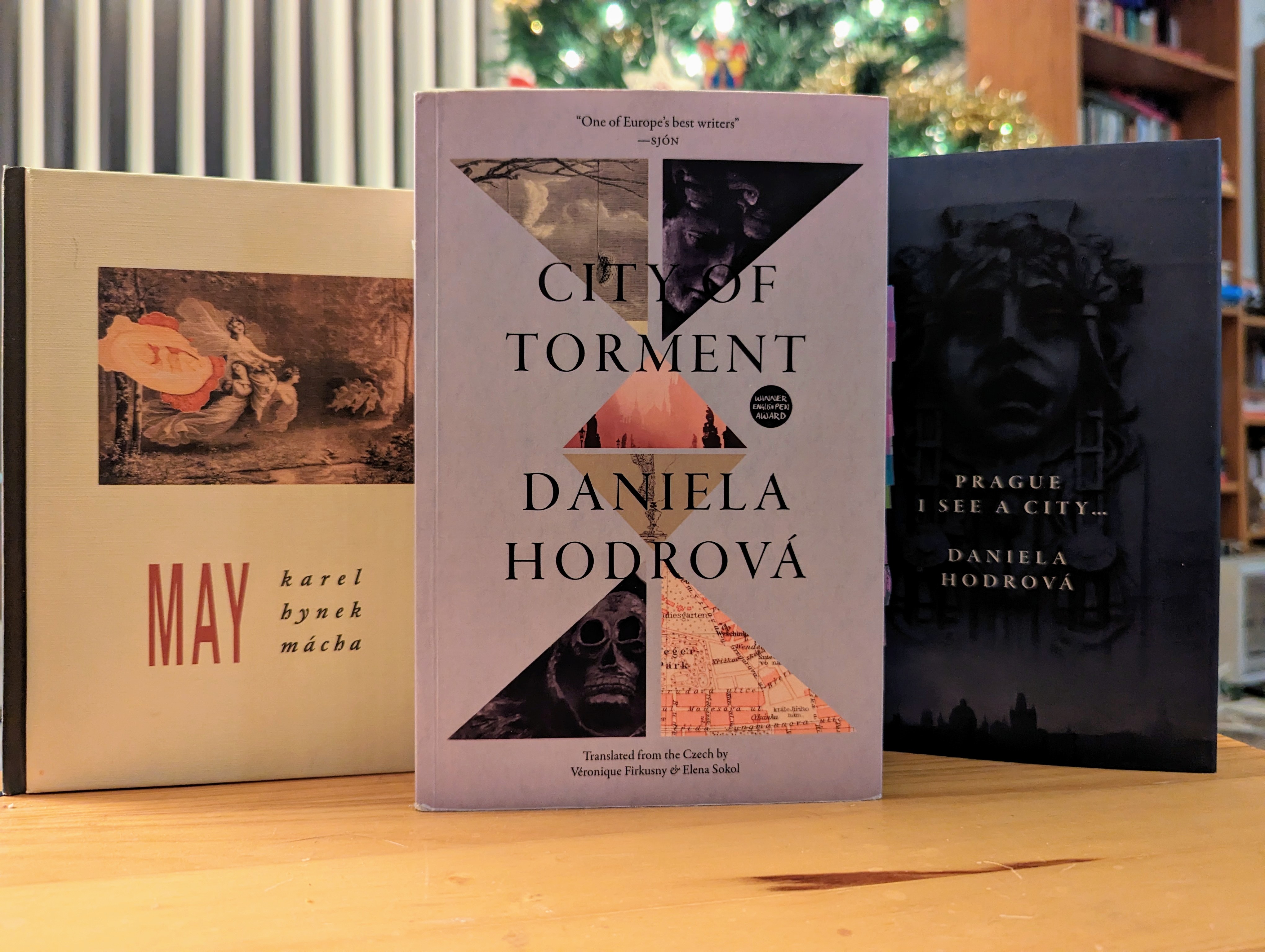
City of Torment – Daniela Hodrová’s monumental trilogy (translated from the Czech by Elena Sokol and others) is a complex, multi-faceted, experimental work that explores a Prague formed and deformed by literary, historical and political forces, haunted by ghosts and the author’s own personal past. After finishing the book, I sensed that I was missing much of the foundational structure—not that it effects the reading in itself—but I wanted to understand more. I read Hodrová’s own companion piece, Prague, I See a City… (translated by David Short) and more recently Karel Hanek Mácha’s epic poem May (translated by Marcela Malek Sulak), but I would love to have access to more of the related literary material, much of which is not yet available in English. I suspect that City of Torment is a text that will keep fueling my own reading for some time.

This year’s poetic treasures:

This is the most challenging category to narrow down. I read many wonderful collections, each so different, but three are particularly special.

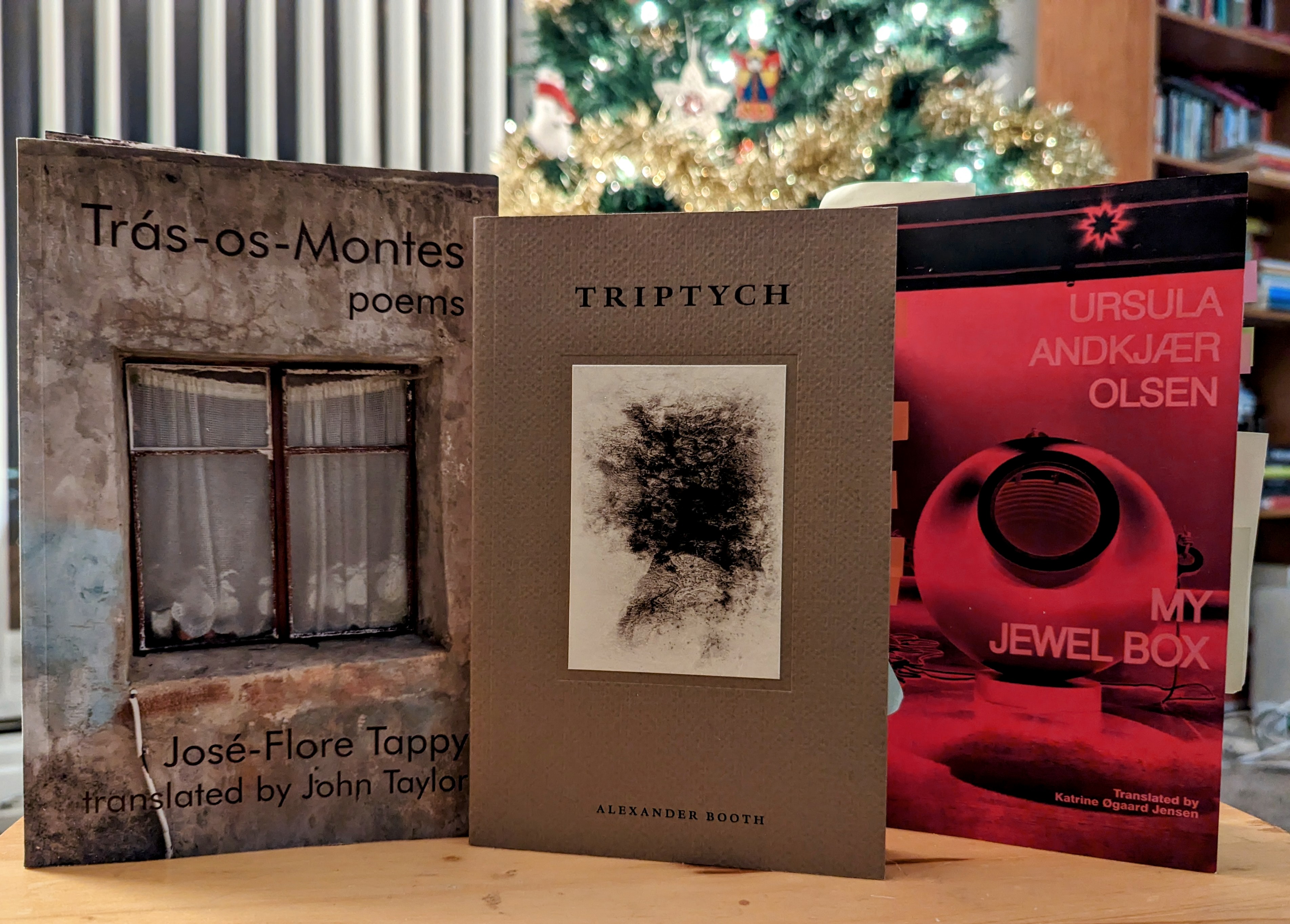
Translator John Taylor has introduced me to a number of excellent poets over the years and in 2022, it was his translation of French-language Swiss poet José-Flore Tappy’s Trás-os-Montes. I read this gorgeous book in August and it is still on my bedside table. It’s not likely to leave that space for a long time yet, and that’s all I need to say.  

I first came to know of Alexander Booth as a translator (and read a number of his translations this year) but his collection, Triptych, stands out not only for the delicate beauty of his poetry, but for the care and attention he put into this self-published volume. A joy to look at, to hold and to read.

Finally, My Jewel Box by Danish poet Ursual Andkjær Olsen is the conclusion of an organically evolving trilogy that began with one of my all-time favourite poetry books, Third-Millennium Heart. Not only is this a powerful work on its own, but I had the great pleasure to speak over Zoom with Olsen and her translator, Katrine Øgaard Jensen, for Brazos Bookstore in May. The perfect way to celebrate a reading experience that has meant so much to me.

Books that defied my expectations this year:

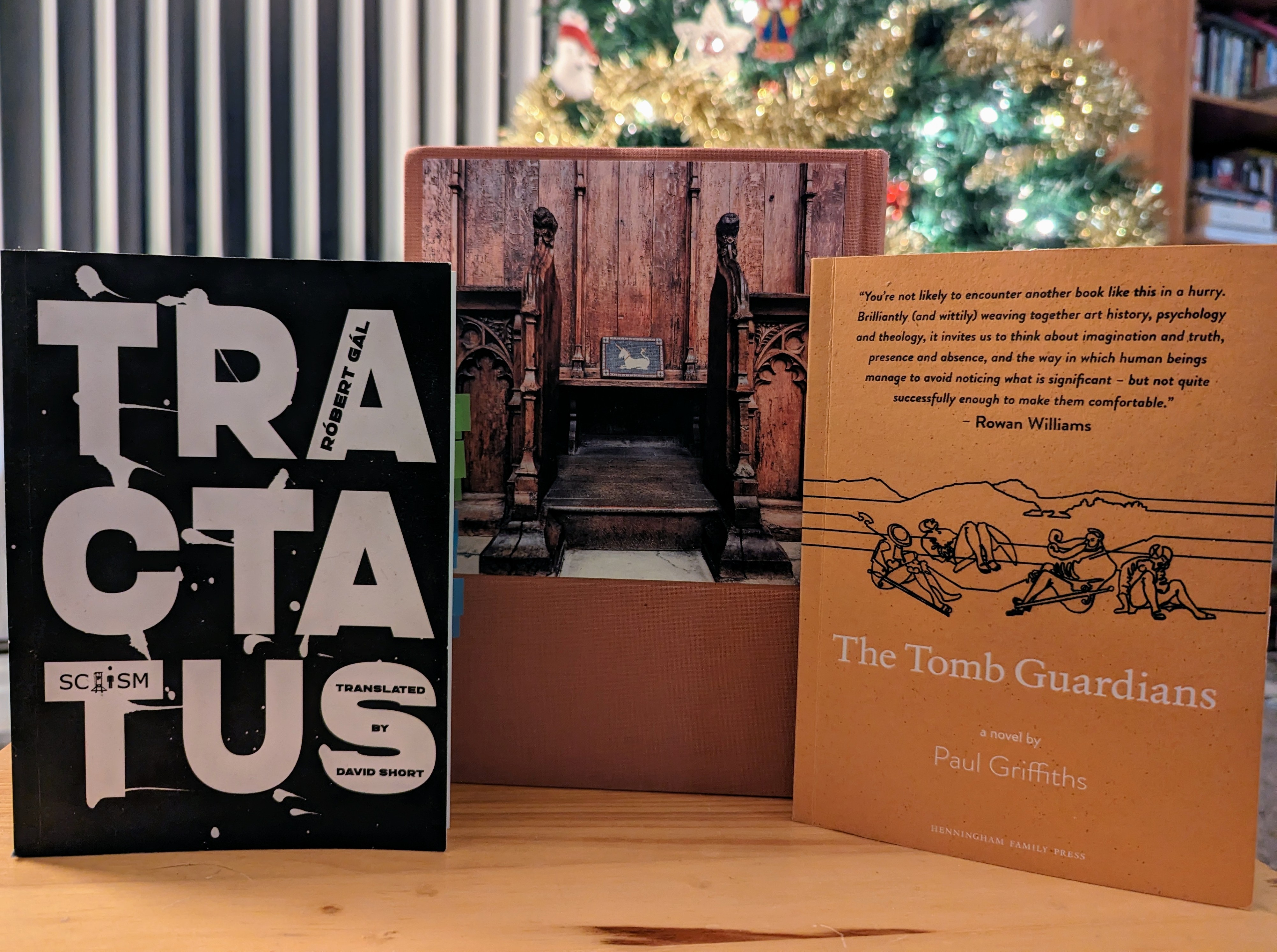
Prague-based writer Róbert Gál has produced books of philosophy, experimental fiction and aphorisms—each one taking a fresh and fluid approach to the realm of ideas and experience. His latest, Tractatus (translated from the Slovak by David Short) takes its inspiration from Wittgenstein’s famous tract to explore a series of epistemological and existential questions in a manner that is engaging, entertaining and provocative.

A Certain Logic of Expectations (you see the back cover here) by Mexican photographer and writer Arturo Soto is a look at the Oxford (yes, that Oxford) that exists a world apart from the grounds of the hallowed educational institution. Soto’s outsider’s perspective and appreciation of the ordinary offers a sharp contrast to the famed structures one associates with the city (and where he was a student himself) and what one typically expects from a photobook.

The third unexpected treat this year was The Tomb Guardians by Paul Griffiths. This short novel about the soldiers sent to guard the tomb where Jesus was buried is an inventive work that explores questions of faith, religion, and art history. Truly one of those boundary-defying works to use a term that seems to get used a little too often these days.

The best books I read in 2022:

Again, an entirely personal assessment.

I loved Esther Kinsky’s River, but Grove (translated from the German by Caroline Schmidt), confirmed for me that she is capable of doing something that other writers whose work skirts the territory occupied by memoir and autofiction rarely achieve, and that is to write from the depth of personal experience while maintaining a degree of opaqueness, if that’s the right word. One is not inundated with detail about the life or relationships of her narrators. Rather, she zeros in on select moments and memories, allowing landscape to carry the larger themes she is exploring. So inspiring to the writer in me.

Monsters Like Us, the debut novel by Ulrike Almut Sandig (translated from the German by Karen Leeder) deals with an extraordinarily difficult topic—childhood sexual abuse. It does not shy away from the very real damage inflicted by predatory family members, nor does it offer a magical happy ending, but it does hint at the possibility of rising above a traumatic past. As in her poetry where Sandig often draws on the darkness of traditional European fairy tales, she infuses this novel with elements and characters that embody the innocence, evil and heroic qualities of folktales within an entirely and vividly contemporary story. So much to think about here.

Hanne Ørstavik’s The Pastor (translated from the Norwegian by Martin Aitken) was my introduction to the work of a Norwegian writer I had a lot about over the years. This slow, melancholy novel set in the far north regions of Norway, beyond the Arctic Circle in the dead of winter, was a perfect fit for me as a reader, in style and subject matter. The story of a female pastor who takes a position in a remote village following a personal loss that she does not fully understand, explores emotional, historical and spiritual questions through a character who is literally stumbling in the dark.

So, what might lie ahead? This past year I embarked on two self-directed reading projects—one to focus on Norwegian literature for two months, the other to read and write about twenty Seagull Books to honour their fortieth anniversary. I found this very rewarding experience. Both projects were flexible enough to allow me freedom, varietyand plenthy of room for off-theme reading, but in each case I encountered authors and read books I might not have prioritized otherwise. For 2023 I would like to turn my attention to another publisher I really admire whose books are steadily piling up in my TBR stack—Archipelago. As with Seagull, they publish a wide range of translated and international literature that meshes well with my own tastes and interests. I don’t have a specific goal in mind, but already have a growing list of Archipelago titles I’d like to read. Other personal projects—public or private—may arise, perhaps more focused toward the personal writing I always promise to get back to, but time will tell. If the last few years have taught us anything, it’s that it’s a long uncertain road from January 1st to December 31st and it’s best not to try to outguess what the road might hold. Hope for the best and prepare for the worst once more.

Best wishes for the New Year and thank you for reading!

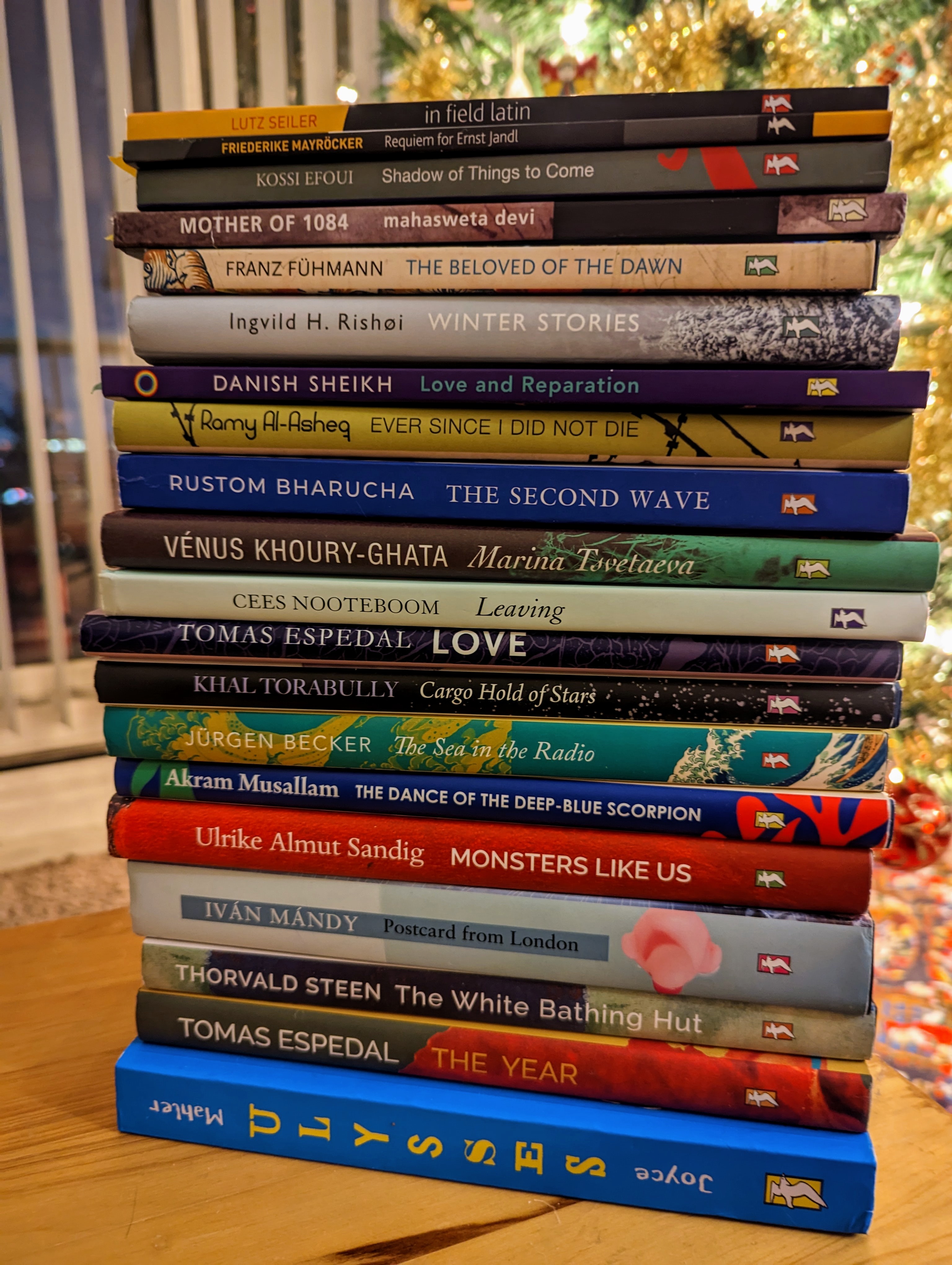
Twenty Seagull books to mark forty years of publishing magic: A 2022 reading project wrap up

Long-time followers of roughghosts will know that I have a particular fondness for Seagull Books. They continually publish a wide range of interesting international and Indian authors, bring many to English language audiences for the first time and, oh, those covers! Senior Editor and Designer Sunandini Banerjee’s work is instantly recognizable, yet always original. And not only have I amassed a healthy collection of their publications, but I have also visited Calcutta twice, taught classes at their School of Publishing and treasured their friendship and encouragement over the years. I admire the work they produce, their dedication to supporting fellow independent publishers in India and abroad, and their work to further understanding and education through the Seagull Foundation for the Arts. So to mark their fortieth anniversary this year I decided, somewhat late in the game, to embark on a personal reading project. I promised myself that I would read and write about twenty Seagull books by year’s end. Twenty for forty.

And here we are.

To date, I have reviewed all but one of these books—the remaining review of Vénus Khoury-Ghata’s Marina Tsvetaeva will follow in the next few days—but I wanted to stop and celebrate twenty excellent reading experiences before the holiday busyness begins. My reading naturally overlapped with my other 2022 self-directed projected, a focus on Norwegian literature, and the annual months devoted to Women in Translation and German Literature that I try to contribute to each year. Within and beyond that there was still plenty of room for variety. Two of the books I read were English originals—both from India—and the rest were translated: six German, four Norwegian, three French (two of which were by African writers, the third Lebanese-French), two Arabic, one Hungarian, one Dutch and one Bengali. I read five works of poetry/prose poetry, nine novels, three collections of short fiction, one long form essay, one play, and one graphic novel. Had I planned this project a little earlier I might have read more nonfiction, but as the year was rushing to a close book length became a deciding factor—December’s four books were necessarily shorter and that influenced choice!

Among this stack of handsome books are some authors I had already come to know and love through Seagull—Tomas Espedal, Vénus Khoury-Ghata, Franz Fühmann, Ulrike Almut Sandig and Friedrike Mayröcker, plus one writer I have long wanted to read: Mahasweta Devi. But, as usual, there were some unexpected surprises among the authors I encountered for the first time, most notably German Jürgen Becker and Hungarian Iván Mándy.

Happy fortieth anniversary, Seagull! Here’s to an ever brighter future.

Books read:
in field latin by Lutz Seiler, (German) translated by Alexander Booth
Requiem for Ernst Jandl by Friedrike Mayröcker (German) translated by Roslyn Theobald
Shadow of Things to Come by Kossi Efoui (Togo/French) translated by Chris Turner
Mother of 1084 by Mahasweta Devi (India/Bengali) translated by Samik Bandyopadhyay
The Beloved of the Dawn by Franz Fühmann (German) translated by Isabelle Fargo Cole
Winter Stories by Ingvild Rishøi (Norwegian) translated by Diane Oakley
Love and Reparation by Danish Sheikh (India)
Ever Since I Did Not Die by Ramy Al-Asheq (Arabic) translated by Isis Nusair
The Second Wave by Rustom Bharucha (India)
Marina Tsvetaeva by Vénus Khoury-Ghata (Lebanese-French) translated by Teresa Lavender Fagan
Leaving by Cees Nooteboom, w/ drawings by Max Neumann (Dutch) translated by David Colmer
Love by Tomas Espedal (Norwegian) translated by James Anderson
Cargo Hold of Stars: Coolitude by Khal Torabully (Mauritis/French) translated by Nancy Naomi Carlson
The Sea in the Radio by Jürgen Becker (German) translated by Alexander Booth
The Dance of the Deep Blue Scorpion by Akram Musallam (Arabic) translated by Sawad Hussain
Monsters Like Us by Ulrike Almut Sandig (German) translated by Karen Leeder
Postcard from London by Iván Mándy (Hungarian) translated by John Batki
The White Bathing Hut by Thorvald Steen (Norwegian) translated by James Anderson
The Year by Tomas Espedal (Norwegian) translated by James Anderson
Ulysses by Nicolas Mahler, after James Joyce (German) translated by Alexander Booth