Another winter solstice is upon us: 2016 – The year in review

Winter solstice. The longest night of the year.

Moving forward, the days grow steadily longer and, in less than two weeks, we will leave a dark, disturbing year behind us.

But it would be reckless to imagine that 2017 will be brighter. However, with luck, we can be forewarned, forearmed, and determined not to relax our guard. We can stand together against the rising tides of hatred, and remember what is truly at stake.

11229294674_e5844929df_z1

Since I started this blog two and a half years ago, winter solstice has become my annual check-in point. Last December, I reflected on the key elements of a year that began with a move to writing seriously about books and culminated with my first review for Numéro Cinq. Against that trajectory, I wrote about my trip to South Africa, and the pulmonary embolism and cardiac arrest that followed within a few weeks of my return. I imagined that the eventful year I had experienced would not likely, for better or worse, be exceeded this year.

Cue 2016.

This has been a year of heartache, anger, and dismay. Around the world and close to home. I watched the violence in Syria, the outcome of the Brexit vote, and the spectacle of the American election, among the other tragic and unexpected events that have unfolded. And as economic uncertainty and anxiety has grown in my own hometown—a city that lives and dies with the price of oil—the crime and homicide rate has risen sharply this year. It does not feel like the same community any more.

Then there is the lengthy roll call of the writers, artists, and performers who have left us. But to be honest, I cannot say that I have felt these losses as acutely as many others… I’ve been distracted by the immediate, personal losses that marked this year. My mother, my father, and one of my closest friends, all gone within the span of two months. And my grief—that most fundamental human emotion—is complicated, inarticulate, and wearing.

It will take time.

11592010455_89917d80e3_z1

But, 2016 has also been a time of amazing growth and opportunity for me as a writer. I don’t know how often I resolved, with the dawn of a new year that: This year I will write. Last December, with that first critical review under my belt, I could not have imagined that I would have, in addition to regular contributions to Numéro Cinq, published reviews at 3:AM, Minor Literature[s], The Quarterly Conversation, and The Rusty Toque. And I would not have dared to dream that I would see my essays and prose pieces published on line and in print, or that I would be invited to join the editorial team of The Scofield. As 2017 approaches, I have a handful of reviews scheduled and several prose projects underway. I’m also feeling inspired to return to photography after a lengthy hiatus, and to see how I can incorporate photos into my written work.

I have much to look forward to, in spite of, or rather, against the new darkness that threatens.

Art and literature are more important than ever at times like this.

So, this seems to be an appropriate time to look back over this year’s reading, and highlight the books that stand out for me.

I’ve read about 50 books to date, a little more than half of what I read in 2015. I don’t even want to hazard a guess as to how many books I bought, received as review copies, or brought home from the library. I feel, as usual, like I fell short of my intentions. However, I have to remember that I was writing, working on critical reviews, and dealing with considerable life stresses over the past twelve months.

More than ever before, I read like a writer this year. That is, I was especially attuned to voice, structure and approach to storytelling. Consequently, the books that made my year-end list tend to reflect this focus. Of course, any “best-of list” leaves out many excellent books. I’ve managed a baker’s dozen here, and it’s probably a reflection of the increased number of off-blog reviews I wrote that this year’s list is predominately composed of new releases. I was surprised to see that once I’d made my selection.

In reverse chronological order, my top reads of 2016 include the following:

Story of Love in Solitude by Roger Lewinter (France), translated by Rachel Careau
I will write about this collection of three short stories once I have completed The Attraction of Things. My verdict is still out on that title, but this tiny book is simply wonderful.

The Inevitable Gift Shop by Will Eaves (UK)
Fragmentary, cross genre writing that works fascinates me. Billed as a “memoir by other means”, it is Eaves’ unique tone that makes this blend of memoir, literary criticism, and poetry so compelling. His thoughtful reflections on reading and writing made this an ideal meditation to turn to after a year of reading critically and exploring my own literary voice.
gravediggerThe Absolute Gravedigger by Vítěslav Nezval (Czech Republic), translated by Stephan Delbos & Tereza Novická)
I have found myself turning to poetry more and more as the world seems increasingly unstable and, well, surreal. This newly translated collection of poetry by one of the best known Czech Surrealists should be essential reading at this time. Originally published in 1937, the darkness he could see on the horizon are all too familiar once again.

The Country Road by Regina Ullmann (Swiss), translated by Kurt Beals
I read this collection of short stories when I was in a very low mood. But in the spare, sombre prose of these tales I found a beauty that, rather than deepening my depression, brought strange comfort. Admired, in her lifetime, by the likes of Rilke, Mann, and Musil, Ullmann’s work is mostly forgotten today. This volume, released in English translation in 2015, is a rare treasure—one that I encountered at just the right moment.

panorama-coverPanorama by Dušan Šarotar (Slovenia), translated by Rawley Grau
For me, as a reader and a writer, one of the most important books I read this year is this literary meditation on migration, language, landscape, and loss. This novel finally broke through my own stubborn determination to hold to a sharp delineation between fiction and nonfiction, and has made me re-evaluate potential approaches to themes I wish to examine. What Šarotar achieves here with his own unique take on what might be deemed a “Sebaldian” approach, is the creation of an atmospheric, captivating, and intelligent work.

The Passion According to G.H. by Clarice Lispector (Brazil), translated by Idra Novey
Oh wow! In a way, I am glad I didn’t read Lispector before writing and publishing my essay “Your Body Will Betray You,” because she is exploring the process of coming into being so beautifully that I might not have been able to write at all after reading this. Employing an unconventional narrative, Lispector’s G.H. experiences a vivid, metaphysical crisis triggered by the sight of a cockroach. The result is a remarkable, thoroughly engaging read. I have at least three more of her books waiting for the new year.

Proxies by Brian Blanchfield (US)
I bought a number of essay collections this year and currently have several on the go. This collection impressed me not only for the way the essays were composed—written without consulting outside sources—but for some of the ideas explored, and for reinforcing the value and possibilities of the personal essay/memoir form. I also greatly appreciated his guiding caveat: Permitting Shame, Error and Guilt, Myself the Single Source.

SergioSergio Y. by Alexandre Vidal Porto (Brazil), translated by Alex Ladd
This book is significant and important for dealing with gender identity and transition in a sensitive and original way. I am, as a transgender person, critical of much of what passes as literary writing on this subject. This is a most impressive work with a startling and unique approach. As I noted in my review, Sergio Y. is novel that approaches the transgender experience from the inside and the outside, allowing for the comfort with names and pronouns to vary, over time and from person to person, reflecting the complexities of relationships that others, even loving family members, can have when an accepted and assumed identity is challenged. That is the book’s greatest strength.
surrThe Surrender by Scott Esposito (US)
This book was on my radar from the moment I first heard of it. Again, despite my typical gender related skepticism, I was drawn to this transgender-themed memoir/film critique/literary diary. I wanted to know how Scott would present his story—one that is not commonly heard. Although his journey is very different than mine, we share a certain sensibility. This is a brave and most wonderful book by a man who has long been one of my heroes. He has since become one of the many literary friends I have come to know and cherish this year.

Layout 1

Atlas of an Anxious Man by Christoph Ransmayr (Austria), translated by Simon Pare
This book was a total surprise when it arrived courtesy of the good people at Seagull Books. This most unusual travelogue, a series of brief “encounters” across the globe, contains some of the most stunning descriptive language I have ever read. Each episode begins with the words “I saw…” and ends with a wise, evocative observation. From the North Pole, to South America, from deep inside the mountains of New Zealand, to a parking lot in San Diego, this is a journey that will not be easily forgotten. Highly recommended.

Quiet Creature on the Corner by João Gilberto Noll (Brazil), translated by Adam Morris
My third Brazilian book on this list is this enigmatic novella that led to one of the most entertaining literary discussions of the year. What is it about? Well that is the challenge. I had to read it three times before I could begin to get a handle on it. The narrator, a young man who finds himself in a strange situation that is rapidly growing stranger, is, in his oddly passive tone, almost more disturbing than whatever might be happening. Opaque and surreal, this book gets under your skin.

The Crocodiles by Youssef Rakha (Egypt), translated by Robin Moger
This novel still holds fast in my memory although I read it back in February. It is, as I described it in my review, a prose poem of simmering power, unwinding across 405 numbered paragraphs, tracing a torturous path from the first stirrings of poetic assurance within a trio of young men in the 1990s to the doomed protests of the Arab Spring. It is a dark, intense exploration of youthful political idealism, that builds on repeated images, themes and refrains to create a compelling narrative force as it moves toward its stunning conclusion. Again, this is another work that is increasingly relevant in today’s world.
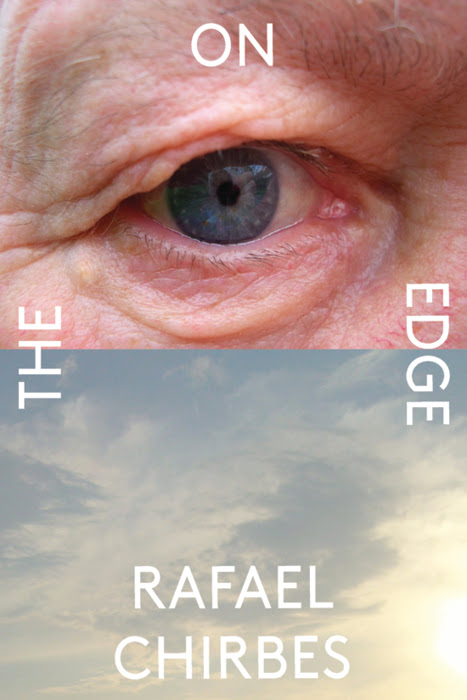
On-the-edgeOn the Edge by Rafael Chirbes (Spain), translated by Margaret Jull Costa
Finally, the very first book I read in 2016 is probably my favourite book of the year. I wrote about this novel at length for Numéro Cinq and I regret that it has not generated more discussion. In what is essentially an extended monologue with brief cameos from other characters, Chirbes creates a memorable, engaging, and tragic character in seventy-year-old Esteban, a man who has lost absolutely everything in the economic collapse of 2008.  Thoroughly human in his wisdom, his resolve, his shortcomings, and his despair; this is a powerful and important book that deals frankly with many of the critical issues—including migration, xenophobia, and economic decline—that are more vital than ever as we step into 2017.

Round and round: 33 Revolutions by Canek Sánchez Guevara

The unnamed protagonist of 33 Revolutions, a stark, relentless portrait of life in Castros’ Cuba, is a divorced, black man—a misfit who chafes against the collective tedium of his existence until he is forced to decide, like so many before him, what, if anything, holds him to his wretched island nation. The revolutionary bloom is long off the Communist rose that once held his hopes and enthusiasm. With weary resignation, he shuffles off to his ministry job day after day, enjoying the few privileges afforded by the little bit of extra money sent to him from his mother overseas, but it is a hollow existence:

Duty and desire. Angrily, he bangs out his dilemma on the typewriter until the paper is perforated with periods and commas. His desire is to be alone in his office, in this city, in this country, and never to be disturbed. Monotony is expressed in a thousand ways and acquires various signs. Work, radio, new bulletins, meals, free time: I live in a scratched record, he thinks, and every day it gets a bit more scratched. Repetition puts you to sleep, and that sleepiness is also repeated; sometimes the needle jumps, a crackling is heard, the rhythm changes, then it sticks again. It always sticks again.

33Threaded through the thirty-three brief chapters of this slender novella, are two repeated refrains: the scratched record and the suffocating tropical heat. This imagery is employed so incessantly that it begins to wear a groove that could, in a longer or less deftly handled work, easily become irritating. Instead, the sheer beauty of the language lends the repetition a peculiar freshness. And that is exactly the intention. Tedium and repetition can be borne, can even seem bearable. Until one day it isn’t, and then all bets are off.

The author of 33 Revolutions, Canek Sánchez Guevara, inherited a proud and defiant spirit  from his grandfather, the famous Marxist revolutionary who fought alongside Fidel Castro. At the age of 22, he rejected the dictatorial politics of his homeland, and left for Mexico where he became a writer, graphic designer, and heavy metal guitarist. He was dedicated to writing and speaking out against Cuba’s single party system and its attendant human rights abuses until he died unexpectedly in 2015, at the age of 40. This hypnotically engaging novel allows his voice to continue on.

With a sense of absurdity that Kafka would appreciate, Sánchez Guevara creates, in his hero, a man who is aware that he stands at odds with the world around him. He finds refuge in books and an incongruous fondness for avant-garde music. He is aware that his life is paradoxical, verging on metaphysical weirdness that is both a blessing and a curse. And this painful self-knowledge does nothing to protect him from the monotony that curses his days or the vivid nightmares that haunt his sleep. He understands his reality all too well:

He looks down at the sea again and drinks straight from the bottle. Behind him, the dirty, beautiful, broken city; in front of him the abyss that suggests defeat…. We win by isolating ourselves, and in isolating ourselves we are defeated, he thinks. The wall is the sea, the screen that protects us and locks us in. There are no borders; those waters are a bulwark and a stockade, a trench and a moat, a barricade and a fence. We resist through isolation. We survive through repetition.

As this ceaseless repetition begins to weaken him, our protagonist’s disaffection grows. An undercurrent of protest starts to build within him, fueled by the oppressive heat and boredom. He had long managed to hold his distance, to stand apart from both the street corner reactionaries and the huddled gossips distorting what the rumours passed down to the masses—but this continual buffering against the insidious mechanisms of state control, starts to wear him down like, well, the needle on a scratched record.

The heat is criminal—it melts neurons, incites to violence, multiplies fertility tenfold. There isn’t a beer for miles around (or water, or a barley drink, or anything that can be bought with national currency). Nothing belongs to me, he thinks. And what about me, do I belong to anything? (The scratched record plays insistently.)

His rebellion starts passively, opting out and feigning sick, but in that act the course is turned.

He finds himself drawn to the shore. His experiences, not only of the city around him but the uncertain and desperate promise that waits beyond the waves, is mediated through the lens of his camera. The frame of the viewfinder becomes his means of contextualizing himself in the world and a focuses his hopes for a possible future elsewhere. Everyone seems to be leaving—his doctor, an old friend from school, groups of kids clinging to rafts of questionable seaworthiness. The camera with its ability to play with depth of field, becomes his tool in an attempt to tell an alternate story, take control of and document his own fate.

This brief novella hits hard. Harder perhaps in the light of Fidel Castro’s recent passing, and in the desperation of migrants risking the seas for a better life elsewhere. The anguish that comes through personal and powerful, and it is more important than ever that we stop for a moment to listen.

33 Revolutions, by Canek Sánchez Guevara is translated  by Howard Curtis and published by Europa Editions.

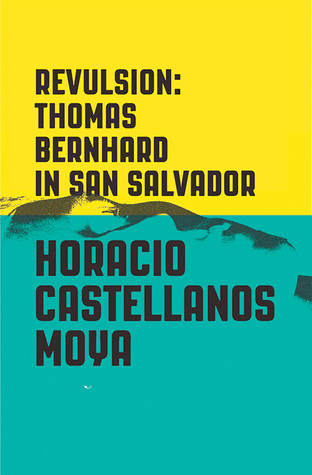
Homecoming – Revulsion: Thomas Bernhard in San Salvador by Horatio Castellanos Moya

In the note appended to the 2007 re-issue of Revulsion: Thomas Bernhard in San Salvador, author Horatio Costellanos Moya describes how a playful exercise in imitation led to very frightening death threats. Within a week of the book’s publication in 1997, his mother called to warn him against returning to El Salvador as he had planned. The immediate and hostile reaction indicates that not only was the element of satire missed, but the miserable misanthropic protagonist’s exaggerated rants were not entirely without grounds. But what angered some, impressed others, and the little book has endured, inspiring study, debate, and requests from citizens of other Central American countries for Castellanos Moya to similarly skewer their troubled nations. And now, at last, this incendiary novella is available in English from New Directions, in a no-holds-barred translation by Lee Klein.

RevulsionPresented with exuberant Bernhardian spirit, Revulsion is a relentless parody of the Austrian writer’s trademark style. The rhythms, repetition, and tone of Bernhard’s classic works are evoked along with a brutal, insistent ravaging of El Salvador and its capital city that is reminiscent, if not even more graphically emphatic, than the famous rants Bernhard routinely leveled against his own native country.

The eponymous narrator here, in a role common to many Bernhard novels, is on the receiving end of a breathless monologue recorded over the course of one single paragraph that stretches for more than 80 pages. The speaker is Edgardo Vega, a professor of art history who fled El Salvador for Montreal at the age of eighteen. Now, a further eighteen years later he has returned for the first time, to attend his mother’s funeral and ensure that her house is sold so that he can secure his claim on his share of her estate. To say there is no love lost between Vega and his native country would be an understatement.  His most prized possession is his Canadian passport, if he is proud of anything it is his successful escape from the pathetic aspirations of his middle class brother, the crime, the social decay, and the miserable dearth of anything resembling class or culture in San Salvador.

San Salvador is horrible, Moya, and the people who populate it are worse, they’re a putrid race, the war unhinged everyone, and if it was already dreadful before I took off, if it was unbearable for my first eighteen years, now it’s vomitous, Moya, a truly vomitous city where only truly sinister people can live, which is why I can’t explain why you’re here, how you can be around people who are so repulsive, around people whose greatest ambition in life is to be a sergeant; have you seen them walk, Moya?

No custom, institution or individual is left unscathed. Vega rails against his brother who owns a lock and key business, but shows no interest in books or art or anything beyond the most pedestrian popular music. He has less respect for his “ex-clothing store clerk” wife and his two “pernicious” boys who spend their time glued to the television set and have the audacity to call him Uncle Eddie. Even the old school friend with whom he is sharing a few hours at the local bar, a place he tolerates only in the quiet hours between 5:00 and 7:00 pm, is not entirely free from a measure of Vega’s contempt. The patient narrator’s literary ambitions are soundly ridiculed. In this way, Castellanos Moya is mocking himself, as he allows his ranting character to eviscerate his country.

The famished little stories about sex and violence aren’t worth it, I say this to you with affection, Moya, you’d be better off staying in journalism or another discipline; but at your age to be publishing these famished stories is a pity, said Vega, no matter how much sex and violence you put into them, there’s no way these famished little stories will transcend. Don’t waste your time, Moya, this isn’t a country of writers, it’s impossible for this country to produce writers of quality; it’s not possible for writers who are worth it to emerge in this country where no one is interested in literature, art, or any manifestation of the spirit.

As Vega’s account of the indignities to which he as thus far been subjected over the course of his return to his home town builds to a hilarious conclusion, one can feel the enthusiasm with which this exercise in imitation was created. Imagery is pushed to a vile extreme in places and, as much as humour slides through, the polemic unleashed against El Salvador is merciless. Castellanos Moya captures Bernhard’s tone and style with an almost pitch perfect delivery right down to the surprise ending. But with a protagonist who spits enough venomous spleen to make Bernhard’s most hyperbolic vitriol read like an afternoon at a Sunday school picnic, it is little wonder the satire was lost on some readers. All the same, for those who love the infectious wit and humour of the Austrian master, Revulsion: Thomas Bernhard in San Salvador is a wonderfully entertaining look at post-Communist El Salvador through a very dark lens.

Poets, artists and other lost souls: Last Evenings on Earth by Roberto Bolaño

A poet can endure anything. Which amounts to saying that a human being can endure anything. But that’s not true: there are obviously limits to what a human being can endure. Really endure. A poet, on the other hand, can endure anything. We grew up with this conviction. The opening assertion is true, but that way lie ruin, madness, and death.

The individuals that populate the stories collected in Roberto Bolaño’s Last Evenings on Earth tend to be poets, writers, artists, and dreamers. Typically they are oddly groundless, restless beings who seem to drift through not only their own lives but through the lives of those they encounter. Most are either exiles or products of the Chilean diaspora, loosely set down or wandering between Mexico or Europe. As a result, their existences carry a ghostly aura, they are haunted by an otherness that is indefinable to themselves and obscures their relationships with others. The narrators or protagonists are unsure of their own memories, sometimes anxious and paranoid, sometimes bored and aloof–unwilling to trust, to fully engage with those around them.

eveningsIn this, my first encounter with Bolaño’s work, I found myself captivated by the misty melancholic mood, the affecting prose, and the characters, who are commonly struggling with the vagaries of what it means to be creative and to find value in life. Yet there is an underlying ambivalence, anxiety, and insecurity that lends the collection an atmosphere that can be unnerving and faintly depressing. And it can also tend to contribute to blurring of the edges of many of the stories so that a reader may, at the end, be left with a sense of appreciating the journey but losing track of the details that set many of the tales apart.

That is not to imply though that there are not stories that stand out. In my reading, my favourites were the ones that happened to strike me as especially sad, but then I read this book at the bedside of a dying parent. Sadness was the order of the day.

The title story follows a young man and his father on an ill fated holiday to Acapulco. Their days pass in relative calm, though a strain can be felt in the relationship between the two. The father wants to go out, have fun, while the son prefers more solitary outings and spends much of his time reading a book about surrealist poets and contemplating the fate of one particular poet, a minor writer who disappeared and was essentially forgotten by his peers. Father and son engage in aimless conversations that highlight their differing temperaments while the latter is haunted by a feeling of impending doom. For a time the imagined threat is held at bay:

Then the lull comes to an end, the forty-eight hours of grace in the course of which B and his father have visited various bars in Acapulco, lain on the beach and slept, eaten, even laughed, and an icy phase begins, a phase that appears to be normal but is ruled by the deities of ice (who do not, however, offer any relief from the heat that reigns in Acapulco), hours of what, in former days, when he was an adolescent perhaps, B would have called boredom, although he certainly would not use that word now, disaster he would say, a private disaster whose main effect is to drive a wedge between B and his father: part of the price they must pay for existing.

As the threat becomes real, the son’s passive reaction to all of the warnings that come his way add to a tension built on the very human ability to fail to act on one’s better instincts. Bolaño is a master at exploiting the ambivalence that erodes relationships. Again and again his characters prefer to observe rather than engage, things are left thought but unsaid until, very often, it is too late.

Another especially poignant story is ‘Mauricio (“The Eye”) Silva’. Here the narrator recounts the experiences of a fellow Chilean exile he meets in Mexico City. The Eye is described as a sensitive man, one who always tried to avoid violence, “even at the risk of being considered a coward.” He eventually finds work as a photographer and as his modest fortunes improve he develops a style of dress that sets him apart from other Chilean exiles and likely leads to the intimation that he is a homosexual–a designation received with considerable derision, even fear, by his fellow countrymen at that time.

One night the narrator encounters The Eye in a cafe. The description of his friend is striking. Bolaño’s characters seem to pay particular attention to the appearances of their friends and acquaintances, almost as if they are looking to read something lurking beneath the surface, an understanding, a message or an ulterior motive:

I sat down next to him and we talked for a while. He seemed translucent. That was the impression I had. The Eye seemed to be made of some vitreous material. His face and the glass of white coffee in front of him seemed to be exchanging signals: two incomprehensible phenomena whose paths had just crossed at that point in the vast universe, making valiant but probably vain attempts to find a common language.

On this evening, The Eye not only confirms his sexuality, but announces that he will be moving to Paris where he can live more openly and pursue the kind of photographic work he has always dreamed of. It will be years before they meet again. The narrator, now married with a child and published books to his credit, crosses paths with The Eye in Berlin and learns of the life altering, disturbing experiences his friend had in India. It seems that the man who had always tried to avoid violence has discovered, like other Latin Americans of his generation born in the 1950’s, that violence would ultimately find him, even on a distant continent.

The fourteen stories that comprise Last Evenings on Earth are imbued with a wistfulness that captures the spirit of dislocation of the exiled. But with his evocative, evenly paced prose Bolaño speaks to a borderlessness that many of us feel when we don’t fit in wherever we happen to be. It is, perhaps, the writer’s soul that responds, I don’t know. I feel at a loss to define it, in this, my first experience with his work, but I do know I will return for more.

Last Evenings on Earth is translated from the Spanish by Chris Andrews and published by New Directions.

All the world’s a stage: On the Edge by Rafael Chirbes – My review for Numéro Cinq

My latest review for Numéro Cinq is now live. On the Edge by the late Rafael Chirbes has just been released in North America (New Directions) with a UK release forthcoming from Harvill Secker in July. This is an unforgiving portrait of Spain in the aftermath of the 2008 economic crisis, through the eyes of one man who has lost everything:

On-the-edge

For the Spanish writer, Rafael Chirbes, there was no room in the creative process for an aesthetic devoid of ethics. As a documentarian of his native country, from the post-war years through the transition to democracy in the 1970’s, and on into the opening decade of the 21st century, the late author offered a defiant chronicle of the point where social, economic, and political dynamics intersect with the harsh realities of the human condition. He argued that if the artistic endeavour aims to stand at that intersection, no perspective could remain neutral:

A point of view situates you somewhere, in a location where potentialities—ways of being—battle one another. When you write, or paint, as when you read or look at something, you have to be conscious of the fact that the author wants to invite you to look where he’s looking. Your mission is to protect yourself. Know that they want to seduce you.

This advice, from a brief interview segment in A Thousand Forests in One Acorn: An Anthology of Spanish-Language Fiction (Valerie Miles, Open Letter Books, 2014), should serve as fair warning before one enters into the emotional labyrinth that is Chirbes’ lauded ninth novel, On the Edge. Recently released by New Directions, in a measured yet lyrical translation by Margaret Jull Costa, this book will serve as highly anticipated introduction for English language readers, to a writer at the height of his powers: a writer who has chosen, in this instance, to stand on the rapidly shifting ground of a country in the throes of economic collapse.

Find the rest of the review here

Reality is a miracle… Things Look Different in the Light by Medardo Fraile

In a story titled “The Sea”, a couple vacationing on the Mediterranean make their way to the seashore each day where the husband joins the line of humans on the beach who sit staring at the water, mesmerized. The experience fills him with a sense of unease.

“The waves were never the same, although they may have repeated themselves in similar cycles. The meaning of the wave never went beyond being a rather comforting mystical murmur. But the sea seemed to express itself in ways superior to the wave, in whole unintelligible paragraphs and speeches, as rich in modes and forms as it was in depths and fishes. On the other hand, I understood nothing of what it said.”

thingsLike the vast sea with its hypnotic surface and hidden secrets, reality is a shimmering quantity in the hands of Spanish author Medardo Fraile. A master of the short story, he is able to distill an experience or sketch out an entire life span within a handful of pages. In this collection, Things Look Different in the Light, he breathes life into a wide variety of unforgettable characters – young or old, ordinary or eccentric. We meet weary professors, crafty spinsters, uncommunicative middle-aged couples, meek bachelors and curious children who don’t quite understand the world of adults. We even encounter inanimate objects that take on lives of their own rich with meaning and emotion, bound to and yet separate from the human with which they are associated.

Consider “A Shirt”, the simple fable of sailor who, after a single love affair, returns alone to his hometown to take up the life of a fisherman. Each day he dons the same tartan shirt until one fateful day when shirt is left behind on the line:

“At around four o’clock in the morning, with no wind to speak of, the shirt began to move. It flapped wildly about, anxious and empty, as if wanting to break free of the pegs gripping its shoulders. The flailing sleeves rose and fell, filled by the invisible lament of some terrible tragedy. They occasionally joined wrists or else stretched wide, arms spread.”

Or share the frustration of the lingerie salesman in “The Lemon Drop” who had imagined a literary career for himself and can’t quite come to terms with the place where life has left him. He wonders what happened to the scabby-kneed boy who used to go bird’s nesting and smoke on the sly:

“Now I never smoke. I used to own a pellet gun. I have big hands, like cowboys in the Wild West. And by ‘I’, I mean this person who is me. This weary fellow who walks home bent beneath the weight of his briefcase, which, one day, grabbed hold of his hand like a dog and feels equally weary.”

From the opening story about a tongue-tied man at a baby’s birthday party, set on edge by a woman he cannot bear to face, to the chillingly beautiful “Last Shout” in which a child recalls a beloved grandmother’s final months; you know you are in the presence of a gifted storyteller. He manages to adjust the focus to bring to light the details that are essential to the tale he wishes to tell. No more, no less. Simply perfect.

Born in Madrid in 1925, Fraile started his career in experimental theatre, a background that may well account for the spare, magical quality of many of his short stories. He left Spain in the 1950‘s, and although he would ultimately settle in Scotland, his work was not made available to English speaking readers until the release of this wonderful collection from Pushkin Press, translated by the renowned Margret Jull Costa, with a warm and enthusiastic introduction by Ali Smith. A fellow blogger, Jacqui at JacquiWine’s Journal first drew my attention to this book so I knew it was one that I wanted to read (sooner rather than alter, that is)  when it was longlisted for this year’s Best Translated Book Award. Things Look Different In the Light has progressed to the shortlist.

Medardo Fraile died in 2013.

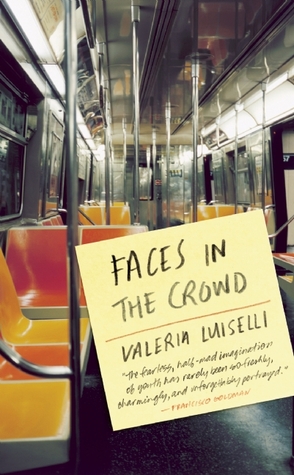
In the window of a passing train: Faces In the Crowd by Valeria Luiselli

“All novels lack something or someone. In this novel there’s no one. No one except a ghost that I used to see sometimes in the subway.”

Faces in the Crowd, the debut novel from the young Mexican novelist Valeria Luiselli, is indeed a book of ghosts. The narrator is a young wife and mother living in Mexico City. As she tries to carve out time and space to write a novel, she draws the reader into a reflective exploration of ghosts – the ghosts that haunt her present house, the ghost of a life she fell into living and working in New York City, and the ghost of Gilberto Owen, an obscure Latin American poet who lived in Harlem in the late 1920s.

And for a book of ghosts it is brilliantly, shockingly alive.

crowdThe novel opens with a deceptively simple narrative feel. Contemporary domestic life is played out against her reflections on her past life in New York City when she was younger, unencumbered and working as a translator for a small independent publisher. She catalogues the friends and lovers that drifted through her spare apartment. One day she happens to encounter the work of Gilberto Owen on a search for potential material for translation, but before long her professional interest turns into an obsession. She tries to pass off her translations of his work as translations by a better known poet, an attempt that comes dangerously close to succeeding. She rescues a dead plant from the roof of the building he once lived in. She imagines that she sees him in the subway – more than once. Finally it is clear to her that she must leave:

“In the subway, on my way home, I saw Owen for the last time. I believe he waved to me. But by then it did not matter, I’d lost my enthusiasm. Something had broken. the ghost, it was obvious, was me.”

For all the empty space in her earlier life, married life is clearly suffocating our narrator. She continually finds herself unable to breathe, struggling to focus on her writing in a large house, cluttered with toys, distracted by the demands of her children – simply referred to as “the boy” and “the baby” – and the jealous curiosity of her architect husband. As the fictionalized first person account of Owen’s life begins to assume a greater prominence within the story, her marriage starts to unravel (or perhaps she simply writes her husband into the background) while the overall narrative structure seems to disintegrate, boundaries blur. The novel within the novel becomes enmeshed with her day-to-day life, folding back on and re-envisioning the experiences recounted from her earlier life in New York. Or was that Owen’s life?

Echoing the continually reshaped game of hide and seek between mother and son running throughout this novel, Faces in the Crowd lays out a metafictional game of hide and seek. Can a horizontal novel be told vertically? How is such a story to be read? Where in translation does truth lie? And when can you play with truth? It winds up to a delightfully oblique ending. Or lack of ending – rather, an invitation to imagine, to reread.

I opened this book completely unprepared for the heart-stopping luminosity of the prose or the way that the narrative is fragmented and rebuilt to create a rich meditation on the nature of story telling. Valeria Luiselli demonstrates a maturity and confidence that belies her age without ever falling into a heavily somber tone. The translation by Christina MacSweeney maintains the lively, poetic flow of this impressive debut. I was pleasantly surprised by this intelligent and enjoyable read.

Faces in the Crowd has been longlisted for the 2015 Best Translated Book Award (BTBA).

Faces in the Crowd by Valeria Luiselli, translated by Christina MacSweeney                Coffee House Press, 2014

Imagining a life lost: In the Beginning was the Sea by Tomás González

For aspiring novelists, the greatest inspiration sometimes lies very close to home – at the heart of their own families. And most often, it is not a happy circumstance they are seeking to reconcile when setting pen to paper.

seaIn the late 1970s Colombian author Tomás González was struggling to build a career for himself as a writer. The murder of his brother Juan, on a farm where he had retreated to find a refuge, would provide the central focus of his debut novel In the Beginning was the Sea, first published in 1983, but not released in English until 2014.

There is a distinctly sober, calculated tone to this tale of J. and his girlfriend Elena, two faded hippies who seek to escape a life of drugs, alcohol, and partying in Medellín by purchasing and moving to a remote tropical farm. J. dreams of a simpler life, a new beginning. It soon becomes clear that he has absolutely no business sense at all. He repeatedly allows himself to be swindled and makes a series of reckless investments. As his debts mount, he demonstrates an uncanny ability to dig himself in deeper, disregarding the warnings of those around him. To add insult to injury, Elena and J. have a volatile relationship at best – one that the isolation of their new home does nothing to mediate. She tends to be caustic and unpleasant, especially to the native blacks who work for her or live in the area. The dislike is instantly reciprocated. J. is much more affable with the locals, a nature lubricated by increasingly copious quantities of cheap alcohol. But as time goes on, his world continues to spiral downward. In the end, as we are repeatedly warned, it will cost him his life.

As the story unfolds, González maintains an emotional distance from his subjects, but he excels at bringing the tropical farm to life. His language is highly evocative.

“Smells. The murky smell of the mangrove swamps carried sometimes on the breeze. The musky, resinous smell of crabs, dead and still raw. The smell of paddocks pounded by the immovable hammer of the noonday sun. The smell of mingled smoke and coffee from the kitchen. The lunchtime smell of fried fish, fried plantains, the heavy scent of
coconut rice. The smell of the suntan lotions and the moisturizers that made Elena’s skin more perfect.”

If there is a weakness here, it is the lack of a solid reference for the hostile and unpleasant behaviour Elena demonstrates throughout this novel. From the opening scenes where her precious sewing machine is damaged, we see a woman who refuses to tolerate any perceived incompetence in others. One is left to wonder what is behind this and what she ever saw in J. A history of divorce and depression is hinted at. His weaknesses are examined a little more closely and we know that he is torn between attraction and frustration with Elena, and that he harbours a deep personal sense of despair and failure. But again, the why’s are never fully explored.

Though some factors or circumstances may, in truth, defy full explanation; In the Beginning was the Sea does draw to a close with an imaginative and heartbreaking elegy, perhaps the one of the finest moments in the entire book.

Independent Foreign Fiction Prize 2015: Pushkin Press deserves to be praised for bringing long ignored works and authors to an English speaking audience. Frank Wynne’s translation is clear and vivid. I hope we will see some of González’s more mature work available in the future.

Border crossing ahead: Signs Preceding the End of the World by Yuri Herrera

“You don’t lift other people’s petticoats.
You don’t stop to wonder about other people’s business.
You don’t decide which messages to deliver and which to let rot.
You are the door, not the one who walks through it.”

signsA sinkhole opens up in the road in the opening passage of Yuri Herrera’s brilliantly inventive Signs Preceding the End of the World. Makina, a streetwise young Mexican woman charged by her mother with a mission to deliver a message to her brother who has disappeared across the border in the US, just narrowly misses being swept into its depth. Or does she? She is a wary customer, old beyond her years, capable of communicating in native, latin and anglo tongue – a skill that has secured the task of manning the central switchboard in her hometown and has equipped her, as well anyone might be, for the daunting task her mother has set out.

The rules outlined above are those that Makina holds close. Securing her safe passage will require making deals with a series of shady characters and her hardened discretion will be vital if she is to reach her destination. The language matches her pace. The short chapters, clipped sentences, and unique vocabulary hurry along, sweeping the reader with it as if time is of the essence and dare not be wasted. There is no time for for frivolities, Makina – and with her the reader – must be on the alert. This is a dangerous journey. It is one that many desperate people make every day. On the far side, the world to be navigated is both familiar and strange.

“The city was an edgy arrangement of cement particles and yellow paint. Signs prohibiting things thronged the streets, leading citizens to see themselves as ever protected, safe, friendly, innocent, proud, and intermittently bewildered, blithe, and buoyant; salt of the only earth worth knowing.”

But for the illegal migrant, temporary or permanent, the risks are real. The rewards often elusive, the costs high.

This slim novel is filled with passages of vivid intensity. Dark, epic in scope if not in scale, a few hours with Herrera is akin to a journey with Dante or Lewis Carroll. Right through to the final breath taking passages, I would challenge a reader to not emerge gasping for air.

Another wonderful offering from And Other Stories, Signs Preceding the End of the World is a deeply rewarding way to spend a few hours. In the Translator’s Note at the end of the novel, Lisa Hillman describes the joys and challenges she faced in capturing the right tone and shaping the language to preserve the magic and power of the original text. The result is an absolutely compulsive read. Highly, highly recommended.

Now, after this brief respite, back to reading the International Foreign Fiction Prize long list with my fellow bloggers on this year’s shadow jury.

A childhood of magic and darkness: By Night The Mountain Burns by Juan Tomás Ávila Laurel

“Every man on our Atlantic Ocean island has his own canoe, and if he doesn’t have one, a new canoe is brought into the world so that he does, so that nobody on the island has to borrow one from anyone else.”

A detailed account of the traditional construction of a canoe on the tiny island of Annobón, an activity that gathers the resources of the entire community, opens By Night the Mountain Burns by Equatorial Guinean writer and political activist Juan Tomás Ávila Laurel. Immediately we are drawn into an engaging, personal, conversational tale. The narrator is a deeply sensitive, if not well educated, man. His voice is fresh, at times naive, frequently looping back to revisit details, questioning the reader or foreshadowing events but deciding to hold off so that he can best share his childhood experiences, as he remembers them, on this remote island where natural resources are limited, life is difficult.

2015-03-14 02.11.35As a young boy, our narrator, lives in a large home with his grandparents and a number of mothers and siblings. Any fathers have long since disappeared to a land across the ocean, so no necessary distinction is made between birth connections, he sees all of the mothers as belonging to all of the children. His grandmother rules the roost while his grandfather is a curiosity to his many grandchildren. For some reason he has built his house facing the away from the sea and he sits watching the mountain that rises above the town day after day. He does not fish or go down to the beach to visit with the other men. In fact he does not come downstairs at all and the children never see him eat.

For our storyteller, the secrets of his his grandfather and a sense of the danger and misery adults must learn to live with begins to become clearer as a series of devastating events sweep his island community, beginning with a fire that starts on the mountainside destroying plot after plot of precious crops and threatening the town itself. Officially a Catholic community, the roots of superstition, folklore and mythology run deep and are intertwined with Christian saints and celebrations. In the wake of the fire, an especially violent act of retribution is carried out against a local woman assumed to be a she-devil, and then, before the community can heal, a plague of cholera sweeps through exacting a devastating toll on the population. Curiously, in this tale in which most characters remain nameless, every adult who dies is named in in full, and a cluster of crosses are inserted into the text to represent the numbers of dead who now crowd the sole cemetery on the island.

Even without the tragedies that run through the core of this account, daily life on the island is filled with challenges. Shortages of kerosene, among many other provisions – salt, soap, matches, tobacco, spirits, fish hooks, nylon rope, clothing – necessitate a careful rationing of light and flame. As a result, this novel is infused with a haunting darkness that is literal, metaphorical and even lyrical. Night brings both security and vulnerability. But moonlit nights are seen as even more threatening:

“… on moonlight nights we felt exposed, for the moon lit up the whole village and advertised our helplessness. I always felt that moonlight nights revealed our skeletons, our defects.”

Magical and evocative in the telling, mixing childhood wonder with reflective adult wisdom, Ávila Laurel introduces a place few will likely have heard of – the island where he grew up. He has been compared to Achebe and Marquez among others, but his account has a much more contemporary edge. When his character speaks of evil on the island, it is difficult not to think of the very brutal reality of the extreme poverty and social inequity that exist in his country as a whole, despite great resource wealth. Rooted in traditional story telling, this is a story for our modern times. It is exactly the type of important story that literature in translation should be bringing to a wider audience and a clear example of the vital role that independent publishers like And Other Stories play in this regard.

Finally, Jethro Soutar’s translation from the original Spanish is fluid, maintaining difficulties that the narrator, who is sharing his tale in Spanish, has finding words to express what Spanish cannot capture of his native island language. The quirks and qualities of his oral account are intact, the humour and insight shine through. Quite an accomplishment given that Ávila Laurel’s involvement in a hunger strike against the government of Equatorial Guinea that led to his ultimate exile to Spain added challenges to the communication between translator and author during the translation process.

International Foreign Fiction Prize 2015: By Night The Mountain Burns is the first long listed title for And Other Stories, and I confess my bias in that I have developed a great affection for this publisher so I am thrilled. I had in fact just purchased this title along with several others and it was sitting at the very top of my TBR list so it was a happy coincidence that it was selected.