To sing the song unsung: A personal answer to Singed by Daniela Cascella

The voice soundless and then, records unheard, song unsung, voice also unsung
dipped enshrouded ensheathed enlandscaped tongueless tongueless tied no story no record.

Daniela Cascella is a literary ecstatic. She engages with the word—written, spoken, sung, depicted—at an essential point of being, at that place where the spirit, soul, or daimon resides.

She listens into the silences, to the whispers and echoes, to the frayed edges of meaning. As a native Italian who writes in English, she attends to the spaces between languages, bending and folding her adopted tongue to affect fractured layers of intent. To open yourself to reading her is to be challenged to read and write with a new sensitivity to sound, voice and significance.

If I sound like an enthusiast, I am. Daniela (if this was a review rather than an answer I would refer to her by her last name—I will honour her instead, as Brazil honours Clarice) has been a vital friend and mentor over the past year and half since I first came to know her. As an essayist, my primary goal is to reach toward an articulation of the ineffable, to give voice to an existence, not between languages, but between gendered experience in a way that gets closer to an expression of being as I understand it than the common dialogue surrounding trans identity allows. I have no idea if that is an attainable goal, but Daniela’s essays and meditations thrill, inspire and ignite me.

Inspire and ignite me.

Ignite.

Her latest book, Singed, takes its title from permutations of sing: sing, singed, sung. It opens with the account of a fire. A few months ago the room at the top of our house caught fire. A large number of books and cds were lost to the flames. I first read of these burned books from a PDF of the text. I responded with horror; I felt wrenched with every title. Returning to this accounting on the printed page a few weeks later, I sensed an exaltation, a calling forth, a rising to a challenge, a refrain to be reclaimed amidst the losses. And that is what Singed is. As Daniela sifts through the ashes and embers, sings through the ashes and embers, she calls forward precious voices—Clarice Lispector, Teresa of Ávila, Laura (Riding) Jackson, Elfriede Jelinek, Marlene van Niekerk, Isak Dinesen, Fleur Jaeggy, Ingeborg Bachmann and more—chanelling their words and their attempts to speak to otherness. Hers is a reading as inhabiting the spaces between words.  The observations she makes and questions she asks, hang in the air, inviting her reader to ponder the unspeakable and challenge the constraints placed on how we’ve been taught to read and to write.

Woven through her literary explorations, are reflections on music and art. These excursions help frame, and reframe, a multi-dimensional engagement with the written word. Hearing, seeing, and speaking are essential activities, as are silence, emptiness, and unfinished forms. A sigh, for example, Clarice’s in particular, which Cascella (at this moment, this feels like a review) first encounters listening to Lispector’s last recorded interview, inspires an intuitive and rhythmic engagement with the works of other writers, a series of echo and dub sessions on the page. The experience of reading and writing a review of Marlene van Niekerk’s The Swan Whisperer, a short tale in which a young student loses himself in his endeavour to transcribe the language of swans, leaves her spellbound, speechless and wordless, unable to write for months. Of that interlude she says:

Today I know that the silence I experienced was a deep working of the stuff that makes writing be. It was the encounter with the substance that eludes you and that causes such physical turmoil when you grasp it in other words, in words you read in a poem or hear in a song, and you recognize their subject as yours.

And the connections she draws when writing across languages are illuminating, especially for those of us who are unilingual. In an essay about Fleur Jaeggy’s as yet untranslated novel, Le statue d’acqua, Cascella writes:

Where did the spirit of the world hide that night its reservoir of dreamers?

The porous blank portions between the words in The Water Statues soak up Jaeggy’s discomfortable writing. They enfold the space of space, or as Gass wrote of Rilke’s Innerweltraum, the space made by Being’s breathing… Not just the space we call consciousness, but the space where we retire in order to avoid a feeling… These spaces are always palpable as though space were smoke, or the mountains of the heart where the last of the hamlet of feeling may be discerned. The blank spaces host echoes, speech where speech ends, the voices of ancestors. Jaeggy herself has acknowledged, in discussing herself hearing writing in between German and Italian, that German is the language of her dreams…

Voices and echoes, and echoes of voices.

Repetition of a refrain.

Call and answer.

If reading Daniela Cascella’s work—including her earlier books, En Abîme and F.M.R.L.— has nurtured in me an alertness to sound in language and imagery, and an awareness of voice, more explicitly a desire to voice what is known without words, Daniela, as a friend and fellow writer, has personally encouraged me to incorporate more photographs (or a photographic sensibility?) into the presentation of my writing—a process I am still just beginning to explore.

But take this image:

July, 2015, mid-winter in Cape Town. This is the Company’s Garden, with the iconic façade of Table Mountain looming in the background. On that white columned building in the distance, if you could see it, is a poster advertising William Kentridge’s multi-media installation, The Refusal of Time. That is the South African National Gallery and this is my last full day in the city. I made my way through the gallery in near isolation and as I passed into the room containing the Kentridge exhibit, the recorded rhythms of metronomes and bellows were triggered and seemed, in the moment, to be contained within this dark space where I experienced the entire presentation alone, surrounded by noise and images, free to wander and absorb the full sensory explosion unhindered. Later, as I explored the rest of the gallery, I realized that the sounds and rhythms of the exhibit resounded and echoed through the entire building, enhancing my sensory appreciation of every photograph, painting and artwork I saw. I cannot think back on that visit to the gallery without hearing and feeling, the steady cadence, the heartbeat, of The Refusal of Time.

But that’s not all, and this where I answer Daniela Cascella and Singed. When we first connected, we shared our mutual appreciation of Marlene van Niekerk—The Swan Whisperer and her monumental novel, Agaat. It is a trace of the latter work I carried with me during my stay in Cape Town. Every time I came into the bowl from my B&B in Sea Point and saw Table Mountain stretching out before me, I could not help but hear the awed voice of the young Agaat after a trip to the cape with her mistress: “I saw Table Mountain.”

I saw Table Mountain.

 That young girl’s voice echoed in my head. Agaat’s voice became my voice. The voice of a past part of myself.

I saw Table Mountain.

 That afternoon, I sat in the café in the Garden, with Kentridge’s metronomes and Agaat’s wonder punctuating every breath, and started to write. I was, I believed, at the beginning of a process of writing my way back through the year that had just passed, from the breaking point of a serious manic episode to the renewal of a sense of self identity and an clear understanding of the unfinished business of being differently gendered in the world. A neat, circular journey  that would, in the writing, lead to healing.

As if.

Life (and death) still held lessons I could not, in that moment, anticipate.

Today, the pen still hesitates on the page. Small forays have been made, but I am only beginning to learn to listen to the voices I am trying to transcribe, the voices of the selves I am and used to be—girl, woman, man.

Somewhere, in the distance, I am calling back the beat of the metronome and a child’s voice: I saw Table Mountain. That child is me. In Cape Town I believed I could rewind time, solstice to solstice, one year back to the day I left my job,  and move on from there.

No.

I need to go back farther. Back into my past and listen for that child’s voice, the child who had a feeling, but no words to express it. To gather what one can know in absence of language, to salvage words from the margins of memories. Attend to that distant silence.

So much has passed in the two and a half years since I took this photograph. I almost died, then both of my parents faded rapidly and were suddenly gone, and the friend who drew me to South Africa committed suicide.

Just when I thought I was ready to write, my life caught fire and burned for over a year. Now it is time to sift through the ashes and embers, re-enter the remembering, and embrace the discomfortable, pen to paper.

Singed by Daniela Cascella is published by Equus Press.

The seduction of ideological extremes: The Jew Car by Franz Fühmann

For months The Jew Car, Franz Fühmann’s autobiographical story cycle, sat on my shelf unread. I had bought it in anticipation of the recent release, in translation, of his last major work, At the Burning Abyss: Experiencing the Georg Trakl Poem. However, for some reason, I could not bring myself to read it. I have never been especially attracted to World War II literature, and with the current resurgence of neo-Nazi sentiments and far-right movements in North America and Europe, I was uncertain if I wanted to venture into a series of stories in which an East German writer traces a path from his enthusiastic adoption of fascist rhetoric as a youth, on through his experiences as a German soldier during the war, to his eventual rejection of Nazi ideology and acceptance of socialism in a Soviet POW camp. I wondered if I had the heart for it, and yet the translator of both volumes, Isabel Fargo Cole, advised me that Fühmann’s personal reflections in At the Burning Abyss would have greater impact and resonance with the background afforded by The Jew Car.

Born in 1922, Fühmann grew up in the predominantly German Sudetenland region of Czechoslovakia, the son of an apothecary who encouraged the development of a strong German nationalism. From the age of ten to fourteen, he attended a Jesuit boarding school in Kalksburg but found the atmosphere stifling. In 1936, he transferred to a school in Reichenberg, where he lived on his own for the first time and became involved in the Sudeten Fascist movement. After the annexation of Sudetenland in 1938, he joined the SA. 1941, he was assigned to the signal corps serving in various locations in the Ukraine before being moved to Greece as Germany’s fortunes declined. He was captured by Soviet forces in 1945. During his years spent as a POW, he would embrace socialism and upon his release in 1949, he finally found himself on German soil for the first time, settling in the GDR where he would spend the rest of his life.

Originally published in 1962, the stories in The Jew Car, which is subtitled Fourteen Days from Two Decades, follow the trajectory of Fühmann’s life between the ages of seven and twenty-seven. Presented with dramatic colour, they offer an attempt to explore the progression of his ideological development during this period. Through an engaging, often ironic voice and well-framed narratives, we watch Fühmann’s fictional alter-ego confront the psychological seduction of the persistent propaganda machine and engage in the mental gymnastics required to continually readjust to accommodate or explain away any evidence that failed to fit with what he has been led to believe.

The title story opens the collection. Set in 1929, the seven year-old narrator is caught up in a wave of rumours sweeping through his grade school. The children listen with a mixture of rapture and fear, to breathless tales of a four Jews in a yellow car who are said to have been travelling through the surrounding countryside, snatching and murdering innocent young girls. When our hero happens to spy a brown car carrying three people one afternoon, it becomes, in his imagination, vividly transformed into the feared mysterious vehicle exactly as described. At school the next day, he is the centre of attention, holding his classmates in thrall until the one person he dearly wishes to impress the most, the girl “with the short, fair hair” neatly puts him in his place. Yet rather than causing him to question his hasty assumptions about the car he actually saw, his humiliation is turned into an increased, abstracted hatred of Jews.

And so the process begins.

Fühmann manages to capture the mixture of naïve enthusiasm, patriotic fervour, and boredom that he and his friends regularly encounter as the tides of history are building around them. He is young, the air is charged with excitement mingled with fear of the dreaded Commune and the anticipation of liberation. At times his young narrator is surprised to catch the worried looks on the faces of his parents and other adults. His faith in the Führer is unshakable and he believes that the German Reich will not abandon the Sudeten German population to murderous cutthroats. This conviction is well captured in the story “The Defense of the Reichenberg Gymnasium.” (September, 1938) Although no violence has yet occurred in his corner of the region at this point, when an alarm summons him and his comrades from the Gymnastic Society to defend the Reichenberg gymnasium from imminent attack, he is ready and eager:

I was excited: I’d never been in a battle like this; the occasional school scuffles didn’t count, the scouting games and the stupid provocations of the police in which I and all the others indulged; now it would turn serious, a real battle with real weapons, and I felt my heart beating, and wondered suddenly how it feels when a knife slips between the ribs. My steps faltered; I didn’t think about the knife, I saw it, and as I passed Ferdl, a sausage vendor who stood not far from the gymnasium, I even thought of stealing off down an alley, but then I scolded myself and walked quickly into the building.

But, as uneventful hours begin to stretch well past lunch time, boredom and hunger start to set in. Ultimately it is decided to send forth a series of provisioning parties to remedy the situation. Young Fühmann is assigned to the third group:

It was a puerile game we were playing, childish antics, and yet murderous, and the awful thing was that we felt neither the puerility no the murderousness. We were in action, under orders, advancing through enemy territory, and so, the five-man shopping commando in the middle and the three-man protective flanks to the left and right, we casually strolled up the street, turned off without incident, made our way back down the parallel street through the tide of workers, Germans and Czechs coming from the morning shift, cut through the arcade, side by side, and at discreet intervals each bought twenty pairs of sausages with rolls and beer.

Fühmann is a gifted storyteller whose poetic prose and ironic tone are pitch perfect, especially in the earlier stories. He creates a portrait of his younger self that is not sentimental or idealized. His moments of empathy for individuals otherwise thought to be inferior are quickly reframed with racist convictions. He does not speak too much about his involvement in direct anti-Semitic actions (though he will in later works). What comes through most strikingly in The Jew Car is the sense of rational isolation that surrounds the individual. Information is strictly mediated, so that otherwise intelligent individuals lose any frame of reference or develop extreme responses to the continual routine of work and deprivation. His steadfast devotion to the military structure will start to weaken as he discovers poetry, although his first published efforts during the war are very much on message. Fühmann will not become a dissident poet until much later, long after the war is over.

The tone of the later stories is soberer, more contained. The narrator describes his conversion to Socialism in terms that border on the religious. He talks about having “scales fall from his eyes” during his training, describes reading Marx, encountered before but now understood in a new light. But he never provides detailed justification—he believes with conviction and is not ready to be swayed. The final tale which describes his arrival in East Germany after his release from imprisonment to join his mother and sister who have been relocated there, is forced and marked by Soviet style melodrama.

In his afterword to the 1979 reissue of The Jew Car, which aimed to address some of the editorial changes made to the original publication, Fühmann noted a shift in tone that impacted the overall flow of the collection:

Probably even while writing I began to sense the inconsistency in this work, expression of a fractured mindset, a switch from self-irony to affirmative pathos that had to lead to a decline in literary quality such as that between the first and last story…

However, although they are autobiographical in nature, these stories are essentially fictionalized—this is not an essay or memoir. That lends the collection a particular power and energy. Yet, there is a clear sense that the ending is idealized and incomplete, as indeed it is. As Isabel Cole’s Afterword goes on to explain, Fühmann’s infatuation with the socialist vision of the GDR will fade as he chafes against the rigid restrictions imposed on individual and creative expression. He will, nonetheless, remain in East Germany for the rest of his life. In 1982, two years before his death, he will publish an in-depth exploration of his personal evolution through his discovery of and affection for the poetry of Georg Trakl. To that work, At the Burning Abyss, my attention can now turn…

The Jew Car by Franz Fühmann is translated by Isabel Fargo Cole and published by Seagull Books.

This review, together with my review of Malina by Ingeborg Bachmann represents my contribution to this year’s German Literature Month. Also related: See my recent interview with translator Isabel Cole, primarily regarding Wolfgang Hilbig, but also touching on Fühmann, which was published at 3:AM Magazine this past month.

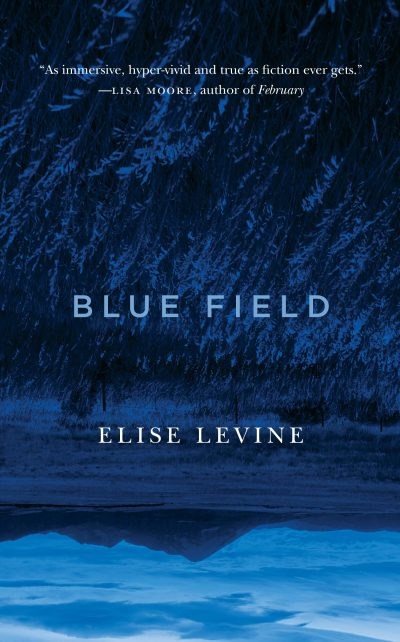
Seeking redemption underwater: Blue Field by Elise Levine—My Rusty Toque review

November is destined to go out as it came in, with a link to a review published elsewhere—in this case, my thoughts on Elise Levine’s Blue Field which appears in the latest issue of The Rusty Toque. This is a book that I heard about when it was released earlier this year, and I was immediately intrigued. However, when I finally sat down to read it, having already committed myself to a review, my first impression was that this was not going to be for me. The first few chapters put me off a little, that is, they led me to think I would find Blue Field difficult to assess fairly. I don’t believe that one should avoid negative reviews, but I feel that, if appropriate, they should be constructive, and if a book simply is not to your taste, it’s very difficult to make any judgement about it one way or another. As John Updike said, and I am paraphrasing, you should not accept for a review a book you are predisposed to dislike or obligated to like.

Then I turned to the promotional materials that came with my review copy. Biblioasis, bless them, frequently include an interview with the author or translator and, with an opportunity to learn more about  Levine, her writing process and interests, I was so impressed that I decided to give her book a second chance. Perhaps because it is somewhat different than the type of book I’ve read lately, I found myself caught off guard by this tale of a woman who takes up cave diving in an effort to find healing after her life has been upended. She is not particularly likable, increasingly reckless, and trapped in an vortex of loss and grief that could cost her everything she has. However, the prose—vivid, pulsating with energy, alternately harsh and shockingly poetic—is finely tuned and relentless in its intensity. Won me over.

Blue Field by Elise Levine is published by Biblioasis.

To find out more, I invite you to check out my review at The Rusty Toque. And while you’re there check out some of the other excellent features in this issue.

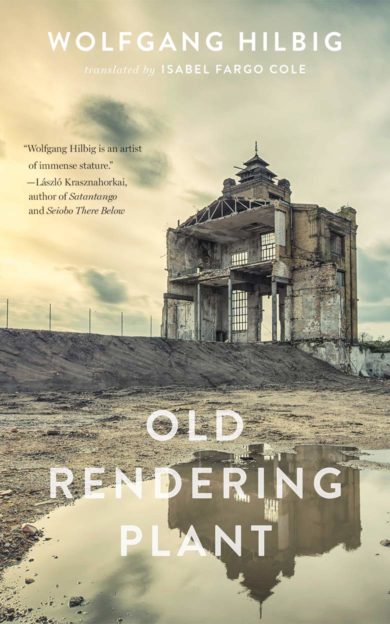
Lost in time with Wolfgang Hilbig: Old Rendering Plant

It is easy to become lost in the dense and convoluted narrative Wolfgang Hilbig unspools in Old Rendering Plant, the most recent translation of his work to reach English audiences. This slight novella invites the reader to wander, with the narrator, through the fields and along the pungent waterways that extend beyond his small East German town. As he rambles on, caught up in his memories of the past and hopes for the future, it’s easy to get swept up—and find oneself disoriented—amidst the industrial ruins where he is forced to confront the dark echoes of recent history and the expectations of the socialist state. It may be, especially for those unfamiliar with Hilbig’s idiosyncratic, stuttering prose, a little unsettling at first, but if one is willing to forego linear narrative expectations, an unforgettable, immersive, atmospheric reading experience awaits.

I read this book last summer to write a review for The Quarterly Conversation. In fact, I probably read it three times over to be able to read and articulate an opening into the narrative, but every time my appreciation of this moody, filmic text increased. As a critic, I derive the most satisfaction from writing about complex, unconventional narratives. My goal is not to give a definitive reading, but to explore the possibilities and questions offered by a piece of literature, while leaving a reader to find his or her own answers (or further questions, as the case may be). It was a sheer joy to write about this book.

My review from the Fall 2017 Issue of The Quarterly Conversation is reproduced below:

Old Rendering Plant by Wolfgang Hilbig (Two Lines Press)

Long after he escaped East Germany to settle in the West, where he continued to reside until his death in 2007, Wolfgang Hilbig remained bound to the darkened landscapes of the GDR. He was not one to downplay the bleak and oppressive qualities of life amid the abandoned mines and crumbling factories of his hometown, Meuselwitz, and his dense, swirling prose evokes a world of strange, suffocating beauty. But his emotional attachment to his birthplace and his complicated misgivings about the benefits of reunification, left him forever torn between East and West—a conflict captured clearly in the stories that comprise the second part of the collection The Sleep of the Righteous. By contrast, Old Rendering Plant, the latest Hilbig offering to be released in English, presents a narrative firmly planted in the GDR that does not travel far beyond the immediate environs of the narrator’s home; yet this tightly defined arena affords the perfect space for a multi-layered exploration of one man’s struggle to define himself against the restrictions and expectations imposed by family, class, history, and circumstance.

Wolfgang Hilbig was born in 1941 in Meuselwitz, near Leipzig. His father disappeared at Stalingrad, so he was raised by his mother and grandparents. His illiterate Polish-born grandfather served as an important father figure, encouraging his aptitude for sports. However, as translator Isabel Fargo Cole notes in her afterword to the novel I, his early obsession with reading and writing soon alienated him from his own family. The works of Poe and the German Romantics held a particular appeal for the budding poet. Following his military service he spent years working in local factories, where, at least on the surface, he epitomized the ideal of the worker-writer that the GDR actively encouraged. Yet, unwilling to follow accepted scripts, Hilbig’s writing was seen as too challenging and obscure, and it soon drew the unwelcome attention of the authorities. Ultimately the desire to write would win out, but the tension between duty to work and to literature became a central theme that he returned to again and again.

In Old Rendering Plant, an extended monologue that slips in and out of passages of pure stream of consciousness, this tension is implicit. Originally published as Alte Abdeckerei in 1991, this novella is a meditation on the formation of identity in an environment that contains a complex network of buried secrets. The narrator is looking back from a vague and indeterminate adult perspective at that point of transition from adolescence to maturity. His is a restless narrative; memories and waters sweep by as he traces and retraces a path along a brook that, bordered by stands of willows, carves a channel through the fields on the outskirts of his hometown. As a child he found refuge in this landscape filled with magic, possibility, and adventure, armed with a wooden sabre and an imaginary foe. It was a place to feel safe and protected.

One of his favorite playgrounds was, against all adult admonishments, found in the fragmented ruins of a coal plant. Here he waged countless fanciful battles until one evening he slipped and fell off a concrete platform. He was fortunate to land in the grass, but later that night he remembered hearing people staggering across the platform above him, and he awoke to find on his right leg evidence of the substance that had caused his fall: “a dried mire, a black-green slurry mixed with blood.” This incident marks the beginning of a loss of innocence, the first intimations of the existence of dreadful truths that, as the narrator ages, begin to take on a greater, more complicated and disturbing significance. As the narrative unfolds, his reminisces and reflections trace his movement toward a reckoning. Gradually, as layers of memory are stripped away, he approaches an clearer understanding of the forces that have driven him. It’s not a comfortable space he finds.

The narrator is a solitary personality, both as a child and as a man, given to wandering the pathways on the edge of town during the hours that mark the transition from late afternoon light to early darkness. He speaks of his family without affection, referring to them as “my relatives.” He passes from childhood into manhood almost imperceptibly, when the adults in his life no longer show interest or concern about his habitual lateness, his tendency to come home after dark. There is only one mention of an anecdote involving a friend, someone he visits on a brief, aborted attempt to break free of the house and town in which he grew up—during that visit, an encounter with the bloated corpse of a dead rat, which he is not even entirely certain is not an illusion or dream, sends him hurrying home. It is perhaps the thought that the horror he hopes to escape is bound to his being, rather than his environment, that frightens him so.

Central to the narrative is a rendering facility hidden among the ruins of the former coal plant. The narrator’s fall from the cement platform was his first direct indication that something nefarious existed there, but he had always been aware of the signs of its presence:

As a child I knew it was the smell of the milk-colored current that washed down the brook, bubbling and steaming like warm soapsuds in the evening. I knew that the smell soaked the banks and seeped under the fields; the mist over the river channel was this smell, and the mist that rose from the topsoil too, infecting everything that grew in the fields, and it rose from the meadows, the grass of the paddocks smelled of the river mist’s cloying essence, the bushes on the banks thrived amid this smell, a smell of flesh . . . old, useless flesh relinquished to the waters, washed its smell through the land to the east, I knew this as a child. Tallow sheathed the snarls of grass on the brook’s edge, ancient fat clung indelibly to the slopes of the embankment; it was a brew of rancid fatback, even covering the paths, boiled-out horns, bones cooked to the point of disintegration . . . the old river-willows luxuriated in this nourishment; countless bluebottles, ill from overfeeding, dripping like glossy shapes made of wax, skimmed sluggishly through the foam, and this shimmering foam, rapidly turning black spun lazily on the water by the willow’s dangling roots.

At a later point—he is at a loss to even specify exactly when, the experience was so intense that it remains trapped in a level of reality between dream and waking—he happened to witness cadavers and sick, terrified animals being unloaded at the site. This plant, nestled among the ruins, was named Germania II after the mine that had once supplied the old coal factory, and it becomes, for the narrator, the source of such complicated questions and emotions that he finds himself unable to pass beyond the bridge and railroad embankment he encounters on his regular sojourns. The smells, memories, and anxieties that arise at this location routinely force him to turn and wearily head for home.

The rendering plant was rumored to employ society’s discarded men. At a time when radio reports of missing persons, and rumors of dangerous foreigners hiding in abandoned buildings, were commonplace, the workers belonged to a stratum of mysterious characters, unnamed and unseen by the light of day. The particular autumn forays that form the pivotal thread of this monologue are motivated by the narrator’s concerns about what his own future holds. He is remembering his final year of school when, with graduation approaching, he has a critical decision to make. This is where his fanciful nature, his defiant poetic spirit, begins to stir as he briefly considers becoming a gardener, inspired by the end of Candide rather than by any fondness for the tilling the soil, and entertains an idyllic life as a miller. He seems oddly determined to disturb his family and his teachers, ultimately announcing his intention to work at Germania II. With a mix of horror and fascination he develops an obsession with the process of rendering carcasses to make soap, and attempts to seek out the elusive workmen. But there is something more complex at play.

This is, at its core, a search for identity and the expression of individuality. The question of where one is heading, is necessarily a question of where one has come from:

my strange interest in bad places was an unacknowledged, unclear interest in our origins . . . because I had not actually experienced the affronts that went with the soil we had sprung from.— On reflection, we were actually exiles. Of course, only in the indefinite way in which all our names were sheer hubris . . . all our names, titles, and nouns. So we were not exiles based on some neat solid idea, but exiles out of instability . . . out of ineptitude, ignorance, antisocial tendencies; we hadn’t been torn from our roots, we had lost our rights, we were in exile because we’d never had roots or rights; we’d never even sought to find them, perhaps we constantly sought the world’s most noxious regions in order to rest our rootlessness, like gray vegetation, feeding on the ground’s nutrients but giving nothing back, we settled in the desolate provinces that were the strongholds of evil, we settled between slag and scrap where we could run riot, rank and uncontested.

What, then, do those most reviled of workers say about him, and his people, who are similarly dispossessed? Is it a matter of degree that divides them? Is it destiny? As the narrator’s monologue continually circles back to this place of darkness and all of the memories that point in its direction, he rekindles the oppressive existential crisis that once drew him to fantasize about disappearing into its foul depths.

As the narrative progresses, Hilbig’s characteristic prose, which flows in fits and starts, like eddies in a stream, swirling, reversing, and moving on again, is hypnotic and disorienting. It is easy to get caught up in the beauty and rhythms of his language, momentarily losing one’s temporal bearings. As such, it is especially ideal for this type of lyrical reflective monologue. When, on occasion, he slides into passages incantatory stream of consciousness the effect is exhilarating. Translator Isabel Fargo Cole has a strong sensitivity and fondness for his idiosyncratic style that comes through in this, as in all of her Hilbig translations (including The Sleep of the Righteous and I).

Reading Hilbig, I often find myself stopping to reread a section before moving on. I revel in losing myself in his long, winding sentences and paragraphs that can stretch on for pages. This can, on the surface, draw allusions to Sebald, though, Hilbig’s prose is quite different in quality, and unlike a Sebaldian narrator, the protagonist of Old Rendering Plant, although he sets out again and again, finds it difficult to push beyond the boundaries his memories and fears have imposed. What is similar in the reading experience, however, is that both can stimulate a desire to distinguish points of departure—with Hilbig, to find those moments where reflections, memories, and memories of dreams diverge, reinforcing temporal dislocations.

The narrator’s troubled forays are rooted in his reluctance to bend to the fate that awaits him, choosing a practical apprenticeship and accepting the bonds of adulthood. He harbours a Romantic sensibility that can only find expression in defiance, in word if not in deed. This resistance continues until one evening when he wanders farther afield than intended. Disoriented, he attempts to make his way back to town, only to witness a dramatic event—an apocalyptic cataclysm resulting from the extensive economic hollowing of the land that tears a wound into the darkened recesses of the soul of his nation and ultimately frees one rootless exile whose lonely monologue culminates in a rousing Joycean climax.


Some thoughts on Michel Leiris’ Phantom Africa and a link to my review at 3:AM

It’s no secret to my literary friends that I have been somewhat obsessed with French writer Michel Leiris this year. I will address this fact further at a later date, but essentially, it is his autobiographical writing that fascinates me—it’s a very internalized, yet sharply observant form of writing about language, memory, and experience. In his epic journal project, Phantom Africa, a detailed, personal record of his experience as part of the Dakar-Djibouti ethnographic expedition in the early 1930s, one see him develop as a writer as the weeks and months past. With a background as a Surrealist poet and an essayist, he was a strong writer at the outset; what evolves over the course of the journey is an uncanny ability to lay himself open on the page with a distinct, idiosyncratic honesty. A discussion of this development forms the primary thread of my review of this critical work, published earlier this week at 3:AM Magazine.

However, the publication of this valuable document  in English, at this point in the ongoing post-colonial narrative, holds an importance that I only allude to in my critique. Leiris’ primary role on the expedition was as secretary-archivist. Ethnographic study was, for all intents and purposes, a mechanism of colonial control and exploitation. Thousands of artifacts, many with profound cultural and spiritual meaning, were collected for display in museums back in France. Some items were purchased, others taken by force or deceit, but in the end, it was all facilitated by an exercise of the power of the colonizer over the colonized. Leiris is not unaware of this fundamental inequity and he does express considerable concern and discontent with the ethics of the entire colonial enterprise, but he also admits to enjoying the thrill of the raid. Of course, it is not appropriate to measure a man outside the context of his times. Leiris’ true gift here lies in is his candid, unedited, record of the events he knows of or takes part in. It forms a vital contribution to the argument in favour of the repatriation of lost art and artifacts to Africa.

Phantom Africa, translated by Brent Hayes Edwards, is published by Seagull Books. My 3:AM review can be found here.

Lanterns buried: Injun by Jordan Abel

From the mid-60s through the mid-70s, I attended a small rural school west of Calgary, Alberta in western Canada. Treaty 7 land, though no one called it that. Children were bussed in from the Stoney Nakoda First Nation (though no one called it that either). The majority would not last beyond grade 5. This was the era of the Sixties Scoop when children were pulled from their homes and placed in foster care, and the wounds of the Residential School System (which was still in operation) ran deep. All we knew was that our friends disappeared one by one. And what did we know of the Indigenous populations of our region? Nothing. In school, when it came time to learn about “Indians,” we studied the Iroquois. The “people of the longhouse” are, let’s say for the sake of argument, about 3,000 kilometres off target.

I am also old enough to remember watching old Western movies and reruns of The Lone Ranger on TV on Saturday afternoons, and to have played “cowboys and Indians” without a second thought. Yet wise enough that, several decades later, when I took my own children to the library to see a screening of Walt Disney’s Peter Pan, I was absolutely ashamed and horrified by the depiction of the native characters in the film. I had a long talk with the kids afterward, insisting that it was not acceptable to entertain those offensive stereotypes under any circumstances. But it is only in recent years that the full force of the need to address the impact of colonialism at home and elsewhere has really started to settle into my consciousness in a profound way.

My most important role now is to listen.

One of the most exciting young Indigenous voices here in Canada today belongs to Jordan Abel, a Nisga’a writer from Vancouver. His book Injun, the winner of this year’s Griffin Poetry Prize is a vital examination of racism and the language of hate. However, for anyone anticipating conventional verse, that expectation is quickly undone in this inventive exercise to reclaim a dehumanizing and insulting slur and undermine the mythology of the West that still holds a romantic appeal. The decorations and themes of the annual Calgary Stampede in my hometown may have been toned down and “corrected,” but the subtext of the spectacle is still intact.

Abel’s work stands, as a reflection of his academic study, at the intersection of the Digital Humanities and Indigenous Literary Studies. He mines documents in the public domain to create what might be imagined as a “revisioned” literature. His third collection, Injun, is a powerful and necessary project of reclamation in the face of a long history of racism, an inventive exercise in decolonial poetics that takes as its initial source material 91 western novels. Using Control+F, he searched these texts for the word “injun” and came up with 509 results.  As he explains:

After separating out each of the sentences that contained the word, I ended up with 26 print pages. I then cut up each page into a section of a long poem. Sometimes I would cut up a page into three- to five- word clusters. Sometimes I would cut up a page without looking. Sometimes I would arrange a page until something sounded right. Sometimes I would just write down how the pieces fell together.

I am aware that many are apprehensive about poetry at its most conventional. They may be wondering what it is like to enter into the territory claimed by Injun. The 26-part title poem, “Injun” runs from strangely lyrical couplets, to the increasingly disjointed and abstracted, and back again to verses formed with fragmented, wounded words. Roughly two thirds of the way through, at its most dispersed, the text flips over and the final sections are read upside down. The format, in itself, speaks to the legacy of colonialism: peoples disrupted, dispersed, almost destroyed, slowly healing. It is not “easy” to read, nor should it be. But is not as difficult or inaccessible as it may sound. Part c), for example, reads:

Some fearful heap
some crooked swell

bent towards him
and produced a pair

of nickel-plated pullers
a bull winder of

dirty tenderness*
that stiffened into

that low-brow ice
that dead injun game

Later, section u) begins:

             th e  d ayki     cksup
lik         e a pa  ck of wo       lves
o              n the         c     ut

    bu   zza            rds
ar     efin              e b     irds
th       at a   refo           ol    ed
b      y m    y    re           dsk   in*
sc  ent

The poem is followed by “Notes.” In this part, faded fragments of sentences containing words marked by numbered notation in the preceding poem (asterisks here, i.e. tenderness, redskin) are aligned by the specific word in bold print, offering an interesting indication of context. As one might expect, a selection of passages containing words like warpath, squaw, or scalped, leave an ugly taste in the mouth.

The final part, “Appendix” is effectively an extended prose piece, created, I presume, by running through the stream of sentences harvested from the source material and digitally erasing every occurrence of i-n-j-u-n. Thus, the very texts that have arisen from and perpetuated a white mythology of the Wild West, are sifted and distilled to create a condensed narrative that is difficult to read without flinching. There is a delicious irony in the repurposing of this material in this way. But the blank spaces solve nothing. They only serve to render visible the ugliness of hatred and racism, and the resulting erasure and stereotyping of Indigenous peoples. The appropriation of language from this “canon” of Western pulp fiction, becomes a sharp commentary on appropriation and how it functions as an instrument of colonialism.

An important and experimentally powerful work, Injun is much more than an exercise in abstraction and recombination. It is a defiant act of reclamation, another step toward the recovery of identity. Nonetheless, it is also a commanding example of the ability of digital tools to assist in the creation of literature.

To that final note, the methodology employed here holds particular interest to me with respect to a project I’m working on to honour my father using material salvaged from his Russian literature collection, the translations of which are almost certainly in the public domain. I wish I had been paying more attention to the Canadian poetry scene before I met Jordan Abel a few weeks ago here at Wordfest. I knew he had won a major award and we talked about writing and poetry as I drove him from the hotel to the venue and back for a sound check, but had I been more familiar with his work beforehand I would have engaged in a serious discussion of technique! All the same, he is a great guy, and an exciting talent to watch.

And then I turned back: The Iliac Crest by Cristina Rivera Garza

Breathing heavily, with fat drops of sweat sliding down my face and chest, I thought of how you are never more authentic than when inside your own nightmares.

I almost hesitate to write about The Iliac Crest. I feel that to tread too carelessly into the heart of this enigmatic dark fable would be risk fracturing its utterly devastating beauty. One may be best to enter its world of shifting borders where space, time, reality, fantasy, sanity, madness, identity, and gender are bent, blurred and ever so steadily unraveled without any preconceptions. Not that there is a viable bread crumb trail that could be followed to ensure Absolute Understanding. But it may be best to let the narrator be your guide, or rather to accompany him as his self-contained, apathetic existence is disturbed and distorted.

The novel is set in an undefined time, in an isolated borderland on the coast between North City and South City.  To travel in either direction requires passing through heavily policed border checkpoints. Disappearance is contagious and faith in feminism is a faded notion—sexist attitudes toward women limit their roles in society. The image is a jarring one, and an atmosphere of hopelessness and decline is prevalent, nowhere more so than in the state hospital where the narrator works as a doctor tending to the destitute, wretched, and deranged who have come there to die.

A note from the author, Mexican writer Cristina Rivera Garza, that opens the book provides some context. Navigating the US-Mexico border has been a constant in her life and this is reflected in the role that the idea of borders, geopolitical and otherwise, plays in this work. Many borders are challenged here, not least of which is the line between male and female. The consequences of rigid gender roles and the silencing of women’s lives and voices is a central concern in the story she has to tell. “Our bodies are keys that open only certain doors,” she says. “Our bodies speak indeed, and our bones are our ultimate testimony. Will we be betrayed by our bones?” As a reader with a gender different history myself, that question haunted me from the outset.

The narrative begins on the classic dark and stormy night, when a stranger appears seeking shelter. She introduces herself as Amparo Dávila. The narrator is instantly captivated by her striking appearance and her expansive presence. But she frightens him. Several hours later, the woman he had been expecting, a former lover referred to only as The Betrayed, arrives and immediately collapses on the threshold. Before long, the women have installed themselves in his home, disrupting his solitary life. While The Betrayed convalesces, Amparo Dávila sets up a daily routine which includes sitting down to write in a notebook. She informs him that she was once a great writer. Now she is writing about her “disappearance” and she believes he can help her.

The narrator is skeptical. He doesn’t trust his unwelcome houseguest. She claims to know truths about him that confuse and unnerve him. And as the Betrayed recovers, he is horrified to discover that they share strange language that is unlike any he has ever encountered. The more he tries to get to the truth behind the identity of The Disappeared as he comes to call the so-called writer, the more he finds himself balancing on the uncertain edge of reality. His emotions swing between desire and anger and fear. He finds himself alienated and isolated. At one point he remarks: “I felt as if I were in a parenthesis in a sentence in an unknown language.”

Certain images and expressions are repeated, like refrains that echo throughout the text, creating an incantatory quality, enhancing the increasingly unsettling mood. The clarity with which the narrator appears to begin his account is steadily eroded until he can no longer trust his own sensations. As the line between truth and lies is obfuscated, the narrative grows chillingly opaque. But the tone remains measured, the language hauntingly beautiful.

I have resisted delving too far into the sequence of events that unfold—real, remembered or imagined—because I feel this is a book best experienced without too much plot detail in advance. But I cannot resist a longer quote that captures the sheer beauty of the prose:

Hurried and intense brushes, a proximity that, out of so much fear, smelled of sweat and adrenaline. Everything, however, would return to normal with a kiss. Usually it was just that: a kiss. One. Lips together. Saliva. Time turned flesh, color. A long kiss, like an expedition. After, just after that, the separation began. The beginning. This. This walk like someone wearing shackles around their ankles, this sensation of the body against air in an age-old battle, this weariness, this desolation. What do I know about the great wings of love? The pelicans appeared again almost overhead, but much higher. I paused to watch them for a couple of minutes. Silence. Air. Time. I imagined them fleeing from their own wings and, in that moment, I raised my finger to my lips, trying to detect traces of something felt from far off in time. Yes, indeed, you turn back. And turning back achieves nothing.

I confess I finished this book breathless. Anxious even. Although I knew that Amparo Dávila, the author at the centre of the mystery, is a real woman—a Mexican writer whose own work often treads the uneasy borders between the real and the uncanny—I decided not to search her until I had finished reading the novel. I was pleased to find an article in the Paris Review online and one of her short stories in the Winter 2017 print issue. Originally published in Spanish in 2002, The Iliac Crest has helped rekindle interest in Dávila who is now in her late 80s. Christina Rivera Garza captures her spirit, but in a mesmerizing, wholly original tale that is perhaps more timely than ever.

The Illiac Crest is translated by Sarah Booker who also provides valuable insights in her Translator’s Note. The publisher is Feminist Press.

Note: Since posting this, translator Sarah Booker has kindly shared links to two other Dávila stories she has translated: “Griselda” and “The Square Patio”  The latter, in particular, has strong resonances in The Iliac Crest.

Where truth lies: A Working Woman by Elvira Navarro

When an author is lauded as a “relentless innovator” and a “meticulous explorer of the psyche’s most obscure alleyways,” it is easy to be skeptical. Those are strong endorsements, and a reader who enjoys a literary challenge knows well that a publisher’s promotional copy can be laced with hyperbole that often falls short of the mark. Yet, Spanish writer Elvira Navarro lives up to her billing with  A Working Woman, newly released from Two Lines Press, one of the most peculiar novels I have read in a long time. Its strangeness is subtle, the tone is ever so slightly off, the structure unconventional, and the narrator’s account inconsistent. The opening section is unsettling, even off-putting, but sets the groundwork for an oddly metafictional tale that unwinds (unravels?) slowly to end with a coda that places the purpose and nature of the entire preceding narrative into question.

It is an uncomfortable book. A rare and original look at the complex dynamics of female companionship, the bonds and distortions of madness, and the desire to find and define oneself, creatively and personally.

Set in Madrid, during in the aftermath of the 2008 economic crisis, Elisia is a proofreader with one novel, an MA in Publishing and an unfinished PhD behind her. She is one of the working wounded, so to speak.  She is lucky to have a job, but it has, over time, been reduced from a series of temporary placements to uncertain independent contract work for a publisher woefully behind with payments. She has already moved from an centrally located apartment to the barrio of Aluche in the southwest part of the city. As her financial circumstances become ever more precarious, she is faced with the prospect of renting her flat’s small second bedroom. When her friend Germán sets her up with Susana she does not know what to expect:

It was twelve thirty when she arrived. She wasn’t as I’d hoped, short and plump like a Hispanic mother, but the Nordic type: tall, blond, horsey, with a complexion the colour of something like raw silk. She was squeezed into a brown coat that came down to her ankles, and had a showy beige scarf around her neck. On her head was a green hat, with a swirl on one side like a flower. Weighed down by so much wool, she could hardly move, and her cheeks briefly glowed with two, perfect rosy circles. She was a bit ridiculous, particularly due to something that seemed to have its source in her nose, which, from the instant she crossed the threshold, appeared unpleasantly alert for any smell, the nostrils flared and quivering. It was such an eloquent gesture that, if I hadn’t previously committed it myself, I would never have considered accepting her as a roommate, and nor would she have taken the tiny room.

Their strained friendship sits at the core of A Working Woman. It is a relationship that seems, for the most part, to occupy an awkward space in the apartment, and in Elisia’s troubled imagination.  She exaggerates Susana’s impressive Amazonian dimensions, and finds her elusive nature—her tendency to at once take over the shared rooms with her belongings but share little about her past or her daily life—disconcerting.

However, by the time Susana crosses Elisia’s threshold for the first time in the narrative, we have already been treated, no exposed, to a graphic portrait of the woman she was twenty years earlier when, in a period of marked mental instability, she took a gay dwarf lover to meet her particular sexual needs. The novel opens with what we are told is a story based on what Susana told Elisia about her madness. “I’ve added some of my own reactions,” she tells us, setting her own words apart in italics, “but to be honest they are very few. It goes without saying her narrative was more chaotic.” For nearly forty pages, the narrator records a bizarre tale of sexual obsession. It’s easy for a reader to wonder what they’ve signed up for. Later on, one begins to suspect, that the entire set up says more about Elisia than whoever Susana may be (or may have been). Especially as she begins to develop symptoms of mental illness herself and is forced into seeking treatment. The layers of madness and sanity overlap with metafictional questions of narrative intent.

A Working Woman is imbued with an intense restlessness and anxiety that extends beyond the characters’ own uncertainties into the world around them. The narrative excavates the raw edges of Madrid where the economic downturn has left its mark. Empty storefronts, abandoned buildings, construction projects halted midstream. Elisia’s nocturnal wanderings through the streets of her neighbourhood is refracted in the countless city maps her roommate constructs out of tiny magazine clippings. But the two women are ultimately on different trajectories in life. Their worlds collide, but their connection, mediated through Elisia’s oddly unbalanced narrative, is neither warm nor natural. It is not even clear that Susana, or at least Susana as presented, exists beyond the narrator’s literary aspirations—or her own delusions.

Confusing? Yes and no. Navarro’s language is direct and compelling. She creates vivid multidimensional physical and psychological landscapes. Her ability to evoke, through her narrator’s breakdown, the sensation of losing the ability to cling to reality is especially powerful, and one I recognize well from my own experiences:

I managed to alight from the bus—there was still no ground under my feet, and I had to support myself against the buildings. Then I sat down in a doorway and stayed there for I don’t know how long, until my sense of touch returned. It occurred to me that I was crazy. I formulated this thought ten, twenty times. Movement was painful. The lacerating rumble of traffic. The tense, high-pitched voices of friends chatting in doorways. The people walking behind me. Their breathing, their bodies, were too close. I was intolerable even to myself, wanted to tear my body to pieces.

From its unusual, attention-grabbing beginning to the curious short chapter that ends (or upends) the book, to read A Working Woman is to enter an altered hyper-reality, a place filled with strange, yet strangely recognizable, figures who leave you wondering where truth lies, and where stories within stories begin, and end.

A Working Woman by Elvira Navarro is translated by Christina MacSweeney and published by Two Lines Press.

Suburban elegies: Bone Ink by Rico Craig

I have been drawn to poetry more than ever this year. A sign of the times. Poetry offers an antidote, a distillation of imagery and emotion, in a world that assaults our senses through the 24-hour news cycle and social media. But, it is also a reflection of my own evolution as a reader and a writer. I want to immerse myself in language, structure, and form. Poetry opens knots in my prose.

But writing about poetry tends to intimidate the non-poet, or the person who has not been trained to read it. But I write about prose without any special training. My intention is typically to attempt to write through the experience of reading a work, a process that, in itself, feeds a deeper reading. So why can’t I apply the same logic to writing about poetry? No reason at all.

Which brings me to Bone Ink, the debut collection, from Australian poet Rico Craig. I bought this book when I was in Sydney earlier this year, and had the good fortune to connect with Rico a few days later. I have often read the work of writers I have come to know online, but this is a rare instance in which I am writing about the work of someone I have actually met in person. So I allowed myself a little space before giving this collection a proper read. And my response is simply: Wow!

This book is divided into two sections: “Bone Ink” and “The Upper Room.” The first part opens with “Angelo,” a gut-level elegy for a dead friend, fueled with adolescent spite and spinning tires:

On the day he died we drove stolen cars
through the suburbs, spray cans knocking like eggs
in a swaying nest. I melted the dash and flicked

matches through the window.
From Parra Rd to Blacktown, our sweat mixed,
desperate, with the stink of scorched plastic;

& we sprayed mourning consonants on every
archway we found. Cops killed Tsakos
& dash lights were our campfire, & in the fretful

lustre we might’ve been mistaken for men.

The poems that follow continue in this vein, marked by visceral imagery, faded nostalgia, and gritty settings peopled with reckless youth and hardscrabble characters. Intimate dramas are played out in bedrooms, on oil rigs, along hospital corridors—childhoods lost, friends misplaced, loves not quite forgotten. These are stories boiled down to their most essential elements, the bare bones and sinew, nerves and raw energy. No word is wasted, every image evoked tells a larger tale. “Hamburg,” for example, begins:

If anyone asks I will say, you are oceans away,
afloat in the ventricles of a great city’s heart,
your fractious brain pecking the afternoon press,

your relentless devices compelling you toward
a smoky eyelet. I will say there is nothing left
to summon. The Rathaus must be dripping

ice, rock salt strewn on our streets of Sternschnaze.

To end, a handfull of stanzas later:

. . . If we meet again
it will be unexpected, as will-less shoppers,
caught lingering in front of a cheese cabinet,

shocked, seeking salvation in a slab of brie.
We’ll both be empty handed, shoeless,
one sock lost in the tide and the breaths we share

will be stained with the silt of industrial cities,
the taste of places bright enough to burn sand into glass.

Upon finishing this book, I returned to an interview conducted by my friend and fellow blogger, Tony Messenger, at the time of the release of Bone Ink. It was no surprise to see Craig explain that he “started as a prose writer trying to write ridiculously long and complex stories, it didn’t go well, but I kept trying, maybe for too long. I finally clicked with poetry as a form when I understood that it gave me a way to tell a fragment from a longer story, but tell it in a way that was satisfyingly rich.” I had forgotten this comment, but it resonated with and reinforced my own reading.

The second part, “The Upper Room,” is more abstract, featuring primal, vivid imagery drawn from art and nature, and woven into stories and urbanized folktales. There is a more mature allegorical quality to these pieces. This section opens with “With Chris Ofili in The Upper Room,” a magical visit to an exhibit of the British painter’s artwork that turns surreal when monkeys slide off their canvases and lead the narrator on an escapade across the city. It closes with the wonderful six-part “Lampedo,” a sequence of taut poems that forge a febrile romance between a contemporary urban dweller and his mythical Amazonian queen.

Here, as in the first section, several of the poems employ shape and form to work in concert with the content to affect a heightened sense of melancholy as in the couple’s bus ride through London re-imagined in “Hand in Glove”:

flex a fist          blow your mist of winter words
into a leather glove                we’ve set course

for the sun-scribed cloud        our bus ride mapped in fine
nibbed biro             a pattern of ley-lines inked

on the surface of your gloves         you trace capillary
streets across threadbare fingers

check off monuments marked on the pleated palm
out the window gulls          unveil    euphoric from ledges

and totter against wind          plunging in great Trafalgic arcs
across the span of our window

This collection, in the span of less than sixty pages, offers a finely tuned series of condensed narratives—indelible portrayals of passion, heartache, and loss that linger in the imagination. Rico Craig’s Bone Ink is a poetic testament to the instinctual urgency of being alive.

The publisher of  Bone Ink has gone out of business. For more information about Rico and this book, see his website.

All is riddle: The Tragic Fate of Moritz Tóth by Dana Todorović

At the heart of Puccini’s final opera, Turandot, is a series of riddles which the ice princess presents to Prince Calaf, her eager suitor. Any wrong answer would mean death. When his successful solutions fail to win her affection, he counters with a riddle of his own. And his is a wager with an equally high risk. He tells her that if she can correctly discover his name by the following day, he will die at daybreak. It is perhaps no coincidence, then, that The Tragic Fate of Moritz Tóth, a novel in which Turandot plays a pivotal role, seems to unfold as a number of riddles—or situations that are difficult to explain—that serve to lead and mislead the characters, and the reader, along the way. 

This short but ambitious novel by Serbian writer Dana Todorović, is one of the new titles in the third round of the Peter Owen World Series, published in collaboration with Istros Books. By employing two stylistically different, but interconnected storylines, Todorović crafts an accessible, inventive exploration of a number of classic literary themes: the nature of good and evil, predestination versus freewill, the redemptive power of art, and the soullessness of modern bureaucratic society. The result is an entertaining, thoughtful read, with a twist that few are likely to see coming.

The titular Moritz Tóth narrates his own story. He is a former punk rocker with a tendency to moody melodrama, at a loss following the death of a woman he had loved. He has been though some rough stretches and his past will leak out in erratic confessions over time, but at the outset he is simply in need of a job. When the employment agency calls, he has little option but to answer. And so this most unlikely candidate ends up as a prompter for a forgetful Calaf in a run of Turandot at the Hungarian State Opera House in Budapest. However, Moritz’s first exposure to opera reawakens in him a long forgotten passion for the violin. As a child he had fiddled Gypsy tunes with his musician grandfather until, in the throes of adolescent rebellion, he had traded his violin for an electric guitar and turned his attention to punk.

The second storyline, narrated in third person, has a more directly fantastical and allegorical quality. Tobias Keller, Adviser for Moral Issues with the Office of the Great Overseer has been summoned to appear before a Disciplinary Committee. Against the codified regulations of this bureaucratic version of heaven, Tobias has been charged with engaging his own freewill in an attempt to influence the circumstances of an individual whose activities he was monitoring. To have acted without following protocol and obtaining permission from above, may well cost him his job. He is accused of triggering a sequence of events designed to involve an intermediary to exert an influence on his subject—one Moritz Tóth. But Tobias has no regrets. He is proud of the outcome, even if, in the end, it actually meant following his own beliefs and defying the norms of the celestial bureaucracy in which he was expected to function. He tells the committee:

‘In my youth, while on a perpetual search for new knowledge and insight, I would often wonder if there was a straw we humans could grasp at to give meaning to our lives, considering that we are deprived of the ability to penetrate the truths of our existence.

‘Then I realized that it all comes down to conviction, or faith, if you will, with which methods of reason share no common ground. And my convictions tell me that if we exclude factors over which humans clearly have no influence, such as the laws of nature, if we exclude situations in which the human being is physically prevented from acting upon their will, then it would be far more beneficial for the human race if each of its members carried within themselves the awareness of the freedom to choose as a birthright, or if they prefer, an inherited burden on their shoulders.’

The two narratives alternate, chapter by chapter Tobias faces repeated challenges against his impulsive action in a system in which honourable intentions appear to have no value, while Moritz becomes aware of a strange character who seems to be following him. This creature’s presence and the appearance of a number of signs that seem to hold prophetic significance, deepen his paranoia and anxiety. As he attempts to solve the chain of riddles confronting him, he begins to suspect he’s the victim of a diabolical plot of Biblical proportions. His wild imagination gets the better of him, threatening his rational judgement altogether. But, what is the true connection, if any, between Tobias’ action and the increasingly strange circumstances in which our hapless former punk has found himself?

The exact nature of the connection remains unclear until the closing pages. Todorović manages to build a complex plot that raises some very profound questions, and present them in an original context. This is, however, a first novel and translated by the author herself. It is impossible to know how much the language might be, in such a circumstance, altered for an English speaking audience. It is worth noting that the narrative can, at times, get weighed down by awkward transitions and clichéd metaphors and similes. It is not enough to detract from what is a highly engaging tale, but it can occasionally strike a sour note.

Ultimately, the real charm of The Tragic Fate of Mortiz Tóth lies in the riddles posed, reminding us, as Ralph Waldo Emerson famously advised: “Life is a succession of lessons which must be lived to be understood. All is riddle, and the key to a riddle is another riddle.”

The Tragic Fate of Mortiz Tóth by Dana Todorović is translated by the author and published as part of the Peter Owen World Series: Serbia, a collaboration between Peter Owen Publishers and Istros Books.