Looking back at a year of reading: 2024 edition

Each year when I review the list of books that I have read, I face the same challenge deciding what to include and what to leave out of a final accounting. As usual there are the books that I know, even as I am reading them, will be among my favourites for the year. Just as I know the ones I don’t like, the ones I won’t even mention or take the time to review. Basically, everything else that I have reviewed, was a good book.

This year, my count far exceeds a respectable “top ten” or “baker’s dozen” and there are some striking factors at play. One is that the ongoing  violence in Gaza has heightened my focus on Palestinian and Arabic language literature—long an area of interest and concern. Five of the Palestinian themed books I read made my year end list. As well, I have paired several titles, typically by the same author or otherwise connected, because the reading of one inspired and was enhanced by the reading of the other (not to mention that such pairings allow me to expand my list). Finally, as reflected by my top books, I read and loved more longer works of fiction this year than usual (for me). No 1000 page tomes yet, but perhaps I’m overcoming some of my long book anxiety.

And so on to the books.

Poetry:
I read far more poetry than I review, but this year I wanted to call attention to four titles.
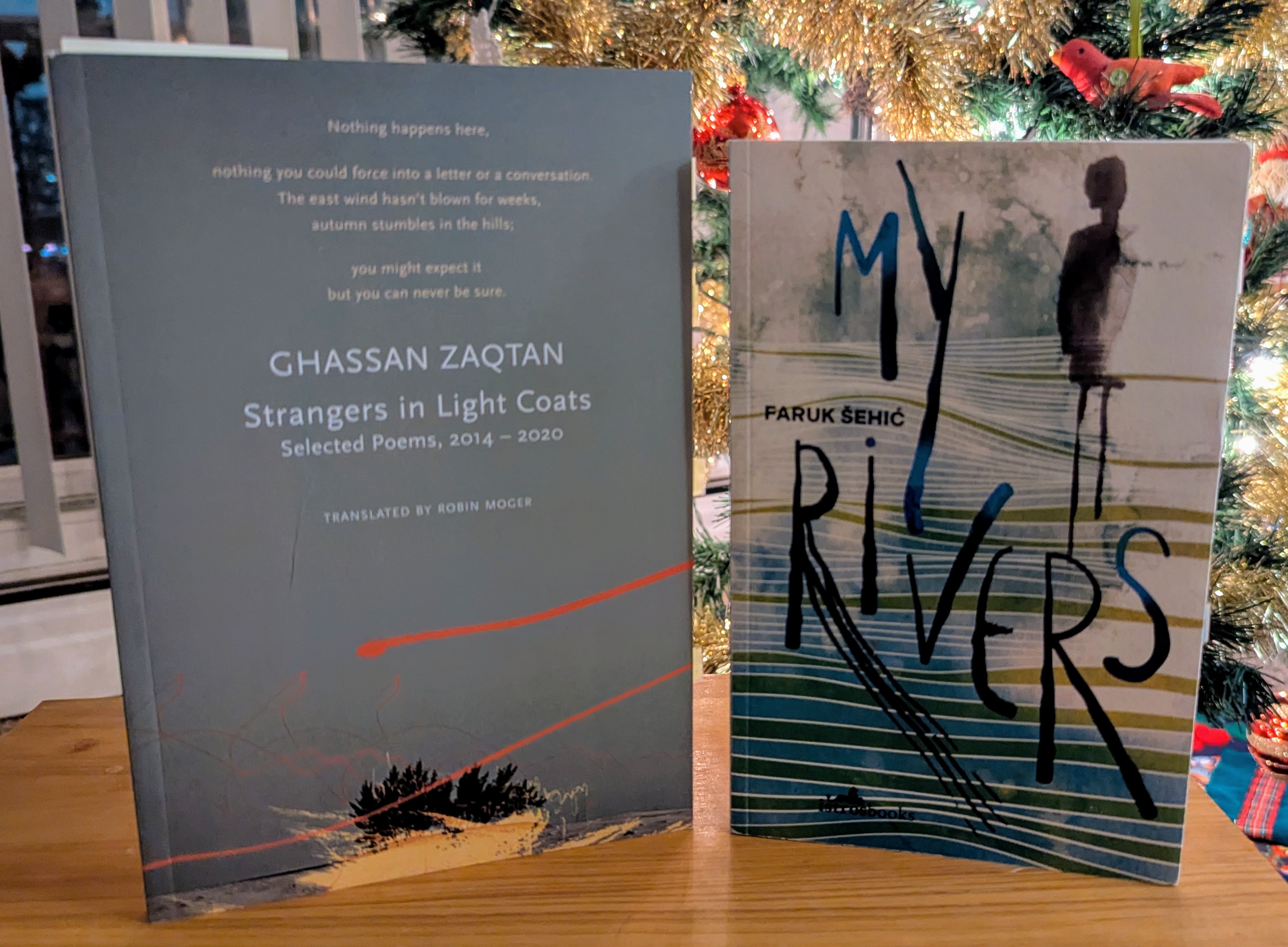
Strangers in Light Coatsevokes by Palestinian poet Ghassan Zaqtan (Arabic, translated by Robin Moger/Seagull Books) is, perhaps, a darker than his earlier collections. Comprised as it is, of poems from recent releases, it actively portrays a world shaped by the reality of decades of occupation and war.

My Rivers by Faruk Šehić (Bosnian, translated by S.D. Curtis/Istros Books) is a collection particularly powerful for its depiction of a legacy of wars in Bosnia/Herzegovina including the genocide in Srebrenica. His speakers carry the burden of history.
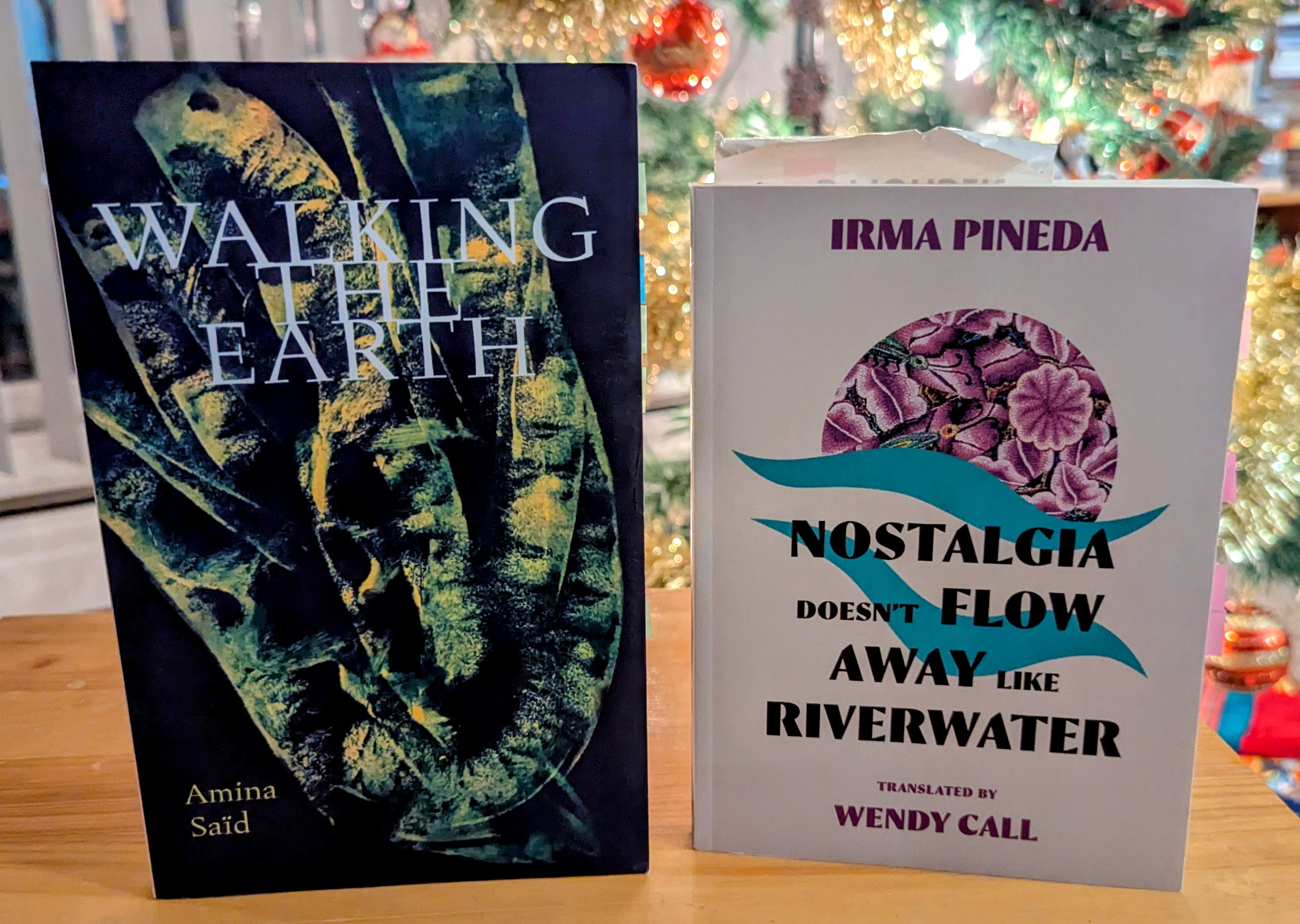
Walking the Earth by Tunisian-French poet Amina Saïd (French, translated by Peter Thompson/Contra Mundum) is such a haunting work of primal beauty that I can’t understand why more of her poetry has not been published in English. Perhaps that will change.

Nostalgia Doesn’t Flow Away Like Rainwater by Irma Pineda is one of a number of small Latin American poetry collection from poets and communities that have not been published in English before. This book, a trilingual collection in Didxazá (Isthmus Zapotec) and Spanish with English translations by Wendy Call (Deep Vellum & Phoneme Media) was particularly special.


Nonfiction:
This year, my favourites include a mix of memoir and essay and a couple of works that defy simple classification.
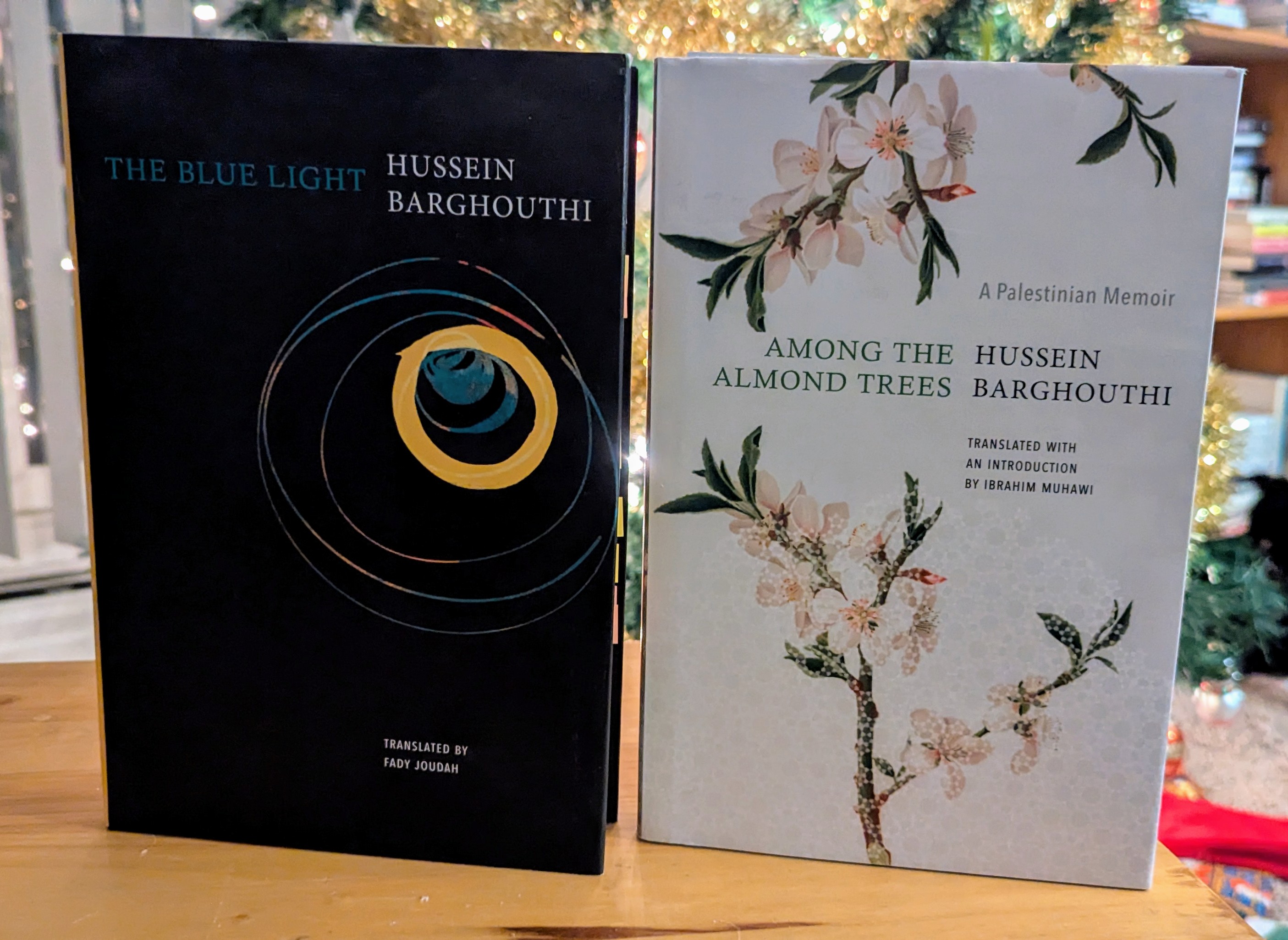
The Blue Light / Among the Almond Trees by Palestinian writer Hussein Barghouthi (Arabic, translated by Fady Joudah and Ibrahim Muhawi respectively/Seagull). Blue Light chronicles Barghouthi’s years in Seattle as a grad student and the eccentric circles he travelled in, whereas Among the Almond Trees is a much more sombre work written when he knew he was dying of cancer. The two books complement each other beautifully.
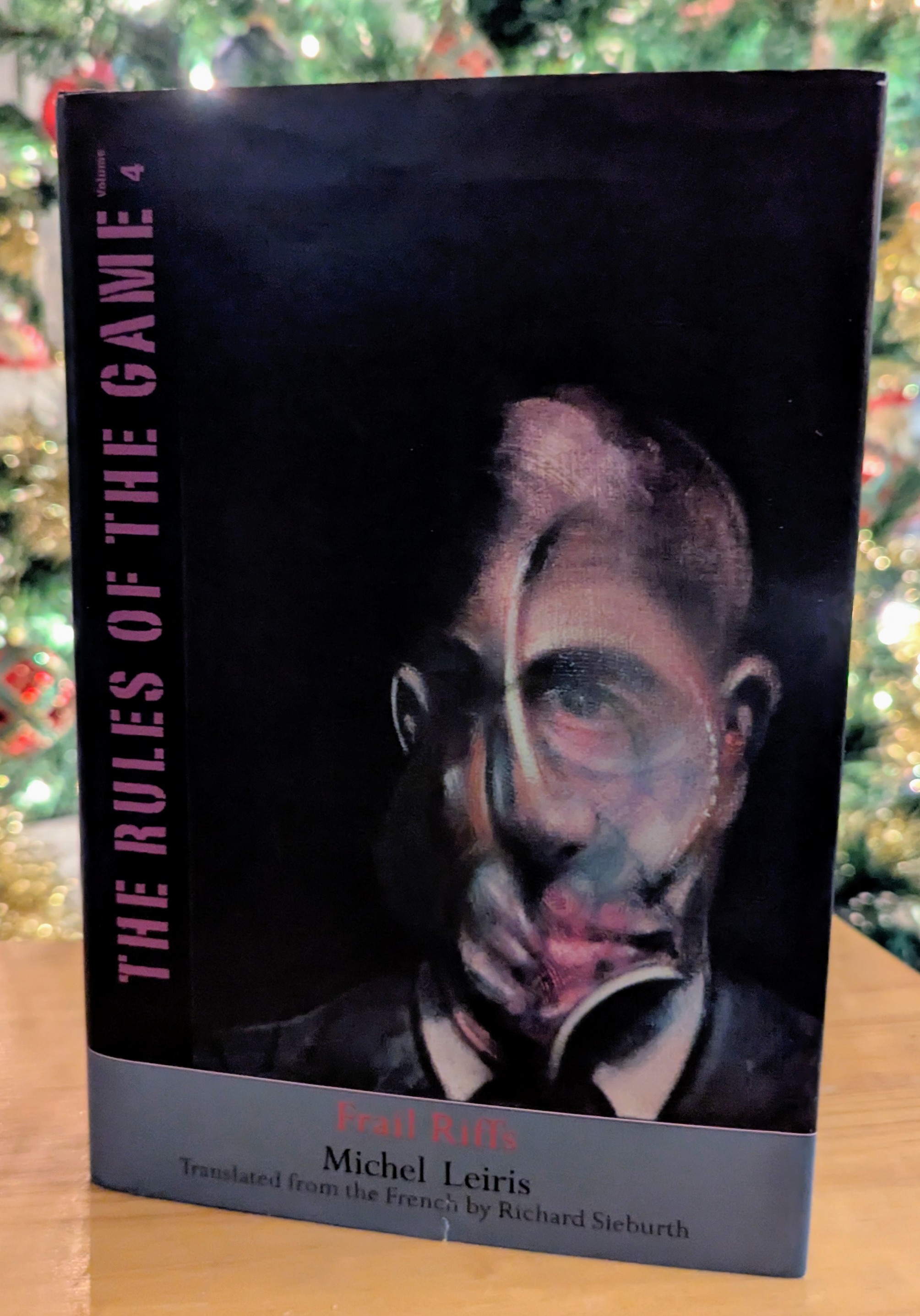
French intellectual, critic, ethnographer and autobiographical essayist Michel Leiris is a writer who means so much to me that the occasion of the release of Frail Riffs (Yale University), the fourth and final volume of his Rules of the Game in Richard Sieburth‘s translation, was not only an excuse to pitch a review but an invitation to revisit the earlier volumes. Definitely a highlight.
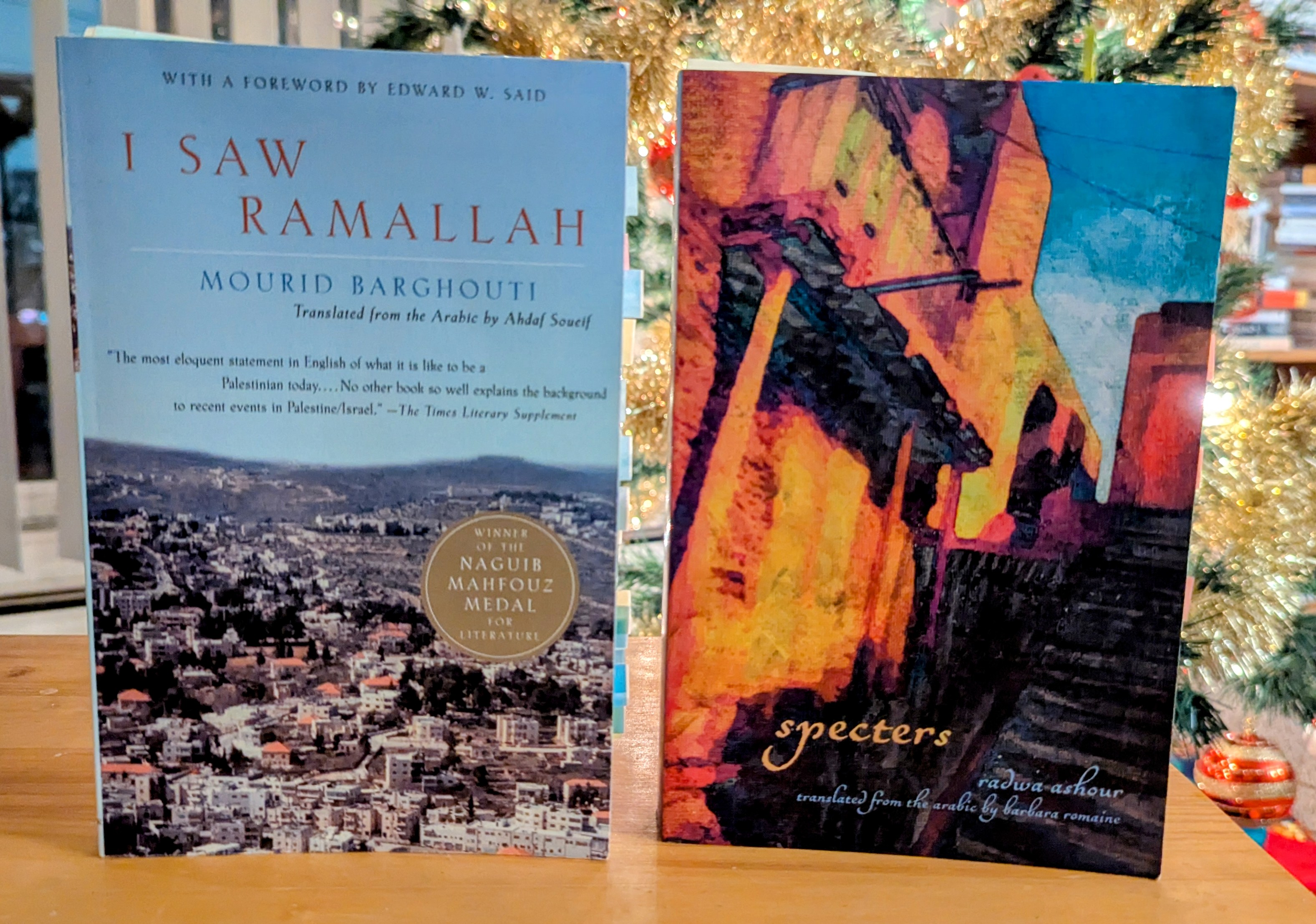
I Saw Ramallah by Mourid Barghouti (Palestinian/Arabic, translated by Ahdaf Soueif/Anchor Books) is a moving memoir detailing the author’s return to his homeland after thirty years of exile. Reading it reminded me that I had a copy of Scepters by his wife, Egyptian novelist Radwa Ashour (Arabic, translated by Barbara Romaine/Interlink Books). This ambitious work blends fiction, history, memoir, and metafiction and I absolutely loved it, but my decision to include it here, like this, rests on the memoir element which complements her husband’s in its account of the many years he was exiled from Egypt—a double exile for him—especially the years in which she travelled back and forth with their young son to visit him while he was living in Hungary.
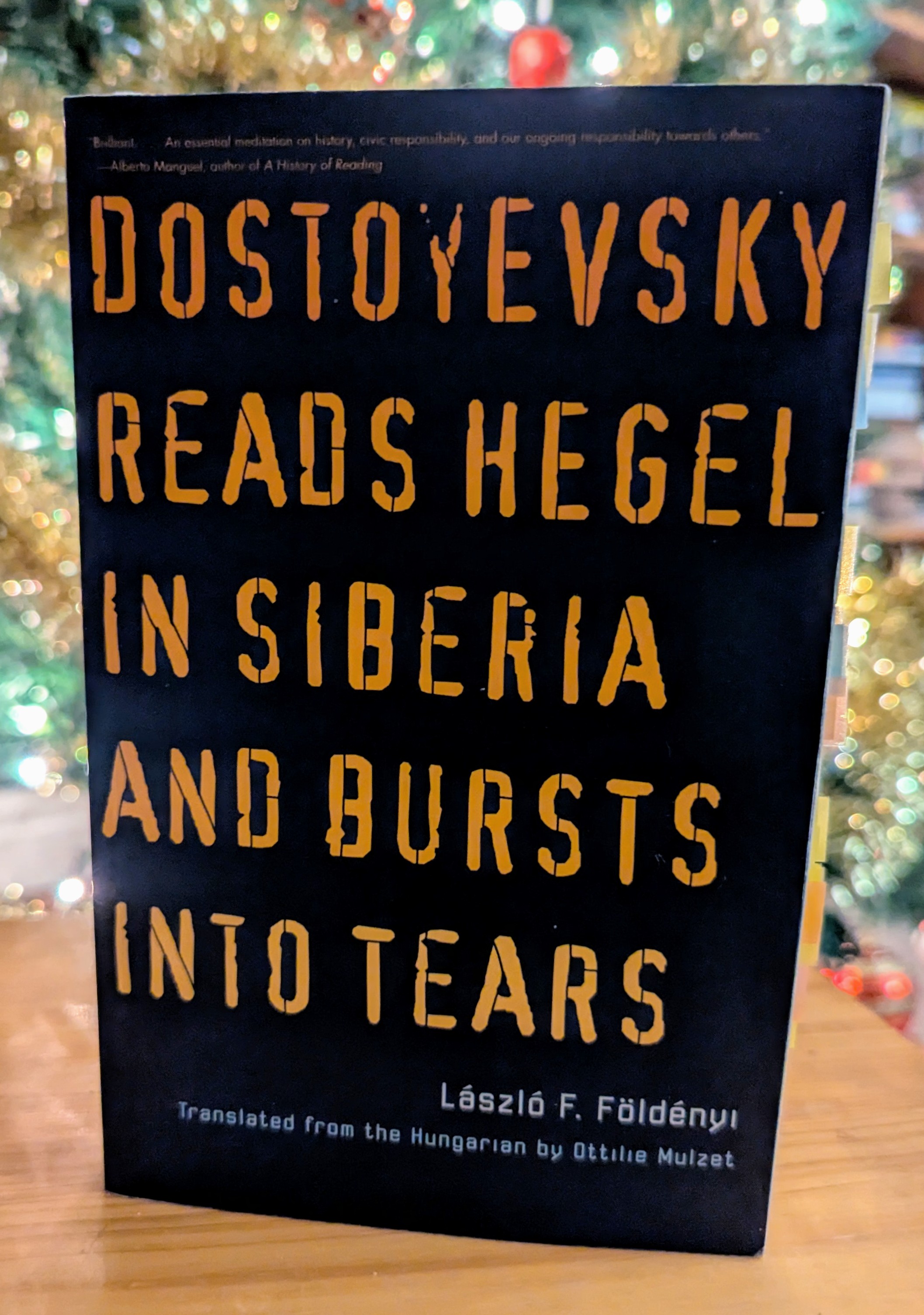
Candidate for the book with the best title, perhaps ever, Dostoyevsky Reads Hegel in Siberia and Bursts into Tears by Hungarian scholar  László Földényi (translated by Ottilie Mulzet/Yale University) was an endlessly fascinating collection of essays exploring the relationship between darkness and light (and similar dichotomies) through the ideas of a variety of writers, thinkers and artists.


Fiction:
As usual, fiction comprised the largest component of my reading and, as I’ve said, I read more relatively longer works than in the past. Normally I have a special fondness for the very spare novella and, of course, my list would not be complete without a few shorter works, including one more pair.
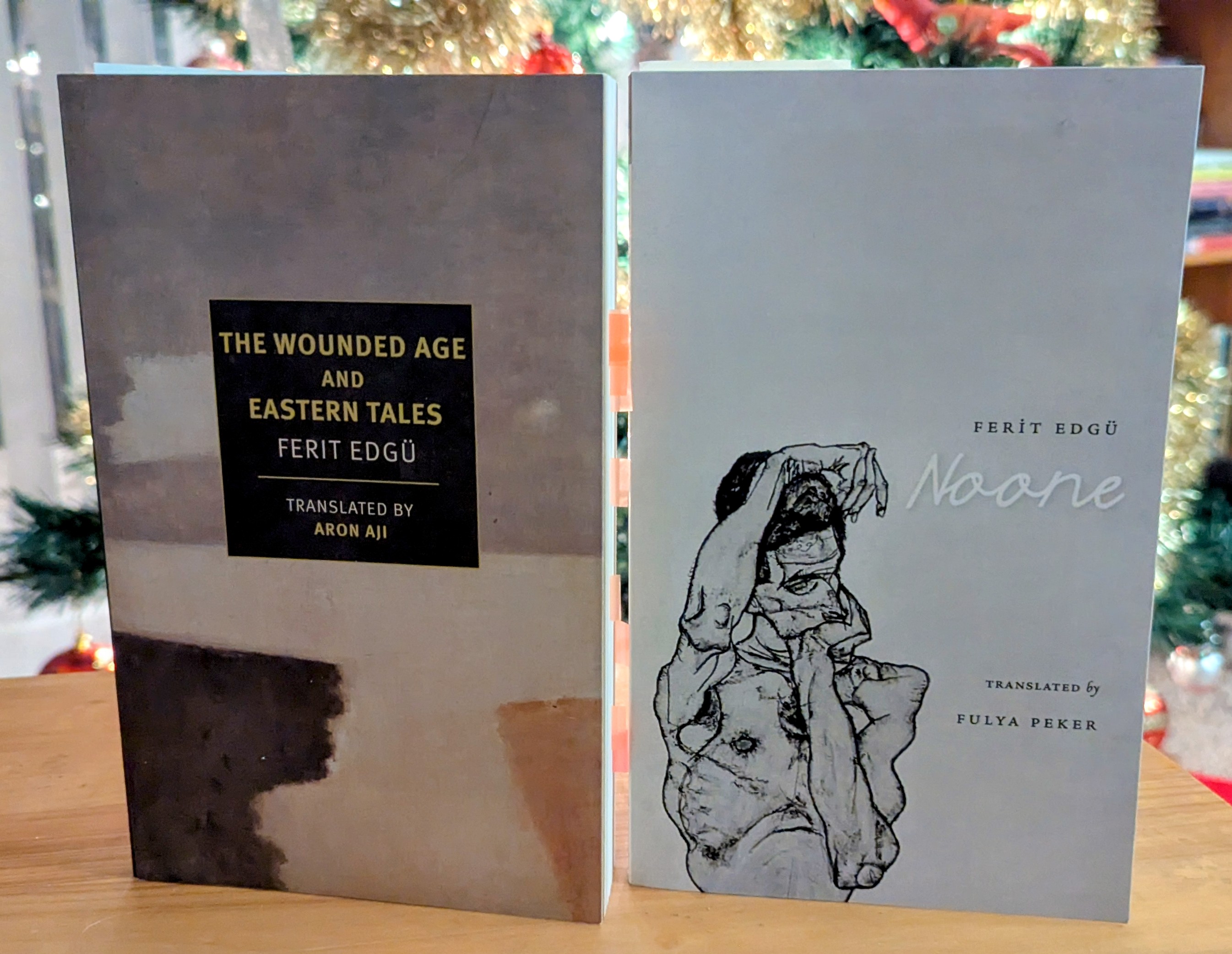
The Wounded Age and Eastern Tales  / Noone by Turkish writer Ferit Edgü—translated by Aron Aji (NYRB Classics) and Fulya Peker Cotra Mundum) respectively—who is sadly one of the writers we lost this year. His work, which draws on the time he spent teaching in the impoverished southeastern region of Turkey in lieu of military service, is filled with great compassion for the people of this troubled area. But his prose is stripped clean, bare, and remarkably powerful.
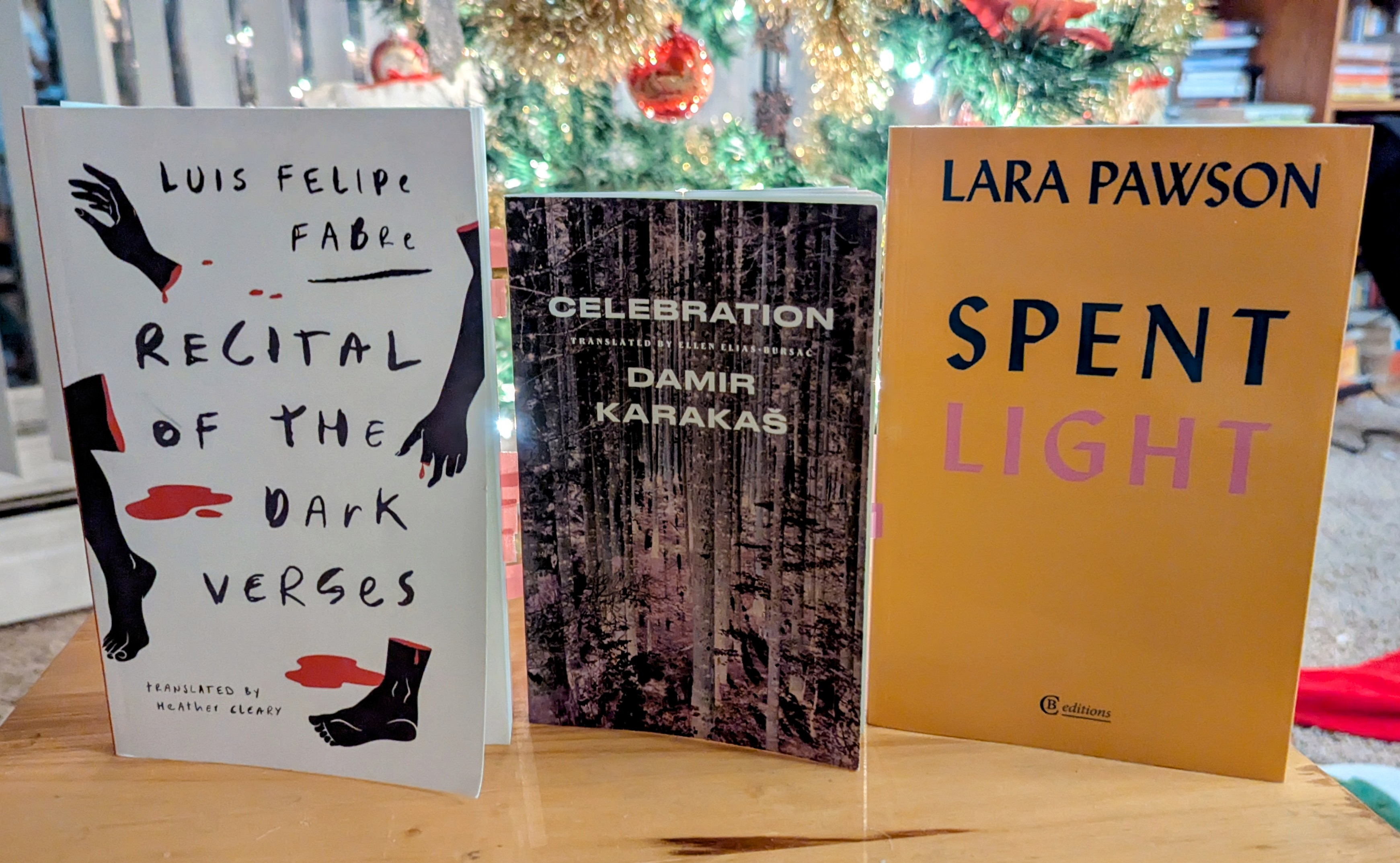
Recital of the Dark Verses by Luis Felipe Fabre (Mexico/Spanish, translated by Heather Cleary/Deep Vellum) is an award wining translation that seems to have garnered less attention than it deserves. This comic Golden Age road trip follows the misadventures of the body of John of the Cross on its clandestine voyage to Seville. Brilliant.

Celebration by Damir Karakaš (Croatian, translated by Ellen Elias-Bursać/ Two Lines Press) is an exceptionally spare, unsentimental novella about the historical forces that pulled the residents of Lika in central Croatia into World War II.

Spent Light by Lara Pawson (CB Editions) is a book I’d been anticipating since reading her This Is the Place to Be. Strange, at times disturbing, often hilarious and always thoughtful, this is one of those books that (thankfully) defies description.
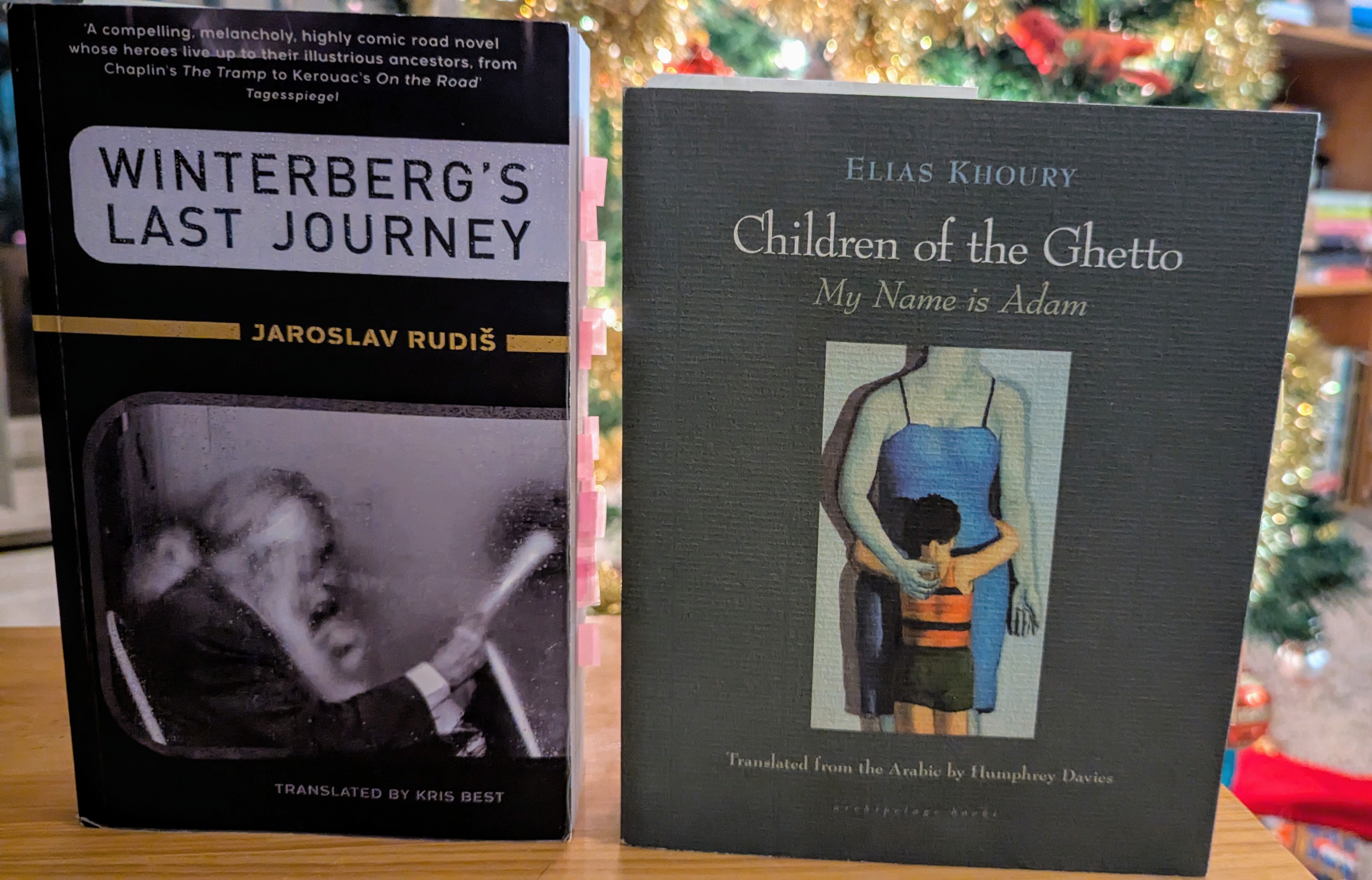
If Celebration is historical fiction at its most spare, Winterberg’s Last Journey by Czech writer Jaroslav Rudiš (German, translated by Kris Best/Jantar Publishing) is the exact opposite. Ambitious, eccentric, and filled with detail, it follows a 99 year-old man and his male nurse as they travel the railways with the aid of 1913 railway guide. What could possibly go wrong?

Children of the Ghetto I: My Name is Adam by Lebanese author Elias Khoury who also died this year (translated by Humphrey Davies/Archipelago Books) is the final Palestinian themed work on my list. This is a challenging and rewarding novel about a man born in the ghetto of Lydda during the Nakba that examines complex questions of identity.
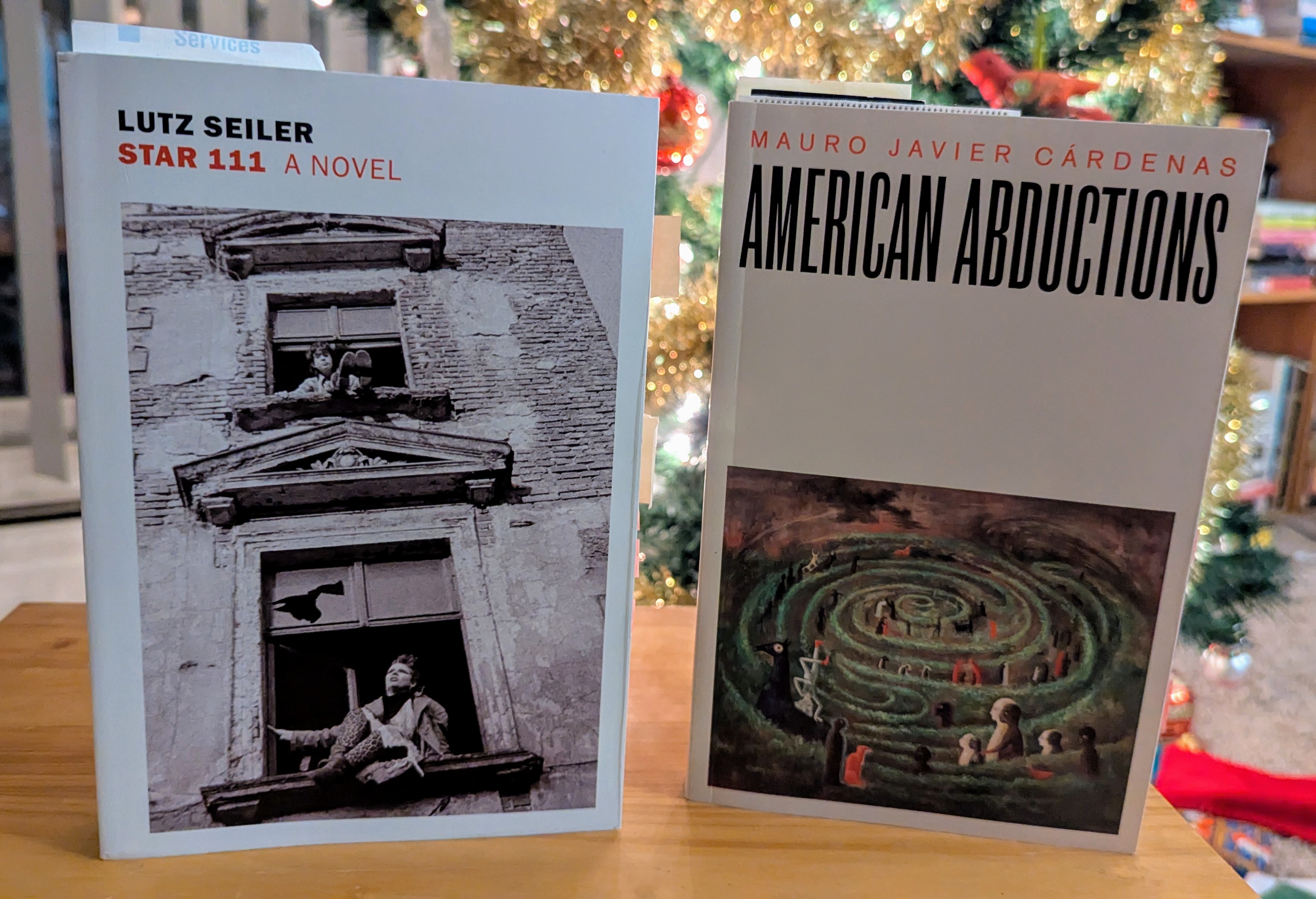
Star 111 by Lutz Seiler (German, translated by Tess Lewis/NYRB Imprints)is the autobiographically inspired story of a young East German would-be poet’s experiences among an eccentric group of idealists in Berlin in the immediate aftermath of the fall of the Wall. I was familiar with Seiler’s poetry before reading this, but I liked this novel so much that it lead me to follow up with his essays and the work of other poets important to him—the best kind of expanding reading experience.

Mauro Javier Cárdenas’ third novel American Abductions (Dalkey Archive) imagines the latest iteration of his hero Antonio in a future in which Latin American migrants are systematically sought out, separated from the children and deported. With a stream of single sentence chapters, he creates a tale that is both fun and uncomfortably too close for comfort. Quite an achievement!

Last but not least, my two favourite books this year are Hungarian:
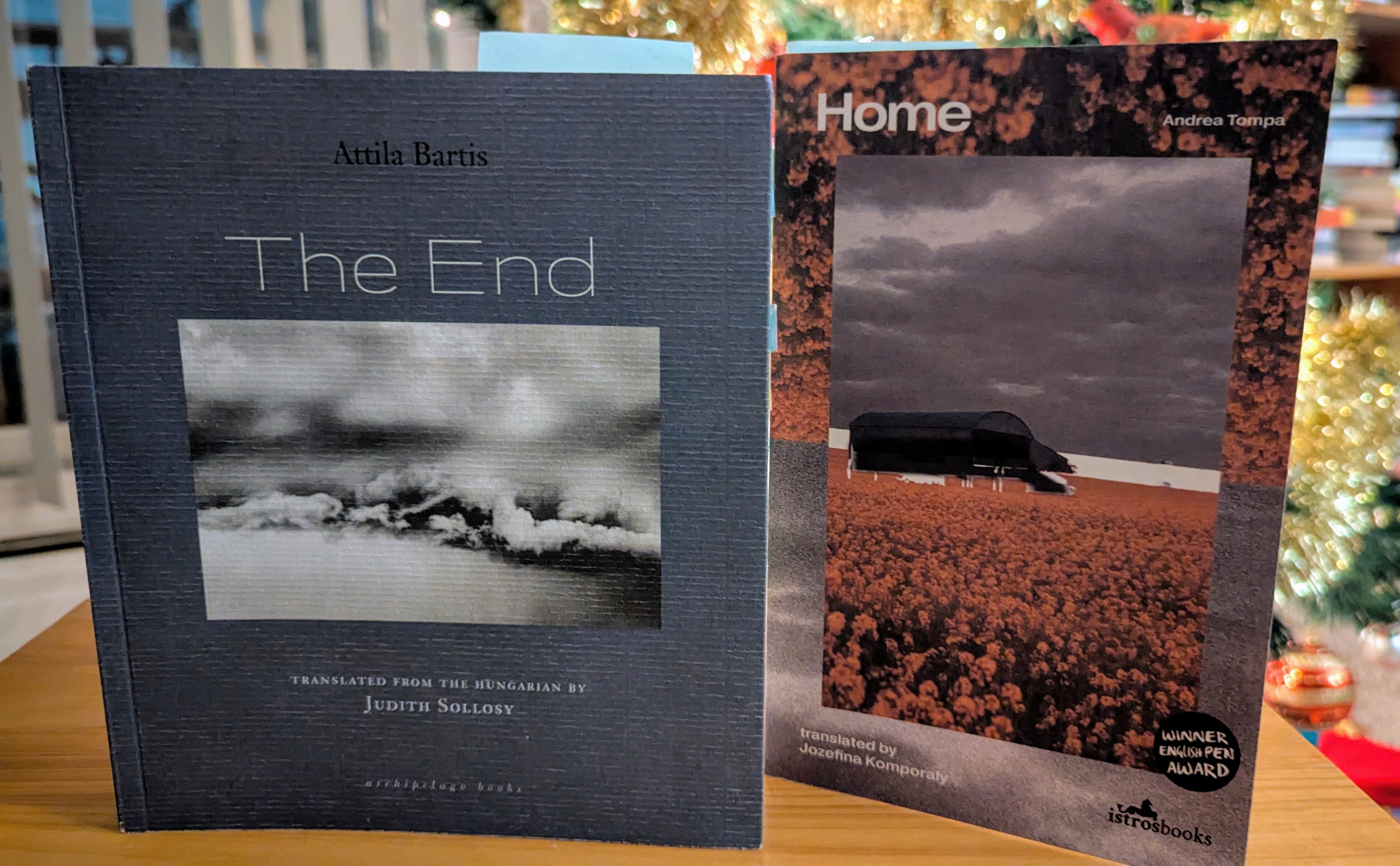
In The End by Attila Bartis (translated by Judith Sollosy/Archipelago Books), a fifty-two year old photographer looks back on his life—his successes and his failures. He reflects on his relationship with his mother, his move to Budapest with his father in the early 1960s following her death, life under Communism and the secrets held by those around him, and the role the camera played in his life. Presented in short chapters, like photographs in prose each with its “punctum,” the 600+ pages of this book just fly by.

Like Attila Bartis, Andrea Tompa also comes from the ethnically Hungarian community of Romania’s Transylvania region and now lives in Budapest. Her novel Home (translated by Jozefina Komporaly/Istros Books) follows a woman travelling to a school reunion, but it is much more. It is a novel about language, about what it means to belong, to have a home and a mother tongue. It’s probably not surprising that my two favourite novels involve protagonists in mid-life, looking at where they are and how they got there. As to why they’re both Hungarian—I suppose I’ll have to read more Hungarian literature in the new year to answer that.

So that is my 2024 wrap up. I’d like to think 2025 will be better than I fear it will, but at least I know there are countless good books to look forward to.

Happy New Year!
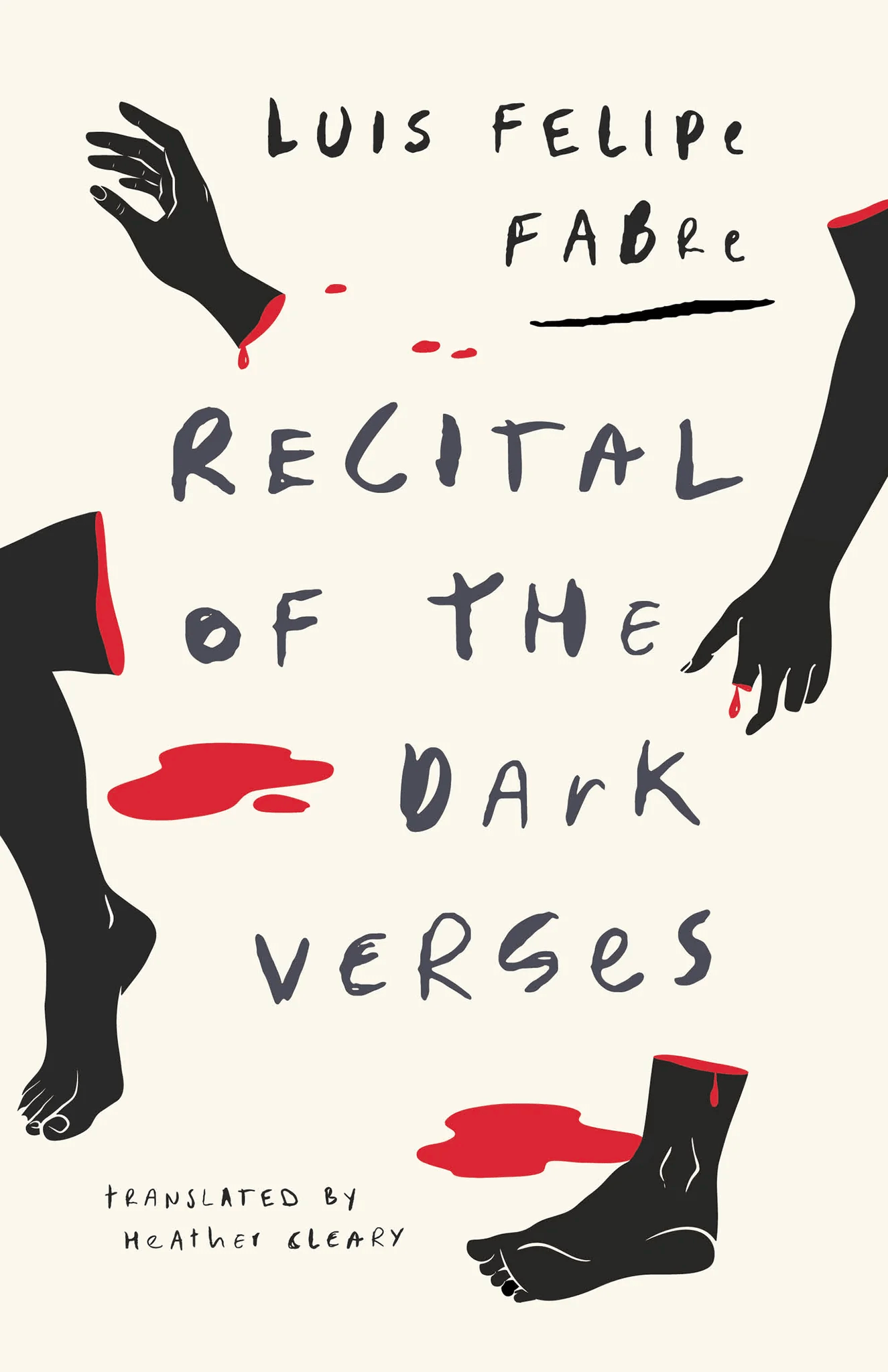
And so they will travel by night: Recital of the Dark Verses by Luis Felipe Fabre

Out into that wondrous night
I stepped unseen and stealthy,
with not a thing in my sight
nor any light to guide me
but one burning in me bright.

(from “On a Dark Night” by Saint John of the Cross)

If Fray Juan, the determined and devout evangelist of the barefoot or Discalced Carmelites, the reformed order founded by Saint Teresa of Ávila, was deemed troublesome during his lifetime, the humble Spanish friar, poet and mystic who would later become known as San Juan de la Cruz or, in English, Saint John of the Cross, was no less disruptive in the months and years that followed his death. In life, his dedication to the austere principles of the reformed order and his success in fostering it’s expansion across sixteenth century Spain upset other Carmelites. In 1577, this led to his torture and confinement in a monastery in Toledo where he composed and committed to memory one of his best loved poems prior to making his daring escape, naked into the “pitch-dark night.” After recovering from his ordeal, he returned to assisting with the spread of chapters of the Discalced Carmelite before eventually joining the monastery in Segovia as prior. Yet, when he disagreed with some changes being made in his order, he was moved to an isolated location where he fell ill with erysipelas. As his condition worsened, he was transferred to the monastery in Úbeda where he died on December 14, 1591 at the age of forty-nine. However, he would not stay there, well, at least not in one piece. The widow doña Ana de Peñalosa, sister of the influential don Luis de Mercado who was Fray Juan’s friend and the funder of the monastery in Segovia, wanted his remains to rest there.

The effort to satisfy that desire is where Mexican writer Luis Felipe Fabre’s Recital of the Dark Verses begins. What follows is an unexpectedly energetic historical-fiction-meets-comic-road-novel that serves up spirituality, adventure, with a healthy amount of bawdy humour. When the bailiff, whose name biographical sources fail to agree on, and his two young assistants, Ferrán and Diego (thus named because no record exists to confirm or contradict the author’s fancy), arrived at the monastery in Úbeda in September or October of 1592 with orders to collected the late friar’s body, they are met with no small measure of resistance. First there’s the matter of the smell emanating from the corpse that has inspired ecstasy in the monks and near frenzy among the townsfolk who have clamoured for any available piece of Fray Juan’s tattered clothing, soiled dressings, or physical person. As the porter explains to Diego and Ferrán, it is a question of:

“The aromatic clamor of his body. The scent of saintliness. The gentlest of perfumes which stirs in the soul yearnings, burnings, and zeal, and which, emanating from beneath the slab whereunder lies Fray Juan and drifting through the air, at times reaches my own nose  like a distant jasmine while at this door I stand.”

It is a scent that cannot be silenced, an aroma that inspires a devotion so intense that it can lead to feverish displays of ardor or, if one fears being deprived of access to it, potential violence. Of course, for those who cannot smell it, or who only detect the normal odour of decay, it can engender doubt and fear about the solidity of one’s own faith.

But that is not all that delays the planned retrieval. When it is uncovered eight or nine months after the friar’s demise, the body Fray Juan, even with all the sores caused by the disease that killed him, is uncorrupted. A finger cut off still draws blood. So the bailiff takes the finger as a token for doña Ana, and instructs the monks to make an effort to encourage some further desiccation, vowing to return the next year. So it is not until April of 1593, that the bailiff and his assistants finally manage to depart Úbeda with the body of Fray Juan in a large leather case—albeit absent an arm left behind as relic. They travel by night, staying off the main roads, but they cannot escape the saintly scent, impossible to disguise, that arises from their secret cargo and which will be responsible for much of the undue attention and danger that will stalk them as they seek to carry out their mission.

Along the way they not only have to face their own fears as the dark nights threaten to close in around them, they must fend off amorous barmaids, a group of shepherds with ill intent, and an angry mob of townsfolk from Úbeda who are determined to retrieve the body of their blessed friar at all costs. Fabre draws on a wealth of often conflicting historical and biographical accounts of the saint’s posthumous journey, while liberally incorporating themes and figures from Greek mythology. But fundamental to this absurd tale of devotion, temptation, and misadventure are the words of San Juan de la Cruz himself. Three of his best known poems—“On a Dark Night,” “Love’s Living Flame” and “Spiritual Canticle”—are recited in full or in part throughout the novel, along with passages from the extensive commentaries the friar wrote to flesh out his own work.

For a man so committed to an especially extreme expression of faith, Fray Juan’s verse is  intensely passionate and sensual in nature, with a speaker that often takes on a female voice, that of a lover seeking to join with her Beloved. The spiritual ecstasy inspired by his words contrasted with the religious attachment his followers hold to his physical body (which will not make it to Segovia fully intact—only his head and torso rest there to this day), set the stage for a philosophical exploration of the blurred line between the heavenly and the worldly domains. On their journey, the three couriers tasked with the transportation of the friar’s body, will all face their own demons. The bailiff doubts his faith, while twenty-year-old Ferrán, who is trying to stay one step ahead of the Inquisition is cynical and unmoved by the mystic’s poetry. However, sixteen year-old Diego, a naive youth in the full turmoil of puberty, finds his tongue possessed by Fray Juan’s words and his soul struggling to balance spiritual inspiration with his own blossoming sexuality:

He was delirious. Delirious with fear, with fever, with hunger, exhaustion, and love. But through his deliria did Diego speak truth as if by the tongue of another. For his deliria were none other than Fray  Juan’s liras and, though Diego knew them not, from him did they spring forth as if from an old and distant void or night or heart.

The result is a tale that is light in tone, but one that easily carries deeper and darker themes on its playful narrative stream. Careful attention is paid to the exegetic tradition and the formal conventions of the saint’s own commentaries. Each chapter opens with an introduction incorporating the specific lines that will be expanded upon therein along with the particular challenges that await our protagonists. To further evoke the mood of the era, Fabre, in the original Spanish text, employs certain archaic verb forms and syntax. Translator Heather Cleary, unable to access exactly the same measures, choses to:

play with word order, an antiquated past tense, and a few lexical choices here and there in order to create similar rhythmic effects, shift the temporality of the narrative without sacrificing clarity, and evoke the ludic sensibility that evades the original.

It works beautifully. The result is a comic Golden Age-hued celebration of the many questions that can arise about the nature of the relationship between the body and the soul, the sacred and the profane. You can take any answers it may suggest as you will.

Recital of the Dark Verses by Luis Felipe Fabre is translated from the Spanish by Heather Cleary and published by Deep Vellum. This book was read as part of Spanish Lit Month 2024.

“Everything meant something else. The apple no longer an apple.” Divided Island by Daniela Tarzona

State the manner of panic, the voice of terror. Approach the scream and grab it with your mouth to make it heard. Right now you’re shouting. You shout with so much force your jugular vein pops out.

If one of the possibilities inherent in the form of the novel is the freedom to break with expectations when the expression of the pressing strangeness of being in the world demands it, Mexican writer Daniela Tarazona’s Divided Island is a work that opens itself up, stretches the boundaries of reality, and fractures into shards of glass to reflect pieces of an uncomfortable and incomplete whole. It is also a response to grief and neurological disorder that is as entrancing as it is disorienting. The brain scan illustrations that open each section of this slender novel seem to indicate that the protagonist (or protagonists) may not be on stable ground, but this fragmented narrative explodes with emotion and shifts gears so abruptly that it undermines the natural inclination to want to “figure it all out” which is, of course, the point. But it is not without meaning, as a meaning does gradually begin to become clearer although the mist never lifts entirely.

Essentially, it is the story of a writer who is grieving the death of her mother. The grief permeates her life and surroundings. This is intensified when, after a series of brains scans, she is given a diagnosis of cerebral dysrhythmia, and suddenly finds herself splitting in two.

Once upon a time there was the sun. Seething sphere. If the word were she, it meant you; you were replicated. Her over you. You over her. Two bodies spinning in circles.

One of the women she becomes leaves and travels to an island where she intends to kill herself. The other, addressed as “you,” stays behind to try to pick up the pieces of her fractured existence and make sense of her life. Her mother and grandmother, both passionate yoga practitioners, come back to her in memories (or are they dreams?), while visions and paranoias haunt her days. And meanwhile, “she” is on the island, contemplating death.

The narrative maintains a trancelike quality throughout as the woman navigates the painful loss of her mother and the altered reality in which she finds herself:

It turns out you’re surrounded, you’re an island with water on all sides: the reams of paper by the desk, the books, the suitcase of jewelry. Your mother’s things. Notes. Letters. Your grandmother’s manuscripts.

Strange things happen to you. The decorations in that tableau of wonders, seem to accurately describe the moment you’re living in: you’ve got an orange tabby; the porcelain plates your mother painted arrive at the house; you wrote a novel about a woman who lays an egg. The tableau existed before the novel. Does the order in which things happen in time really matter? Being surrounded means sinking in sand. Your body gets lost among objects, you can barely open your eyes. Seeing is a state of grace, here, right now.

Several historical and literary figures, most notably the Costa Rican born poet Eunice Odio who emigrated to Mexico, appear in the woman’s memories and dreams of her grandmother—the woman who stays, mind you, the woman who wants to die is on an island awaiting her own demise. Despite their separate trajectories, it is made clear on several occasions that these women are one and the same being. Two selves estranged from one another? Or an existential neural short circuit? Or are both emerging and diverging through the act of writing itself? The story runs toward and against itself as images resurface and the medical mystery lying behind the neurological scattering is given more substance—as much as substance is possible from measuring electrical patterns and data, that is.

The brain scan images that illustrate the book do belong to the author herself, so although this is far from a clinical text, Tarazona may be drawing, to some extent, on personal experience. Yet, one senses she is guided by a desire to explore emotional intensity and perceptual distortion from a purely poetic perspective. And that is the best way to read and appreciate Divided Island. A close comparison (and probable influence) is Clarice Lispector, but this unusual, alluring tale of an excitable mind and the two women who share it is a startling and singular work that rewards multiple readings.

Divided Island by Daniela Tarazona is translated from the Spanish by Lizzie Davis and Kevin Gregory Dunn and published by Deep Vellum.

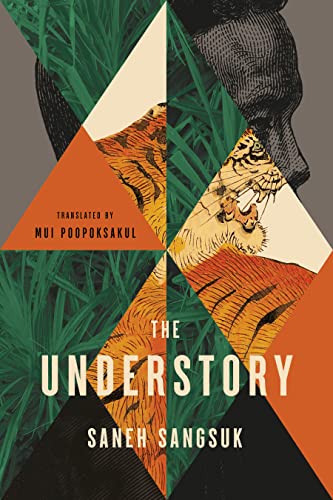
But I was a child of the jungle: The Understory by Saneh Sangsuk

Toward the end of the Afterword to his novel The Understory, Thai author Saneh Sangsuk, having acknowledged the myriad of sources and resources that informed his tale, describes just how his work originated and quickly assumed a life of its own:

One day in early 2002, I had set out to write a short story, which was meant to be a very short story. What I had had in mind was a ghost story precisely of the kind often subject to ridicule. But after two paragraphs, The Understory began to take shape. The story that I had started had shifted toward a new direction, and I, considerably irritated and discouraged, submitted to it, watched it from afar, to see how it would unfold.

To imagine a potential novel-length work asserting itself after only two paragraphs, is an indication that the seeds of the tale had possibly been simmering the writer’s imagination for decades, but it’s also important to recognize that each paragraph in the final printed edition of this book extends for at least ten pages or more. So that is a little more of a runway than it first sounds. Nonetheless, if Sangsuk found himself so immediately swept up in his own creation, that same energy is fully transmitted to the reader in this engrossing tale of an inveterate storyteller determined to share the magic of a disappearing habitat and the wisdom of a fading culture before it is too late.

The third person narrative of the first quarter or so of The Understory introduces the village of Praeknamdang, a small farming community in Thailand, and the eccentric ninety-three year-old abbot of the local temple, Luang Paw Tien. Seventy-three years into his monkhood, this ancient man still continues his daily alms walk, some seven kilometres long, accompanied by his beloved ox, a practice he will maintain until illness and old age finally claim him years later. By then, the village will be on the verge of being abandoned. But when this story takes place, or rather, when the story within this story is told, it is the winter of 2510 BE, or 1967 CE, and Luang Paw Tien is still defying his age and actively engaged in his community. This year, however, has been a difficult one, marked by a flood that devastated the season’s rice crop. The villagers, young and old, are despondent, and their loving monk is worried about them. At night, as everyone gathers around a communal fire, he joins them as usual. He was always welcome. Night after night, he would entertain the villagers with stories drawn from his long journey to India to visit the Buddha’s birthplace, or with one of the countless tales—funny, spooky, or fantastic—that comprised his regular repertoire of entertainments. “To the serious-minded adults, he was the teller of tall tales who breached the precept concerning monks and untruthful speech, but to the children, he was a trove of magical stories.”

Yet, on this particular night, he feels that he has run out of stories and hand-me-down tales. His thoughts are troubled:

Whenever the old bhikkhu thought of the fates of the men and women and children of Praeknamdang, a terrible gloom would wash over him and fill his heart. The shadow of decline and deterioration had long loomed over those fields, and that shadow now seemed to be growing ever larger and more intense, since large swaths of the jungle had been destroyed, and it seemed he was the only one able to sense the ruinous omens. The dull hums of tragedy emanating from beneath the ground were as powerful as tsunamis, and it seemed he was the only one able to sense their menace. The village was soon to become deserted, and that it would be deserted seemed inescapable. The natives and their children and grandchildren would one day be relegated to the position of serfs because, even in those years, rights to the land that had from time immemorial belonged to the people of Praeknamdang were falling into the hands of people from elsewhere.

Aware that the adults may already to be lost to this inevitable state of affairs, Luang Paw Tien decides to turn his full attention to the eager and attentive children gathered around him and launches into a personal account of his own childhood and early adulthood—an account that begins with a little historical context and soon erupts into a lively monologue featuring his eccentric hunter father, Old Man Jumpa, his patient farmer mother, Mae Duangbulan, and an ongoing life and death battle with the jungle’s most feared inhabitant, the tiger.

The world in which Luang Paw Tien grew up was one in which the dense jungle with all its riches and dangers hovered close around Praeknamdang, and shaped both the lives and the imaginations of the villagers. As a child of the forest, Luang Paw Tien was acquainted with its magic and its perils from a young age, but one stood above all:

In the jungle, even in the full light of day, even when I was trekking with Old Man Junpa or with other grownups, a tiger’s growl, however far away it was, made my heart skip a beat. And during those times when I was less than well-behaved and wandered off playing, as children do, a tiger’s growl, even from afar, even in the full light of day, triggered a rash of goosebumps all over my body. When a tiger revealed itself, no matter where, all the different animals would call out frenzied, panicked warnings to their own kind, and next thing you knew, silence would spread through that part of the jungle.

When the tiger does strike close to home, in a deadly and horrifying way, the future monk is only ten years old it changes the course of his life quickly. But, seasoned storyteller that he is, he allows the story to unfold slowly, somehow managing to maintain the level of excitement and throughout.

As narrator, Lunag Paw Tien is openly blending a mix of folklore and fact, reminding his listeners that there once were beliefs and practices that might now sound strange to those who have grown up in world where the jungle has been pushed back and somewhat tamed in the interest of agriculture. But when he young, the jungle was still capable of keeping man in his place. As an author, Saneh Sangsuk, draws on a wealth of materials to evoke a disappeared way of life. He demonstrates a deep respect for nature and traditional practices, one that comes through no matter how eccentric and larger-than-life his characters and story may be. That is because

The Understory is, above all, a celebration of the power of oral storytelling. As such, the most infectious element of this novel lies in the rhythmic energy and flow of the narrative which is captured to great effect in Mui Poopoksakul’s translation. In an interview for Asymptote, she describes how meticulous he is with language and how sensitive he is to its musicality. She says that when she first started working with him, she was surprised that he could state the exact length of time it should take to read any one of his works. She thought it might be some kind of exaggeration:

But as it turned out, he just has a very clear idea of how his texts should sound. I don’t know if he’s actually timed it, but when you talk to him, it almost feels like he has, because he has such a specific idea of the flow. It was only after I spent a lot of time talking with him that I realized that he was not kidding when he said those numbers. And so, working on his texts, I have to be hyper-aware of rhythm.

Her translation so adeptly captures the a musical flow in English, that this text, with its long unbroken paragraphs, moves at such a keenly calibrated pace and just the right level of sustained suspense that it is an absolute delight to read.

The Understory by Saneh Sangsuk is translated from the Thai by Mui Poopoksakul and published in North America by Deep Vellum. The UK edition is published by Peirene.

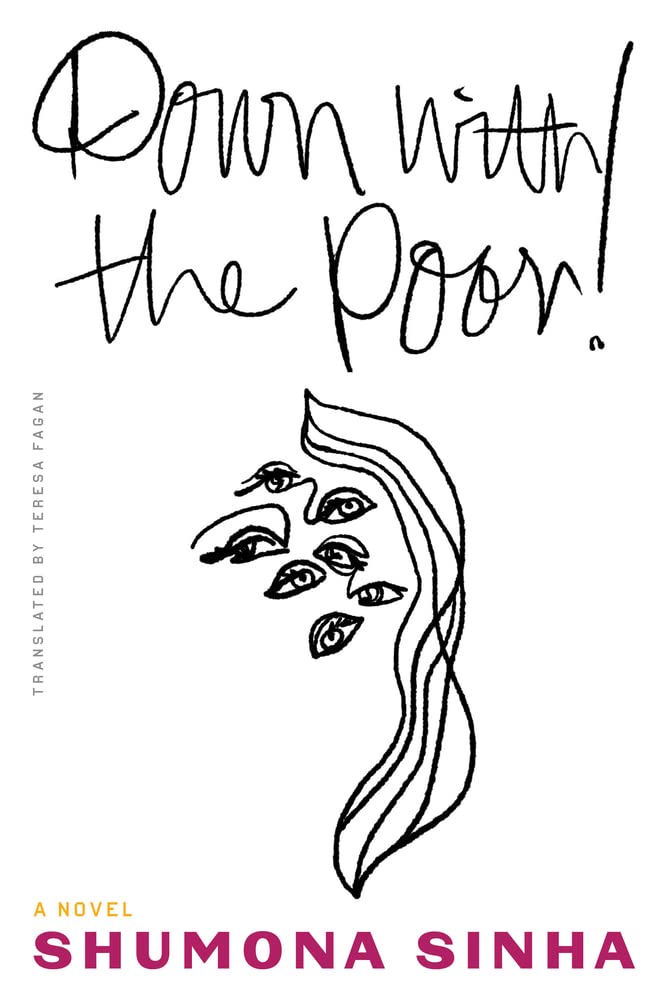
“I’m afraid of myself.” Down with the Poor! By Shumona Sinha

In my half-sleep I saw faces and bodies emerge out of the floor tiles. Blissful, intrigued, tormented people. They appeared when I blinked my eyes. Disappeared when I blinked my eyes. Like this night, in this police cell. To tell the truth, I am still not rid of that shouting and whispering.

Opening with an epilogue from Pascal Quignard about the implication inherent in ancient Greek notions of liberty and freedom of movement that those who defy borders and fences are akin to wild beasts rather than obedient animals, and taking its title from Baudelaire’s narrative prose poem “Assommons les pauvres!” in which a self-enlightened man inadvertently rebalances inequality by violently attacking an elderly beggar, unleashing an equally violent response from his victim, Shumona Sinha’s novella Down with the Poor! is a relentless meditation on the complicated and corrupted system that drives desperate migrants to seek fairer shores, only to find themselves mired in equally, if not worse, circumstances and threatens to destroy the spirits of those who attempt to help them. As she lies in a cell in a Paris police station, a young woman endeavours to untangle the forces that conspired to drive her, an Indian immigrant working as a translator for asylum claimants, to assault a migrant on the metro by smashing a bottle over his head.

Born and raised in Calcutta, Sinha started studying French at the age of twenty-two and moved to Paris a couple of years later. In this award winning novel, her second, originally published in 2011, her unnamed narrator is also from Calcutta. She is a woman who has tried to separate herself from her parents and her hometown, but finds the shadows of Kali, the city’s dark, powerful and protective deity, and Mother Teresa, its symbol of charity, haunt the life she had imagined she had earned, far from memories of poverty, in France, the adopted country she loves. Everything starts to unravel when a series of personal and professional endings lead her to accept employment as an interpreter—a “language gymnast”—in an office on the edge of Paris where ragged petitioners are called to appear before an officer and make their case, or more typically repeat the story they’ve been forced to purchase, in the hope that they might be allowed to stay in a new hostile, unwelcoming land and make some kind of better life.

Unfolding as an intense monologue, poetic and compulsive, the narrator, in light of her arrest and recent interrogation, navigates a flood of feverish thoughts and memories in attempt to figure out how and where things started to fall apart in her world. From early on it is apparent that her role as the conveyor of meaning, from her first language to her second, is more than a simple act of rewording. For her, it is an act of verbal alchemy that carries an emotional cost.

The officer spoke her language, the language of the host country, the language of glass-walled offices. The petitioner spoke his supplicant’s language, the language of the hidden, the language of the ghetto. And I repeated what he said, translated it and served it up piping hot. The foreign language melted in my mouth, leaving its aroma. When I said the words, those of my native language, they turned awkwardly in my mouth, paralyzed my tongue, echoed in my head, hammered my brain like the wrong notes on a wobbly piano. It was a rope bridge, thin, quivering, between the petitioners and me. I had to lean toward each one of them to hold out my hand, lean into their dismembered, chopped-up sentences, fish for their disjointed words and reassemble them, weave them together, make them sound coherent.

The stories she hears, the horrors, real and embellished alike, start to seep into her being. She finds herself carrying their pain. Their desperation. The knowledge that many, if not most, have paid smugglers dearly, become slaves consigned to a poverty much more wretched and inhumane that anything they left behind, builds up inside her. She seeks to shake it in meaningless sexual encounters, while secretly harbouring an attraction for a female officer that she cannot quite articulate.

Over time, her work takes her into other overlooked corners of the city’s margins, while the in the offices of her primary employment, she finds it increasingly difficult to hold herself apart from the stories she hears. Questions of class, colour, gender are never far from her mind, knowing that her own skin, sex and status bind her to and irrevocably separate her from the masses of refugees, while also keeping her apart from those who are driven into work with these populations by charitable passions. She cannot help but absorb the fear she encounters in others. Eventually that fear is transformed into anger and in turn her anger frightens her. She finds she is afraid of herself.

Holding its intensity for a little over one hundred pages, Down with the Poor! is a poetic novella that addresses some of the most pressing and difficult questions we face today in a manner that is shocking, brutal and lonely. This is a very powerful little book.

Down with the Poor! by Shumona Sinha is translated from the French by Teresa Lavender Fagan and published by Deep Vellum in North America and Les Fugitives in the UK.

A book is vegetal: The Geography of Rebels Trilogy by Maria Gabriela Llansol

I then began to accumulate memories of the future in a great meditation

There was a woman named Maria Gabriela Llansol, born in Lisbon who, fleeing repression in her native country, put herself into exile in Belgium for twenty years before returning to Portugal to settle in Sintra for the rest of her life. She was a writer when she arrived in Belgium, but it was during her time there in that, in an environment more conducive to her creative energies, writing began to flow in earnest—that she became as she might have preferred to say, a “writing being,”[i] for hers is a deeply inhabited landscape within which an experience of living with the wisdom of the past and the present, of human, animal and plant life alike, is not only possible but necessary.

Despite a relatively late start, Llansol would go on to have an extraordinarily prolific career as an author and translator. At the time of her death at the age of seventy-six in 2008, she left twenty-seven published books and more than seventy notebooks. Her singular style won her significant critical praise, but she was not expecting her books to attract a general audience. Like the many religious, historical and literary figures who move through her texts, she was writing with the belief that her work would outlive her. And so it has, for those who venture into her literary universe are unlikely to emerge unchanged. But it is a journey that requires one to have a willingness to suspend expectations of how a work of fiction should behave. In fact, Llansol herself would reject the notion that her books are fiction at all:

I don’t see them that way. Because they are really books based on a reality that is lived, that is an intimate observation of my journey as a body, as a person. So even though they usually call it fiction, I think this writing isn’t fiction. It is the product of an experience that deepens, a textual conveyance of the worlds I traverse.[ii]

This understanding encourages an engagement with her novels, then, as one might with mystical and philosophical writings that are continually questioning, seeking and exploring relationships where the “characters” and the authorial voice is a shifting, open plain—sometimes specified, other times formless and timeless. Conventions of spatial and temporal continuity have their own logic. And yet, as one catches the rhythm and flow, a beautiful, sensitive, otherworldly narrative unfolds.

The first opportunity English language readers have had to enter Llansol’s expansive world came with the 2018 release The Geography of Rebels Trilogy from Deep Vellum in Audrey Young’s translation. Comprised of three linked novellas, The Book of Communities, The Remaining Life and In the House of July & August, these works can be considered as a clear directional shift away from the two short story collections she had already published and later dismissed as too conventional. They are connected thematically, with recurring personages, the first two texts perhaps to a greater extent than the third, but for Llansol all her books draw on her own earlier books as well as the writers, texts, conversations and experiences that she has along the way. She sees writing as a cumulative process, one in which “characters” appear and reappear, situations recur and take on new realities, while at the centre of it all is the being, the writing being, who is “giving them a certain response.”[iii] As such, perspectives shift, moving in and out of a first person voice that may or may not identify itself in a fragmented narrative that often drops off mid-sentence or rearranges itself on the page into narrow columns. Yet although it may sound unlikely, Llansol’s work is enveloping, atmospheric and not difficult to read if one respects the fact that it is not prescriptive in nature, but rather inquisitive and exploratory.

The Book of Communities opens with the description of a woman who “did not want children from her womb” and instead invited men to bring their children to be educated. While the children recite passages from the writings of Saint John of the Cross she entertains dreams of the discalced Carmelite himself. This woman initially echoes Llansol who, upon moving to Belgium, taught in a community school for international students, but she introduces herself as Ana del Mercado y Peñalosa, a historical figure who was a friend and benefactress of Saint John of the Cross. Little detail is known about her life, so into this open biographical space blossoms an enigmatic, inspirational and generative female force whose presence provides a continuity to the trilogy, at times central to the “action,” at other times observing, and eventually seemingly directing activities from afar. Ana de Peñalosa is regularly described as being near the end of her life, at one point she appears to die and be immediately reborn, but it begins to seem that she is simply ageless. Yet, although death is spoken of with some fear, “living” and “dead” have no permanent meaning in this world. Many of the characters or “figures” that populate these novels are long dead, often by centuries or not yet born at the time in which the work is loosely set—the years of the Counter Reformation. But, of course, this trilogy exists on its own plane of reality, one in which writing is the vital and essential metaphysical force that unites disparate strands to form images with their own unique integrity.

The work proceeds through a series of often strange or surreal scenes or vignettes. Some are centred around a house that belongs to (or is dreamed into existence by) Ana de Peñalosa in a remote, forested area near a river. Others depict periods of exile or wandering. A number of controversial, even heretical, figures are drawn into the narrative, including John of the Cross, the radical Protestant Thomas Müntzer, Friedrich Nietzsche, 13th century mystic Hadewijch, Meister Eckhart, Lorenzo de Medici and many more. Animals and plants are also an important part of the community that arises—in their own right and as forms that human characters assume permanently or in passing. John and Thomas Müntzer are especially dear to Ana de Peñalosa; she refers to them as her sons. The latter, beheaded in 1525 for his role in the German Peasant Revolt, carries his head with him throughout. Nietzsche, who arrives first in correspondence before appearing in person, also briefly in child-like form, will spend more of his time alone in his room writing and is the third key figure, while the fourth, Hadewijch, the Flemish Christian Beguine known for her ecstatic poetry, appears midway through the trilogy and becomes more influential as the work progresses.

The third novella, In the House of July & August, maintains a somewhat more consistent narrative. It is revolves around an imagined community of Beguines, the Christian lay order of women who dedicated themselves to a life of devotion and service, which includes among their number, Hadewijch. Ana de Peñalosa appears to have a role directing the lives of this group along with a man referred to as Luis M. He is not further identified, but early in The Book of Communities, Ana de Peñalosa speaks of a brother-in-law, Don Luis del Mercado who entrusted her with care of her niece Inés, so there may be a nod toward the historical Ana here. Nonetheless, Luis has a cryptic relationship to these women that may extend to the physical. There is a deeply sensual feminine aspect to this community who are known as The Ladies of Complete Love.

If the act of writing and the book have an existential quality in the first two books of The Geography of Rebels, both become somewhat more concrete in the third as the focus turns to the printing and production of texts and the acquisition of manuscripts. One of the beguines, Marguerite, is sent to study in the house of Christophe Plantin, the French printer and book publisher who lived and worked in Antwerp. The craft becomes a vocation for herself and some of her sisters until she is sent on a dream-like mission to locate the headwaters of the Tigris and the Euphrates where she is to obtain an important document. Meanwhile her dearest companion, Eleanor, is sent Portugal to work as a gardener before being taken to Lisbon to live in a convent where she discovers a library containing forbidden books. Communications between Marguerite and Eleanor form much of the narrative, however, this is still a world featuring enigmatic beings, neither living nor dead, consultations with ancient and arcane knowledge and an intense connection to rivers. In other words, well within Llansol’s expansive, yet self-contained universe—one that is, as ever, realized through a living text, carried on a breath and a prayer.

Maria Gabriela Llansol’s works may defy easy summary or classification, but they are born of a deep personal engagement with the philosophers, authors and spiritual figures who emerge in her writings. There are few writers to whom she can be meaningfully compared, Clarice Lispector and Fernando Pessoa possibly being the most immediate, but hers was a life-long project with a distinct and innovative continuity running from book to book that allowed her to chart a literary cartography all her own. One can only hope that this luminous trilogy will be followed by further opportunities for English language readers to explore Llansol’s oeuvre.

The Geography of Rebels: The Book of Communities, The Remaining Life and In the House of July & August by Maria Gabriela Llansol is translated by Audrey Young with an Introduction by Gonçalo M. Tavares and an Afterword by Benjamin Moser, and published by Deep Vellum.

Endnotes:
[i] This is from a transcript of a radio interview with Llansol recorded in 1997 at the time of the release of her Inquérito às Quatro Confidências: Diary III, translated by Audrey Young and reproduced with permission on Anthony’s excellent site Times Flow Stemmed. Llansol discusses her own unique perspective on the nature of her writing.
[ii] Ibid.
[iii] Ibid.

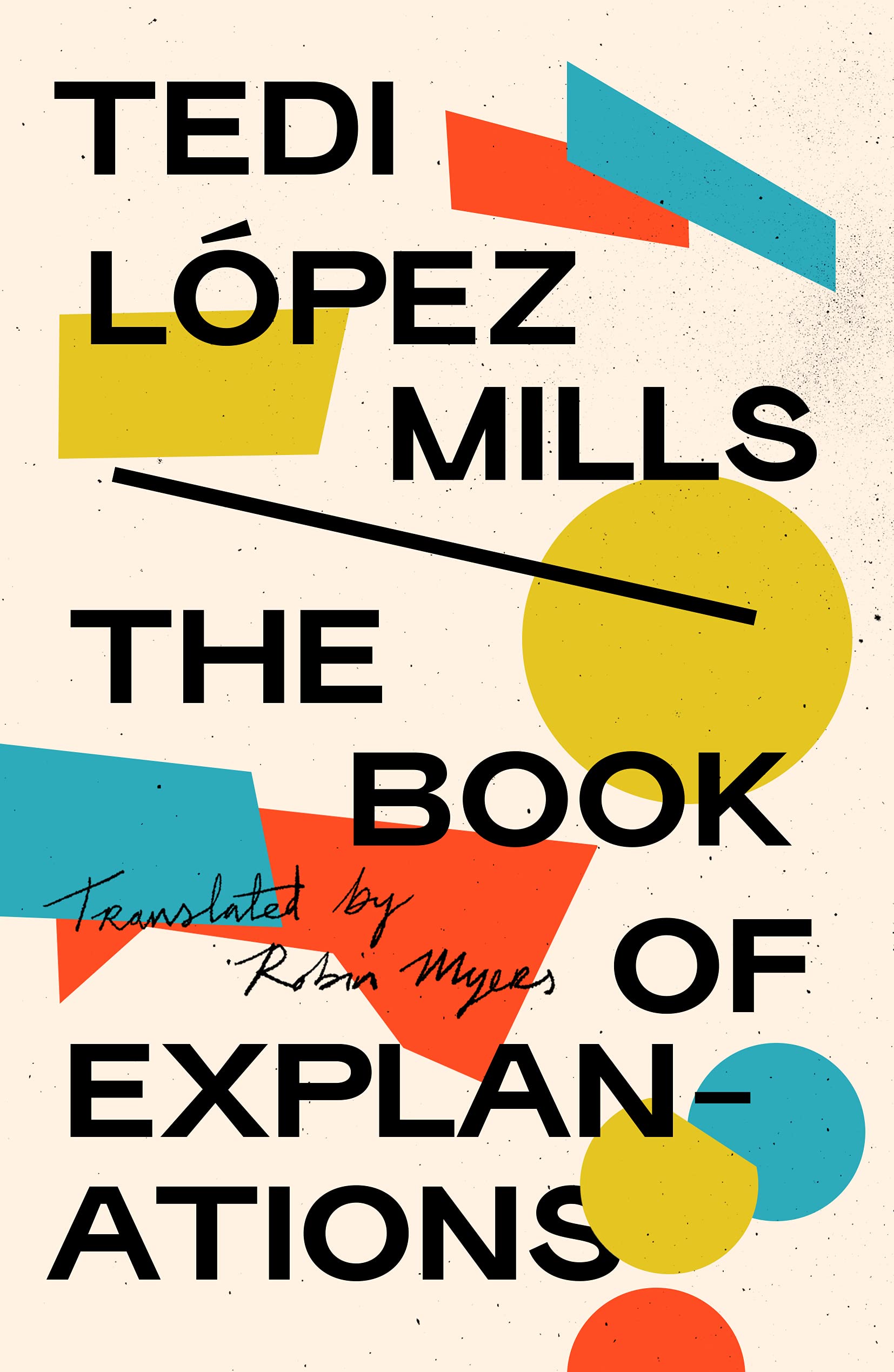
Searching for the ever elusive “I”: The Book of Explanations by Tedi López Mills

Lately, when I imagine, I remember. Then I shift into a peaceful kind of forgetfulness. And I start to imagine again, remembering. Like a circle that’s no longer vicious because it erases its own trail, little by little, always resketching its outline for the first time.

How much of identity is memory? It would seem that the experience of being in the world is dependent on memory because each moment, as it passes, becomes part of an ever accumulating past—a past that gives coherency to the existential “I.” Yet, can what we think we know about ourselves help us live with our choices, idiosyncrasies, strengths and faults? In her inventive and intelligent collection of personal essays, The Book of Explanations, Mexican poet and writer Tedi López Mills begins with a look at a most basic question of identity, her “improper” (read: “unconventional”) name, followed by playfully distinctive explorations and dissections of the nature of memory. These opening pieces set the groundwork for a journey that will carry us through many of the experiences, influences, values and ideals that make her who she is and, by extension, any one of us who we are—or might be—because, after all, what can anyone ever really know for certain?

I don’t know the history of the fourteen essays—cleverly numbered from 0 through 13— that comprise The Book of Explanations. That is, I cannot tell if the original 2012 collection was assembled from previously published pieces or intended as a cohesive work from the outset, but it definitely succeeds as a whole. López Mills’ style is eclectic and fresh; her essays open up in unexpected directions, adopting different forms and approaches from piece to piece. She is always very much present, drawing on memories and personal experience, but even her more memoirish essays swing toward broader social, psychological and philosophical questions.

After her early forays into the nature of remembering, López Mills turns her attention to that strange period of often dark introspection otherwise known as adolescence and to reflections on the peculiarities of family dynamics. As a teenager, the author, or  her possible alter ego/alternate “I,” falls into to some classically heavy reading—Hesse, Nietzsche—in search of formulative role models. On her family’s frequently uprooted home front, her father, an eccentric, frustrated architect of dreams and schemes, is an unpredictable but memorable character while her mother is the stabilizing presence. She explores the lasting impact of her childhood in the essay “Father, Mother, Children,” where she posits: “Maybe there are no happy families, just happy days. I remember them because they’re always flanked by unhappy ones.” Her father, she says, was “erratic, original every day,” her mother “homogenous, predictable.” She is tempted to imagine who her mother might have been without children, although that necessarily imagines the imaginer out of existence. This leads into a fascinating observation about childlessness—her own situation which she insists is neither right or wrong—and its implications:

You belong to yourself, and in the end you may realize that your persona dims if you don’t put it at risk; you start melting away into a nervous, perfectionist mind. The influence of childlessness may even be more shocking, a deprivation so intense that it triggers hallucinations of a crowd as you rummage around, hearing no one’s noise. A fictitious identity, if forced and constant. While there’s no room for regret—you can’t undo what was never done—there’s an extravagant kind of nostalgia. You miss the future, not the past.

Either option, parenting or childlessness, simply puts you on one side of anguish or the other. And as a parent, I would add that you can experience an extravagant kind of nostalgia as well. In fact, I suspect that we all have some aspects of our lives in which it is the future we miss, not the past.

From one essay to the next, López Mills, examines those notions that intrigue or trouble her, or both. Her affection for cats, the pervasive and evasive nature of guilt (a regular evening visitor), what makes some people prone to jealousy (something she does not experience) and what makes others “good” (something she would like to be). She defends pessimism in what is essentially an essay about Cioran, makes some astute observations of the way we show or fail to show compassion for those in need and, finally, engages in a spirited Wittgensteinian-like investigation of wisdom by way of by Marcus Aurelius, Epictetus and the Bhagavad Gita with plenty of introspective musing unfolding over 54 short reflections.

Not only is López Mills an engaging companion with a philosopher’s tendency to question and a poet’s sensitive attention to language, she puts herself—as the typically uncertain “I”—into all of the subjects she explores in a way that is always thoughtful and recognizable. This is a book filled with so many intriguing thoughts and ideas, but it is never intimidating or alienating. At a time when “genre-bending” essays have become quite popular, I sensed something here that I have not found in other similarly described collections. I suspect it may have to do with age. Although I grew up in a different environment and my soul searching may have had some differing triggers along the way, I had a sense from early in this collection that the author had to be close to my own age. There were no particular pop culture references to cling to but rather a shared atmosphere of being a teenager in the seventies, and a certain accumulated, well, wisdom. I finally looked her bio up online and discovered that she was born in 1959 and is just one year older than I am. Even though this book, first published in Spanish in 2012, was probably compiled when she was in her early fifties, I felt I was reading a contemporary.

It’s so easy to believe we know it all when young, but the older you get the more you realize how naïve your younger self was and the more you appreciate how little you ever really understand about who you are. At fifty or sixty, you may care less what others think in explicit terms, but that doesn’t mean you stop trying to figure out what it all means at the end of the day. As with one of my heroes, Michel Leris, who differs greatly from López Mills in style but not in intent, there is this unending desire to catch oneself in the act of being and examine a subject—the elusive “I”—which can really only be observed in passing. Both writers know we can look back at what we remember, but in the moment we are fluid beings and what we remember is always being reimagined. There will always be more questions than answers.

And that’s okay.

The Book of Explanations by Tedi López Mills is translated from the Spanish by Robin Myers and published by Deep Vellum.

“I was a soldier and this is the nation’s soil!” No Windmills in Basra by Diaa Jubaili

Basra, in southeastern Iraq, is the country’s principle port city, best known to lovers of The Thousand and One Arabian Nights, as the site from which Sinbad set sail. But over the course of its long history, from the time it was first founded as a military camp in 635 CE to the present day, it has had a rich, diverse, and often troubled history. More recent times have been marked by the repeated onslaught of violence and destruction during the Iran-Iraq War, the Persian Gulf War and the Iraq War. Imagine, then, this grim reality as a back drop—sometimes distant, sometimes immediate—for whimsical, melancholy and magical flash fiction and you have an idea what Diaa Jubaili’s newly released collection No Windmills in Basra has in store. Of course, with seventy-five brief stories and one more expansive piece, many variations of joy and heartache play out across the pages of this lively, inventive volume.

Born in Basra in 1977, Jubaili has published eight novels and two earlier collections of short stories, but No Windmills in Basra is his first book to be translated into English and his first foray into the territory of flash fiction. In an interview with Chip Rossetti, the translator of his new book, he explained this move:

I chose this genre because there are ideas that can’t sustain elaboration or filling in gaps with things that don’t mean much to the reader. Getting an idea across with the least number of words is a difficult task, but just the challenge of doing it isn’t enough: the writer has to have an exceptional ability to create surprise. But I’ve loved this genre of concentrated narrative for a long time, and I read a lot about it before I tried writing the first text.

He goes on to talk about the importance of using vivid, poetic language to build a scene and provoke questions in the mind of the reader. Puns and play on meanings also appeal to him, an energy that charges his powerful, often surprising conclusions.

The stories in this collection are divided thematically—wars, love, mothers, women, children, poets and miscellaneous—but, as one might expect, key elements like war, love and family reappear throughout. Jubaili’s preparatory work serves him well—his tales are tightly woven, witty and affecting. Fantastical elements abound, a reflection of the importance of magic in Arabic folktales, often employed with humour, irony and black comedy. For instance, in one story, a man returning to his hometown after the end of the Iran-Iraq War finds his family plot of land has turned into a wasteland of salt. Tirelessly he and his sons work to rejuvenate the soil, hoping to restore it and once again harvest fruits and vegetables. But to their surprise they awaken the rotting corpses of soldiers, fallen there over the intervening years, who bitterly complain that with the salt gone they have been deprived of all they had left—the taste of death. In another, a woman suddenly loses her sense of taste after eating her first banana. As time goes on she loses her sense of smell, then she loses her colour. She grows weaker while everything else thrives around her. In the end she has become water. Elsewhere, we encounter a child who develops a plan to deal with dreaded stealth bombers, a young woman with sparrows in her ribcage and a blind woman searching for and finding a particular photo of her dead son by its scent. Ranging in length from a single paragraph to a few pages, this collection moves from the capricious to the tragic and back again.

At times Jubaili calls on traditional folklore and stories from the Quran (briefly explained in translator’s notes, as needed), but he also references and often invokes a wide range of western and international literary figures, sometimes even making them central characters as in the story “Death Stones” where Mrs. Woolf, collecting stones to fill her pockets for her fateful final walk, keeps setting her collection aside to pursue more, only to return and find her stash gone. Eventually she crosses the river, sets down a new collection, and watches from behind a tree as a young girl, also named Virginia, picks up the stones and skips them across the water’s surface. In another, Flaubert and Tolstoy meet and decide to exchange characters. And on it goes. It is impossible to offer more than the most minimal sampling of what this endlessly surprising collection contains, but across seventy-six brief stories, there is much to delight and entertain. At the same time, we are also granted a vision of Basra and life during wartime in a fashion that only flash fiction can deliver.

No Windmills in Basra by Diaa Jubaili is translated from the Arabic by Chip Rossetti and published by Deep Vellum.

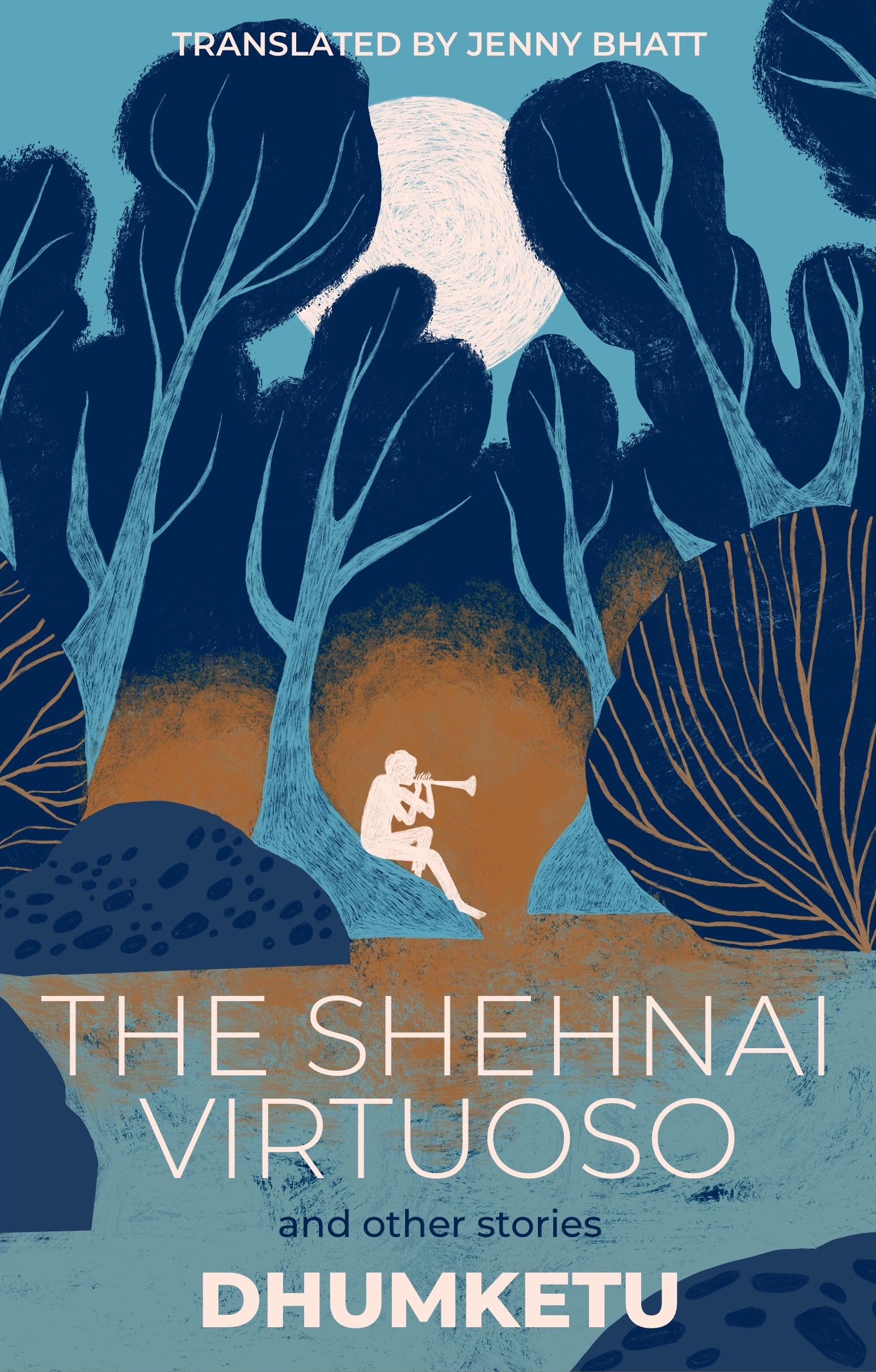
A storyteller from Gujarat arrives: The Shehnai Virtuoso by Dhumketu

The short story is that which, like a flash of lightning, pierces right through while establishing a viewpoint; without any other machinations, simply gestures with a finger to awaken dormant emotions; creates an entirely new imaginary world around the reader. The novel says whatever it wants. The short story, by rousing the imagination and emotions, only alludes to or provides a spark of what it wants to say. That is why the writer of the short story needs a reader who is impressionable, emotional, swift and intelligent; to such a reader, he will be forever in debt.

– Dhumketu, Introduction to his collection, Tankha I

It would be no exaggeration to suggest that the South Asian literature that commands the most immediate attention outside the sub-continent is that which is written in English—even within India, English-language authors occupy a considerable amount of shelf space. Yet, the Indian Constitution recognizes 22 official languages and there are hundreds of other spoken languages and dialects, including English. So one might imagine that we are only able to access the tip of a rich literary iceberg. However, with the recent International Booker win for Daisy Rockwell’s translation of Geetanjali Shree’s Tomb of Sand (Ret Samadhi), the first ever Hindi winner, a heightened awareness of the riches of translated and yet-to-be translated literature from across South Asia is spreading near and far.

How fortuitous then, that in this increasingly welcoming environment, a magical Guajarati storyteller has arrived on North American shores to share a broad selection of his well-loved tales with a wider contemporary audience, a journey made possible by an attentive and gifted translator. Writing under the pen name Dhumketu, Gaurishankar Govardhanram Joshi (1892 1965) was one of the most prominent and prolific Gujarati writers of the first half of the twentieth century. He produced work across a broad range of genres, but was especially notable as a master of the short-story, publishing twenty-four volumes during his lifetime. When one enters this newly-released collection, The Shehnai Virtuoso and Other Stories, it is best to prepare to settle in and be carried away—it is difficult to resist the temptation to “read just one more…”

In her helpful Introduction, translator Jenny Bhatt traces the evolution of the Gujarati short story and the influence of European, Russian and American literature on the form. However, Dhumketu (whose chosen name means “comet”) distinguished himself from his contemporaries in a number of important ways. Firstly, he invited the reader into the inner worlds of his characters through skillful use of plot, theme, action, setting and dialogue. A second critical feature was his “focus on people from all walks of life—rural to royal, young to old.” He also set many stories among the poor and lower classes and castes, characters often either overlooked or caricatured by other writers. Finally, his stories often depict strong-willed, independent women and sensitive men, granting them varied roles and circumstances within his work in a manner that was progressive for his time and, as a result, relevant for ours.

The Shehnai Virtuoso gathers twenty-six stories that span Dhumketu’s career, opening with his best-known work, “The Post Office”—the melancholy tale of a man who waits in vain for a letter from his daughter. This piece sets the tone for a varied collection that touches on a wide range of deeply human themes. Although the majority of the tales are set in rural Gujarat, a few are set elsewhere, like Darjeeling, Karnataka, and an ancient kingdom in what is now Bihar.

Throughout, Dhumketu demonstrates an uncanny ability to pull a reader right into a story with little fuss, a skill that seems to become even tighter and more focused over the course of his career, and thus over the course of this volume. And even though there are definitely some themes that recur, the perspective, approach and atmosphere shifts from story to story, keeping his tales fresh and engaging. Nonetheless, he knows the innate value of timeless themes—jealousy, greed, heartbreak, loss—exploring them through the adventures of devious, manipulative personalities, ill-fated lovers, tragic heroes and quiet, isolated souls who express themselves most fully through music.

Not openly active in the political struggle for Independence that marked his time, Dhumketu did not shy away from allowing his characters, narrators and plots illustrate and express important ideas of freedom and matters of social injustice, recognizing perhaps that literature provides room for more complex and nuanced presentations to emerge, even in short form. The play of power and status, born of wealth, class and caste, is an intrinsic element of many of his stories—the vulnerability of the simple soul and the tragedy of the combination of beauty and poverty held a particular appeal—but he resists proselytizing. Rather, wonderfully wise and pertinent observations are regularly woven into his narratives that he trusts his readers to understand.

Another striking quality that emerges in some of the most powerful tales in this collection is Dhumketu’s capacity for an exceptional evocation of the depths of sorrow and loss.  The title story, for example, is one of several tales featuring gifted, yet mentally damaged musicians who suffer a loss that impacts and colours their ability to play and the soul wrenching effect of the notes their instruments produce. “The Shehnai Virtuoso” is a simple account of traveller who happens to stop in an unremarkable village on what happens to be a most fortuitous night—the death anniversary of the son of a talented shehnai (an oboe-like instrument constructed of reed and wood or metal) player, the only time when the devastated father picks up his instrument. No one in the village misses this annual moonlit performance. Our cynical narrator expects little when suddenly:

Through the air, such despairing, lamenting harmonies emanated from the sad tunes of the shehnai player that just single note of his falling on the ear felt like a language only the soul understands! As if today, having the opportunity to hear that language, the soul had rendered the entire body and all the senses and had overtaken the mind.

Oh to be present on that forested night! But for my money, one of the most moving stories from this rich and varied collection, is “The Prisoner of Andaman.” This is the tale of a man who returns to his native village after serving twenty years in prison for murder. Visaji, eager to see his home and friends again is met by the harsh realization that he has been forgotten, only his crime remains to distinguish him. The love that is “brimming over in his own heart” after so many years of penance and exile, is met with hostile indifference. Dhumketu portrays his growing anguish so acutely—“it felt as if his legs had broken. His heart was wounded”—that it is impossible not to share his pain, no matter his past.

In selecting the stories that comprise this collection, translator Bhatt wanted to showcase the range of Dhumketu’s work and encourage an appreciation of his chronological progression as a writer, so she chose one story from each of his published collections, plus two. As such she has created an excellent and entertaining introduction to this important Gujarati author—not an easy task over a longer volume like this. Her keen translation incorporates common expressions  and terms, explained in footnotes and a brief glossary only if necessary, thus preserving the flavour of the culture and the communities of Dhumketu’s fictional world.

The Shehnai Virtuoso and Other Stories by Dhumketu is translated by Jenny Bhatt and published by Deep Vellum. An earlier edit of this collection was published in India in 2020 as Ratno Dholi: The Best Stories of Dhumketu (Harper Perennial).

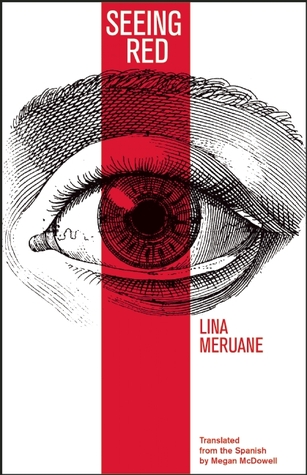
Love is blind too: Seeing Red by Lina Meruane

The claustrophobic atmosphere of Lina Meruane’s compelling novel, Seeing Red, envelopes you from the first lines. The narrator, Lucina, is distraught. Sentences end mid-thought. Unfinished. A party is in full swing, only a room away, but she is suddenly alone, isolated.

I had to give myself an injection at twelve o’clock sharp but now I wouldn’t make it, because the pile of precariously balanced coats let my purse slide to the floor, because instead of stopping conscientiously, as I should have, I bent over and reached to pick it up . And a firecracker went off in my head. But it was no fire I was seeing, it was blood spilling out inside my eye. The most shockingly beautiful blood I have ever seen. The most outrageous. The most terrifying.

A diabetic diagnosed with a serious condition affecting her eyes, Lucina had been warned against leaning over and now one thoughtless movement has left her eyesight, her work and her normal connections to the external world threatened by a curtain of blood. What follows is a deeply internalized monologue that builds in neurotic intensity, narrated by a woman struggling against her worst fears with a rapidly diminishing reserve of dignity and grace.

Inspired by her own real-life episode of blindness, Seeing Red is not exactly an autobiographical novel. In an interview, the Chilean author and essayist explains that she began writing what she thought would be a memoir, but as the relationship with truth began to interest her less, it quickly became a piece of fiction. She was, however, keenly interested in capturing the experience of blindness as “seen” from the perspective of the unseeing person—something raw that would be in contrast to the tendency in Latin American literature to present blind characters from view of the outsider.

Set in the early 2000s, Lucina, the protagonist of Seeing Red is, like her creator, a writer (writing under the name “Lina” Meruane) who lives in New York City with her boyfriend Ignacio, an academic. Their relationship is only about six months old and they are just about to move to a new apartment when her sight starts to rapidly disappear. She faces an uncertain prognosis, and a delay before the doctor will be able to consider operating, but they are bound to one another by the intense emotion of a new romance. That’s a good thing, because Lucina will test it, especially when she flies home to Chile to visit her parents—both of whom are doctors—while Ignacio attends a conference in Argentina. He soon joins her as they to try to salvage a vacation they’d planned, one that is now restricted to Chile, primarily to her family’s Santiago home, because of her fragile condition. Relying on her memory, she guides her partner through a city he has never visited, trying at the same time to blindly negotiate an emotional minefield of complicated family dynamics and past relationships.

The narrative style cleverly enhances the increasingly unreliable nature of Lucina’s connection to the world around her. Through a series of unbroken single-paragraph sections, each two or three pages long, we are held hostage to her unseeing perspective. Thoughts unspoken race through her mind, as she imagines how those around her are reacting, picturing their expressions and adding to their words her own visualized commentary. She second guesses herself. She second guesses everyone and everything. One can only imagine how her patient partner or her aloof mother really feel as everything is channelled through Lucina’s  personal filter. Her reconstructions. Her cynical digressions. Her abruptly aborted sentences.  As readers we have to trust her descriptions which are themselves coloured by her anxieties and growing agitation.

Aren’t you dying of cold? Ignacio insisted, rubbing his hands together as if lighting a fire. I was trained to resist the damp air that was seeping into his bones. His teeth chattered. He got up from the chair and bent his legs to wake them up. He rummaged quickly in a packet of cigarettes, the match scratched my ears, and I heard him suck on the cigarette in spite of his imaginary flu. I could envision him forming fragile smoke rings that his forced cough then tore apart, his dry cough and the beaten voice of a bellyaching Galician. Winter in my Santiago made him remember winter in his own, in Compostela, and he told me again how as a boy he’d slept beside a wall that let water filter in from outside, how he’d spent his whole childhood sick, covered in rashes, his ears hardened by chilblains. He exaggerated his hardships, or invented them, all so as not to talk about our own.

The question of her relationship with Ignacio, and whether it will stand the strain, haunts Lucina. She wants to give him the freedom to decide if he would be willing to stay, even if the unthinkable happens and her sight never returns, and yet they are each terrified of being alone, lost and overwhelmed by the enormous implications that hang over them both. Conversations begin but are quickly aborted. Strange sexual urges obsess her. Once back in New York, with surgery ahead, the narrative only becomes more charged and visceral and surreal. In Megan McDowell’s excellent translation, none of the energy or intensity is lost. Lucina is a complex, difficult, thoroughly compelling character. Her story vividly demonstrates the fear of losing control, the limitations of relying on the mind’s eye and the extreme pressures a person in crisis can put on those close to them.

Seeing Red by Lina Meruane is translated by Megan McDowell and published by Deep Vellum.