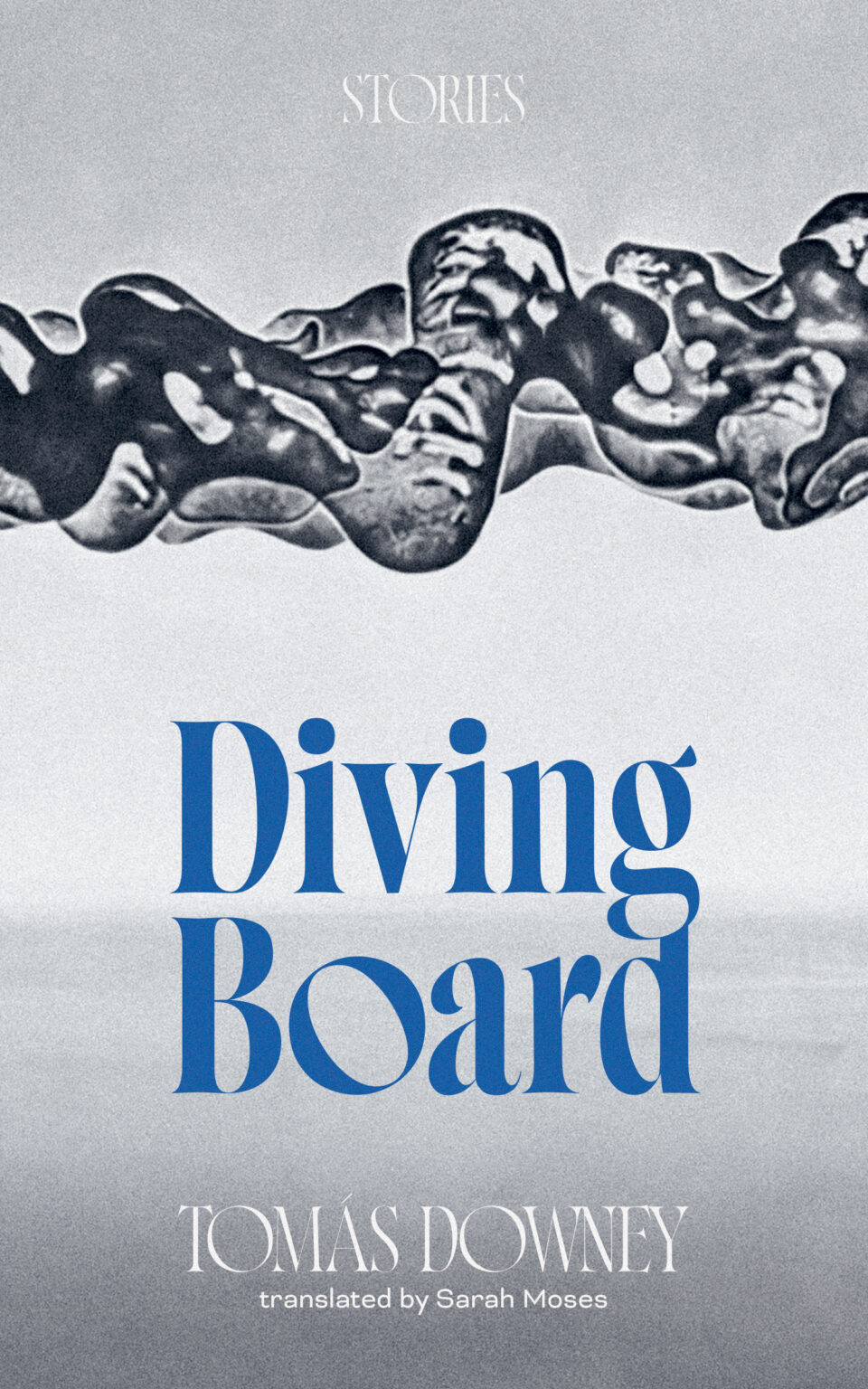
Slipping into the twilight zone: Diving Board by Tomás Downey

The first thing I think to write is this: what’s happening to me is incredible. But immediately, I stop—I’m suspicious of everything. I think about it, reread the sentence, and the pen slips through my fingers and falls to the floor. It bounces and flips in the air, does some involuntary acrobatics. Describing what’s concrete is easier.
(from “Astronaut”)

If there’s a common feature uniting the nineteen stories gathered together in Diving Board, Argentinian writer Tomás Downey’s first collection in English translation, it’s the uncomfortably close focus he places on the experiences of his narrators or protagonists. His lens is so tight that the edges of the world around them becomes  increasingly distorted, leaving them emotionally isolated and alone. Consider “The Astronaut” quoted above, for instance. The narrator is a man who has inexplicably found himself freed from the restraints of gravity, a condition that has literally turned his world upside down. Only at ease resting on the ceiling, every time he returns, even briefly, to the floor he is struck by waves of dizziness and nausea. There is no magic in this altered reality; everyone else, his wife included, remains grounded, unreachable. He decides there is only one means of escape—an open window.
Born in Buenos Aires in 1984, Downey is one of Argentina’s foremost short story writers, a master of a strangely unsettling terrain that his fellow Argentinian writer Mariana Enriquez refers to as bizarro fiction, not a genre but: “a disturbing variant that hides a vague threat, that leaves the reader feeling something between awe and unease.” As such, his stories vary from harsh realism to fantasy to horror to speculative fiction, but regardless of form, he tends to minimize set-up and avoid resolution altogether, intensifying the tension. In most instances, his settings lack excessive detail which allows circumstances, personalities, and interrelationships to take centre stage. As a result, even stories that take place in rural settings have a certain pervasive claustrophobia.

Short story collections, especially those that contain so many titles, can run the risk of falling into either unevenness or sameness. With Diving Board however, even if many of the tales involve either couples or families, no two stories are alike. Each treads a distinct terrain. In “The Cloud,” a thick, damp fog settles on a community, driving everyone indoors as the temperature rises and snails and slugs seem to multiply rapidly. A family tries to wait it out as this strange, heavy, wet plague spreads. In “Horce,” a man buys a seed that grows into a horse, a creature he hopes will offer him an excuse to reach out to the woman he loves, but instead the vegetal animal only increases his isolation. And, in the title story, a divorced father takes his daughter to a swimming pool, but when he finally agrees to allow her to jump off the diving board, she disappears into thin air:

Josefina leans over again, gauging the distance. She walks back to get a running start. She runs, jumps. He closes his eyes for a second, they’re irritated by the sun and the bleach. He hears a scream or a laugh. When he opens his eyes, Josefina should be in the air, about to fall, but she’s not. He hasn’t heard a splash either.

While many of Downey’s stories exist on the edge of the uncanny, reminiscent of Rod Serling’s Twilight Zone and its iterations, others lean straight into horror with characters who harbour cruel and twisted intentions. The action often stops just as things fall apart or in some vague aftermath. No explanations or reasons are ever offered. But sometimes there seems to be a deeper, more serious message. Such is the case with my favourite piece, “The Men Go to War.” Although it is not tied to any specific conflict, Argentina and other Latin American countries have seen their share of uprisings, coups, and warfare, but in truth this tale could take place anywhere, any time. The setting here lies in the shadow of a brutal war. Jose’s husband Manuel is a soldier. Every day she sits at home, refusing invitations to go out or welcome visitors. She is angry at her husband’s willingness to get involved. Then two officers appear at the door with the grim news that Manuel has been killed. They tell her that the incident occurred in a critical battle. They assure her they are winning:

Jose nods, possibly without listening. She’s used to condolences and accepts them with the hint of a smile, trying to downplay their importance, and always responds with a look that’s melancholic and resigned. She waits for the moment to pass, for nothing further to be said on the subject. Whatever it takes, she needs to believe that Manuel’s death is one fact among many, that it’s not of great importance. Thousands have died, all the women are widows, all the children orphans, winter is almost over, and the roofs of the houses need to be repaired. This week there were bananas at the market. When was the last time there were bananas at the market?

Jose’s measured response only cracks briefly when she is given all that remains of her husband, a knife with a mahogany handle and leather sleeve that had once belonged to his father. But when the men have left, she places it in a drawer. Then, as the days pass and winter begins to give way to spring, the official visits continue repeating the same script. Jose seems to be trapped in some kind of time loop, a repetition she responds to with the same questions, the same acceptance, the same self-control. This is yet another story that dissolves into its mysteries rather than revealing them.

Downey’s haunting, weird tales tend to linger, leaving a discomposing sensation in their wake. But they leave one wanting to move on and find out where his imagination will wander next. His stories have appeared in a number of English language publications, but now with this collection, translated in clear, clean prose by Sarah Moses, a broader introduction to the eerie landscape his characters inhabit is available in one volume.

Diving Board by Tomás Downey is translated from the Spanish by Sarah Moses and published by Invisible Publishing.
Looking back at a year of reading: 2024 edition

Each year when I review the list of books that I have read, I face the same challenge deciding what to include and what to leave out of a final accounting. As usual there are the books that I know, even as I am reading them, will be among my favourites for the year. Just as I know the ones I don’t like, the ones I won’t even mention or take the time to review. Basically, everything else that I have reviewed, was a good book.

This year, my count far exceeds a respectable “top ten” or “baker’s dozen” and there are some striking factors at play. One is that the ongoing  violence in Gaza has heightened my focus on Palestinian and Arabic language literature—long an area of interest and concern. Five of the Palestinian themed books I read made my year end list. As well, I have paired several titles, typically by the same author or otherwise connected, because the reading of one inspired and was enhanced by the reading of the other (not to mention that such pairings allow me to expand my list). Finally, as reflected by my top books, I read and loved more longer works of fiction this year than usual (for me). No 1000 page tomes yet, but perhaps I’m overcoming some of my long book anxiety.

And so on to the books.

Poetry:
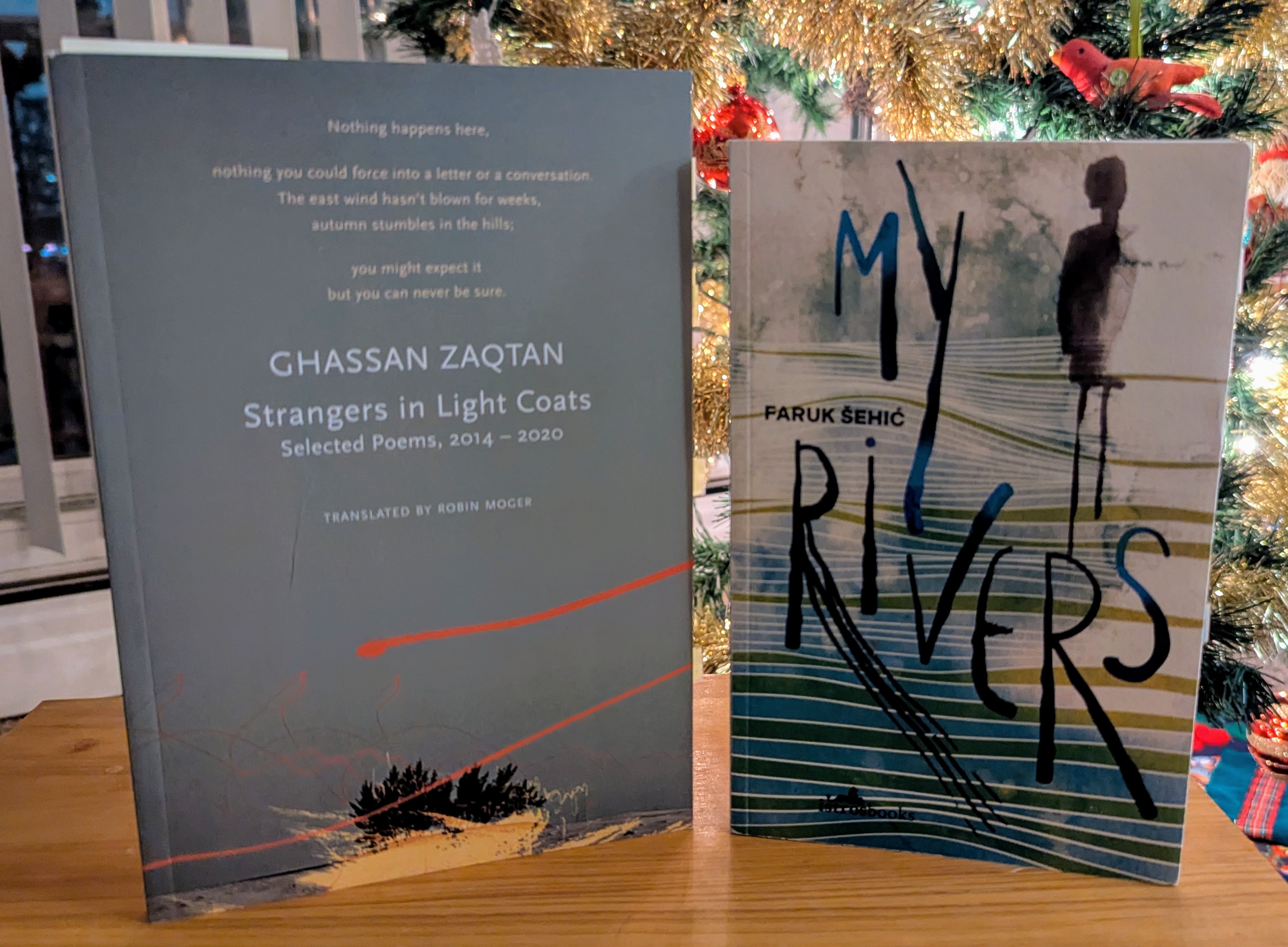
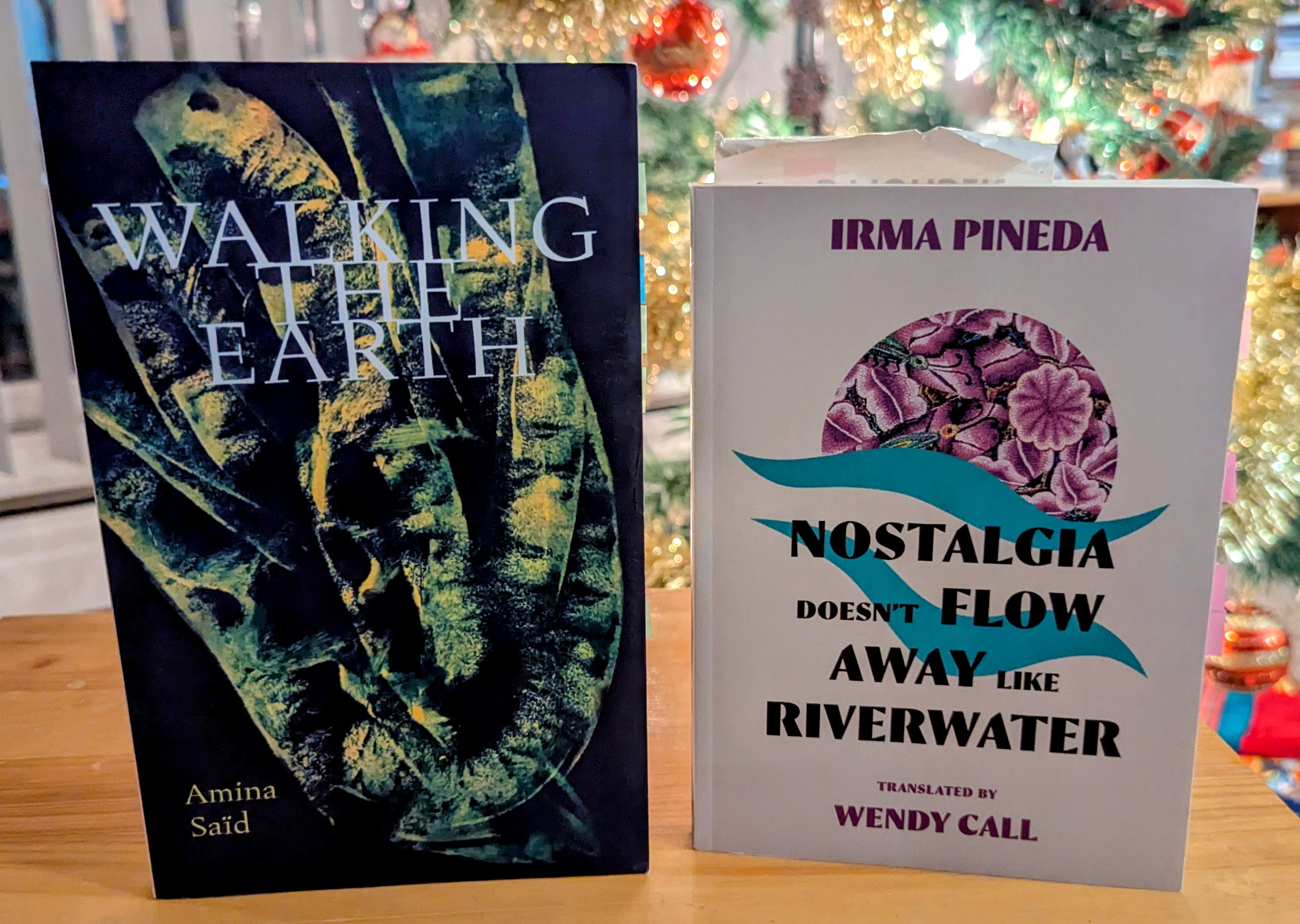
I read far more poetry than I review, but this year I wanted to call attention to four titles.

Strangers in Light Coatsevokes by Palestinian poet Ghassan Zaqtan (Arabic, translated by Robin Moger/Seagull Books) is, perhaps, a darker than his earlier collections. Comprised as it is, of poems from recent releases, it actively portrays a world shaped by the reality of decades of occupation and war.

My Rivers by Faruk Šehić (Bosnian, translated by S.D. Curtis/Istros Books) is a collection particularly powerful for its depiction of a legacy of wars in Bosnia/Herzegovina including the genocide in Srebrenica. His speakers carry the burden of history.

Walking the Earth by Tunisian-French poet Amina Saïd (French, translated by Peter Thompson/Contra Mundum) is such a haunting work of primal beauty that I can’t understand why more of her poetry has not been published in English. Perhaps that will change.

Nostalgia Doesn’t Flow Away Like Rainwater by Irma Pineda is one of a number of small Latin American poetry collection from poets and communities that have not been published in English before. This book, a trilingual collection in Didxazá (Isthmus Zapotec) and Spanish with English translations by Wendy Call (Deep Vellum & Phoneme Media) was particularly special.


Nonfiction:
This year, my favourites include a mix of memoir and essay and a couple of works that defy simple classification.

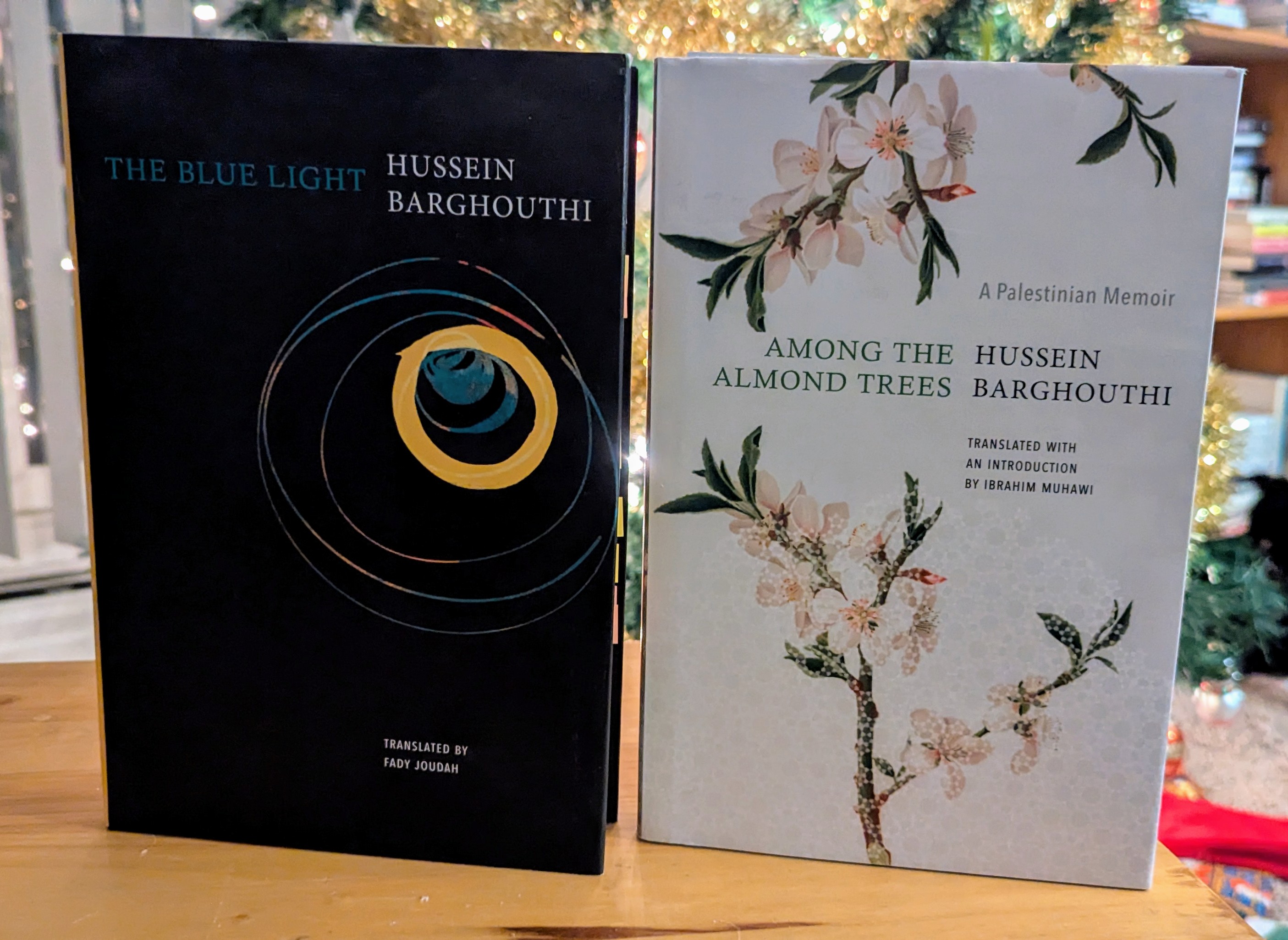
The Blue Light / Among the Almond Trees by Palestinian writer Hussein Barghouthi (Arabic, translated by Fady Joudah and Ibrahim Muhawi respectively/Seagull). Blue Light chronicles Barghouthi’s years in Seattle as a grad student and the eccentric circles he travelled in, whereas Among the Almond Trees is a much more sombre work written when he knew he was dying of cancer. The two books complement each other beautifully.

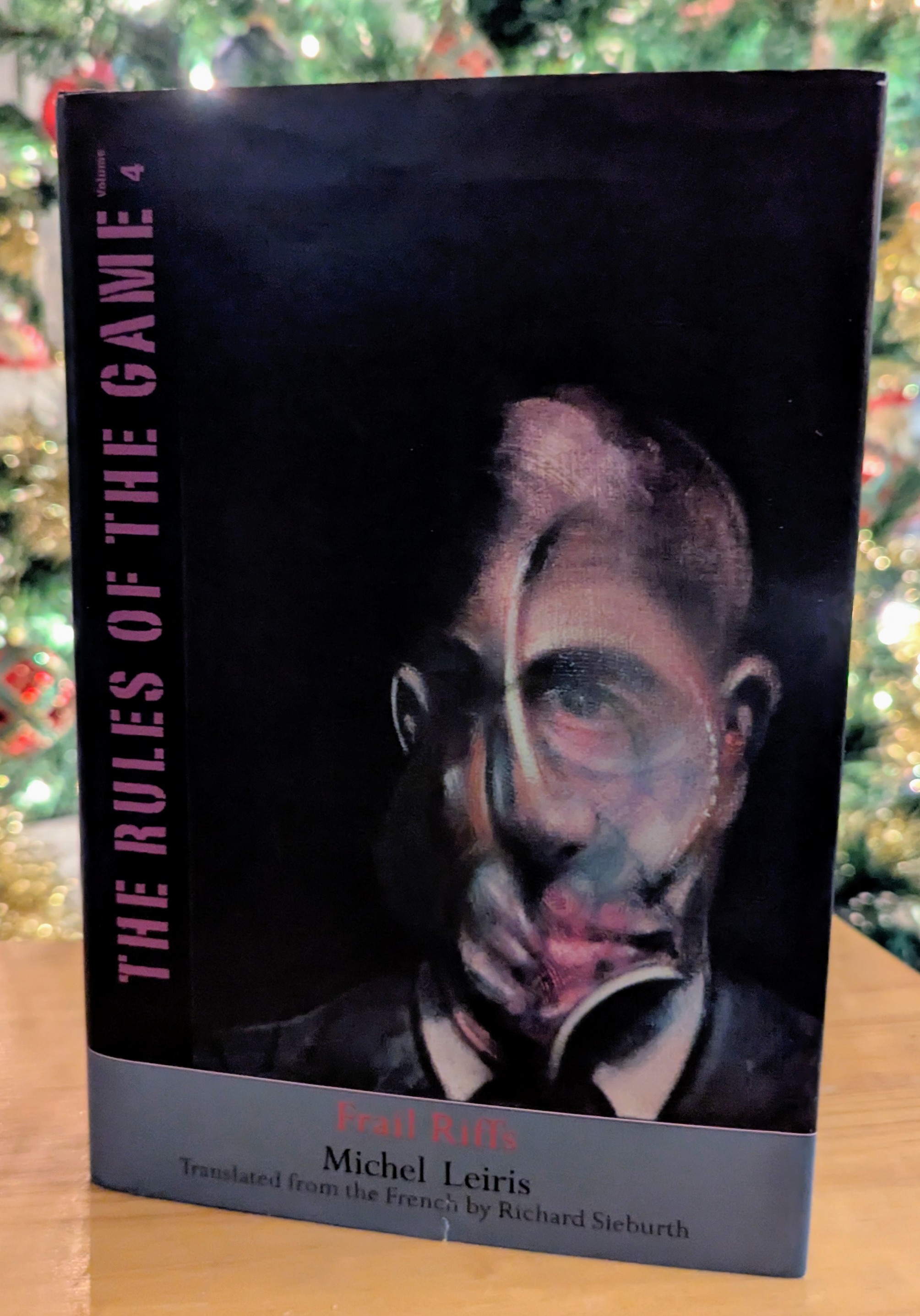
French intellectual, critic, ethnographer and autobiographical essayist Michel Leiris is a writer who means so much to me that the occasion of the release of Frail Riffs (Yale University), the fourth and final volume of his Rules of the Game in Richard Sieburth‘s translation, was not only an excuse to pitch a review but an invitation to revisit the earlier volumes. Definitely a highlight.

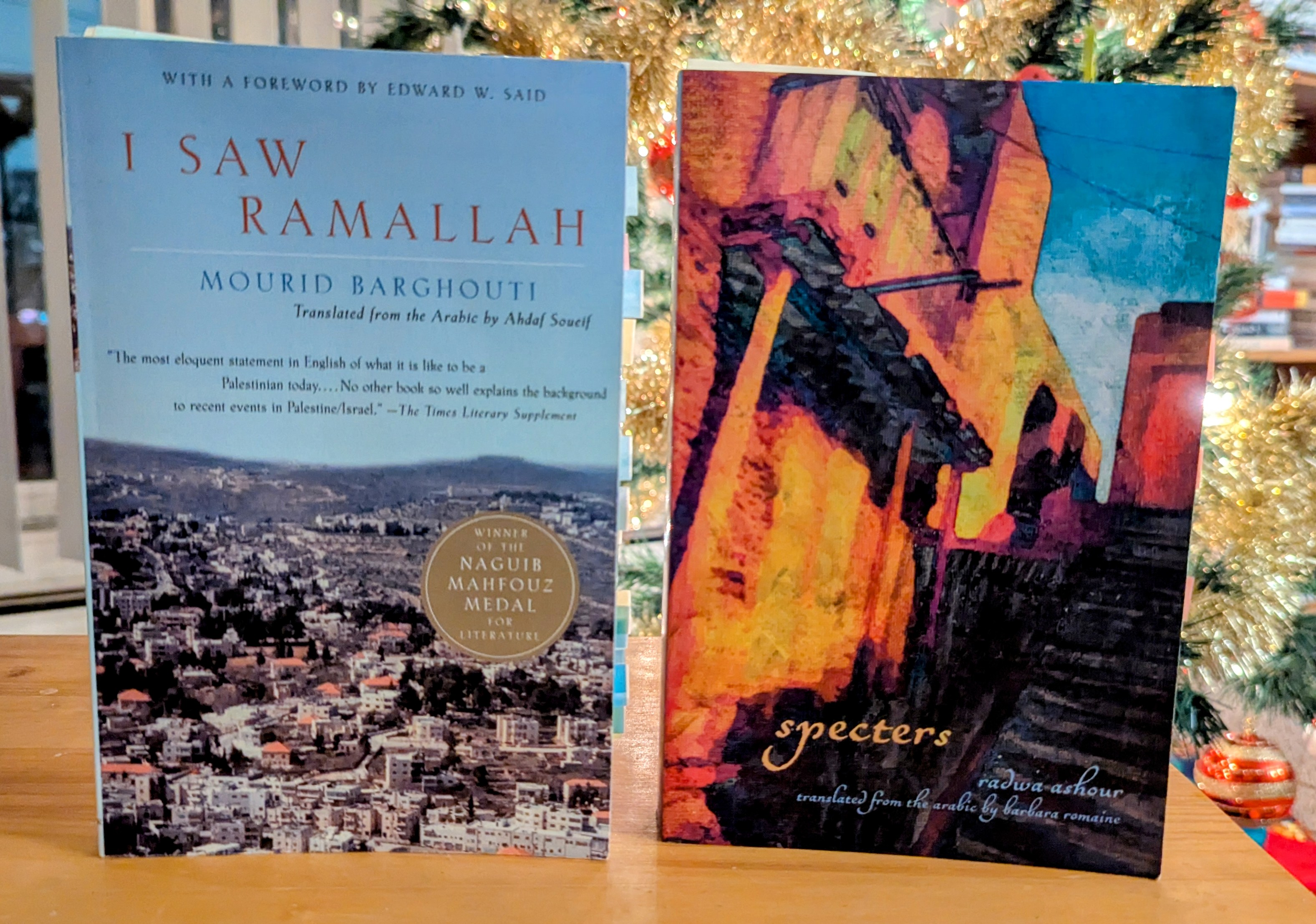
I Saw Ramallah by Mourid Barghouti (Palestinian/Arabic, translated by Ahdaf Soueif/Anchor Books) is a moving memoir detailing the author’s return to his homeland after thirty years of exile. Reading it reminded me that I had a copy of Scepters by his wife, Egyptian novelist Radwa Ashour (Arabic, translated by Barbara Romaine/Interlink Books). This ambitious work blends fiction, history, memoir, and metafiction and I absolutely loved it, but my decision to include it here, like this, rests on the memoir element which complements her husband’s in its account of the many years he was exiled from Egypt—a double exile for him—especially the years in which she travelled back and forth with their young son to visit him while he was living in Hungary.

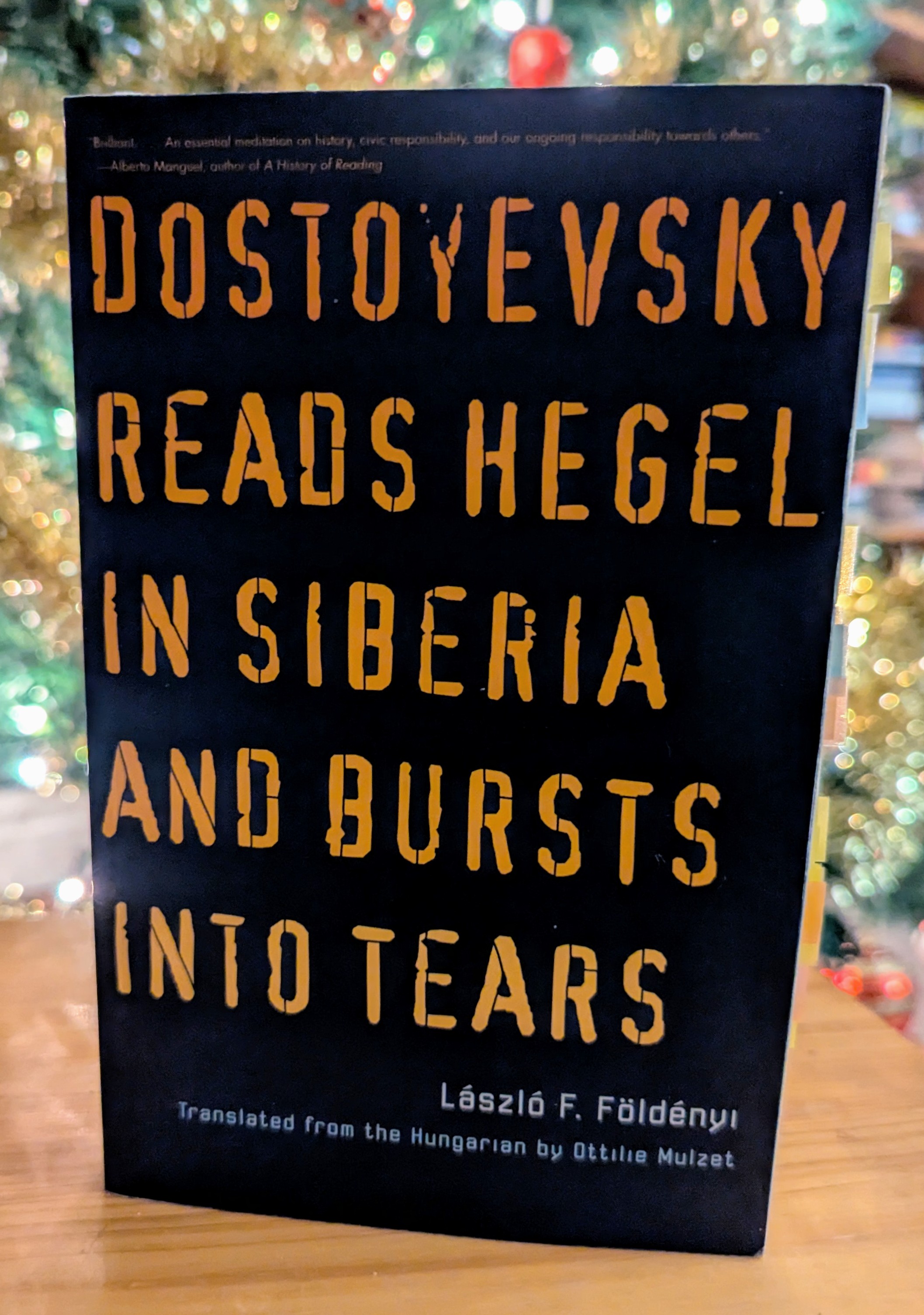
Candidate for the book with the best title, perhaps ever, Dostoyevsky Reads Hegel in Siberia and Bursts into Tears by Hungarian scholar  László Földényi (translated by Ottilie Mulzet/Yale University) was an endlessly fascinating collection of essays exploring the relationship between darkness and light (and similar dichotomies) through the ideas of a variety of writers, thinkers and artists.


Fiction:
As usual, fiction comprised the largest component of my reading and, as I’ve said, I read more relatively longer works than in the past. Normally I have a special fondness for the very spare novella and, of course, my list would not be complete without a few shorter works, including one more pair.

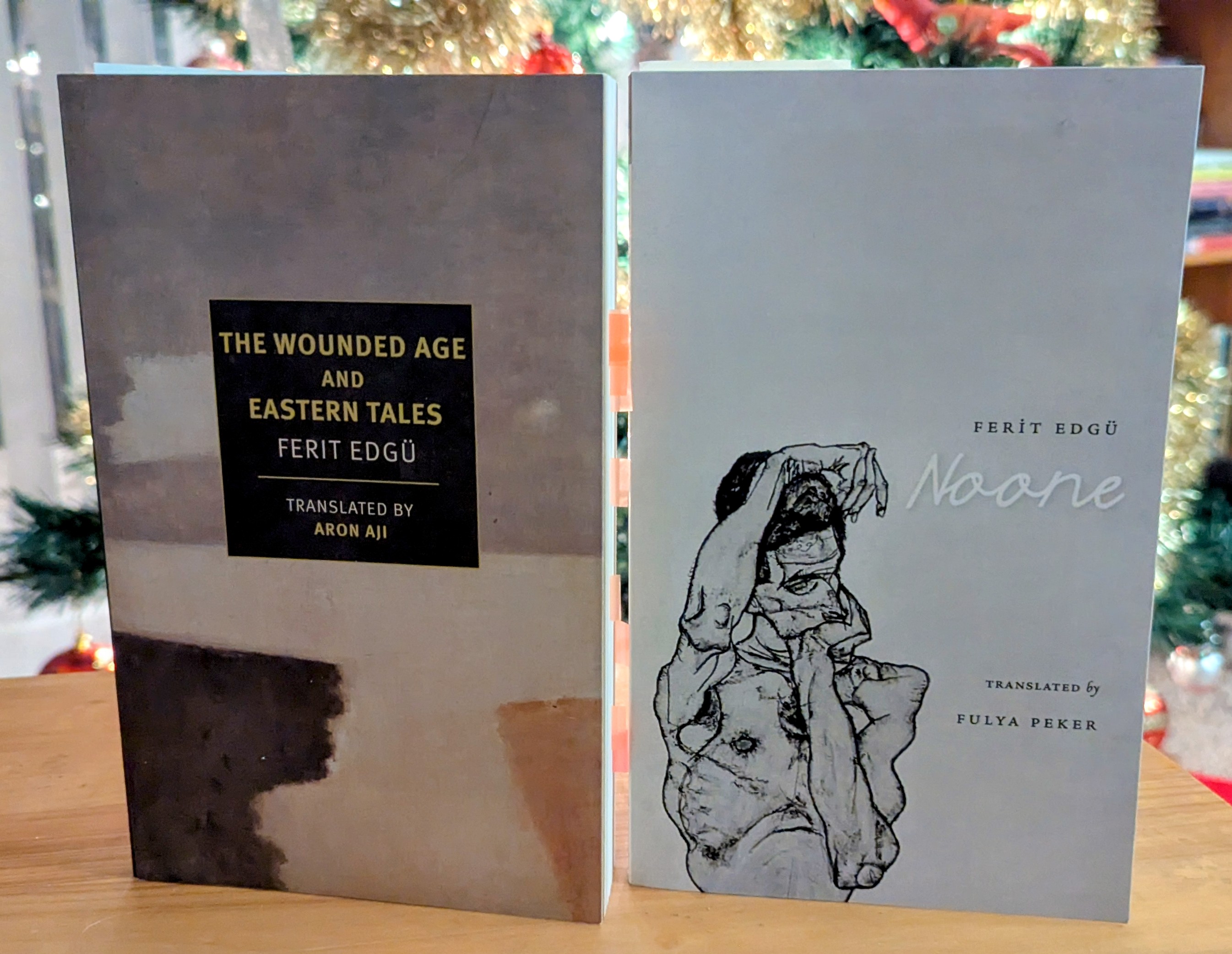
The Wounded Age and Eastern Tales  / Noone by Turkish writer Ferit Edgü—translated by Aron Aji (NYRB Classics) and Fulya Peker Cotra Mundum) respectively—who is sadly one of the writers we lost this year. His work, which draws on the time he spent teaching in the impoverished southeastern region of Turkey in lieu of military service, is filled with great compassion for the people of this troubled area. But his prose is stripped clean, bare, and remarkably powerful.

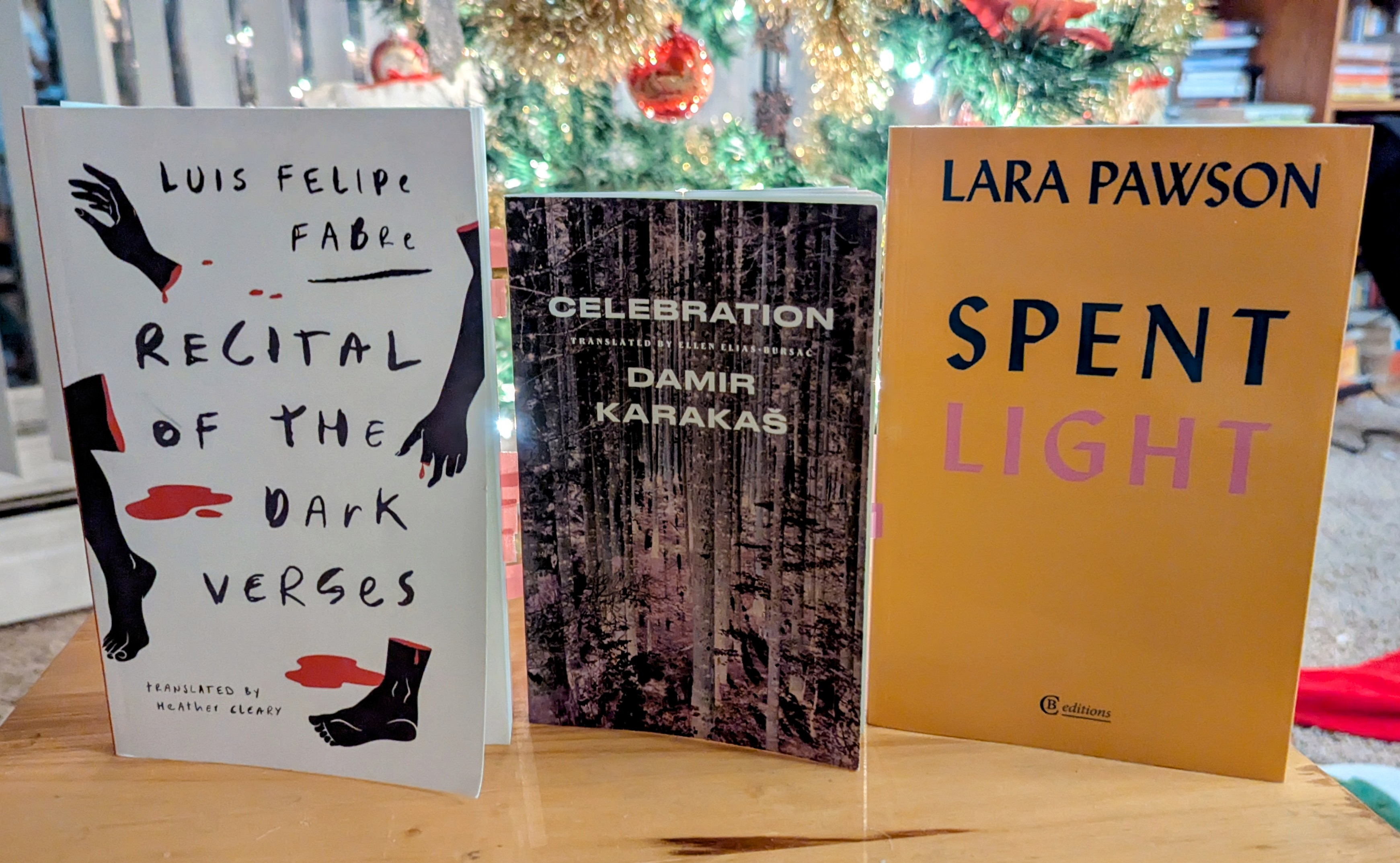
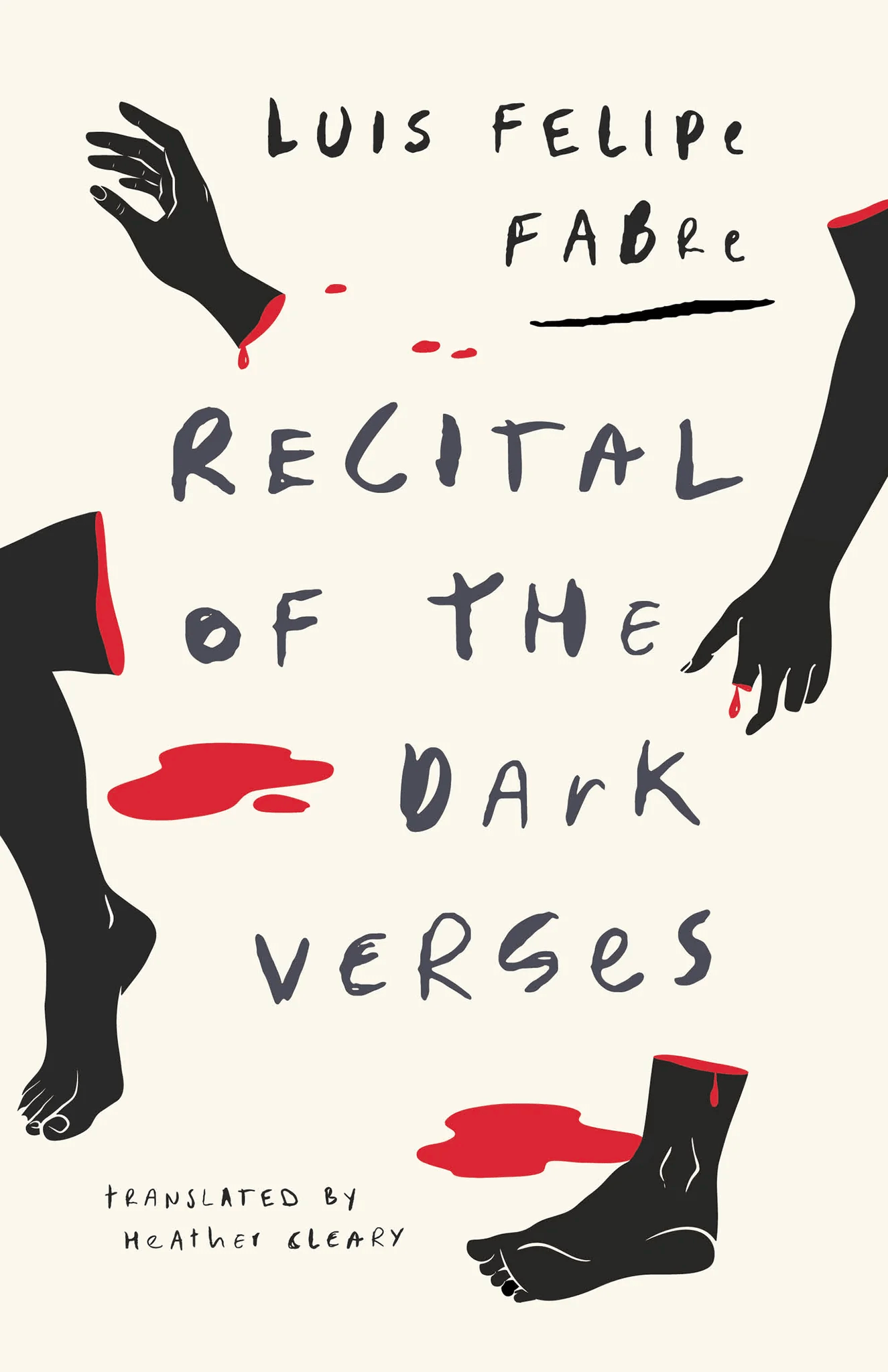
Recital of the Dark Verses by Luis Felipe Fabre (Mexico/Spanish, translated by Heather Cleary/Deep Vellum) is an award wining translation that seems to have garnered less attention than it deserves. This comic Golden Age road trip follows the misadventures of the body of John of the Cross on its clandestine voyage to Seville. Brilliant.

Celebration by Damir Karakaš (Croatian, translated by Ellen Elias-Bursać/ Two Lines Press) is an exceptionally spare, unsentimental novella about the historical forces that pulled the residents of Lika in central Croatia into World War II.

Spent Light by Lara Pawson (CB Editions) is a book I’d been anticipating since reading her This Is the Place to Be. Strange, at times disturbing, often hilarious and always thoughtful, this is one of those books that (thankfully) defies description.

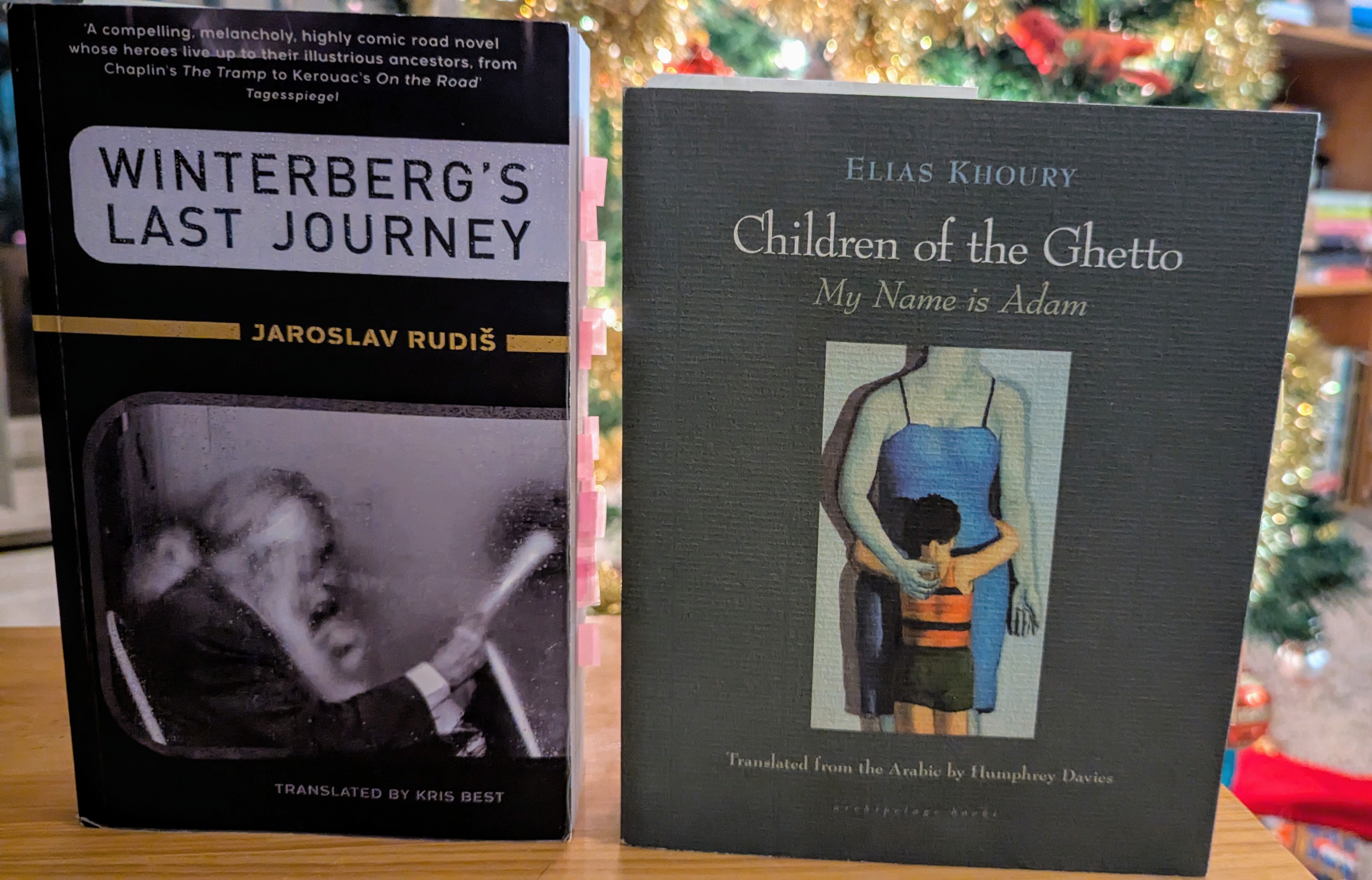
If Celebration is historical fiction at its most spare, Winterberg’s Last Journey by Czech writer Jaroslav Rudiš (German, translated by Kris Best/Jantar Publishing) is the exact opposite. Ambitious, eccentric, and filled with detail, it follows a 99 year-old man and his male nurse as they travel the railways with the aid of 1913 railway guide. What could possibly go wrong?

Children of the Ghetto I: My Name is Adam by Lebanese author Elias Khoury who also died this year (translated by Humphrey Davies/Archipelago Books) is the final Palestinian themed work on my list. This is a challenging and rewarding novel about a man born in the ghetto of Lydda during the Nakba that examines complex questions of identity.

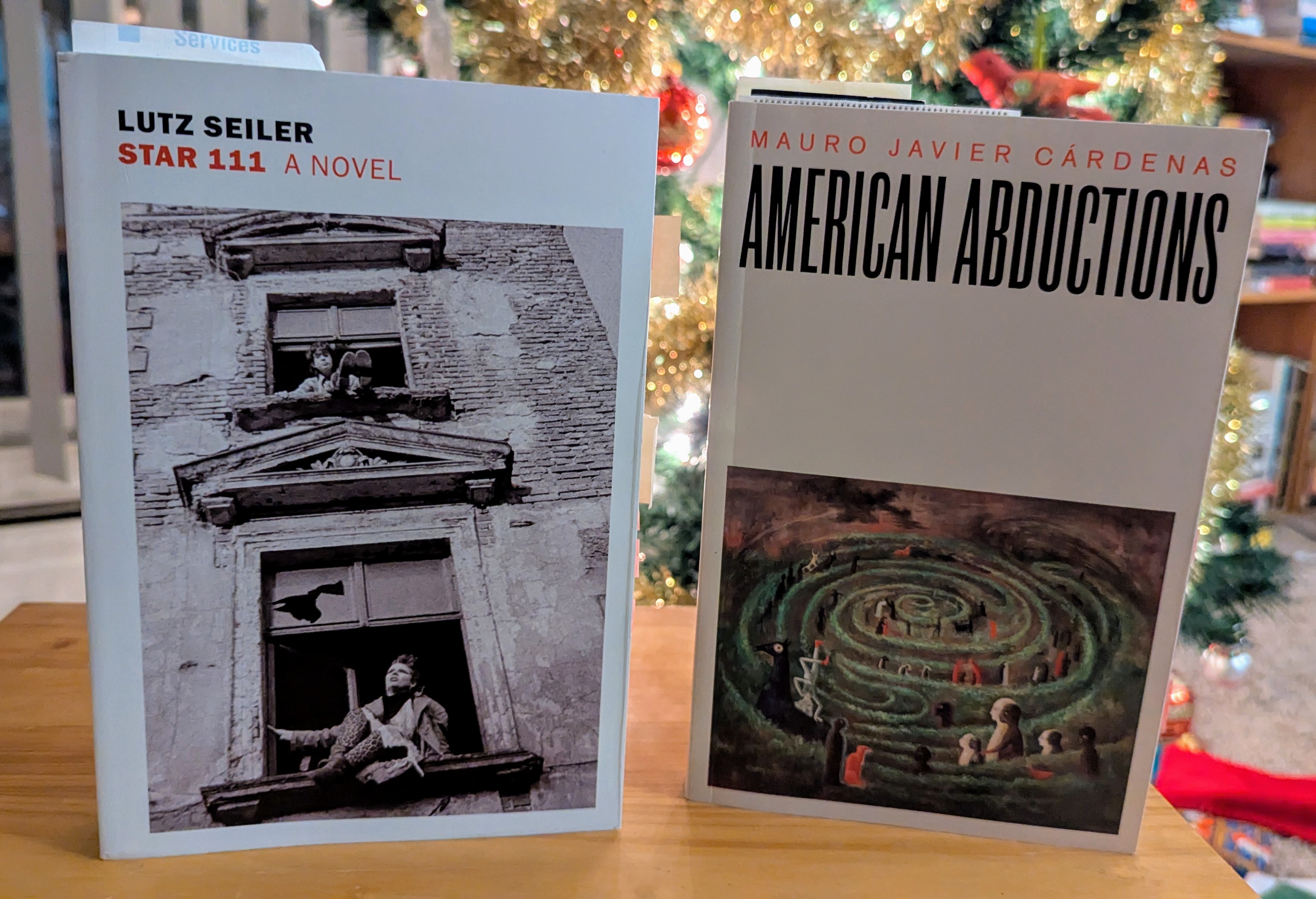
Star 111 by Lutz Seiler (German, translated by Tess Lewis/NYRB Imprints)is the autobiographically inspired story of a young East German would-be poet’s experiences among an eccentric group of idealists in Berlin in the immediate aftermath of the fall of the Wall. I was familiar with Seiler’s poetry before reading this, but I liked this novel so much that it lead me to follow up with his essays and the work of other poets important to him—the best kind of expanding reading experience.

Mauro Javier Cárdenas’ third novel American Abductions (Dalkey Archive) imagines the latest iteration of his hero Antonio in a future in which Latin American migrants are systematically sought out, separated from the children and deported. With a stream of single sentence chapters, he creates a tale that is both fun and uncomfortably too close for comfort. Quite an achievement!

Last but not least, my two favourite books this year are Hungarian:

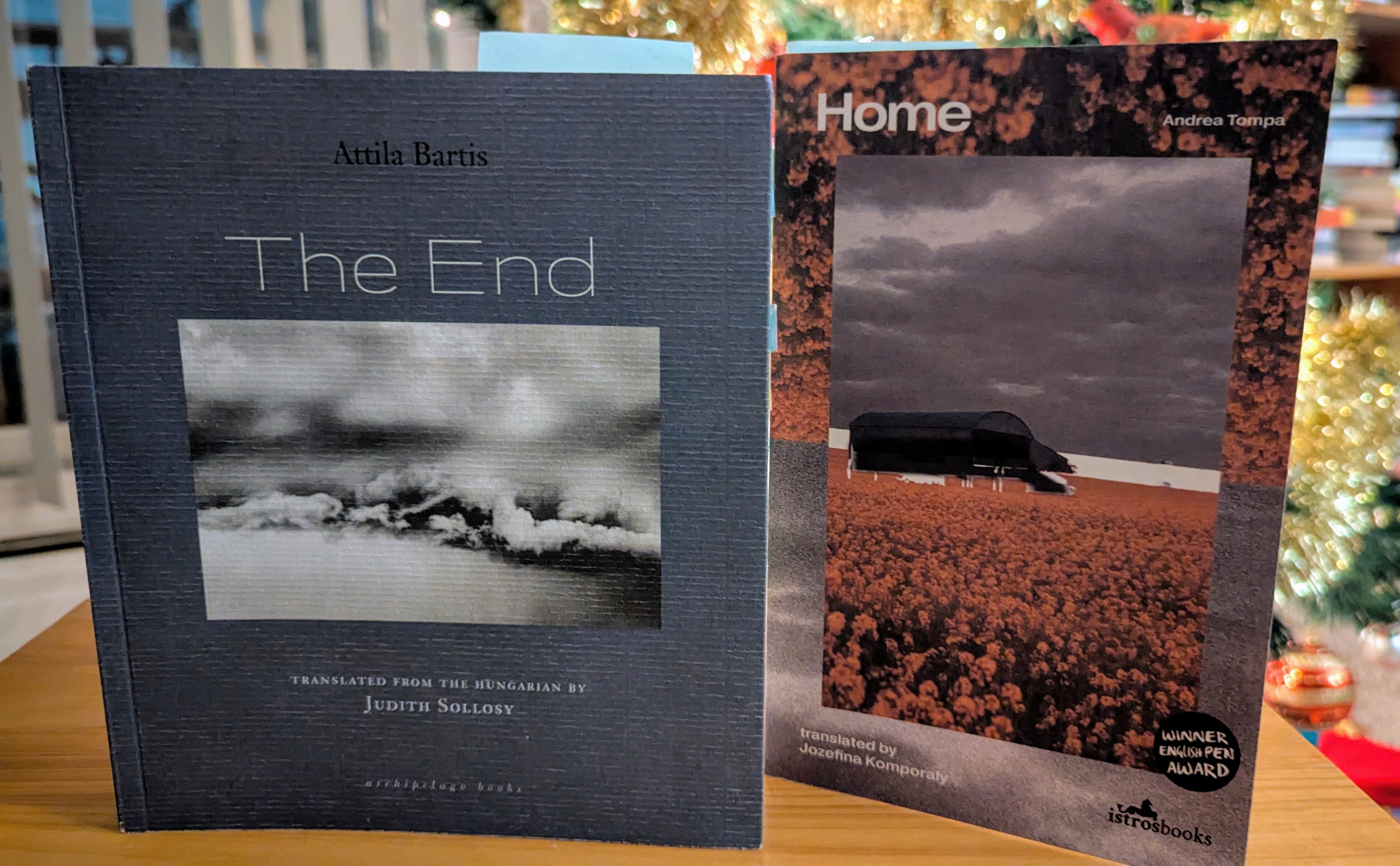
In The End by Attila Bartis (translated by Judith Sollosy/Archipelago Books), a fifty-two year old photographer looks back on his life—his successes and his failures. He reflects on his relationship with his mother, his move to Budapest with his father in the early 1960s following her death, life under Communism and the secrets held by those around him, and the role the camera played in his life. Presented in short chapters, like photographs in prose each with its “punctum,” the 600+ pages of this book just fly by.

Like Attila Bartis, Andrea Tompa also comes from the ethnically Hungarian community of Romania’s Transylvania region and now lives in Budapest. Her novel Home (translated by Jozefina Komporaly/Istros Books) follows a woman travelling to a school reunion, but it is much more. It is a novel about language, about what it means to belong, to have a home and a mother tongue. It’s probably not surprising that my two favourite novels involve protagonists in mid-life, looking at where they are and how they got there. As to why they’re both Hungarian—I suppose I’ll have to read more Hungarian literature in the new year to answer that.

So that is my 2024 wrap up. I’d like to think 2025 will be better than I fear it will, but at least I know there are countless good books to look forward to.

Happy New Year!

Creature discomforts: Natural Histories by Guadalupe Nettel

The ties between animals and human beings can be as complex as those that bind us people. There are some who maintain bonds of reluctant cordiality with their pets. They feed them, take them for walks if need be, but rarely do they speak to them for walks if need be but rarely do they speak to them other than to scold or “educate” them. In contrast, there are others who make of their turtles their closest confidants. Every night they lean in toward their tanks and tell them about what happened to them at work, the confrontation they put off with their boss, their doubts, and their hopes for love.
(from “Felina”)

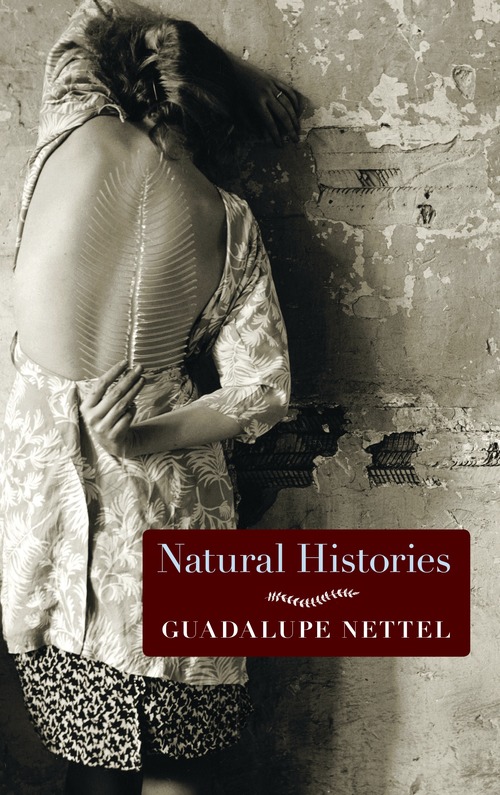
Guadalupe Nettel is one of those writers I have long wanted to read. The kind that when you finally do get to them, you ask yourself: “Why have I waited so long?” Natural Histories, a collection of five short stories, each exploring a protagonist’s engagement with an animal of some description—from felines to fungus—offers a perfect introduction to her uncanny ability to craft strong characters and compelling narratives that slip seamlessly into the murkier regions of ordinary human existence.

Born in Mexico City in 1973, Nettel spent part of her childhood in France, returning again to Paris to complete a PhD in linguistics. As a result, she is very much at home setting her stories on either side of the Atlantic as this compilation clearly demonstrates. The first story, “The Marriage of the Red Fish” is set in Paris and follows the breakdown of the narrator’s marriage following the birth her first child, a trajectory that seems to be mirrored in the tenuous relationship between a pair of Beta splendens, or Siamese fighting fish, gifted to the couple just months before their daughter was due. Lila’s arrival puts an immediate strain on the professional couple who are not quite prepared for the shift in their domestic situation and it gets worse when the narrator’s maternity leave is unexpectedly extended—she begins to feel trapped at home, her husband feels confined when he has to come home. Like their pet fish who, true to their species, are not inclined to peaceful cohabitation, the new parents find their personal dynamics altered:

As it were, in those stagnant waters in which Vincent and I moved, our relationship continued on its gradual course toward putrefaction. We never laughed anymore, or enjoyed ourselves at all. The most positive emotion I was able to feel toward him in several weeks was appreciation every time he made dinner or stayed home to takr care of Lila so I could go to the movies with a friend. It was a blessing, his relieving me. I adored my daughter and overall delighted in her company. But I also needed to have moments by myself, in silence, moments of freedom and escape in which I could reclaim, even if only for a couple of hours, my individuality.

This story, although it traces a common path of marital dissolution, stands apart by virtue of a strong narrative voice and the magnified role the fate of the unhappy fish play in what we want to imagine should be the happiest time of a new family’s life together.

The tensions evident in the opening story, become subtly darker and stranger in the stories that follow. In my favourite piece, “War in the Trash Cans,” an entomologist recounts her childhood experiences at the home of her middle class aunt with whom she was sent to live after her bohemian parents split and neither was up to childcare responsibilities. For the young narrator, the housekeeper and her mother become her unlikely allies in an otherwise alien environment and, as she puts it, “those two women taught me more things than I’d learned in an entire year of school.” Those lessons, rooted in folklore and traditional wisdom, arise when an invasion of cockroaches sets the entire household on edge.

Other stories involve unwanted pregnancy, a musician who nurtures a strange fungus she acquires from a married lover, and a boy whose father brings home a poisonous  snake as part of his obsessive endeavour to reconnect with his Chinese roots. In each case, the protagonist or one of the characters finds in another creature or creatures, something that balances their insecurities, and reflects the unfamiliar circumstances in which they have found themselves. And yet, each story, its characters and setting, opens up new and unexpected territory. As a set of five, loosely thematically linked, longer pieces—ranging from about twenty to thirty pages—this collection is well-paced, always entertaining, now has me keen to read more of Guadalupe Nettel’s work.

Natural Histories by Guadalupe Nettel is translated from the Spanish by J. T. Lichtenstein and published by Seven Stories Press.

It’s so hard to be a stranger: A Blind Salmon by Julia Wong Kcomt

i looked into his low eyes
black, tired
i looked into his heart
and that splotch of vigor
made me
ephemeral, tardy, rancid, and fleeting

we arrive at the altar
in a state of absorption
i request a living offering
start to cough, phlegmy
till i’ve nearly smashed to pieces
at his feet

– from “opium weddings”

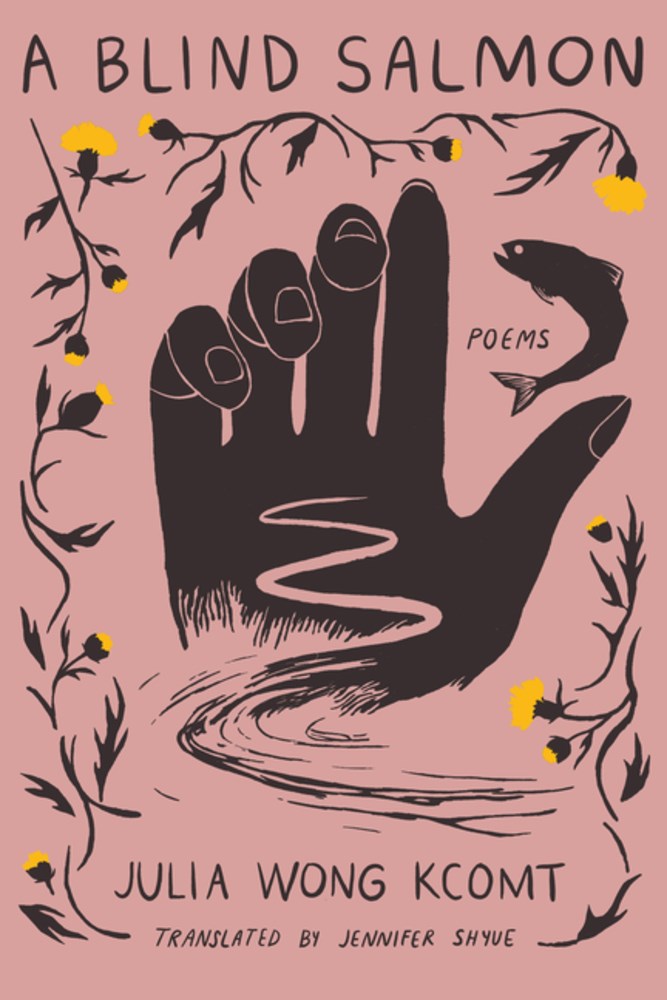
The poetry of Julia Wong Kcomt turns on the unexpected, crosses cultures, languages and borders, reflecting who she is, where she comes from and where she has travelled to and lived. Born into a Chinese-Peruvian (tusán) family in the desert city of Chépen, Peru, in 1965, she was a prolific writer whose work included eighteen books of poetry, along with a number books of fiction and hybrid prose. Questions of identity and belonging are central to her writing, as are themes of migration, motherhood, and the body.

A Blind Salmon, her sixth collection, originally published in 2008, is her first full-length work to be published in English translation. Translator Jennifer Shyue who has a particular interest in Asian-Peruvian writers, has been engaged with her and her poetry for several years making this volume a welcome introduction to an intriguing and important poetic voice. Sadly, however,  Kcomt did not live to see its release; she died in March of this year at the age of 59.

Composed while she was living in Buenos Aries, the poems in this dual-language collection, often involve a shift between languages—Kcomt was multilingual, speaking Spanish, English, German, and Portuguese—creating a challenge of sorts for Shyue, especially when the original contains English. This is handled with the use of an alternate sans serif typeface when appropriate, or by bringing Spanish into her English translation for the words or lines in English in the original, as in the poem “tijuana big margarita.” When German arises, it is left as is. This shifting linguistic terrain, like the sands of the region she comes from, adds texture and variation when they appear.

The poem “on sameness” which is repeated or echoed in the collection, is another wonderful example of the multilingual dynamic at play. The first appearance features Kcomt’s own English version of her poem “sobre la igualdad,” presented in two different typefaces on facing pages (the regular typeface and that which is used to denote English in the original). The wording is, naturally, identical. It opens:

in the circle, sweet circle
of intense immortality

where is my china?
the land with no owners
the face is not repeating itself

Later, when the poem is revisited, Kcomt’s Spanish original faces Shyue’s translation, which she made before reading the poet’s own translation (or at least refreshing her memory of a more distant encounter). The similarities and differences shine a light on the perspective a translator brings to her reading of another’s work—line by line and as a whole:

in the circle, sweet circle
of intense immortality

where my faraway chinese country stayed
the great country of all
where no faces repeat

This collection contains a mix of verse and narrative prose poems, the latter sometimes stretching on for three or more pages and offering a broader canvas for the exploration of identity and belonging, in some instances twice removed when set in Germany where Kcomt studied for a time. They address trying to find a home of some sort, balancing relationships, and finding invisible lines can be crossed in an instant as in “aunt emma doesn’t want to die” where the Asian-Latin American speaker, a foreign student, offends her elderly employer with her attraction to a man in a photo (“no looking, margarita. he’s not for you.”) and is forced to leave her home:

when i was moving out, you wouldn’t look at me. at  the geographic latitudes i’m from, we’re unfamiliar with that feeling, is it called ethnic guilt? perpetuation of folklore.

reiner was the forbidden fruit next to that tiger from kenya and you hated me because I took a bite that full-moon night as the children danced in costumes in the square.

[. . .]

and though i thought reiner would come looking for me or call me, that didn’t happen. not that it would have been necessary. his torso had imprinted on my groin. sometimes skin serves as a sort of reproduction.

in student housing i was once again surrounded by people like me. foreigners. it’s so hard to be stranger, to come from elsewhere, to fight, to steal, to do anything to get inside and the insiders throw you bait only to take it away.

The poems in A Blind Salmon seem to become increasingly charged with life and energy each time they are revisited. Kcomt’s speakers are bold and unapologetic, reaching out with language that is sensual, unexpected, unsettling. Her images are often startlingly corporeal, yet always touching the tender complexities of being in the world, a world that does not always no how to understand you, or you it, but one that is fully alive.

A Blind Salmon by Julia Wong Kcomt is translated from the Spanish by Jennifer Shyue and published by Deep Vellum/Phoneme Media.

And so they will travel by night: Recital of the Dark Verses by Luis Felipe Fabre

Out into that wondrous night
I stepped unseen and stealthy,
with not a thing in my sight
nor any light to guide me
but one burning in me bright.

(from “On a Dark Night” by Saint John of the Cross)

If Fray Juan, the determined and devout evangelist of the barefoot or Discalced Carmelites, the reformed order founded by Saint Teresa of Ávila, was deemed troublesome during his lifetime, the humble Spanish friar, poet and mystic who would later become known as San Juan de la Cruz or, in English, Saint John of the Cross, was no less disruptive in the months and years that followed his death. In life, his dedication to the austere principles of the reformed order and his success in fostering it’s expansion across sixteenth century Spain upset other Carmelites. In 1577, this led to his torture and confinement in a monastery in Toledo where he composed and committed to memory one of his best loved poems prior to making his daring escape, naked into the “pitch-dark night.” After recovering from his ordeal, he returned to assisting with the spread of chapters of the Discalced Carmelite before eventually joining the monastery in Segovia as prior. Yet, when he disagreed with some changes being made in his order, he was moved to an isolated location where he fell ill with erysipelas. As his condition worsened, he was transferred to the monastery in Úbeda where he died on December 14, 1591 at the age of forty-nine. However, he would not stay there, well, at least not in one piece. The widow doña Ana de Peñalosa, sister of the influential don Luis de Mercado who was Fray Juan’s friend and the funder of the monastery in Segovia, wanted his remains to rest there.

The effort to satisfy that desire is where Mexican writer Luis Felipe Fabre’s Recital of the Dark Verses begins. What follows is an unexpectedly energetic historical-fiction-meets-comic-road-novel that serves up spirituality, adventure, with a healthy amount of bawdy humour. When the bailiff, whose name biographical sources fail to agree on, and his two young assistants, Ferrán and Diego (thus named because no record exists to confirm or contradict the author’s fancy), arrived at the monastery in Úbeda in September or October of 1592 with orders to collected the late friar’s body, they are met with no small measure of resistance. First there’s the matter of the smell emanating from the corpse that has inspired ecstasy in the monks and near frenzy among the townsfolk who have clamoured for any available piece of Fray Juan’s tattered clothing, soiled dressings, or physical person. As the porter explains to Diego and Ferrán, it is a question of:

“The aromatic clamor of his body. The scent of saintliness. The gentlest of perfumes which stirs in the soul yearnings, burnings, and zeal, and which, emanating from beneath the slab whereunder lies Fray Juan and drifting through the air, at times reaches my own nose  like a distant jasmine while at this door I stand.”

It is a scent that cannot be silenced, an aroma that inspires a devotion so intense that it can lead to feverish displays of ardor or, if one fears being deprived of access to it, potential violence. Of course, for those who cannot smell it, or who only detect the normal odour of decay, it can engender doubt and fear about the solidity of one’s own faith.

But that is not all that delays the planned retrieval. When it is uncovered eight or nine months after the friar’s demise, the body Fray Juan, even with all the sores caused by the disease that killed him, is uncorrupted. A finger cut off still draws blood. So the bailiff takes the finger as a token for doña Ana, and instructs the monks to make an effort to encourage some further desiccation, vowing to return the next year. So it is not until April of 1593, that the bailiff and his assistants finally manage to depart Úbeda with the body of Fray Juan in a large leather case—albeit absent an arm left behind as relic. They travel by night, staying off the main roads, but they cannot escape the saintly scent, impossible to disguise, that arises from their secret cargo and which will be responsible for much of the undue attention and danger that will stalk them as they seek to carry out their mission.

Along the way they not only have to face their own fears as the dark nights threaten to close in around them, they must fend off amorous barmaids, a group of shepherds with ill intent, and an angry mob of townsfolk from Úbeda who are determined to retrieve the body of their blessed friar at all costs. Fabre draws on a wealth of often conflicting historical and biographical accounts of the saint’s posthumous journey, while liberally incorporating themes and figures from Greek mythology. But fundamental to this absurd tale of devotion, temptation, and misadventure are the words of San Juan de la Cruz himself. Three of his best known poems—“On a Dark Night,” “Love’s Living Flame” and “Spiritual Canticle”—are recited in full or in part throughout the novel, along with passages from the extensive commentaries the friar wrote to flesh out his own work.

For a man so committed to an especially extreme expression of faith, Fray Juan’s verse is  intensely passionate and sensual in nature, with a speaker that often takes on a female voice, that of a lover seeking to join with her Beloved. The spiritual ecstasy inspired by his words contrasted with the religious attachment his followers hold to his physical body (which will not make it to Segovia fully intact—only his head and torso rest there to this day), set the stage for a philosophical exploration of the blurred line between the heavenly and the worldly domains. On their journey, the three couriers tasked with the transportation of the friar’s body, will all face their own demons. The bailiff doubts his faith, while twenty-year-old Ferrán, who is trying to stay one step ahead of the Inquisition is cynical and unmoved by the mystic’s poetry. However, sixteen year-old Diego, a naive youth in the full turmoil of puberty, finds his tongue possessed by Fray Juan’s words and his soul struggling to balance spiritual inspiration with his own blossoming sexuality:

He was delirious. Delirious with fear, with fever, with hunger, exhaustion, and love. But through his deliria did Diego speak truth as if by the tongue of another. For his deliria were none other than Fray  Juan’s liras and, though Diego knew them not, from him did they spring forth as if from an old and distant void or night or heart.

The result is a tale that is light in tone, but one that easily carries deeper and darker themes on its playful narrative stream. Careful attention is paid to the exegetic tradition and the formal conventions of the saint’s own commentaries. Each chapter opens with an introduction incorporating the specific lines that will be expanded upon therein along with the particular challenges that await our protagonists. To further evoke the mood of the era, Fabre, in the original Spanish text, employs certain archaic verb forms and syntax. Translator Heather Cleary, unable to access exactly the same measures, choses to:

play with word order, an antiquated past tense, and a few lexical choices here and there in order to create similar rhythmic effects, shift the temporality of the narrative without sacrificing clarity, and evoke the ludic sensibility that evades the original.

It works beautifully. The result is a comic Golden Age-hued celebration of the many questions that can arise about the nature of the relationship between the body and the soul, the sacred and the profane. You can take any answers it may suggest as you will.

Recital of the Dark Verses by Luis Felipe Fabre is translated from the Spanish by Heather Cleary and published by Deep Vellum. This book was read as part of Spanish Lit Month 2024.

With a restless curiosity: A Question of Belonging: Crónicas by Hebe Uhart

To experience the world through the words of the esteemed Argentinian writer Hebe Urhart is to be offered a uniquely calm and compassionate view of ordinary places and people that effortlessly makes them seem anything but ordinary. A Question of Belonging, a newly translated collection of her crónicas—short, informal, observational writings, often published in newspapers or magazines—pulls together a selection of texts composed over five decades, and offers a fine introduction to the distinctive voice she brought to this form, one that became increasingly important to her over the course of her literary life (she also published two novels and collections of short fiction).

In her fascinating introduction, Mariana Enríquez reports that Uhart always considered herself a “writer of the outskirts.” She was born in Morena, a town on the edge of greater Buenos Aires, and experienced many family tragedies in her early life. As a young adult, she took on a position a rural school teacher in an impoverished region and cites that experience as one which not only helped her mature, but taught her to guard against self-centredness. Yet, she was also restless and loved to travel, devoting much of her writing to chronicling her excursions. Enríquez describes her friend as:

so unlike most people I have met in my life: she was brave, curious, carefree, sure of herself. Yet, as a traveler, she didn’t like going to big cities – they unsettled her (despite having visited many, of course). She preferred small towns. Places that were easy to get to know. Because what she loved was talking to people. These trips, day trips, in general (she referred to herself as a “domestic” chronicler) were a search for different ways of expression, a search that would take on the contours of the place itself.

The early pieces in A Question of Belonging, with the exception of a description of train trip to La Paz taken when she was twenty, tend to be brief musings, sometimes personal, but also more general observations about topics like the way pets seem to resemble their owners or how families commonly inherit a style in keeping with their political leanings, even if the politics themselves are not always passed down. Her writings are peppered with examples of her characteristic subtle humour, something is that sustained even as her work becomes more serious and more political throughout her career. “Inheritance,” reproduced on the Paris Review blog offers a perfect taste of her wit and style.

Once the travel bug sets in, her trips become a key subject for her chronicles. Her excursions would take her to cities, towns and communities throughout Latin America, but time and costs often kept her closer to home. In “Irazusta” she describes how:

Once, when I did not have the money to go on vacation, I saw a TV ad for Irazusta, a town of a thousand residents. The reporter explained that the town was near Gualeguaychú and then asked some women cooking what kind of tourist attractions it had to offer. One of them said, “The handcar on the railroad and the otters bathing in the lagoon.”

Not extraordinary attractions per se, but the women seemed optimistic about summoning a visitor. And so I went.

When she arrives, she discovers there are no accommodations. Residents simply open their homes to this novel phenomenon—a tourist. In fact, the TV ad lures twenty tourists and the town is beside itself with excitement. Undeterred by the ad hoc way interactions and opportunities that arise in this otherwise ignored community, Uhart manages to find, amid the pigs running around freely, an interesting assortment of intelligent people to engage with.

No matter where she goes, Uhart’s approach is one of open curiosity; she displays an honest interest without judgement, in the lives and customs of others. Socially conscious, she is keen to learn more about Indigenous peoples and, in her typically unobtrusive way, call attention to the layers of discrimination existing in Latin American societies—typically allowing the people she engages with to express their concerns in their own words. And, more than once, she finds herself up against people who do not wish to entertain her questions, or even her attempts to be cordial. But, she never lets that upset her. She figures they must have their reasons and, if she senses her presence is truly unwanted, she simply remains silent or, if possible, leaves.

A lifelong teacher, she frequently seeks out local historians or anthropologists to interview, and visits libraries and schools. She is especially interested in language and colloquial expressions—finding in them clues to the diverse ways that different peoples view and understand the world. But she also likes to take time to herself, to observe. One of her favourite means of exploration is to simply walk through neighbourhoods, look at the homes and gardens, visit local markets, and then find a comfortable café where she can sit and watch people pass by.

Uhart’s crónicas paint vivid portraits through relatively spare accounts. She tends to be well prepared when she ventures into a community, and draws on what she has read to guide her interactions, but the intention is to ignite her reader’s interest and awareness, rather than to overwhelm them. But she can be energetic in her descriptions, as in “Río is a State of Mind,” her rollicking take on Río de Janeiro during Carnival:

Río bares it all: its gardens, its past, its beggars, its beauty, its ugliness. An obese man with two bellies, one on top of the other, is eating at the restaurant. His shirt isn’t long enough, but he doesn’t mind. Beggars move around the street without fear for themselves or others: one of them was ranting with a very long iron bar in hand – nobody seemed to be frightened. A man with dyed blond hair was dipping a piece of bread inside a can of Coke and offering it to anybody who walked by. Another beggar, a woman this time, was wearing an underskirt that hung behind her like the train of an evening gown. She sat down at a bar next to some middle-class women and drank like any other customer.

During her time in the Brazilian city, she also takes an opportunity to explore another of her favourite resources—the programs available on the television set in her hotel room. Unlike many fellow writers and academics, Uhart loved TV. As a source of information and as entertainment.

Although she does not discuss finances, her excursions are generally modest, either day trips from her home in Buenos Aires (even visits to areas within the city limits), or longer trips by bus, train, car, small plane or some combination thereof. In addition to Argentina and Brazil, the crónicas in A Question of Belonging see her visiting Paraguay, Colombia, Bolivia, and Peru. Later in life, when her literary fame led to invitations to attend festivals in major centres, she would go, but tended to find the crowds, the disorienting hotels, the vast festival grounds, and the general businessiness overwhelming. She is inclined to try to get away, to explore and see what the location has to offer outside the closed festival environment. In the longest text here, “Off to Mexico,” she details a visit to Guadalajara and Mexico City in 2014, when she was already in her late seventies. It’s an account rich with humour, scenic descriptions, and historical and literary references. No trip can ever be wasted. Since she’s in the country, she hopes to come to understand something of Mexico’s history, society, and culture.

Rarely does Uhart write directly about her own life in these dispatches, the exceptions in this collection include the first piece, “A Memory from my Personal Life” in which she recalls an alcoholic boyfriend from her past, a brief account of her varied experiences with therapy, and the final crónica, “My Bed Away from Home,” published just days after her death in 2018, at the age of eighty-one. Here, with remarkable humour and sensitivity, she writes about a stay in the hospital when she already very ill. She starts in ICU and eventually gets “promoted” to Intermediate Care where she is delighted to discover her bed is close enough to the bathroom that she go on her own. She details her frustration with some of the staff and the humiliation of having her diapers changed in full view of others, but as ever, she is careful to keep in mind that so many of her fellow patients are in much more compromised and unfortunate circumstances than she is; she never wishes to be overly self-centred. Humble and grateful to the end.

A Question of Belonging: Crónicas by Hebe Urhart is translated from the Spanish by Anna Vilner and published by Archipelago Books.

“Everything meant something else. The apple no longer an apple.” Divided Island by Daniela Tarzona

State the manner of panic, the voice of terror. Approach the scream and grab it with your mouth to make it heard. Right now you’re shouting. You shout with so much force your jugular vein pops out.

If one of the possibilities inherent in the form of the novel is the freedom to break with expectations when the expression of the pressing strangeness of being in the world demands it, Mexican writer Daniela Tarazona’s Divided Island is a work that opens itself up, stretches the boundaries of reality, and fractures into shards of glass to reflect pieces of an uncomfortable and incomplete whole. It is also a response to grief and neurological disorder that is as entrancing as it is disorienting. The brain scan illustrations that open each section of this slender novel seem to indicate that the protagonist (or protagonists) may not be on stable ground, but this fragmented narrative explodes with emotion and shifts gears so abruptly that it undermines the natural inclination to want to “figure it all out” which is, of course, the point. But it is not without meaning, as a meaning does gradually begin to become clearer although the mist never lifts entirely.

Essentially, it is the story of a writer who is grieving the death of her mother. The grief permeates her life and surroundings. This is intensified when, after a series of brains scans, she is given a diagnosis of cerebral dysrhythmia, and suddenly finds herself splitting in two.

Once upon a time there was the sun. Seething sphere. If the word were she, it meant you; you were replicated. Her over you. You over her. Two bodies spinning in circles.

One of the women she becomes leaves and travels to an island where she intends to kill herself. The other, addressed as “you,” stays behind to try to pick up the pieces of her fractured existence and make sense of her life. Her mother and grandmother, both passionate yoga practitioners, come back to her in memories (or are they dreams?), while visions and paranoias haunt her days. And meanwhile, “she” is on the island, contemplating death.

The narrative maintains a trancelike quality throughout as the woman navigates the painful loss of her mother and the altered reality in which she finds herself:

It turns out you’re surrounded, you’re an island with water on all sides: the reams of paper by the desk, the books, the suitcase of jewelry. Your mother’s things. Notes. Letters. Your grandmother’s manuscripts.

Strange things happen to you. The decorations in that tableau of wonders, seem to accurately describe the moment you’re living in: you’ve got an orange tabby; the porcelain plates your mother painted arrive at the house; you wrote a novel about a woman who lays an egg. The tableau existed before the novel. Does the order in which things happen in time really matter? Being surrounded means sinking in sand. Your body gets lost among objects, you can barely open your eyes. Seeing is a state of grace, here, right now.

Several historical and literary figures, most notably the Costa Rican born poet Eunice Odio who emigrated to Mexico, appear in the woman’s memories and dreams of her grandmother—the woman who stays, mind you, the woman who wants to die is on an island awaiting her own demise. Despite their separate trajectories, it is made clear on several occasions that these women are one and the same being. Two selves estranged from one another? Or an existential neural short circuit? Or are both emerging and diverging through the act of writing itself? The story runs toward and against itself as images resurface and the medical mystery lying behind the neurological scattering is given more substance—as much as substance is possible from measuring electrical patterns and data, that is.

The brain scan images that illustrate the book do belong to the author herself, so although this is far from a clinical text, Tarazona may be drawing, to some extent, on personal experience. Yet, one senses she is guided by a desire to explore emotional intensity and perceptual distortion from a purely poetic perspective. And that is the best way to read and appreciate Divided Island. A close comparison (and probable influence) is Clarice Lispector, but this unusual, alluring tale of an excitable mind and the two women who share it is a startling and singular work that rewards multiple readings.

Divided Island by Daniela Tarazona is translated from the Spanish by Lizzie Davis and Kevin Gregory Dunn and published by Deep Vellum.

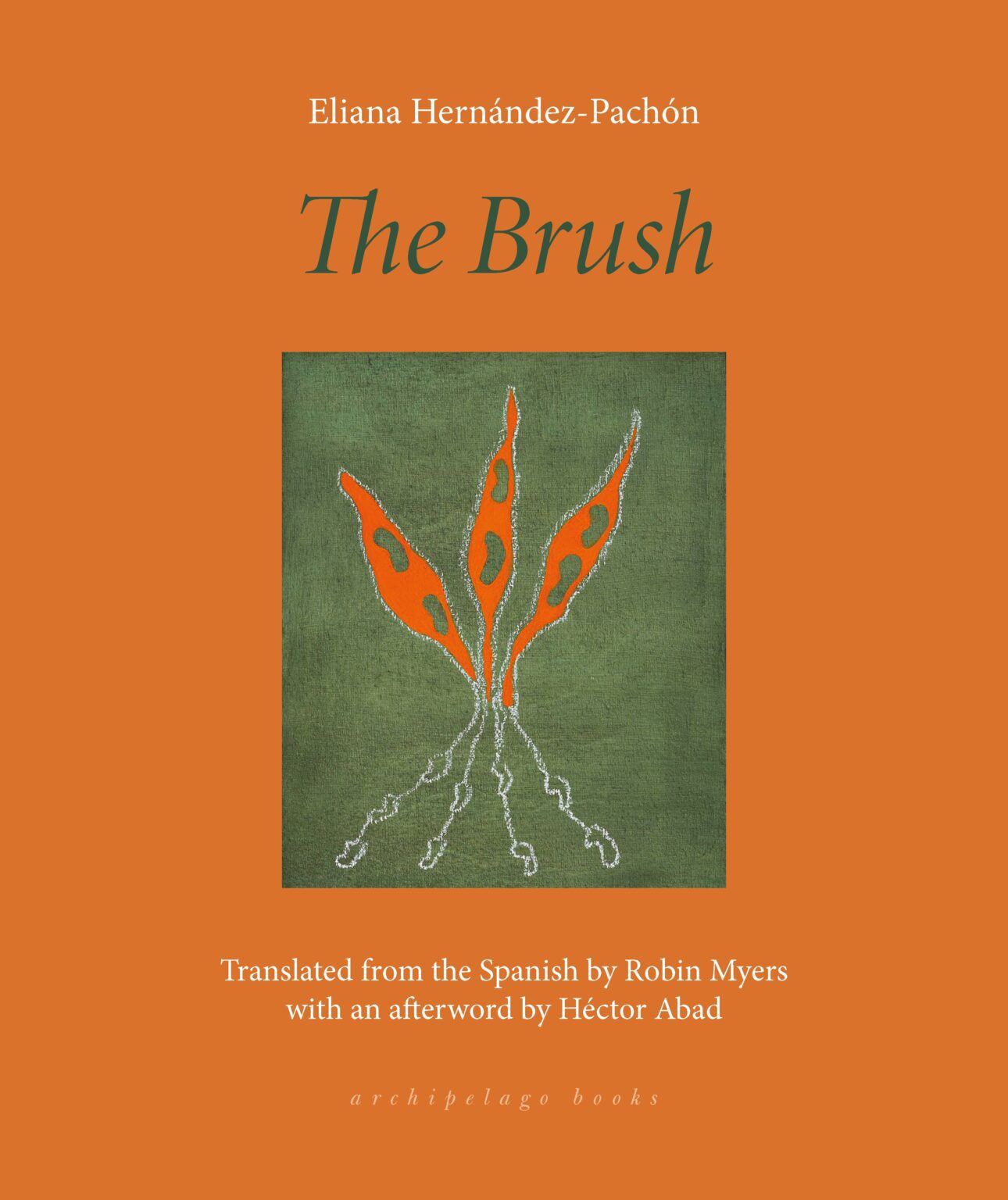
After the night, day breaks: The Brush by Eliana Hernández-Pachón

Pablo and Ester live in the hills. Their children are grown. Their lives are simple, bound to the land, but lately there have been signs, omens. Pablo is concerned:

For some time now
he’s felt a heavy change pressing the air,
and can’t explain it.
Like when
he walks through town at night,
and when he hears the animals
can’t sleep.

Sensing danger, he gathers some papers and items in a box and goes out to bury it while Ester sleeps. And then they come.

Between the 16th and the 21st of February, 2000, members of the United Self-Defense Forces of Colombia descended upon the Montes de Maria region and attacked the people:

During this incident, known as the Massacre of El Salado, paramilitary forces tortured, slashed, decapitated, and sexually assaulted the defenseless population, forcing their relatives and neighbors to watch the executions. Throughout, the militiamen played drums they found in the village cultural center and blasted music on speakers they took from people’s homes.

Sixty people were killed. The Colombian Marine Corps battalion charged with protecting the area was nowhere in sight—they had withdrawn the day before the massacre began. With The Brush, a taut work of narrative poetry, Colombian poet and educator Eliana Hernández-Pachón draws on the official 2009 report on the massacre to bring the story of this brutal event into focus in an unusual and affecting manner.

The tragedy of this horror exists on many levels—the unimaginable terror of the attack itself which was not an isolated event, the lingering trauma of the survivors, and the years of fighting for a formal apology and reparations from the government. As a story well-known within Colombia, the poet says in an interview that “if I was going to tell it anew, then I would need a new form.” Her approach is to pass the account on to several distinct characters or voices and allow these diverse perspectives to carry the varied layers of this tragedy.

The first of three sections belongs to Pablo who has reason to be worried about the growing tensions. He will not survive the attack. The second part belongs to the thoughts of Ester, his wife, in the days that follow. She wonders where Pablo is, what might have happened, heading out into the brush to try to find him. And then…

Crossing the glade, she sees
a shadow vanish
in a glimmer of undergrowth.
Hey! she shouts.
And the woman approaches warily
leading a little girl by the hand.
A whisper first, and now her clearer voice:
They did it to me with a knife, the woman says
and points to a mark on her arm.
They also did things
I can’t talk about.

Knowing it is unsafe to return, the two women and child are now forced to keep moving through the brush.

In the third section, the Brush—the dense, living forest vegetation—is granted it own direct, poetic voice. It is The Brush that stands as witness, to sights, sounds and sensations, from the crushing footfalls of the approaching militants and falling bodies in the town square, to the careful movement through the forest of survivors, and, finally, to the blossoms and blooms that will welcome those who eventually return.

In conversation with The Brush’s testimony, Hernández-Pachón engages input from The Investigators and The Witnesses. These perspectives, drawn from official sources, define and correct one another, while the Brush adds its own comments and clarifications. The human choruses are presented in prose, but even if the Witnesses’ offerings are more poetic in tone, both stand in sharp tonal contrast with the lyrical, omniscient voice of the Brush. The Brush, it turns out, can tell a tale of horror and grief that people, especially those who have been victimized, are often unable to fully articulate.

The questions still survive:
what does it think about, the brush, somnambulist,
after it’s seen it all?
The day that follows night returns
its artifice, the well-known
interlocking of the hours:
how is it that time didn’t stop,
why do the grain’s unopened eyes
keep growing?

A disconcerting calmness rests over this book-length sequence of poems that, in a mere 57 pages, manages to capture the contradictions and harmonies that arise in response to acts of extreme violence. That calmness serves to unsettle the reader and honour the survivors, while placing this event within a wider ecosystem and granting a voice to nature, the one force, perhaps, that can truly offer both understanding and healing.

The Brush by Eliana Hernández-Pachón with an Afterword by Héctor Abad is translated from the Spanish by Robin Myers and published by Archipelago Books.

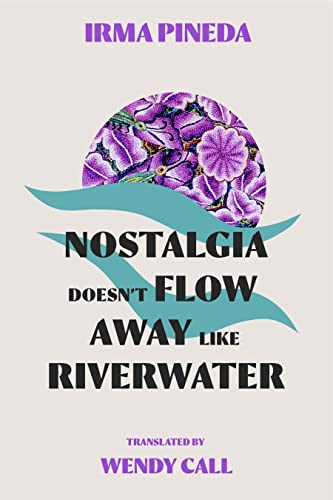
Even the birds have gone away: Nostalgia Doesn’t Flow Away Like Riverwater by Irma Pineda

A drop of salt on paper
is silence killing us
Where have your footsteps taken you?
In what corner of the world
.                                  do they hear your laughter?
What shard of earth drinks your tears?

– from “A drop of salt on paper”

****

I traveled the path from the south
my feet blistered with memories
so tired from dragging
all my people’s dreams

– from “I travelled the path from the south”

The migration conversation, in various formulations, is occurring in countries and communities around the globe. Migrant workers are needed to do jobs no one else wants, but the migrants themselves are viewed with suspicion and worse; foreign students and the higher tuitions they can be charged are courted, but when they arrive they are blamed for housing shortages; and refugees fleeing war, famine and persecution—well, nobody really wants them at all it seems. But what about those who see no other option for themselves and their families than to seek opportunities abroad even if it means facing precarious, illegal conditions, torn from the land that they love, fueled by the hope that they will someday be able to go home again? And what about those who stay behind, holding onto tradition, waiting for the absent worker to return?

Nostalgia Doesn’t Flow Away Like Riverwater, a three-part sequence of poems by Indigenous Latin American poet Irma Pineda, breathes life into the painful situation in which many people in her own hometown of Juchitán, Oaxaca, have found themselves over the years. Pineda publishes her poems bilingually, in Didxazá, the language of the Binnizá (Isthmus Zapotec) people, and Spanish. She describes these two versions as “mirror poems.” In this collection, translator Wendy Call who has been translating Pineda’s work for many years, draws from both languages, with the close support of the poet herself, to create English translations. As she describes in her introductory essay, there are certain features of English that are closer to Didxazá than Spanish is, allowing her to reflect some qualities that cannot be maintained between the two original versions. The result is a simmering trilingual collection that offers even an unilingual Anglophone reader the opportunity explore and compare the very different appearance and tones of the poems as they appear in the three languages.

The poems in Nostalgia Doesn’t Flow Away Like River Water are divided into three sections of twelve poems each. They are “persona poems,” carrying the voices of two fictional characters from the poet’s hometown of Juchitán—one who has travelled north to the United States looking for work as an undocumented labourer, and their partner who has stayed behind. The poems speak to the impact of ecological pressures, climate change and pollution on the local fishing industry, as a main driver of migrants, men and youth, out of the community, leaving those who stay to try to hold on to their traditions for future generations and for those they hope might return. As Pineda explained to Call, “I create poetry as a way to keep collective memory of my culture alive and to reflect on what is happening to our culture. When I say ‘our culture,’ of course I’m also referring to the earth and the sea.” The river, the sea and the soil all feature in these poems, as do references to Isthmus Zapotec legends and stories.

The first part of this work, MY HEART IN TWO / Chupa ladzidua’ / Dos mi corazon, chronicles the migrating partner’s decision to leave. The reluctance to leave and sadness of those who must let a loved one go is palpable. The inevitability of homesickness is understood from the first poem onward:

Pack your suitcase well
leave the pain here
.                I will take good care of it
leave the nostalgia
.                so it won’t make you sick once you are there

– from “The Suitcase”

At the same time, the uncertainty of the fate that lies ahead of the departing partner weighs heavily:

Doubt wounds me
not knowing which rocks
I must stumble over
not knowing which paths lead
to my destiny
no way to stare
my future in the face

– from “Doubt”

The closing poems of the first section see the migrant departing before daybreak to make it easier on themselves and those who must stay behind. Part II, ON THE PATH / Lu neza / Sobre el camino chronicles the journey north while the character remaining behind speaks of the forces that have led so many to leave and the changed face of the village:

Where did its lifeblood go?
Did its unbearable silence scare away
the dogs?
There are no children in the street,
not even the robbers prowling the roofs
Even the birds have gone away…

– from “The houses of your village have eyes”

In the pieces in this central sequence the sense of absence and distance becomes increasingly evident. Far away from all they have known and loved, the feeling of homelessness and alienation settles on the migrant:

I don’t know which hurts us more
the misfortunes we left behind
or those we find here
becoming invisible
no one looks into my black eyes
no one hears the songs on my tongue
is my brown skin transparent?

– from “Many full moons have passed”

If the second part is transitional in relationship to place and form—somewhat direct and contained—the third, THE DAY WILL COME / Zedandá tí dxi / Un dia llegará, is intense in emotion and energy, similar to the first but more so. The longing is more desperate, tears flow freely, at home and abroad, and the migrant worries that if they are ever able to return will they be forever ruined by their experience in the north. Yet, for the partner waiting back home in southern Mexico, there is no question that welcome awaits no matter the circumstances. Nostalgia is a force pulling on both sides, a desire to be together where they belong is strong:

             You will return to me
lugging your heavy bags
in clothes woven of pain
and words carried from the other side
You will return with strange rhythms
unrecognizable thoughts
I won’t hold fear in my hands
but rather my heart’s song

– from “The days won’t end”

Nostalgia Doesn’t Flow Away Like Riverwater is a very special collection that lays bare the painful decisions that migrants face and the risks they take to provide a better future for their families, while exposing the sacrifices made by those who stay behind. By publishing her poetry in her native tongue, Didxazá, and in Spanish, Pineda is not only writing of and for the Binnizá (Isthmus Zapotec) people, but inviting others to hear their stories. Now with this trilingual edition, English language readers have the ability to appreciate this vital poetic conversation at a time when we need to be listening to the voices of others more than ever.

Nostalgia Doesn’t Flow Away Like Riverwater / Xilase qui rié di’ sicasi rié nisa guiigu’ / La nostalgia no se marcha como el agua de los ríos by Irma Pineda in Didxazá (Isthmus Zapotec) and Spanish with English translations by Wendy Call is published by Deep Vellum & Phoneme Media.

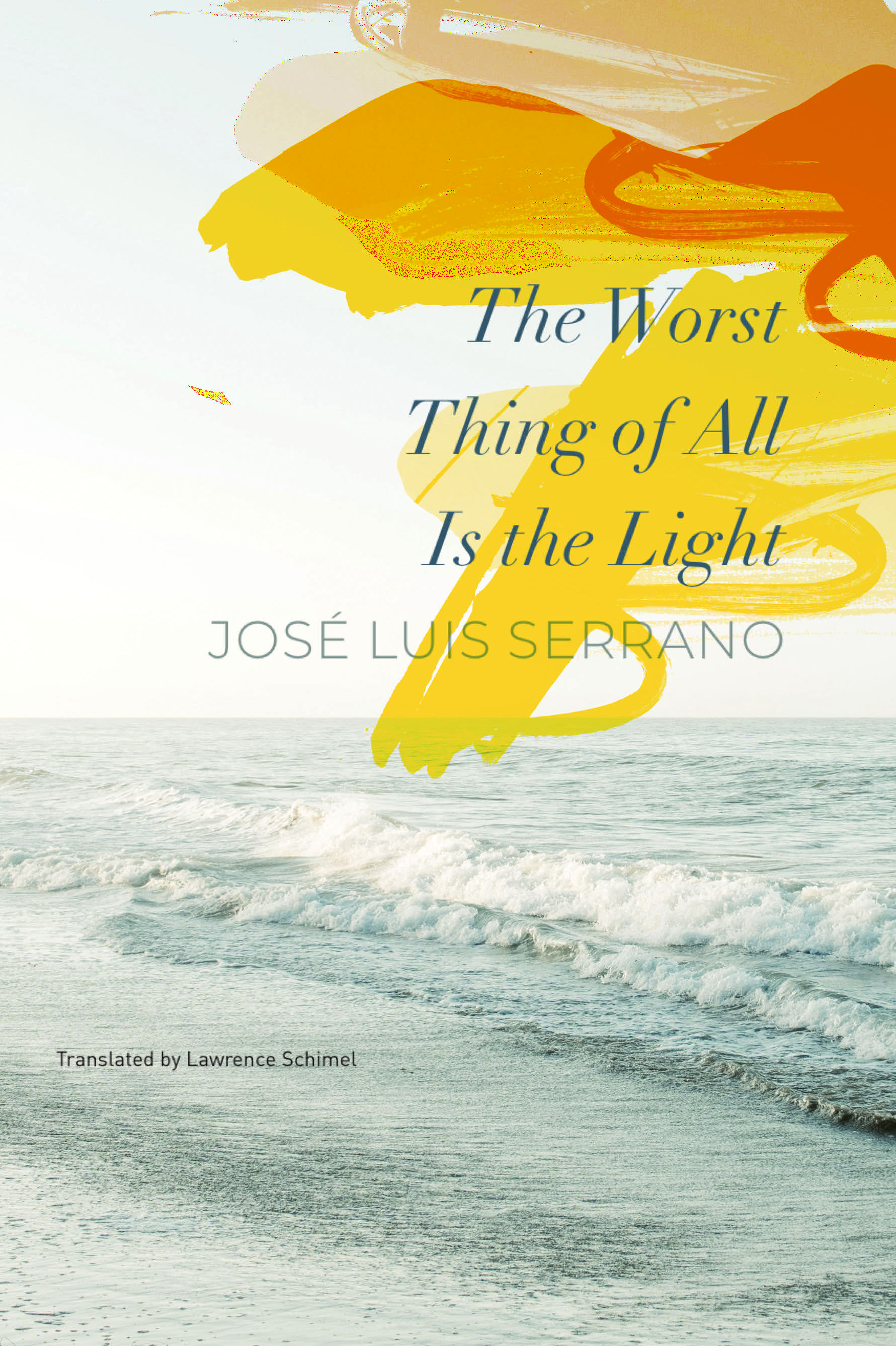
What is important is to love: The Worst Thing of All is the Light by José Luis Serrano

The worst thing of all is the light because it’s always the same, but we are not ever the same, and then that light reminds us of the others we were before, once, those others who did things that now we would not do, that we don’t admit to having done. In spring, the light of a clear, bright day, when the wind has left the air clean and pure, leads us to clearer days, days of youth, of holidays. Or that yellow light of autumn, also clean, sharp at the final hours of the afternoon.

Light, light, light. Such is the thread along which the thoughts of Edorta, a middle-aged man, run through the course of his free-flowing poetic reflections, a diary of sorts, addressed to, but not meant to be read by, his long-time friend Koldo. As he reaches for a way to understand and articulate his tangled and conflicted feelings, light serves as a mechanism of memory, sometimes consoling, at other times cruel. But Edorta’s musings are only half of The Worst Thing of All is the Light, an inventive, metafictional novel that sets an exploration of the boundaries between friendship and desire against a parallel examination of the relationship between imagination and reality.

Edorta and Koldo are the creations of Spanish writer José Luis Serrano, but within this double stranded novel, they are also the evolving characters taking shape in the mind of an “author” who is, presumably, a fictionalized representation of Serrano himself. In a series of journal entries, the author/narrator records the activities and conversations that mark each day of a vacation he and his husband are spending in Bilbao. His report, which details where they go, what they eat and what they talk about, is addressed to his husband directly, with the all familiarity two decades together has wrought. These dated entries, each illustrated with a scenic photograph, occur over the course of ten days in August of 2014 and appear to set up the proposed novel the author is planning to write: the story of a very close friendship—one that might even be described as love—between two heterosexual men. He’s not sure if he will be able to pull it off (his husband is even more skeptical) but he knows it will require an inventive approach, perhaps one that plays a fragmented diary of some kind against an author’s journal within which the potential narrative structure and details are formulated and debated. His husband plays the foil, devil’s advocate and, sometimes, the anxious spouse:

“But then, aren’t you going to write a normal novel?”

“I never write a normal novel. What’s more, I’ve always made it clear that I’m unable to tell a story, There will just be snippets, bits of what could have been the novel. Perhaps a diary by Edorta.”

“And these dialogues.”

“That’s right. Perhaps not these, but others I make up based on these.”

“And will I be myself? I’m worried about being myself in your novel, worried that you’ll put me in your novel.”

With chapters that alternate between the author’s journal and Edorta’s diary, the novel that exists is the one that the author is planning to write—the final project and a self-conscious analysis of that project in its formative state. This is where the metafictional game lies, where the boundary between literature and reality blurs and where questions about the “fictional” characters, their relationship, and the nature of love and attraction arise. As the author and his husband debate the possibility of platonic desire between men from the outside in so far as they can intellectualize beyond their own homosexuality, Edorta explores the matter from within, in trying to articulate the quality of his affection for Koldo while holding to an assumption of his own heterosexuality.

Edorta’s diary offerings are undated; each one is named after a song released by the Bristol-based UK independent Sarah Records(1987–1995), and opens with the artist name, catalog number, and a few lines of lyric. These sections resemble a form of stream of consciousness, admittedly composed in writing, but unfolding without clear direction or specific chronology as if Edorta is trying to sort out his feelings on the page. Consequently, allusions—to the light in particular—and scenes from the past are revisited repeatedly. Where he is writing from, temporally speaking, is intentionally vague, though he does often correct himself, pulling out of his revery to recall that adult life, relationships, and children have made the endless days of youth but a memory. Their occasions to actually be together are now few and time-constrained. His longing is palpable, his prose dense with fervid imagery:

Today I lug the grief of not being able to say the unsayable, fighting with the anguish of being and not wanting to be, of sinking into oblivion forever or of turning back, before even being, before myself, where there is not even oblivion. Life breaks loose from the poplars in tatters, and the branches, outlined in green-black shadows, shrink inward in their extinction of dying rapture, paralysed, surprised by the cold of November, overwhelmed in its frozen casket of gargoyles and waits.

The confluence of a grown man’s sense of loss with an adolescent ardor enhances the interrupted, unstructured memories and reflections that the novel’s “author” seems to want to capture with Edorta’s diary passages.

The two alternating streams form an intriguing novel that presents itself—openly—as a meditation on the nature of attraction, love, and memory within a discussion of the questions that arise in the process of formulating a story that a writer wishes to tell. But does it work as a cohesive whole? Certainly neither half of the equation—the author’s descriptive vacation diary or Edorta’s endless poetic entreaties to Koldo—would hold as a sufficiently interesting narrative on its own. Yet together they complicate one another, less to provide one complete story (even with the metafictional reshuffling of expectations that occurs as the novel nears a close) than to continually raise questions about the exercise of creating and inhabiting characters to flesh out a story that an author may or may not be able to realize. As such, much hinges on the idea of platonic love and the degree to which sexuality influences the way one conceives of and is able to realistically depict an attraction that differs from one’s own.

Are Edorta’s feelings for Koldo of a different order than anything his friend can ever return? On several occasions he tries to reassure himself that they are not. Certainly he recalls and cherishes moments of intimacy that seemed to have distressed and embarrassed Koldo. But he is unable to let go of the need to define and claim his love, whatever it may be, even if he would not be the first person, regardless of orientation, to be hopelessly attracted to someone who, shall we say, plays for “the other team.” Of course, as the author’s creation, one has to ask, who exactly—Edorta or his creator—is unable to accept that their affection for the other might just be of a different order? The author’s admitted obsession from the very beginning of the novel is: “What is important is to love whether or not it’s reciprocated.” However, if, at the end of the day, to love truly is enough is a question that may prove easier to ask than to answer.

The Worst Thing of All is the Light by José Luis Serrano is translated from the Spanish by Lawrence Schimel and published by Seagull Books as part of the Pride List.