Creature discomforts: Natural Histories by Guadalupe Nettel

The ties between animals and human beings can be as complex as those that bind us people. There are some who maintain bonds of reluctant cordiality with their pets. They feed them, take them for walks if need be, but rarely do they speak to them for walks if need be but rarely do they speak to them other than to scold or “educate” them. In contrast, there are others who make of their turtles their closest confidants. Every night they lean in toward their tanks and tell them about what happened to them at work, the confrontation they put off with their boss, their doubts, and their hopes for love.
(from “Felina”)

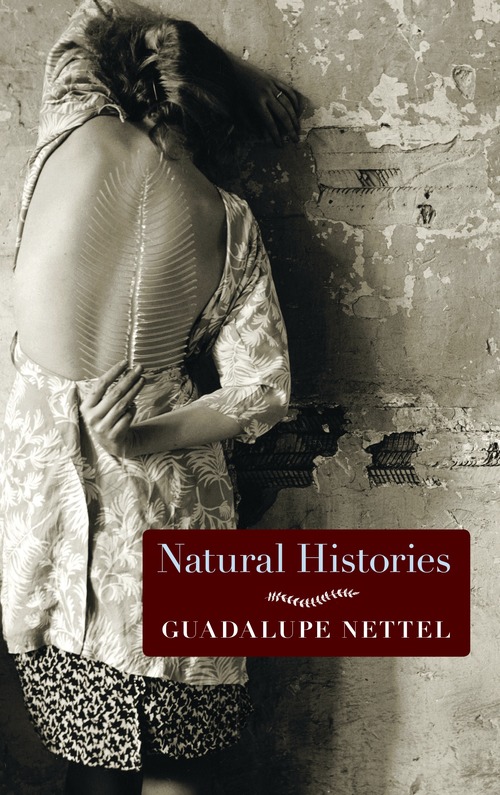
Guadalupe Nettel is one of those writers I have long wanted to read. The kind that when you finally do get to them, you ask yourself: “Why have I waited so long?” Natural Histories, a collection of five short stories, each exploring a protagonist’s engagement with an animal of some description—from felines to fungus—offers a perfect introduction to her uncanny ability to craft strong characters and compelling narratives that slip seamlessly into the murkier regions of ordinary human existence.
Born in Mexico City in 1973, Nettel spent part of her childhood in France, returning again to Paris to complete a PhD in linguistics. As a result, she is very much at home setting her stories on either side of the Atlantic as this compilation clearly demonstrates. The first story, “The Marriage of the Red Fish” is set in Paris and follows the breakdown of the narrator’s marriage following the birth her first child, a trajectory that seems to be mirrored in the tenuous relationship between a pair of Beta splendens, or Siamese fighting fish, gifted to the couple just months before their daughter was due. Lila’s arrival puts an immediate strain on the professional couple who are not quite prepared for the shift in their domestic situation and it gets worse when the narrator’s maternity leave is unexpectedly extended—she begins to feel trapped at home, her husband feels confined when he has to come home. Like their pet fish who, true to their species, are not inclined to peaceful cohabitation, the new parents find their personal dynamics altered:

As it were, in those stagnant waters in which Vincent and I moved, our relationship continued on its gradual course toward putrefaction. We never laughed anymore, or enjoyed ourselves at all. The most positive emotion I was able to feel toward him in several weeks was appreciation every time he made dinner or stayed home to takr care of Lila so I could go to the movies with a friend. It was a blessing, his relieving me. I adored my daughter and overall delighted in her company. But I also needed to have moments by myself, in silence, moments of freedom and escape in which I could reclaim, even if only for a couple of hours, my individuality.

This story, although it traces a common path of marital dissolution, stands apart by virtue of a strong narrative voice and the magnified role the fate of the unhappy fish play in what we want to imagine should be the happiest time of a new family’s life together.

The tensions evident in the opening story, become subtly darker and stranger in the stories that follow. In my favourite piece, “War in the Trash Cans,” an entomologist recounts her childhood experiences at the home of her middle class aunt with whom she was sent to live after her bohemian parents split and neither was up to childcare responsibilities. For the young narrator, the housekeeper and her mother become her unlikely allies in an otherwise alien environment and, as she puts it, “those two women taught me more things than I’d learned in an entire year of school.” Those lessons, rooted in folklore and traditional wisdom, arise when an invasion of cockroaches sets the entire household on edge.

Other stories involve unwanted pregnancy, a musician who nurtures a strange fungus she acquires from a married lover, and a boy whose father brings home a poisonous  snake as part of his obsessive endeavour to reconnect with his Chinese roots. In each case, the protagonist or one of the characters finds in another creature or creatures, something that balances their insecurities, and reflects the unfamiliar circumstances in which they have found themselves. And yet, each story, its characters and setting, opens up new and unexpected territory. As a set of five, loosely thematically linked, longer pieces—ranging from about twenty to thirty pages—this collection is well-paced, always entertaining, now has me keen to read more of Guadalupe Nettel’s work.

Natural Histories by Guadalupe Nettel is translated from the Spanish by J. T. Lichtenstein and published by Seven Stories Press.
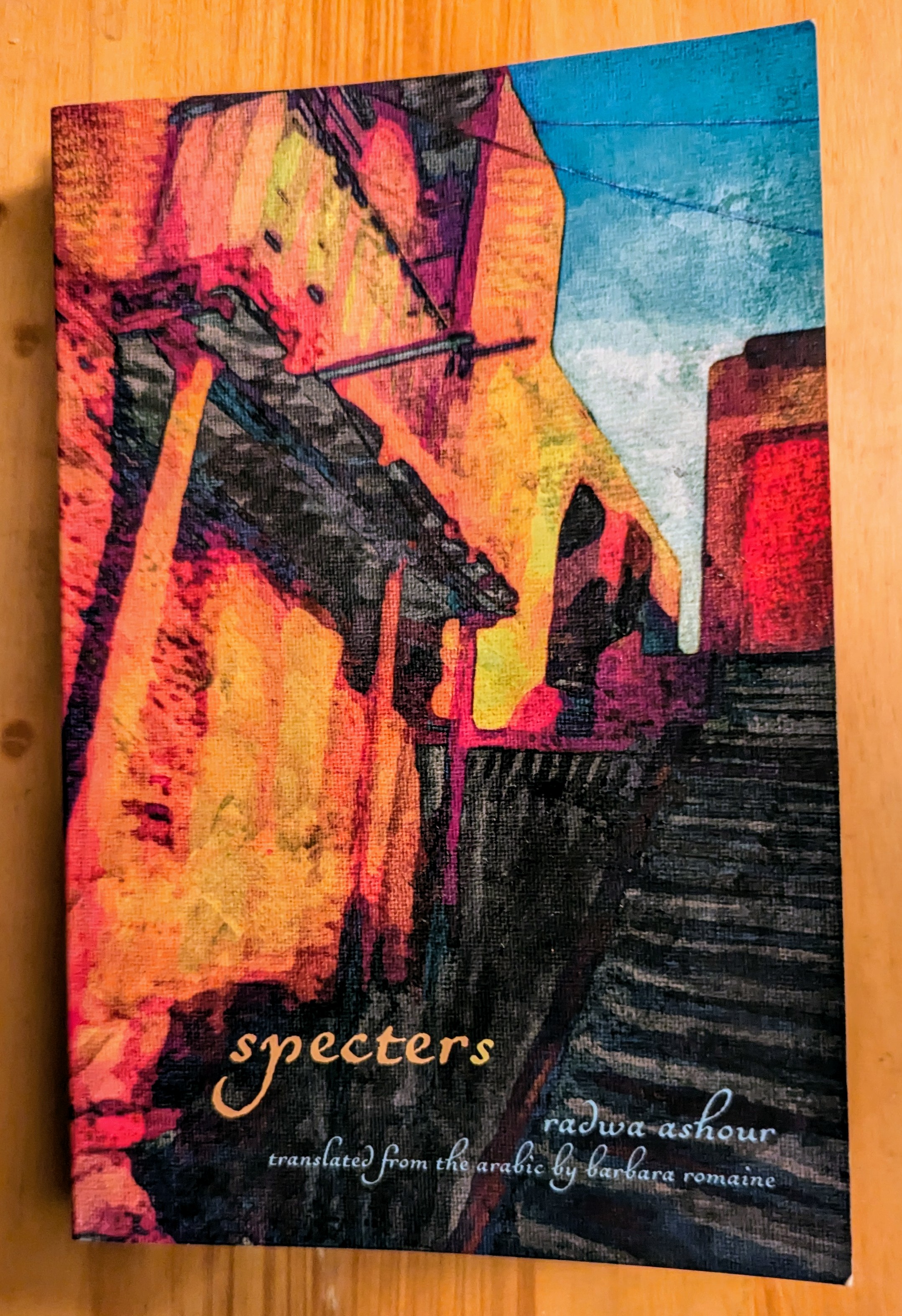
Suspended between two lives: Specters by Radwa Ashour

To the young, because they are young, everything looks bigger, taking on proportions relative to their age and to the space their bodies occupy, amidst other bodies heavier, taller, and broader than theirs. The tallest person is the oldest, and the uncle or aunt who has reached the age of thirty is of such an advanced age that it is difficult to grasp the concept of this “thirty,” based on the five fingers, or even ten, that the child will hold out to indicate his age. As for the grandfather or grandmother, that’s another story, combining reality and fantasy, the perceptible and the obscure, for the stories they tell of the past place them between two worlds, one foot here and the other there, with this mysterious “there” reaching into a past of which God alone knows the beginning and the end.

Scepters, by Egyptian novelist and academic Radwa Ashour, is a work that is ever seeking to place itself in relation to time and place, history and memoir, fiction and metafiction. Complex, multilayered, and dynamic, it explores the many ways truths can be approached, examined, and understood. This novel opens with the portrait of Shagar, a strong-willed woman, widowed young, who refused to remarry, raised three children on her own and became the matriarch of her community with, later in life, an uncanny ability to hear the voices of ghosts. The story then turns to her great granddaughter, and namesake, whose unusual appellation (meaning “tree”) was given at the insistence of her grandfather despite strong opposition in the family. As such, the name would align her with her paternal grandfather whose “inexhaustible supply of stories” would have a significant and lasting influence on her life.

But then, the narrative voice shifts. Radwa, the author, enters and immediately raises questions:

What happened? Why did I leap so suddenly from Shagar the child to middle-aged Shagar? I reread what I have written, mull it over, stare at the lighted screen, and wonder whether I should continue the story of young Shagar, or return to her great grandmother, or trace the path of her descendants to arrive, once again, at the grandchild. And the ghosts—should I consign them to marginal obscurity, leaving them to hover on the periphery of the text, or admit them fully and elucidate some of their stories?

She considers erasing what she’s written and starting over with her own story. She then debates whether she should keep Shagar and interweave two separate stories into one. “Who is Shagar?” she asks. Before the chapter is out, Shagar, the now fifty year-old professor of history is back. But not for long.

Moving between memoir, novel-in-progress, metafictional asides, and historical research, Scepters tells the story of two women born on the same day, growing up in Cairo on opposite sides of the Nile. One will become a novelist, the other an historian writing a book called The Scepters about the 1948 massacre at Deir Yassin in Palestine. They will attend the same university, and become involved to varying degrees with the student protests of the 1970s and 80s. However, although both author and character share birthdates and professions, if in different disciplines, and are writing books with similar names, this is not autofiction, nor is Shagar an alter ego. Shagar remains single and much of her story reflects her need to find meaning through political action, and through the lives of her students and a young boy who lives next door. There is an inherent emptiness that she will not find an answer to until the close of the novel. Radwa, by contrast, marries Palestinian poet Mourid Barghouti, exiled from his native country in 1967, and then deported from Egypt ten years later when their son Tamim is an infant. Much of her personal story recounts the complications—emotional, practical, and bureaucratic—of trying to maintain family life divided between countries during the precious time afforded by summer and holiday breaks. As such, it is a vital and deeply personal complement to Barghouti’s own account of the same period in his moving memoir I Saw Ramallah.

Generally, the fictional and nonfiction streams that comprise Specters unfold in alternating chapters, one or two at a time. Shagar’s academic life, as a student and as a professor, is central to her story. As is her often disruptive existence within the academic environment. She is political, active in protests, and will spend time in prison, briefly during her graduate years and again later. It is something that she does not necessarily see as a negative:

In September 1981, when she was dismissed from the university, she didn’t panic; after all, she was no longer under pressure to write a thesis or dissertation. There was nothing in the decision that threatened a transformation in the course of her life.

In prison there was ample time to consider the particulars of a life dispersed randomly in the press of daily concerns. In prison there is time, because the days and the nights as well, take their time: each hour has its own sphere, through which she passes in stoic endurance, and into which the succeeding hour does not crowd. Perseverant, country hours that know none of that feverish haste, the constantly ringing telephone, or the harried pushing and shoving in the city’s streets and its overflowing buses, its chaotic rhythms.

Shagar is determined, self-reliant, but not without doubts. About her students, and about changes she observes in the youth. The motivation to political protest of her own younger years now seems to pull promising young people to more radical and dangerous pursuits. Eventually she will turn her attention fully to her research and the subject she has wanted to explore since she first switched from ancient to modern history in the final year of undergrad studies: the massacre at Deir Yassin.

Shagar’s story naturally contains more direct historical and documentary materials—from the notebook filled with reflection her grandfather leaves her to testimonials of survivors of the massacre. But of course, the research is ultimately Radwa’s, a fact that leads at one point to a discussion of her approach to writing her well-known historical novel set in late fifteenth century Granada. This is but one of many places in which the lines between memoir and fiction are openly crossed. Shagar is someone she sometimes loses track of and she finds herself wondering what Shagar is up to or what she would think about something. The explicit and playful metafictional element of this inventive novel within a memoir (or is it a memoir within a novel?) is not only essential to its coherency, but the key to its richness and depth.  Blurring the boundaries between the personal and the political—witnessed in Shagar’s life as much as in Radwa’s—highlights the inability to separate the creative process from the research involved or the characters created. Yet, set against the backdrop of ongoing protest, conflict, and instability—in Egypt, Israel, Palestine, Lebanon, and Iraq—real lives can only find so much anonymity through fiction. The memoirist can chose what and how much she wishes to reveal, whereas for the documentarian, truths, especially the voices of survivors of violence, must be respected and preserved as faithfully as possible. These are the sorts of concerns Radwa Ashour seeks to balance in Specters. Where one life lived ends and another imagined begins cannot be clearly defined with a simple shift from first to third person, for such shifts occur, on occasion, within each thread, but at the end of the day, one is left to wonder if it is ultimately through the lens of fiction that ghosts can ever truly be heard.

Specters by Radwa Ashour is translated from the Arabic by Barbara Romaine and published by Interlink Books.

A wanderer between two worlds: The Postman of Abruzzo by Vénus Khoury-Ghata

“Rifling through the papers of a dead man isn’t enough to bring him back to life.”

Ten years after her geneticist husband died following his return from a village in a mountainous part of southern Italy, Laure leaves her home in Paris in search of something—she’s not sure exactly what—that will help her understand why he kept returning to this isolated community of displaced Albanians again and again. As Luc travelled to collect samples from populations scattered across the globe, being left behind became such a constant condition of their marriage that Laure can’t quite accept that he is really gone for good. The only way to come to terms with this unsettled absence, she is certain, is to visit the one place he had returned to fifteen times and where, on his last trip, his “heart had broken down.” Armed with a folder of his final notes on the Albanians and her portable typewriter, she arrives in Malaterra in the region of Abruzzo, and rents a house.

This is the set-up of Lebanese-French writer Vénus Khoury-Ghata’s 2012 novella, The Postman of Abruzzo, the latest of her works to be released by Seagull Books in Teresa Lavender-Fagan’s English translation. But, if Laure embarks on her journey under the illusion that she will somehow be able to put names to the anonymous donors of blood, urine and saliva recorded in her husband’s files, as if some code rests in the notes she has yet to transcribe, she soon recognizes the foolishness of that idea. What she encounters instead is an eccentric collection of characters who hold fast to beliefs and traditions long since forgotten back in their homeland, preserved in Abruzzo like a fly in amber, and she discovers she is not the only one mourning an unresolved past.

The first and most essential villager Laure meets is Yussuf, the postman of the title. On her first day, he arrives on the doorstep of her cave-like temporary residence high on the exposed mountainside above the valley where the villagers are spending the hot summer months. He has come, he tells her, to feed a litter of kittens, and promises to return every day regardless of whether or not he has any mail to deliver. As one of the only people in town who can read, having learned in prison, he knows everyone’s secrets and has an opinion on everything, sharing his knowledge and uncanny insights with the newcomer as he see fit. Yet, although he can read, the postman has no time for writing:

Putting words on top of words doesn’t construct a house, doesn’t make a child or a tree grow, doesn’t plough a field or prevent locusts from devouring an entire crop of corn. The pages one writes on a table don’t change the shape of the table but make the brain of the one writing explode. Too many word’s crack one’s skull and shorten one’s life.

With his mailbag and his tendency to hold fast to the letters that he feels are too painful to deliver or too important to release to the vagaries of the postal system, Yussuf plays a critical role linking the residents of Malaterra to one another, and Laure, as an outsider, to the community where she hopes the answers to the questions Luc has bequeathed her lie.

The only person in the village who professes to have a true respect for words is the Kosovar, the sole Muslim in a community of Catholics, who has, over the years, bitterly retreated into the confines of his dusty bookshop. In Laure he hopes he has found a kindred spirit, but his desperation and general state of deterioration unnerve her. The other residents are of a much earthier stock, including Mourad, the lusty baker, who proposes marriage despite the fact that he already has a wife and household full of children and the local women who, guided by superstitions, eye the skinny, short-skirted foreigner with distrust. Most are widows, by fact or fate, as economics have driven husbands and sons away to seek work in cities from which they rarely return. And they all seem to remember a Luc very different from the one his wife thought she knew. But the one person who interests and terrifies Laure most is Helena, the woman who cared for Luc in his illness and sent his washed and ironed shirts to Paris after his evacuation to a hospital in Rome. Helena has been waiting thirty years, rusty rifle at hand, to avenge the deflowering and subsequent death of her daughter—by hanging from a fig tree with her mother’s assistance.

Even the mountains mourned the girl, only the mother’s eyes were dry. She cried inside. Condolences poured in from every direction: plastic buckets of every colour, aluminum pans, wicker baskets, even a nightingale in a cage, but nothing consoled her. The priest who refused to give her absolution because of suicide was immediately replaced with another priest. No people are more solidary than Albanians. It makes sense! The same blood flows in their veins . . .

This blood, O negative, not only binds this community and attracted the interest of the foreign medico, but nurtures a deep-seated tradition of blood tax and blood debt imported and preserved through generations of migrants. Laure’s agitation is heightened when Yussuf reveals that a letter sitting undelivered in his bag indicates that the “boy” Helena has been waiting for, known as the Australian because he was rushed off to an uncle in Sydney for his safety, is finally on his way back to Malaterra. His arrival will affect the entire village, Laure included.

The Postman of Abruzzo reads a little like a fable set in a place caught between the modern world and a past that is filled with a complicated network of ancient traditions and carefully maintained prejudices. Laure is also caught between two worlds, half-underground and half-aboveground as the Kosovar keenly observes. Khoury-Ghata’s prose, characteristically poetic, spare, and unsentimental, is perfectly suited for the telling. Sometimes it is simply breathtaking to experience the way she can conjure a vivid and moving image with just a few well-placed words. With this work she uses this gift for precision to craft a story of loyalty, love and loss that is both tender and gently absurd.

The Postman of Abruzzo by Vénus Khoury-Ghata is translated from the French by Teresa Lavender Fagan and published by Seagull Books.

In a hidden corner of the world: In Red by Magdalena Tulli

Whoever has been everywhere and seen everything, last of all should pay a visit to Stitchings. Simply take a seat in a sleigh and, before being overcome by sleep, speed across a plain that’s as empty as a bank sheet of paper, boundless as life itself. Sooner or later this someone—perhaps it is a traveling salesman with a valise full of samples—will see great mounds of snow stretching along streets to the four corners of the earth, toward empty, icy expanses.

It begins like this, with the sketch of a town isolated against a fanciful landscape of an unending winter, each gloomy day broken only for a moment at lunchtime between soup and the main course. It is sometime after the turn of the twentieth century, when Poland was divided among three empires—Austria-Hungary, Russia and Prussia—but Stitchings exists in an imaginary fourth partition under the control of a Swedish garrison, a condition the residents consider most favourable. As the years pass, however, conflict and commerce from the outside world will exert influence on the community of Stitchings for better or worse.

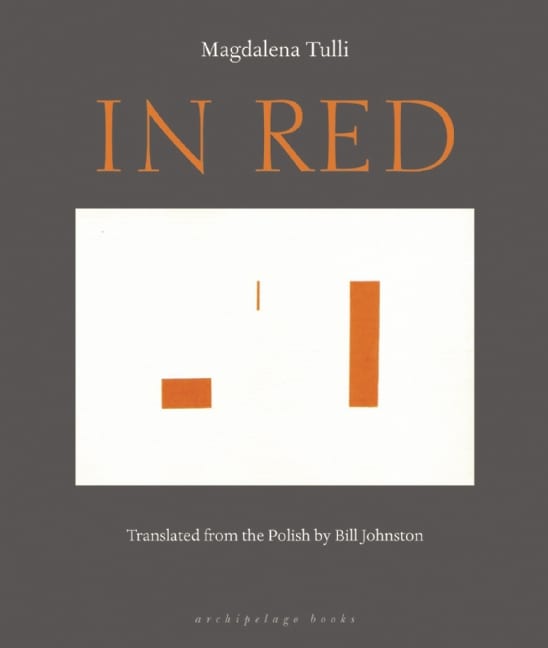
In Red, the 1998 novella by Polish writer Magdalena Tulli is a celebration of the power of stories to create a world that is at once magical and a microcosm of the early decades of the twentieth century in her native country. Echoes of Calvino and Saramago can be heard in her portrait of Stitchings and the many eccentric characters who pass through it and strange circumstances that arise in its streets, structures and public places. Defined by its industry and modes of approach—or exit—the town is, when we first arrive, home to three factories and a salt mine and, should one not approach by sleigh, a railway station to welcome newcomers. The primary businesses, all longstanding family concerns, are Strobbel’s porcelain works, Neumann’s phonograph record factory and Loom & Son who manage the flow of money and goods, and manufacture fine ladies’ corsets for the local and international market. Meanwhile, the salt mine and its miners hold an economic role that is essential to the very lifeblood of the town:

But it was to them alone that the factories, stores, banking houses, and law firms owed their prosperity. Any kind of enterprise would have run aground in a heartbeat if there’d been a lack of salt, which, as everyone knows, is the essence of tears. For along with riches, success in industry and commerce brings weeping. A boom requires weeping if it is to last. Otherwise it will dry up. A certain number of tears are needed to fill the channels of trade and allow the expeditious flow of assets and liabilities, just as water under the keel is essential for ships with holds full of cargo.

This town is no stranger to weeping. As war brings destruction its commercial strongholds, and death and injury to a generation of young men, the function of the various business and the visions of their new owners and managers evolve. Cycles of poverty and prosperity follow and the seasonal nature of the environment around Stitchings grows warmer. Eventually the snow is but a distant memory, a port is open to ships ferrying goods and visitors, and the daylight hours begin to expand until night is reduced to a brief daily moment of dimness. In the sweltering heat, sailors roam the streets and frequent the brothel. Life in Stitchings goes on. And, sometimes, it does not, as charcters fall prey to injury, illness and despair.

For a reader accustomed to following the path of an individual protagonist or collection of individuals, In Red might feel underdeveloped. But the primary character is the place, Stitchings. It evolves, with changes in development, climate and atmosphere rising and falling over the course of this short novella. People, as the framing reinforces—regularly describing how prospective visitors can approach or exit this mythical space—are transient figures whether they are born and die there or brought by commerce, external factors or familial obligation. They fall into routines, often emotionally destructive for themselves and those around them. There is, it seems, little true happiness in the streets and hallways of Stitchings. For that a person really needs to escape.

This fantastic fable moves forward with the inexorable pressure of forces that come from outside and from within. With a tumultuous flow of images, Tulli’s narrative never stops to take stock. It is up to the reader to catch references and pick up on the wry commentary woven into the account. Following the detail is less important than riding the flow, and appreciating the wisdom and humour woven into this dark tale. In the end we are reminded that the story is an entity with its own ontological motivation, but formed as it is on a community caught in the ebb and flow of larger world currents, it carries the best and worst of human nature in its wake.

In Red by Magdalena Tulli is translated from the Polish by Bill Johnston and published by Archipelago Books.

Making every word count: The Questionable Ones by Judith Keller

A police car drives slowly along the streetcar tracks in front of the central station. The officers scrutinize the waiting pedestrians through the window. Most of those waiting here are out of the question. But some do come into question. These are the questionable ones.

This simple story, “Casting,” not only provides the title for Judith Keller’s collection of micro fictions, now available in English translation by Tess Lewis, but is a perfect representation of what this young Swiss writer is able to achieve with an economy words and a sensitivity to the multiple meanings that potentially blossom from familiar expressions. A quick glance at this book of short (sometimes very short) stories can be misleading. Some pieces are barely two sentences, a number extend for a page or two, while a few stretch to seven or more pages. One might then wonder how much a of story such an abbreviated form can contain, but as Keller knows well, the careful choice of words and the confidence to leave open space for the reader is key.

Arranged into sections named after stops on the Zurich tram line, the stories in The Questionable Ones offer snapshots into the lives, passions and idiosyncrasies of a variety of characters. Absurd, often humorous, sometimes reaching toward the political, Keller’s micro fictions reflect recognizable human emotions and actions, frequently relying on common expressions taken to their literal extreme, or language that is inherently ambiguous. Of course, this reliance on meaning, especially in such a confined literary space, presents a particular challenge for a translator.

The publisher’s webpage for this book features links to a published interview and a video conversation between the author and her translator, both recorded in April 2020 when the pandemic had intervened in Keller’s plans to attend a festival and a residency in New York City. Although both cover her literary influences—including Robert Walser and Ilse Aichinger—and the reasoning behind her unusual decision to study German as a foreign language in Bogota, Colombia, the video is particularly enlightening. It not only offers anyone interested a taste of Keller’s mini fictions, read by the author herself, but zeroes in on some of the difficult decisions her translator faced when the choice of an appropriate word to convey the nuances implicit in the original was not obvious. At this point, the translations were not necessarily fixed in their final form, so several times, Lewis and Keller discuss possible options for critical words in particular pieces. After all, if every word counts in the initial composition, the same is true for the translation. Further, the opportunity to witness the writer and translator openly examining the subtleties of meaning together is inspiring.

Keller’s playfulness with words and capacity to see things from a slightly odd angle allows her to pack more into a few sentences or a few pages in ways that longer, more conventional fiction might not. Less is more. Each piece is left open for interpretation, encouraging the reader to imagine a larger tale. They are at once sketches and revealing portraits of ordinary people trying to make sense of life, one way or another. As well, the spare prose, focused on the most essential, if unusual, qualities of  character and setting leads to some wonderful images. Take for example, the opening of the two-page story “In a House”:

A band of light lay on a hillside as if a glance from half-closed eyes had fallen from above. On the hill stood a house and in it lived a man whose movements were slow. He slowly raked the leaves. He had a wife and two sons. His wife looked like an owl with her brown and golden eyes. She had taken to standing behind herself and sending her body on ahead and calmly watching what happened to it. Their marriage was a muted one.

The only obvious connection between the stories that comprise The Questionable Ones and the tram stations that denote each section—Bucheggplatz, Schwert, Micafil and so on—is the recurring piece, always called “High Time” that closes out each sequence. The circumstances change, but each instance, begins with a “far-fetched woman” making her way through the city, by day or by night, often reaching the relevant tram station and, ends with the acknowledgement that she, or someone else, has been “waiting for it to be high time for a good while now.” This variation on a theme within which what “high time” is meant to refer to is never revealed, adds an intriguing continuity to this irresistible collection of microfictions.

The Questionable Ones by Judith Keller is translated from the German by Tess Lewis and published by Seagull Books.

“I’m afraid of myself.” Down with the Poor! By Shumona Sinha

In my half-sleep I saw faces and bodies emerge out of the floor tiles. Blissful, intrigued, tormented people. They appeared when I blinked my eyes. Disappeared when I blinked my eyes. Like this night, in this police cell. To tell the truth, I am still not rid of that shouting and whispering.

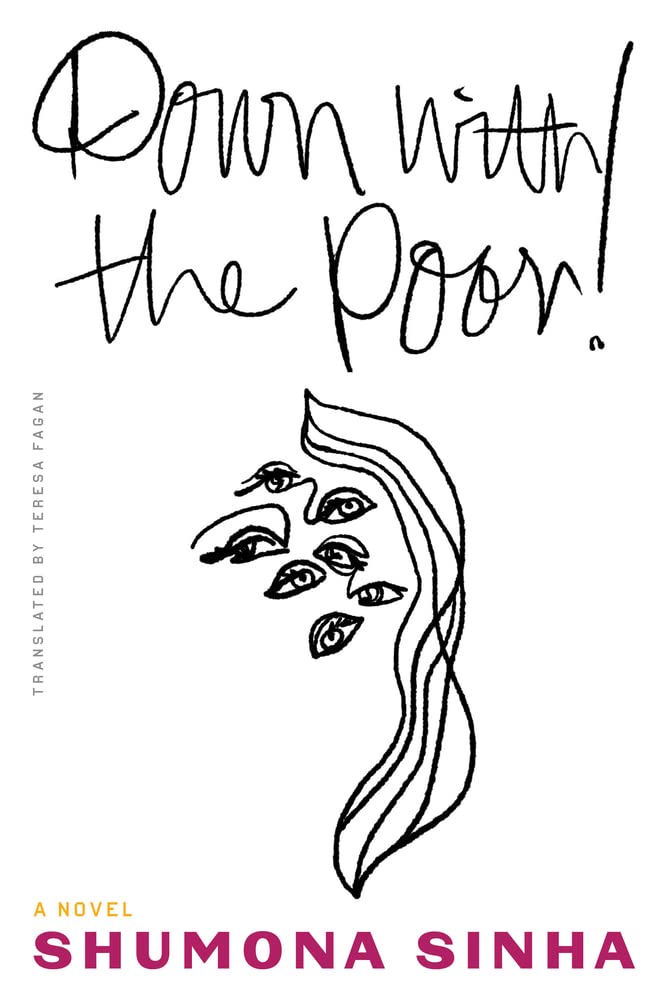
Opening with an epilogue from Pascal Quignard about the implication inherent in ancient Greek notions of liberty and freedom of movement that those who defy borders and fences are akin to wild beasts rather than obedient animals, and taking its title from Baudelaire’s narrative prose poem “Assommons les pauvres!” in which a self-enlightened man inadvertently rebalances inequality by violently attacking an elderly beggar, unleashing an equally violent response from his victim, Shumona Sinha’s novella Down with the Poor! is a relentless meditation on the complicated and corrupted system that drives desperate migrants to seek fairer shores, only to find themselves mired in equally, if not worse, circumstances and threatens to destroy the spirits of those who attempt to help them. As she lies in a cell in a Paris police station, a young woman endeavours to untangle the forces that conspired to drive her, an Indian immigrant working as a translator for asylum claimants, to assault a migrant on the metro by smashing a bottle over his head.

Born and raised in Calcutta, Sinha started studying French at the age of twenty-two and moved to Paris a couple of years later. In this award winning novel, her second, originally published in 2011, her unnamed narrator is also from Calcutta. She is a woman who has tried to separate herself from her parents and her hometown, but finds the shadows of Kali, the city’s dark, powerful and protective deity, and Mother Teresa, its symbol of charity, haunt the life she had imagined she had earned, far from memories of poverty, in France, the adopted country she loves. Everything starts to unravel when a series of personal and professional endings lead her to accept employment as an interpreter—a “language gymnast”—in an office on the edge of Paris where ragged petitioners are called to appear before an officer and make their case, or more typically repeat the story they’ve been forced to purchase, in the hope that they might be allowed to stay in a new hostile, unwelcoming land and make some kind of better life.

Unfolding as an intense monologue, poetic and compulsive, the narrator, in light of her arrest and recent interrogation, navigates a flood of feverish thoughts and memories in attempt to figure out how and where things started to fall apart in her world. From early on it is apparent that her role as the conveyor of meaning, from her first language to her second, is more than a simple act of rewording. For her, it is an act of verbal alchemy that carries an emotional cost.

The officer spoke her language, the language of the host country, the language of glass-walled offices. The petitioner spoke his supplicant’s language, the language of the hidden, the language of the ghetto. And I repeated what he said, translated it and served it up piping hot. The foreign language melted in my mouth, leaving its aroma. When I said the words, those of my native language, they turned awkwardly in my mouth, paralyzed my tongue, echoed in my head, hammered my brain like the wrong notes on a wobbly piano. It was a rope bridge, thin, quivering, between the petitioners and me. I had to lean toward each one of them to hold out my hand, lean into their dismembered, chopped-up sentences, fish for their disjointed words and reassemble them, weave them together, make them sound coherent.

The stories she hears, the horrors, real and embellished alike, start to seep into her being. She finds herself carrying their pain. Their desperation. The knowledge that many, if not most, have paid smugglers dearly, become slaves consigned to a poverty much more wretched and inhumane that anything they left behind, builds up inside her. She seeks to shake it in meaningless sexual encounters, while secretly harbouring an attraction for a female officer that she cannot quite articulate.

Over time, her work takes her into other overlooked corners of the city’s margins, while the in the offices of her primary employment, she finds it increasingly difficult to hold herself apart from the stories she hears. Questions of class, colour, gender are never far from her mind, knowing that her own skin, sex and status bind her to and irrevocably separate her from the masses of refugees, while also keeping her apart from those who are driven into work with these populations by charitable passions. She cannot help but absorb the fear she encounters in others. Eventually that fear is transformed into anger and in turn her anger frightens her. She finds she is afraid of herself.

Holding its intensity for a little over one hundred pages, Down with the Poor! is a poetic novella that addresses some of the most pressing and difficult questions we face today in a manner that is shocking, brutal and lonely. This is a very powerful little book.

Down with the Poor! by Shumona Sinha is translated from the French by Teresa Lavender Fagan and published by Deep Vellum in North America and Les Fugitives in the UK.

Women in Translation Month 2023: Some suggestions from the past year of reading

August. Another Women in Translation Month is upon us. I have already read my first contribution to the annual project with a review to come in a few days but, as usual, there will be a few non-women read and reviewed this month as well. Nonetheless, I hope to make a good showing.

Looking back over the reviews I posted since last year’s edition, I see that I have read less women in translation than I expected—less women over all, perhaps, but my reading has been governed a little more by review copies and release dates than usual, something which can be offer opportunities and present restrictions. However, I have read some excellent books since last August and if you are looking for suggestions, I have linked them here:

Eastbound by Maylis de Kerangal, translated by Jessica Moore (French)             — A spare, yet intense thriller. (Archipelago)

Balkan Bombshells: Contemporary Women’s Writing from Serbia and Montenegro, compiled and translated by Will Firth — A  surprisingly sharp, strong collection introducing many new voices. (Istros Books)

Grove by Esther Kinsky, translated by Caroline Schmidt (German) A novel born of grief and a healing sojourn in Italy by one of my favourite contemporary writers. (Fitzcarraldo /Transit Books)

Rombo by Esther Kinsky, translated by Caroline Schmidt (German) — Again Kinsky’s acute sensitivity to landscape writing frames this fictionalized account of a year of devastating earthquakes in northern Italy. (Fitzcarraldo/NYRB)

The Book of Explanations by Tedi López Mills, translated by Robin Myers (Mexico/Spanish) — A highly original collection of essays that I simply loved. (Deep Vellum)

Mothers and Truckers by Ivana Dobrakovová, translated by Julia and Peter Sherwood (Slovak) — Five stories, five difficult, complicated women you won’t easily forget. (Jantar Publishing)

The Geography of Rebels Trilogy by Maria Gabriela Llansol, translated by Audrey Young (Portugal) — A surreal, immersive tale of saints, heretics, philosophers, strong-willed women and what it means to write. Quite unlike anything I’ve ever read. (Deep Vellum)

Requiem for Ernst Jandl by Friederike Mayröcker, translated by Roslyn Theobald (German) — A collection of poems Mayröcker composed after her long time partner’s death, perhaps the best place to start with her idiosyncratic work. (Seagull Books)

Hospital by Sanya Rushdi, translated by Arunava Sinha (Australia/Bengali) — Rushdi, a Bangladeshi Australian writer draws on personal experience to capture the reality of psychosis with humour and grace. (Seagull Books/Giramondo)

Twilight of Torment I by Léonora Miano, translated by Gila Walker (Cameroon/French) — Over the course of one night, three women with a connection to a man who is absent, tell their stories of love and determination. (Seagull Books)

Marina Tsvetaeva: To Die in Yelabuga, by Vénus Khoury-Ghata, translated by  Teresa Lavender-Fagan (Lebanese French) — Another favourite author offers an intense, short fictional account of the life of the tragic Russian poet.

If you are looking for Women in Translation Month inspiration, I can recommend any one of these wonderful books.

A chronicle of pain: Mother of 1084 by Mahasweta Devi

The pain had come at eight in the evening. Hem with all her experience had said, It won’t take time, Ma. The womb has started pushing it out. Hem held her hands and said, Let all be well. Let God bring you back, the two of you separate.

Sujata’s story is framed and defined by pain. As it opens she is asleep, her dreams have transported her back twenty-two years, to the morning following an agonizing night of labour and emergency surgery when she gave birth to her fourth child and second son, Brati. Now she is awoken by searing pain once more, on the same date, January seventeenth, but this time an inflamed appendix is to blame. Once her abdominal distress begins to settle, a glance at the calendar takes her back to the early hours of yet another January seventeenth, just two years earlier, when the telephone suddenly rang. At the other end of the line, a voice summoned her to the morgue. There she would find her beloved son reduced to a numbered corpse, 1084.

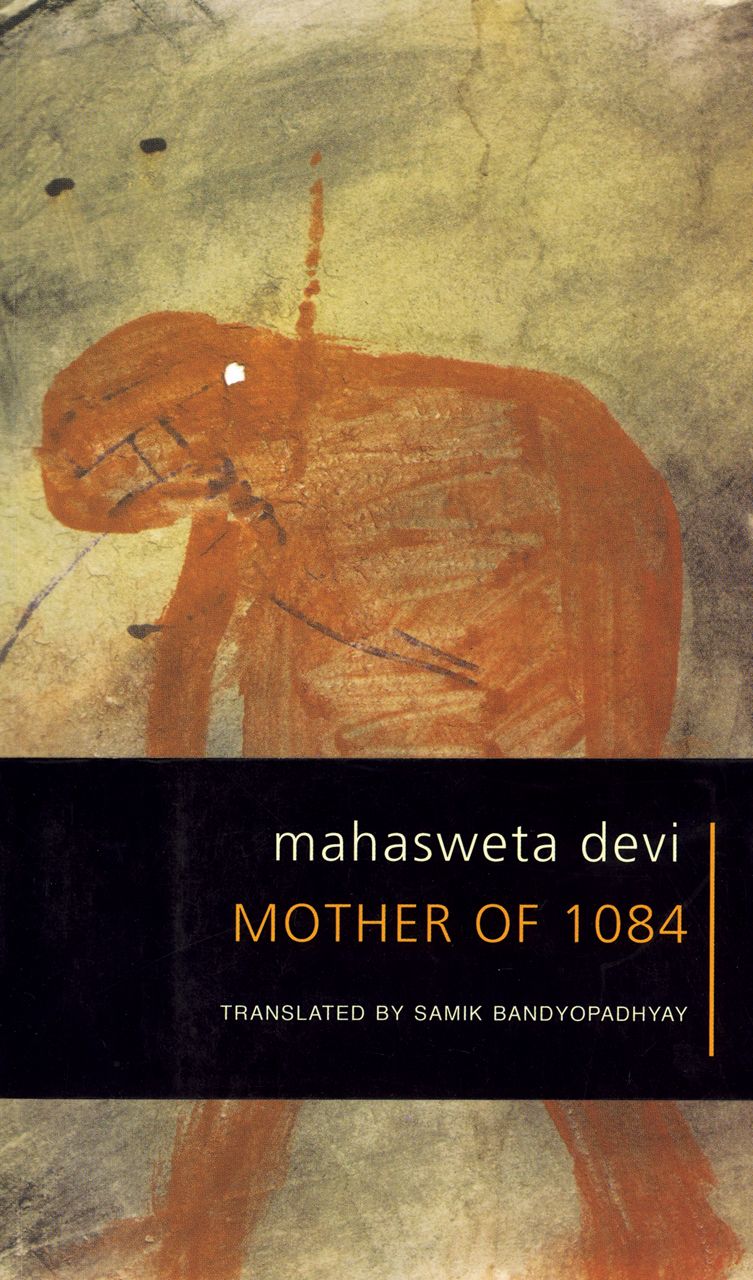
Set over the late sixties and early seventies, during the first phase of the Maoist-inspired Naxalite insurgency in West Bengal, Mother of 1084 by Indian writer and activist, Mahasweta Devi (1926–2016), is a focused examination of the impact of targeted violence on those left behind through the story of one woman stranded in her loss and grief. Sujata comes from a background of privilege, raised in a wealthy Calcutta family and afforded an education, but in marriage her life is constrained by the roles her social class expects of her. At the time of the critical events in this novel, she is in her early fifties. Her oldest son and daughter, Jyoti and Neepa, are both married and each have one child. Jyoti and his family, as custom would have it, lives in the family home. The younger daughter, Tuli, has a serious boyfriend. Her husband, Dibyananth—or as he is often described, “Jyoti’s father”—is a successful businessman with, once his wife decided she wanted no more children, a string of mistresses on the side. Sujata also has a job at a banking office, taken on her own initiative when her mother-in-law was still alive and commanding the daily affairs of the household. It is something she has refused to give up.

Brati, the youngest son, had always been unlike his other siblings. Imaginative and sensitive, he was easily frightened and deeply attached to his mother. From his earliest years on through adolescence, their bond was close while there was little love lost between Dibyananth and his second son. Naturally Sujata was blamed for spoiling him and making him weak. When Brati is killed with a group of young Naxalite revolutionaries, his father’s immediate concern is to assure that no one knows of his involvement. He pulls a few strings and Brati’s name is omitted from the news reports while at home all evidence of his existence is cleared away and locked in his bedroom on the uppermost floor. Sujata finds herself on the wrong side of her own family, on the side of the dead man who had failed to consider the shame and embarrassment he would cause. She is left alone to try to make sense of why her son had been drawn to such a radical movement and to understand the events of the night on the eve of his twentieth birthday that had cost him his life. It was a death that could not be classified in any of the usual ways—illness, accident, crime:

All that Brati could be charged with was that he had lost faith in the social system itself. Brati had decided for himself that freedom could not come from the path society and the state offered. Brati had not remained content with writing slogans on the wall, he had come to commit himself to the slogans. There lay his offence.

Extending from morning to evening over the course of a single day, exactly two years after his death, Mother of 1084 chronicles Sujata’s attempt to honour her son’s memory and perhaps find some sense of closure. At home, Tuli is preparing to hold her engagement party. Although it is her brother’s birth anniversary, the date has been determined by her future mother-in-law’s American guru—her own mother’s feelings be damned. Between attending to the necessary arrangements in the house, Sujata will make two excursions that will help fill in some of the missing information she craves, but not necessarily bring any peace.

In the afternoon she travels out from central Calcutta to the colony where the mother of Somu, one of Brati’s friends, lives. The young men killed had spent their last hours in her house. Sujata had first met Somu’s mother when she went to identify her son’s body and she had found in this poor woman a kind of a kindred spirit, another mother who understood the loss. But face to face with the graphic details of that fateful night and the absolutely devastating effect it has had on this impoverished family, she is reminded that her social status will forever be a barrier that cannot be wished away. The two women, brought together in shock and pain at the morgue and the crematorium, share an affinity that can never be more than temporary:

Time was stronger than grief. Grief is the bank. Time the flowing river, heaping earth upon earth upon grief.

Later that afternoon, Sujata makes another outing, this one closer in location and class, but again one with a divide that cannot be breached. For the first and last time, she visits Brati’s girlfriend Nandini who has recently been released from prison, bearing the injuries of torture and incarceration. In this encounter there is a bitter demonstration of the activist’s unshakable resolve, something the grieving mother will never fully appreciate. Upon returning home to where guests are gathered, Sujata is clearly affected by her experiences, and all of the memories and details that have come back to her over the course of that day. But even as pain rips through her abdomen, she must once more attempt to play her role as wife and mother. At least for the moment.

One of Devi’s most widely-read books, Mother of 1084 is not explicitly concerned with the broader political context of the Naxalite insurgency, rather it turns its attention to the intimate human experience—the appeal of the movement to individuals from different backgrounds, the reality of betrayal, the brutality of the violence, and the wide range of responses from the families and communities affected. That is not to suggest that this is not an intensely political work, but by centring an apolitical protagonist who finds herself navigating the space between the shocking indifference of her family and social class, the devastation of the bereaved who exist in the midst of conflict and destitution, and the anger of the activist committed to the cause at all costs, Devi crafts a powerful, unforgiving narrative. Sujata is the troubled conscience of this tightly woven novella but one is ever aware how very small she is against society’s pretense of normality in a time of upheaval.

Mother of 1084 by Mahasweta Devi is translated from the Bengali by Samik Bandyopadhyay and published by Seagull Books.

So much space to fill: Thirsty Sea by Erica Mou

Today it’s twenty-five years since I killed my sister.

Nobody has ever said it out loud, but I can hear other people’s thoughts loud and clear. And the unmanageable ones have a special sound: they make a low constant rumble like waves crashing against docks, like high heels as you carry on walking, resisting and smiling.

My mother says it wasn’t my fault.

My mother wears them often, high heels that is.

The voice of Maria, the narrator of Erica Mou’s debut novel Thirsty Sea, sings with a heady mix of guilt, defiance and insecurity. Not always likeable, sometimes driven to over dramatic metaphor, she manages to maintain an irresistible, infectious flow that carries you right along with her, even if you may sometimes wonder how or why other the characters in her life put up with her at all. She’s a little injured perhaps, but you can’t help hoping she will find a way to start to heal. It makes for a strangely captivating read.

Thirsty Sea is the first offering of Héloïse Press, a new venture dedicated to publishing contemporary female narrative that launched in the UK earlier this year. Mou is an award winning Italian indie singer-songwriter who brings a free-spirited musical energy to her writing, a vitality that is captured with creativity by translator Clarissa Botsford. In her introductory note, Botsford describes the challenges inherent in translating the work of an author who delights in playing with double meanings. It was necessary at times to make changes and alterations, especially to the short poems that occur within and at the close of each chapter. These brief verses have a title that reflects back on the theme just covered and, as such, it was not always possible or desirable to translate directly from Italian to English. Fortunately she had an opportunity to meet and work with Mou herself and the author was more than open to the idea of “trans-creating.” As she said: “It’s my text. We can do with it what we like.”

Watermark

All you needed to do was pick me up and shine a light
to see whether I’d ever been there

Maria, named after her two Maria grandmothers, is a thirty-two year-old woman living in Bari, Italy, with her extraordinarily patient partner Nicola. He is a pilot and she is the proprietor of a rather unlikely business, a gift-finding service—unlikely because she herself has never liked receiving gifts. This resistance, like most of the self-imposed roadblocks in her life and relationships, has its origins in the tragic death of her younger sister, Summer, when Maria was seven and her sister three. Despite frequent reassurances from her mother and several therapists, Maria cannot let go of a sense that she was somehow at fault, that everyone who knows of the situation sees her as a murderer. Her unyielding monologue continually turns comments, questions and recollections into varieties of self-accusation. Her sharp tongue is turned on herself and everyone else, though, for the most part, she manages to keep from expressing her harsher observations out loud.

Unfolding over the course of one twenty-four hour period, from one evening to the next, Maria gradually fills in details from her life, colouring in a self-portrait of a woman burdened by guilt, feeling crushed by her mother, alienated from her father and stifled by Nicola who wants to have a baby. She is weighed down by a block of marble she imagines carrying in her chest. Everything with Maria is intensified, technicolour, against the grey backdrop of her mother, her father’s crumbling edifice and Nicola’s pristine white palette. Almost the only person she trusts with the occasional honest expression of her feelings is Ruth, an American she met while visiting London in her youth. But what comes through loudest is the sense that Maria is truly isolated by her own inability trust herself. She cannot shake the trauma of her sister’s death no matter how unaffected she attempts to sound.

As the narrative unfolds and the pieces start to fall into place, tension builds. By this point we are attached to this wounded but entirely relatable soul as she nears a critical turning point. All we can do at that moment is trust that she will know what is right. For her. With Maria, Erica Mou has created a truly engaging, oddly eccentric character and a well-paced narrative that leaves one wondering where the future will take her. Definitely a writer to watch.

Thirsty Sea by Erica Mou is translated by Clarissa Botsford and published by Héloïse Press.

Somewhere between night and day: Trás-os-Montes by José-Flore Tappy

Dark, endless,
lampless
behind the windowpanes

the night

Yet even it
ends up famished
can be heard fidgeting,
shrinking to better flee,
suddenly escaping
over the roofs

Spare, essential in its spirit, the voice of Swiss poet José-Flore Tappy strikes a distinctive note  from the first lines of “The Corridor,” the poem that opens Before the Night, the first part of her book Trás-os-Montes—a note that continues to rise off all the pages that follow. Born in Lausanne in 1954, Tappy is a highly respected writer, researcher and translator. The present collection of poetry, her seventh, was awarded the prestigious Swiss Prize for Literature in 2019 and is now available in a dual language French / English edition in John Taylor’s translation. (Her first six books were released in a single volume as Sheds / Hangars in 2014, again in Taylor’s translation, available from Bitter Oleander Press.)

In his Preface, Taylor provides an overview of the key poetic elements at play in the poems, linking them, where appropriate, to a continuation or development of approaches emerging in Tappy’s earlier poetry. His long association with the poet and her work allows him to contextualize the themes that arise, but a conversation between poet and translator recorded and published in translation in The Fortnightly Review, offers a valuable opportunity to hear Tappy discuss her poetic philosophy and this work in particular. In speaking about her own poetic evolution, she notes that Spanish and Latin American poets have had an abiding presence in her life and writing. Taylor wonders how this influence is reflected and she responds:

Surely natural elements in all their intensity: the Mediterranean, the arid lands, the most deserted landscapes, or the poorest landscapes. This is where my imagination goes and where I recover my roots. I have spent many moments of my life on one of the Balearic islands, and I came of age in the midst of an environment that was at once solar and maritime — and very harsh, where sunlight can be hostile, the vegetation overgrown and inhospitable, where the violence of nature demands a strong existential response from a human being. The southern European landscapes and their inhabitants, the harshness of their daily lives, have always accompanied me: Spain, but also Sicily, Greece, and Portugal.

This sensitivity to the human-natural interplay of intense landscapes is directly evident in Trás-os-Montes which is set in Portugal and Spain, along with an extended poetic epigram set in Greece. The first series of poems, Before the Night, feature a village woman, Maria, as she tends to the tasks of her daily life in “Trás-os-Montes” (which means “on the other side of the mountains”), an impoverished, isolated region of northern Portugal with an aging population clustered in small villages, almost forgotten by the rest of the country, bound to this austere lifestyle by deep ancestral roots.

Tiny and bent over
the sink, so far from us
in her blue apron, lost
in her rain boots, she’s sorting
the black cherries, setting the ripest
off to the side, separating them
from the rotten ones

She seems to be measuring
an old dream from a distance,
visiting it with her fingertips

behind the bare windowpane
the clouds
leave stains

We see her tending her garden, cleaning her home, straightening a fence, heading off to market, engaging in communal activities. But this is more than a quotidian cataloguing of chores or portrayal of a life shaped by the forces of nature and defined by time. The precise, economical language carries its own emotional and existential weight. Through the speaker’s observations of this woman who is at once a real person and someone who stands for a kind of “universal humanity,” Tappy is exercising a form of distanced depiction to ask questions about what life means. She says:

This book does not draw her portrait, nor address her (she will obviously never read me!). It’s actually the opposite that happens. . . Without her knowing so, this discreet hardworking woman holds out a mirror to me, and in this mirror I look at myself. This woman is a lamp for me. She illumines me and helps me to think, to think about myself.

This sequence of poems, then, lays the groundwork for those of the second section, The Blank Hour. Here the tone is more personal, while landscape—natural and man-made—becomes an even stronger feature, as trails and roads lead the speaker into an encounter with an intimate past.  Although in neither section is a location explicitly stated, these poems are ostensibly set in the Balearic Islands of Spain where Tappy has spent much time during her life. The imagery is bleak and beautiful, coloured with an atmosphere of memory and loss that grows deeper as the sequence proceeds.

But for those who go afar
with neither lamp nor landmark
under a sky of black snow,
the earth with its lighthouses,
its bits of bone, its rockets,
the earth so noisy during the day,
every evening closes up
like a wooden chest
over hope

There is, again, a real person at the centre of The Blank Hour, someone Tappy once loved who has passed away. Her speaker, the lyric “I” which she understands as “an ‘augmented I,’ as it were, composed of personal experiences but also of projections of my imagination,” addresses this individual and encounters his absence in the places they once knew together. Her language, so evocative, illuminates the experience of sorrow and grief so perfectly. Our losses always seem magnified, not only by specific locations but by the vastness of the universe itself.

Today the tamarisks
covered with dust from the trucks,
pink stars become gray
that you’ll never see again,
persist,
and the enamel-bright houses
bunch together. In silence
they stand, staving off
absence

A single fault line suffices, however,
and that look from the past returns,
slipping by mistake
into the heart, reopening
what had been locked up so well

a nearby star twinkling
and ripping

In reading Trás-os-Montes, one has a sense of journeying alongside the speaker, yet at the end we are each, poet and reader alike, left alone to understand the destinations we have reached. Tappy’s poetic process is openly existential in a way that prescribes no specific conclusion. The story she is telling, she claims, is not her own but rather a means to self-understanding: “By writing, I get myself going on a path, towards a deeper, renewed self.” As such, the story we read, is, at least to some degree, our own, shaped and coloured by our lives and experiences. And that is the true beauty and power of poetry.

Trás-os-Montes by José-Flore Tappy is translated from the French by John Taylor and published by MadHat Press.