Since I finished Esther Kinsky’s magnificent novel River, it has been difficult for me to contain my enthusiasm for this work, and yet, with a major review on the way, I wanted to refrain from talking at length about my reading of this languid, mesmerizing meditation on the relationships we have with place—those we live in, pass through, or linger in uncertainly during points of transition. That review is now live, and yet Kinsky’s book is still working its way through my system.
River is a slow read; immersive, poetic, attentive to detail. It creates an atmosphere of intimacy with the spaces the unnamed narrator traverses during a time of restless displacement in a community on the edge of London; a time of gathering and preparation for leaving the city where she has lived for a number of years. Some of these spaces are immediate, defined by the course of the river Lea. Others exist in the distance, temporally and physically. And yet, although there are clear parallels between Kinsky’s own life history and the locations her narrator visits, River occupies an intentionally indistinct borderland between fiction and memoir, focusing on experience in the moment over biographical background and detail, resulting in a narrative that flows, organically, like the rivers than run through it.
My review of River can be found at the online site of the singular journal Music& Literature. The opening passages are reproduced below, you can read the rest of it here.
A mood, an atmosphere, rises up from the opening pages of Esther Kinsky’s River—a melancholy that unfolds so softly, so insistently that I repeatedly had to remind myself that I was reading words that originally existed in German. I found myself wondering: What would the German feel like in my hands? How would its texture taste, guttural tones against the back of my throat? These are questions that, in their asking, underscore how River is a text to linger in, to touch, to absorb, and recognize one’s self in. We follow the narrator as she temporarily suspends her life, settling for a time in a marginal community on the edge of London, so she can slowly disengage herself from a number of years spent in the city, and prepare, mentally and emotionally, to take her final leave. The process she details seems to be one we, too, undergo in reading River.
Under a pale sun and in the whitish, shadowless light peculiar to this place and these seasons, I took to following tracks which, time and again, led me back through the alder grove. This partly mutilated wetland wood with its childhood flowers and wild birds secretly appealing to my memory was my gateway to the lower reaches, to the path downstream that gradually taught me, during the final months of my stay, to find my own names for a city I had already spent many years labouring to decipher—names only walking and looking could force me to extract and reassemble from a web of trickling memories, a debris of stored images and sounds, a tissue of tangled words.
River by Esther Kinsky is translated from the German by Iain Galbraith and published by Fitzcarraldo Editions in the UK and Transit Books in North America.
Brother In Ice is an exercise in trust—a risky venture, not unlike the expeditions into the blank canvas of the polar regions that Alicia Kopf traces in the early chapters of her ambitious hybrid novel. There is a distinct sense that the Catalan artist and writer is thinking out loud, mapping her own haphazard journey across the page. She could have lost her way, slipped into a crevasse and disappeared beneath the weight of her own icebound mission. But no. What she has produced, in the end, through an eclectic and inventive blend of autobiographical fiction, arctic-inspired scientific detours, and historical diversions, is a thoughtful meditation about identity, family, and the challenges of trying to explore one’s self through art.
To dissect Brother In Ice is to risk making it sound strange, possibly unreadable, but Kopf’s balance and restraint hold its often disparate pieces together. The opening section of the book, “Frozen Heroes”, reflects the narrator’s obsession with all things polar: shipwrecks, penguins, the anatomy of snowflakes, and, above all, the heroic, often reckless, rush to explore the furthermost regions of the globe and endure extreme conditions, all with the desire to lay claim to undefined spaces, explain mysteries and achieve impossible goals. To be the first. Grainy black and white archival photographs add to the accounts, but what allows such brief, nonfictional excursions to work is the author’s light hand and thoughtful voice. In these early pages we are also offered our first glimpse into the narrator’s family and personal life. In particular we are introduced to her autistic older brother:
My brother is a man trapped in ice. He looks at us through it; he is there and he is not there. Or more precisely, there is a fissure inside him that periodically freezes over. When he is present, his outline is more clearly defined; other times he’s submerged for a while.
He is interested in planes, trains, cars, cats, dogs and birds, inclined to watch them carefully and intently, but he is consistently unable to carry out ordinary tasks without being cued or asking what he should do. His presence, in what is ultimately a broken family, is significant.
The scientific diversions continue into the second section, “Library Atop an Iceberg” but gradually the autobiographically toned fiction moves to center stage. After a rather defiant adolescence, complicated by negotiating the rough terrain between her divorced parents, the narrator makes her way to university where she persists in studying art and literature, worrying about the practicality of pursuing endeavours that are likely to be less than self-sustaining. She supports herself, first in retail and then with odd teaching jobs, has her first serious romance, and ultimately, her first art show. She travels, struggles to get along with her mother, and worries about what will become of her brother and her responsibility for him as he ages. The chapters, if you can call them that, are short, vignettes and reflections, played out against glacial motifs.
Finally, in the third section, she visits Iceland.
Throughout this unusual novel, the narrator herself is on a quest. She is not even certain what it is that she is searching for. Like the polar explorers, in pursuit of a shifting point on the ice, in a vast white terrain, she is writing in an effort to render the invisible visible. This is the artist’s quest—one in which the question may be as elusive and ill-defined as the answer. Near the end of the first part, the narrator admits:
I often find myself getting stuck in this project. I see nothing before me, just white. Yet beneath there are many things. The shrieking of seals. Was it the poles I wanted to talk about? Or is it just the image of the snow that fascinates me? Instability, confusion, cold (it’s hot), determination. Sensations that were the constant companions of the polar explorers, as well as those of us who work with the blank white page. Because I’m not interested in the polar explorers in and of themselves, but rather in the idea of investigation, of seeking out something in an unstable space. I’d like to talk about all of that as a metaphor, because what interests me is the possibility of an epic, a new epic, without foes or enemies; an epic involving oneself and an idea. Like the epic that artists and writers undertake.
Hers is a journey that resonated deeply with me. Especially as a writer working in the uneasy territory of memoir, I loved the openness, the questioning, the self-doubt Kopf allows her narrator (and presumably herself) as this odd creation takes shape. As her own questions and explanations start to come into focus, the layers of inspiration that preceded her quest, finally start to make sense. The beauty of this book is not simply that it is an intriguing and original account of one woman’s coming to terms with some of the unresolved fractures in her own history, it is a challenge to other explorers who venture forth with pen or paintbrush in hand to forge their own paths as they seek to tell their stories.
Brother In Ice by Alicia Kopf is translated from Catalan by Mara Faye Lethem, and published by And Other Stories.
“Everyone who knows anything of history also knows that great social revolutions are impossible without the feminine ferment.” . MARX
So begins Blood of the Dawn, the devastating debut novel by Peruvian author Claudia Salazar Jiménez. This slender volume that captures, at gut level, the horror of the “Time of Fear”, the years when the Shining Path insurgency was at its most intense is tightly bound to the intimate feminine experience. It is an exercise with little narrative distance—one that takes three women from very different backgrounds, closes in on their unique perspectives, backgrounds, and motivations, and weaves back and forth between their stories. When their disparate trajectories intersect, their individual fates, at least in that time and place, become shockingly similar.
In 1980, a fringe group of Maoist terrorists stole ballot boxes and burned them in the public square of the town of Chuschi, setting off a time of fear and violence that would, over the next twenty years, leave 70,000 dead. Set primarily during the first decade of this “People’s War,” Salazar Jiménez’s novel is a bold attempt to give voice to those not often heard. On both sides of the conflict.
There is Marcela, a disillusioned, yet idealistic teacher who is seduced by the message of the Shining Path and its charismatic leaders. Abandoning her husband and young daughter, she joins the battle. Her first person account is reported from prison, where she looks back at her childhood, early adulthood and her time with the guerilla group. In the face of regular interrogation she is still defiant, still holding on to a loyalty that cannot quite be dissolved despite the atrocities she has observed, participated in and experienced. Hers is a complicated narrative that takes the reader right into the conflicted reasoning, force of conviction, and group dynamics that shape a terrorist.
The women advance, marching along the gray patio. The first of them holds a banner with the image of Comrade Leader. Honor and glory to the proletariat and the people of Peru. Hair trained under green caps. Red blouses. Aquamarine skirts to the knee. Marching in formation. Educated in the shining trenches of combat. Jail others call it; prison. All at the same pace. Give one’s life for the party and the revolution. Banners of red flags with a yellow star. Torches in hand. Rhythm. Rhythm. Rhythm. Drum one. Drum two. Drum three. The feminine ferment rising. We travel a shining path. We struggle without truce to the end.
The second character is Melanie, a young photojournalist in love with a female artist who has moved to Paris. She imagines that the conflict in the mountains holds the story she is meant to record. A city dweller, she is quite unprepared for the harsh realities she finds. Her story is told in a first person present that highlights both her passions and her naivete. She will discover that her camera is neither welcomed by the villagers she meets, nor does it provide a shield against the sights, sounds and smells that will come to permeate her very being.
The next hamlet is a cloud of smoke. It’s hard to make out anything clearly. My camera feels heavier than usual. That’s fine; its weight anchors me to reality in this spectral place. What’s left when everything is done? Nothing. Where should I go look now? What should my lens focus on?
Finally, the truly innocent victim in the situation is the Indigenous peasant woman Modesta, who will lose everything as insurgents and soldiers repeatedly cross through her village, leaving a trail of rape, torture and murder. Her account is reported in the second person—a startling powerful perspective—until, toward the end when she finds her own voice and picks up her own thread. By then we see her slowly finding a resilience and strength that is fragile and determined at once, caught in war that makes no sense to her.
Every day at exactly four in the afternoon, new words parade into your ears just like the terrorists parade every morning. That if the class, they say, that if the proletariat, they say; that if the revolution, they say, that if the people’s war, they say, are saying, say. You only nod in agreement, already tuning out. They speak of people you don’t know, a certain Marx, a certain Lenin, a certain Mao, and a certain President Leader who is boss of them all. We’re all going to be equal, they say.
The atmosphere is claustrophobic. Wound through the plaited threads of the women’s stories are episodes of unattributed stream of consciousness and short quotes from political and philosophical sources. Repetition is employed to reinforce the relentlessness of the savage violence, and the point at which the narratives of the three protagonists blur in identical experiences of excruciating violation. The anonymity of the moment is in sharp contrast to the differing paths that lead each woman to that point, and the diverging courses their lives follow afterward. In an interesting Translator’s Note, Elizabeth Bryer brings to light some of the challenges of reflecting, in English, the different voices through use of rhythm, ideological focus and cultural references as appropriate to each woman.
In the end, Blood of the Dawn comes very close to risking losing its impact with the bludgeoning effect of the brutal tableau that unfolds. Fortunately this a spare, tightly controlled work and, to its credit, one that raises more questions than it answers, even leaving its own characters uncertain. A brave debut, indeed.
Blood of the Dawn by Claudia Salazar Jiménez is translated by Elizabeth Bryer and published by Deep Vellum.
Sometimes there is a remarkable serendipity in the way books come into our lives, perhaps at the right time, the right place or in the right company. I tucked Noor Al Samarrai’s El Cerrito into my bag as I headed to San Francisco last month. As a rambling poetic odyssey that slips in and out of the Bay Area, especially in its earlier—chapters? poems?—let’s say episodes, there was a certain geographic kismet in this selection. But even more surprising was the way this small, spare experimental volume paired so neatly with my other read throughout the same period—Esther Kinsky’s multi-layered, evocative novel, River.
On the surface, this might seem an unlikely confluence. Kinsky is only a few years older than I am whereas Al Samarrai is my daughter’s age (born in 1992). But I was swept away by both works which, at times, seemed to echo and reverberate against one another. Both women are poets and both gravitate toward a lyrical appreciation of the ordinary, everyday elements of their surroundings, at home and abroad. Both Al Samarrai and Kinsky, via her narrator, are restless wanderers, although the latter is a loner while the former typically travels with friends. They take regular excursions through familiar environments close to home—the suburban fringes of the San Francisco Bay Area and London respectively—and pilgrimages afar. Both take photographs. And both offer a thoughtful, often quirky, take on the world and what it means to be alive in it.
El Cerrito, from the inexhaustibly original indie press Inside the Castle, is a pocket-sized volume, designed with a lot of open space. What began with a couple of shorter, more confined excursions through the town of El Cerrito, California in 2012 and 2013, was expanded, over time, to encompass a broader area, within California and abroad, reaching into Sweden, Lebanon, Bosnia, Turkey and beyond to finally wind to a close in North Berkely. The journey is not exactly chronological, nor is it heavily orchestrated or forced. There is a casual, curious, yet introspective feel to the entries which are themselves generously footnoted with historical, biographical, literary, and linguistic references. Combined with occasional black and white photographs, these poetic musings become geographically defined intertextual weavings with layers of meaning that can be wrapped and unwrapped along the way.
Al Samarrai is a contemporary suburban flaneuse, another commonality she shares with Kinsky’s narrator. Both are drawn to those liminal spaces where the suburban meets natural environments. A series of poems trace repeated visits over several years to an area christened TEPCO beach for the fragments from a long since destroyed porcelain factory littering a stretch of waterfront. Sometimes it appears elusive, impossible to relocate. On the poet’s last visit, in 2016, the romance is gone:
Love wasn’t there.
May as well have been alone.
This place in my language: a kanji symbol
to tell someone you’re special,
dear to me. Meaning instilled
by visits spanning a season.
A season drawn out
into years, coated
in alternate weathers.
Connecting to others turned me inward, ultimately
an appreciation of beauty’s just not enough.
For me, one of the most illuminating qualities of El Cerrito, comes from the insights afforded by Al Samarrai’s Muslim-American background. A US-born child of immigrants who grows up to discover The Hobbit and The Lord of the Rings in grade school, her assured comfort in the country of her birth is altered at an early age:
One of the first few days of fourth grade was September 11, 2001. Mama touched my elbow before I clambered from her car that morning. Don’t tell anyone you’re Iraqi, okay? I didn’t understand why anyone would ask where I was from. What am I supposed to say? Tell them you’re Lebanese. Nodded empty assent.
that day, green knit jacket,
tag “MADE IN IRAQ”
scratched at my neck.
Sprinkled throughout this book are references to Arabic expressions and traditional foods. Her visits to Bosnia and Turkey in particular are enriched with footnotes that add interesting historical and cultural background. She carries a singular fascination with cemeteries and burial practices on her wanderings at home and abroad, and yet there is a youthful spirit and sense of adventure that speaks to equal measures of innocence and irreverence. Early episodes bring in friends, social gatherings, and love affairs, all tinged with the aroma of late adolescence, spiked with a thoughtful undertone that, at least for me as an older reader, brings back memories of the slow, sobering transition toward adulthood that takes place as you venture further from home in your early twenties. You think you are grown up.
And then you grow up some more.
The night we left there was a pink moon on a dusky turquoise sky, verging into purple (could I carry these colors in a suitcase?). At a Syrian-owned restaurant near the bus station, they gave us free hummus, salad, baklava. We gave our bread to beggars, and were given more. Nalini said it was because I spoke Arabic, but they didn’t seem to recognize me as an Arab. Or maybe true recognition’s casual. I didn’t then recognize the extent of the refugee crisis,* really, though I would come to that little by little, and then in deep gasps.
On the bus we were shushed for speaking loudly, giggled and felt very American.
.—“Road to Ephesus”
There is something slightly haphazard to the way El Cerrito unfolds. A series of geographically or thematically linked entries will be set apart by episodes that seem to fit nowhere. Brief reflections, set in a country or location that is never mentioned again, appear like random notes or a postcard tucked in here and there. This creates the effect of a book that happens as you open it. You can read it end to end, but you don’t have to. The empty pages invite a little doodling or random thoughts along the way. Because the greatest gift of a book like this—and this can be said equally of a longer, more complex and yet not entirely dissimilar work like River—is that it invites you to take note of your own environment, the people you meet, and the places you visit, and how they change and change you, over time.
* This was September, 2015. By August, 2015, the number of asylum seeks crossing into Europe illegally through Greece and Turkey had more than quintupled since 2014 according to a study by the European Stability Initiative.
It’s summertime, somewhere in the vast Hungarian plain, and this one’s a scorcher. The heat presses down on the residents of an unnamed village and threatens to reduce the river—the refuge and solace toward which the winter weary turn to enjoy what little holidays they can scavenge—into a fetid stream. But at the nearby üdülő, the local holiday site with its beach and bar and holiday homes on stilts, seasonal activities will not be curtailed:
On weekdays it was still quiet in the üdülő, but the bar already smelt of what had been left behind from the weekend: spilt beer, sweat, the girls’ summer perfumes, the exhaust clouds of the motorcyclists and helpless chlorine bleach with urine. Around midday clouds appeared over the bend in the river. The sky turned white, the river dark, the heat did not abate, became dense, bright, the poplar leaves rustled, sounded like whirring metal scarecrow strips. The small boats lay pale grey by the bank, motionless, congealed into a river panorama, from which only a powerful gust of wind or the hand of a wrangler or rower could awake them.
On the beach and back in town this will be a summer filled with drama, heartache, and melancholy—business as usual, but with a twist. This year there is a stranger in their midst, the New Woman, who has arrived from afar and settled in with Antal, the mason, who has in turn abandoned his wife and son. Such is the basic outline of Esther Kinsky’s first prose work, the novella, Summer Resort, a short, playfully poetic fable filled with a seemingly endless cast of tragicomic characters and bursting at the seams with striking and delightful wordplay.
With the attention that has come with the publication of River (see my review at Music & Lietrature), Kinsky’s only other translated work to date is likely to attract renewed interest. Compared to River, this earlier novel lacks the emotional resonance and meditative depth that one looking backward might hope for, but what it does offer deserves to be appreciated in its own terms, as an exuberant display of highly-charged linguistic energy, and a clear indication of the animated imagination, attentiveness to nature and the astute eye for detail that will characterize the prose in her longer, more serious work.
Summer Resort is an exercise in tight, contained story telling peopled with eccentric characters. Many exist almost as caricatures, like the Kozac boys who maintain a certain status in town and at the beach—admired, tolerated and resented in turn—the Onion Men, and the generic Marikas and Zsuzsas in their bikinis and glitter sandals. Others fall into closer focus. Lacibácsi the scrap yard dealer who runs the bar at the üdülő each summer aspiring to be a “manbytheriver, a poplarshadowman, a confidant of drunks,” his wife Éva (christened Ruthwoman by the New Woman) and Krisztí, the leather-clad woman who settles herself at the bar, a welcome if uninvited assistant. But at the heart of the story are Antal, his ex-wife Ildi, and son Miklós who each take a brief turn directly narrating pieces of their lives, now forever changed by the insertion of the mysterious New Woman into their midst.
More than anything though, this village and its inhabitants serves as a broad tapestry for Kinsky to weave her poetic magic. Her characters are the ordinary folk, the policeman, the railwayman, the small-time hustlers, the day labourers and the farm workers. Victims of shifting economies, closing industries and faded hopes. The üdülő is a place to lose themselves, to play and dream, but this year of heat and drought, is marked by fires, a shrinking river, and restless bodies tossing between sweat soaked sheets. There is an affectionate sadness that rolls across the surface of the narrative, and a quiet resignation that seeps into the dialogue. But the language is fierce, the imagery vivid: “Katica’s mouth was rose red with lipstick, there was so much red on it that it stood out in the üdülő like a wound.”
This is a startlingly sensual work. Here we find the elements that will later become so essential to the absorbing intensity of River. Kinsky has an unwavering awareness of detail, colour, scents, and sounds. Nature contains both the beautiful and the bleak, the lighthearted and the devastating. As is the case with the river that here, on this flat, unforgiving landscape, is a primal force:
What belongs to the river, what to the land? The floods come swiftly and silently. The river swells up, in the course of a night it casts of the sham cloak of gentleness, bursts its banks, spills over tops of embankments, carries off objects, animals, people. The undertow and thrust of the water changes the landscape. Sky, water, destroyed treetops, helpless house roofs as far as the eye can see. Then the river creeps back into its gentle course, trickles sweetly between the devastated rampant undergrowth of the bank which sticks this way and that, reflects the sky and sun, has long ago secretly discarded in the bushes what it has snatched away, where it is transformed, missing persons first become foul impediments, the vermin of the riverbank and water meadows gathering around them in great clouds, then pale, hollow bodies, through which the wind blows the quiet music of melancholy, which always lurks here in the undergrowth.
Esther Kinsky is a German poet, writer and translator. She has translated literature from English, Russian and Polish, including works by Olga Tokarczuk and Magdalena Tulli. Folkloric tones, reminiscent of some of their work come through here, perhaps, as does a pure poetic sensibility. A restless incantation for the loves and lives that collide in the course of one brittle, unrelenting summer, Summer Resort is a work well worth visiting for anyone interested in tracing the headwaters of River. And anyone else who simply enjoys a good tale.
Summer Resort is translated by Kinsky’s late husband, Martin Chalmers, and published by Seagull Books.
What does it mean to talk about masculinity today, in the twenty-first century, when serious questions of equality still remain unaddressed, gender identity is increasingly fluid, and there are new expectations of accountability and responsibility in our interactions with one another? It’s a matter I often feel ill-equipped to engage with even though I am well aware of what I appear to be when people see me. A white, middle-aged man. My hidden past is not seen, a significant disability I live with is not visible, and yet, I am not without privilege. But much of that privilege is not afforded by my gender, in fact there are distinct situations in which my gender presentation has been a marked disadvantage—as a single parent, for instance. But a recent experience here in my neighbourhood brought home to me a situation in which neither my gender, nor my colour, was an attribute in my favour.
I was walking home from the store when I was approached by a young black man. He was visibly distressed. “There’s a little girl on the street and she’s naked,” he told me. He went on to say he did not have a phone to call the cops, but I knew his reluctance ran deeper than that. The girl, when I reached her, was a child, about four years old, possibly of Indigenous heritage, whom I have often seen unattended on the street or sidewalk, sometimes riding a bicycle, but never with an adult in sight. On this day she was wearing a little shirt and nothing else. Not even underwear. Running up and down along what can be a relatively busy road. Yet at this moment, there was no one around at all. A taxi driver, also a black man, slowed down and called to me from his passenger side window. He was also upset. I told him I would try to do something. And then I’m thinking: a middle-aged white man is also in a precarious situation being seen walking down the street or talking with a half-naked child.
I asked the girl where she lived and told her she could not be on the street like that. She had to go home. She went up to a house but would not go in, instead stood alongside the house, playfully, like this was a game. I moved back several houses to ensure that she didn’t run back onto the road and called the police. I told the officer I did not feel comfortable intervening any further, but how concerned I and the two black men I’d encountered were to see this child, so vulnerable and unattended.
I realized that, but for a decision made in my late thirties, I would, as a middle-aged white woman, have been in a better position to directly ensure the child’s security until the police arrived.
I transitioned to male at forty to ease a longstanding gender disconnect, not because I grew up identifying as or wanting to be a boy or a man and not because I was naturally masculine in my interests or inclinations, but because I could never shake the deep seated feeling I was not female. This was eighteen years ago, long before transgender became a widely acknowledged phenomenon, especially for female-to-male.
When I finally decided to proceed, that second puberty was a shock. It radically upended everything I thought I understood about men. Testosterone is a game changer. Physically, emotionally and sexually. And so now, among a mixed group of friends, when gender debates arise, I am torn—I empathize with men, but I know what it is like to grow up and live as a female person in the world. And I have a son and a daughter. And yet my experience, my being in the world, has always been othered, cross-gendered, transgendered, and it always will be.All of this is a long and roundabout way of getting to What Kind of Man Are You (Brick Books), Toronto-based poet Degan Davis’ debut collection. Manhood and masculinity—in all its shades of vanity, foolishness, joy and sorrow—are themes that recur throughout his poetry. Davis, a Gestalt therapist by day, draws on his own experiences as a son, a parent and a partner, but also his love of music and, one would imagine, many hours listening to others as they work through the challenges in their own lives. I happened upon this book when I attended a reading here, keen to see another author, local writer Marcello di Cintio who had recently released a book about Palestine, Pay No Heed to the Rockets. Davis, who happened to be out in Banff at the time, came into Calgary for a most unusual and fascinating double bill. But, masculinity dominated the lively discussion that followed. In the audience there was a psychologist concerned with the high suicide rate in middle-aged men, a woman who was writing a novel about war and wanted to understand the male attraction to conflict and violence, and a young transman early in transition. Possibly one of the best book reading events I’ve been to.
However, because it is so easy for poetry books to come and go with little attention, I decided to write a review of What Kind of Man Are You for the latest edition of the relatively new and quite wonderful Canadian-based journal, The /tƐmz/ Review. You can find my review here (the layout is really nice and clean and suits poetic quotes beautifully, by the way). And while you’re there, have a look at the rest of the issue!
There seems to be considerable debate these days about where the line should be drawn between the literary license to imagine and the appropriation of voices of those of different genders, sexualities, cultures, ethnicities and racial identities. What was once considered acceptable is now questioned. And, although race is often considered a boundary to be respected or only be crossed with exceptional care, in a highly stratified cultures, class or caste or ethnic heritage may also come in to play. The concern is that the dominant voice will not only be given more attention, but that others risk being reduced to stereotypes and caricatures.
I recently abandoned a book that, despite some very witty and engaging writing, seemed to be freely exploiting mental illness, poverty and family dysfunction as justification for a smart-assed narrator with all the warmth of a sociopath. Anyone who has been suicidal or lost a loved one to suicide will know it is no laughing matter. The charm quickly fizzled and turned to distaste for me. Apparently the poor and mentally ill are still fair game for slapstick humour and humiliation.
However, it is entirely different when the humour, social commentary or complex stories are owned from within a community, told by its members. That is, I would argue, the importance of supporting and encouraging contributions to literature, theatre, film and the arts from marginal voices.
Cue Mundo Cruel, a series of short, sharp stories that take you into the heart of a small community peopled with eccentric, mostly queer characters—a world that Puerto Rican writer Luis Negrón knows well. It is his own:
Santurce, Puerto Rico, once known as Cangrejos, meaning Crabs, but no longer. Santurce. Blocks and blocks full of doctor’s offices and temples—Catholic, Evangelical, Mormon, Rosicrucian, Espiritista, Jewish, and yoga-ist, if that’s what you call it. The stench of sewers 24/7. Unbearable heat. Reggaeton, old school salsa, boleros, bachatas, jukeboxes, pool halls, slot machines. Topless bars, Dominican bars, gay bars. Catholic schools, beauty schools, vocational schools, and schools where you can get a professional degree in just one year and without much homework. . —from the “The Vampire of Moca”
A striking array of voices and personalities pass through the stories in this slender collection, and their lives are often disturbing, filled with misfortune, dark humour and an uncanny resilience. Most of the pieces are first person narratives, often presented as monologues or one-sided conversations, and, in one instance, as a series of increasingly desperate notes without a reply. The opening piece “The Chosen One” will challenge a few readers with its precocious young narrator, gleefully recounting his very early initiation into sexual activity with boys and men, experiences bound, as he sees it, to his “special” role within the church. Crude, unnerving, and funny this is in its way a backhanded satire on the degree of sexual abuse that can and does occur. But our young narrator refuses to see himself as the victim. His story sets the stage for the hustlers and the heartache that re-emerges in later stories, but it is not typical. Truth be told there is no “typical” here at all.
What is remarkable about this collection is the variety—each story is different in style and tone. Negrón channels a wide range of characters with compassion and affection, even those who espouse homophobic and xenophobic views, allowing each to demonstrate his or her own narrowness or generosity. The one-side conversations and observed dialogues are particularly effective in this regard, allowing us to eavesdrop, without further comment. The infectious, campy energy of “La Edwin” offers a perfect example:
Ahá! . . . Listen, changing the subject, did La Edwin call you? . . . Yes, Edwin. The one who thinks she’s a man. Honey, the one from the support group . . . That’s weird because that little queen is calling everybody . . . Yeah, her, that’s the one . . . Oh I didn’t know they called her that. You’re bad, girl, bad, bad . . . Well she called me last night, drr-unk out of her mind . . . Saying that he felt all alone, that for him it was difficult to deal with all this shit, meaning gayness . . . I let her go on . . . So she could get it out of her system. Wait a second, I’m getting another call . . . Aló, aló. Aló, aló. How weird, they hung up . . . The thing is, a man left her . . . Yeah, girl, she got involved with one of those lefty fupistas who plant bombs and want the ROTC out of the university . . . Yeah, girl, since they can’t liberate the motherland, they’re going to liberate themselves sexually.
It’s a fun little romp, but the story it tells about queer identity and sexual insecurity is serious.
Most of the stories in Mundo Cruel are quite short, or rather, as long as they need to be. None feel like they are dragged out too far, preferring to offer snapshots of life in this marginalized community. As is typical, some are stronger than others. Likely each reader will have their own favourites. For me it is the sad, but beautiful, story, “The Garden”. Set in the late 1980s, it is the account of a love affair between a young man and his older lover who is dying of AIDS. Nestito’s boyfriend, Willie, shares a house with his sister Sharon who has a longstanding, secret love affair of her own. Together the three of them make an odd, but happy family. As Willie nears the end of his life they plan a party. Another indication of Negrón’s versatility, this is by far the tenderest, most heart-wrenching piece in the collection:
I lay down next to Willie. He had recently taken a bath. He had changed with me ever since he became bedridden. For months he ignored me as at the party where we had met. I wasn’t me, I was part of a duo with Sharon. “You two this, you guys that.” I looked closely at his body and passed my hand over his chest. His armpits were tender ground for little flowers. I hugged him gently. His bones felt fragile. Body, host. Orchard fed with alien nutrients. I sought his face, kissed the dry sores, brushed away an eyelash that rested on his cheek. I looked into his eyes and found, finally, after eight months and sixteen days, desire.
Only 91 pages long, Mundo Cruel offers a wonderful introduction to a skilled, sensitive storyteller and the strange, sometimes dark little corner of the world he knows and clearly loves.
Translated by Suzanne Jill Levine and published by Seven Stories, I read this book as part of the Spanish/Portuguese Literature Month (and, to be fair, the tail end of Pride as well).
The end of June is upon us and I have managed to get through Pride month with a minimal amount of stress and anxiety. In my city the official celebrations are not held until late August, but there is plenty of Pride around all the same. I have written before about my general sense of disconnect from the LGBTQ community, and the rejection and isolation I’ve experienced over the years. But to be honest, I look at Pride with some measure of envy. I wonder what it would feel like to be able to celebrate myself for who I am and not wish, after all these years, that my life had been different.
There is, in many a queer life, an inability to negotiate the public and the private, the secret and the shared, in a fluid wholistic way. Sacrifice becomes an element of existence in the world.
Time, place, and cultural considerations have long had an impact on queer lives lived. Set in Calcutta and California, Don’t Let Him Know by Sandip Roy is the kind of LGBTQ story that resonates with me, even if my own experience is very different. A queer life dominated by a need to hide and a failure to find release and connection the way one longs for is not simply a story of the past. This novel speaks to the choices we make in our attempts to salvage some normalcy when what we need or long for is denied or feared to be impossible—a reality that reaches beyond the constraints of culture or questions of sexuality or gender identity.
This warm and richly woven tale examines the shifting dynamics within a traditional Bengali family as values slowly change in response to influences from inside and outside India. Roy, a writer and journalist from Calcutta, who lived in the US for twenty years before returning to his native city, draws on his own experiences growing up in a protected, comfortable family as well as the challenges and freedoms afforded by moving to America, in this multi-faceted exploration of the conflicts between identity, honesty, and obligation.
Central to the story is Romola who, having agreed to a marriage negotiated by eager family members, finds herself in small town Illinois with Avinash Mitra, a quiet young man she hardly knows. When a letter from India arrives one day, the homesick bride tears it open without checking carefully and finds herself holding a letter from her husband’s lover who had hoped that they would be able to build a life for themselves in the US, away from the prohibitions of Indian society. This man, Sumit, wonders why Avinash did not wait. Romola, unable to begin to process the information, tucks the letter away. She does not confront her husband. His secret remains with him, her awareness of his secret remains with her. Years later, after his father’s death, their son, Amit, finds the second page of the letter and assumes he has uncovered a piece of his mother’s hidden past. Secrets multiply.
Moving back and forth in time, this novel traces the childhood and youth of both Avinash and Romola, their years together as a family back in Calcutta where they raise their child in a multi-generational household, and Amit’s eventual settlement in San Francisco where he marries an American woman and becomes a father himself. A fine example of classic, emotionally balanced storytelling, each chapter adds to a network of secrets, large and small, creating a rich and bittersweet tapestry. Roy resists the temptation to break open the fragile restraints that bind his main characters, and although not entirely without hope, there is a deep sadness at the heart of Don’t Let Him Know. For Romola this is often expressed in a degree of repressed bitterness, making her, at times, less than likeable. Avinash, by contrast, withdraws. He often appears to fade into the sidelines, something that anyone who has lived for a significant amount of time closeted or otherwise invisible will recognize. His first attempt, later in life, to connect with other gay men finds him awkwardly out of synch and results in an episode that is by turns humiliating, exciting, and potentially dangerous. As a reader, I longed to know him more, yet I admire Roy’s decision to tell this story, this way.
Many LGBTQ people exist in spaces defined by loss and longing.
There is more at play here, of course. Questions of class, race, tradition, and family honour also arise, but, as with the central conflict, these issues are woven into the texture of the story. Finally, this is a novel rich in sensual detail—light, scents, and sounds. Places, from the streets of Calcutta to suburban America neighbourhoods, are skillfully evoked. My recent stay in Calcutta enhanced my appreciation of that setting in particular, with the many small features I recognized adding an extra dimension to my enjoyment of this book. A more “conventional” read for me, perhaps, it turned out to be a perfect choice for Pride month,
Don’t Let Him Know by Sandip Roy is published by Bloomsbury.
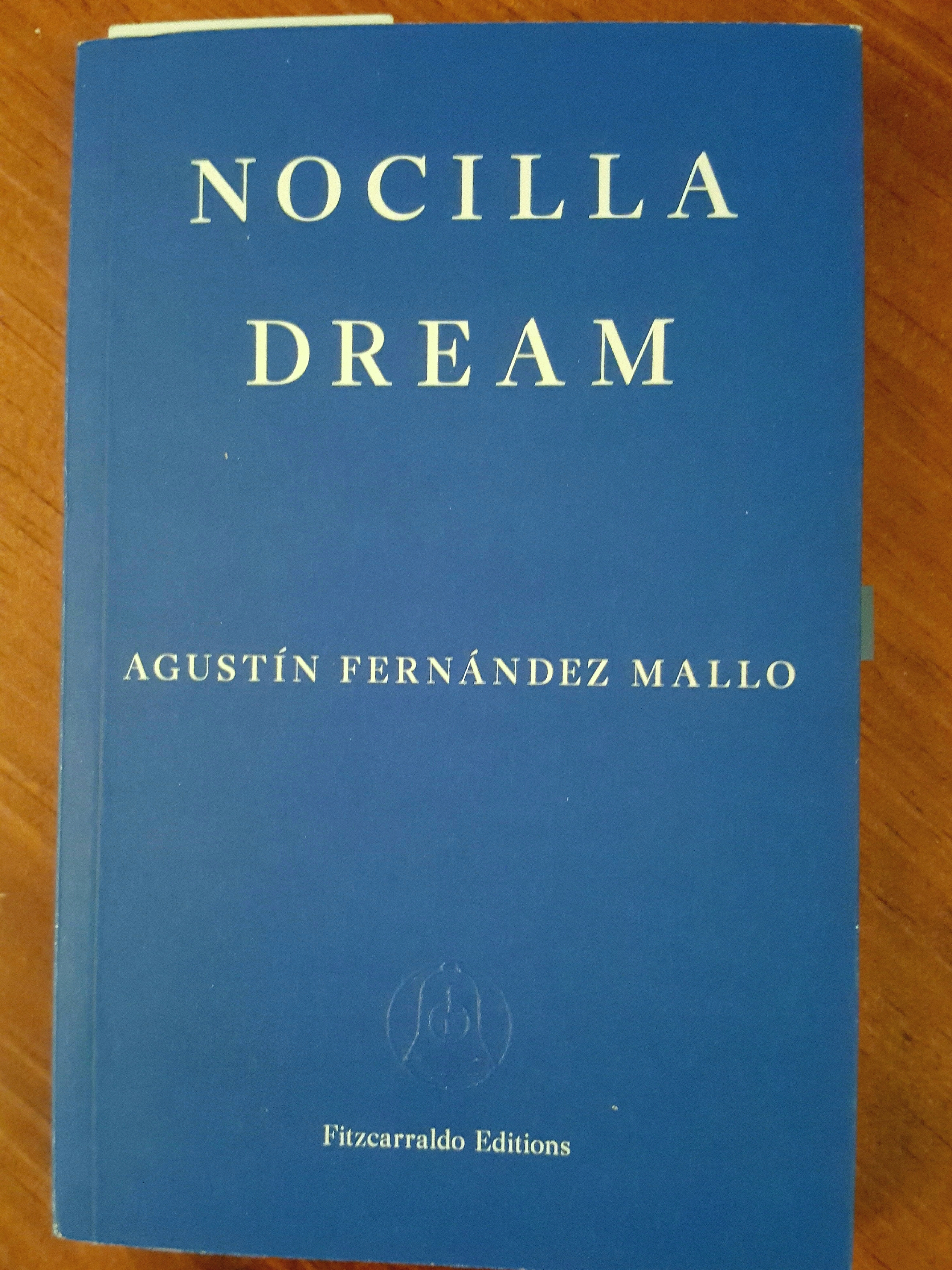
One thing that struck me as I threaded my way through Agustín Fernández Mallo’s Nocilla Dream—the first part of his three-part Nocilla Project—in this second year of the Trump presidency is that a new level of unreality has descended on this sorry globe rendering some elements of this inventive blend of fiction and nonfiction decidedly quaint, like a relic of another time. In this exercise, fragments drawn from literary, scientific and technical sources form the web or framework around which a clutch of stories featuring eccentric characters circulate. The centre point is rooted in a distinctly European-imagined American west. But this web was woven in the early/mid-2000s (the original Spanish language release was published in 2006) and now, in 2018, we’re not in in the same American, let alone global, landscape anymore. Ours is one more bizarre than any Fernández Mallo imagined.
In an interview with 3:AM Magazine, the Spanish writer—and trained physicist—explains the philosophy underlying his approach to his work, something he describes as “complex realism”:
…what I’m suggesting is that the writer must be realist, always realist, but not realist in the sense we have usually used the term in literature. If reality today is different from the reality of 30 years ago, we can’t keep describing reality in the same way as we did 30 years ago. Today we understand that reality corresponds to a model — or, even better, the sum of various models — which in science are termed “complex systems” — not complicated or difficult, that’s a different thing! This complexity is what creates that which we all know — the World — is connected in a system of networks — and I’m not referring only to the internet but also to thousands of analog networks in which we are all immersed at every instant. Until a short time ago, we knew the world in parts, whereas now we know that those parts are all connected through a system of networks with a very concrete topology.
The fundamentals that hold this project together are still every bit as valid, but the consequences of interconnectedness are just that more unnerving in light of the disturbing, current state of the United States.
Nocilla Dream unfolds over a series of 113 segments. One encounters fragments drawn from computer science, physics, literature, filmography, and more woven into a series of stories, character sketches and narratives that diverge and dovetail to form one multifaceted, strangely cohesive whole. Even the most random pieces fit somewhere into a larger zone of interconnection, in time, place, or theme. It is, in a sense, a conceptual novelistic experience. And, rather than being showy and intertexually obscure, it is a highly readable book that becomes even more engaging the further you move into it, as odd connections are made, strange eccentric characters emerge and pass through, and the assorted references and reflections begin to add up to some logic of their own.
While in many respects Nocilla Dream is groundless—that is, it exists beyond the framework of any particular story, location or collection of facts—there are some central motifs and ideas that provide a degree of orientation and link, however loosely, a disparate set of solitary or peculiar souls spread across the globe. The primary one is a desolate stretch of road with a curious attraction:
Indeed, technically its name is US Route 50. It’s in Nevada and it’s the loneliest highway in North America. Passing through semi-mountainous desert, it links Carson City and the town of Ely. A highway in which, it ought to be stressed, there is precisely nothing. Nothing. A 260-mile stretch with a brothel at either end. In conceptual terms, only one thing on this entire route vaguely calls to mind the existence of humanity: a poplar tree, the only one that found water, with hundreds of pairs of trainers hanging from its branches.
The highway with this singular feature becomes the perfect centralizing image. One that could easily fall into cliché, or worse, a nod to magic realism, but it is not. This book is at once too imaginative and too pragmatic for that. Crossing the landscape we have an assortment of characters including a wandering ex-boxer, lovelorn prostitutes, an Argentinian architect and devotee of Borges who suffers a crisis of faith, the self-proclaimed citizens of several scattered micronations, competitive surfers, expats in China, an elderly American artist who moves to Madrid where she secludes herself in her apartment and, because the primary locus is America after all, an illegal immigrant who hopes to disappear in a remote place. No character takes on a leading role, if you will, though some have a greater presence than others. All are essentially portraits, photographs fleshed in a little more detail than the images in the suitcase abandoned by a dedicated collector of the photographs of strangers—but not much more. Some narrative pieces are replayed, spread out in fragments and vignettes, while others pass quickly. But in the end they stack up nicely. Meaning filters through.
Reflections, observations and quotes from articles, textbooks and literary works are woven into the flow of micro-narratives, providing a conceptual backdrop against which the novel’s construction can be understood.
If there isn’t any space there isn’t any light. The world is unthinkable without light [Heraclitus said it, Einstein said it, the A-Team in Episode 237 said it, and many others besides]. And yet, inside everyone’s bodies all is darkness, zones in the Universe never touched by light – or, if touched by light, only because of illness or decomposition. It’s unsettling to think you exist because this death exists inside you, this zone of endless night. It’s unsettling to consider that the inside of a PC is more alive than you are, that in there everything’s completely lit up.
Linking and playing with images and ideas like this, Fernández Mallo suggests, arises quite naturally from his background as a poet. He is comfortable with thinking on a symbolic level and yet “these metaphors and connections or modal links must be rich in meaning, rich in symbolism, and they must say things which haven’t been said before, they must truly ‘construct reality’.” This construction is neither forced nor superfluous. There is no obligation to fill in all the missing pieces, draw all the lines. Just the opposite. Nocilla Dream is a novel which is richer for all its abstracted, empty space.
Of course, against the backdrop of the last few weeks of erratic policy issuing forth from the Twitter account-driven agenda of the US President, this book has an extra surreal tone. Prescient or nostalgic? Only time will tell.
Nocilla Dream by Agustín Fernández Mallo is translated by Thomas Bunstead and published by Fitzcarraldo Editions.
He may confound some readers, but for my money, the enigmatic East German writer Wolfgang Hilbig is fine company. His landscapes are evocative, filmic spaces, obscured by the mists of a troubled history of secrets and shame. His narratives are restless. His characters are misfits, unable and unwilling to conform. Their tales explore the dynamics of loss from personal, social and political angles. And even within the scope of a novella, these stories expand far beyond the confines of the pages, haunting and reworking themselves within the reader’s mind long after the book is finished.
Or, at least, that has been my experience.
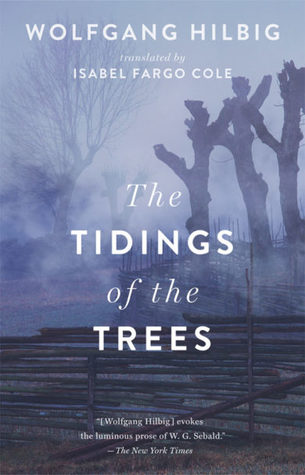
The most recent Hilbig release from Two Lines Press, The Tidings of the Trees, traverses a terrain at once familiar and yet quite distinct from the watery byways of Old Rendering Plant. This is a complex, magical tale that examines the importance of stories to hold onto and preserve the memories that the State is intent on erasing. As ever, translator Isabel Fargo Cole deftly captures the unique rhythms and energies of this text, and Hilbig fans will be pleased to know another work, The Women, is forthcoming in November.
I wrote about this book for an online journal run by the UK publisher Splice. It seems to no longer be online, so I’ve reproduced the original page and review below.
Wolfgang Hilbig, The Tidings of the Trees.
Translated by Isabel Fargo Cole.
Two Lines Press. $12.95. Buy direct from the publisher.
When the Berlin Wall was closed in August 1961, effectively sealing the final point of exit for East German citizens seeking asylum in the West, Wolfgang Hilbig was just shy of his twentieth birthday. With this action, the GDR became a completely contained state, isolated from the rest of the world. In The Tidings of the Trees (trans. Isabel Fargo Cole), the latest Hilbig translation to be released from Two Lines Press, this moment and its impact open a vortex around which the protagonist’s crisis of identity spins. Described as one of Hilbig’s most accessible works, Tidings proceeds on a somewhat different note than last year’s release, Old Rendering Plant, but ultimately it follows a route no less oblique or circuitous. Powerful and more overtly political perhaps, it is also a tale rich with fantastic imagery that openly explores the ability of fiction to preserve the past, mediate the present, and offer hope for the future.
Whereas Old Rendering Plant was a deeply immersive first-person monologue slipping at times into pure stream-of-consciousness, TheTidings of the Trees presents a multi-level narrative with an unidentified narrator who records the first-person account of the central character, Waller, occasionally breaking in to describe the actions and behaviours observed as the story is being related. It can be argued that Hilbig’s protagonists tend to be, to a greater or lesser extent, shadows of himself, and Waller is no exception. He is an aspiring writer of approximately the same age, who lives with his mother and grandmother in a small industrial town surrounded by forests and the physical legacy of strip mining. Like his cohorts he is apprenticed into work at a local factory after finishing school, but over time this work gradually loses its relevance as he becomes more deeply absorbed in a desperate effort to write — to secure his story on the page. At the time of this recorded account, one can assume the frustrated storyteller is about forty years old, an age by which Hilbig had already abandoned the factory for a writer’s life and relocated to East Berlin. Our hero in this novel is finding that transition much more agonising, and yet for Waller, as for his creator, writing is an act of defiance and self-preservation:
Write… write, I say to myself, or everything will whirl into forgetfulness. Write so the thread won’t be severed… a thousand stories are too few. So the flow won’t be broken, so the lamps over the desks won’t go out. Write or you’ll be without a past, without a future, nothing but a will-less plaything of bureaucracy.
However, no matter how long he sits hunched over a desk, the words fail to come. The empty pages and scratched-out lines drive the would-be writer out, night after night, in search of his own story.
Waller’s regular expeditions lead him to an area on the outskirts of town, where an expanding field of garbage and ash has encroached on a roadway once lined with cherry trees. It is an abiding groundlessness that draws him here; for twenty years he has felt he has had “no place to sit”, as he puts it, nowhere to belong. This desolate area holds an attraction and, he hopes, the key to his own nebulous history, now strangely distorted by his alienation from community engagement within a society where collective historical amnesia has long been encouraged. The expanse of refuse which had originated as a disused strip mine, filled in initially with the rubble of bombed-out buildings, then successive layers of garbage and ash, carries an aura of stagnation and weighted silence. In this Waller recognises the ghosts of the past, his own included. But more specifically he is fascinated by the garbagemen who scour the discarded remains to salvage whatever they can. First presented as wraith-like spectres moving over the landscape, they are depicted as outcasts, as scavengers who have formed their own inaccessible culture. Yet, as Waller’s account proceeds, he is pulled closer into their orbit.
The other focus of his habitual visits to this location at the edge of the ash heap is an ongoing search for the cherry trees that he remembers from an earlier time. He was searching for them, he advises us, even when they still existed, and he continues, having come to the conclusion that, in most instances, reality “has been debased to a worthless product of language.” It is as if Waller imagines his mission to find his own story — that is, to grasp sensible hold of his own memories — as part of a greater effort to preserve and capture the memories of a time and place nearly forgotten. To that end, the proud and beautiful cherry trees stand as symbols of everything he has lost — youth, promise, and hope in the future. They haunt him. And he is determined to attempt to write them back into existence:
And the story might tell of a time ten years ago, or might date back two or three decades; the sentence I set down at the top of the page — twenty years or two days ago — made no difference whatsoever: The trees of the cherry lane have vanished! There can exist, it seems to me, an infinite series of stories telling how this happened. … I can fit only a fraction of them beneath that opening sentence. Or perhaps a barely graspable shadow of ash, light as a breath… for the cherry trees to return, I’d have to tell all the stories about them.
This endeavour to tell even a handful of the possible stories of the trees, has, over time, become entwined in Waller’s memory and imagination with a series of possible stories about the garbagemen. His willingness to embrace uncertainty contributes to the magical and disorienting qualities of his tale. He is not simply laying out one story, unwinding one single thread, but rather telling multiple variations of his own stories to find, he hopes, some truth, and release the barrier that has blocked the flow of words onto the page.
The Tidings of the Trees is a tale of dislocation, in time and space. Waller struggles with temporal context, not only in writing, but in recounting his story. His account stalls several times. His interlocutor notes that it seems as if he is uncertain about what time frame he should follow. He frequently repeats his conviction that twenty years of his life seem to have lost their meaning, passing in a haze, one moment blurred into the next, leaving his memories and time confused. He continually attempts to re-enter the story at different points because his own internal chronology is unreliable. The only clear point of reference he can hold to is that fateful summer when the borders closed, the “summer of the Wall.” From that point, his life began to take on a fictional tone. His thoughts became confused as reality started to slip its moorings. While everyone else seemed to move forward and forget how life used to be, Waller found himself tangled in a grey zone. And it has continued to become greyer.
Once East Germany is firmly sealed off, he is struck with the disheartening sense that his future is fixed, pre-written. This is the initial trigger of his retreat from town and factory life. If one feels trapped in a rigid, scripted narrative, the only rebellion is to attempt to seize control of one’s own story. For Waller, the answer seems to lie in writing. Yet, as his fellow citizens settle into a pattern of State-dictated ideals, routines, and conventions, he realises that they defy his attempts to craft characters and build stories around them. Where can he take them? The GDR encouraged a form of worker’s literature, a celebration of Socialist norms and values, but for Waller, as for Hilbig, art cannot be thus constrained. “Normality was normal”, we are told, “because it had lost its stories… [and] only when the mask of normality was torn off did reasons for stories exist once again.”
Stories, then, in the context of this novella, serve multiple functions, individual and societal. In the garbagemen, our dispirited writer sees a metaphor for the process of the preservation and maintenance of the past. As these marginalised individuals dig through the ash to retrieve discarded objects — utensils, tools, clothing, and an unseemly number of mannequins — Waller imagines that they are essentially performing a communal act of remembering, of keeping alive a history that would otherwise be buried and lost. Afraid that he too is at a loss, that critical events have slipped from his memory’s grasp, he is drawn to these enigmatic characters who are, he believes, incapable of forgetting. He finds himself moving among them, slowly assuming a similar appearance, and ultimately taking refuge in their storage shed during a storm:
Here I was… I’d been here for a near-eternity, and already I was almost a ghost… a monster, shaped from the substance of eternity, a sculpture of ash muffled in ancient ghostly garments… and the garbagemen, who believed in mythical creatures, had long ago accepted me as their ghost, slinking around me breathlessly and on tiptoe; and they’d consigned the citizens from the shop windows to the garbage, for I was the true artwork of their time, I was the statue which alone fulfilled all their time’s aesthetic requirements, their time that was no time at all… the trees of the cherry lane have vanished; this single sentence, long since extinguished and grown cold, stood there upon the page, and they’d given me infinite time to write a second one.
In classic Hilbig fashion, the narrative regularly loops back on itself, images are revisited again and again, and a restless, searching energy courses through the prose. Yet unlike the fluid, meandering flow of Old Rendering Plant, there is a greater variation of pace and tone, and a distinctive urgency and poetic passion to Waller’s discourse. Place is also a vital presence, but with Tidings, an emptiness or absence dominates. The vast field of refuse, home to little more than coarse shrubs, is a denuded environment. However, as the resting ground of discarded objects with a link to the past, it contains an existential element. This is realised not only through the actions of the garbagemen, but in the accumulated ash that hangs in the air, and clings to Waller and his surroundings. And then, of course, there are the cherry trees, natural and spectral at once, imagined alive, destroyed, or gone wild, the lost messengers whose tidings our protagonist so anxiously pursues.
Finally, as the fourth Hilbig translation to be released in English, The Tidings of the Treesis a testament to translator Isabel Fargo Cole’s exceptional acuity to the nuances of the late German author’s idiosyncratic prose. Although Hilbig typically starts with a character in a setting that has roots in his own life experience, once set in motion, his narratives each follow their own unique course. Where a predictable sameness might be expected to settle in, Hilbig’s ability to create strangely engaging characters and evoke distinct environments of oppressive beauty, in concert with Cole’s sensitive translations, ensure that each encounter with his work feels fresh and vital.
.
Joseph Schreiber is a writer based in Calgary, Canada. He is Criticism/Nonfiction editor at 3:AM Magazine. His reviews and essays have been published in a variety of literary sites and publications including Numéro Cinq, Quarterly Conversation, Minor Literature[s], and RIC Journal. He also maintains a literary site called Roughghosts and tweets @roughghosts.
 River is a slow read; immersive, poetic, attentive to detail. It creates an atmosphere of intimacy with the spaces the unnamed narrator traverses during a time of restless displacement in a community on the edge of London; a time of gathering and preparation for leaving the city where she has lived for a number of years. Some of these spaces are immediate, defined by the course of the river Lea. Others exist in the distance, temporally and physically. And yet, although there are clear parallels between Kinsky’s own life history and the locations her narrator visits, River occupies an intentionally indistinct borderland between fiction and memoir, focusing on experience in the moment over biographical background and detail, resulting in a narrative that flows, organically, like the rivers than run through it.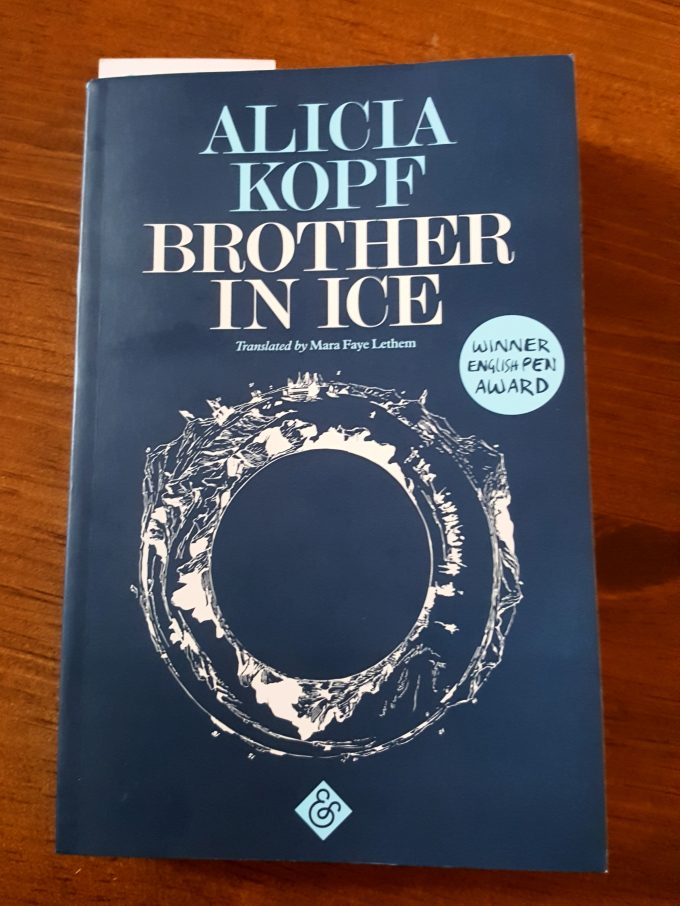




 roughghosts