Where truth lies: A Working Woman by Elvira Navarro

When an author is lauded as a “relentless innovator” and a “meticulous explorer of the psyche’s most obscure alleyways,” it is easy to be skeptical. Those are strong endorsements, and a reader who enjoys a literary challenge knows well that a publisher’s promotional copy can be laced with hyperbole that often falls short of the mark. Yet, Spanish writer Elvira Navarro lives up to her billing with  A Working Woman, newly released from Two Lines Press, one of the most peculiar novels I have read in a long time. Its strangeness is subtle, the tone is ever so slightly off, the structure unconventional, and the narrator’s account inconsistent. The opening section is unsettling, even off-putting, but sets the groundwork for an oddly metafictional tale that unwinds (unravels?) slowly to end with a coda that places the purpose and nature of the entire preceding narrative into question.

It is an uncomfortable book. A rare and original look at the complex dynamics of female companionship, the bonds and distortions of madness, and the desire to find and define oneself, creatively and personally.
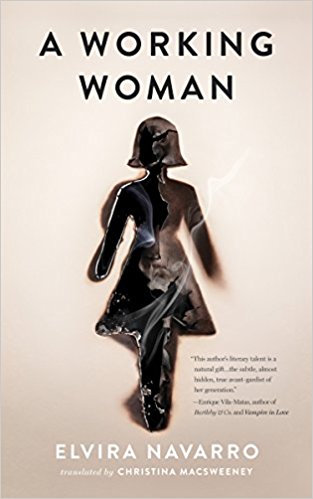
Set in Madrid, during in the aftermath of the 2008 economic crisis, Elisia is a proofreader with one novel, an MA in Publishing and an unfinished PhD behind her. She is one of the working wounded, so to speak.  She is lucky to have a job, but it has, over time, been reduced from a series of temporary placements to uncertain independent contract work for a publisher woefully behind with payments. She has already moved from an centrally located apartment to the barrio of Aluche in the southwest part of the city. As her financial circumstances become ever more precarious, she is faced with the prospect of renting her flat’s small second bedroom. When her friend Germán sets her up with Susana she does not know what to expect:

It was twelve thirty when she arrived. She wasn’t as I’d hoped, short and plump like a Hispanic mother, but the Nordic type: tall, blond, horsey, with a complexion the colour of something like raw silk. She was squeezed into a brown coat that came down to her ankles, and had a showy beige scarf around her neck. On her head was a green hat, with a swirl on one side like a flower. Weighed down by so much wool, she could hardly move, and her cheeks briefly glowed with two, perfect rosy circles. She was a bit ridiculous, particularly due to something that seemed to have its source in her nose, which, from the instant she crossed the threshold, appeared unpleasantly alert for any smell, the nostrils flared and quivering. It was such an eloquent gesture that, if I hadn’t previously committed it myself, I would never have considered accepting her as a roommate, and nor would she have taken the tiny room.

Their strained friendship sits at the core of A Working Woman. It is a relationship that seems, for the most part, to occupy an awkward space in the apartment, and in Elisia’s troubled imagination.  She exaggerates Susana’s impressive Amazonian dimensions, and finds her elusive nature—her tendency to at once take over the shared rooms with her belongings but share little about her past or her daily life—disconcerting.

However, by the time Susana crosses Elisia’s threshold for the first time in the narrative, we have already been treated, no exposed, to a graphic portrait of the woman she was twenty years earlier when, in a period of marked mental instability, she took a gay dwarf lover to meet her particular sexual needs. The novel opens with what we are told is a story based on what Susana told Elisia about her madness. “I’ve added some of my own reactions,” she tells us, setting her own words apart in italics, “but to be honest they are very few. It goes without saying her narrative was more chaotic.” For nearly forty pages, the narrator records a bizarre tale of sexual obsession. It’s easy for a reader to wonder what they’ve signed up for. Later on, one begins to suspect, that the entire set up says more about Elisia than whoever Susana may be (or may have been). Especially as she begins to develop symptoms of mental illness herself and is forced into seeking treatment. The layers of madness and sanity overlap with metafictional questions of narrative intent.

A Working Woman is imbued with an intense restlessness and anxiety that extends beyond the characters’ own uncertainties into the world around them. The narrative excavates the raw edges of Madrid where the economic downturn has left its mark. Empty storefronts, abandoned buildings, construction projects halted midstream. Elisia’s nocturnal wanderings through the streets of her neighbourhood is refracted in the countless city maps her roommate constructs out of tiny magazine clippings. But the two women are ultimately on different trajectories in life. Their worlds collide, but their connection, mediated through Elisia’s oddly unbalanced narrative, is neither warm nor natural. It is not even clear that Susana, or at least Susana as presented, exists beyond the narrator’s literary aspirations—or her own delusions.

Confusing? Yes and no. Navarro’s language is direct and compelling. She creates vivid multidimensional physical and psychological landscapes. Her ability to evoke, through her narrator’s breakdown, the sensation of losing the ability to cling to reality is especially powerful, and one I recognize well from my own experiences:

I managed to alight from the bus—there was still no ground under my feet, and I had to support myself against the buildings. Then I sat down in a doorway and stayed there for I don’t know how long, until my sense of touch returned. It occurred to me that I was crazy. I formulated this thought ten, twenty times. Movement was painful. The lacerating rumble of traffic. The tense, high-pitched voices of friends chatting in doorways. The people walking behind me. Their breathing, their bodies, were too close. I was intolerable even to myself, wanted to tear my body to pieces.

From its unusual, attention-grabbing beginning to the curious short chapter that ends (or upends) the book, to read A Working Woman is to enter an altered hyper-reality, a place filled with strange, yet strangely recognizable, figures who leave you wondering where truth lies, and where stories within stories begin, and end.

A Working Woman by Elvira Navarro is translated by Christina MacSweeney and published by Two Lines Press.


The loose ends of memories: Before by Carmen Boullosa

The opening passage of Mexican writer Carmen Boullousa’s novel Before—the first she wrote, albeit the second to be published—is, at first blush, disorienting.

Where were we when we got to this point? Didn’t they tell you? Who could tell you if you had nobody to ask? And do you yourself remember? Particularly if you’re not here… And if I keep on? Well if I keep on perhaps you’ll show up.

A most unlikely welcome. But then our winsome young narrator is not here either. She greets us from a point beyond bodied existence, beyond a life cut short with the advent of puberty. She is lost in a realm of troubled memories, and in an attempt to find herself, to talk herself back into being, she invents a listener, one who is likewise no longer alive, to whom she can recount her recollections and, she hopes, confront the trauma that has continued to haunt her. “How would I like you to be?” she asks her conjured audience, “I’d like you to be whatever you were!”

As she revisits her past, attempting to start at the very beginning, with her own birth, memories and emotions pour forth in a jumble of childhood anecdotes crossed with her reflections about the limitations of language and the perplexity of familial relationships. Her estranged connection with her own past is palpable. She describes playing games with her older sisters, her fondness for her father, and the sense of security she feels with her grandmother. She paints vivid images of life at her Catholic girl’s school. But she speaks of her mother, whom she insists on referring to as Esther, with an odd, pained distance. And she is hypersensitive to noises, creating a “lexicon” of her own. She finds comfort in the ones that can be explained by the light of day, but fears the insistent sound of footsteps that haunt her in her dreams, that wake her in a state of panic. The steps threatens to envelop her in darkness. She seeks refuge in both practical and enchanted solutions. She feels she just barely escapes their pursuit:

I didn’t know what I could do against this persecution. When I was younger, I stayed in bed or ran to my parents’ bed to let them protect me, but Dad never let me sleep in their room, thinking my nighttime terror was “clowning,” which was the word he used to describe it. Some nights I managed to trick them and stay asleep on a rug at the foot of their bed, thinking their closeness would defend me, but when I was older, let’s say around the age of nine, I stopped having recourse to the rug; if I didn’t stay in bed waiting for the noises to hit me, I walked through the house trying to elude them.

Her memories are not orderly, they vie for her attention, and often require the insertion of backstories to give them context. This allows for an odd logic, a somewhat disjointed storytelling. Some memories bring her unexpected joy, make her feel “alive again,” while others rekindle fears and mock her loneliness, her “opacity” and “sadness.” As a ghost, her connection with her life is complicated, suspended on the cusp of womanhood. The stories she shares often take on magical overtones in the retelling. Some of this reflects the enthusiasm and imagination of childhood fantasy, but as she gets older, an ominous superstition grows. As the narrative progresses, our heroine is winding her way toward an event almost too unbearably painful to return to. As readers we know that her death awaits, but there is another heartbreaking loss that precedes it.

Underlying this fragmented account of a privileged childhood in Mexico City, is the sense that adults and children exist in separate spheres. A rotation of caregivers passes through their lives and the eldest sister takes on some of the surrogate parenting roles, while the mother and father pursue careers and social engagements. When her sisters become young women, seeming to enter overnight a world of brassieres, stockings, and nail polish, the narrator promises that she will not follow suit. She does not realize, she admits when she confesses this, that she has sealed her fate with this wish.

There is an uncanny urgency and intensity to this ghostly coming-of-age story. Boullosa’s own Catholic upbringing in the 1950s and 60s, and the early death of her mother when she was fifteen are echoed here, suggesting that it may have been as imperative for her to tell this tale as it is for her protagonist to share hers. And what better way to create a distance, a place of relative safety, than to root a narrative in the afterlife? Not that any of her narrator’s animated energy or distracted childhood logic is lost in the process. Rather, we are presented with a unique blend of curiosity and innocence, tinged with wisdom and sorrow.

A most unusual and affecting tale.

Originally released in Spanish in 1989, Before is translated by Peter Bush, with an introduction by Phillip Lopate, and published by Deep Vellum.

Into the redheaded night: From the Observatory by Julio Cortázar

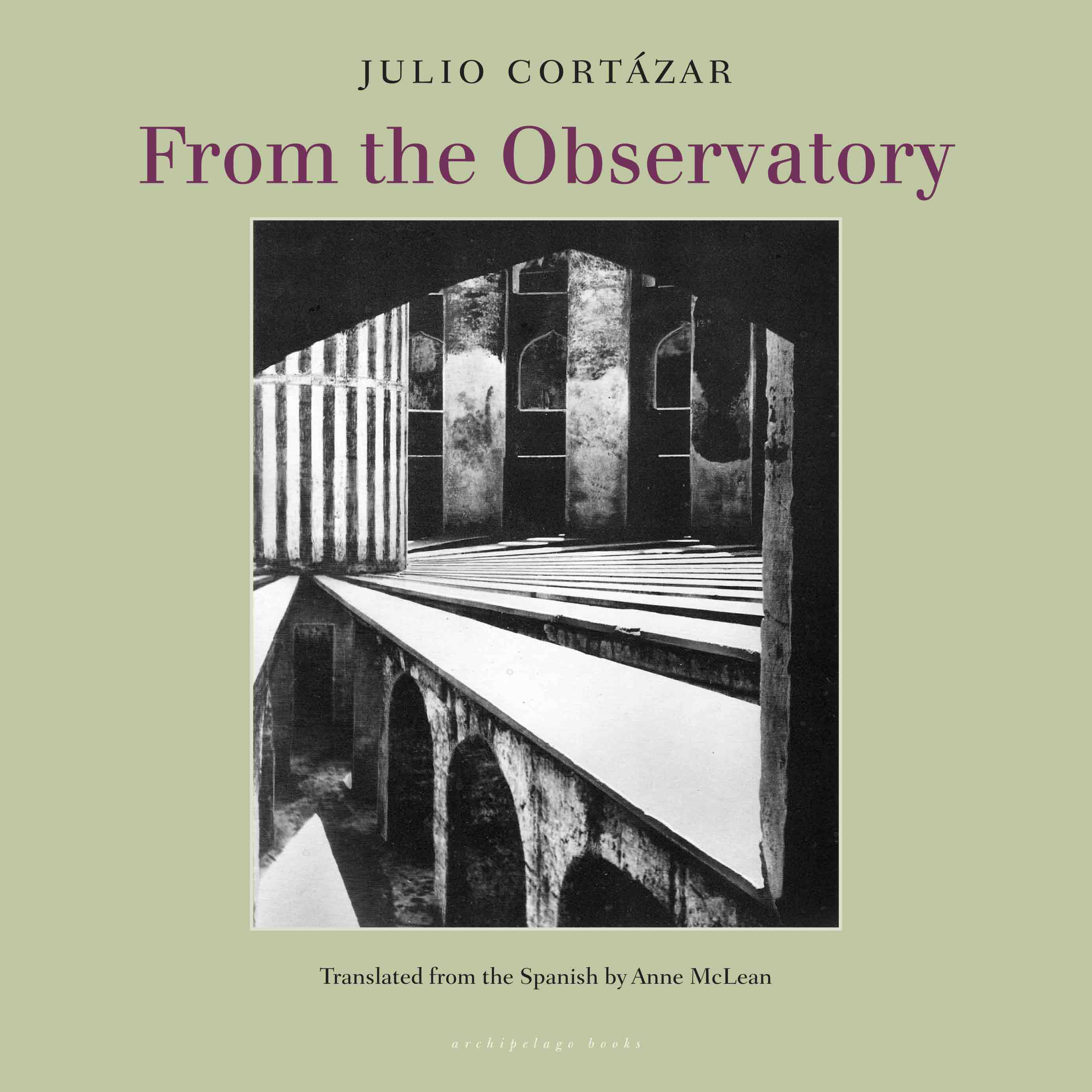
Serendipity is one of the joys of bookstore browsing. Case in point, my discovery of From the Observatory, a book I’d never heard of, discovered amid a selection of Archipelago Books in a local indie bookshop. There was something in the confluence of text and images that instantly captured my imagination. I had to take it home.

Billed as perhaps the “most unconventional work” of Argentinean author Julio Cortázar, an author who was not exactly known for sticking to conventions, this slender volume is essentially a meandering essay that moves between poetic contemplation of the life cycle of the European eel and reveries inspired by the precise angles and arches of the observatories constructed by Sawai Jai Singh, in Jaipur and Dehli, during the 18th century. If that sounds like an unlikely basis for a meditative discourse, the relentless flow of dream-like imagery pulls one into a space reflected in the silvery passage of migrating eels through dark waters and in the movement of stars across the night sky—a space that opens to an exploration of the nature of humanity, morality and society. One simply has to be willing to let go and follow the unspooling sentences:

Lovely is the science, sweet the words that follow the course of the elvers [eels at this stage of their life cycle] and tell us their saga, lovely and sweet and hypnotic like the silvery terraces of Jaipur where an astronomer in his day wielded a vocabulary just as lovely and sweet to conjure the unnameable and pour it onto soothing parchments, inheritance for the species, school lesson, barbiturate for essential insomniacs, and comes the day when the elvers have entered into the deepest depths of their hydrographic copulation, planetary spermatozoa already inside the egg of the high pools, in the ponds where the rivers settle down and dream, and the winding phalluses of the vital night calm down, bed down, the black columns lose their lithe erection advancing and probing, the individuals are born of themselves, separate off from the common serpent, feel their own way and at their own risk along the dangerous edges of ponds, of life; the time begins, no one can know when, of the yellow eel, the youth of the species in its conquered territory, the finally friendly water compliantly encircling the bodies at rest there.

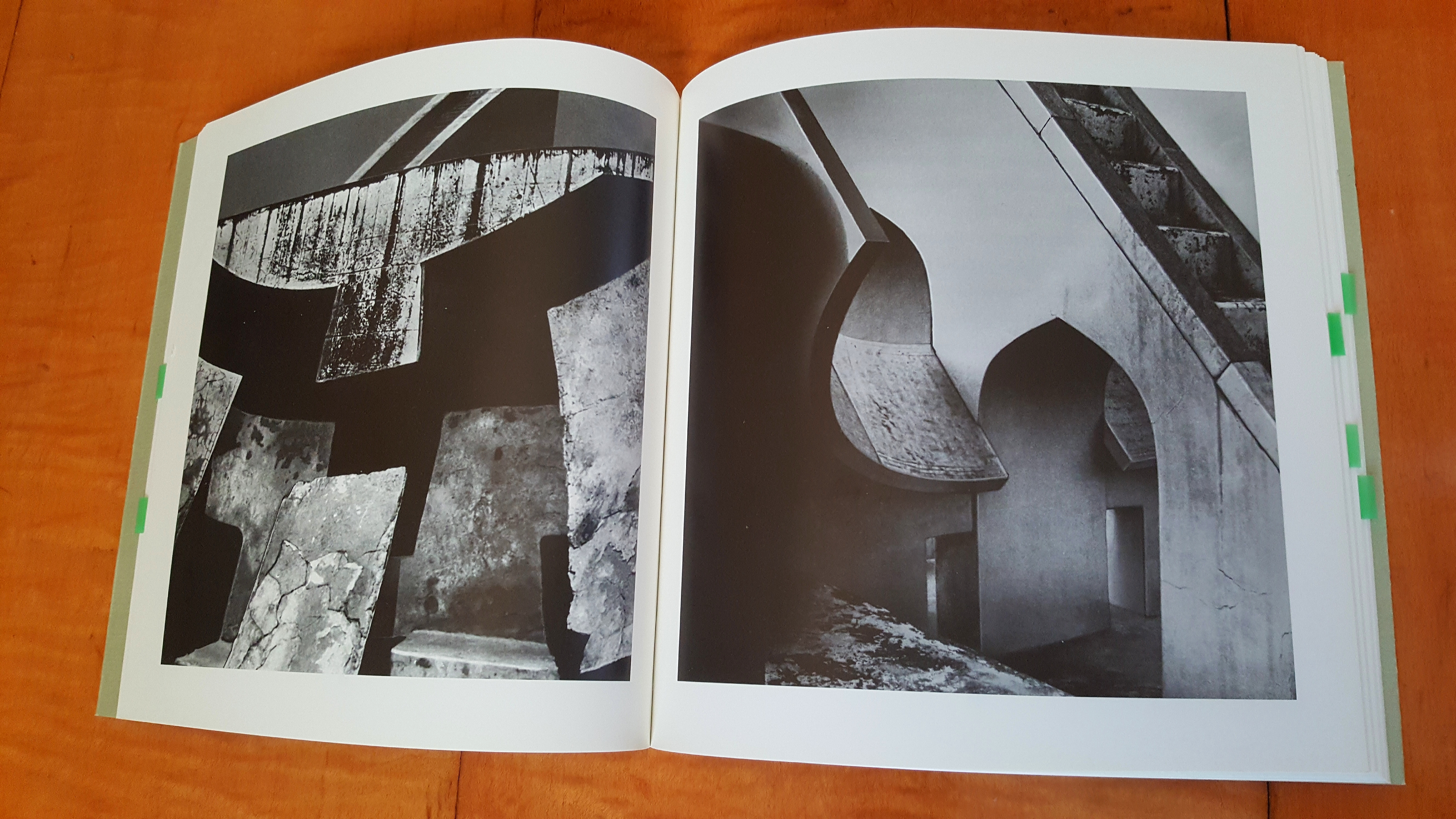
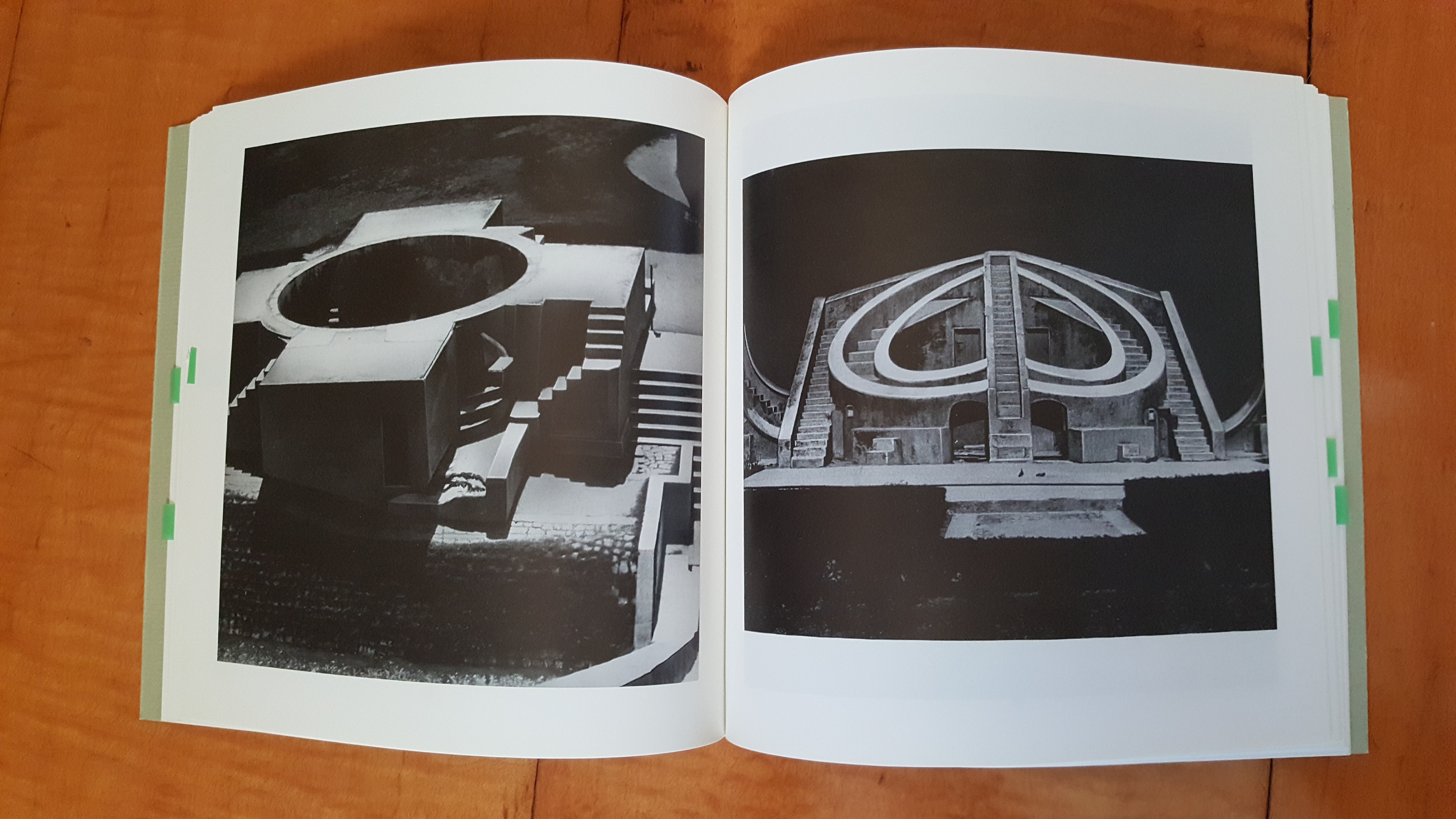
Punctuating this mesmerizing text is a series of photographs taken by Cortázar himself at the observatories, and converted with the assistance of Antonio Gálvez into coarse, grainy black and white images. They provide a stark, antiquated contrast to the winding, lyrical prose.

There is an inherent sensuality to the language throughout—from the detailed descriptions of the eel’s extended journey, to the imagined sentiments of an Indian prince viewing the night sky, to the predicament of man seeking to make sense of life:

Nevertheless there Lady Science and her cohorts, morality, the city, society position themselves for ambush again: barely has one reached the skin, the beautiful surface of the face and the breasts and the thighs, the revolution is a sea of wheat in the wind, a pole vault over history bought and sold, but the man who steps out in the open begins to suspect the old in the new, bumps into those who’re still seeing the ends in the means, he realizes that in this blind spot of the human bull’s eye lurks a false definition of the species, that idols persist beneath other identities, work and discipline, fervor and obedience, legislated love, education for A, B and C, free and compulsory; beneath, within, in the womb of the redheaded night, another revolution must bide its time like the eels beneath the sargassum.

We move back and forth from Jai Singh’s observatories, constructed with mathematical precision as a response to the tyranny of the stars which for centuries had dictated the fate of his lineage, declining as he measured the skies; to the masses of eels, subject to the tyranny of genetic forces, irresistibly drawn through a long fresh water migration to ultimately return, mate and die, in the waters of the ocean. Within its two primary threads, From the Observatory, invites questions about the destiny of humanity, caught between passion and logic, nature and science, dream and reality.

Thoughtful and refreshing, this short book—barely 80 pages, roughly half given over to images—is the perfect accompaniment to a hot summer afternoon.

From the Observatory is translated from the Spanish by Anne McLean, and published by Archipelago Books.

“It has been wonderful to know you”: My Tender Matador by Pedro Lemebel

September, 1986—spring in Santiago and rumours that the Dictator’s days are numbered are stirring the spirits of the determined, young idealistic members of the resistance. It has been another year of blackouts, street violence and police brutality. The setting is a lower-class neighbourhood where years of unemployment have taken a toll, buildings stand in disrepair, and a certain aging princess has found a castle to call her own:

. . . the scrawny house on the corner, three stories high with a staircase like a backbone leading to the room on the rooftop. From there could be seen the city in the shadows crowned with a turbid veil of dust. It was no bigger than a dovecote with three walls and a railing that was just wide enough for the Queen of the Corner—her hands moving as if playing on a marimba—to hang the sheets, tablecloths, and underpants out to dry.

Her dilapidated dwelling is decorated in style. Boxes festooned with fabrics, ribbons and dramatic imagination stand in for the finest furniture. Our heroine, a balding, drag-queen in her forties bearing the ravages of a rough life, is at last settled. As she embroiders linens for wealthy clients, and sings along with her favourite golden oldies on the radio, she dreams of Carlos, the handsome young student she met at the local store. He had approached her to ask if he could store some boxes of books in her home. She was not the silly old fool she allowed him to think she was, but—those eyes, that virile voice—how could she say “no”? Hopelessly smitten, she swoons like a schoolgirl, and soon more boxes arrive. Before long she agrees to allow a small army of students slip up the stairway to “study” in her rooftop room.

After all, what could possibly go wrong?

Thus begins My Tender Matador by late Chilean writer, Pedro Lemebel (1952-2015). With a queerly delightful energy, this is a love story that moves quickly and takes no prisoners. The Queen offers an unlikely refuge and serves as a convenient decoy for Carlos and his fellow Marxists. Caught up in a flutter of fluctuating emotions, especially when a string of days without a word from Carlos send her swinging between anger and anxiety, she berates herself for her infatuation. Her trannie sisters tease her wildly, but express their concerns, while Carlos himself is caught off guard by his own conflicted emotions. Something in the uninhibited joy and performative enthusiasms the Queen reveals moves him like no woman ever has. As her sensitivity to the political realities of the present are heightened, he is sent into revisiting a boyhood sexual initiation.

And yet, can anything come of this flirtatious friendship?

Running as counterpoint to the Queen’s story, is a second narrative stream featuring General Pinochet presented as a hen-pecked, weary, and paranoid old man. His wife’s constant nattering runs him down:

Oh, it’s just not fair; look at all these wrinkles I’m getting on my forehead, Augusto. Look, I have almost as many as you do, and I’m much younger than you are. It must be these difficult times we are living in, all the frights and frustrations I experience at your side. No other woman would have tolerated her husband being treated by the international press as a tyrant, a dictator, a murderer. And even though it is all lies, even though all Chileans know you saved our nation, don’t tell me it hasn’t been embarrassing. Yes, as I said, it’s a nightmare to think that all those penniless Communists who consider themselves writers blow their noses at you.

His only retreat is to sink back into dreams, seeking the comfort of his childhood toys. But even his dreams betray him, shifting into nightmares. What emerges is a portrait of a vain, paranoid, brittle, and homophobic man slowly losing his hold on power.

My Tender Matador is at once highly entertaining and politically astute satire. Lemebel weaves narrative with unmarked dialogue into seamless paragraphs that facilitate playful banter, emotional discharge, and the escalation of tension:

As she rushed down the stairs trying to straighten out her few remaining clumps of hair, she knew she wouldn’t say anything to him; she wouldn’t even bring it up. Anyway, Carlos was so careless she could forgive him for anything, as long as she could see him again in the doorway, like sun rushing out from behind the clouds, to offer explanations…. The young man as beautiful as an emerald was asking for her smile. How about a cigarette? he asked with his strawberry mouth, conquering her again with those puppy-dog eyes. What, did you think I was angry? But we had such a good time. Did you enjoy it? Anyway, the next time I go away, it might be forever. Carlos lowered his voice and looked at the mysterious boxes, and a curtain of emptiness unfurled over the moment. Then something pounded its way into her sissy-boy soul. Something Carlos was telling her contained a shard of truth. A fear, a foreboding, something intangible that darkened his pretty boy smile.

The flowery imagery and campy energy is infectious. The outrageous queerness that the Queen performs with her fellow transvestites is crude, and in today’s gay community which often endeavours to downplay and reject obvious femme presentations, there is a brash coarseness that rarely extends into contemporary gay-themed literary fiction. But the Queen of the Corner is not a caricature. She is drawn from the heart. A cross-dresser himself, Lemebel knows her intimately, and her story offers a romantic comedy into which he can throw his passions and concerns and allow them to play out on the page. In his obituary for The New Yorker, author Garth Greenwall portrays Lemebel as:

…a writer who called himself a “queen” (una loca) and “a poor old faggot” (un marica pobre y viejo), and whose style and obsessions were forged on the social margins and in political opposition. Lemebel defined himself against establishments of all kinds: against Pinochet’s military dictatorship, but also against the Marxist resistance that condemned homosexuality as a bourgeois vice; against the neoliberal consensus behind Chile’s “economic miracle,” but also against the L.G.B.T. activists who Lemebel believed were making commodities of queer suffering and queer lives.

Look closely, and one can see all of these undercurrents coursing through the repartee, antics and drama of My Tender Matador.

But it is the simple human need to love and be desired that gives it its soul.

Translated by Katherine Silver, My Tender Matador is, to date, the only one of Lemebel’s novels to have been translated into English.

A methodical madness: Colonel Lágrimas by Carlos Fonseca

On a cold winter day, in a remote location high in the Pyrenees, an old man is bent over his desk intent on completing an ambitious, eccentric project. Time is against him. He is an enigma—reclusive and unknowable. And the goal of Carlos Fonseca (Suarez)’s infectious debut novel, Colonel Lágrimas, is to attempt to unravel and piece together the true identity of this strange man and the circumstances that led him to this place. But it’s no ordinary investigation and the colonel at the centre of attention is a military man only in his own imagination. He is, or rather was, a brilliant mathematician, a cryptic solver of abstract puzzles, who at the height of his fame, suddenly retreated from academia, embarking on a strange journey toward isolation and obscurity.

Our guide in this inquiry is a playful voyeur who follows the aged recluse through the course of a single day, spinning a fragmented, nonlinear narrative of anecdotes, historical asides, interruptions, and discursions. At times we are invited to observe our subject as if through a lens, sometimes zooming in to a level of pixelated hyper-reality. At other times we watch as an invisible (or unnoticed) presence, slipping into the frame to rustle around in his photographs and letters when the colonel is asleep or otherwise occupied. As readers we are complicit. Curiosity is mixed with a sense that we are invading the secret world of a man lost to the caprices of a second, doomed childhood:

Where is the border of the private? Where is the sentry to tell us when we should stop, draw a line, move no closer, and have a little respect? We imagine that at some point, when we’re getting too close, we’ll no longer see him and only the pixels of the background will be left, atmosphere with no storyline.

The pleasure of the intruder.

Much more than an exercise in intellectual and linguistic experimentation, the hero of Colonel Lágrimas is loosely based on the strange life of Alexander Grothendieck, the enigmatic German-born mathematician who played a major role in the development of modern algebraic geometry before suddenly abandoning his career in mid-stride, ultimately spending his later years in seclusion. Fonseca, who was born in Costa Rica and raised in Puerto Rico, grants his colonel a Mexican birth, a Russian Jewish mother given to painting the same volcano day after day, and anarchist father who fatally throws his lot in with the Spanish Republicans. There are crossovers and echoes with Grothendieck’s life which held its own share of mystery. But here we have a character on whom the spotlight can be dialed in much closer, even if we can never get inside his head, so to speak. In an interview published in Numéro Cinq, Fonseca describes his novel as the product of an intersection of his obsessions with the elusive German mathematician, with archives and archival novels, and with Chuck Close’s large portraits often composed of “pixels” created out of mini-paintings. Stylistically he says he sees his writing as, in some sense, a product of his origins, that is, as “the strange offspring of the Puerto Rican baroque writing, on the one hand, and Costa Rican minimalism and experimentation, on the other.”

Thus, by playing the voyeuristic detective narrator’s close observations of the colonel’s daily routine and his current effort to record the lives of three imagined alchemical divas against a collection of historical anecdotes we begin to build an image of an old man racing against time to contain an essence of a history he is trying to forget. Woven into the narrative are descriptions of faded photographs, aphorisms from his father’s notebook, and postcards from a long correspondence with Maximiliano, a Mexican who gets inextricably bound in his former hero’s eccentric archival efforts. Themes repeat, patterns form. And binding it all is the regular appearance of a doodled spiral of barbed wire and a complex algebraic equation that are assumed to be connected. Gradually, layer by layer, a picture starts to take shape.  The fragments are the pixels needed to construct a fuller portrait of the life of our solitary subject.

His is a life that crosses many of the major events of the twentieth century—the Spanish Civil War, the Second World War, Vietnam—albeit a step out of time or logic, forever anachronistic. We learn that our “young colonel” rejected his past and began a lifelong pattern of slipping behind masks at an early age. He headed off, on his own, to occupied Paris, when he was ten. Within a few years he had adopted the role of an orphan. Later, having earned respect as a mathematical genius, he suddenly tosses it all to teach math in Vietnam during the war. At present, on the day we spend watching him in his absent-minded pursuits, he is engaged in writing the “autobiographies of other people,” his trio of historical divas. Or are they a means of assuaging a guilt that has driven his odd behaviour? That is not an easy question to answer.

There are two ways of approaching the colonel. You can see him from a distance, his romantic profile like a tired genius who finally surrendered to the madness of endless projects. Easy to see him in this genius-like aspect, prisoner of dementia, a captive of the memory of his traumatic childhood. More difficult though to approach him to the point of belief, to where we believe in his projects. To see him up close in his more criminal profile: no longer a genius, no longer mad, but rather a man who waited, patiently, until the day came that would strip him of his talent so he could sit down to write what he always wanted.

As a portrait of our stateless colonel is fleshed out in what is more a process of questioning, refining, and focusing possibilities—attempting to solve an individual life as an algebraic equation—it is impossible not to feel pity for this man who struggles with writer’s block, has an unknown audience waiting outside his bathroom door as he sings in the bath, is observed as he dresses up in his finest regalia, and critiqued as he performs a drunken oratory in what he can only assume is the guarded privacy of his own home. Examined as a collection of data, analyzed and psychoanalyzed in his waning days, he will not be allowed to slip quietly into obscurity.

And whether that would secretly please him or not, we will never know.

Colonel Lágrimas is translated from the Spanish by Megan McDowell and published by Restless Books.

By the “sun of the dead”: Wolf Moon by Julio Llamazares

The moon has not come out tonight either. The night is like a cold black stain on the outline of the beech groves, which climb up the mountain and into the fog like ghostly armies of ice. It smells of rosemary and shredded ferns.

Our boots slosh through the mud searching for the elusive surface of the ground with each step. Our sub-machine-guns shine in the darkness like iron moons.

We carry on climbing towards the Amarza Pass, towards the roof of the world and solitude.

Set in the Cantabrian Mountains of northern Spain in the years following the collapse of the Republican front in Austrias in 1937, through the end of the Spanish Civil War and beyond, the above passage from the early pages of Julio Llamazares’ novel Wolf Moon could stand as a refrain that will echo down through the pages that follow. Inspired, the author tells us, by his childhood hero, Casmiro Férnandez Arias, one of the countless resistance fighters who led his brothers and comrades to seek refuge in the wilderness where they would be relentlessly pursued to their deaths or driven into exile, the result is a skilful blend of thrilling adventure, harsh natural beauty, and heartbreaking loss. An epic tale rendered with power and lyric intensity.

Wolf Moon is part of the Spanish Season of the World Series published by Peter Owen in association with Istros Books. It is in keeping with the high quality established with the debut Slovenian Season issued last fall. Born in Léon Province in 1955, Llamazares studied law but soon left for a career in journalism and literature. He released several volumes of poetry before turning to fiction. His poetic sensibility is especially evident in the present work, his first novel, originally published in 1985.

The desperate circumstances of the four Republicans at the heart of this story is immediately evident from the opening passages. The leader, Ramiro, is hiding in a ruined hut with his brother Juan, a fellow villager, Gildo, and the narrator. They are on their way over a mountain pass hoping to reach a region closer to home. But remaining hidden is critical. They must restrict their travel to the hours after nightfall and they must be on a constant alert for Franco’s Guardia Civil. “Daylight, we are told, “is not good for dead men.” Containment, darkness, and the tedium of waiting are recurring themes as they seek concealment, first in an abandoned mine, and eventually in a camouflaged cave where they will remain for years:

Since we got here I’ve scarcely felt the terrible moaning of the beast in the depths of my stomach, which bayed despairingly so many times in the final months of the war. It was even worse during the five days when we did not eat at all as we fled across the mountains, in the rain, from a more physical beast, more human and bloodthirsty, which pursued us implacably. It is as if the dampness and cold of the cave have penetrated my bones and my soul, imprisoning me here, lying beside the fire day and night with no interest in eating and talking or even peering through the mouth of the cave to look at the hard, overcast sky.

The narrative has a distinctive lyrical quality. This is most apparent in the strong presence of the natural elements. The landscape, weather, flora and fauna are continually evoked. Nature can be seen as a critical protagonist throughout—an aid, a threat, and a constant force to be reckoned with. As an account of years of seclusion in a wild environment this enhances the reader’s sense of connection with the characters and their plight. Wisely, Llamazares has chosen to make his narrator, Ángel, a school teacher. The tension, the emotion, and the striking bucolic imagery all work well through his voice, in tune with his sensitive, poetic personality. Otherwise, the language might risk feeling a little forced or melodramatic.

Over time, the fugitives engage in cautious contact with their home villages and families, but always at great risk to all involved. Tragic losses do occur, and the little band shrinks and becomes more isolated as the guardias continue their pursuit unabated, even after the war ends. The fugitives, the “men from the hills,” have taken on the status of mythic legend over time, fueling the official pressure to drive them out. In the end, those who survive will be those who manage to make it into France where the Spanish resistance will continue into the 1960s. What Wolf Moon captures so effectively is the alternating claustrophobia and physical exposure of life in hiding and on the run. It is a tribute to the incredible endurance of the young men who sacrificed the best years of their lives deep in the mountains—hungry, injured, and clinging like ghosts to the shadows—and the price paid by their families and the rural communities who likewise lived under continual fear and threat during this time.

It is, like many a great epic, a powerful testament to the futility and human cost of war.

Wolf Moon is translated by Simon Deefholts and Kathryn Phillip-Miles.

Of reality and imagination: To Begin at the Beginning by Javier Marías

In the opening paragraph of her “Postface” to Javier Marías’ recently released contribution to the Cahier Series, To Begin at the Beginning, famed translator Margaret Jull Costa confesses that every time she starts to work on a new Marías novel, she thinks: “I can’t do this.” His work, with its long, convoluted sentences, and its precise, but shifting, language lies ahead of her at the outset of each project, and until she gets back into the flow she feels a sense of anxiety. I must admit that similar sort of uncertainty faces me as a reader. I wonder, am I ready to commit to Marías again right now? Unfortunately, with a few efforts since I was first swept away by A Heart So White many years ago, the answer has been no, not now.

beginSo imagine my delight with this short, reflective essay about the art of taking the stuff of life—the truths and myths that arise from one’s own family history—and using, even re-using them, to tell stories, create literature. I found this Marías, talking about his family, and his approach to the art of writing, so wonderful to read that I’ve mentally added his trilogy to my list of books to read. And that is one of the absolute joys of the Cahier Series: the opportunity to meet, or meet again, a writer or translator, and spend a little time with them as they explore writing or translating, or the intersection of both, in unique and original ways.

Marías, the highly-respected Spanish novelist and translator, sets out in this piece to explain his desire to devote his energies to writing “inventions,” and why, even when he borrows elements from real life, so to speak, he is inclined to break them up, and blend them into his fictional characters and creations rather than putting them in, unaltered.

2017-01-15-02-12-11 He begins by trying to set himself apart from writers who make every effort to make their fictional offerings appear factual, and expresses his dismay whenever presented with the expression: Based on real events. His inevitable reaction? “I’m filled with a feeling of tedium and anticipatory boredom, of distrust and resistance, of suspicion and even scepticism,” he says, going on to be more exacting:

‘What is so strange and unbelievable, so extraordinarily random, arbitrary, and corny about this story that, even though it’s already happened in real life, they still want to tell me about it, even warning me that I have to believe it whether I like it or not, because this is how it was, this is what actually happened?’

2017-01-15-02-13-49Of course, in the essay that follows, he goes on to share aspects of his own family history, reaching back to his Cuban great-grandfather, pulling out some of the stories that have made their way into one or more of his novels. This abbreviated family history is fascinating in its own right (inadvertently causing one to think that any story “true” or otherwise can be magic in the hands of the right storyteller), but his discussion of his process of re-imagining and working people and incidents from the past into his fictions—and the decisions he has faced when handling elements of the real within the world of invention—is equally compelling.

2017-01-15-02-10-09Marías reports that, when he writes, he applies the same principle of knowledge that is at play in life. He does not know if what he writes at page five of a novel will prove to be a good idea at page 200 any more than we can know if what we do at age twenty will seem to have been wise from the vantage point of forty, and so on. In writing, one has the advantage of editing, adjusting events back and forth between earlier and later portions of the work, giving meaning to the capricious and superfluous, as required, so that “what had no meaning at the beginning does have meaning at the end.” Subject as it is to the unforeseeable variables that mould reality, he contends, life makes a very poor novelist. Imagination is a critical mediator—and one of the essential keys to literature— filtering the invented and the actual, rendering everything equal.

To Begin at the Beginning, the twenty-eighth addition to the Cahier Series, offers an opportunity to spend a little time in the company of a renowned novelist and his chief translator. Illustrated by the works of Cuban artist Wilfredo Lam, it will likely be appreciated by Marías’ committed readers. For those who have little or no experience with his novels, it serves as an ideal introduction, or, as in my case, an inspiration to read more.

The Cahier Series is a joint publication from the Center for Writers and Translators of the American University of Paris and Sylph Editions.

Another winter solstice is upon us: 2016 – The year in review

Winter solstice. The longest night of the year.

Moving forward, the days grow steadily longer and, in less than two weeks, we will leave a dark, disturbing year behind us.

But it would be reckless to imagine that 2017 will be brighter. However, with luck, we can be forewarned, forearmed, and determined not to relax our guard. We can stand together against the rising tides of hatred, and remember what is truly at stake.

11229294674_e5844929df_z1

Since I started this blog two and a half years ago, winter solstice has become my annual check-in point. Last December, I reflected on the key elements of a year that began with a move to writing seriously about books and culminated with my first review for Numéro Cinq. Against that trajectory, I wrote about my trip to South Africa, and the pulmonary embolism and cardiac arrest that followed within a few weeks of my return. I imagined that the eventful year I had experienced would not likely, for better or worse, be exceeded this year.

Cue 2016.

This has been a year of heartache, anger, and dismay. Around the world and close to home. I watched the violence in Syria, the outcome of the Brexit vote, and the spectacle of the American election, among the other tragic and unexpected events that have unfolded. And as economic uncertainty and anxiety has grown in my own hometown—a city that lives and dies with the price of oil—the crime and homicide rate has risen sharply this year. It does not feel like the same community any more.

Then there is the lengthy roll call of the writers, artists, and performers who have left us. But to be honest, I cannot say that I have felt these losses as acutely as many others… I’ve been distracted by the immediate, personal losses that marked this year. My mother, my father, and one of my closest friends, all gone within the span of two months. And my grief—that most fundamental human emotion—is complicated, inarticulate, and wearing.

It will take time.

11592010455_89917d80e3_z1

But, 2016 has also been a time of amazing growth and opportunity for me as a writer. I don’t know how often I resolved, with the dawn of a new year that: This year I will write. Last December, with that first critical review under my belt, I could not have imagined that I would have, in addition to regular contributions to Numéro Cinq, published reviews at 3:AM, Minor Literature[s], The Quarterly Conversation, and The Rusty Toque. And I would not have dared to dream that I would see my essays and prose pieces published on line and in print, or that I would be invited to join the editorial team of The Scofield. As 2017 approaches, I have a handful of reviews scheduled and several prose projects underway. I’m also feeling inspired to return to photography after a lengthy hiatus, and to see how I can incorporate photos into my written work.

I have much to look forward to, in spite of, or rather, against the new darkness that threatens.

Art and literature are more important than ever at times like this.

So, this seems to be an appropriate time to look back over this year’s reading, and highlight the books that stand out for me.

I’ve read about 50 books to date, a little more than half of what I read in 2015. I don’t even want to hazard a guess as to how many books I bought, received as review copies, or brought home from the library. I feel, as usual, like I fell short of my intentions. However, I have to remember that I was writing, working on critical reviews, and dealing with considerable life stresses over the past twelve months.

More than ever before, I read like a writer this year. That is, I was especially attuned to voice, structure and approach to storytelling. Consequently, the books that made my year-end list tend to reflect this focus. Of course, any “best-of list” leaves out many excellent books. I’ve managed a baker’s dozen here, and it’s probably a reflection of the increased number of off-blog reviews I wrote that this year’s list is predominately composed of new releases. I was surprised to see that once I’d made my selection.

In reverse chronological order, my top reads of 2016 include the following:

Story of Love in Solitude by Roger Lewinter (France), translated by Rachel Careau
I will write about this collection of three short stories once I have completed The Attraction of Things. My verdict is still out on that title, but this tiny book is simply wonderful.

The Inevitable Gift Shop by Will Eaves (UK)
Fragmentary, cross genre writing that works fascinates me. Billed as a “memoir by other means”, it is Eaves’ unique tone that makes this blend of memoir, literary criticism, and poetry so compelling. His thoughtful reflections on reading and writing made this an ideal meditation to turn to after a year of reading critically and exploring my own literary voice.

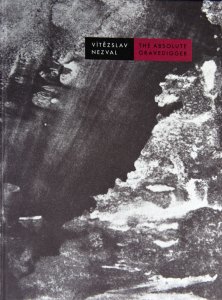
gravediggerThe Absolute Gravedigger by Vítěslav Nezval (Czech Republic), translated by Stephan Delbos & Tereza Novická)
I have found myself turning to poetry more and more as the world seems increasingly unstable and, well, surreal. This newly translated collection of poetry by one of the best known Czech Surrealists should be essential reading at this time. Originally published in 1937, the darkness he could see on the horizon are all too familiar once again.

The Country Road by Regina Ullmann (Swiss), translated by Kurt Beals
I read this collection of short stories when I was in a very low mood. But in the spare, sombre prose of these tales I found a beauty that, rather than deepening my depression, brought strange comfort. Admired, in her lifetime, by the likes of Rilke, Mann, and Musil, Ullmann’s work is mostly forgotten today. This volume, released in English translation in 2015, is a rare treasure—one that I encountered at just the right moment.

panorama-coverPanorama by Dušan Šarotar (Slovenia), translated by Rawley Grau
For me, as a reader and a writer, one of the most important books I read this year is this literary meditation on migration, language, landscape, and loss. This novel finally broke through my own stubborn determination to hold to a sharp delineation between fiction and nonfiction, and has made me re-evaluate potential approaches to themes I wish to examine. What Šarotar achieves here with his own unique take on what might be deemed a “Sebaldian” approach, is the creation of an atmospheric, captivating, and intelligent work.

The Passion According to G.H. by Clarice Lispector (Brazil), translated by Idra Novey
Oh wow! In a way, I am glad I didn’t read Lispector before writing and publishing my essay “Your Body Will Betray You,” because she is exploring the process of coming into being so beautifully that I might not have been able to write at all after reading this. Employing an unconventional narrative, Lispector’s G.H. experiences a vivid, metaphysical crisis triggered by the sight of a cockroach. The result is a remarkable, thoroughly engaging read. I have at least three more of her books waiting for the new year.

Proxies by Brian Blanchfield (US)
I bought a number of essay collections this year and currently have several on the go. This collection impressed me not only for the way the essays were composed—written without consulting outside sources—but for some of the ideas explored, and for reinforcing the value and possibilities of the personal essay/memoir form. I also greatly appreciated his guiding caveat: Permitting Shame, Error and Guilt, Myself the Single Source.

SergioSergio Y. by Alexandre Vidal Porto (Brazil), translated by Alex Ladd
This book is significant and important for dealing with gender identity and transition in a sensitive and original way. I am, as a transgender person, critical of much of what passes as literary writing on this subject. This is a most impressive work with a startling and unique approach. As I noted in my review, Sergio Y. is novel that approaches the transgender experience from the inside and the outside, allowing for the comfort with names and pronouns to vary, over time and from person to person, reflecting the complexities of relationships that others, even loving family members, can have when an accepted and assumed identity is challenged. That is the book’s greatest strength.

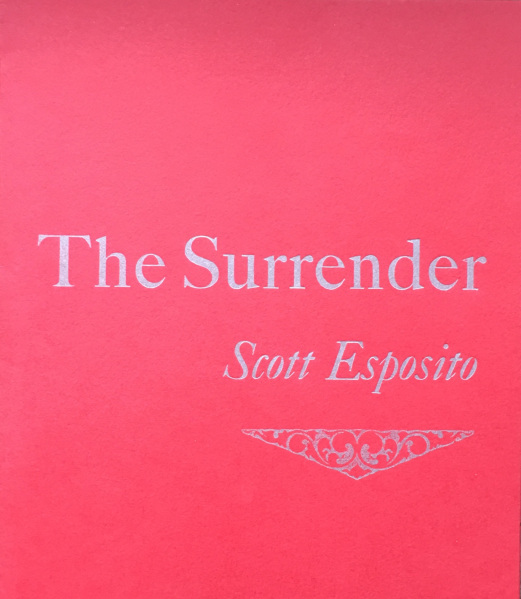
surrThe Surrender by Scott Esposito (US)
This book was on my radar from the moment I first heard of it. Again, despite my typical gender related skepticism, I was drawn to this transgender-themed memoir/film critique/literary diary. I wanted to know how Scott would present his story—one that is not commonly heard. Although his journey is very different than mine, we share a certain sensibility. This is a brave and most wonderful book by a man who has long been one of my heroes. He has since become one of the many literary friends I have come to know and cherish this year.

Layout 1

Atlas of an Anxious Man by Christoph Ransmayr (Austria), translated by Simon Pare
This book was a total surprise when it arrived courtesy of the good people at Seagull Books. This most unusual travelogue, a series of brief “encounters” across the globe, contains some of the most stunning descriptive language I have ever read. Each episode begins with the words “I saw…” and ends with a wise, evocative observation. From the North Pole, to South America, from deep inside the mountains of New Zealand, to a parking lot in San Diego, this is a journey that will not be easily forgotten. Highly recommended.

Quiet Creature on the Corner by João Gilberto Noll (Brazil), translated by Adam Morris
My third Brazilian book on this list is this enigmatic novella that led to one of the most entertaining literary discussions of the year. What is it about? Well that is the challenge. I had to read it three times before I could begin to get a handle on it. The narrator, a young man who finds himself in a strange situation that is rapidly growing stranger, is, in his oddly passive tone, almost more disturbing than whatever might be happening. Opaque and surreal, this book gets under your skin.

The Crocodiles by Youssef Rakha (Egypt), translated by Robin Moger
This novel still holds fast in my memory although I read it back in February. It is, as I described it in my review, a prose poem of simmering power, unwinding across 405 numbered paragraphs, tracing a torturous path from the first stirrings of poetic assurance within a trio of young men in the 1990s to the doomed protests of the Arab Spring. It is a dark, intense exploration of youthful political idealism, that builds on repeated images, themes and refrains to create a compelling narrative force as it moves toward its stunning conclusion. Again, this is another work that is increasingly relevant in today’s world.

On-the-edgeOn the Edge by Rafael Chirbes (Spain), translated by Margaret Jull Costa
Finally, the very first book I read in 2016 is probably my favourite book of the year. I wrote about this novel at length for Numéro Cinq and I regret that it has not generated more discussion. In what is essentially an extended monologue with brief cameos from other characters, Chirbes creates a memorable, engaging, and tragic character in seventy-year-old Esteban, a man who has lost absolutely everything in the economic collapse of 2008.  Thoroughly human in his wisdom, his resolve, his shortcomings, and his despair; this is a powerful and important book that deals frankly with many of the critical issues—including migration, xenophobia, and economic decline—that are more vital than ever as we step into 2017.

Round and round: 33 Revolutions by Canek Sánchez Guevara

The unnamed protagonist of 33 Revolutions, a stark, relentless portrait of life in Castros’ Cuba, is a divorced, black man—a misfit who chafes against the collective tedium of his existence until he is forced to decide, like so many before him, what, if anything, holds him to his wretched island nation. The revolutionary bloom is long off the Communist rose that once held his hopes and enthusiasm. With weary resignation, he shuffles off to his ministry job day after day, enjoying the few privileges afforded by the little bit of extra money sent to him from his mother overseas, but it is a hollow existence:

Duty and desire. Angrily, he bangs out his dilemma on the typewriter until the paper is perforated with periods and commas. His desire is to be alone in his office, in this city, in this country, and never to be disturbed. Monotony is expressed in a thousand ways and acquires various signs. Work, radio, new bulletins, meals, free time: I live in a scratched record, he thinks, and every day it gets a bit more scratched. Repetition puts you to sleep, and that sleepiness is also repeated; sometimes the needle jumps, a crackling is heard, the rhythm changes, then it sticks again. It always sticks again.

33Threaded through the thirty-three brief chapters of this slender novella, are two repeated refrains: the scratched record and the suffocating tropical heat. This imagery is employed so incessantly that it begins to wear a groove that could, in a longer or less deftly handled work, easily become irritating. Instead, the sheer beauty of the language lends the repetition a peculiar freshness. And that is exactly the intention. Tedium and repetition can be borne, can even seem bearable. Until one day it isn’t, and then all bets are off.

The author of 33 Revolutions, Canek Sánchez Guevara, inherited a proud and defiant spirit  from his grandfather, the famous Marxist revolutionary who fought alongside Fidel Castro. At the age of 22, he rejected the dictatorial politics of his homeland, and left for Mexico where he became a writer, graphic designer, and heavy metal guitarist. He was dedicated to writing and speaking out against Cuba’s single party system and its attendant human rights abuses until he died unexpectedly in 2015, at the age of 40. This hypnotically engaging novel allows his voice to continue on.

With a sense of absurdity that Kafka would appreciate, Sánchez Guevara creates, in his hero, a man who is aware that he stands at odds with the world around him. He finds refuge in books and an incongruous fondness for avant-garde music. He is aware that his life is paradoxical, verging on metaphysical weirdness that is both a blessing and a curse. And this painful self-knowledge does nothing to protect him from the monotony that curses his days or the vivid nightmares that haunt his sleep. He understands his reality all too well:

He looks down at the sea again and drinks straight from the bottle. Behind him, the dirty, beautiful, broken city; in front of him the abyss that suggests defeat…. We win by isolating ourselves, and in isolating ourselves we are defeated, he thinks. The wall is the sea, the screen that protects us and locks us in. There are no borders; those waters are a bulwark and a stockade, a trench and a moat, a barricade and a fence. We resist through isolation. We survive through repetition.

As this ceaseless repetition begins to weaken him, our protagonist’s disaffection grows. An undercurrent of protest starts to build within him, fueled by the oppressive heat and boredom. He had long managed to hold his distance, to stand apart from both the street corner reactionaries and the huddled gossips distorting what the rumours passed down to the masses—but this continual buffering against the insidious mechanisms of state control, starts to wear him down like, well, the needle on a scratched record.

The heat is criminal—it melts neurons, incites to violence, multiplies fertility tenfold. There isn’t a beer for miles around (or water, or a barley drink, or anything that can be bought with national currency). Nothing belongs to me, he thinks. And what about me, do I belong to anything? (The scratched record plays insistently.)

His rebellion starts passively, opting out and feigning sick, but in that act the course is turned.

He finds himself drawn to the shore. His experiences, not only of the city around him but the uncertain and desperate promise that waits beyond the waves, is mediated through the lens of his camera. The frame of the viewfinder becomes his means of contextualizing himself in the world and a focuses his hopes for a possible future elsewhere. Everyone seems to be leaving—his doctor, an old friend from school, groups of kids clinging to rafts of questionable seaworthiness. The camera with its ability to play with depth of field, becomes his tool in an attempt to tell an alternate story, take control of and document his own fate.

This brief novella hits hard. Harder perhaps in the light of Fidel Castro’s recent passing, and in the desperation of migrants risking the seas for a better life elsewhere. The anguish that comes through personal and powerful, and it is more important than ever that we stop for a moment to listen.

33 Revolutions, by Canek Sánchez Guevara is translated  by Howard Curtis and published by Europa Editions.

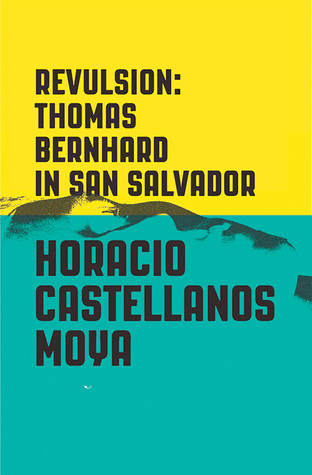
Homecoming – Revulsion: Thomas Bernhard in San Salvador by Horatio Castellanos Moya

In the note appended to the 2007 re-issue of Revulsion: Thomas Bernhard in San Salvador, author Horatio Costellanos Moya describes how a playful exercise in imitation led to very frightening death threats. Within a week of the book’s publication in 1997, his mother called to warn him against returning to El Salvador as he had planned. The immediate and hostile reaction indicates that not only was the element of satire missed, but the miserable misanthropic protagonist’s exaggerated rants were not entirely without grounds. But what angered some, impressed others, and the little book has endured, inspiring study, debate, and requests from citizens of other Central American countries for Castellanos Moya to similarly skewer their troubled nations. And now, at last, this incendiary novella is available in English from New Directions, in a no-holds-barred translation by Lee Klein.

RevulsionPresented with exuberant Bernhardian spirit, Revulsion is a relentless parody of the Austrian writer’s trademark style. The rhythms, repetition, and tone of Bernhard’s classic works are evoked along with a brutal, insistent ravaging of El Salvador and its capital city that is reminiscent, if not even more graphically emphatic, than the famous rants Bernhard routinely leveled against his own native country.

The eponymous narrator here, in a role common to many Bernhard novels, is on the receiving end of a breathless monologue recorded over the course of one single paragraph that stretches for more than 80 pages. The speaker is Edgardo Vega, a professor of art history who fled El Salvador for Montreal at the age of eighteen. Now, a further eighteen years later he has returned for the first time, to attend his mother’s funeral and ensure that her house is sold so that he can secure his claim on his share of her estate. To say there is no love lost between Vega and his native country would be an understatement.  His most prized possession is his Canadian passport, if he is proud of anything it is his successful escape from the pathetic aspirations of his middle class brother, the crime, the social decay, and the miserable dearth of anything resembling class or culture in San Salvador.

San Salvador is horrible, Moya, and the people who populate it are worse, they’re a putrid race, the war unhinged everyone, and if it was already dreadful before I took off, if it was unbearable for my first eighteen years, now it’s vomitous, Moya, a truly vomitous city where only truly sinister people can live, which is why I can’t explain why you’re here, how you can be around people who are so repulsive, around people whose greatest ambition in life is to be a sergeant; have you seen them walk, Moya?

No custom, institution or individual is left unscathed. Vega rails against his brother who owns a lock and key business, but shows no interest in books or art or anything beyond the most pedestrian popular music. He has less respect for his “ex-clothing store clerk” wife and his two “pernicious” boys who spend their time glued to the television set and have the audacity to call him Uncle Eddie. Even the old school friend with whom he is sharing a few hours at the local bar, a place he tolerates only in the quiet hours between 5:00 and 7:00 pm, is not entirely free from a measure of Vega’s contempt. The patient narrator’s literary ambitions are soundly ridiculed. In this way, Castellanos Moya is mocking himself, as he allows his ranting character to eviscerate his country.

The famished little stories about sex and violence aren’t worth it, I say this to you with affection, Moya, you’d be better off staying in journalism or another discipline; but at your age to be publishing these famished stories is a pity, said Vega, no matter how much sex and violence you put into them, there’s no way these famished little stories will transcend. Don’t waste your time, Moya, this isn’t a country of writers, it’s impossible for this country to produce writers of quality; it’s not possible for writers who are worth it to emerge in this country where no one is interested in literature, art, or any manifestation of the spirit.

As Vega’s account of the indignities to which he as thus far been subjected over the course of his return to his home town builds to a hilarious conclusion, one can feel the enthusiasm with which this exercise in imitation was created. Imagery is pushed to a vile extreme in places and, as much as humour slides through, the polemic unleashed against El Salvador is merciless. Castellanos Moya captures Bernhard’s tone and style with an almost pitch perfect delivery right down to the surprise ending. But with a protagonist who spits enough venomous spleen to make Bernhard’s most hyperbolic vitriol read like an afternoon at a Sunday school picnic, it is little wonder the satire was lost on some readers. All the same, for those who love the infectious wit and humour of the Austrian master, Revulsion: Thomas Bernhard in San Salvador is a wonderfully entertaining look at post-Communist El Salvador through a very dark lens.