Everyone’s a monster: Gnome by Robert Lunday

We’re accountable for our boundaries, and for an indeterminate space just beyond—though we share that space with others, also accountable. Society’s a jostling. (“Medusa’s Head”)

In high school I worked, for a while, as a cashier at a sporting goods shop. One evening, in the middle of a busy end-of-season sale, I looked up at the mother and son standing at my till, and saw, where the boy’s face should have been, what I remember as a gaping black hole. Horrified, I completed the transaction without lifting my eyes again. As soon as it was possible I feigned illness and went home. To this day, I have no idea what manner of abnormality might have distorted his visage. I’d always been exceptionally squeamish, with a limited tolerance for the grotesque and gruesome, so there was no question that I would have chanced a second look to, as I imagine was a common reaction, stare at this oddity, even re-evaluate my initial response. Unexpected encounters with damaged or deformed faces still tend to trigger in me an aftershock, a need to find a reassurance in the ordinary:

The only thing more warped than freakishness, however, is the revulsion it engenders in the rest of us. We’re all chance images: faces in crowds, doors, wood grain or fabric bunching, the duck-rabbit or left-old/right-young lady; what if you were nothing but an optical illusion, and not a very amusing one at that? There’s a time-gravity, a pull this way or the other, such that we see only through desire or regret. Everyone’s a monster, made from looming disaster less than the real flaws that spun us into moving objects, searchers for the missing piece: the shadow-line, the peculiar mark, the curving strangeness. A lost knowledge: but beauty, specifically the remembered beauty of the Medusa, lets one inside. (“Cloverleaf”)

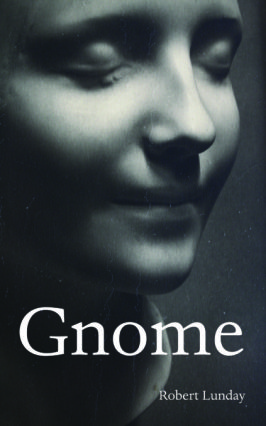
The face is the gateway, the focal point, and the fertile plain of Gnome by American poet Robert Lunday. But what, exactly is Gnome? Drawing on and incorporating literary, philosophical, and biological sources, it is a personal exploration—at once introspective and heuristic—of “face” in its multitude of meanings and implications. An existential physiognomy. Prose poetry pushing into meditative essay and back again.

The first, and to date only, book published by the inimitable Black Sun Lit, Gnome is a collection of intertextual ruminations that incorporate the words and ideas of writers and thinkers as diverse as Max Picard, Laurence Hutton, Elaine Scarry, Rilke, Yeats, Witold Gombrowicz, Kōbō Abe, and many more. Precise and considered, but never forced, the result is a series of reflections that wander from classical Greek history to psychology, from art theory to embryology. The prose shimmers with lyrical immediacy and aphoristic wisdom.

The magic of a work like this, fusing essay and poetry as it does, is the capacity to appeal to readers who might not expect to like either. But we all have faces, exist behind them, and interact with a sea of faces, real and perceived in the world around us. As such it is the ideal fundamentally human substratum through which to consider what it means to be human, to be alive in the world, and remembered in time.

The face is written by glancing phrases into a paragraph, an essay. The phrases are numerous, but much the same, after all. The face doesn’t have much to say except “I am,” “you are,” “it is” when reduced to a stare. And yet, as the world breathes around it, refracts it, ravages it, loves it, a face figures countless versions of itself into the life framed out of the mirror. I gather these figurations, save them, dissect them, arrange them in a grand monument to the fleeting visage they mark. Study the face from every angle, it becomes a cheering crowd, a thousand faces, all inklings of one face: it’s not me but my charioteer, steering one horse upwards, one down. (“The Corinthian Maid”)

Lunday’s project is essentially an open-ended phenomenological exercise, albeit with a strong Platonic edge. His task is to question—to test the instability of the lines we draw between memory and identity, internal and external reality, the embodied and the imagined. He draws on his own personal experience and observation, and builds on and around the thoughts of others, to offer reflections that we intuitively recognize ourselves.

“The atmosphere is of itself adapted to gather up instantaneously and to leave behind it every image and likeness of whatever body it sees.” (Leonardo da Vinci) The face is most often a retrospect: someone new reminds us of someone we knew before, a former friend, a type we’ve discovered in our various travels and meetings. Familiarity gradually unfolds, and the new and old faces form intersections of doubt and trust. (“Gyges’ Ring”)

Endlessly thought provoking, Gnome explores the myriad ways that “face” can be understood, but it is not prescriptive. It invites engagement. As I read it, I not only remembered that long-ago encounter with the “faceless boy;” I also thought about the way my own face—and more critically its role as mediator between myself and society—has changed over the past few decades. And I’m not referring to the inevitable effects of gravity and time. My once-feminine past is only vestigial now in the bald, bearded, unequivocally male face I see in the mirror. But which version is the mask? It depends on how you look at it.

Masks carry the bodies toward and away from one another. Spaces of association border one another; gaze and gawk interpenetrate, and meaning forms from our spontaneous, physical responsiveness to each other. The limit-experiences: insomnia, fatigue, erotic life, birth and death, wisdom.

In my face, my life as a theatre of one.

Silence, silence! A Skeleton Plays Violin: Book Three of Our Trakl — Georg Trakl

Listen carefully, what do you see?

Clouds expose their unyielding breasts,
And bedecked by leaves and berries
You see grinning in the dark pines
A skeleton play violin.

When Book One of Our Trakl emerged two years ago, attentive readers and lovers of beautiful books sensed the beginning of a very special project dedicated to the work of the Austrian poet who continues to intrigue and enthrall us more than one hundred years after his untimely death in 1914, at the age of twenty-seven. Translator James Reidel was introduced to Georg Trakl in the late 1970s, when he was himself beginning to write poetry. Early on he was made aware of the difficulty and importance of translating Trakl’s work. As the years went on, he would make his way back to Trakl through reading, and translating, Thomas Bernhard, Ingeborg Bachman and Franz Werfel. In the meantime, new Trakl translations had emerged and so, with this series published by Seagull Books, he has added his own contribution—his own approach to this ever elusive and enigmatic writer.

The first two volumes of Our Trakl represent complete collections of poems, as selected and prepared by the poet: Poems (Gedichte, 1913) and Sebastian Dreaming (Sebastian im Traum, published posthumously in 1915). The third and final part, A Skeleton Plays Violin, gathers Trakl’s early and late published works, unpublished pieces, and significant variants and derivations, in yet another beautifully designed edition. Through the poems and prose collected here, presented chronologically and woven together with a sensitive biographical essay, we can trace his development as a poet, and see potential indications of where he might have gone had he survived the war and his own demons. With Poems and Sebastian Dreaming close at hand, reading can become a truly immersive experience.

Immediately one notices a strong youthful, romantic quality to Trakl’s earliest creative efforts which include prose, plays, and poetry. Religious and classical Greek themes recur, as do sombre images of suffering and neglect. Born in 1887, he began writing and publishing in his late teens when he was working as an apprentice pharmacist in Salzburg—a job that afforded him access to the drugs he had been sampling seriously from the age of fourteen and that would continue to play a significant role in his life. The intensity that is said to have marked his personal demeanour comes through in his early work, granting it an eerie maturity.

A move to Vienna to continue his pharmaceutical studies in 1908, led to periods of depression and anxiety. While his reputation as a poet grew, he was unsatisfied and critical of his work. His unhappiness in the capital, worsened in part by the complications of having his beloved sister present for a time, is reflected in his published poetry from this period. It is possible to feeling the aching in his words, as in the first two stanza of “Twilight”:

You are dishevelled, wracked by every pain
And shake from every jarring melody,
You a broken harp—a wretched heart,
From which blossom misery’s sick flowers.

Who bid your adversary, your killer,
The one who stole the last spark of your soul,
The way he degodded this barren world
Into a whore foul, sick, pale with decay!

In 1910, Trakl’s sister to whom he had always been close—perhaps too close—left Vienna to return to Salzburg. Two months later, in June, his father died, an event which had a major impact on the entire family, economically and functionally. However, his corpse and ghost would provide inspiration for his son’s poetry which, at this time, began to shake loose a nostalgia for the past, and the influence of the Symbolists and German Romantics, to find its own distinct voice. Sexual tension is increasingly sublimated and Trakl’s lines become “ever more discrete, simple and painterly.” His imagery also shifts:

Liminal beings begin to populate the poems—angels, demons, dead gods, nymphs, fawns and statues of dead nobles, hunted animals, skeletons, corpses and the ever-shape-shifting presence of the poet and the figure of the sister. And this figure may be more of a composite than we know, for Trakl adored his older sisters too.

A persistent presence in Trakl’s life and poetry is his younger sister Grete. The rumoured incestuous nature—or at least longings— that bound the two is a subject of measured discussion in the biographical segments, Reidel preferring, ultimately, to leave the poetry to speak for itself, as it will.

Toward the end of 1910, with a need to support himself, Trakl joined the army. He was assigned to the Garrison Hospital in Vienna where his commanding officer would later describe him as hardworking and friendly. Mid-1911 saw him return to Salzburg where he worked as a civilian pharmacist until the spring of 1912 when he was promoted to Garrison Hospital 10 in Innsbruck. Initially unimpressed with his new location in spite of its glorious forested and mountainous setting, he soon became involved with a new literary circle, and made connections that would prove critical to his career and lead to the publication of his first book. Thus he made peace with the surrounding landscape which also begins to make its way into his poetry. However, as his poetic soul flourishes, his work life suffers. Ultimately, unable to hold a job, he surrenders himself to writing, and the increasingly reckless life of a poet.

The extensive central sections of A Skeleton Plays Violin, which feature unpublished poems and versions of published pieces, offer a window into the refining of Trakl’s imagination and craft. We see him spinning, again and again, the phrases, imagery, and themes he wishes to perfect—the crimson mouth, the screaming faun, the turn of the season, the quality of light—and watch the tightening of his language as the final version is formed. Reidel’s selection covers a wide terrain, yet is careful to bring together those variants and completed works that highlight Trakl’s growth and maturity over time. It is impossible though, not to notice that his work only seems to grow darker.

For Trakl, periods of depression and panic attacks marked the second half of 1913. He continued to consume alcohol and drugs, cocaine and morphine, at a remarkable rate. He saw himself as a doomed soul, even as his star was steadily rising in German poetry. He held to his writing to see him through that winter. He continued to attract impressive admirers, including Ludwig Wittgenstein, and plans were made for a second volume of poetry. However, with the assassination of Archduke Ferdinand in June of 1914, Trakl’s world was upended. With the advent of what would become the First World War, he was assigned as a medic to a frontline infantry unit heading east. The conditions soon took a toll on his mental and emotional health. He was hospitalized in Krakow following a suicide threat, and was found, in his room, on November 3, dead from an apparent cocaine overdose.

His later published poems show that a deep melancholy had long settled into his work. “Evening Reel,” for instance, published in October of 1913 opens with playful natural imagery, albeit a little grim:

Fields of asters brown and blue,
Children play there by the grave vaults,
In the open skies of evening,
Blown into the clear skies,
Seagulls hover silver-grey.
Horns call in the flood meadow.

To end, even gloomier, three stanzas later:

The candles’ glow weaves dreamlike,
Paints this youthful flesh decaying,
Cling-clang! Hear in the fog,
Ring in time with the violins,
And bones dance along naked,
Long does the moon peer inside.

Trakl’s final published poems are stormy and dramatic. The wistful beauty is gone; the imagery is now steeped with darkness—war is at hand. “The Despair” captures the scene:

Then the black horses leap
On a pasture in fog.
You soldiers!
From the hill where the sun wheels dying
The laughing blood rushes
Amid oaks
Speechless! O the grumbling despair
Of the army, a steel helmet
Dropped clattering from a crimson brow.

Until the end, Trakl held fast to poetry. It has been suggested that the news that the publication of Sebastian Dreaming would have to be put off until the war ended played a pivotal role in his final desperation. We will never know exactly what finally tipped the scales for a man whose scales tipped so heavily to dark side so often in his short life. Nonetheless, his last creative efforts form a rousing crescendo to the third and closing volume of this ambitious poetic project.

Wisely and appropriately, the final words are perhaps best left to Trakl himself, from “Revelation and Perdition,” the grim, haunting prose piece which closes out this powerful testament to a troubled poet, lost too soon:

When I walked into the garden in twilight, and the black figure of evil had yielded to me, the hyacinthine stillness of the night surrounded me; and I sailed in a crescent-shaped boat across the stagnant pond and a sweet peace touched me on the brow turned to stone; and when I died in witness, fear and that pain deepest inside me died; and the blue shadow of the boy rose lightning the darkness, a soft singing; on lunar wings, above the greening treetops, crystal cliffs, rose the white face of the sister.

A Skeleton Plays Violin: The Early, Unpublished and Last Works of Georg Trakl is translated by James Reidel and published by Seagull Books.

Thirty-seven journeys from French to English: I Never Talk About It by Véronique Côté and Steve Gagnon

We all have our secrets; the habits, hopes, histories, and horrors that we keep to ourselves. We all hold something inside that we never talk about. It may be painful; it might be embarrassing. It can be major, it can be insignificant, but either way we all have a truth to guard.

This is the concept behind an inventive collaboration between Véronique Côté and Steve Gagnon, two Quebecois writers, actors and directors who created thirty-seven short confessional monologues to be performed live, and then gathered into a book titled Chaque automne j’ai envie de mourir. However, a unique and daring thing happened as this collection made its way from French into English. Thirty-seven different translators were invited along for the ride. The result, I Never Talk About It, is the latest release from QC Fiction, and further evidence of this ambitious young publisher’s determination to offer Canadian and international audiences original, exciting new work from Quebec.

The prose pieces that comprise this book demonstrate a wide range in structure and voice from unsophisticated and straightforward, to quirky stream of consciousness, to stylized and experimental. This variety creates the perfect environment in which to explore the considerations and decisions a translator faces in guiding a text from one language to another.

The translators invited into this intriguing exercise come from around the world and include seasoned professionals alongside first-timers without any specialized training or experience. Some are Francophones more accustomed to moving from English to French, while others have little or no familiarity with Quebecois usage and culture. There are teachers, students, and authors.  Each story is followed by a brief biography of the translator along with his or her comments about the challenges they faced and the approach they employed. Because, as editor and translator Peter McCambridge indicates in his introduction:

…there’s always an approach, always a slant, always a distortion or deviation from the original, however slight or well-intentioned. Often it makes for a smoother reading experience in English. But it’s nice to know it’s there, all the same…. Because there are few wrong answers. Because any translation is a question and then an answer.

And yes, there may be few wrong answers, but as a reader with a special fondness for translated and international literature, there are certainly approaches that, in the reading, seem to work better than others. However, unless we hear about the choices that are made we cannot know what we might be missing, or why some books leave us wondering: Is it the original or the translation that seems off?

 The greatest reward offered by a book like I Never Talk About It is a space to explore one’s own reaction to concise pieces, first on their own and then in the light of the translator’s reflections.

Because the original works are essentially performative, with variations in tone and flow, many translators mention the challenge of maintaining the energy of the French text. Often the chosen approach involves an intensive engagement with the text. Pablo Strauss describes translating as:

…a slow, unscientific process of writing and rewriting until you can’t look at the piece any more. Experience has taught me that translation has no rules; the translations I love are at once loose and careful.

Later on, Lori Saint-Martin admits that:

I read the piece about 786 times, a couple of times out loud, mentally thinking of avenues without writing anything down; then I did a really fast, intuitive draft as if writing it creatively myself…put it aside, and rewrote it three more times, pulling it closer to the original sometimes, sometimes a bit further away to boomerang it back closer.

It’s probably a coincidence but the stories they translated, “Nightmares” and “Constellation” were among my favourites.

One of my pet peeves when it comes to translated or even international literature originally written in English, is that decisions are sometimes made to make the work more palatable to an American or British audience. In this collection two translators chose to relocate the specifics and tone of their pieces—one to the US, the other to the UK—removing the Quebec (which were also essentially Canadian) references. To my ear, the results were out of place and disappointing. As a frequent reader of South African literature I have seen this tendency too, whether English originals or translations from Afrikaans, all the bakkies are turned into pick-up trucks and so on. For me it amounts to unfortunate accommodation and contributes to the homogenization of international literature lest any local flavour be off-putting.

In the end, I Never Talk About It is more than an enlightening glimpse into the myriad of ways that texts can be approached by a translator; it is an entertaining, and often deeply moving, look into the private anxieties, obsessions, confessions, and passions of a diverse cast of characters.

To be an outsider who is at home everywhere: The Oblivion Seekers by Isabelle Eberhardt

Long and white, the road twists like a snake toward the far-off places, toward the bright edges of the earth. It burns in the sunlight, a dusty stripe between the wheat’s dull gold on one side, and the shimmering red hills and grey-green scrub on the other. In the distance, prosperous farms, ruined mud walls, a few huts. Everything seems asleep, stricken by the heat of the day. A chanting comes up from the plain, a sound as long as the unsheltered road, or as poverty without the hope of change tomorrow, or as weeping that goes unheard. The Kabyl farmers are singing as they work. The pale wheat, the brown barley, lie piled on the earth’s flanks, and the earth herself lies back, exhausted by her labor pains. (“Outside”)

For Isabelle Eberhardt, the open road was the ultimate image of freedom—a symbol of liberty that called to her again and again. As such, she had a special affinity for vagrants or wayfarers. They feature regularly in her collection of short stories and vignettes, The Oblivion Seekers. To be confined—by physical walls, by obligations, or by the restraints of fin de siècle European society—is unbearable. Her characters give up comfort, security, even love, to find a place where they belong. Quite often it is a life of solitary independence they choose. Singular in her defiance, her passion, and her determination to set her own course, it is impossible to appreciate her writing without at least a cursory look at the remarkable life from which it emerged.

Born in Geneva in 1877, the illegitimate daughter of a Russian Nihilist, Eberhardt was an unconventional free spirit who lived a charmed, if short, life filled with drama and adventure. Her father set the groundwork, insisting she labour alongside her brothers when she was young, learn to handle a horse properly, and appear regularly in public dressed in men’s clothing. He was inadvertently preparing her for the rigors of life in the deserts of North Africa, while his demanding expectations likely fueled her longing to escape. By the time she was twenty, she had already made her first trip to Algeria and converted to Islam.

Apart from a few short trips back to Europe, Africa had claimed her soul. Yet for the French colonists, her lifestyle was nothing short of scandalous. Her preference for men’s clothing—and Arab styled at that—was looked on with suspicion. She adopted a male persona, although she rarely fooled anyone with respect to her gender, and could often be found in the café, smoking hashish, perhaps inviting a soldier home for the night. The colonial officials suspected she was a spy. Meanwhile, she bought a horse and headed off to explore the desert. On her travels she befriended other Muslims in the area including a young Algerian soldier named Sliman Ehnni, who would become her one great love.

Under her male name she joined the Qadriya, a secretive Sufi brotherhood that exercised considerable power over unconquered desert tribes. She subsequently became more openly political, writing articles and stories celebrating North African Arab culture and protesting the French colonial administration. This attracted further unwanted attention, now from rival religious cults as well as the government. In 1901, only a stroke of dumb luck saved her from a would-be assassin when her attacker’s sword bounced off a wire, missing her head but nearly removing her arm. Once she recovered, Eberhardt was ordered out of French North Africa, so she was forced to head to Marseilles. With luck, Sliman was able to join her and the two were married. In 1902, the couple returned to Algeria. They were destitute, but they experienced a few months of peaceful happiness there. It would not last, more challenges, risk and adventure awaited. However, by 1904, hard living, recurring illness, and probable syphilis began to take its toll. After a near fatal bout of malaria, she left the hospital against doctor’s orders to meet up with her husband. They enjoyed one last night together before a flash flood collapsed the mud hut they were staying in. Isabelle did not survive. She was twenty-seven years old.

At heart, writing was the only career Eberhardt had ever truly desired. Sadly, much of her work was destroyed in the flood that claimed her life, but several posthumous collections of her stories were published. And her incredible, unconventional life inspired a biography by Welsh author and explorer, Cecily Mackworth, which drew the attention of Paul Bowles, an ideal translator for the adventurous young writer if there ever was one. The Oblivion Seekers gathers eleven short prose pieces, a brief travel diary, and a defiant letter to the editor in which Eberhardt defends her life among the Arab population. The stories read like parables, feature primarily Muslim characters, and sensual, vivid descriptions of the North African landscape. Yet there is very little sentimentality here; the tone is measured and controlled.

Her characters are typically independent spirits, either restless or unwilling to be bound to the life that is expected of them. “Taalith” tells the tale of a young widow who chooses death over forced marriage to an older man, while “The Rival” paints the portrait of a vagrant who abandons the wandering life to settle with his beloved only to discover that his bliss cannot withstand the pull of the road; his desire for his other mistress, “tyrannical and drunk with sun” draws him back. Under the fragrant flowers of the Judas tree in his garden he looks at his sleeping lover:

Already she was no more than a vaporous vision, something without consistence that would soon be absorbed by the clear moonlight.

Her image was indistinct, very far away, scarcely visible. Then the vagrant, who still loved her, understood that at dawn he would be leaving, and his heart grew heavy.

He took one of the big flowers of the spicy camphor tree and pressed it to his lips to stifle a sob. (The Rival)

Considering the time and her background, Eberhardt’s stories are particularly striking. They reflect her deep connection to Arab populations of North Africa and mark her early contribution to a decolonial narrative. She is not a voyeur, her affections are honest, not romanticized. This is especially powerful in the title story, “The Oblivion Seekers,” one of the few first person narratives, which describes a setting she knew well personally—a kif den in Kenadsa in the Sahara Desert. She describes the patrons, the wanderers and the regular kif-smokers and the course of a typical evening:

The seekers of oblivion sing and clap their hands lazily; their dream-voices ring out late into the night, in the dim light of the mica-paned lantern. Then little by little the voices fall, grow muffled, the words are slower. Finally the smokers are quiet, and merely stare at the flowers in ecstasy. They are epicureans, voluptuaries; perhaps they are sages. Even in the darkest purlieu of Morocco’s underworld such men can reach the magic horizon where they are free to build their dream-palaces of delight. (The Oblivion Seekers)

There is a mesmerizing quality to Eberhardt’s prose. Her life was marked hardship and poverty, mixed with turns of good fortune and great passion, but through it all she retained a self-contained humility and it is this quality that comes through in her prose. As Bowles notes in his Preface: “Her wisdom lay in knowing that what she sought was unreachable. ‘We are, all of us, poor wretches, and those who prefer not to understand this are even worse off than the rest of us.’”

Wise words still.

The Oblivion Seekers by Isabell Eberhardt is translated by Paul Bowles, and published by City Lights Books. An edition is also available from Peter Owen.

Our uncertain stories: Immortal for Quite Some Time by Scott Abbott

There is a fortuitous intersection between my first, and to date, only attempt to capture a memoirish reflection on the page, and Scott Abbott’s memoirish reflection, Immortal for Quite Some Time. My Minor Literature[s] essay was published a year ago this past May, just as Scott was proofing his book. I followed that process via his blog, The Goalie’s Anxiety. We shared concerns about opening oneself to strangers. When my small piece went live, his reaction was so immediate and gut-level, that I returned to his positive words repeatedly in the weeks that followed. Now, my reading and my attempt to record my reaction to his finished book comes at a time when I am seriously beginning to build on the project that started with my initial essay and flesh out a life twice lived—my own. And although, on the surface, the circumstances driving our explorations would seem very different, both involve fundamental, human questions of identity, belief, and family. As a result, my reading of this work is decidedly idiosyncratic.

Immortal for Quite Some Time is, as Abbott states in his epilogue, a “fraternal meditation,” an attempt to answer a question posed by his brother John, who died of AIDS in 1991, at the age of forty. Estranged from his devout LDS family for several years prior to his death, John’s question is simple: “Are we friends, my brother?” Scott’s reply, complicated by his loss of faith, conflicts with the rigidity of the Mormon church, a loveless marriage, the demands of parenthood, and a deeply ingrained homophobia, is ultimately more than two decades in the articulation. Presented in the form of diary excerpts, highlighted with images, outtakes from John’s notebooks, and the input of a critical counter narrative voice, Abbott struggles to reach a place of comfort with the answer he so dearly wants to offer. Thus, we are warned, from outset, that this is not a memoir: “The story is uncertain, the characters are in flux, the voices are plural, the photographs as troubled as the prose.”

It is this disclaimer that promises an honesty that respects all the shadowed corners one encounters looking into a life lived—whether that is someone else’s life or one’s own.

Immortal opens in the morgue in Boise, Idaho. The image of John’s body on the examination table forms a stark pivot point that his brother’s thoughts return to again and again: “His feet are livid.” From there, the narrative swings back to Farmington, New Mexico, 1950, midpoint between the births of Scott and John, only fourteen months apart, and moves, with broad strides, through the 50s, 60s and into the 1970s. Scott’s missionary obligations and academic aspirations take him to Germany, where an intellectual infection will begin to work its way into the assumptions and presumptions of his strict Mormon upbringing. John will go to Italy and, for years, his family will speculate if that is where he was “corrupted,” or whether he was “lured” into homosexual behavior at some earlier point. One of Scott’s first steps to reconciliation and acceptance of John’s orientation will involve coming to understand that sexuality has a biological basis. Not that that understanding provides a desired comfort with his own, decidedly heterosexual, attractions for many years.

Scott’s belief in God slips away from him much more readily than his homophobia. However, he continues to uphold the expectations imposed on him by his background. He marries young and before long is supporting a brood of seven with a teaching position at Bringham Young University. John, despite strong grades and an interest in pre-med studies, ends up working as a cook in a series of cafés. His contact with his family is limited and strained. His notebooks reveal little about his personal life. Abbott is clearly troubled by his brother’s isolation and sadness. It was not easy to be gay in the 1970s and 80s, but coming from an uncompromising religious tradition made it much more difficult. It still is today.

Throughout this work, John is a memory, a ghost, as much as a loved and lost brother and son. As readers, we only hear his voice filtered through time. See him peering from old photographs. In that sense, Immortal for Quite Some Time, reads like a fraternal love letter, an apology, and a reckoning. Scott Abbott is wise enough to know that the only story he can really tell is his own. And it is a fascinating, raw, and honest exploration of the intellectual, emotional, and political conflicts that have made him the man he is today. As his story progresses, a critical voice intervenes to challenge his recorded recollections, forcing him to answer and clarify his statements. Toward the end John is also granted a greater presence. (The use of italics, bold type and font facilitates these imagined exchanges in a manner that is simple and effective.) This is more than stylistic device. It is a reminder that we can never and should never stop questioning ourselves even in telling our own stories. It is a good lesson for me to keep in mind too.

As I made my way through this book, I encountered many questions I need to ask myself in piecing together my story. I do not come from a rigid religious background, but in my case I am the outcast, the one set apart by sexuality and gender. I sought to conform to a different, but equally confining set of rules and expectations. I mourn the loss of a sibling, a stillborn sister I never had, and the imagined image of her that I could not be.

The person I have to answer is myself, finding the courage to ask the question is my goal. That will require a memoir of some kind. Just as, in spite of himself, Scott Abbott ended up with a memoir of sorts to answer his brother.

Immortal for Quite Some Time is published by The University of Utah Press.

To be someone: The Faster I Walk, The Smaller I Am by Kjersti A. Skomsvold

It may seem counterintuitive given the immediate obsession with death and a life unlived, but this quirky little book, opens with promise. Mathea Martinsen, the self-deprecating narrator, is an odd character, an elderly woman as afraid of living as she is of dying.  What concerns her most is that she will pass unnoticed, that her existence will not be registered. With an irrational fear of other people, and a preference to stay home watching TV and knitting an inexhaustible supply of ear warmers, she has reached the far side of life and is given to morose reflections on the fact that she has failed to make an impression on the world. Each morning she reads the obituaries, relieved not to find herself listed there. And yet, she reasons, an obituary would be proof that she had been someone, if only a presence noted in passing. She considers writing her own obituary and sending it in to the paper so that it will be on hand when the time comes, assuming that is, that someone notices that she is missing (or registers a smell coming from her apartment).

Cheery? Well, having just witnessed an increase in nuclear posturing between the US and North Korea, riots on the streets of Charlottesville, Virginia, mud slides in Sierra Leone, and carnage on the streets of Barcelona, one could argue that The Faster I Walk, The Smaller I Am by Norwegian writer Kjersti A. Skomsvold is the perfect, light refreshing read—intimations of death notwithstanding. And it is an enjoyable diversion, but strangely unconvincing if one is looking for a meaningful meditation on what it means to be alive.

Serious times welcome distractions. However, is that enough?

Mathea and her husband live in a cooperative where they stick to themselves as they have for decades. High school sweethearts, were brought together after Mathea, a natural loner given to lurking on the edge of the schoolyard, attracted not one, but two bolts of lightning, one after the other. This exceptionally unlikely occurrence caught the attention of a similarly unpopular classmate with a penchant for statistics:

“The chances of being struck by lightning twice in the same spot are less than ε, if ε equals a microscopically small quantity” was the first thing Epsilon said to me. “It’s completely unbelievable.” He didn’t know how truly unbelievable it was, because nothing had ever singled me out. The spun bottle never pointed at me, the neighborhood kids never found me when we played hide-and-seek, and I never found the almond in the pudding at Christmas, one or the other of my parents always found it, which was almost a bit suspicious.

Epsilon works as a statistician, continuing well beyond retirement years, and measures life in statistically accurate probabilities. He is as eccentric as his wife, but at least he gets out of the house and, one suspects, has some semblance of a social existence. His career gives his life meaning—calculable and quantifiable—while his wife, with mortality facing her, has not even begun to figure out how to live.

She walks to the store, sometimes giving the time of day, literally, to a strange man she sees on her way, and buys countless jars of jam, hoping she will chance upon one she can actually open. She buries a time capsule and calls information repeatedly to request her own number, just to register the sense that she is a popular person. She likes to rhyme her thoughts, a strange game that affords for rather clichéd statements which one hopes may be in part an effect of translation. Nonetheless, Mathea comes across as a rather shallow, even irritating character—one can sense Epsilon’s stoic resolve and patience pushed at times to its limits—and she almost appears to recognize her own obstinacy. Yet she is powerless to fight it except in the most strangely counter-productive ways. What is humorous at the outset of this novella, quickly grows strained.

In the end, The Faster I Walk the Smaller I Am is somewhat like the meringues our narrator prides herself on making. Not enough substance to work as an allegory. Not dark enough to turn Mathea and Epsilon’s strangely isolated existence into a mildly gothic tale. A charming read on a week that, in world news, was in sore need of some charm, but, in the end, likely too lightweight to linger.

The Faster I Walk, The Smaller I Am is translated by Kerri A. Pierce and published by Dalkey Archive.

The loose ends of memories: Before by Carmen Boullosa

The opening passage of Mexican writer Carmen Boullousa’s novel Before—the first she wrote, albeit the second to be published—is, at first blush, disorienting.

Where were we when we got to this point? Didn’t they tell you? Who could tell you if you had nobody to ask? And do you yourself remember? Particularly if you’re not here… And if I keep on? Well if I keep on perhaps you’ll show up.

A most unlikely welcome. But then our winsome young narrator is not here either. She greets us from a point beyond bodied existence, beyond a life cut short with the advent of puberty. She is lost in a realm of troubled memories, and in an attempt to find herself, to talk herself back into being, she invents a listener, one who is likewise no longer alive, to whom she can recount her recollections and, she hopes, confront the trauma that has continued to haunt her. “How would I like you to be?” she asks her conjured audience, “I’d like you to be whatever you were!”

As she revisits her past, attempting to start at the very beginning, with her own birth, memories and emotions pour forth in a jumble of childhood anecdotes crossed with her reflections about the limitations of language and the perplexity of familial relationships. Her estranged connection with her own past is palpable. She describes playing games with her older sisters, her fondness for her father, and the sense of security she feels with her grandmother. She paints vivid images of life at her Catholic girl’s school. But she speaks of her mother, whom she insists on referring to as Esther, with an odd, pained distance. And she is hypersensitive to noises, creating a “lexicon” of her own. She finds comfort in the ones that can be explained by the light of day, but fears the insistent sound of footsteps that haunt her in her dreams, that wake her in a state of panic. The steps threatens to envelop her in darkness. She seeks refuge in both practical and enchanted solutions. She feels she just barely escapes their pursuit:

I didn’t know what I could do against this persecution. When I was younger, I stayed in bed or ran to my parents’ bed to let them protect me, but Dad never let me sleep in their room, thinking my nighttime terror was “clowning,” which was the word he used to describe it. Some nights I managed to trick them and stay asleep on a rug at the foot of their bed, thinking their closeness would defend me, but when I was older, let’s say around the age of nine, I stopped having recourse to the rug; if I didn’t stay in bed waiting for the noises to hit me, I walked through the house trying to elude them.

Her memories are not orderly, they vie for her attention, and often require the insertion of backstories to give them context. This allows for an odd logic, a somewhat disjointed storytelling. Some memories bring her unexpected joy, make her feel “alive again,” while others rekindle fears and mock her loneliness, her “opacity” and “sadness.” As a ghost, her connection with her life is complicated, suspended on the cusp of womanhood. The stories she shares often take on magical overtones in the retelling. Some of this reflects the enthusiasm and imagination of childhood fantasy, but as she gets older, an ominous superstition grows. As the narrative progresses, our heroine is winding her way toward an event almost too unbearably painful to return to. As readers we know that her death awaits, but there is another heartbreaking loss that precedes it.

Underlying this fragmented account of a privileged childhood in Mexico City, is the sense that adults and children exist in separate spheres. A rotation of caregivers passes through their lives and the eldest sister takes on some of the surrogate parenting roles, while the mother and father pursue careers and social engagements. When her sisters become young women, seeming to enter overnight a world of brassieres, stockings, and nail polish, the narrator promises that she will not follow suit. She does not realize, she admits when she confesses this, that she has sealed her fate with this wish.

There is an uncanny urgency and intensity to this ghostly coming-of-age story. Boullosa’s own Catholic upbringing in the 1950s and 60s, and the early death of her mother when she was fifteen are echoed here, suggesting that it may have been as imperative for her to tell this tale as it is for her protagonist to share hers. And what better way to create a distance, a place of relative safety, than to root a narrative in the afterlife? Not that any of her narrator’s animated energy or distracted childhood logic is lost in the process. Rather, we are presented with a unique blend of curiosity and innocence, tinged with wisdom and sorrow.

A most unusual and affecting tale.

Originally released in Spanish in 1989, Before is translated by Peter Bush, with an introduction by Phillip Lopate, and published by Deep Vellum.

Long nights have no stories: Plats by John Trefry

Few books keep me awake at night. Few books invade my dreams. Plats did both.

But then, few books are like Plats.

First, things first. The author, John Trefry, is a friend of mine. We’ve gone head to head reviewing the same titles for different venues, we’ve talked about writing, and I’ve floated a project I have in mind inspired, in part, by his first book, Thy Decay Thou Seest By Thy Desire, by him for his feedback and guidance. We have never met, but at his suggestion, I read Michel Butor’s Mobile earlier this year. However, we have never discussed Plats at any length.

We’ll talk about it as soon as I publish this piece.

Butor’s influence can be found in the pages of this novel, but where Mobile is borne of a road trip across America in the late 1950s—open spaces, small towns, Howard Johnsons—Plats is dreamy claustrophobia. The darkness, the light, the textures—skies, water, sand, carpet, paint, asphalt—suffocate, soak, dissolve, and distort streets, hallways, furniture, bodies. Time is measured in a series of anchorless reference points that heighten the sense that everything is happening at once in a continuous existential flux and flow.

Think Mobile filtered through the late Beckett of Company and Ill Seen Ill Said, pulled into 21st century and re-invented in Trefry’s architect’s imagination.

Plats is a novel of sanitized urban decay, it exists in a space that blurs the experiential lines between deserts, ocean, streets, apartment towers, and generic office environments. It inhabits the modern American city, the tidal city, the anonymous city. Plats is a novel of Los Angeles.

The glass is very cold and damp. The hollow beyond is sealed, excised, solitary. Its refusal is total, it refuses the city, warm sun. It refuses you because it is not there. Rooms do not reappear. They are there to be filled with emptiness and reflections. These are empty cells where you put the apartments, the dust of age and sleep. They have yet to be forgotten.

Plats is non-narrative, language driven, and constrained. The rhythm and structure is precise—each page contains exactly three paragraphs of eleven lines each. The imagery and energy of the paragraphs fluctuates, holding to patterns that gradually shift throughout the course of the 156 pages. The characters, the women that populate this novel—“I,” “she”, and “you”—have a disassociated relationship with one another. They embody a femaleness in dress, hair, stockings, shoes, but are remarkably sexless. And it is never really clear whether they are three distinct entities or aspects of one fractured whole. They interact abstractly, repel, reflect and absorb one another. Their bodies are loosely inhabited, articulated, disjointed, atomized as is the city that encases and envelopes them.

A word spreads across you, a characterization or clue settles into the gentle stupor of your creation. The years that have led up to your limp entrance and disassociated gaze were filled with unspoken projections I have forgotten. I casually entered into awkward silences with you in my mind and then interrupted them with cascades of trinkets washing through my apartment. You were the sand and the water, you were lost, now you have me, you have what is mine, you need it, I no longer do. There is no story in the words. They are characters that erase themselves by happening and being recognized. When they become real, shared between us, a little bit of me is let loose, a view, a movement, a lost hope, it could be in you, settling on your skin, it could be lost in the room, amongst the detritus.

In this kind of literary environment, the reader sets the terms of engagement. One can drift across the text, engage and disengage, listen to the language, watch the flickering scenes pass. If there is meaning to be discerned, it will be dependent on the experiential context that an individual brings to the reading.

Not the other way around.

Plats is essentially an extended prose poem. The language is eerie, strange, intoxicating. From time to time I would stop and read a few pages aloud, just to hear the words unfold. I would notice images repeating: rinds, splayed limbs, chair legs, floral prints, shoulder blades, and my favourite: pleats.

Plats places pleats in places you never pictured pleated beyond curtains and skirts smoothed against the thigh: “pleats of moonlight,” “pleats of a dreamt dawn in waves,” “pleats of indoor night.”

If there is an intention in this book, apart from the conceits that govern its design, it can be met as an attempt to invite the reader/observer into an experience that emulates the disordered, depersonalization, and de-realization associated with schizophrenia. Read that way, it is granted a defined frightening, disorienting beauty. I would suggest that as one possible, but not prescribed, approach. It can be understood as a kind of contemporary metaphysics, a meditation on the quotidian tedium of urban existence—disembodiment as a coping mechanism—where the expanses of desert and ocean are reduced to an idea that drifts through the porous cocoon of concrete towers. The hallways breathe, alleys pulse and the city and its inhabitants are locked in a symbiotic relationship.

Or it can be encountered as something else altogether. That is the true magic of Plats. My own experience was decidedly idiosyncratic, running on several levels at once.

But I’ll talk to John about that.

Plats is published by Inside the Castle


“It has been wonderful to know you”: My Tender Matador by Pedro Lemebel

September, 1986—spring in Santiago and rumours that the Dictator’s days are numbered are stirring the spirits of the determined, young idealistic members of the resistance. It has been another year of blackouts, street violence and police brutality. The setting is a lower-class neighbourhood where years of unemployment have taken a toll, buildings stand in disrepair, and a certain aging princess has found a castle to call her own:

. . . the scrawny house on the corner, three stories high with a staircase like a backbone leading to the room on the rooftop. From there could be seen the city in the shadows crowned with a turbid veil of dust. It was no bigger than a dovecote with three walls and a railing that was just wide enough for the Queen of the Corner—her hands moving as if playing on a marimba—to hang the sheets, tablecloths, and underpants out to dry.

Her dilapidated dwelling is decorated in style. Boxes festooned with fabrics, ribbons and dramatic imagination stand in for the finest furniture. Our heroine, a balding, drag-queen in her forties bearing the ravages of a rough life, is at last settled. As she embroiders linens for wealthy clients, and sings along with her favourite golden oldies on the radio, she dreams of Carlos, the handsome young student she met at the local store. He had approached her to ask if he could store some boxes of books in her home. She was not the silly old fool she allowed him to think she was, but—those eyes, that virile voice—how could she say “no”? Hopelessly smitten, she swoons like a schoolgirl, and soon more boxes arrive. Before long she agrees to allow a small army of students slip up the stairway to “study” in her rooftop room.

After all, what could possibly go wrong?

Thus begins My Tender Matador by late Chilean writer, Pedro Lemebel (1952-2015). With a queerly delightful energy, this is a love story that moves quickly and takes no prisoners. The Queen offers an unlikely refuge and serves as a convenient decoy for Carlos and his fellow Marxists. Caught up in a flutter of fluctuating emotions, especially when a string of days without a word from Carlos send her swinging between anger and anxiety, she berates herself for her infatuation. Her trannie sisters tease her wildly, but express their concerns, while Carlos himself is caught off guard by his own conflicted emotions. Something in the uninhibited joy and performative enthusiasms the Queen reveals moves him like no woman ever has. As her sensitivity to the political realities of the present are heightened, he is sent into revisiting a boyhood sexual initiation.

And yet, can anything come of this flirtatious friendship?

Running as counterpoint to the Queen’s story, is a second narrative stream featuring General Pinochet presented as a hen-pecked, weary, and paranoid old man. His wife’s constant nattering runs him down:

Oh, it’s just not fair; look at all these wrinkles I’m getting on my forehead, Augusto. Look, I have almost as many as you do, and I’m much younger than you are. It must be these difficult times we are living in, all the frights and frustrations I experience at your side. No other woman would have tolerated her husband being treated by the international press as a tyrant, a dictator, a murderer. And even though it is all lies, even though all Chileans know you saved our nation, don’t tell me it hasn’t been embarrassing. Yes, as I said, it’s a nightmare to think that all those penniless Communists who consider themselves writers blow their noses at you.

His only retreat is to sink back into dreams, seeking the comfort of his childhood toys. But even his dreams betray him, shifting into nightmares. What emerges is a portrait of a vain, paranoid, brittle, and homophobic man slowly losing his hold on power.

My Tender Matador is at once highly entertaining and politically astute satire. Lemebel weaves narrative with unmarked dialogue into seamless paragraphs that facilitate playful banter, emotional discharge, and the escalation of tension:

As she rushed down the stairs trying to straighten out her few remaining clumps of hair, she knew she wouldn’t say anything to him; she wouldn’t even bring it up. Anyway, Carlos was so careless she could forgive him for anything, as long as she could see him again in the doorway, like sun rushing out from behind the clouds, to offer explanations…. The young man as beautiful as an emerald was asking for her smile. How about a cigarette? he asked with his strawberry mouth, conquering her again with those puppy-dog eyes. What, did you think I was angry? But we had such a good time. Did you enjoy it? Anyway, the next time I go away, it might be forever. Carlos lowered his voice and looked at the mysterious boxes, and a curtain of emptiness unfurled over the moment. Then something pounded its way into her sissy-boy soul. Something Carlos was telling her contained a shard of truth. A fear, a foreboding, something intangible that darkened his pretty boy smile.

The flowery imagery and campy energy is infectious. The outrageous queerness that the Queen performs with her fellow transvestites is crude, and in today’s gay community which often endeavours to downplay and reject obvious femme presentations, there is a brash coarseness that rarely extends into contemporary gay-themed literary fiction. But the Queen of the Corner is not a caricature. She is drawn from the heart. A cross-dresser himself, Lemebel knows her intimately, and her story offers a romantic comedy into which he can throw his passions and concerns and allow them to play out on the page. In his obituary for The New Yorker, author Garth Greenwall portrays Lemebel as:

…a writer who called himself a “queen” (una loca) and “a poor old faggot” (un marica pobre y viejo), and whose style and obsessions were forged on the social margins and in political opposition. Lemebel defined himself against establishments of all kinds: against Pinochet’s military dictatorship, but also against the Marxist resistance that condemned homosexuality as a bourgeois vice; against the neoliberal consensus behind Chile’s “economic miracle,” but also against the L.G.B.T. activists who Lemebel believed were making commodities of queer suffering and queer lives.

Look closely, and one can see all of these undercurrents coursing through the repartee, antics and drama of My Tender Matador.

But it is the simple human need to love and be desired that gives it its soul.

Translated by Katherine Silver, My Tender Matador is, to date, the only one of Lemebel’s novels to have been translated into English.

Fans of Fleur Jaeggy rejoice: A link to my review of I Am the Brother of XX and These Possible Lives at Numéro Cinq

Any one who has fallen under the spell of the shimmering spare prose of Swiss-born Italian writer Fleur Jaeggy is well aware of her uncanny ability to evoke subtle shades of darkness and weave tales that linger in the imagination. However, for English speaking readers it has been a long wait for new work to emerge in translation. Fourteen years to be precise. That patience is finally rewarded, as this month sees the highly anticipated release of not one, but two recent collections: I Am the Brother of XX, a compilation of short stories, and These Possible Lives, a set of three hyper-condensed biographical essays.

These works, not surprisingly, reflect a more personal, reflective quality than her earlier fiction, directly featuring, at times, other writers with whom she became friends over the years. Familiar themes are also revisited, lines between light and dark are blurred. Her prose is, as ever, sharp, essential, charged with spine-tingling beauty. And applied to biographical subjects—De Quincey, Keats and Marcel Schwob—it is quite wonderful indeed.

I invite you to read my full review of these new releases at Numéro Cinq. Here is a taste. Please link through at the end to read the rest. A second link leads to an excerpt:

Sacred Inertia | Review of I Am the Brother of XX & These Possible Lives by Fleur Jaeggy — Joseph Schreiber

One might argue that Fleur Jaeggy does not write so much as channel language, allowing her words to form imaginary spaces that exist on an altered plane of experience. To read her is to inhabit, for a moment, that space—one that exists in the shadows, one that contains, to borrow an expression from one of her earlier stories, a certain “sacred inertia.” You can almost feel it. There is an unmistakable current of brisk, melancholic foreboding that courses beneath the surface of her prose. The chill can make you shudder, the stark beauty of her terse sentences catch your breath. Atmospheric. Disconcerting. And strangely alluring. It is a rare author who manages to sustain an emotionally intense voice that is at once distinct, abstracted, and tightly restrained. However, anyone who has fallen under the spell of Jaeggy’s fiction will know its undefinable appeal.

Of Italian-speaking Swiss heritage, Jaeggy was born in Zurich in 1940. Raised and educated in Switzerland, she moved to Rome when her studies were complete. There she met Thomas Bernhard and Ingeborg Bachmann. The latter would become an especially close friend. In 1968, she relocated to Milan to work with the famed publishing house, Adelphi Edizioni. She married writer and publisher Roberto Calasso, and established a reputation as a novelist and translator over the following years. But it was her masterful fourth novel, I beati anni del castigo (1989), translated as Sweet Days of Discipline (Tim Parks, 1991), that introduced her to an English speaking audience. Exquisitely spare, this subtly disturbing tale of obsession set in a boarding school in the Swiss Alps, examines themes that continue to resurface in her work: familial dysfunction, emotional detachment, and a preternatural obsession with sadness or, as her narrator so poignantly puts it, the “pleasure of disappointment.”

Continue reading here:

Read the story “The Black Lace Veil” here: