Some reflections on my first experience with (shadow) jury duty

The official shortlist for the Independent Foreign Fiction Prize was announced within the last 24 hours or so. A few hours before that, the shadow jury that I am part of revealed its selection of its six book shortlist. How do they match up? Only on two points. With The End of Days by Jenny Erpenbeck (translated by Susan Bernofsky) and Haruki Murakami’s Colorless Tsukuru Tazaki and His Years of Pilgimage (translated by Philip Gabriel). Personally I am pleased with the first title but would not have chosen the latter for either list. But that is the way it goes. The experience of reading alongside 10 other bloggers has been challenging, exciting and a terrific insight into the joys and frustrations of shadow jury dury. That includes: finding terrific new books, dragging oneself through books that – without obligation – would have been abandoned at page 30, and watching some books you want to champion proceed while others fall by the wayside.

iffpAnd we are not done yet. A winner, the shadow version and the real one, will be announced on May 27. We will see if we agree. The longlists are as follows:

The Shadow IFFP Longlist (with links to my reviews):
Boodlines
Marcello Fois (tr. Silvester Mazarella)

Colorless Tsukuru Tazaki and His Years of Pilgrimage
Haruki Murakami (tr. Philip Gabriel)

The Dead Lake
Hamid Ismailov (tr. Andrew Bromfield)

The End of Days
Jenny Erpenbeck (tr. Susan Bernofsky)

The Ravens
Tomas Bannerhed (tr. Sarah Death)

Zone
Mathias Énard (tr. Charlotte Mandell)
Added by jury members who feel it was an oversight
(I have yet to complete and review)

The official list, in addition to the Murakami and the Erpenbeck titles, includes the following:

By Night the Mountain Burns
Juan Tomás Ávila Laurel (tr. Jethro Soutar)

F: A Novel
Daniel Kehlmann (tr. Carol Brown Janeway)

In the Beginning was the Sea
Tomas Gonzalez (tr. Frank Wynne)

While the Gods Were Sleeping
Erwin Mortier (tr. Paul Vincent)

I believe that our shadow jury has presented a solid shortlist, but I must confess that my favourite overall title, While the Gods Were Sleeping, did not fare well on the shadow poll so I am secretly happy to see it receive the attention of the official shortlisting. Likewise I am delighted to see And Other Stories, one of my favourite independent publishers, make the cut with their first ever longlisted title.

So what have I learned so far?

– There is a great community of online book bloggers and I have “met” so many avid  readers of translated fiction (and other literature too)
– The jury process is one of compromise and strongly divergent opinions between readers based on taste and inclination
– I have never read so many books in such a short time – I can do it – but it is a relief to have the pressure off a bit (I do not envy the Booker judges their task!)
– Twitter can suck up hours of your life, but again, is a great way to engage with readers around the world (and with authors and publishers too which is very cool)
– My TBR pile continues to grow astronomically the more that I blog about books and encounter fellow readers and amazing indie publishers

There are no roads here: The Last Lover by Can Xue

To enter into the pages of The Last Lover by Chinese author Can Xue, is to surrender yourself to a shimmering, surreal dream world – a space where human souls cross paths with animal spirits, experience love and loss, and embark on journeys that intersect with some measure of a real world then cross back into magical landscapes. There are no clear parameters to follow, once you feel you are beginning to make sense of things, the floor falls away beneath you or you find yourself trapped in a labyrinth, or both at once. Nothing is what it seems, and the main characters are equally confused, conflicted, uncertain about whom to trust or what is happening to them.

Does it all come together at the end? Brilliantly yes. Perhaps. And I’m not entirely certain.

lastTo attempt to outline the plot of The Last Lover would be fruitless. Essentially the novel revolves around several key couples living in an unnamed ostensibly western country. The central figure, if it is possible to see him as such, is Joe. He is an avid reader, capable of losing himself in books, forever weaving a story of his own from the threads of the stories he reads. His wife Maria is a housewife who weaves images into tapestries and seems to have a capacity to channel mystical energies. Daniel is their teenaged son who drops out of school to take up his passion for gardening full-time. The dynamic between the three family members shifts – close on some levels but following separate trajectories on others.

Vincent is Joe’s employer, the owner of a successful clothing company. He seems distracted and at odds from the onset, while his intense wife Lisa is convinced he is having an affair. Apparently he also appears to be able to be in two places at once, a remarkably common occurrence in the world of The Last Lover. Vincent and Lisa are deeply in love but wrestling with the demons of their own peculiar mid-life crises.

Reagan, a client of Vincent’s Rose Clothing Company, is the 50 year-old bachelor and owner of a rubber plantation south of the city where the others live. He is drawn to Ida, a young woman of obscure Asian origin, who is working on his farm. Theirs is probably the most overtly surreal of all the relationships, but that is not imply that any couple has anything approaching a routine domestic existence. The overlapping and entwined connections between the six key characters forms a strong thread that pulls the reader into and through this anfractuous tale.

Winding in and out of the lives of the key figures is an ambiguous cast of other entities – mysterious Asian and/or Middle Eastern women, odd servants and drivers, eccentric loners, beautiful street cleaners with curious doppelgängers and a host of cats, snakes, birds, mice, insects and other creatures. Earthquakes rumble throughout the novel, shaking some characters to the core while passing unnoticed by others. Fires rage, floods wash mountainsides away, roses exert magnetic energies, and dream worlds collide – not just with assumed reality, but between dreamers. Sexual desire arises frequently – at times characters are surprised by the intensity of the arousal, the unexpected gender of their object of attraction and the insubstantiality of most ensuing encounters.

As the story unfolds, moving through of layers of unreality, the tendency is to try look for clues, to assign meaning and value. My thought is that meaning is a slippery concept here, amorphous and shifting. Can Xue herself has advised that modernist literature requires the reader to turn inward to seek the structure of time and space within one’s soul, to be able to grasp the structure of the work. But structure is one thing, meaning is something else entirely. I would argue that this a work that will open itself up to the receptive reader, and be met by each reader on his or her own terms with what they bring to the experience.

I took pages and pages of notes, delighting in tracing connections, amazed by the depth of reading possible. In the end I was most keenly aware of themes of migration, the sense of a lost connection with a home left behind, the loneliness of love, the ambiguity of remembering and forgetting, and the increasingly virtual quality of our connections with others in our modern world. But those are my perceptions at this moment. Can Xue, (her real name is Deng Xiaohua, her pseudonym meaning “dirty snow that refuses to melt”) is a self taught writer. The Cultural Revolution abruptly ended her education after elementary school, so she took to educating herself, reading poetry and fiction and steeping herself in the classical Western canon and Russian literature. She has cited Kafka, Borges, Cervantes and Dante as influences. Echoes of Calvino are strong and I could not help but think of contemporary writers like Ben Okri and Sjón among others.

This is actually my first encounter with contemporary Chinese literature. This morning it was announced as a contender for the Best Translated Book Award (BTBA), making it the one title to appear on both major annual translated fiction award longlists. Annelise Finegan Wasmoen’s translation is clear, spare and lyrical. She maintains a steady pace and brings to life the sounds that reverberate throughout the text – the su su rustling of pages, si si hissing of snakes, the cha cha whisper of snow – preserving what one imagines might approach the sensory experience of reading The Last Lover in the original Chinese.

Independent Foreign Fiction Prize 2015 / Best Translated Book Award 2015: A demanding read that defeated a few members of our IFFP shadow jury, this was a highly rewarding reading experience for me. I will definitely seek out more of Can Xue’s work. A taste of her short stories, some of which can be found on line and this insightful feature from Music & Literature were helpful, though I avoided reading other interpretations closely before finishing the book. I would encourage a reader interested in a challenge to persevere, open to the riches that this type of literature can offer.

Update: The Last Lover has been awarded the 2015 BTBA Award. Of the six of the ten shortlisted BTBA titles I read it was my favourite all along. Congratulations to Can Xue and Annelise Finegan Wasmoen!

Imagining a life lost: In the Beginning was the Sea by Tomás González

For aspiring novelists, the greatest inspiration sometimes lies very close to home – at the heart of their own families. And most often, it is not a happy circumstance they are seeking to reconcile when setting pen to paper.

seaIn the late 1970s Colombian author Tomás González was struggling to build a career for himself as a writer. The murder of his brother Juan, on a farm where he had retreated to find a refuge, would provide the central focus of his debut novel In the Beginning was the Sea, first published in 1983, but not released in English until 2014.

There is a distinctly sober, calculated tone to this tale of J. and his girlfriend Elena, two faded hippies who seek to escape a life of drugs, alcohol, and partying in Medellín by purchasing and moving to a remote tropical farm. J. dreams of a simpler life, a new beginning. It soon becomes clear that he has absolutely no business sense at all. He repeatedly allows himself to be swindled and makes a series of reckless investments. As his debts mount, he demonstrates an uncanny ability to dig himself in deeper, disregarding the warnings of those around him. To add insult to injury, Elena and J. have a volatile relationship at best – one that the isolation of their new home does nothing to mediate. She tends to be caustic and unpleasant, especially to the native blacks who work for her or live in the area. The dislike is instantly reciprocated. J. is much more affable with the locals, a nature lubricated by increasingly copious quantities of cheap alcohol. But as time goes on, his world continues to spiral downward. In the end, as we are repeatedly warned, it will cost him his life.

As the story unfolds, González maintains an emotional distance from his subjects, but he excels at bringing the tropical farm to life. His language is highly evocative.

“Smells. The murky smell of the mangrove swamps carried sometimes on the breeze. The musky, resinous smell of crabs, dead and still raw. The smell of paddocks pounded by the immovable hammer of the noonday sun. The smell of mingled smoke and coffee from the kitchen. The lunchtime smell of fried fish, fried plantains, the heavy scent of
coconut rice. The smell of the suntan lotions and the moisturizers that made Elena’s skin more perfect.”

If there is a weakness here, it is the lack of a solid reference for the hostile and unpleasant behaviour Elena demonstrates throughout this novel. From the opening scenes where her precious sewing machine is damaged, we see a woman who refuses to tolerate any perceived incompetence in others. One is left to wonder what is behind this and what she ever saw in J. A history of divorce and depression is hinted at. His weaknesses are examined a little more closely and we know that he is torn between attraction and frustration with Elena, and that he harbours a deep personal sense of despair and failure. But again, the why’s are never fully explored.

Though some factors or circumstances may, in truth, defy full explanation; In the Beginning was the Sea does draw to a close with an imaginative and heartbreaking elegy, perhaps the one of the finest moments in the entire book.

Independent Foreign Fiction Prize 2015: Pushkin Press deserves to be praised for bringing long ignored works and authors to an English speaking audience. Frank Wynne’s translation is clear and vivid. I hope we will see some of González’s more mature work available in the future.

Let’s do the timewarp… Look Who’s Back by Timur Vermes

The year is 2011. A disoriented Adolph Hitler awakes in an abandoned lot in Berlin. Yes, that Hitler. He doesn’t know how he got there, but in 66 years he has not aged a day. Taken in by a newsagent who marvels at his uncanny resemblance to you-know-who, right down to the authentic uniform, he has to accommodate himself to a world which is alien. But accommodation is not his strong suit. What follows is a biting commentary on our modern world and, as such, it is fitting that he finds an audience for his rehashed rhetoric through TV and You-Tube. An audience that does not always interpret his “performance” as satire. After all, in his mind he is dead serious.

2015-03-25 11.23.17As you might imagine, this premise affords Timur Vermes, the German author of Look Who’s Back, an opportunity for much humour. The newly revived Hitler faces a host of curiosities  and surprising sights. He marvels at plastic bags, satellite dishes, the computer with its “internetwork” and all the residents of “dubious Aryan heritage.”

His first encounter with a modern television set is quite funny.

“To begin with I assumed that the flat, dark plate in my room must be some bizarre work of art. Then, taking into consideration its shape, I speculated that it might serve as a means of storing my shirts overnight without them creasing.”

Once a hotel maid introduces him to the secrets of the TV and its remote, he is very dismayed to find one cooking show after another. Naturally it is a waste to have such an effective tool for propaganda dedicated to such bland mediocrity. No worries though. Before long Hitler will be making his way on to the televised airwaves.

Even after more than six decades, he has not mellowed. His naivety is amusing, but his single-minded commitment to the visions, ambitions, and speeches of his past is chilling. It creates an abiding discomfort in the reader. That is, of course, the purpose, but the satire does wear a little thin over the course of the novel.

Author Timur Vermes does manage to maintain a consistent and steady voice throughout this accomplished debut. He keeps his Hitler grounded in reality, at least as he perceives it. Translator Jamie Bulloch does an excellent job of incorporating words that are most effectively kept in the original German, and in creating a realistic English slang for the younger characters. Together this all works to produce a quick, entertaining, if somewhat disturbing, read.

Independent Foreign Fiction Prize 2015: Look Who’s Back is well crafted and provides ample food for thought. It has a strong commercial appeal which may act in its favour for a spot on the short list.

Portents of death: The Ravens by Tomas Bannerhed

“The brook here in the forest – where did it begin —
Don’t think like that!
Not about beginnings and endings, but just about what is.
Throw in a stone and make time stop.”

The passage of time, the flow of seasons, the repetitive routine of life on the farm – these are the currents that course through The Ravens, the English-language debut from Swedish author Tomas Bannerhed. The landscape is rugged and raw. The land, reclaimed from peat bogs, is stingy and unforgiving. The weather is harsh and unpredictable. It can break a man’s back and, if he is not careful, it can drive him mad.

ravensThe events of this dark rural novel unfold over the span of one year from spring to spring. Our narrator, Klas, is a sensitive and intelligent 12 year-old boy with a passion for birds. His ear is finally tuned to the songs and calls of the species that nest in the trees and marshlands near his home, he knows their habits and is on the lookout for the chance visitors who may happen to appear outside their normal range. Birds are not only an obsession but a refuge and distraction from the pressures at home.

Klas has a troubled relationship with his father who, as the year progresses, is clearly losing his grip on reality. Ange is haunted by the cries of ravens that only he can hear. He constantly worries away at a huge pile of scrap metal and bemoans the endless work that weighs down on him on the farm. The more he complains and beseeches the Lord for the trials he suffers, the more he drives his older son to the marshes. Klas’ mother exercises a weary stoicism, continually working to pull her family together, while his younger brother spends much of his time retreating to increasingly juvenile behaviour. Hanging over the family is the legacy of mental illness. Klas’ grandfather committed suicide, his father is becoming more unpredictable and eccentric, and, in his heart, Klas is terrified that he too will inherit both the farm and the madness.

The summer sees a hint of respite for young Klas as the attentions of Veronika, an attractive girl from the city, set his hormones reeling. True to form he takes her on a late night birdwatching outing, but she disappears to the city soon after. Before long Ange overdoses on pills and is committed to a psychiatric hospital. As his father fades, Klas will be forced to question whether he will be able to carry the weight that will be placed on his shoulders. And as Klas appears to be pursued by voices and superstitions of his own, the reader has to wonder if he is not already haunted by demons. An eye he imagines above his bed disturbs his sleep, the voices keep driving him to the marsh’s edge.

“Stare down into a mirror.
No sign of life. Just my own blurred face and the tiniest ripples if you looked really carefully, like vibrations in the air from the silently whirring wings of the circling gnats. A pond skater came shooting across the water on its sewing-thread legs. Here and there, gas bubbles percolated gently to the surface and popped with a wet sigh.
Is that all?
No toothless Marsh Wife leering down there, no long arms and yellow nails like claws to draw you down into the black hole?”

There is much to love in this novel. The landscape comes alive. The language is achingly beautiful and spare, smoothly translated by Sarah Death. As someone who grew up in a rural environment in the 1970s, I found that the cassette tapes, aging hippies, and city fashions that Klas encounters when he visits Veronika brought back memories. The darkness that seeps through and builds as the story progresses is well managed. My only criticism would be that I felt it might benefit from being edited a little more tightly in the first half.

Independent Foreign Fiction Prize 2015: This is certainly one of the more ambitious of the long listed novels and I would be pleased to see it make the short list.

A nuclear folktale: The Dead Lake by Hamid Ismailov

lakeAt the beginning of The Dead Lake, by Uzbek author Hamid Ismailov, an unnamed traveller encounters Yerzhan, a 27 year-old man seemingly confined to the body of a young boy, playing violin on the platform of a railway station. Fascinated by this odd character, he invites him to join him on his  train journey where Yerzhan proceeds to share his account of growing up in a two-family railway “stop” on the steppes of Kazakhstan during the years of the Cold War. The landscape of his homeland, vast and underpopulated, is seen to be the ideal testing ground for the Soviet side of the nuclear arms race. The tremors and explosions that rock the “Zone” become a terrifying feature of daily life for the nearby residents.The resulting radiation will take a much more devastating toll.

Early on Yerzhan finds respite in music. At the age of three, he shows exceptional musical aptitude for playing his granddad’s dombra, graduating quickly to the violin. For years music consumes him. A Hungarian worker at the Mobile Construction Unit is found to tutor the young musical prodigy. He absorbs the music, quickly learning to read and play many classical masterpieces.

“He dreamt these phrases, together with the sounds of the violin in the different-coloured, rounded notes. His dreams had never been so jolly before. The notes walked about like little men. This one was fat and pompous, with a huge pot belly, while these minced along on skinny legs.”

reedHe also finds a personal hero in the handsome Dean Reed, the American born pop and rock singer who became a celebrity behind the Iron Curtain, and imagines himself growing in the image of his mentor and securing the heart of his beloved Aisulu. But when he suddenly stops growing at the age of 12, his intended continues to grow, eventually reaching an unusual height for a woman. His heartache, which he seeks to answer in the songs, magic, and legends of his people becomes an allegory for the very real and tragic legacy that atomic fallout has left on the land and people of this remote part of the world.

This moving novella is part of Peirene Press’ Coming of Age series. Ismailov breathes life into the steppes, from the snow dusted barren slopes, to the ubiquitous worms, lice, and flies. The silence of the landscapes is contrasted with the violence of the test flights and explosions. The musical tones of violin meet traditional folksongs. Andrew Bromfield’s sensitive translation form the Russian is especially effective in maintaining the lyrical quality of the songs that are woven into the tale. The result is a simple, but thought-provoking read.

Independent Foreign Fiction Prize 2015: It is good to see small, subscription supported presses like Peirene receiving the attention that these nominations bring to the wonderful stories that deserve to reach a wider audience.

Survival, but at what cost? The Giraffe’s Neck by Judith Schalansky

Okay, first a warning. After all you, the reader, deserve to be warned. Nature, in blind disregard, does not grant that privilege. Survival affords no foresight. But here it is: If you require a sympathetic, likeable protagonist this is not your novel. If you want a story with redemption, turn away. But if you want to read a book that is intelligent, darkly satirical, and beautifully illustrated, The Giraffe’s Neck (Bloomsbury), the second novel from the young German author Judith Schalansky, is an original, engaging and, ultimately, gut wrenching read.

giraffeInge Lohmark is a biology teacher at a school in the former East Germany, where reunification has shifted the economic environment so rapidly that the native inhabitants are struggling to adapt. The population is declining. Within four years the school where she has taught for the past three decades will close its doors for good. For all her passion for natural history, teaching is not a vocation for Inge so much as a call to arms, a battle in which she faces down the enemy year after year, employing the tools of the evolutionary biologist – define, classify, and label the specimen who pass through her classroom with the faint hope that she can force some knowledge into their adolescent heads.

Outside the classroom her life is similarly ordered and seemingly devoid of compassion. Her husband Wolfgang has become obsessed with ostriches, tending to his beloved flock, expanding his business, and frequently going days without crossing paths with his wife. Their daughter Claudia is in America, she left for study years earlier but has always found a reason to stay. Inge is clearly emotionally conflicted as she looks forward to looming retirement but her resolute, stubborn nature leaves little room for cracks to form in her tough facade. Until a curious attraction to a female student sets her off balance.

Much of The Giraffe’s Neck takes the form of a misanthropic monologue. The language is spare, direct. Human beings, individually or collectively, take much of the brunt of her bitter and darkly humourous rants (think Thomas Bernhard with short clipped sentences):

“Marie Schlicter was standing at the bus stop. Head thrown back. Stuck up. High horse. The brain a windfall, ideally packaged in the shell of a skull. Doctor’s daughter. Moved here to get some fresh air. But Marie Schlicter didn’t take the air. Did she breathe at all?”

Balanced against Inge’s internal tirades are truly lyrical passages describing the countryside and clear indications that her self control is hiding pain rather than pride, interspersed with delicately beautiful illustrations by the author. The overall effect is original and impressive. Evolutionary biology, in Schlansky’s hands, serves as a metaphor for the challenges facing the former GDR as it struggles to adjust to a rapidly shifting environment. Adaptation is critical for survival, but even successful strategies come with advantages and costs. Change the circumstances too fast and yesterday’s asset is today’s weakness.

International Foreign Fiction Prize 2015: This is my fifth read from the longlist. Again it strikes an entirely fresh tone from the books I have read to date. The translator, Shaun Whiteside, has translated a wide range of German authors (as well as also working with French, Italian and Dutch). The distinctive and fresh character of this exciting young German author comes through nicely. Some readers are likely to find the narrator’s character difficult but with a strong affection for Beckett and Bernhard I found it to be a delight. There is, after all, a deeper and important thread beneath the surface, as in all good dark satire.

A song of the 20th century in five parts: The End of Days by Jenny Erpenbeck

“Some are destined to stay behind, some are destined to depart, and yet others to arrive.
That’s how life works.”

The metaphysical truth that binds the five overlapping narratives that tell this story of one German woman’s life is simple: A day on which a life comes to an end is still far from the end of days.

end1Like waves crashing upon the shore and retreating again, in each section of this mesmerizing novel by German author Jenny Erpenbeck, the unnamed female character at its centre dies. Born in Galicia, in 1902, to a Jewish mother and a Christian father, the first section imagines her dying before her first birthday. While her mother sits shiva, her father escapes to America in his grief and the young family never recovers.

But then, the narrator steps in and asks us to reconsider the possibility that the infant’s life might have been saved and that another fate unfolds. Now, a second daughter follows the first and the father relocates his family to Vienna in hopes of improving his ability to support his wife and daughters. But war breaks out and life is cold, unimaginably cold, and meagre provisions are meted out to the hungry residents who line up each night, through the night, clutching their ration cards. As her father obsessively copies out earthquake reports brought home from his work in the department of meteorology and her mother assumes she is leading a questionable life, our heroine is simply in her late teens, trying to understand all of the normal passions of adolescence in an atmosphere that seems to hold out little hope. This time she will lose hope and conspire to take her own life.

In her third incarnation we find her in Moscow, having aligned herself with the Communists and trying to write and re-write her own story in a desperate attempt to save herself and, if possible, her husband who has already been arrested. This central section, the longest and densest, forms the axis upon which 20th century European history and the life of the woman at the heart of The End of Days seems to turn. Her own allegiances are complicated, everything she had believed in is tested, and the ground shifts so quickly that holding fast to moral or political ideals is like, well, surviving an earthquake. Her fate, like so many of her relatives is seemingly inescapable.

Or is it?

New Directions edition

As well as being a writer, Erpenbeck is also an opera director; and the hypnotic, haunting images and motifs that arise, disappear, and resurface throughout this exquisite novel are reminiscent of the phrases that are repeated and built upon in an extended piece of classic music. The mood is mournful, as themes of loss and the experience of death and grief are revisited, each time within vastly different contexts. Susan Bernofsky’s deft translation sustains the rhythm and music of the language. In the hands of a lesser writer this would seem contrived, but here, the bones are bare, the emotions raw and the result heartbreaking, horrifying and beautiful in its sheer humanity. The prose is spare, evocative. It gets under the skin, works its way right into the reader’s heart.

I could say so much more, but quite honestly, this book deserves to be experienced not described.

International Foreign Fiction Prize 2015: I finished this book on the eve of the announcement of the IFFP long list and I am thrilled to see it included. (Published by Portebello in the UK, I have the New Directions edition.) I feel confident that it will be one of my personal top reads of the year and I will be looking to read more of Erpenbeck’s earlier work in the future.

Looking to distant horizons: A few reflections on reading from afar

It is not entirely clear in my memory, but by this time last year, the stress of trying to hold myself together in the face of mounting pressures in what had become a deeply dysfunctional workplace, was taking a serious toll on my emotional and mental health. I have not been able to return to regular work since last June. I have struggled to gather the energy to attend to many of the regular household tasks that seem to pile up week after week. My cameras, once my faithful companions, have hardly been touched. The unbearable sameness of my city fails to inspire and seems to be closing in on me despite a remarkably mild winter. But one activity has remained undiminished and if anything has flourished with the extra time I have these days. I am talking about reading.

A fraction of my shelves, some read, most not (yet).

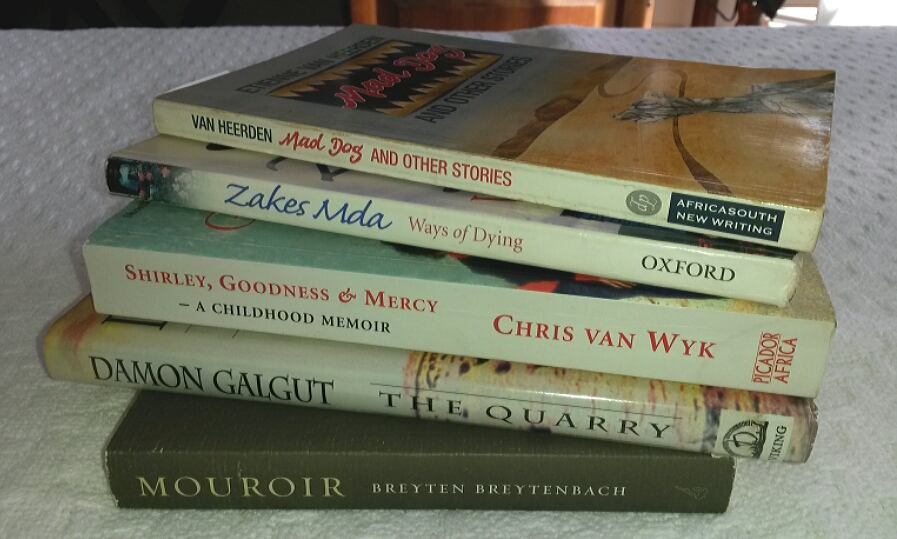
Most of the books I read take me elsewhere. As I turn my blog focus more and more toward literary themes, it is clear that I have a few idiosyncrasies. I have a definite interest in South African literature. This owes its genesis in part to my own experiences knowing a number of South Africans over the years, from watching the momentous changes that have taken place in the country during my adult years, and in the understanding that the new South Africa faces challenges that create a context for important discussions that we need to continue to keep open. Discussions we can all learn from in our increasingly global reality. The same holds true for another area with which I have an increasing literary interest – central and Eastern Europe. The political turmoil of the past century has provided ample inspiration for a wide range of exciting  literature, which, thanks to an increasing number of industrious small publishers, is catching the attention of English speaking audiences. Slowly but surely.

Of course, at the core of all great literature, classic and contemporary, is the essential quality of the human experience. We are born, we grow old, we fall in love, we lose those we love, we battle darkness, we face fear, we hope, we reach for those moments of joy. And the more I open myself to the stories of others from around the world, the less alone I feel.

But then there is this nagging guilt. As a Canadian, why don’t I read more Canadian writers? Well I do, but so many leave me unsatisfied and rarely reach my blog. And those I am especially fond of have tended to come from elsewhere; that is, they are Canadian with a hyphen and frequently write from that transitional perspective. I don’t think it was always that way. Maybe I have just been land bound too long. Maybe I crave the exotic just a little after all.

Well until I can travel, I will keep my bags packed, my options open and and a healthy pile of books standing by from near and far.

Behind the photographic impulse: Double Negative by Ivan Vladislavić

Copyright JM Schreiber, 2013

“How can I say what these fragments mean to me? The awkward truths of my life take shape in their negative spaces. In the lengthening shadows of the official histories, looming like triumphal arches over every small messy life, these scraps saved from the onrush of the ordinary are the last signs I can bring myself to consult.”

When we first meet him, Neville Lister, the narrator of Double Negative, is a disaffected young man, uncertain and aimless in a fractured and troubled environment – apartheid South Africa. It is the early 1980s and he cannot quite find his footing, either in academic study, the political protestations of his friends, or the mixed allegiances of his parents’ generation. The stakes are high, but his ambivalence is a luxury well known to middle class youth. Being close in age to Neville and his creator, South African author Ivan Vladislavić, I could not help but chuckle at his repeated references to “Beerhunter”, (a party game we Canadians lay claim to, by the way) or recognize the insidiousness with which The Eagles’ Hotel California album seems to define our lives even if we never owned a copy of that recording. However, unlike our most reluctant hero, I did not have political unrest or the real threat of conscription bearing down on me.

Double NDouble Negative traces Neville’s evolution from long-haired, pipe smoking dropout to middle-aged late blooming artist, framed against the shifting political, cultural and socioeconomic backdrop of Johannesburg. In the first section, “Available Light”, his father arranges a meeting with a famed local photographer, Saul Auerbach, in the hopes that the encounter might inspire his son to reach beyond his current employment assisting a man who spray paints lines on roadways. As Neville tags along, Auerbach and a journalist friend devise a game that will direct their photographic pursuit for the day. Standing on a hillside with a panoramic view of the city below, each man choses a roof top. They manage to visit two of the three selected homes where Auerbach charms his way in, and coaxes photographs out of the inhabitants – a poor black woman with her two surviving triplets living in a backyard shack and a white woman in a lounge suffocated with furniture and curios. But before they visit Neville’s choice, the photographer’s energy and his necessary light have faded and they head home.

When our narrator picks up the thread of his story in the second section, “Dead Letters”, he has been in London for ten years and the first free elections have just been held in South Africa. Swept up in a wave of nostalgic homesickness he flies home. By this time he is also making a living behind the lens, but as a commercial photographer. He returns to a city already morphing under new dynamics, post apartheid – street names changing, houses and entire city blocks replaced. Cities are, at the best of times, constantly re-inventing themselves, shedding their skins. The effects are more profound under the pressures that have been released and confronted in places like Johannesburg, where, by the time we catch up with Neville again for the final installment “Small Talk”, he has taken to photographing the ubiquitous walls that have arisen to close off and protect the city’s inhabitants from each other.

Upon his return to South Africa, he had experimented with trying to enter a home to photograph the resident, drawn, of course, to the house he had first chosen so many years earlier. The experience almost swallows him whole but does, in turn, offer the direction that will inform his own artistic photographic ventures. He no longer wants to see what lies behind the walls that have been erected. He draws the resident out but refuses to enter. It is now 2009 and our hero is being subjected to an interview by an eager, self-promoting young reporter and blogger who intersperses her blog posts with a litany of handy household tips that would make Oprah proud. She is of a entirely new breed, neither weighed down by nor fully appreciative of the reality of her nation’s history. By contrast, Neville Lister occupies the transitional space. As photography has moved from film to digital, a medium with remarkable capacity for storage and the editing and altering of images, so is his country altering and editing its own collective memories.

More than anything, this is a story that unfolds as a series of images, captured with Vladislavić’s poetic eye for detail. He translates scenes, the photographic and the interpersonal, with a language so effortlessly descriptive that I often stopped to re-read a paragraph for the sheer pleasure. Neville describes “gumption” as a “word that stuck to the roof of your mouth like peanut butter”. A character “moulted” his jacket. In navigating the city he talks of following “the simple arguments of avenues and squares”.
This ability to transform language into imagery is nowhere more apparent than in his descriptions of the scenes, immortalized by the lens of the camera under the direction of the photographer. One of the photographs resulting from the initial outing with Saul Auerbach is described in vivid detail:

“Mrs Ditton sat in the armchair beside the fireplace. The coffee table had been dragged away – there is no trace of it in the photograph – to expose the floorboards and a corner of the rug. Looming on the left is the largest of the cabinets, so imposing you would say it belongs in a department store. The chair has wooden arms with ledges for tea cups and on each side of these lies a pie-crust of crochet work and a coaster. The chair sprawls with its arms open wide and its fists clenched, and she wallows in its lap.”

I imagine that anyone with an SLR camera and a tripod has experimented with long exposures and the creation of ghost images. It seems to be a rite of passage. Double Negative is, in many respects, a book of ghosts. Visiting with the woman living in the house he had selected so many years earlier, Neville feels weighed down by the voices swirling around her lounge. In referring to the annotated cookbook passed down from his mother, he reflects that the food “tastes better when the ghosts adjust the seasonings.” And ghosts haunt a collection of dead letters that come into his possession and, it seems, may be destined to lead him into his next “artistic” endeavour. If growing older is a process of acknowledging and coming to terms with the ghosts we carry, our narrator is older and wiser but still working away to make sense of it all by the end of this book.

And so is his country.

Note: Originally published in South Africa in 2011, Double Negative was released to an international audience in 2013 (with an introduction by Teju Cole) through the amazing publisher And Other Stories. Supported by their unique subscription model, this release was followed by the publication of an earlier title, The Restless Supermarket in 2014, and his upcoming collection of stories, 101 Detectives, will be released this year. Ivan Vladslavić was recently named one of three recipients of the 2015 Windham Campbell Prize for fiction along with Teju Cole and Helon Habila.