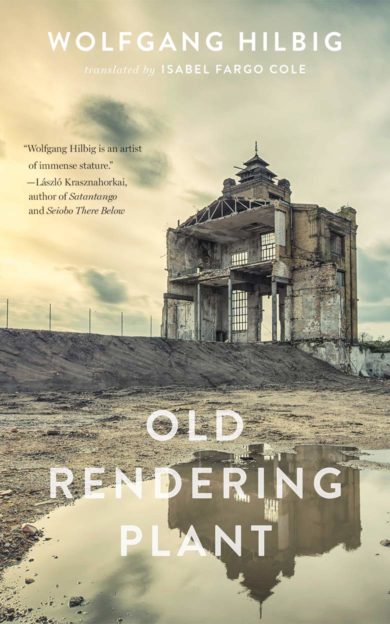
Lost in time with Wolfgang Hilbig: Old Rendering Plant

It is easy to become lost in the dense and convoluted narrative Wolfgang Hilbig unspools in Old Rendering Plant, the most recent translation of his work to reach English audiences. This slight novella invites the reader to wander, with the narrator, through the fields and along the pungent waterways that extend beyond his small East German town. As he rambles on, caught up in his memories of the past and hopes for the future, it’s easy to get swept up—and find oneself disoriented—amidst the industrial ruins where he is forced to confront the dark echoes of recent history and the expectations of the socialist state. It may be, especially for those unfamiliar with Hilbig’s idiosyncratic, stuttering prose, a little unsettling at first, but if one is willing to forego linear narrative expectations, an unforgettable, immersive, atmospheric reading experience awaits.

I read this book last summer to write a review for The Quarterly Conversation. In fact, I probably read it three times over to be able to read and articulate an opening into the narrative, but every time my appreciation of this moody, filmic text increased. As a critic, I derive the most satisfaction from writing about complex, unconventional narratives. My goal is not to give a definitive reading, but to explore the possibilities and questions offered by a piece of literature, while leaving a reader to find his or her own answers (or further questions, as the case may be). It was a sheer joy to write about this book.

My review from the Fall 2017 Issue of The Quarterly Conversation is reproduced below:

Old Rendering Plant by Wolfgang Hilbig (Two Lines Press)

Long after he escaped East Germany to settle in the West, where he continued to reside until his death in 2007, Wolfgang Hilbig remained bound to the darkened landscapes of the GDR. He was not one to downplay the bleak and oppressive qualities of life amid the abandoned mines and crumbling factories of his hometown, Meuselwitz, and his dense, swirling prose evokes a world of strange, suffocating beauty. But his emotional attachment to his birthplace and his complicated misgivings about the benefits of reunification, left him forever torn between East and West—a conflict captured clearly in the stories that comprise the second part of the collection The Sleep of the Righteous. By contrast, Old Rendering Plant, the latest Hilbig offering to be released in English, presents a narrative firmly planted in the GDR that does not travel far beyond the immediate environs of the narrator’s home; yet this tightly defined arena affords the perfect space for a multi-layered exploration of one man’s struggle to define himself against the restrictions and expectations imposed by family, class, history, and circumstance.

Wolfgang Hilbig was born in 1941 in Meuselwitz, near Leipzig. His father disappeared at Stalingrad, so he was raised by his mother and grandparents. His illiterate Polish-born grandfather served as an important father figure, encouraging his aptitude for sports. However, as translator Isabel Fargo Cole notes in her afterword to the novel I, his early obsession with reading and writing soon alienated him from his own family. The works of Poe and the German Romantics held a particular appeal for the budding poet. Following his military service he spent years working in local factories, where, at least on the surface, he epitomized the ideal of the worker-writer that the GDR actively encouraged. Yet, unwilling to follow accepted scripts, Hilbig’s writing was seen as too challenging and obscure, and it soon drew the unwelcome attention of the authorities. Ultimately the desire to write would win out, but the tension between duty to work and to literature became a central theme that he returned to again and again.

In Old Rendering Plant, an extended monologue that slips in and out of passages of pure stream of consciousness, this tension is implicit. Originally published as Alte Abdeckerei in 1991, this novella is a meditation on the formation of identity in an environment that contains a complex network of buried secrets. The narrator is looking back from a vague and indeterminate adult perspective at that point of transition from adolescence to maturity. His is a restless narrative; memories and waters sweep by as he traces and retraces a path along a brook that, bordered by stands of willows, carves a channel through the fields on the outskirts of his hometown. As a child he found refuge in this landscape filled with magic, possibility, and adventure, armed with a wooden sabre and an imaginary foe. It was a place to feel safe and protected.

One of his favorite playgrounds was, against all adult admonishments, found in the fragmented ruins of a coal plant. Here he waged countless fanciful battles until one evening he slipped and fell off a concrete platform. He was fortunate to land in the grass, but later that night he remembered hearing people staggering across the platform above him, and he awoke to find on his right leg evidence of the substance that had caused his fall: “a dried mire, a black-green slurry mixed with blood.” This incident marks the beginning of a loss of innocence, the first intimations of the existence of dreadful truths that, as the narrator ages, begin to take on a greater, more complicated and disturbing significance. As the narrative unfolds, his reminisces and reflections trace his movement toward a reckoning. Gradually, as layers of memory are stripped away, he approaches an clearer understanding of the forces that have driven him. It’s not a comfortable space he finds.

The narrator is a solitary personality, both as a child and as a man, given to wandering the pathways on the edge of town during the hours that mark the transition from late afternoon light to early darkness. He speaks of his family without affection, referring to them as “my relatives.” He passes from childhood into manhood almost imperceptibly, when the adults in his life no longer show interest or concern about his habitual lateness, his tendency to come home after dark. There is only one mention of an anecdote involving a friend, someone he visits on a brief, aborted attempt to break free of the house and town in which he grew up—during that visit, an encounter with the bloated corpse of a dead rat, which he is not even entirely certain is not an illusion or dream, sends him hurrying home. It is perhaps the thought that the horror he hopes to escape is bound to his being, rather than his environment, that frightens him so.

Central to the narrative is a rendering facility hidden among the ruins of the former coal plant. The narrator’s fall from the cement platform was his first direct indication that something nefarious existed there, but he had always been aware of the signs of its presence:

As a child I knew it was the smell of the milk-colored current that washed down the brook, bubbling and steaming like warm soapsuds in the evening. I knew that the smell soaked the banks and seeped under the fields; the mist over the river channel was this smell, and the mist that rose from the topsoil too, infecting everything that grew in the fields, and it rose from the meadows, the grass of the paddocks smelled of the river mist’s cloying essence, the bushes on the banks thrived amid this smell, a smell of flesh . . . old, useless flesh relinquished to the waters, washed its smell through the land to the east, I knew this as a child. Tallow sheathed the snarls of grass on the brook’s edge, ancient fat clung indelibly to the slopes of the embankment; it was a brew of rancid fatback, even covering the paths, boiled-out horns, bones cooked to the point of disintegration . . . the old river-willows luxuriated in this nourishment; countless bluebottles, ill from overfeeding, dripping like glossy shapes made of wax, skimmed sluggishly through the foam, and this shimmering foam, rapidly turning black spun lazily on the water by the willow’s dangling roots.

At a later point—he is at a loss to even specify exactly when, the experience was so intense that it remains trapped in a level of reality between dream and waking—he happened to witness cadavers and sick, terrified animals being unloaded at the site. This plant, nestled among the ruins, was named Germania II after the mine that had once supplied the old coal factory, and it becomes, for the narrator, the source of such complicated questions and emotions that he finds himself unable to pass beyond the bridge and railroad embankment he encounters on his regular sojourns. The smells, memories, and anxieties that arise at this location routinely force him to turn and wearily head for home.

The rendering plant was rumored to employ society’s discarded men. At a time when radio reports of missing persons, and rumors of dangerous foreigners hiding in abandoned buildings, were commonplace, the workers belonged to a stratum of mysterious characters, unnamed and unseen by the light of day. The particular autumn forays that form the pivotal thread of this monologue are motivated by the narrator’s concerns about what his own future holds. He is remembering his final year of school when, with graduation approaching, he has a critical decision to make. This is where his fanciful nature, his defiant poetic spirit, begins to stir as he briefly considers becoming a gardener, inspired by the end of Candide rather than by any fondness for the tilling the soil, and entertains an idyllic life as a miller. He seems oddly determined to disturb his family and his teachers, ultimately announcing his intention to work at Germania II. With a mix of horror and fascination he develops an obsession with the process of rendering carcasses to make soap, and attempts to seek out the elusive workmen. But there is something more complex at play.

This is, at its core, a search for identity and the expression of individuality. The question of where one is heading, is necessarily a question of where one has come from:

my strange interest in bad places was an unacknowledged, unclear interest in our origins . . . because I had not actually experienced the affronts that went with the soil we had sprung from.— On reflection, we were actually exiles. Of course, only in the indefinite way in which all our names were sheer hubris . . . all our names, titles, and nouns. So we were not exiles based on some neat solid idea, but exiles out of instability . . . out of ineptitude, ignorance, antisocial tendencies; we hadn’t been torn from our roots, we had lost our rights, we were in exile because we’d never had roots or rights; we’d never even sought to find them, perhaps we constantly sought the world’s most noxious regions in order to rest our rootlessness, like gray vegetation, feeding on the ground’s nutrients but giving nothing back, we settled in the desolate provinces that were the strongholds of evil, we settled between slag and scrap where we could run riot, rank and uncontested.

What, then, do those most reviled of workers say about him, and his people, who are similarly dispossessed? Is it a matter of degree that divides them? Is it destiny? As the narrator’s monologue continually circles back to this place of darkness and all of the memories that point in its direction, he rekindles the oppressive existential crisis that once drew him to fantasize about disappearing into its foul depths.

As the narrative progresses, Hilbig’s characteristic prose, which flows in fits and starts, like eddies in a stream, swirling, reversing, and moving on again, is hypnotic and disorienting. It is easy to get caught up in the beauty and rhythms of his language, momentarily losing one’s temporal bearings. As such, it is especially ideal for this type of lyrical reflective monologue. When, on occasion, he slides into passages incantatory stream of consciousness the effect is exhilarating. Translator Isabel Fargo Cole has a strong sensitivity and fondness for his idiosyncratic style that comes through in this, as in all of her Hilbig translations (including The Sleep of the Righteous and I).

Reading Hilbig, I often find myself stopping to reread a section before moving on. I revel in losing myself in his long, winding sentences and paragraphs that can stretch on for pages. This can, on the surface, draw allusions to Sebald, though, Hilbig’s prose is quite different in quality, and unlike a Sebaldian narrator, the protagonist of Old Rendering Plant, although he sets out again and again, finds it difficult to push beyond the boundaries his memories and fears have imposed. What is similar in the reading experience, however, is that both can stimulate a desire to distinguish points of departure—with Hilbig, to find those moments where reflections, memories, and memories of dreams diverge, reinforcing temporal dislocations.

The narrator’s troubled forays are rooted in his reluctance to bend to the fate that awaits him, choosing a practical apprenticeship and accepting the bonds of adulthood. He harbours a Romantic sensibility that can only find expression in defiance, in word if not in deed. This resistance continues until one evening when he wanders farther afield than intended. Disoriented, he attempts to make his way back to town, only to witness a dramatic event—an apocalyptic cataclysm resulting from the extensive economic hollowing of the land that tears a wound into the darkened recesses of the soul of his nation and ultimately frees one rootless exile whose lonely monologue culminates in a rousing Joycean climax.


Silence, silence! A Skeleton Plays Violin: Book Three of Our Trakl — Georg Trakl

Listen carefully, what do you see?

Clouds expose their unyielding breasts,
And bedecked by leaves and berries
You see grinning in the dark pines
A skeleton play violin.

When Book One of Our Trakl emerged two years ago, attentive readers and lovers of beautiful books sensed the beginning of a very special project dedicated to the work of the Austrian poet who continues to intrigue and enthrall us more than one hundred years after his untimely death in 1914, at the age of twenty-seven. Translator James Reidel was introduced to Georg Trakl in the late 1970s, when he was himself beginning to write poetry. Early on he was made aware of the difficulty and importance of translating Trakl’s work. As the years went on, he would make his way back to Trakl through reading, and translating, Thomas Bernhard, Ingeborg Bachman and Franz Werfel. In the meantime, new Trakl translations had emerged and so, with this series published by Seagull Books, he has added his own contribution—his own approach to this ever elusive and enigmatic writer.

The first two volumes of Our Trakl represent complete collections of poems, as selected and prepared by the poet: Poems (Gedichte, 1913) and Sebastian Dreaming (Sebastian im Traum, published posthumously in 1915). The third and final part, A Skeleton Plays Violin, gathers Trakl’s early and late published works, unpublished pieces, and significant variants and derivations, in yet another beautifully designed edition. Through the poems and prose collected here, presented chronologically and woven together with a sensitive biographical essay, we can trace his development as a poet, and see potential indications of where he might have gone had he survived the war and his own demons. With Poems and Sebastian Dreaming close at hand, reading can become a truly immersive experience.

Immediately one notices a strong youthful, romantic quality to Trakl’s earliest creative efforts which include prose, plays, and poetry. Religious and classical Greek themes recur, as do sombre images of suffering and neglect. Born in 1887, he began writing and publishing in his late teens when he was working as an apprentice pharmacist in Salzburg—a job that afforded him access to the drugs he had been sampling seriously from the age of fourteen and that would continue to play a significant role in his life. The intensity that is said to have marked his personal demeanour comes through in his early work, granting it an eerie maturity.

A move to Vienna to continue his pharmaceutical studies in 1908, led to periods of depression and anxiety. While his reputation as a poet grew, he was unsatisfied and critical of his work. His unhappiness in the capital, worsened in part by the complications of having his beloved sister present for a time, is reflected in his published poetry from this period. It is possible to feeling the aching in his words, as in the first two stanza of “Twilight”:

You are dishevelled, wracked by every pain
And shake from every jarring melody,
You a broken harp—a wretched heart,
From which blossom misery’s sick flowers.

Who bid your adversary, your killer,
The one who stole the last spark of your soul,
The way he degodded this barren world
Into a whore foul, sick, pale with decay!

In 1910, Trakl’s sister to whom he had always been close—perhaps too close—left Vienna to return to Salzburg. Two months later, in June, his father died, an event which had a major impact on the entire family, economically and functionally. However, his corpse and ghost would provide inspiration for his son’s poetry which, at this time, began to shake loose a nostalgia for the past, and the influence of the Symbolists and German Romantics, to find its own distinct voice. Sexual tension is increasingly sublimated and Trakl’s lines become “ever more discrete, simple and painterly.” His imagery also shifts:

Liminal beings begin to populate the poems—angels, demons, dead gods, nymphs, fawns and statues of dead nobles, hunted animals, skeletons, corpses and the ever-shape-shifting presence of the poet and the figure of the sister. And this figure may be more of a composite than we know, for Trakl adored his older sisters too.

A persistent presence in Trakl’s life and poetry is his younger sister Grete. The rumoured incestuous nature—or at least longings— that bound the two is a subject of measured discussion in the biographical segments, Reidel preferring, ultimately, to leave the poetry to speak for itself, as it will.

Toward the end of 1910, with a need to support himself, Trakl joined the army. He was assigned to the Garrison Hospital in Vienna where his commanding officer would later describe him as hardworking and friendly. Mid-1911 saw him return to Salzburg where he worked as a civilian pharmacist until the spring of 1912 when he was promoted to Garrison Hospital 10 in Innsbruck. Initially unimpressed with his new location in spite of its glorious forested and mountainous setting, he soon became involved with a new literary circle, and made connections that would prove critical to his career and lead to the publication of his first book. Thus he made peace with the surrounding landscape which also begins to make its way into his poetry. However, as his poetic soul flourishes, his work life suffers. Ultimately, unable to hold a job, he surrenders himself to writing, and the increasingly reckless life of a poet.

The extensive central sections of A Skeleton Plays Violin, which feature unpublished poems and versions of published pieces, offer a window into the refining of Trakl’s imagination and craft. We see him spinning, again and again, the phrases, imagery, and themes he wishes to perfect—the crimson mouth, the screaming faun, the turn of the season, the quality of light—and watch the tightening of his language as the final version is formed. Reidel’s selection covers a wide terrain, yet is careful to bring together those variants and completed works that highlight Trakl’s growth and maturity over time. It is impossible though, not to notice that his work only seems to grow darker.

For Trakl, periods of depression and panic attacks marked the second half of 1913. He continued to consume alcohol and drugs, cocaine and morphine, at a remarkable rate. He saw himself as a doomed soul, even as his star was steadily rising in German poetry. He held to his writing to see him through that winter. He continued to attract impressive admirers, including Ludwig Wittgenstein, and plans were made for a second volume of poetry. However, with the assassination of Archduke Ferdinand in June of 1914, Trakl’s world was upended. With the advent of what would become the First World War, he was assigned as a medic to a frontline infantry unit heading east. The conditions soon took a toll on his mental and emotional health. He was hospitalized in Krakow following a suicide threat, and was found, in his room, on November 3, dead from an apparent cocaine overdose.

His later published poems show that a deep melancholy had long settled into his work. “Evening Reel,” for instance, published in October of 1913 opens with playful natural imagery, albeit a little grim:

Fields of asters brown and blue,
Children play there by the grave vaults,
In the open skies of evening,
Blown into the clear skies,
Seagulls hover silver-grey.
Horns call in the flood meadow.

To end, even gloomier, three stanzas later:

The candles’ glow weaves dreamlike,
Paints this youthful flesh decaying,
Cling-clang! Hear in the fog,
Ring in time with the violins,
And bones dance along naked,
Long does the moon peer inside.

Trakl’s final published poems are stormy and dramatic. The wistful beauty is gone; the imagery is now steeped with darkness—war is at hand. “The Despair” captures the scene:

Then the black horses leap
On a pasture in fog.
You soldiers!
From the hill where the sun wheels dying
The laughing blood rushes
Amid oaks
Speechless! O the grumbling despair
Of the army, a steel helmet
Dropped clattering from a crimson brow.

Until the end, Trakl held fast to poetry. It has been suggested that the news that the publication of Sebastian Dreaming would have to be put off until the war ended played a pivotal role in his final desperation. We will never know exactly what finally tipped the scales for a man whose scales tipped so heavily to dark side so often in his short life. Nonetheless, his last creative efforts form a rousing crescendo to the third and closing volume of this ambitious poetic project.

Wisely and appropriately, the final words are perhaps best left to Trakl himself, from “Revelation and Perdition,” the grim, haunting prose piece which closes out this powerful testament to a troubled poet, lost too soon:

When I walked into the garden in twilight, and the black figure of evil had yielded to me, the hyacinthine stillness of the night surrounded me; and I sailed in a crescent-shaped boat across the stagnant pond and a sweet peace touched me on the brow turned to stone; and when I died in witness, fear and that pain deepest inside me died; and the blue shadow of the boy rose lightning the darkness, a soft singing; on lunar wings, above the greening treetops, crystal cliffs, rose the white face of the sister.

A Skeleton Plays Violin: The Early, Unpublished and Last Works of Georg Trakl is translated by James Reidel and published by Seagull Books.

For World Poetry Day, excerpts from a few books on my bedside table

In honour of World Poetry Day (which at the moment, in my time zone, is still happening), I thought I would take a moment to look at some of the poetry currently on my bedside table. I sometimes write about the poetry I read, but do not feel equipped to formally review it. That doesn’t keep me from enjoying it, of course.

I read a lot of poetry in translation. It can, perhaps, be a challenge to capture the spirit of a poem in another language, but that’s not a reason to deny its worth. Poetry opens up worlds of experience in a way prose typically cannot. And when competing (or rather, complementary) translations emerge, I like to think of that as an opportunity to re-experience a piece of literature reflected through a somewhat different prism.

I have a fondness for collections, complete or selected, that allow me to sample a poet’s work across their career, and delight in the magic of opening a book randomly, finding words that strike home. The following pieces are taken from the works I have been spending time with lately:

Water binds me to your name.
Nothings is left of me except you.
Nothing is left of you except me—
a stranger caressing the thighs of a stranger.
O stranger, what will we do with what is left
of the stillness and the brief sleep between two myths?
Nothing carries us: neither path nor home.
Was this the same path from the beginning?
Or did our dreams find a Mongolian horse on a hill
and exchange us for him?
What shall we do?
What shall we do without exile?

—Mahmoud Darwish, from “Who Am I, without Exile?”, translated from Arabic by Sinan Antoon, collected in Unfortunately, it was Paradise: Selected Poems (University of California Press)

* * *

I’m a Child of this Century

I’m a child of this dreary century
a child who never grew up
Doubts that set my tongue on fire
burned my wings
I learned to walk
then I unlearned it
I grew weary of oases
and camels eager for ruins
My head turned to the East
I lie in the middle of the road
And wait for the caravan of the mad

—Abdellatif Laâbi, from Beyond the Barbed Wire: Selected Poems, translated from French by André Naffi-Sahely (Caranet Press)

* * *

Every day wakes up to some abuse
in my monologue is
embedded the legend of my sorrow,
with thousand year-old grief
I prevailed over my dirty life,
but not over the rationality of the winter cold . . .

In taprooms you rip off
the tattered shreds of your tragedy,
no forest, no merit, no archangel . . .

Above your poetry a swarm of birds mows
mows and mows a life imploring . . .
nothing for anyone
in the proximity of this dream,
nothing for worldly lovers . . .

Fruit of rottenness,
a wicked sun . . .
Temple ruins, broken pieces gathering
on the rediscovered shore . . .
in gloomy courtyards books opening . . .
Verses on abandoned walls . . .

. . . not the perfect one,
not the dead man, who drove you into the cities . . .
Trust in your song.
You plough the earth with your fragments,
cold begot you . . .
You, left behind by your creators . . .

—Thomas Bernhard, from Collected Poems, translated from German by James Reidel (forthcoming from Seagull Books)

In good company: The Walk by Robert Walser

On Christmas Day, sixty years after Swiss writer, Robert Walser, took his fateful last winter stroll, I went for a walk through my neighbourhood. It was cold, -23C, but the low sun shone on a fresh 15 cm of snow, making it an ideal day for photographs. This being the first Christmas after the deaths of three of the people closest to me, it was a time of invigorated spirit and creativity mixed with sadness. Not entirely unlike the emotions recounted in the book I opened after returning home—Walser’s novella, The Walk.

walkNotably the first of Walser’s work to be translated into English, the path that led to the present edition of this book, a part of New Direction’s Pearl series, is interesting and informative. The original translation by Christopher Middleton was published 1955, and based on the 1917 stand-alone publication of The Walk. When the same piece was released as part of the 1920 collection, Seeland, the author had edited his first version—streamlining some sections, padding out others. With this in mind, translator Susan Bernofsky, applied Walser’s edits, only as necessary, to Middleton’s work. The resulting volume is a unique collaboration and, as Bernofsky notes in her introduction, the two versions offer fascinating insight into Walser’s “evolution as a writer.”

The narrator is a writer and a self-styled flâneur whose environment is not the bustling metropolis, but a semi-rural/semi-suburban setting featuring bucolic scenery and peopled with eccentric characters. The novella opens with our hero leaving the gloomy isolation of his daily confrontation with the empty page, to set off on a series of errands. He is in a jaunty, positive mood. It’s evident that being out on the street is where he feels most free, confident, and at ease.  Opinionated, observant, and self-conscious, the narrative that unfolds is marked by an excessive chattiness. Whether he is addressing the reader or someone he encounters, a certain manic energy drives the perambulator’s account:

In the water of a fountain a dog refreshes itself, in the blue air swallows twitter. One or two ladies in astonishingly short skirts and astoundingly high, snug, fine, elegant, dainty colored booties make themselves as conspicuous as anything else. Moreover two summer or straw hats catch my eye. The story about the straw hats is this: it is that in the bright, gentle air I suddenly see two enchanting hats; under the hats stand two fairly prosperous-looking gentlemen, who by means of a bold, elegant, courteous waving of hats seem to be bidding each other good morning, which is an occasion upon which the hats are evidently more important than their wearers and owners. The writer is nonetheless very humbly asked to be a bit careful to avoid jokes as well as other superfluousnesses. It is hoped that he understands this, once and for all.

This excessive attention to detail, and the tendency to address himself in the third person with slightly self-deprecating humour, creates a distinctively Walserian tone that would influence Bernhard and be so admired by Walter Benjamin and W.G. Sebald.

As he continues on his walk, Walser’s narrator, will stop into a bookshop and bakery, dine with a female friend, and attend to a variety of errands. He waxes lyrical, sometimes taking his praise well over the top when describing some of the houses, gardens, and natural settings he passes by, while he explodes with outrage at the slightest provocation. Inspired to impromptu speech-making, he bends over backward to flatter several women he encounters, and recites from memory a long-winded insulting diatribe to the unknown recipient of a letter he mails:

“He who works honestly, and devotedly exerts himself, is in the eyes of people like you, an outspoken ass. In this I do not err; for my little finger can tell me that I am right. I must dare to tell you to your face that you abuse your position because you know full well how many annoyances and tedious complications would be entailed if anyone were to rap your knuckles. In the grace and favor which you enjoy, ensconced in your privileged prescriptive position, you are still wide open to attack, for you feel without a doubt how insecure you are.”

In his outbursts, it becomes increasingly apparent that the writer/walker is channelling his own insecurities such as in the much-foreshadowed incident in which he angrily confronts a tailor whom he is determined to take for task for the fit of a suit—one it’s uncertain he either wants or, more likely, can afford. At his next stop, he proceeds to grovel before a tax official, explaining how his writerly profession does not provide a reliable income and he thus requires that he be taxed at the lowest feasible rate. When the taxman points out that he always seems to be out walking rather than plying his trade, the narrator launches into a detailed explanation of the critical importance of his daily excursions to the gathering and processing of the ideas that he will commit to paper when he returns to his dwelling:

“Walk,” was my answer, “I definitely must, to invigorate myself and to maintain contact with the living world, without perceiving which I could neither write the half of one more single word, nor produce a poem in verse or prose. Without walking, I would be dead, and would long since been forced to abandon my profession, which I love passionately.”

As the narrator reaches his destination, the end point of his outing where he will rest and reflect, all pomposity and bravado give way to the underlying sadness and loss that he carries with him. He walks then, not just for inspiration, but to try escape a gloom that is not confined to his room alone.

31036737474_a1cd68f48e_b

The Walk was the only one of Walser’s works to be published in English during his lifetime. Now, sixty years after his death, his many novels and short story collections continue to appear regularly in translation. For a man who spent so much of his life confined to mental health facilities, nearly forgotten, and who fell silently in the snow on a solitary walk, this particular novella, so lovingly tended by two of his best known translators, is a fitting honour to his memory.

Another winter solstice is upon us: 2016 – The year in review

Winter solstice. The longest night of the year.

Moving forward, the days grow steadily longer and, in less than two weeks, we will leave a dark, disturbing year behind us.

But it would be reckless to imagine that 2017 will be brighter. However, with luck, we can be forewarned, forearmed, and determined not to relax our guard. We can stand together against the rising tides of hatred, and remember what is truly at stake.

11229294674_e5844929df_z1

Since I started this blog two and a half years ago, winter solstice has become my annual check-in point. Last December, I reflected on the key elements of a year that began with a move to writing seriously about books and culminated with my first review for Numéro Cinq. Against that trajectory, I wrote about my trip to South Africa, and the pulmonary embolism and cardiac arrest that followed within a few weeks of my return. I imagined that the eventful year I had experienced would not likely, for better or worse, be exceeded this year.

Cue 2016.

This has been a year of heartache, anger, and dismay. Around the world and close to home. I watched the violence in Syria, the outcome of the Brexit vote, and the spectacle of the American election, among the other tragic and unexpected events that have unfolded. And as economic uncertainty and anxiety has grown in my own hometown—a city that lives and dies with the price of oil—the crime and homicide rate has risen sharply this year. It does not feel like the same community any more.

Then there is the lengthy roll call of the writers, artists, and performers who have left us. But to be honest, I cannot say that I have felt these losses as acutely as many others… I’ve been distracted by the immediate, personal losses that marked this year. My mother, my father, and one of my closest friends, all gone within the span of two months. And my grief—that most fundamental human emotion—is complicated, inarticulate, and wearing.

It will take time.

11592010455_89917d80e3_z1

But, 2016 has also been a time of amazing growth and opportunity for me as a writer. I don’t know how often I resolved, with the dawn of a new year that: This year I will write. Last December, with that first critical review under my belt, I could not have imagined that I would have, in addition to regular contributions to Numéro Cinq, published reviews at 3:AM, Minor Literature[s], The Quarterly Conversation, and The Rusty Toque. And I would not have dared to dream that I would see my essays and prose pieces published on line and in print, or that I would be invited to join the editorial team of The Scofield. As 2017 approaches, I have a handful of reviews scheduled and several prose projects underway. I’m also feeling inspired to return to photography after a lengthy hiatus, and to see how I can incorporate photos into my written work.

I have much to look forward to, in spite of, or rather, against the new darkness that threatens.

Art and literature are more important than ever at times like this.

So, this seems to be an appropriate time to look back over this year’s reading, and highlight the books that stand out for me.

I’ve read about 50 books to date, a little more than half of what I read in 2015. I don’t even want to hazard a guess as to how many books I bought, received as review copies, or brought home from the library. I feel, as usual, like I fell short of my intentions. However, I have to remember that I was writing, working on critical reviews, and dealing with considerable life stresses over the past twelve months.

More than ever before, I read like a writer this year. That is, I was especially attuned to voice, structure and approach to storytelling. Consequently, the books that made my year-end list tend to reflect this focus. Of course, any “best-of list” leaves out many excellent books. I’ve managed a baker’s dozen here, and it’s probably a reflection of the increased number of off-blog reviews I wrote that this year’s list is predominately composed of new releases. I was surprised to see that once I’d made my selection.

In reverse chronological order, my top reads of 2016 include the following:

Story of Love in Solitude by Roger Lewinter (France), translated by Rachel Careau
I will write about this collection of three short stories once I have completed The Attraction of Things. My verdict is still out on that title, but this tiny book is simply wonderful.

The Inevitable Gift Shop by Will Eaves (UK)
Fragmentary, cross genre writing that works fascinates me. Billed as a “memoir by other means”, it is Eaves’ unique tone that makes this blend of memoir, literary criticism, and poetry so compelling. His thoughtful reflections on reading and writing made this an ideal meditation to turn to after a year of reading critically and exploring my own literary voice.

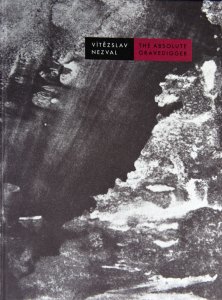
gravediggerThe Absolute Gravedigger by Vítěslav Nezval (Czech Republic), translated by Stephan Delbos & Tereza Novická)
I have found myself turning to poetry more and more as the world seems increasingly unstable and, well, surreal. This newly translated collection of poetry by one of the best known Czech Surrealists should be essential reading at this time. Originally published in 1937, the darkness he could see on the horizon are all too familiar once again.

The Country Road by Regina Ullmann (Swiss), translated by Kurt Beals
I read this collection of short stories when I was in a very low mood. But in the spare, sombre prose of these tales I found a beauty that, rather than deepening my depression, brought strange comfort. Admired, in her lifetime, by the likes of Rilke, Mann, and Musil, Ullmann’s work is mostly forgotten today. This volume, released in English translation in 2015, is a rare treasure—one that I encountered at just the right moment.

panorama-coverPanorama by Dušan Šarotar (Slovenia), translated by Rawley Grau
For me, as a reader and a writer, one of the most important books I read this year is this literary meditation on migration, language, landscape, and loss. This novel finally broke through my own stubborn determination to hold to a sharp delineation between fiction and nonfiction, and has made me re-evaluate potential approaches to themes I wish to examine. What Šarotar achieves here with his own unique take on what might be deemed a “Sebaldian” approach, is the creation of an atmospheric, captivating, and intelligent work.

The Passion According to G.H. by Clarice Lispector (Brazil), translated by Idra Novey
Oh wow! In a way, I am glad I didn’t read Lispector before writing and publishing my essay “Your Body Will Betray You,” because she is exploring the process of coming into being so beautifully that I might not have been able to write at all after reading this. Employing an unconventional narrative, Lispector’s G.H. experiences a vivid, metaphysical crisis triggered by the sight of a cockroach. The result is a remarkable, thoroughly engaging read. I have at least three more of her books waiting for the new year.

Proxies by Brian Blanchfield (US)
I bought a number of essay collections this year and currently have several on the go. This collection impressed me not only for the way the essays were composed—written without consulting outside sources—but for some of the ideas explored, and for reinforcing the value and possibilities of the personal essay/memoir form. I also greatly appreciated his guiding caveat: Permitting Shame, Error and Guilt, Myself the Single Source.

SergioSergio Y. by Alexandre Vidal Porto (Brazil), translated by Alex Ladd
This book is significant and important for dealing with gender identity and transition in a sensitive and original way. I am, as a transgender person, critical of much of what passes as literary writing on this subject. This is a most impressive work with a startling and unique approach. As I noted in my review, Sergio Y. is novel that approaches the transgender experience from the inside and the outside, allowing for the comfort with names and pronouns to vary, over time and from person to person, reflecting the complexities of relationships that others, even loving family members, can have when an accepted and assumed identity is challenged. That is the book’s greatest strength.

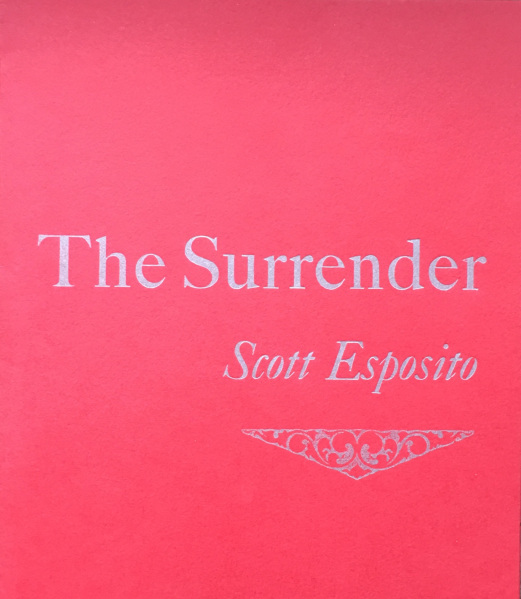
surrThe Surrender by Scott Esposito (US)
This book was on my radar from the moment I first heard of it. Again, despite my typical gender related skepticism, I was drawn to this transgender-themed memoir/film critique/literary diary. I wanted to know how Scott would present his story—one that is not commonly heard. Although his journey is very different than mine, we share a certain sensibility. This is a brave and most wonderful book by a man who has long been one of my heroes. He has since become one of the many literary friends I have come to know and cherish this year.

Layout 1

Atlas of an Anxious Man by Christoph Ransmayr (Austria), translated by Simon Pare
This book was a total surprise when it arrived courtesy of the good people at Seagull Books. This most unusual travelogue, a series of brief “encounters” across the globe, contains some of the most stunning descriptive language I have ever read. Each episode begins with the words “I saw…” and ends with a wise, evocative observation. From the North Pole, to South America, from deep inside the mountains of New Zealand, to a parking lot in San Diego, this is a journey that will not be easily forgotten. Highly recommended.

Quiet Creature on the Corner by João Gilberto Noll (Brazil), translated by Adam Morris
My third Brazilian book on this list is this enigmatic novella that led to one of the most entertaining literary discussions of the year. What is it about? Well that is the challenge. I had to read it three times before I could begin to get a handle on it. The narrator, a young man who finds himself in a strange situation that is rapidly growing stranger, is, in his oddly passive tone, almost more disturbing than whatever might be happening. Opaque and surreal, this book gets under your skin.

The Crocodiles by Youssef Rakha (Egypt), translated by Robin Moger
This novel still holds fast in my memory although I read it back in February. It is, as I described it in my review, a prose poem of simmering power, unwinding across 405 numbered paragraphs, tracing a torturous path from the first stirrings of poetic assurance within a trio of young men in the 1990s to the doomed protests of the Arab Spring. It is a dark, intense exploration of youthful political idealism, that builds on repeated images, themes and refrains to create a compelling narrative force as it moves toward its stunning conclusion. Again, this is another work that is increasingly relevant in today’s world.

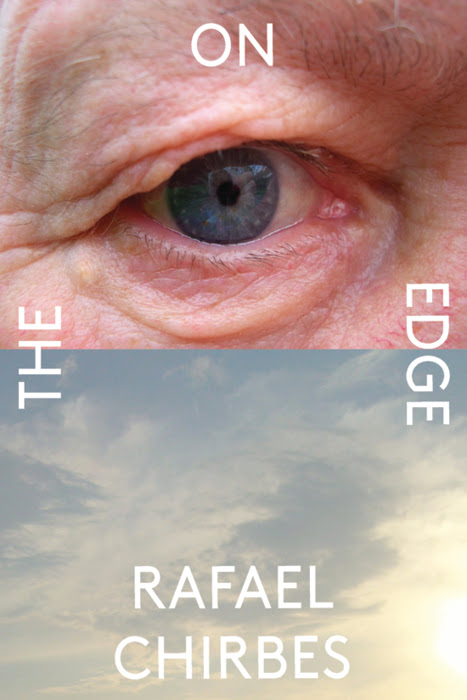
On-the-edgeOn the Edge by Rafael Chirbes (Spain), translated by Margaret Jull Costa
Finally, the very first book I read in 2016 is probably my favourite book of the year. I wrote about this novel at length for Numéro Cinq and I regret that it has not generated more discussion. In what is essentially an extended monologue with brief cameos from other characters, Chirbes creates a memorable, engaging, and tragic character in seventy-year-old Esteban, a man who has lost absolutely everything in the economic collapse of 2008.  Thoroughly human in his wisdom, his resolve, his shortcomings, and his despair; this is a powerful and important book that deals frankly with many of the critical issues—including migration, xenophobia, and economic decline—that are more vital than ever as we step into 2017.

When you fall out of reality: Dispatches from Moments of Calm by Alexander Kluge & Gerhard Richter

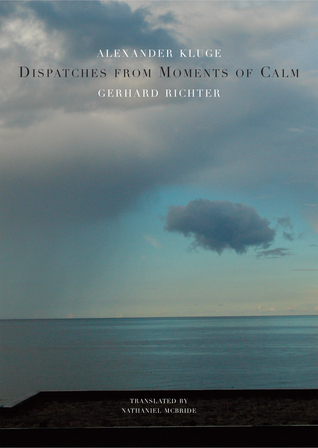
As we witness an unprecedented assault on the integrity and role of journalists and the news media, fueled by recent events in the US—and, let’s be fair, in many other nations in our current climate of political unease—this collaborative effort to re-imagine an alternative approach to capturing reality is ever more timely and precious. The genesis of Dispatches from Moments of Calm (Seagull Books, 2016) lies in an unusual experiment. For one day, October 5, 2012, all of the noisy and distressing political reportage evaporated from the pages of the German national newspaper, Die Welt. In its place? Thirty pages of photographs capturing the simplicity of the everyday—a quiet interlude in restless times, created and directed by renowned artist Gerhard Richter.

calmInspired by this singular attempt to create a “moment of calm,” writer and film maker, Alexander Kluge, started to work on a collection of small stories to accompany the images. Richter responded in turn with the proposal of a collaboration. He added more photos; Kluge wrote more stories. The resulting book—a continuation of their first successful joint publication, December (2010/2012)is an important, and given the mood of the current times and the circumstances of the project’s origin, a more meditative and philosophical work.

The photographs scattered throughout the text isolate the ordinary instant. The atmosphere is placid, low-key. We see a dog sleeping in the sun, the blurred image of a family at a meal, a deserted downtown street, images of nature, children at play, a moody seascape, and more. But each image exists in a space apart from time and the world. And Kluge’s fictions, taking off as they so frequently do, from real life people, events, and ideas, offer the ideal counterpoint. Many of the stories explicitly explore the intersection between art, music and reality:

László Moholy-Nagy was asked whether a photograph reproduces a piece of reality. He denied the claim. He replied that a photograph is constituted by the fact that it concentrates on an actual moment and records it, becoming a textual addition existing outside the world. He knew, the Bauhaus man continued, series and networks of such photographs, which relate to reality or current events like a mirror (including the gaps in that reality, to a silence or to a nothingness), but which, when cut off from the rapidly receding stratification of time, would form themselves into their own republic, one that would superimpose itself (like an El Niño mudslide) onto the original impression that caused the photograph, which itself would have disappeared from the participants’ memory, had they never had the impression to begin with.

Dispatches comprises 89 stories and 64 pictures. Some of the stories—which range from a paragraph or two to a couple of pages—were composed to accompany, after the fact, specific images from the original Die Welt project. Both Kluge and Richter added more contributions on their own. In the resulting book, the confluence between images seems to be accidental, rather than exacting. Where a connection exists, the image is unlikely to occur near the corresponding story. This arrangement adds to the incidental flow of the work. There is, however a thematic structuring at play.

2016-11-30-22-39-33The book is divided into five parts. The stories in first section turn on the element of chance. With narratives featuring real figures from science, music, and history, alongside parables drawn from nature and from everyday life, Kluge explores the vagaries of fate and circumstance. The consequences, happy or unhappy, have the effect of promoting a sense of disequilibrium—an awareness of the fleeting quality of those moments of calm that we experience.

The second part takes us into the city starting with stories set in modern urban spaces, moving back in time to vignettes that speculate on the Mesopotamian origins of the city-state and ruminations on the nature of the concept “city.” This section closes with a story featuring sociologist Richard Sennett:

The city that we carry around inside ourselves, he said, is visible. But when you see a city destroyed by bombs, one which you do not know and means nothing to you, and you nevertheless feel sad, then you can see from this reaction that we carry around inside ourselves just such an invisible city. You see the city only when it has been lost.

These words seamlessly lead into a collection of stories set in the Middle East—Beirut, Lebanon, Syria, Israel—engaging current events, history and even opera to reflect, in words, the very instants Moholy-Nagy imagined captured in the mirror of a photograph.

2016-11-30-22-29-25The final two sections sharpen the focus on questions of reality—how we report it, record it, place ourselves in relation to it. The philosophical musings Kluge entertains in these brief stories offer so much to contemplate. His ability to exploit the fluid intersection between what we, especially in English language literature, want to divide into fact and fiction, lends his stories the sense that these should be considered fragmentary pieces of nonfiction. The influence that his work had on W. G. Sebald is evidenced in this regard. These stories, parables, and reflections are, in themselves, narrative truths—regardless of whether they describe events as they really occurred, or if they even occurred at all. Kluge wants to make you stop, in the moment, and think. Here, as an illustration, is one of my favourite stories, in its entirety to provide a taste of Kluge at work:

For many centuries, thousands of monks in monasteries between Ireland and Byzantium, dotted like islands across the barbaric land, were writing out the holy texts. Their zeal and their great efforts produced mistakes. The result was that the texts imperceptibly expanded. One learned monk in Samanca was delighted to find a text by Ovid on the back of a copy of the apocryphal LOGION OF ST JOHN. The copyist on the island of Reichenau could not resist including this interpolation. In this way, a text was expanded in a distinctly “unholy” manner.

A transcription of texts (just as if evolution had been tinkering with their DNA texts) doesn’t only create lines to new future texts. It can also be reconstructed in the direction of paradise. The way there leads through indeterminacies. ‘Nearer, my God to Thee’ was the music played by the orchestra on board the Titanic as the ship went down. But it is also the working instructions to copyists of all countries, who are driven from the omphalos of experience into the parallel world (heterotopia), the pre-world history and the future world (the world of our children, who are so attached to life). For copyists, all images are NOW-TIME.

I don’t know if it is the nature of the project from which this collaboration arose, that is, as an attempt to visually introduce an element of calm to the daily news cycle, that gives this book its impact, but in contrast to December, which I read at the end of last year (my review is here), Dispatches from Moments of Calm is a more powerful, comprehensive work. But then it may be a question of timing. Originally published in German in 2013, the driving forces against which Richter’s photographic interlude at Die Welt was superimposed, have not slowed. Uncertainty has increased and continues to grow. But as Kluge and Richter, two of the most influential and respected artists of their generation stand to remind us, art is more critical than ever at times like the one we find ourselves in at the end of 2016.

Like the dome of lights over a great city, the STATE OF THE NEWS forms an aura in which a general notion of what matters in the world coalesces.

It is out of such NEWS VALUES and not out of the facts themselves that the daily image of the reality of our world is put together. The products of poetry form an antithesis to this daily fluctuation. In painted images, and in the narratives of short stories and novels, time outside stands still.

Dispatches from Moments of Calm by Alexander Kluge and Gerhard Richter is translated by Nathaniel McBride and published by Seagull Books. A second edition of their earlier collaboration, December (translated by Martin Chalmers) will be published, also by Seagull, in paperback, in Spring 2017.

Souls in disarray: The Country Road by Regina Ullmann

It is no coincidence that the landscape of the earth is identical to that of the heart.

The work of Swiss poet and writer, Regina Ullmann, is permeated with an abiding sadness that seems to speak to the core of human existence. Her language, contemplative without moralizing, pierces the surface of the façades we present to the world. Encountering her work, one has the sense that she is drawing on a deep, dark well. But light filters through, creating a canvas that evokes rural and small town life in the early decades of the twentieth century—a world inhabited by farm labourers, young girls and women harbouring secrets, lonely old folk, circus performers, and hunchbacks.

2016-11-11-23-11-09Ullmann was born in Gallen, Switzerland, in 1884, into the family of a Jewish-Austrian businessman. Her father died when she was only a few years old. In 1902, she and her mother moved to Munich, where she would first read a number of the key poets of the day, including Rainer Maria Rilke who would become an important mentor and patron. However, Ullmann’s personal life was difficult. She had two daughters out of wedlock, the second with psychoanalyst Otto Gross, who left her emotionally wounded. Depression dogged her, worsening after her mother’s suicide in 1938. Her conversion to Catholicism in 1911, a move that greatly informed the tone of her work, was not sufficient to prevent her expulsion from the German Writers Association in 1935 on the basis of her Jewish heritage, so she left Germany, spending several years in Austria before relocating to her Swiss birthplace, where she would remain for over twenty years. She returned to Germany only a few months before her death in early 1961.

Throughout her career, Ullmann, won critical praise from the likes of Thomas Mann, Hermann Hesse and Robert Musil—in addition to her champion Rilke—but she remained largely unknown and often struggled to make ends meet. She was, perhaps a step out of time, a modernist trailing ghosts of the past, but with the release of her 1921 story collection, The Country Road, in English translation (by Kurt Beals, New Directions, 2015), her fragile, haunting work is offered a new lease on life.

And I, for one, was ready to meet her.

From the opening paragraphs of the title story, I was struck by the spare, unforgiving earnestness and sombre beauty of the prose:

Summer, but a younger summer than this one; the summer back then was no more than my equal in years. True, I still wasn’t happy, not happy to my core, but I had to be in the way that everyone is. The sun set me ablaze. It grazed on the green knoll where I sat, a knoll with almost sacred form, where I had taken refuge from the dust of the country road. Because I was weary. I was weary because I was alone. This long country road before and behind me… The bends that it made around this knoll, the poplars—even heaven itself could not relieve my bleakness. I was ill at ease, because just a short way into my walk, this road had already dragged me into its misery and squalor. It was an uncanny country road. An all-knowing road. A road reserved for those who had been, in some way, left alone.

In a sense, this opening sets the tone for the entire collection, evoking a landscape with its illusory freedom that will reappear again and again, balanced against the confined spaces—rented rooms, taverns, houses—occupied by people who often live alone or are drawn into shared solitude. Her narrators tend to affect a dispassionate distance, a non-judgemental piety, whether telling their own stories or imagining the thoughts and motivations of others; however, there is a persistent awareness of social stigmatization against which the most disadvantaged of her characters are regarded or disregarded. Ullmann’s world is one in which deeply burdened souls cross paths, rarely unveiling the true nature of the crosses that they bear.

It is difficult to convey the mood of these stories without implying that this is a catalogue of darkness and despair. There is rather a grounded and humane sadness, an awareness of loss that recurs. But there is more. Throughout the collection, an animated natural world—flowers, forests, gardens, vegetables, berries, stars and blue skies—regularly reminds the reader that an unquenchable beauty does exist against the odds. The story “Strawberries,” one of several tales narrated by a young girl who, like the author, has an older sister and a single mother, captures perfectly the summer magic of childhood:

Perhaps you will argue that the three of us had never learned to go without. But what does it mean to go without—assuming that we really couldn’t do it—if not to take pleasure in looking at things. We returned from our trips to the market feeling sated, and often we hadn’t bought a single bouquet, a single basket of early cherries. And the treasure chests of our minds was wide open. But the little mirror inside that chest had only to reflect the ground; it showed the stand piled high with fruits and vegetables. But we felt how that world, like jewelry and old music, was transformed and passed over into us.

Ullmann’s other worldliness that sees her writing suspended somewhere between modernism and an earlier form of gothic folk tale is best illustrated in “The Old Tavern Sign,” one of the strongest and most striking pieces in the entire collection. It begins with an old tavern “in a hidden corner of Styria,” that stood, “as if it had been left vacant, like an etching made by one soul to tell another just what a house really is.” The story follows the troubled emotions of a young farmhand who falls for a beautiful young girl—deaf-mute and simple-minded—who had been taken in and cared for by the old horsekeeper. The girl, as she grows, remains indifferent to all and everything around her, but her caregiver and the beasts, wild and domestic, protect her and keep her safe. The farmhand knows his affections are misdirected, and struggles to fight his persistent desire to go to the horse pasture:

But if he didn’t know this love, it surely knew him. It always recognized him. It knew if he lifted the pitchfork, how he lifted it, whether he took large steps or stood still, where he stood and dreamt. And when he slept, it took the power of its dreams for its own, and dreamt for him. He was climbing a fir tree, up to the top and then beyond. He didn’t even notice he was past its tip. And so he fell over it, down to the ground, and lay there with dream-shattered limbs, on the edge of the forest, and yet in his bed, and it was night, or morning. It didn’t matter, anyway.

In the end, as human desire meets the force of nature, with savage intensity, Ullmann maintains a measured poetic account that is as breathtaking as it is brutal.

This is a collection that is at once perfectly pitched my current state of sorrow, grief, and depression—and yet stunningly beautiful to read. Ullmann’s vivid imagery, her lost and lonely characters, and the gentle, thoughtful pace of her prose offers unexpected comfort for the weary soul. This is, in the end, an offering of small and tender joys.

Goethe Dies by Thomas Bernhard – My Numéro Cinq review

I have written about Thomas Bernhard’s novels before, but faced with prospect of writing a longer critical review of a book containing four short stories I was faced with a dilemma: What does one say about Bernhard?

The question really is: How much familiarity with Bernhard should one assume? He is, most definitely, a singular writer. Those of us who count ourselves among the converted tend to have bulging bookshelves filled with a healthy supply of Bernhard’s novels, memoirs and poetry. Others are uncertain or fail to be immediately captivated. A bit of Bernhard primer is thus in order for those potential new readers, especially in this instance, because Goethe Dies, the collection at hand, offers a perfect opportunity to experience the magic of the master in miniature. A treat I argue for readers no matter their degree of prior acquaintance.

So in the following review published at Numéro Cinq earlier this week I tried to balance my general discussion of Bernhard’s prose style to provide a context for the appreciation of my analysis of the stories that would not be too redundant for the experienced or too vague for the novice.

Here’s a taste of the review, please click through the link at the end to read the rest. And while you’re there have a look around. There is another great issue shaping up at NC.

A Master Set Loose in a Small Space: Review of Thomas Bernhard’s Goethe Dies — Joseph Schreiber

Goethe Dies

Once acquainted with the work of the late Austrian writer, Thomas Bernhard, it is difficult to remain indifferent. One is either put off by his endlessly convoluted sentences, his bitter, misanthropic vision, and his fondness for digressive, contradictory and self-obsessed narratives; or one is swept up in the singular energetic flow of his darkly comic genius and never looks back. For those who find themselves in the latter camp, the announcement of a newly translated collection of four short stories originally published in periodicals in the early 1980’s is good news indeed.

Bernhard in short form may lack the unleashed full force intensity afforded when a single paragraph is allowed to unspool over one or two hundred pages or more; but these minor works, if you like, offer a valuable and entertaining opportunity to observe a master at play in a small, contained space. As with the early stories of Prose and the micro-fiction of The Voice Imitator, the short pieces collected in Goethe Dies, recently released by Seagull Books, highlight many of the essential elements that lend Bernhard’s work such a distinctive, infectious voice. Consequently, they may be best appreciated against a certain familiarity with the author and the idiosyncratic features that characterize his novels.

Continue reading here:

Peace for the soul: Sebastian Dreaming by Georg Trakl

Mother bore the babe in the white moon,
In the shadow of the walnuts, ancient elderberry,
Drunk on poppy juice, the lament of the thrush;
And silently
A bearded face bows with compassion over her

Quietly in the dark of the window; and the old chattel
Of ancestors
Lay broken up; love and autumn reverie.

Layout 1So begins “Sebastian Dreaming”, the centre piece of the second and final collection of poems prepared for publication by Georg Trakl during his lifetime. His first collection, Poems (Gedichte) had been published to warm reception in 1913, but, one year later as he was awaiting the release of this volume, he received word that the war would indefinitely delay all further publications. It is thought that this news, in conjunction with the mental and emotional stress he suffered working in the dire conditions of a wartime military hospital, contributed to his early demise. On November 3, 1914, he was found dead of a cocaine overdose. He was twenty-seven years old.

Sebastian Dreaming (Sebastian im Traum), represents the second book of Our Trakl, a three part series of new translations of Trakl’s complete works by American poet and translator James Reidel. Recently released by Seagull Books, this volume joins Poems, which was published in 2015. True to form it is finely crafted and beautifully presented. Although the poems here have appeared in other compilations, and editions of selected works, Reidel contends that this book deserves to be read, as Trakl intended, as a single volume. As with Poems, the reader is invited to spend time with the work as a whole, to engage with Trakl’s fractured, dream-like vision.

In an earlier review of the first volume of this series, I traced an overview of Trakl’s life and included links to Reidel’s essay about this project in the journal Mudlark. The elements of Trakl’s poetry, and the challenges facing the translator, are perhaps even more strikingly evident in this book. The motifs that dominate his first collection – rural landscape, nature, colour, signs of life, images of death and the abiding presence of his beloved sister Grete – are all here, but there is a more restrained and disjointed feel to many of the pieces. This reflects, according to Reidel, Trakl’s continuous efforts to try to pluck poems out of his experience, efforts that fall apart and lead him to return to the same images and motifs repeatedly:

“Indeed, translating him is like finding ones footing on the blue glass mountain of fairy tales—with Grete the princess within. The great irony, for me, is that the constant improvements, revisions, and corrections are in keeping with Trakl’s method, with all his obsessive autumns, black birds, neologisms—and in that same spirit—his Schwesterei, his sistering his poems, his madness, decay, and constant sense of downfall and sunset and the like. There is in Trakl a constant reworking, a constant revisit to the same forest, to see the same blue deer, and so on, to the same working poems to see them in the right light, or, more often, the right gloom.”

As a reader coming to this work, I am neither inclined nor qualified to enter into a critical assessment of Sebastian Dreaming or the translation at hand. Other translations of Trakl’s poetry are available and I do not believe that any one translation is superior to another, especially with poetry, although readers, with or without an ability to approach the work in the original, are bound to have preferences. The first version of a piece encountered? The one that sounds most pleasing in English? The translation that is most exacting in content and form to the German?

As noted in my earlier review of Poems, Reidel indicated in his introduction to that volume that his intention is to try to capture Trakl in a sense that would be as close as possible to the experience of the original reading, keeping in mind the time and the influences that would have shaped his work. As he explains, “I want to actually channel Trakl, his craft (with its implicit painterliness) and work ethic, to have him, so to speak, absorbed in the right dosages he – as a poet, pharmacist and addict – intended.” The care and sensitivity Reidel has brought to his work comes through, touching the reader across the century that has passed since the poet’s death.

Sebastian Dreaming is divided into five sections. The final part, consisting of one longer, magnificent prose poem, “Dream and Benightment” (previously translated as “Dream and Derangement”) stands as my personal favourite, given my current fondness and attraction to the form. It is an intense and powerful piece:

Hate scorched his heart, lust. Then he stepped into the green of the summer garden in the guise of a silent child, in whom he recognized his benighted face shining. Woe the evening at the window, when a grey skeleton emerged from crimson flowers, death. O, you towers and bells; and the shadows of the night fell upon him as a stone.

The poems in this book are charged, if possible, with a more sombre atmosphere than his earlier collection. The sadness comes through clearly and lingers. The recurring themes are visited from varying angles and directions. One can sense the poet trying to focus his vision while over it all hangs the eerie premonition of death that will soon be freed from the pages and realized by the increasingly discouraged and depressed writer.

I will leave you with a complete taste from this collection, in the form of this striking, spare poem:

Peace and Silence

Shepherds buried the sun in the leafless forest.
A fisherman pulled
The moon from the freezing pond in a net of hair.

In the blue crystal
Lives the pale man whose cheek rests against his stars;
Or he nods his head in crimson sleep.

Yet the black flight of the birds always stirs
The beholder, the saint of blue flowers,
The stillness near recalls forgotten things, extinguished angels.

Once more the brow nights over the lunar stone;
A shining boy
The sister appears in autumn and black corruption.

Georg Trakl’s Sebastian Dreaming: Book Two of Our Trakl, translated by James Reidel, is now available from Seagull Books.

Painting the world with words: Atlas of an Anxious Man by Christoph Ransmayr

“I saw a jet-black darkness tattooed with countless dots of light above me, an apparently boundless firmament stretching out to the deepest universe, while I lay on the bottom of a rowing boat that a Maori ferryman pushed through the night with the strokes of his oar.”

Layout 1Thus begins “In Space” one of the 70 episodes collected by Austrian writer Christoph Ransmayr in his unconventional and utterly captivating Atlas of an Anxious Man, newly released from Seagull Books in a translation by Simon Pare. Seemingly caught in a dreamscape somewhere between travelogue and memoir, he leads the reader on an unforgettable journey that stretches across the globe in a series of evocative vignettes. Such as the one quoted above which, we soon learn, is an account of a tour into a system of caves deep within mountains on New Zealand’s South Island. The night sky Ransmayr is lying beneath is an illusion created by the luminous larvae of a gnat species clinging to the cave ceiling. Insects that mistakenly fly up toward the false heavens are soon snared in a web of sticky silken threads and become nourishment for the growing larvae. Nestled securely within the bottom of the boat, the author goes on to recount a frightening experience from earlier that same day as he made his way through a high mountain pass to reach this site:

“After snow had begun to fall in large flakes just before the top of the pass, my rental car, not equipped for wintry conditions, began to slide backwards – backwards! – with churning wheels down an already snow swept rise towards the edge of the road and a rocky slope. The slope was so steep that my car seemed destined to somersault over and over down to a mountain stream far below, running black and silent towards the valley bottom.”

He is about to jump and let the car go on without him when it comes to a stop perilously close to the edge where passing trekkers find him and tow him to safety with their jeep. In four pages we are treated to both the wonders and the terrors of nature, narrated with the skill and confidence of a gifted storyteller.

Each episode begins with an observation: “I saw an open grave in the shade of a huge araucaria pine” or “I saw a fisherman cursing as he steered for Baltimore harbour in the south-west of Ireland” or “I saw a three-toed sloth on the veranda of blue wooden house on Costa Rica’s Pacific coast” or “I saw a naked man through binoculars from my cover behind dusty firethorn bushes.” Even a tale that seems to begin with a most ordinary descriptive passage becomes, before you know it, an engaging portrait of a place, an experience, a character. Ransmayr has an uncanny ability to focus his lens on the small details to bring a location, a time, an event to life.

The 70 entries follow neither chronological nor geographical order, and occasionally he even slips back in time to capture experiences from his own life in Austria, reaching as far as the age of three with the account of a storm that lifted the roof off his house when he was watching his mother hang wet laundry across the attic room. Whether he is observing a bird on a remote rock face, watching a man tee off at the North Pole, describing a bullfight in Spain, or trekking through the Himalayas; he is never a disinterested observer. His engagement with the people, creatures, and landscapes he encounters is always curious but respectful. In the waters of the Dominican Caribbean for example, he floats among the waves watching a humpback whale cow and her young sleeping far below. When the calf suddenly breaks free from its mother’s protective shadow and heads up for the surface, Ransmayr panics as the parent rushes up towards him in pursuit. She comes close enough that he can see the iris of her eye:

“The giant looked at me. No, she brushed me with her gaze and altered her course by a hair’s breadth, just enough that we didn’t touch each other. Yet although she avoided me with this hint of a deviation, and therefore recognized and acknowledged my existence, I discerned a complete indifference in her look – akin to the mountain’s toward someone climbing it, or the sky’s toward someone flying through it – that I was overcome by a feeling that I would dissolve into nothing before these eyes, disappear before them as though I had never lived. Maybe this Atlantic giant in black had actually swept up from its realm in the deep to convey to an Atlantic swimmer how rich and varied, unchanged and natural the world was without him.”

His travels typically take him to the far reaches, off the beaten track, to locations accessed on foot, or by bicycle, assorted boats, tour buses, rental vehicles and more. He explores history, lifts his telescope to the heavens, and encounters politically tense environments. No two entries are the same, few extend beyond 6 to 8 pages, some are only 2 or 3 pages long. I found it best to take my time with this book, reading a few entries a day and allowing the awe to linger. This is not an ordinary travelogue by any means, but it is a shimmering example of what makes the best travel writing sparkle. The theme, if there is one, that unites and drives the narrative from beginning to end is possibly simply wonder. Not that Ransmayr is blind to the poverty, suffering and threats he encounters. His immediate reactions are sometimes frustration, even fear, but he manages, remarkably to find a glimmer, an image, a thought that affirms life, no matter how small or seemingly insignificant.

However, what really makes this book such a joy to read is the sheer beauty of the language and the author’s ability to weave his experiences and observations into stories that are moving and original, time and again. I’ll leave you with end one of my favourites in which he tells of emerging from mangrove swamps in Sumatra to encounter, in a clearing, a building on stilts. On the patio a man is singing with a karaoke machine, but his only audience is composed of the geckos clinging to the roof. Ransmayr takes a seat and as he listens to the singer perform the Rolling Stones’ “Love in Vain” he is transported back to a snowy night in Austria, a wedding and corduroy suits. Suddenly a lightening strike from an approaching storm knocks the power out. Oddly, the singer fiddles with the controls, seemingly determined to try to turn the machine back on until a thin man in a sarong appears and calls to him:

“The singer laughed. And then the thin man was beside him, took him by the hand and led him carefully down the stage steps and between the empty chairs and tables to one of the walkways, and I realized that the singer, who was groping for obstacles with his free hand, could not have seen the lightening and could not have seen how the neon tubes and control lamps had gone out, nor how night had fallen so suddenly over the mangroves, swallowing up swarms of insects and a tin sky with hundreds of geckos stuck to it. Karaoke. A blind man had sung to me out of the mangroves of Sumatra back to the village of my birth.”

Thank you to Seagull Books for kindly sending me on this journey.