There is a glow, a particular confidence that emanates from the poetry of German essayist and writer, Hans Mangus Enzensberger. It is manifested in his uncanny ability to take the smallest, even mundane, observations and transform them into poems that catch one unaware. I want to call it an earnestness, but it is more than that, it is the capacity to reflect with equal humility and humour on both the simple and the profound moments, an ability that can only come with time and a long, full life. The second of the ninety-nine poems or meditations that comprise his collection, A History of Clouds, is an early example. “Sins of Omission” is a confession of sorts—a list of presumed shortcomings that begins with the aging narrator admitting to being absent, not hurrying over “when the need was greatest,” but closes with a wide range of “sins”:
Forgot to confess,
shied away
from improving the world,
never dropped out or in at the right time,
failed to take my pills
three times a day.
Yes, I abstained from
killing people. Yes,
I didn’t call.
For the time being I have even
refrained from dying.
Forgive me, if you can.
Or just let it be.
(trans. by Martin Chalmers)
From the outset then, the appeal of his clear uncomplicated verse and his gently sarcastic tone is clearly evident; making it easy to see why he is generally considered to be Germany’s most important living poet.
Born in Bavaria in 1929, Enzensberger’s poetry covers a vast range of subject matter, and he is also an editor, translator, and a vital, often controversial, essayist. This collection was published in its original German in 2003, in the early years of a new century, when the poet was in his seventies. The opening section frequently touches on private moments and emotion, and includes some wonderful images of the simple intimacies of long-term relationships, of shared beds and lives—the wonder of a breath, a touch, proximity—while the second turns its attention to the lives of others, conjuring portraits that are historical, political or literary. A particularly poignant piece is the haunting elegy to fellow countryman WG Sebald “Who touched us, / who seemed to have come from afar / to the sinister, unhomely homeland. / Little kept him here. / Nothing but the search for traces / with a divining rod of words / which twitched in his hand.” (From “For Max Sebald”, trans. by Martin Chalmers)
Enzensberger’s curiosity for the world, his far flung interests and experiences provide fertile backdrops for his wry commentaries on life. In later sections, he often appeals to science, philosophy and cosmology to illustrate an idea, making his poems them feel at once timely and out of time. One of my favourite pieces is the rather beautifully blunt “At Times” which begins:
When you meet someone
who is smarter or more stupid than you—
don’t make too much of it.
The ants and the gods,
believe me, feel just the same.
And goes on to remind us of our humble place in nature, insisting we are all relatively average in the grand scheme of things, insisting that is good, because:
Somewhere or other you’re always discovering
an even more radiant beauty,
someone even more worse off.
You’re mediocre,
luckily. Accept it!
Seven degrees centigrade more
or less on the thermometer—
and you would be beyond saving.
(trans. by Martin Chalmers)
Unassuming, but delightfully perceptive, it is possibly the single entry I return to more than any other. But this book is filled with many such everyday wisdoms. An appreciation of irony is, perhaps essential for the full impact of Enzensberger’s poetry, however, I have come, over the years, to believe such an appreciation is almost a basic life skill.
And then there are, of course, the clouds. In various of incarnations, clouds pass through many of these poems, often unexpected, but in the twelve-part title piece that closes out the collection, their presence is rendered more explicit:
Their wanderings high up
are quiet and inexorable.
Nothing bothers them.
Probably they believe
in resurrection, thoughtlessly
happy like me,
lying on my back and
watching them for a while.
(trans. by Esther Kinsky)
This meditation on clouds, or an “Archaeology of clouds—a science for the angels,” explores the wonder, the wanderings, and human response these meteorological phenomenon, cursed and loved for both their presence and their absence, one that is ultimately “A separate species, transient, but older than our kind.” A fitting end to a book that begins with the most essential and down-to earth aspects of life, and through ninety-nine short poems, reminds us that we are bound to this planet, and then leaves us, in the end, quite literally hanging in the air.
A History of Clouds: 99 Meditations by Hans Magnus Enzensberger is translated by Martin Chalmers and Esther Kinsky, and published by Seagull Books.
If absence makes the heart grow stronger, absence tinged with the uncertainty of love returned can lead the heart and the imagination to wander into realms beyond the merely mortal. To contemplate romantic perfection. To be filled with a longing for something that may no longer exist. To attempt to counter the earthly with the heavenly. To trust in angels.
The wonderfully titled TheSex of the Angels, The Saints in their Heaven is essentially a series of missives from a lovelorn poet to a mysterious red-haired beauty from whom he has been separated by time, distance and, perhaps, some recklessness on his part. He is writing from County Cork in the south of Ireland, a place which is not his home, where he is exiled, or has exiled himself, sending into the nightly blackness a chain of love letters ever so loosely disguised as a sensual, passionate and mildly profane angelology accompanied by miniaturized hagiographies. Originally published in German in 2001, this extraordinary work by Austrian writer Raoul Schrott, with its arresting illustrations by Italian artist Arnold Mario Dall’O, is now available from the inimitable Seagull Books in Karen Leeder’s delicately rendered translation. Fictional, but not a conventional novel, essayistic, but meditative in style, this book is an engaging blend of philosophy, mythology, the classical sciences, saintly heroism, and earthbound human romantic longing.
Our narrator begins, as one would expect, with Dionysius the Areopagite—not the saint, but the fifth century Syrian Neoplatonist who, writing in the name and style of his sanctified predecessor was the first to craft a hierarchy of angels and demons, a celestial stepladder to God for dark times. Within Pseudo-Dionysius’ model of an angel-sustained universe, he locates himself and his own angelic entity:
For Earth he chose only a single one, which he placed in the lower arc of my ribs where I can feel it now, hard as a little planet. I carry it with me (even now in the train it keeps to its orbit) and sometimes I can see it before me: its mouth, black brows and a storm of red hair over its freckles, an incarnation of St. Elmo’s fire.
Captive and captivated, he writes as if possessed, bringing the Aurora Borealis, Samuel Johnson, Greek and Babylonian mythology and more into his musings as he tries to make sense of his fate, this spell of infatuation under which he is labouring. His thoughts never stray far from his beloved even though his letters have yet to elicit a response. He is continues his conversation into the silence, remembering their moments together. It is not entirely clear how much he really has to build on, how much they ever had, a quality that amplifies the sense of yearning:
Then as I sat next to you in the great hall, I heard you more than saw you beside me; I listened to you; wings folding shut. Do I bore you with all these sophistries and sentimentalities? It is only because the post takes so damned long, because I don’t know whether you will ever respond, not how; because I must eke out the little that I have to create a picture of you: little stones for a mosaic. The angels help me lay it out.
As he wanders the past and waits in the present, meditating on the nature of the role of angels in the affairs of humans, especially his own, our poet paints an image of a windswept remoteness, an isolation actual and emotional. He references local towns, harbours and natural features, like the aptly named Mount Gabriel. The ocean is never far away, and water is a major presence in his memories, his sense of loss, and much of the mythology he calls on. His heartache is pervasive, and achingly beautiful:
I walk through the grass; it brushes against my shoes. All is still, and I wish your voice was with me now, whispered and low so that only I could hear it. Instead the moon starts off on a soliloquy. Where it stands, stubbornly apart, is the southwest and somewhere behind is where you are, as if only I had to concentrate to see that far, peer over the curvature of the earth. But where you are it is an hour later, I only wish I knew how to catch up that hour.
Because the distance that haunts him is temporal, in more than one sense of the word, trusting the angels, even if as he admits, he does not believe in them, has a certain logic. A comfort.
Turning to John Scotus Eriugena, the ninth century Irish theologian, best known for translating and commenting on Pseudo-Dionysius, the narrator reflects on the inverted balance existing between humans and their heavenly counterparts:
the angel finds its form within humankind through the spirit (intellectus) of the angel that is in the man; and man comes into being in the angel through the spirit of humankind within him and so on and so forth for all eternity without a single Amen being granted to us in Eriugenia’s scholastic permutations. We are nothing but the imaginings of angels; and angels exist only in our thoughts: that is our paradox not theirs.
He has entrusted his love and his beloved to the care of angels, to hold her for him in their thoughts. And yet, as her own distinction from the angels becomes less clear in his letters, one has to wonder how much she has begun to exist only in his thoughts. If she, in her epistolary silence is possibly not thinking of him, what existential questions does that raise? For him? For any of us who has ever loved hopelessly another who will never return our affection? At heart, he knows, it seems.
And: no, I am not writing for writing’s sake; no, if my letters were in any way beautiful, there were so only on account of you; no, they are not complete in themselves; all they do is beg for the answer and conceal best they can the question (they tiptoe in stealth as I know they are trespassing on your territory). No, your cheeks were so warm that it felt as if I could have woken up next to you; no, there is nothing that could possibly dis-appoint you from the rank of the angels; no, the Amores will never run out of arrows, although I make a rather unholy Sebastian; and no, the angels will not wear themselves out with words; writing to you brought at least a few hours relief, then you started up again humming in my ears.
The Sex of the Angels, The Saints in Their Heavens reads like an extended meditative conversational prose poem, a playful interplay between earth and the heavens, grounded in the inescapable humanness of romantic love. The rich illustrations and micro biographies of the lives and martyrdom of the saints accompanying the text work together to form a running commentary on the interrelationship between love, spirituality, literature and art. This book could almost be, if one didn’t know better, the work of the angels themselves.
If this has been a year of poetry for me, that is, of extending my ear to listen to the voices of contemporary poets, the greatest lesson has come in the form of an understanding that I, as a non-poet, must come to each collection with a willingness to be open to both the language and the silences a poet employs. I have also learned that poetry that leans too closely into the confessional is not as rewarding as that which reaches toward the human condition, be that political, historical or personal. And I’ve found that, like a good essay, a poem should leave space at its centre for questions and meanings to take shape, shift, and re-form. It is that space that pulls me, as a reader, back into my favourite poems, again and again.
At first blush, the work of German poet Ulrike Almut Sandig may seem deceptively simple. One could slip through quickly and miss the musicality, the odd fantastical turns, and the political undertones. Born in 1979, in a rural part of what was, at the time, East Germany, Sandig first emerged as a radical poet, posting poems on lampstands and distributing them as flyers. From the beginning she has been drawn to experimenting with the presentation and delivery of poetry, intent on opening the form to those who might be unfamiliar with or resistant to it. This has led to collaborations with musicians, and visual and sound artists on CDs, audiobooks and multimedia presentations. Her work invites the reader, or listener, into a world of familiar images and shadowy ambiguities.
Thick of It, recently released from Seagull Books, marks the first appearance of Sandig’s work in English. In her generous introduction, translator Karen Leeder, calls attention to the poet’s transformative approach to language:
Blisteringly contemporary, but with a kind of purity too; by turns comic, ironic, sceptical or nostalgic, it is also profoundly musical. The poems explore an urgently urban reality but are splintered with references to nightmares, the Bible, fairy tales, nursery rhymes, hymns, Goethe, Emily Dickinson and Kafka. Sandig abandons the traditional upper-case for sentences and end-of-line punctuation so as to exploit multiple meanings, stretches syntax, plays with idioms… and surfs on patterns of sound…
Titles at the top of pieces are uncommon, rather, the title, as such, is often woven into the poem, indicated by boldface type. As well, she frequently sets her poems in pairs that echo, reflect and undermine one another. The original title Dickicht which means “thicket”, speaks to this intertwining of meanings. Leeder extends this one step further, by bending the English title to “thick of it”.The poems in this collection, which draw heavily on images of nature—trees and birds—and movement—migration and travel—are separated into two sections “North” and “South”, set apart by the “Centre of the World” which contains a single six-line poem. Loss, and certain measured melancholy, runs through her poetry, things and people are misplaced, slipping from memory. Birds, seasons, and people are ever leaving and returning. Throughout the collection, poems often address a “you”, an other. Sometimes an intimacy is implied, but as the translator indicates, Sandig often plays the formal “Sie” against the informal “du”, a distinction lost in translation, so “you” encountered here is allowed an openness that can be understood as specific or general, individual or plural.
The first part is more firmly rooted, as much as any of these poems are ever rooted, in nature and fragments of the everyday, real and dreamed:
behind my eyes the others sit and watch
everything I see. I only see what I can see.
at night I see the marten in the porchlight
under the foxglove tree, not moving a muscle,
becoming invisible in the fading light. I see
no comets, no satellites. I see nothing but
the scrap of moon and my own reflection
in the glass…
— from “behind my eyes”
The second section, “South”, is a less clearly defined space, sometimes more fantastical—visited by ghosts, a centaur and a gardening John the Baptist—other times more personal, although that atmosphere is frequently strained. Nostalgia and sadness run deeper in this part of the world:
can you still see me? you won’t
recognize me. already we are almost
not there. were you the one who looked right
through me?
try again, hard as you can, look closely:
we were
never that pale.
— from “this photos of us”
The world evoked in Thick of It is one that expands with every return visit. Translator Karen Leeder’s enthusiasm for Sandig’s creative and performative energy is palpable—it comes through the more one reads across this collection, moving with and against its currents. Encountering it, as I have, as winter settles in and the year draws to a close has been especially fortuitous. I cannot leave this short review without a poem, “denuded trees,” perfect for the season, that deserves to be heard in full:
when I left the afternoon was already over. straggling
children tidied themselves from the playground into the
houses. the first rockets hissed invisibly, still almost inaudible
the throb of the bass. the roadside for quite some distance
was overcast with the haze of denuded trees, they smelled
of cuckoo flowers in the woods, and dozing above them the real
clouds in the wind hole, polar light, biting ice. once a chunk
of milk glass fell to the ground in front of me. before I could
tread on it, it melted away. that’s when I finally left. after that
I forgot everything here. I was back by new year.
Thick of It by Ulrike Almut Sandig, translated by Karen Leeder, is published by Seagull Books.
Although there was a time when I would read occasional police procedurals, somewhat like a palate cleanser between what I might called “more serious” reads, my reading focus has shifted over the past decade or so and, consequently, it’s been a long time since I picked up a crime novel as much for lack of time than anything. However, when The Nameless Day by German writer Friedrich Ani arrived at my home wrapped in a stunning Sunandini Banerjee-designed dustjacket, I thought that, after so long, it might be a refreshing change of pace. What I found was slower-paced, more character driven, less solution focused read than I might have expected and, in my case, it was a good fit.
Recently retired, police detective Jakob Franck is looking forward to settling into an existence that will, he hopes, no longer be haunted by the mournful presence of ghostly visitors from the past challenging him with their unresolved secrets. Instead, he is unexpectedly contacted by a living herald of a case he had not directly investigated but had never forgotten. Twenty years earlier he had been charged to deliver to a family the news that their seventeen year-old daughter had been found hanging from a tree in the park. This particular task, the bearing of unbearably painful news, had become one that Franck seemed to excel at and so he had agreed to make the call. Only the mother was home. As she registered the news, Doris Winther collapsed into the arms of the detective and he ended up holding her, just inside the doorway, for seven long hours. The sort of unprecedented, irregular occurrence that leaves its mark. A little more than a year later, mother would follow daughter, recreating the act in the yard of the family home. Both deaths were declared suicides.
Suddenly, after two decades, Ludwig Winther, widow and bereaved father, re-enters Franck’s life clinging to a desperate conviction that his daughter was in fact murdered. He beseeches the former detective to have a look at the matter just one more time. Old habits die hard, Franck’s professional instincts are readily aroused:
Once again Franck caught himself thinking like an interrogator with only the admissible conclusion of an investigation in mind. But the man sitting in front of him, broken and bent by the leaden emptiness of his life, was no witness, he was a relative, a surviving dependent, the father of a daughter, the husband of a woman who had also hung herself and left behind a man who ever since had been wandering through the cages of his questions.
What unfolds is a re-awakening of memories, Franck’s own and those of the various people he contacts as he moves through a re-examination of those who knew Esther Winther—her classmates, her maternal aunt in Berlin, family friends, and neighbours. The narrative holds close to his perspective, and that of her diminished father, who, having been informally held responsible for his daughter’s and his wife’s deaths, has been reduced to living in an attic flat and working as a part-time delivery driver. Both men are in their sixties, divorced and widowed, and they have each chosen to remain unattached, but their loneliness is palatable. Around them the varied secondary and peripheral characters also echo various degrees of emotional isolation, grief and guilt linked back to either Esther’s unexplained suicide or to their own private tragedies. The world Ani so skillfully brings to life is not a happy one; the depth of family trauma reverberating throughout:
The silence, Franck thought, had driven that family into an inner and unsurmountable homelessness. The time to make a wish had never arrived for any of them; not even, he thought, looking towards the door again—no sound came from the other room—for Winther’s sister-in-law in Berlin. Inge Rigah had escaped the approaching shadow in her family’s world rather early, but in the place she had freely chosen to go she had instead become a prisoner of her dream, which she refused to realize or allowed only to remain as a sketch. In Esther she saw herself as a free spirit that no one could cage; and so, after her niece’s death, all that was left was the wrinkled anger she had carried around from the very first time she ever met Ludwig Winther.
As Franck works his way through the circle of connected individuals, concerns and accusations routinely circle back to the very man who initiated the reinvestigation of his daughter’s death. If not entirely sympathetic, Ludwig Winther is the tragic victim here. He had wanted to provide a good life for his family and in the end he lost everything—his daughter, his wife, his career, and his home. He became the focal point of anger and blame, accused of being inadequate at the very least, of rumoured unspeakable acts at the worst. Twice bereaved he was never granted the respect and space to grieve. His wife, sister-in-law, his daughter’s classmates all believed that he was directly or indirectly responsible for driving Esther to the point of no return. After twenty years, a small and defeated man, his attempt to find closure by proving to himself, at the very least, that fault belonged to someone else.
Whether anyone will find closure at the end of The Nameless Day is debatable. For some crime fiction readers that may be less than fully rewarding. For me, the questions that arise from the facts that we do learn are far more fascinating for the lack of resolution, for fate, and for the things we can never know. The dead may come to visit, but they tend to keep their secrets to themselves.
In the end, The Nameless Day is a satisfying, psychologically engaging read. Translated by Alexander Booth, the language is rich and poetic, and Ani’s willingness to leave room for what is unspeakable, unknowable and unsettled makes this a novel that will potentially appeal to a wide audience.
The Nameless Day by Friedrich Ani is published by Seagull Books.
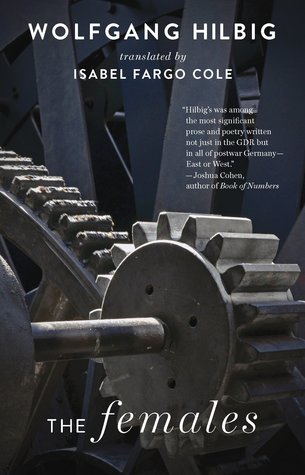
Over the past four years, five works by German author Wolfgang Hilbig have appeared in Isabel Fargo Cole’s lucid, evocative translations, each release bringing the late writer—always a literary outsider in life—an expanded following. The most recent offering, the fourth from Two Lines Press is the earliest, chronologically speaking. Originally published in 1987, The Females is an unrepentant portrait of a man burdened by a deeply and darkly distorted sense of shame and self-loathing. Classic Hilbig protagonist on one level, yet embryonic relative to the more abstract introspective narrators who move through many of his subsequent works.
This novella is set, like so much of Hilbig’s fiction, in a small industrial community in postwar East Germany. The narrator is, by his own description, a rather foul and socially inept misfit, a middle-aged man who still lives with his mother and harbours a troubled and seemingly stunted adolescent notion of women. He is not simply unnamed, but acutely aware of having been rendered nameless. Within the context of Hilbig’s shorter works this story is more explicit in its anger toward the state with its control of desire, creative and sexual. The recent history of his country, the ruins of war and the politics of the National Socialism, looms large. The imagery is gritty, coarse and vulgar, but the narrator’s desperate search for identity lends him a level of sympathy. He feels ashamed at his own corruption—especially a youthful turn at pornography, yet feels neutered and powerless. In the bluntness of its approach, The Females seems somewhat less refined than Old Rendering Plant and the Tidings of the Trees which follow several years later, but having this earlier work published in English at this point allows readers familiar with his oeuvre to see developmental themes at play.
True to form, this is an absorbing, compulsive read, one that slips regularly into a nausea-inducing, full-frontal assault on the senses. The opening passages are fair warning. The protagonist is working at a pressing shop in a former munitions factory. The shop floor is entirely staffed by women and, confined to a dank basement room, his task is to clean the molds. From his subterranean vantage point he watches the women work the machinery:
Through the grating above me, damp, smoldering heat flooded down with steady force. I sat on a chair beneath the grate amid this hot tide, hidden in semidarkness, several bottles of beer by my chair; when I drank the beer seemed to gush instantly from all my pores, lukewarm, not even changing temperature inside my body. It was ceaseless strain—my head constantly tilted back—to stare through the grate into the light, always hoping to see the women up there step across the bars.
He obsesses over every movement the women make, sexualizing the physical routine of the manufacturing activity, longing for a fleeting taste of femininity, and masturbating in his gloomy enclosure. Needless to say, he is employed on borrowed time. “I had gradually begun to transform into a sickness,” he tells us, one that is characteristically “utterly excessive; an agony not quite human, it was no longer that of an animal either.” Dismissed from his job, he takes to wandering the streets at night and notices, that something has suddenly been drained from the atmosphere. As an aspiring writer, the only vocation he has ever truly desired despite the disdain this ambition evoked in his family and society alike, he had once been able to look at the dismal world around him and, as he puts it, “make the filth glitter”. Now, either in reality or in his madness, his environment had been altered.
Much to his dismay, he becomes convinced of a most horrifying truth:
It was no help at all to sense I was possessed by an obsession, in my overpotent head a cascade of letters blazed: all the females had vanished from town, and with them had fled every trace of femininity.—Not only that, I felt that even feminine nouns had fallen out of use; I thought I suddenly noticed people in town referring to trash cans as der Kübel instead of die Tonne. When I saw those trash cans from afar, set up in long rows along the curbs that summer—something unlikely to change, as the trash collection service was still more dysfunctional then than in the winter—at first I’d think a line of unshapely females was loitering there, dully iridescent in the bluish streetlights, and I’d hurry toward them. I’d realize they were just the trash cans I saw every night, from their gaping orifices hung rubbish that looked hairy, that had an undefinable evil about it.
His desperate, guilt-ridden efforts to make sense of this situation, to set it right somehow, drives the nonlinear, obsessive, self-deprecating and bitter narrative of The Females. Some of the imagery is harsh, off-putting, and sexist. In his defence the protagonist blames the psychopathology of the state under which he was raised, one in which “the sex drive was declared to be abnormal…and sex to be capitalistic”. He clearly has had no real, substantial and healthy relationships with women. He wants to be loved, longs for normal human contact, but fears that his anxious desire will drive others away, that as his desperation becomes evident, he grows increasingly hideous—“A monster with putrefaction written in the crannies of its skin as hectic red blotches, with uric acid drying and itching on its pate, a madness no longer stoppable as damp tufts of hair began painlessly detaching themselves.” His frustration is redirected back at women—his mother included—and it his inability to conform to the expectations of those around him. To see the world as he is supposed to see it.
At the core of this novella lies a crisis of masculinity. Hilbig, like many of his generation grew up fatherless. His father had disappeared at Stalingrad and he was raised by his mother and maternal grandparents. His characters often struggle with the rigid expectations of manhood in their closed society. As men who are naturally drawn to creative pursuits, they react against the predetermined factory life by trying to find their missing role models among the social outcasts—garbage men or the workers at a rendering plant. In the world Hilbig presents in The Females, the State is the all-powerful progenitor, women are brutish and masculine, men are soft and delicate, psychologically castrated. His protagonist is criticized by his family for failing to live up to an ideal set by his father, though it is not clear that his father is more than a myth he has no real memory of. He is seeking an absolution through the women who have controlled, avoided and now eluded him, longing to heal a wound with roots, ultimately, deep in childhood memory and buried national history. He chooses to work in a factory staffed by females to try to be near their presence and feels cut off from a vital reality when he is cast out. In the shadowy depths of the town’s laneways he is searching for a feminine presence which he can only vaguely remember, distrusting his imagination and distorting reality into misplaced freakish phallic and vaginal imagery.
His is a strange, and strangely fascinating existential pursuit. “The world outside my window,” he is inclined to tell himself, “lacks the gaze that is mine”:
But I’d had to realize that I was no one.—I didn’t know whether I existed; the fact of my birth had been kept secret from me. They kept it secret to punish me, for I hadn’t turned out to be the thing they’d hope to bestow upon the world. Yes, I’d made the mistake of having myself be born, having myself be raised by the state and its pedagogy, by pedagogy and its state—I’d practically volunteered for it—but then I turned out differently. And so I had to be nullified, voided; there was neither a womb nor a pedagogy nor a state for the creature I’d become. I didn’t even have a name to lay claim to.
The Females is a challenging read in today’s climate of gender sensitivity. But emerging at a time when Germany was still divided (though Hilbig was by this time already living in west Berlin), its message’s bold, brutal delivery possibly reflects a more immediate frustration. Either way, it is a powerful short work that takes no prisoners.
Deftly translated by Isabel Fargo Cole, The Females by Wolfgang Hilbig is published by Two Lines Press.
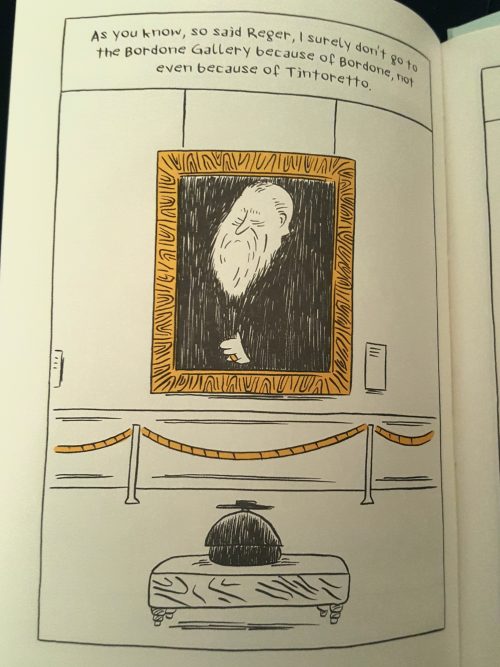
Anyone familiar with the unbroken, single paragraph monologues that characterize the typical novel by late Austrian writer, Thomas Bernhard, might find it hard to imagine how his work could be realized in the medium of the graphic novel. I mean wouldn’t there be too many words to corral on the blank page? How could the intensity of the original be translated? For Austrian cartoonist and animator Nicolas Mahler it’s simply a matter of focusing on the essentials of the story and letting his quirky illustrations and creative use of space do the rest. As a result, his graphic interpretation of Bernhard’s Old Masters: A Comedy is, well, something of a small masterpiece. One suspects that the author himself, and his alter ego characters, Reger and Atzbacher, would secretly agree, despite their shared conviction that a true artistic masterpiece is impossible to achieve, let alone imagine.
Rendered in stark black and white drawings playing on extremes—massive architectural details, characters who are tiny and squat, elongated and thin, or large and corpulent, often grotesque, appear against golden yellow highlights (a distant echo of the artwork in Ludwig Bemelmans’ Madeline series)—Mahler allows his images to complement and amplify the ridicule, humour and disgust so intrinsic to this and the majority of Bernhard’s idiosyncratic prose. Frequently recurring of images—the museum security guard, Irrsigler, seems to spend an inordinate amount of time disappearing into the men’s room—visually mimic Bernhard’s fondness for repeating phrases and motifs. As the blurb on the back of the newly released English language translation of this comic-book take on a comic classic states: “The Master of Overstatement meets the Master of Understatement.”
And it’s a match made in, well, the Art History Museum in Vienna.
There is precious little action in Old Masters and little obvious plot. It is, however, a spirited takedown of Bernhard’s favourite targets: the Catholic Church, the State, the arts and artists—his characteristically dark, satirical look at the world in general and Viennese society in particular. But it is also, in the end, a touching, sad and surprisingly romantic tale.
The story unfolds, if you will, at the musem, on a bench in the “so-called Bordone Gallery” directly across from Tintoretto’s White-Bearded Man. Here sits Reger, as he is wont to do every other day. Meanwhile, the narrator, his long-time friend Atbacher, observes him, just out of sight, from the “so-called Sebastiano Gallery” waiting for exactly eleven thirty, the time at which the two men have agreed to meet. Reger’s invitation is out of character because the they had met there just the day before and this second consecutive rendezvous was not in keeping with the typical pattern of either man. Curious as to the reason for Reger’s invitation to break from habit, Atbacher has arrived an hour early so as to watch his friend undetected. Naturally, this provides him the opportunity to launch into a lengthy account of Reger’s family history, his opinionated views, and his predilection to spend every other day at the museum, seated across from Tintoretto’s White-Bearded Man. In the novel this monologue consumes the bulk of the text. The same is true in this version which contains roughly the same number of pages, but much, much fewer words!We learn that Reger, the museum regular, has been visiting the Art History Museum for over three decades. Yet his attitude toward great art, the work of the “so-called” old masters, is one of disdain. Philosophically, he muses that a detail might be perfected, but the whole of any painting, sculpture, or other artwork ultimately leaves us appalled:
There is no perfect painting and there is no perfect book and there is no perfect piece of music, said Reger, that is the truth.
None of these world-famous masterpieces, no matter who did them, is actually something whole and perfect. That reassures me, he said. In essence, this makes me happy.
Only when we unswervingly come to the realization that there isn’t this whole or perfect thing do we have a possibility of survival.
And that has been the reason why I have gone to the Art History Museum for over thirty years…
As one might a expect, a number of artists, writers, and thinkers are subject harsh, and often hilarious, criticism as Reger, speaking through Atbacher’s account, expresses his unbridled opinions. Nineteenth century Austrian author, Adalbert Stifter, for example, is written off as a “kitsch master” with “enough kitsch on any random page to satisfy more than one generation of poetry-thirsty nuns and nurses” and then, strangely, compared to Heidegger, that “National Socialist, knickerbocker-wearing Philistine.” No one tosses out an insult like a cranky Bernhard character!There is, of course, much more below the surface than insults and irritation. That is where his peculiar wisdom lies. And, in this story, we learn that our irascible main character Reger’s antipathy to the old masters, and artists in general, has its roots in an emptiness they cannot fill. One that speaks to his, and our, need for love.One does not need to be familiar with Old Masters in its original form to enjoy this book (I wasn’t), but exposure to Bernhard in his full verbal intensity probably is. The satire, the heartbreaking warmth of the ending, and the sheer feat of rendering the mood and spirit of the Austrian writer’s pessimism and bleak humour into a graphic novel is not likely to be fully appreciated otherwise. I am a huge admirer of Bernhard, but I confess I’ve never really been drawn to graphic novels (pardon the pun). But the other night, when my son found this book on the doorstep of my old house where it had been left by a courier, I was immediately captivated. It has been a difficult few weeks and Bernhard’s misanthropic humour, oddly, is always strange comfort at such times. The beauty of this book is that it is not only a delight to read and look at, but I can imagine myself returning to it and rereading it many times (after all it doesn’t take very long—it’s akin to an instant hit of Bernhard relief).
Thomas Bernhard’s Old Masters, illustrated by Nicolas Mahler, is translated from the German by James Reidel, and published by Seagull Books. Essential medicine for any Bernhard fan, I’d say.
Since I finished Esther Kinsky’s magnificent novel River, it has been difficult for me to contain my enthusiasm for this work, and yet, with a major review on the way, I wanted to refrain from talking at length about my reading of this languid, mesmerizing meditation on the relationships we have with place—those we live in, pass through, or linger in uncertainly during points of transition. That review is now live, and yet Kinsky’s book is still working its way through my system.
River is a slow read; immersive, poetic, attentive to detail. It creates an atmosphere of intimacy with the spaces the unnamed narrator traverses during a time of restless displacement in a community on the edge of London; a time of gathering and preparation for leaving the city where she has lived for a number of years. Some of these spaces are immediate, defined by the course of the river Lea. Others exist in the distance, temporally and physically. And yet, although there are clear parallels between Kinsky’s own life history and the locations her narrator visits, River occupies an intentionally indistinct borderland between fiction and memoir, focusing on experience in the moment over biographical background and detail, resulting in a narrative that flows, organically, like the rivers than run through it.
My review of River can be found at the online site of the singular journal Music& Literature. The opening passages are reproduced below, you can read the rest of it here.
A mood, an atmosphere, rises up from the opening pages of Esther Kinsky’s River—a melancholy that unfolds so softly, so insistently that I repeatedly had to remind myself that I was reading words that originally existed in German. I found myself wondering: What would the German feel like in my hands? How would its texture taste, guttural tones against the back of my throat? These are questions that, in their asking, underscore how River is a text to linger in, to touch, to absorb, and recognize one’s self in. We follow the narrator as she temporarily suspends her life, settling for a time in a marginal community on the edge of London, so she can slowly disengage herself from a number of years spent in the city, and prepare, mentally and emotionally, to take her final leave. The process she details seems to be one we, too, undergo in reading River.
Under a pale sun and in the whitish, shadowless light peculiar to this place and these seasons, I took to following tracks which, time and again, led me back through the alder grove. This partly mutilated wetland wood with its childhood flowers and wild birds secretly appealing to my memory was my gateway to the lower reaches, to the path downstream that gradually taught me, during the final months of my stay, to find my own names for a city I had already spent many years labouring to decipher—names only walking and looking could force me to extract and reassemble from a web of trickling memories, a debris of stored images and sounds, a tissue of tangled words.
River by Esther Kinsky is translated from the German by Iain Galbraith and published by Fitzcarraldo Editions in the UK and Transit Books in North America.
It’s summertime, somewhere in the vast Hungarian plain, and this one’s a scorcher. The heat presses down on the residents of an unnamed village and threatens to reduce the river—the refuge and solace toward which the winter weary turn to enjoy what little holidays they can scavenge—into a fetid stream. But at the nearby üdülő, the local holiday site with its beach and bar and holiday homes on stilts, seasonal activities will not be curtailed:
On weekdays it was still quiet in the üdülő, but the bar already smelt of what had been left behind from the weekend: spilt beer, sweat, the girls’ summer perfumes, the exhaust clouds of the motorcyclists and helpless chlorine bleach with urine. Around midday clouds appeared over the bend in the river. The sky turned white, the river dark, the heat did not abate, became dense, bright, the poplar leaves rustled, sounded like whirring metal scarecrow strips. The small boats lay pale grey by the bank, motionless, congealed into a river panorama, from which only a powerful gust of wind or the hand of a wrangler or rower could awake them.
On the beach and back in town this will be a summer filled with drama, heartache, and melancholy—business as usual, but with a twist. This year there is a stranger in their midst, the New Woman, who has arrived from afar and settled in with Antal, the mason, who has in turn abandoned his wife and son. Such is the basic outline of Esther Kinsky’s first prose work, the novella, Summer Resort, a short, playfully poetic fable filled with a seemingly endless cast of tragicomic characters and bursting at the seams with striking and delightful wordplay.
With the attention that has come with the publication of River (see my review at Music & Lietrature), Kinsky’s only other translated work to date is likely to attract renewed interest. Compared to River, this earlier novel lacks the emotional resonance and meditative depth that one looking backward might hope for, but what it does offer deserves to be appreciated in its own terms, as an exuberant display of highly-charged linguistic energy, and a clear indication of the animated imagination, attentiveness to nature and the astute eye for detail that will characterize the prose in her longer, more serious work.
Summer Resort is an exercise in tight, contained story telling peopled with eccentric characters. Many exist almost as caricatures, like the Kozac boys who maintain a certain status in town and at the beach—admired, tolerated and resented in turn—the Onion Men, and the generic Marikas and Zsuzsas in their bikinis and glitter sandals. Others fall into closer focus. Lacibácsi the scrap yard dealer who runs the bar at the üdülő each summer aspiring to be a “manbytheriver, a poplarshadowman, a confidant of drunks,” his wife Éva (christened Ruthwoman by the New Woman) and Krisztí, the leather-clad woman who settles herself at the bar, a welcome if uninvited assistant. But at the heart of the story are Antal, his ex-wife Ildi, and son Miklós who each take a brief turn directly narrating pieces of their lives, now forever changed by the insertion of the mysterious New Woman into their midst.
More than anything though, this village and its inhabitants serves as a broad tapestry for Kinsky to weave her poetic magic. Her characters are the ordinary folk, the policeman, the railwayman, the small-time hustlers, the day labourers and the farm workers. Victims of shifting economies, closing industries and faded hopes. The üdülő is a place to lose themselves, to play and dream, but this year of heat and drought, is marked by fires, a shrinking river, and restless bodies tossing between sweat soaked sheets. There is an affectionate sadness that rolls across the surface of the narrative, and a quiet resignation that seeps into the dialogue. But the language is fierce, the imagery vivid: “Katica’s mouth was rose red with lipstick, there was so much red on it that it stood out in the üdülő like a wound.”
This is a startlingly sensual work. Here we find the elements that will later become so essential to the absorbing intensity of River. Kinsky has an unwavering awareness of detail, colour, scents, and sounds. Nature contains both the beautiful and the bleak, the lighthearted and the devastating. As is the case with the river that here, on this flat, unforgiving landscape, is a primal force:
What belongs to the river, what to the land? The floods come swiftly and silently. The river swells up, in the course of a night it casts of the sham cloak of gentleness, bursts its banks, spills over tops of embankments, carries off objects, animals, people. The undertow and thrust of the water changes the landscape. Sky, water, destroyed treetops, helpless house roofs as far as the eye can see. Then the river creeps back into its gentle course, trickles sweetly between the devastated rampant undergrowth of the bank which sticks this way and that, reflects the sky and sun, has long ago secretly discarded in the bushes what it has snatched away, where it is transformed, missing persons first become foul impediments, the vermin of the riverbank and water meadows gathering around them in great clouds, then pale, hollow bodies, through which the wind blows the quiet music of melancholy, which always lurks here in the undergrowth.
Esther Kinsky is a German poet, writer and translator. She has translated literature from English, Russian and Polish, including works by Olga Tokarczuk and Magdalena Tulli. Folkloric tones, reminiscent of some of their work come through here, perhaps, as does a pure poetic sensibility. A restless incantation for the loves and lives that collide in the course of one brittle, unrelenting summer, Summer Resort is a work well worth visiting for anyone interested in tracing the headwaters of River. And anyone else who simply enjoys a good tale.
Summer Resort is translated by Kinsky’s late husband, Martin Chalmers, and published by Seagull Books.
One week into Women in Translation Month and I’ve yet to jump into the conversation. I’ve been reading German author Esther Kinsky, her novel River for review and Summer Resort for background. However, since the North American release of River is not until early September, I don’t know if my review will actually run this month. But then, if it isn’t possible to pack August with translations of female writers, it is a consideration that can be worked into one’s reading year round. To that end I thought I’d share some of the posts I’ve written about works by women in translation that I’ve enjoyed since last August:
A Working Woman — Elvira Navarro (Spain, tr. Christina MacSweeney) The Iliac Crest — Cristina Rivera Garza (Mexico, tr. Sarah Booker) Malina — Ingeborg Bachmann (Austria/German, tr. Philip Boehm) Hair Everywhere — Tea Tulić (Croatia, tr. Coral Petkovich) Endless Summer —Madame Nielsen (Denmark, tr. Gaye Kynoch) – linked to external review SS Proleterka — Fleur Jaeggy (Italy, tr. Alistair McEwen)
Poetry: Before Lyricism — Eleni Vakalo (Greece, tr. Karen Emmerich) Third-Millenium Heart — Ursula Andkjær Olsen (Denmark, tr. Katrine Øgaard Jensen) – linked to an external review
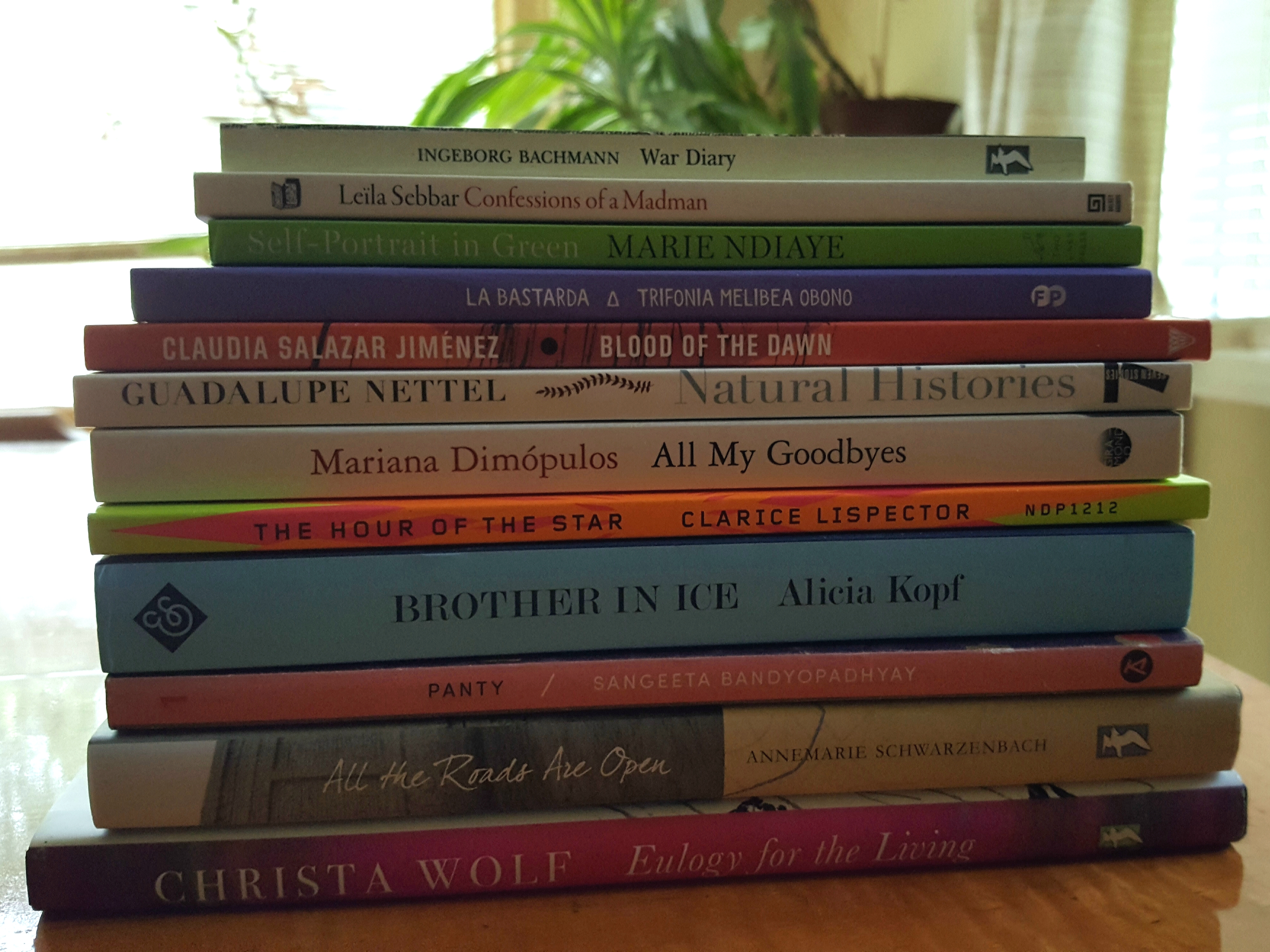
This year I’ve gathered a stack of possibilities—not that I expect to get through even half of them, but I like to have choice. And, because there is a lot going on in my life these days and a handful of other English language titles vying for my attention, I’ve selected relatively slender fare. Finally, because it is still Spanish and Portuguese Literature Months, this collection includes five Spanish, one Portuguese,one Bengali, two French, and three German language books.
And because poetry occupies more of my readerly attention these days, I’ve pulled out two poetic contenders:
Negative Space is translated from Albanian, Hospital Series from Italian. Both titles are from New Directions.
It was Wolfgang Hilbig’s story collection The Sleep of the Righteous, published in 2015 by Two Lines Press, that brought the late German author and his translator, Isabel Fargo Cole, to my attention. It might seem as if they arrived hand-in-hand, after all her translation of his novel I (Ich) appeared from Seagull Books around the same time, but of course, she has translated works by a variety of German language authors before and since those two titles emerged. But it would be fair to say that her efforts to champion Hilbig, her deep appreciation of his work, and her ability to be able to bring his convoluted sentences and filmic imagery to life in English continue to win him more admirers with each subsequent release. Most recently, she was awarded the Helen & Kurt Wolff Prize for her translation of Old Rendering Plant.
Photo credit: Emma Braslavsky
I have had the pleasure of interviewing this gifted translator twice now, and both times, when her generous responses to my questions arrived in my email, I read them with excitement and renewed appreciation. The latest interview was published at Splice this past week. In this piece, we talk about the most recent Hilbig release, The Tidings of the Trees, and the ways in which this work differs from last fall’s Old Rendering Plant. My questions were derived from my own reading of the book and were not sent until my review had been submitted for publication.
In the years since our first contact, I have read and reviewed Isabel’s translations of Klaus Hoffer and Franz Fühmann, and have added the works of several other authors she has translated to my library as well. But Hilbig remains central. So I am thrilled and honoured to be speaking with her in person in San Francisco on Tuesday night, July 24, as the Center for the Art of Translation celebrates her work, her recent award, and the release The Tidings of the Trees.
UPDATE:
The online journal Splice was hosting no longer appears to exist, so I have reproduced the original interview with Isabel as it first appeared below:
Wolfgang Hilbig, The Tidings of the Trees.
Translated by Isabel Fargo Cole.
Two Lines Press. $12.95. Buy direct from the publisher.
Isabel Fargo Cole grew up in New York City and studied at the University of Chicago, but she has lived in Berlin as a writer and translator since 1995. In 2013 she received a PEN/Heim Translation Fund Award to translate Franz Fühmann’s At the Burning Abyss for Seagull Books, and in 2014 her translation of Fühmann’s The Jew Car was shortlisted for the Oxford-Weidenfeld Translation Prize. More recently, she has published several translations of the works of Wolfgang Hilbig, and she won this year’s Wolff Translator’s Prize from the Goethe Institut for her translation of Hilbig’s Old Rendering Plant, published by Two Lines Press.
Her latest Hilbig translation is The Tidings of the Trees. Reviewing the book for Splice, Joseph Schreiber praised it as “a tale rich with fantastic imagery that openly explores the ability of fiction to preserve the past, mediate the present, and offer hope for the future.” Concurrent with the publication of Trees, Isabel Fargo Cole generously gave her time to correspond with Joseph via email and offer her take on working with Hilbig’s words.
TheTidings of the Trees, newly released from Two Line Press, is your fourth published Wolfgang Hilbig translation. Would you mind taking a moment to frame this novella within his body of work? When was it released and where does it fit?
The German edition (Die Kunde von den Bäumen) first appeared in 1992. It’s the last of a number of novella-length works Hilbig wrote in the 1980s and early 1990s. In terms of subject matter, it fits into a broader complex of works, culminating in the story collection The Sleep of the Righteous (2015), which explore Hilbig’s home town of Meuselwitz and the industrial wasteland around it. Hilbig returns time and again to the same landscape to explore different aspects and develop different metaphorical images.
.
This novella is described as one of his most accessible works. On the surface, perhaps, relative to the very close, internalised monologue of Old Rendering Plant(2017), it might appear to be a more straightforward, less claustrophobic tale. It’s a multi-level narrative wherein the main character, Waller, is telling his story to an unidentified narrator who records the account. We can place him in time, we know how old he is, and we have passing outside observations of his actions and behaviour as he is speaking. However, as much as time, space, reality, and fantasy are blurred in both novels, Waller is less able to follow and make sense of his own memories, and seems as concerned with touching abstract truths as he is with tracking down his own lost time. Consequently, much is left unresolved, unresolvable even.
Can you comment on the similarities and differences between these two novels with respect to the way reality is disrupted, and the challenges raised for yourself as translator?
Actually there’s just one narrator who sometimes refers to himself in the third person, as “Waller”. In many of Hilbig’s works — notably in ‘I’ (2015) — the author shifts between first and third person as a way of embodying how his narrators reflect on themselves or relate to their past, how writers observe and fictionalise themselves almost to the point of schizophrenia. In comparison with Old Rendering Plant, the landscape is more minimal, the language is a bit sparer; Hilbig is working with a more reduced and clear-cut palette of imagery and symbolism. This foregrounds the narrative structures, the interplay of perspectives and time frames. This is a story about storytelling, or rather its impossibility: the narrator tries to evoke the chopped-down cherry trees that once lined a road that led to a village that has vanished as well, swallowed by strip mines, and to describe the circumstances of these disappearances. This shifts to an effort to recall the taboo subject of Germany’s division and the disappearances it entailed.
On a number of levels, it’s about the difficulty of finding the right place to write from: “A place to sit! I’d lament, circling my empty chair.” Of course, the chair is just a metaphor or an alibi; the question is how to find the right perspective from which to reconstruct the memory or tell the story. And so the narrator shifts into the third person voice, as though that might help, or as though to watch himself writing; or he tries to adopt the perspective of the “garbagemen” who sift through the refuse of the past and seem to possess secret knowledge. Hilbig explores the question of adopting a persona or shifting personae to tell a story from, and the dangerous disorientation this can entail. And he explores how a writer devises and manipulates “figures” to act out his story: Figur in German is the standard word for a fictional character, but Hilbig exploits its literal sense of physical shapes that are seen from outside and remain rather alien, like puppets. Hilbig’s narrators find it difficult to relate to other people at all, and struggle with the sense that, in writing about them, they are producing mere simulations. In Trees, this takes physical form as the narrator arranges discarded store mannequins in tableaux in an attempt to communicate with the inscrutable garbagemen — an absurdist metaphor for storytelling.
These senses of simulation, unreality, dissociation, and an unstable “I” goes along with an unstable sense of time. Storytelling both asserts and complicates the notion of a linear timeline with a clear sequence of events bound by cause and effect — a story has to assume these things to some degree to have any coherence, but the very act of telling a story complicates the timeline and the causalities by situating a storyteller somewhere within or outside it. In Tidings of the Trees, Hilbig plays with the tension between the notion of a coherent “story” that exists out there, or within the memory, and simply needs to be recorded, and the teller’s actual struggle to grope toward this story and piece it together out of fragmented bits of time and space.
This is a struggle for the translator as well, as the often paradoxical-seeming tense shifts need to be attended to; the labyrinth of nested flashbacks and flashes of déja-vu is very much intended, and just as intentionally left without a resolution. In the end, the narrator comes to see the course of events as cyclical, narrated in “a language of return”, and he cedes the act of storytelling to the trees themselves: “storytelling without motive, a stream of story that followed only the slow rhythms at work in the place where the trees were.” The vanished trees write their story in their own ash upon the narrator’s empty page.
.
On a related note, I would like to ask you about the prose style in The Tidings of the Trees. In my reading, I sensed more variation in pace and tone than in some of Hilbig’s other stories and novels. There seems to be a more measured tone to much of Waller’s discourse; one finds more short sentences, less of the long, winding, stuttering flow of words. This is perhaps because the protagonist is trying to make himself understood to his audience. However, he has a hard time orienting himself within his own story and has an admitted disregard for reality. And there are many passages of exceptional urgency and poetic energy. How would you describe the differences in this narrative?
As you noted above, there is less of the intensely sensual, immediate, stream-of-consciousness style that you find in Old Rendering Plant or The Sleep of the Righteous. Perhaps the narrator of Trees is trying to access that more immediate mode of writing, but failing (at least until the very end, when he lets the trees speak). He has a greater detachment from the writing process; he’s reflecting on the act of writing, or rather his inability to perform that act: “But when storytelling reconstructs — or, in my case, manufactures — the problems of telling stories, it’s the pinnacle of self-circumscription. … I don’t know. Literature like that is unworthy of interest.” He’s ironising the postmodern irony of writing about writing — but taking it so far that irony turns into existential urgency. At the same time, Trees has more actual story, asserts more concrete, external goings-on (however fantastical and jumbled) than, say, Old Rendering Plant, which feels like a pure interior monologue.
.
Both Waller and the narrator of Old Rendering Plant are drawn to mysterious social outcasts, and, in each case, these elusive characters — the garbagemen who salvage goods from the ash heaps on the outskirts of town and the men who work in the depths of the rendering plant in the abandoned coal factory — are imagined in grotesque, surreal terms, and inspire some of the most exhilarating passages in each work. However, Waller’s identification with the garbagemen is more complicated, at once strange and enigmatic, and yet in their actions he sees a clear model for his intended act of preservation through storytelling. How do you see the roles, political and aesthetic, that these types of characters play in Hilbig’s work?
Hilbig was an outsider himself, as a self-taught non-conformist working-class writer in East Germany and as a working-class East German writer in West Germany. So it’s not surprising that he tended to write about outcasts — often his narrators are loners on the margins of society who become fascinated by people even more radically marginal than they are. Those marginal figures seem to represent, or have access to, things that society would prefer to forget, down to the crimes of the GDR and Nazi dictatorships. Interestingly, it’s hard to pin them down either as victims or perpetrators. In Old Rendering Plant, they might be war fugitives from Eastern Europe, or they might be old SS or Stasi men. In Trees, they seem to be in a state of exile from society, sifting through its detritus on the outskirts; on the other hand, they apparently act as an integral part of society’s digestive system, performing a function that remains constant across historical eras. They’re the people who quite literally do society’s dirty work.
.
Wolfgang Hilbig has a tendency to create narrators or protagonists who share basic biographical details very similar to his own, even if it is not made explicit. Their stories generally explore variations on a common theme — the search for identity in a society that enforces a rigid conformity of thought and action — and yet, each story or novel follows its own distinct path. Tidings is no exception, but this novel is also very explicitly about the responsibility of the writer and the enormity of his (or her) task. Waller’s twenty missing years form, in no small part, a severe case of writer’s block. Here he is, in mid-life, staring at the same sentence: “The cherry trees have vanished!” The question of the missing cherry trees that once lined the road to the nearby village, now also gone, represent a much larger, more vital story — about preserving memory, history, and hope. Would it be fair to say that this portrait of the writer’s task, if not his relative productivity, makes Waller an especially personal alter-ego for Hilbig?
I feel he’s actually a less personal and more abstract alter-ego: the Writer. There’s less of the texture of Hilbig’s own memories and biography, and he keeps stepping back from the narrator, referring to him in the third person, seeing him from the outside, actually spotting him in the distance, as a kind of doppelgänger. And he puts him in absurd situations that feel more consciously constructed, with more ironic detachment.
I think the cherry trees are in fact central: they are the story — or the storyteller, as the end hints. The cherry lane is one of Hilbig’s rare (but crucial) images of pure, innocent natural beauty, of a small paradise that existed within memory. It may have vanished, but it dominates the story, and in the end it prevails: the eternal, cyclical language of nature takes over the task of the writer.
.
Finally, you have recently been awarded the prestigious Helen & Kurt Wolff Prize for your translation of Old Rendering Plant. Congratulations! With another Hilbig translation, The Women, due later this year, the appetite for his work among Anglophone readers seems to be solid and growing stronger. There must be considerable satisfaction in this positive reception, and in being recognised for your intuitive and sensitive renderings. How do you feel about his reception? And more critically, in light of the disturbing political trends we’ve been witnessing in the West of late, do you think his message has a new relevance?
Thank you! I’m thrilled to see his work finally getting the English-language readership it deserves. I certainly think he has a lot to say to us about the cruel and unsavoury sides of social orders; about the way historical traumas are passed down and continue to do harm even (and especially) as they are denied and repressed; about the sheer mass of depression, anger, and hopelessness that can build up among people who feel alienated from their societies, from each other, and from their natural surroundings; about the (self-)destructiveness that results. I don’t think he has a “message” in the sense that he’s asking us to understand x so we can do y. But perhaps he asks us simply to recognise the dark shadows and the “garbage” on the outskirts of town as something integral to the human experience. Those strange sinister characters out there, whether they’re victims or perpetrators or both, aren’t “the other” — they’re alter-egos, reflections of ourselves and our own potentialities. Facing the darkness won’t perform some kind of therapeutic magic and automatically empower us to transcend it, but it could help us to proceed from a position of humility, a deeper understanding of our own and others’ limitations, absurdities, and burdens. At least that’s the best way I can think of to explain why I personally find his work moving and bracing, if not exactly comforting, at this particular time.
.
Joseph Schreiber is a writer based in Calgary, Canada. He is Criticism/Nonfiction editor at 3:AM Magazine. His reviews and essays have been published in a variety of literary sites and publications including Numéro Cinq, Quarterly Conversation, Minor Literature[s], and RIC Journal. He also maintains a literary site called Roughghosts and tweets @roughghosts.
 Born in Bavaria in 1929, Enzensberger’s poetry covers a vast range of subject matter, and he is also an editor, translator, and a vital, often controversial, essayist. This collection was published in its original German in 2003, in the early years of a new century, when the poet was in his seventies. The opening section frequently touches on private moments and emotion, and includes some wonderful images of the simple intimacies of long-term relationships, of shared beds and lives—the wonder of a breath, a touch, proximity—while the second turns its attention to the lives of others, conjuring portraits that are historical, political or literary. A particularly poignant piece is the haunting elegy to fellow countryman WG Sebald “Who touched us, / who seemed to have come from afar / to the sinister, unhomely homeland. / Little kept him here. / Nothing but the search for traces / with a divining rod of words / which twitched in his hand.” (From “For Max Sebald”, trans. by Martin Chalmers)
 Unassuming, but delightfully perceptive, it is possibly the single entry I return to more than any other. But this book is filled with many such everyday wisdoms. An appreciation of irony is, perhaps essential for the full impact of Enzensberger’s poetry, however, I have come, over the years, to believe such an appreciation is almost a basic life skill.