The dying gold of ruined stars – Poems: Book One of Our Trakl by Georg Trakl

“Sun, autumnal, thin and shy,
And the fruit falls from the trees.
Stillness dwells within its blue rooms
During a long afternoon.”

– from “Whispered during the Afternoon”, Georg Trakl, translation by James Reidel

Many years ago when I was in school, poetry, in so far as we were introduced to it, was almost exclusively the works of English language poets. In high school I fell under the spell of the English Romantic writers and that was the beginning. Over the years though, I would be inclined to think that most of the poets I have become obsessed with wrote in English, that is, until I began to read more translated fiction. With that my attention shifted, or to be more precise, my horizons became broader.

TraklThis year, a German book enthusiast I have come to know through the “internet of book discussions”, the corner of the web I inhabit, introduced me to Austrian poet Georg Trakl. Somehow he had escaped my attention before. Of course, when you come to read poetry in translation, the question of the translation itself becomes critical. Typically, when more than one translation of a poet’s work exists I try to access and compare a few. But when Seagull Books released the first installment of a three part series of Trakl’s poetry, I did not hesitate to order a copy, sight unseen.

Poems: Book One of Our Trakl is a new translation, by American poet and translator James Reidel, of the poet’s first collection, simply titled Poems (Gedichte), which was originally published in 1913. In his note at the opening of this volume, Reidel recounts that he has endeavoured to preserve the same concentrated mania that marks the works of the 19th century poets Trakl would have read: Baudelaire, Rimbaud, Verlaine, Hölderlin and Poe. He says:

“I want to actually channel Trakl, his craft (with its implicit painterliness) and work ethic, to have him, so to speak, absorbed in the right dosages he – as a poet, pharmacist and addict – intended.”

Reidel does go on to add that to emulate Trakl’s delivery in English, the rhyme scheme of the original poems is often necessarily sacrificed, but the contortions required to retain  rhyme can trivialize a poet’s spirit and tone.

In an essay in the online poetry journal Mudlark, Reidel expands on his Trakl translation project. He provides an overview of Trakl’s short and tragic life, as well a discussion of his approach to the translation, and a selection of his translations presented with the original German. A poet himself, Reidel brings a sensitivity and insight to his reading and approach that I, as reader, value:

“I have found that when you read Trakl in the original German, you get a snapshot of what is there. When you go back, you get another view. It may be sharper or less so, and with the feeling that it is intentionally less so. This can be frustrating for those who speak and think in English, that lawyer of languages. There is no fixed point to reading him or rendering him. This makes any book of translations simply a collection of snapshots of a particular reading at any point in time. Another way of rendering/reading a Trakl poem is through the barrel of a kaleidoscope, where one can only fix on a view when one stops or when the glass bits sometimes jam. I do this.”

Born in 1887, into a prosperous Salzburg family, Trakl was a precocious child, creative and intelligent – by his early teens he was experimenting with lyric verse that showed great promise. He could, however, be withdrawn and prone to depression. He was exceptionally close to his sister Margarete (Grete), a musical prodigy with whom he is thought to have engaged in an incestuous relationship. He began publishing poems in 1908, in Vienna where he had gone to study pharmacology, a tempting profession for one who already had a tendency towards addiction. As a budding poet, he enjoyed early success and mentorship during the following years, ultimately attracting the discreet patronage of Ludwig Wittgenstein. But the outbreak of war forced him into military service. Relying on his training as a pharmacist he hoped to avoid direct combat, but the trauma of trying to attend to desperately wounded troops without adequate supplies would drive him to attempt suicide. He was sent to a military hospital in Kraków for observation, but suffered a relapse and was found dead of a cocaine overdose on November 3, 1914. He was 27 years old.

                Patterns of Decay  (c) JM Schreiber, 2011
Patterns of Decay , Copyright JM Schreiber, 2011

This first volume of Trackl’s poetry, beautifully bound and presented by Seagull books, readily lends itself to an immersive reading from beginning to end. The autumnal themes that feature so strongly make it an even more evocative read for someone like myself at this time – that is, in November in the northern hemisphere – but autumn is rendered almost metaphorical in his verses. Nature figures in his work, rendered through rural and religious imagery; however nature, for Trakl, is one which couches death and decay as an intrinsic element of its stark beauty and haunting appeal:

In the evening, when the bells toll of peace,
I follow the birds in their glorious flights,
Long multitudes, like pious trains of pilgrims,
Disappearing into autumn’s clear breadths.

Wandering through the twilight-filled garden
I dream following their brighter destinies
And feel the sundials barely move any more.
So I follow their journeys above the clouds.

There a blast of decay makes me start to tremble.
The blackbird laments in the leafless branches.
The red vine totters on rusting trellises.

While like a dance of death of pale children
Around the dark weathered rim of the fountain
The blue asters toss shivering in the wind.

– “Decay”

These are quiet, brooding poems that show a clear obsession with decline. They speak to a young poet struggling to capture the gloom in his own soul, consequently the poems have a very immediate and personal feel. Are they depressing? As someone who has had his own lifelong challenges with mood dysregulation, I find his words oddly comforting. I am not equipped to offer a critique of poetry, I am afraid I can, in this case, only speak to what I feel. And I don’t believe I am alone in registering a profound personal response to Trackl’s poetry. In his short life he produced a small, but vital, body of work that would have an important influence on other German language poets including Paul Celan, Thomas Bernhard and Peter Handke; and draw the ongoing interest of poets, translators and readers outside of German speaking countries that continues to this day, just over one hundred years after his death.

For my part, I can only eagerly look forward to the upcoming additions to Our Trakl.

For all the restless souls: The Sleep of the Righteous by Wolfgang Hilbig

The landscape haunting the seven intermeshed stories that make up The Sleep of the Righteous by the late German writer Wolfgang Hilbig, is decidedly bleak. The fulcrum around which these stories pivots is an industrial town south of Leipzig – run down, defined by its drabness, perpetually unfinished, bordered by mine pits, the ruins of munitions factories, a lake, marshes,and, beyond that, the forest. Before and after reunification, this town remains a place in which time exists on another plane of reality, at least as far as the narrators – all varying shades of the same man with more than a passing resemblance to Hilbig himself – experience or remember it:

“Time persisted here in dogged immutability; the autumnal fog banks that merged beneath an earth-colored sky appeared unlikely to pass for decades to come. And more and more smoke seemed to spill from the sodden lowlands into the flat clouds, which, even in the afternoon, were nocturnal.”

sleepThis powerful collection is divided into two parts. The first part focuses on childhood, coming of age or, as it often seems, waiting to come of age, to “rise at last from the state of useless, unfinished, in-between beings”. Set in the years immediately following the Second World War, the town is a place where men are in short supply. The majority of the children are fatherless, their mothers widowed, and few babies are born. Consequently, relationships and social dynamics are skewed. In the opening story, “The Place of Storms”, the young narrator endeavours to negotiate the murky waters between the realm of the “little children” and that of the “older children”. Rumours that his grandfather has a gun boost his status and potential for crossing the divide, while the horrific swim trunks his mother knits him complete with suspenders are a decided barrier. All of the awkward anxiety of youth is played out in the grimy pools of the abandoned mine pits at the end of the street where children wile away the summer hours divorced from the world of the suffering, lamenting adults in their lives.

The stories in the second part are set in the 1990’s, after the Wall has come down. The protagonists are all now grown men, writers, who have long since moved away from this small town, but find that they are unable to stay away. Restless, they regularly return to encounter ghosts, to visit an aging mother, or to escape a disintegrating relationship. No matter how long they may have been away, they never really leave the place behind. But they return to a town that is dying, industries and businesses that have been abandoned, and memories that cannot be escaped. In the final, and longest story, “The Dark Man”, the unnamed narrator is an established author who encounters, on the darkened streets of his old hometown, a stranger who has pursed him and now reveals that he was the Stasi agent responsible for intercepting and reading the writer’s correspondence. He claims to have a collection of letters originally intended for our hero’s former lover, a woman who presently lies near death. The narrator is disturbed, but determined not to let this curious relic of the GDR get the better of him – he denies any suggestion that he and his enemy have anything in common. Yet when he gets back to his mother’s apartment, the man in the bathroom mirror bears a haunting resemblance to what he could manage to make out of the stranger in the dark.

The Sleep of the Righteous is one of those books where you may well be inclined to stop and reread a paragraph several times before moving on, not because it is opaque or dense, but because the language is so captivating; the flow and rhythms, like eddies in a stream of water, swirling, reversing, and moving forward again. The brief title story is a sadly lyrical meditation on the cycle of guilt and recrimination that binds and defines the relationship between a boy and his grandfather who, in a reorganization of sleeping arrangements, end up sharing a bed following the death of the grandmother – a demise that one of them might have inadvertently caused. It opens:

“The dark divests us of our qualities. — Though we breathe more greedily, struggling for life, for some fleeting substance from the darkness… it is the darkness that forms a mute block above us: intangible matter our breaths cannot lighten… it seems to burst apart at each answer from the old man, each lament of breath, yet sinks in again swiftly to weigh down still closer, in the cohesive calm of myriad tiny black, gyrating viruses. And we rest one whole long night in this block of black viruses, we rest from the toils of the day: from the everyday toil of circling each other, still and hostile.”

Night after night, grandfather and grandson twist and turn to a nocturnal chorus of queries and accusations, in this poetic evocation of the tensions that underlie the fictions that families maintain to make sense of the very ordinary tragedies that strike close to home.

In his introduction to this volume, Hungarian writer László Krasznahorkai, writes that in focusing on the mundane, the everyday life in East Germany, Hilbig manages to heighten the oppressiveness of that existence, rendering it all the more horrific as a consequence: “He wrote his astounding novels about a world in which only the weak, the sensitive, those incapable of bargaining and in no way heroic, can sense the chaos and the surrealism.” However, the measured, heavily weighted quality that hangs over the stories in The Sleep of the Righteousness, is bouyed by the sheer beauty of the prose and the quiet resilience with which the protagonists respond to the circumstances that history has gifted them. This could be a depressing read but somehow it is not.

Translator Isabel Fargo Cole, in a recent interview in World Literature Today, indicates that this collection is one of Hilbig’s most autobiographical works. His narrators tend to share the same basic features of his background – his grandfather emigrated from Poland, his father disappeared at Stalingrad, and he grew up with his mother in a household dominated by women. The town he mythologizes in his tales is modeled after the same one where he was born and grew up. Yet, it does not feel liked these are connected as part of a continuous narrative so much as each protagonist seems to have a similar launching point from which he proceeds to tell his story. There are overlaps and divergences along the way.

The Sleep of the Righteous is published by Two Lines Press. Along with his earlier novel,  I, which was also translated by Isabel Fargo Cole and released by Seagull Books this summer, English speaking readers finally have a chance to experience the sombre magic of Wolfgang Hilbig. And, hopefully, look forward to more.

What can or should a story be? The Swan Whisperer by Marlene van Niekerk

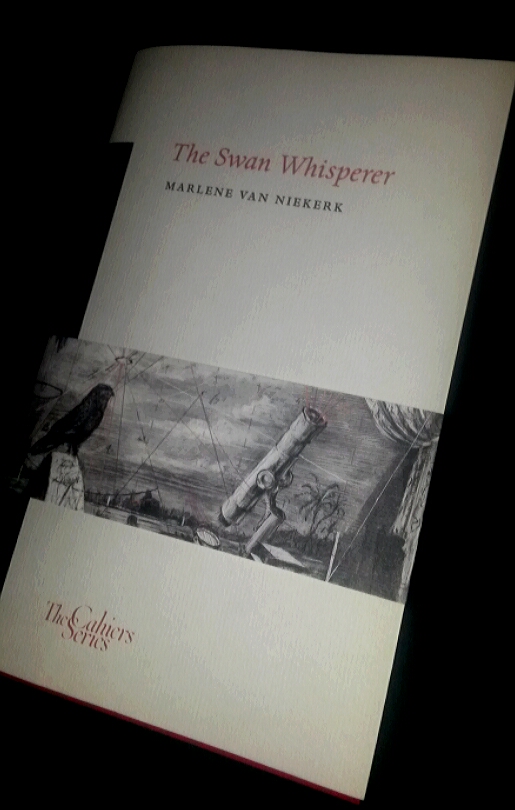
The Swan Whisperer by Marlene van Niekerk is the literary equivalent of an impossible space – that is, this 40-page sewn paperback, lush with illustrations by fellow South African, famed artist William Kentridge, contains a tale much larger than its size would suggest. It begins modestly. Subtitled An Inaugural Lecture, van Niekerk opens with a series of questions for her imagined audience:

“What does one teach when one is a teacher of Creative Writing? The true? The good? The beautiful? Should one teach criticism, fantasy, or faith? What is the use of literature? What is its place on the greater canvas of human endeavours? And perhaps I should also ask: Can a story offer consolation?”

Voluminous texts have been penned to examine questions such as these, and yet within the 18 pages that lie ahead once the illustrations have been accounted for, is our esteemed professor at the lectern is planning to explore them all? No, she is going to tell a story, offer a fable within a fable, share an experience that she claims rendered these questions irrelevant for her.

2015-11-11 03.16.04What plays out in this inventive and thoughtful allegorical tale is an exploration of the relationship between language and meaning, meaning and truth, truth and the stories we tell which, in turn, leads back to language. Van Niekerk casts herself in the role of the skeptic. At the outset she is busy with the final revisions on a novel that is almost complete. Around her, the rest of her life and responsibilities have been suspended while she survives on frozen dinners and ignores her untended house and garden. The last thing she is prepared to welcome at this moment is a 67-page letter from a former student who, she discovers, is writing from a hospital bed in Amsterdam. She had recommended him for a student fellowship in the city with the thought that the change of place might finally help this pale, anxious young man finish off his MA and move on. But she is certain without reading beyond the first few paragraphs that there is little hope for him and most certainly nothing in his massive missive for her.

And so it goes. After reading a little further, she tucks his letter into a drawer and forgets about it until an unusual package arrives: a dummy of her new novel in which he has written notes and dates, along with 16 cassette tapes. Gradually she will be drawn into the story he wants – no, needs – to share. Cynically she reads about how her student, Kasper Olwagon, believes he has discovered, quite magically almost, an unusual homeless man who seems to have an uncanny ability to summon swans to himself. He watches the man for a while and ultimately takes this vagrant home. He longs to know how this apparent ‘swan whisperer’ calls to the magnificent birds, but for all of his efforts, Kasper is unable to encourage or help him to speak.

2015-11-11 03.18.55In his long letter, Kasper anticipates his professor’s reaction, but he persists and over time, as she is drawn into the mystery and returns repeatedly to his letter for clues. She reads about his attempts to extract meaning from the murmurings he believes he heard, his desire to translate the language of swans. She hears in his efforts echoes of Afrikaans. Slowly she will begin to understand the meaning of the cryptic note that accompanied his parcel containing the book and tapes. The last words he wrote to her were: “Farewell to the worlds of will and representation!” As readers we are invited to follow the entwined journeys of student and teacher to that place where all of those questions posed at the beginning seem to be archaic, irrelevant. And once those rhetorical questions are left behind, one begins to appreciate the expanse of the impossible space contained in this small book.

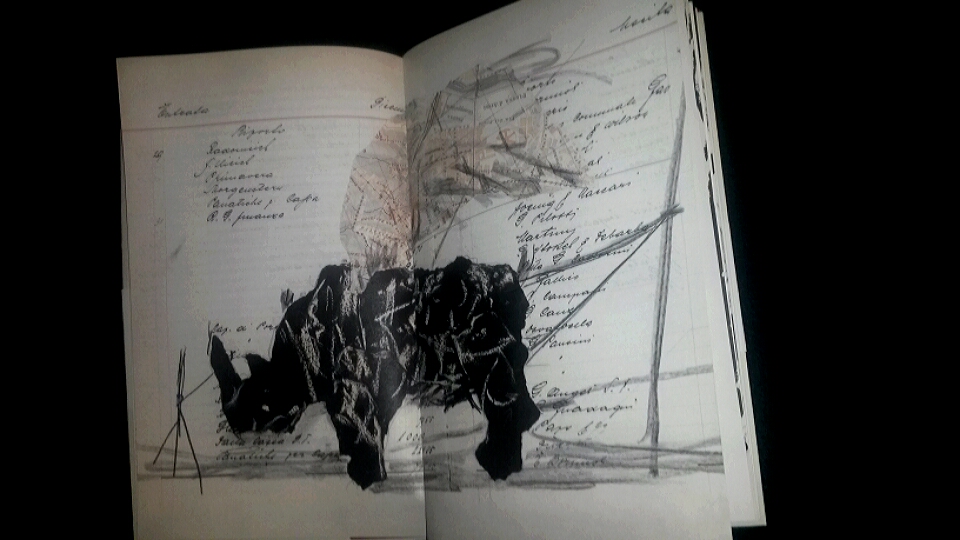
2015-11-11 03.21.17The Swan Whisperer is the latest addition to the “Cahier Series”, a joint project of the Center for Writers and Translators at the American University of Paris and Sylph Editions. Eminent writers and translators are invited to offer their reflections on writing, on translating, and on the intersection between the two activities. Each volume is accompanied by illustrations. Here, the striking black and white drawings by William Kentridge act almost as a visual soundtrack. His work has a tendency to explode off the page. The images complement the story by exploring the relationship between artists, animals and language. The text is translated from the Afrikaans by Marius Swart and the author.

2015-11-11 03.13.44I have to add that this particular volume held a special appeal for me. This spring I read, for the first time, Marlene van Niekerk’s magnificent novel Agaat. Not only is this a complex, deeply moving story; but the way that language is evoked and brought into play presented a challenge well met by the translator, Michiel Heyns. Not long after this encounter I made my first visit to South Africa and I had the singular pleasure of experiencing William Kentridge’s installation “The Refusal of Time” at the National Gallery in Cape Town. It was, I felt, like a command performance as no one else even ventured into the room beyond a quick glance at the door. Their loss and one of my fondest memories of my stay in the city.

And now I have both artists together in this enchanting and thought provoking book.

Last letter from Petrópolis: Montaigne by Stefan Zweig

Over the course of his life, Stefan Zweig was a most prolific writer, known not only for his novels and plays, but also for a wide range of historical and literary biographies. He has been criticized as a lightweight by those who fail to appreciate his charms, but it is difficult to deny the passion for literature and lifelong learning that informed his work. With his biographical subjects he followed the topics and personalities that caught his attention and, perhaps as a consequence, he was drawn to write about those whose work and ideas he admired, as well as some of the figures who played darker roles in history.

motaigneThe last of the writers to captivate him, the subject of his final book, was Michel de Montaigne. Hitler’s rise to power in 1934 drove Zweig from his native Austria to England, but by 1940, with Europe torn apart by war, he crossed the Atlantic to New York City where he stayed briefly before moving even further to Petrópolis, a German community in Brazil. Here in the mountains north of Rio de Janeiro, far from the library he been forced to abandon in Vienna, he would uncover a dusty copy of Montaigne’s Essais in the cellar of his house. He made this fortuitous discovery in the autumn of 1941 and his delight in it would preoccupy the final months of his life. In February of 1942, Stefan Zweig and his wife were found dead in their home. It is not certain but, as much as Montaigne provided him the comfort of a kindred spirit speaking out across the centuries, he may have also inspired or reinforced his decision to end his own life.

Zweig opens his biography with a confession that when he first encountered Montaigne at the age of 20, he was filled with youthful idealism for the new century that was dawning. He could not imagine what relevance he might find in this “Frenchman already yellowed by time and lost in the riddles of his Latin quotations”. Ahead he could only envision the prospects of peace and progress. Rediscovering Montaigne 40 years later, he found immediate parallels between the violent upheaval of the years of the Reformation and the devastating collapse of 20th century glory into the brutal waves of intolerance and destruction sweeping Europe. Curiously, the age of 20 was also the age at which Montaigne himself decided to end his formal education on the conviction that by 20 the soul is formed and thus, beyond that point, the spirit will not be further enhanced. He would, of course, turn his attentions inward in his lifelong effort to understand that soul.

There is, in the course of this short biographical account, little that will be new to anyone acquainted with the general details of Montaigne’s life and writings. What is of more interest is what this essay reveals about Zweig’s mindset in the last winter of his life. This is very clearly a personal undertaking. Even though Zweig set about researching the social and political context in which Montaigne lived, the resulting work was never subjected to a judicious edit and, as it exists, it tends to be overly repetitive in some aspects, especially where Zweig’s enthusiasm runs high. He finds in Montaigne a friend, a wise counsel so desperately needed when his own despair at the state of the world is reaching an all time low and, as such, he is inclined to defend his friend against his critics even if his arguments tend to be based in emotion rather than reason. The only criticism he himself is willing to levy is with respect to his hero’s noted disregard for his children and the women in his life, and his desire to find refuge from their demands on his energies. Still, Montaigne’s withdrawal to his tower to contemplate the nature of the self – that is, the self that interests him most dearly: his own – is a choice that draws Zweig’s sympathy and support.

As a writer and a lifelong lover of literature and history, Zweig finds a like-minded ally in Montaigne. He admires the way that Montaigne engages with books. He reads without obligation or duty, choosing to discard books that are not working for him. As Zweig remarks:

“He is without doubt a serendipitous reader, an amateur reader, but there has never been, in his time or in any other, a finer or more perceptive reader. Concerning Montaigne’s judgement on books I am 100 per cent in accordance.”

Later he continues:

“The great lesson Montaigne receives from books is that reading, in its rich diversity, sharpens his faculty of judgement. It impels him to respond, to lend his own counsel. And this is why Montaigne tends to annotate his books, underlining passages and writing at the end the date on which he read them, or the impression that they made on him in that moment.”

It is hard to argue with this sentiment. Two lovers of books, passionate about reading are bound to feel instant kinship, even when reaching across time and space. For a man in exile, cut off from his intellectual community in Europe, it is not difficult to imagine that Zweig felt he had found a soul mate in Montaigne.

But then why was this bond, this example of a man so firmly dedicated to the question of how one should live, not sufficient to carry Zweig through his darkest hours? Montaigne is careful in his essays not to dictate how others should live. His focus is always turned inward. He shares what he finds and what he comes to believe he should strive for in living. Zweig draws up a list of the constraints that Montaigne expresses a desire to avoid including: vanity or pride, presumption, fear and hope, belief and superstition, ambition and avarice, fanatacism, and family and familiar surroundings. There is, however, one more:

“And one last freedom: in the face of death. Life hangs on the will of others, but death on our own will: ‘La plus volontaire mort c’est la plus belle.’”

That is, he insists, the most voluntary death is the most beautiful. If Zweig who was known to struggle with depression had already contemplated suicide (and according to the translator’s introduction he had expressed that sentiment before), one cannot help but wonder if he found some measure of validation in Montaigne’s writings.

This biography stands as an example of the deeply personal impact that literature can have on a reader. Zweig argues that there are writers who come to you, or come back to you, at the time when you are ready to hear them. This final work took precedence over any of this other writing projects in the months leading up to February 22, 1942, the day he and his wife each took an overdose of barbiturates and lay down together hand in hand. In a sense Montaigne exists as a final effort for a sensitive writer to make peace with a world that seemed to have spun off its axis. For that reason alone it is worth the read.

glm_v

Translated from the German by Will Stone, Montaigne by Stefan Zweig is a new released from Pushkin Books.

Listen closely now – The Voice Imitator: 104 Stories by Thomas Bernhard

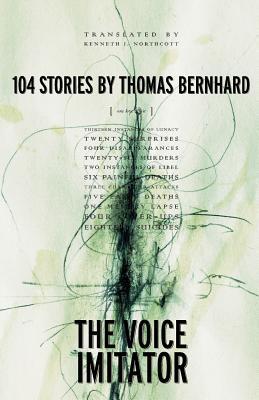
[one love affair]

THIRTEEN INSTANCES OF LUNACY
TWENTY SURPRISES
FOUR DISAPPEARANCES
TWENTY-SIX MURDERS
TWO INSTANCES OF LIBEL
SIX PAINFUL DEATHS
THREE CHARACTER ATTACKS
FIVE EARLY DEATHS
ONE MEMORY LAPSE
FOUR COVER-UPS
EIGHTEEN SUICIDES

With the list above, the cover of the University of Chicago publication of The Voice Imitator offers a warning to the potential reader of the themes that feature in the 104 stories that lie ahead. For seasoned readers of Thomas Bernhard none are likely a surprise, though it is quite possible to emerge at the end thinking, “were there only 26 murders and 18 suicides?” Chances are it feels like there are more. But that’s okay. Would you really expect less?

VoiceIf the thought of encountering a volume containing 104 stories sounds intimidating, be assured that this collection spans all of 104 pages. This is Bernhard in microcosm, all of the acerbic wit and dark charm one could want from the Austrian playwright, poet and novelist distilled into brief anecdotal tales, each recounted within the space of one page.
The longest fill the page, the shortest are no more than a few lines.

Drawing on newspaper reports, rumour, and overheard conversations, Bernhard exploits this condensed form of fiction to tackle his favourite targets, including, of course, his native country. Even in a confined space, he finds room to explore the foibles of human nature and contemplate the bitter ironies of life. There is a healthy dose of death – murder, suicide, accident – some, tragic, some absurd; and no small measure of madness. Featuring a familiar retinue of philosophers and professors, craftsmen and woodcutters, musicians and artists, freaks and loners; the stars of these anecdotes and fables are driven by conviction, thwarted ambition, disillusion, and disappointment. Just like, well, the rest of us.

The least effective pieces are the very shortest. A few more lines are often in order to set the scene, to draw the drama, to pull the the punch. But even then, the emotional impact can be striking with less than half a page:

“Sitting in the early train, we happen to look out of the window just at the moment when we are passing the ravine into which our school group, with whom we had undertaken an excursion to the waterfall, had plunged fifteen years ago, and we think about how we were saved but the others were killed forever. The teacher who had been taking our group to the waterfall hanged herself immediately after a sentence of eight year’s imprisonment had been passed on her by the Salzburg Provincial Court. When the train passes the scene of the accident, we can hear our own cries intermingled with the cries of the whole group.”                        (Early Train)

The use of the first person plural in the majority of these stories lends an intimate tone. One can almost imagine the narrator as one of those inveterate storytellers who always has an entertaining morsel at hand: a family legend, a piece of wisdom, a mini tirade to share. Bernhard’s language plays on repetition, relies on qualifiers like “so-called” – one can almost see the air quotes – and, in this shortened format, he delights in throwing a punch at the end, leaving the reader with a gasp, a nod, or an ironic laugh.

Some might see this as an introduction to Bernhard for those uncomfortable diving into, say, a single-paragraph 200 page novel. But it works even better, one might argue, as a treat for those who are already acquainted with some of Bernhard’s classic works. Each little anecdotal story stands like a glimpse into the windows of Bernhard’s world… the themes, characters, and images that feature in his longer works shine, isolated for a moment, in the space of a single page or less. Contained in this way, his rhythm, his cynicism, and acerbic wit ring through. Bite-sized Bernhard to marvel at and enjoy.

glm_vThe Voice Imitator is translated by Kenneth J. Northcott. This stands as my first contribution for the German Literature Month reading challenge.

What no love can heal: Dry Season by Gabriela Babnik

Harmattan: A cold-dry trade wind that blows across the West African subcontinent from the Sahara to the Gulf of Guinea during the winter months bringing dust storms, low humidity and an increased risk of fire outbreaks. This is the trademark wind of the dry season.

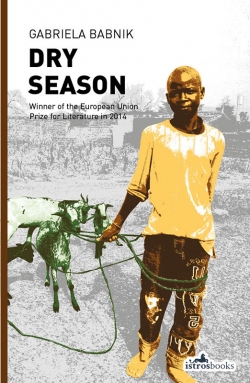
dry-season-cover_54aff6fb99d92_250x800rAs Gabriela Babnik’s novel Dry Season opens, we find a 62 year-old Slovenian woman, Ana, lying in bed with a 27 year-old Bukinabé man, and it is immediately clear that her path to reclaim herself will defy conventions. But then, as we come to know her, we realize that she has long been resistant to the constraints of convention. Ana and the young man, Ismael, are not yet lovers, despite the fact that they awake in the same bed. Their first encounter is uncertain, tentative. Across the boundaries of age, race, class, and culture, they have been drawn to each other with their own dark histories lying twisted inside. As these two disparate individuals take turns addressing the reader – that is the most accurate way of describing the manner in which their stories are uncoiled – we gradually begin to learn more about their pasts and their feelings toward one another.

Ismael and his friend are targeting tourists to rob when he first spots Ana. He is drawn to her but does not see her as a potential mark; he does not sense that she is carrying much of monetary value. It is something else, though he is not entirely certain what that is. For Ana, her attraction to black men is rooted in an earlier time in her life: a chance encounter and subsequent affair with a Sudanese man that has left an unfilled and aching space in her memory. It is not clear that she knows, or is ready to confront, what she truly hopes this young man can heal in her:

“But this sleeping man in front of me was from another time. He had a god drawn on his face. I wanted to say that earlier but it slipped my mind. As I was walking toward him from the other side of the avenue, I felt a strong desire for him to touch the secret territory inside me. Ever since I gave birth thirty years ago, I knew I had to put it aside for a while. I mean touching the silky surface of blades of grass with my palm or licking honey slowly from a metal spoon and then looking at my face in it.”

Ana admits that she has literally walked out on her life in Ljubljana, a life she sees as reduced to the design of illustrated throw pillows, trapped an inherited house with a view of the garden. She is haunted by the suicide of her distant mother, the decline and end of her marriage, the return of her long absent father, and the descent into madness of her only child. Behind all of this is a persistent pain, a bitter groundlessness borne of the fact that she was adopted from an orphanage. It colours, perhaps even distorts, a sense of abandonment that no person, place or career can fill. Her escape to Africa is a deliberate attempt to fill this void.

As Ismael takes up his side of the narrative in turn, it becomes evident that these two unlikely lovers share some common demons. His father is unknown to him and this status defines him and his mother in the village in which they live. They are subject to open shaming and abuse until the day when they are finally rescued and removed to a longed for but equally uncertain life in the big city. They take up residence for a while with a man he calls Baba, and who becomes, over time, a sort of surrogate father whose albino son, Malik, will grow to be both a friend and a recklessly dangerous influence. But in the meantime, Ismael’s increasingly unstable mother will flee to the streets. Together they beg on the roadside and sleep under a bridge until his mother is suddenly killed when he is seven years old.

“Not long before they told me that a lorry had run her over – that it was really her, and not one of the night women or morning women – we had grown apart. Or maybe she had grown apart from me, I am not sure. It is possible that I was a burden to her. In our village seven-year-old boys are already responsible for themselves. They bite into green fruit, never meet their mama except in dreams, and eventually get used to her not being around and start paying attention to the things that are around.”

Suspended between an aborted childhood and a tenuous adulthood, Ismael seeks to fill the mother-shaped hole in his life through several women who look after him for a time. He is eager, hungry to learn to read and write, but his opportunities are limited by his circumstances. He drifts back to the street scene, takes on odd jobs, works for a while fixing up old cars, and eventually falls into the pattern of robbing tourists with his friend Malik. Ana is, for him, a respite, possibly even a path out of a life marked by poverty, loneliness, neglect, and extreme brutality.

Dry Season is, in no small way, a sharp break from what one might expect from the literature of a small central European country. Eschewing a linear narrative and conventional storytelling, we are confronted with an unusual blend of metafictional devices – the fact that the action is occurring within the context of a novel is evoked repeatedly, as is a magical realism common in so much African literature, as a way of seeing and accepting ghosts and magic in the world. It is not the Balkan Wars but the tumultuous recent history of Burkina Faso that forms the critical political backdrop. Sex and sexuality are presented with an overt frankness, from the innocent masturbatory explorations of a young boy to the full fleshed desires and needs of a mature woman. Loneliness drives both Ana and Ismael to seek refuge in one another’s bodies, where they find, for a time at least, an intensely passionate release.

The open relationship between a white woman and a black man less than half her age does not go unnoticed on the streets of Ouagadougou. Ana, as the outsider, is forced to confront the reality of the African society against the mythology that has drawn her to the continent and into Ismael’s arms. Once the veil begins to drop in the aftermath of an attack on a cab in which they were riding, she says:

“I was wrong about you, Ismael. I thought you were a quiet, withdrawn fellow, who still walks in a world of timelessness, of gods, of moral certainties and natural laws, and even such constraints as religion and gender, but now I see you are one of them, one of the bandits.”

He counters:

“I am not what you think. I am a man who walks on a reddish road, the man you saw from the cab. I saw you seeing him. You thought, how backward they are, poor things, they learn on the ground, make love on the ground, eat off the ground, but that ground, that earth, which you take in your hand and let crumble through your fingers, it is all we have.”

She finds herself relying on the assistance of street children, who in turn taunt and mock her. She depends so closely on Ismael to be her guide and protector that she easily loses her way in his absence. The risks that they both ultimately face are significant and potentially devastating. There is no escape to a magical wonderland. Especially when the true trauma, the denied reality, lies inside rather than outside of the person longing to escape.

This novel is a demanding and startlingly rewarding read. Both Ana and Ismael have stories that they urgently need to share, that are weighing them down. Both stories contain hidden corners that must be turned, secrets that are difficult to bear. The narrative threads move back and forth in time, building on past experiences repeatedly to flesh out more detail. The novel that is being created in the present moment, if you will, becomes a space of self-examination and revelation for the two narrators. The separate strands become entwined, creating the effect of a tightly braided cord that then begins to fray as the relationship falls apart. The magic fades but the telling grows increasingly surreal, leading up to an exhilarating and shocking revelation in the final pages.

Another stunning release from UK-based Istros Books, Dry Season will be released on November 16, 2015.

This review has been posted on the blog of the Free Word Centre in London.

In partnership with Istros Books, the Free Word Centre is hosting an evening with Gabriela Babnik and translator Rawley Grau on Monday, November 9, 2015. See details here.

Life in a company town: Arvida by Samuel Archibald

You could almost envision Arvida as a town constructed as a backdrop, like a movie set, just waiting to be called upon by a talented story teller; one who would pull and draw legends, myths, and memories out of the woodwork of his hometown and re-imagine them, use them as fuel for his creative fire – a writer like Samuel Archibald. And you would not be that far off. Arvida was, in truth, a company town, founded in 1927 on the banks on the Saguenay River, 240 km north of Quebec City. Archibald describes the town’s genesis as follows:

“The Americans built the town beside the aluminum smelter in a hundred and thirty-five days. There’d been nothing around for 200 million years, then there was the Alcan smelter, and a hundred and thirty-five days later, a town.”

A town with no history suddenly appearing in the middle of nowhere was a haven for those with a past to escape, those who wanted to forget or be forgotten… “a town of second chances”.

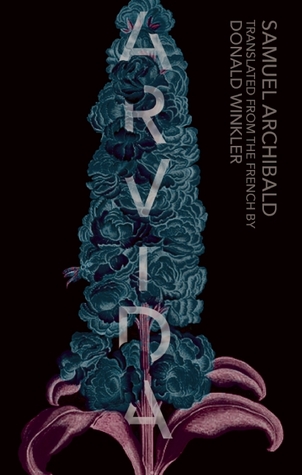
arvidaBy the time that Archibald was born 1978, Arvida had been fused with the town of Jonquière and today a number of smaller communities have been amalgamated to form the city of Sanguenay. Arvida, as separate entity, the model town once praised by the New York Times no longer exists as such. But its glory days, its decline, its humanity – and a measure of misguided inhumanity – provide a wealth of inspiration for the stories that make up Arvida, Archibald’s short story collection first published in French in 2011, and now available in English translation. It has been shortlisted for the 2015 Giller Prize.

On the back cover of this book, Samuel Archibald is compared to a “Proust-obsessed Cormac McCarthy”. Stir in a nod to Stephen King and it is not an inaccurate billing. There is a dark heart throbbing throughout these stories, a pulse that binds them together, weaving often disparate tales into a surprisingly coherent and effective whole.

The series is bookended by the first and third parts of the “Arvida” story: “My Father and Proust” and “Madeleines”. Together with “The Centre of Leisure and Forgetfulness” (Arvida II) which appears about two thirds of the way through, we have a fictional glimpse of the author, his family, and his hometown. Funny, sad, and philosophical, this tripartite tale begins with humorous accounts of the narrator’s father’s boyhood penchant for stealing pastries and ends with the challenge of facing Proust’s madeleines armed only with the memory of McNuggets, anchored in the middle with a celebration of the spirit and fortitude of his grandparents and the characters that brighten small town life at its best.

Many of the stories that fill out the collection are decidedly darker. Blood and violence are not unknown. But then neither are dreams and a spirit of magic. “Cryptozoology” features a father and son who live between dream and waking life without holding one as more valid than the other. Sharing a cabin in the woods, 13 year-old Jim is essentially his hard-drinking father’s care taker, driving him home from social gatherings, and cleaning and sobering him up the morning after. On the road and along the traplines he is haunted by sightings of an elusive animal, perhaps a cougar, that cross into his sleeping hours and take on an increasingly mythical significance as Jim himself becomes ill.

“Now Jim is dreaming and listening. He hears what they’re saying about him. He’d like to reassure them, to explain to them. He often has a dream with no up nor down, where the beast attacks him and devours him. It’s a dream of carnivorousness and violence, but not of death. He does not expire while the cougar is annihilating his body, he fossilizes within the animal like a memory of flesh.”

Ghosts are also a featured presence in Arvida, from the old fashioned gothic horror of “A Mirror in the Mirror”, the tale of a woman who wastes away into a state of otherworldliness waiting for her playwright husband to return from an extended stay in Montreal; to the spirits, real or imagined, that haunt and ultimately destroy the family life of a man who takes on the restoration of a crumbling historic mansion. But the horror theme is taken to an extreme in “Jigai”, a gruesome fantastical tale of ritual mutilation set in Japan, safely across the globe from small town Quebec. It is apparently an allegory of an unimaginably brutal story Archibald heard when he was growing up. Placing it in the middle of this collection however, has the effect of providing a powerful counter point to the small moments and the everyday terrors, fears, and passions of life in a remote community.

The fictional Arvida is inhabited by a wide assortment of colourful, often hapless, indiviuals. For example, in “América”, for the promise of three thousand dollars, a pair of young men decide to accept the challenge of smuggling a woman from Costa Rica into the United States. First they enlist a cokehead as an accomplice who turns out to be little more than a burden that must be abandoned, and then neglect to consider the impact that the events of September 2001 will have on their attempt to cross the border in 2002. Later on in another story, “The Last-Born”, a man who is less than a deep thinker, decides he can kill a man, again for a couple thousand dollars. Yet what starts out as attempted murder, turns into an unexpectedly heartwarming tale. Archibald is sensitive to the complicated dynamics of human interaction, allowing his characters to find their own ways in to and, with luck, out of trouble.

Arvida was very well received in Quebec. Archibald worked with translator Donald Winkler for a year to realize the work in English. Hopefully the Giller nomination will serve to introduce him to a wider audience, and to provide a well deserved boost for his small publisher, Biblioasis, who had three titles on the long list this year, two moving on to the short list. The stories in Arvida may be inspired by a particular place, but they vividly evoke the reality of small town Canadian life, especially in the 1960’s and 70’s. They could be set in any number of communities across the country, especially those company towns that rose up around mining or pulp and paper factories. Some, like Arvida have been absorbed into larger centres, while others are fading away.

The heartbreak of a parent’s love: Skylark by Dezső Kosztolányi

“How children suffer for their parents, and parents for their children.”

The setting is Sárszeg, a fictional Hungarian town at the turn of the twentieth century, a nondescript dusty community with one black topped road and its own illusions of class and society aspirations – a fine restaurant, a theatre and a gentleman’s club – but for anyone with eyes on true cosmopolitan existence it is but a provincial backwater. To the Vajkays, Ákos, his wife, and his daughter Skylark, it is home. They live quietly, increasingly keeping to themselves over the years. Father has taken an early retirement for health reasons and spends his days pouring over historical volumes, tracing out family trees and studying heraldry. Mother tends house with the assistance, or perhaps under the direction, of her daughter, who, at age 35, can safely be considered a spinster beyond the faintest chance of any marriage prospects.skylark

Unfolding with the feeling, at least on the surface, of a gentle fable, this short novel by Hungarian author Dezső Kosztolányi (1885-1936) covers the span of one week in the lives of the Vajkay family. At the outset Mother and Father (and that is what they are most frequently called) are diligently cramming everything their beloved daughter may reasonably require into an old suitcase in preparation for her visit to her aunt and uncle in the country. The week that she will be away is the longest that they have ever been parted.

As the train carries Skylark away, her parents stand on the platform, rather numb and bereft. How will they make it through the long days ahead? They have always been a unit though, truth be told, fate, not choice has rendered the situation thus. The couple had long since discarded the serious hope that their homely daughter would secure a suitor. Only the vaguest flickers remained and they did not burn bright. And that fact bound them to her ever more closely with each passing year:

“Skylark was a good girl, Ákos would often say, to himself as much as anyone else. A very good girl, his only pride and joy.

He knew she was not pretty, poor thing, and for a long time this had cut him to the quick. Later he began to see her less clearly, her image gradually blurring in a dull and numbing fog. Without really thinking any more, he loved her as she was, loved her boundlessly.”

Skylark’s absence in their home is felt acutely at first. The hollowness weighs in on her parents. Having decided to eat out while their primary cook is away, the couple (referred to as “elderly” though they are only in their late 50s) reluctantly take themselves off to the King of Hungary, the restaurant their daughter has assured them is passable if less than desirable on all counts. It was the best option. Cultivating condescending opinions of almost any aspect of community life was a popular Vajkay family pastime – a practice that achieved little more than to assure their social isolation. Yet, away from Skylark’s influence, Father is soon delighting in the restaurant’s gastronomic offerings, reconnecting with his circle of old friends, and even enjoying a little alcohol and a cigar after a lengthy period of health related abstinence. Their resurfacing in public does not go by unnoticed:

“Strangers turned to look at them as they passed. Not that there was anything unusual about their appearance. People simply weren’t accustomed to seeing them there in the street, like old couches that belong in the living room and look so strange when, once or twice a year, they’re put outside to air.”

Soon the couple is invited to the theatre, Mother buys a crocodile handbag for the occasion and together they are warmly welcomed back into the life of the town. The flurry of excitement they experience, freed from the strict influence of their daughter, surprises them both. But when Ákos returns from his triumphant re-appearance at the local gentlemen’s club’s regular Thursday night dinner obnoxiously intoxicated, Mother and Father are forced to confront an ugly suspicion that both have harboured but neither has dared to speak: Do they still love their daughter? Or has pity has matured into hate? The tension that builds from that point forward takes a sharp twist the following evening when Skylark’s train is greatly delayed.

Filled with a cast of eccentric secondary characters, and fueled by a mildly sarcastic humour, Skylark is tale is told in a highly entertaining, direct manner that moves at a strong, steady pace to a simple yet heartrending conclusion. This is a fundamentally human story. At its core is a poignant truth that each member of this small family carries in his or her own way – a deep sadness that holds them together and defines them in their world.

kosztolanyi2Published in 1924, Skylark was Kosztolányi’s third novel. He started out as a journalist before turning to poetry and then fiction. He was also an important critic and translator and, in 1931, he served as the first president of the Hungarian PEN Club.

1924-ClubThis NYRB edition features an extensive introduction by Hungarian writer Péter Esterházy which not only details the author’s life but examines the significant impact he had on the Hungarian language itself. The translator of the text and introduction is Richard Aczel.

Probing the fantastic imagination: Inside the Head of Bruno Schulz by Maxim Biller

“Schulz was incomparably gifted as an explorer of his own inner life.”
– J M Coetzee

The year is 1938. In the dull light of a basement apartment in the town of Drohobycz a man is anxiously penning a letter to his literary hero Thomas Mann. He works at a desk that is too low for him. When he is disturbed and distressed by the sound of birds pecking at the high windows he slips down onto the floor and continues working there until the falling autumn light forces him back up to the desk. On the walls of his room hang drawings he has made – fantastic dark sketches of domineering women and desperate men.

bruno_schulz_paintingThe man is famed Polish writer and artist Bruno Schulz. As he composes his missive to Dr Mann, German author Maxim Biller is conducting a guided tour to the interior thoughts, fantasies and fears – make that Fear with a capital F – that he imagines fueling Schulz’s surreal and creative imagination. The resulting novella, Inside the Head of Bruno Schulz serves as a delightfully inventive introduction to an original and influential writer.

“Ever since he could remember Bruno – for that was the name of the man with the face like a paper kite – had awoken every morning with Fear in his heart. Fear and he had breakfast together in Lisowski’s tearoom, Fear accompanied him to the High School and looked over his shoulder as the boys put their unsuccessful sketches of animals down in front of him, as well as plaster models, covered with black fingerprints, of their sweet little heads.”

Biller paints a portrait of a deeply anxious man… a character that would be at home in one of Schulz’s own stories. When he meet him he is unsuccessfully struggling with a novel. He lives with his sister and her two sons. She still believes her dead husband will return. His students whom he thinks of as “bird-brained” literally appear to him as birds, at his window and in his room. He has a conflicted affection for a sado-masochistic sports and philosophy teacher whom he describes as beautiful despite her hairy monkey face and filthy matted hair. But more critically, he carries an impending sense of doom as it increasingly seems inevitable that Germany will be moving toward Poland. It is with that in mind that he is writing to Thomas Mann.

inside headA most curious and twisted fellow claiming to be the great writer has turned up in this small town, charming the residents with enticing stories and grotesque gatherings. The fictional Bruno is anxious to alert Dr Mann to the existence of this impostor whom he suspects is actually a Nazi spy, and to beseech him to consider offering a poor Polish writer critical assistance. With an opportunity to publish in a prestigious journal or an introduction to an important publisher, the timid Bruno believes he might find the courage to leave Poland. He has even written a story in German to include with his appeal.

Combining biographical facts with a wildly fantastic vision that echoes Schulz’s own dark, dreamlike work, Inside the Head of Bruno Schulz is a lateral approach to the writer’s restless creative energy. A brief biography and two of Schulz’s own short stories, “Birds” and “Cinnamon Shops” follow the primary text, making this short book which clocks in at under 100 pages, an irresistible invitation to explore more of the work of this important Polish writer. Unfortunately a number of stories and the unfinished novel he was at work on in this tale were lost after his death so what remains is limited. However, Schulz himself has resurfaced and been has been re-invented and re-discovered as a writer and artist time and time again in novels by Cynthia Ozick, David Grossman and Philip Roth among others, as well in plays and film. (See the essay “The Strange Afterlife of Bruno Schulz” by Jaimy Gordon for an excellent overview.)

SchulzBruno Schulz was a Polish-Jewish writer born in 1892 in Drohobycz, a town historically part of the kingdom of Poland,  now part of the Ukraine. During his lifetime he published two collections of short stories, The Street of Crocodiles and Sanatorium Under the Sign of the Hourglass. He was known to be at work on a novel, The Messiah, which has not survived. He worked as an artist and an art teacher for many years. When the Germans moved into Poland during the Second World War, his artwork granted him temporary protection under the auspices of an admiring Gestapo officer in exchange for the painting a mural in the officer’s home. On November 19, 1942, walking home with a loaf of bread, he was shot in the back of the head by another Gestapo officer, a rival of his protector. He was 50 years-old.

Published by Pushkin Press (April, 2015 in the UK/October 2015 in North America), Inside the Head of Bruno Schulz is translated from the German by Anthea Bell. The stories “Birds” and “Cinnamon Shops” from The Street of Crocodiles, were translated from the Polish by Celina Wieniewska and originally published 1963.

Nothing less than the big questions: A reflection on Signs & Symptoms by Róbert Gál

“He who seeks, shall be found out.

What is not worth speaking about, is not even worth keeping silent about.

Consciousness is a disease of the spirit.

If life were bearable, there would be no death.”

This is not a review in the formal sense, but an attempt to formulate an answer to the question: So what do you think of Signs & Symptoms?

symptomsSimple, yes? Well, yes and no. It cannot be answered in this forum without an overview of the book in question so it will look suspiciously like a review. So be it. A few weeks back I read and reviewed a book entitled On Wing by poetic Slovak philosopher Róbert Gál, a recent release from Dalkey Archive Press. Signs & Symptoms was an earlier work translated into English and published by Prague-based Twisted Spoon Press in 2003. My copy and the question above, are courtesy of the author.

First of all, the book itself is beautiful to look at and to hold. Textured covers, French flaps, thick paper and an ethereal series of black and white photographs created specifically to accompany this work. But more about those later.

The text consists of three separate pieces unified by recurring themes. The first section “Epigraffiti”, is a collection of single-line aphorisms composed between 1995 and 2000. There is a distinctly pessimistic tone here in these simple observations about life, death, God, truth and the measure of possibility against faith, hope and the experience of time:

“Where possibility ends, there the past begins.

Reality is a long-forgotten possibility now being fulfilled.

The future never happened.”

A reflective neurotic, sometimes bitter, despondency prevails. Although this is the simplest section to read, I emerged feeling a slight heaviness in my chest. If this work begins, as the author’s note suggests from a “bottom”, a low place, this earliest segment sets the stage.

The centrepiece of the book is the second section, “Signs & Symptoms” which is, in turn divided into four parts or “circles”. The first circle sets off with a series of short prose pieces which open with an anecdotal feel – fragmented stories and conversations that lead into speculative statements. The philosophical observations soon take over completely.

“Panic is the emotional tremor of a short circuit, a protracted slide into permanent irritation. Not daring to say YES is symptomatic of fearing an expected NO. The moment before is firmly decided on taking a risky leap beyond. Signs speak through expression.”

The second and third circles, still maintain the short fragmented format but engage in much more intense, condensed ontological arguments, frequently requiring careful reading and re-reading. Here we are bluntly confronted with statements about the nature of being, existence as measured in hope, pain and desire. The real meaty stuff. This is where a few reviewers I found fell off the map a little. Me, I grabbed my journal, finding in these sections fuel for honing some of the ontological truths I have encountered in my particular experience of being in the world. Observations that I hope to be able to articulate in a writing project of my own.

Finally, the “fourth circle” opens up the atmosphere again, relaxing the intensity with some very striking observations about the reality of human relationships to the self and others.

The book closes with a section entitled “Postludia”, a collection of single sentence aphorisms and fragmented prose pieces. Distant echoes of themes from the earlier sections resurface here but the atmosphere is quieter, wiser, more poetic. If the author’s intent, as he indicates, is to re-imagine Romanian philosopher Emil Cioran, as avant-garde jazz musician John Zorn brought the music of Ornette Coleman “into the present” on his album Spy vs Spy, then it is in this final part of Signs & Symptoms that the contemporary feels especially close at hand and the work as a single experience reaches a sense of completion.

“‘Create a mask in your own image,’ runs the imperative of assimiliation.”

or

“Sympathy means that everyone is to blame for everything. And this excuses us, mitigating our guilt.

Nonethelss, such a purification takes entire lifetimes to carry out…”

Against this philosophical text which, taken as a whole, strikes me as On Wing did, with an inherent musicality (albeit discordant and experimental at times), the illustrations – a series of nude self portraits by Slovak photographer Lucia Nimcová – play against the text like a sort of dance. As illustrations they are intentionally metaphoric, but I found that the contrast of remote or removed images, frequently showing no head or face, against tight close ups, foster a separate and unique philosophical monologue that works well to complement or contradict the text, both being valid and desirable effects.

So, if it isn’t apparent, I would have to say that I found this to be an absorbing and challenging read. It is coming to me just at the right time for a number of reasons. But there is, of course, a fundamental universality to questions about the nature of existence or man would not have been pondering them for millennia. At this moment I am not looking for answers, I am rather focused on exploring and refining a way of posing questions to others.

There was a time, almost 30 years ago I shudder to think, when I completed a degree in Philosophy. It was not my first degree and I proved adept at synthesizing the most complex ideas and re-framing and defending them. I graduated summa cum laude. But I was neither fighting with ideas nor digesting them. On one of my last days I ran into a professor who asked after my plans. I told him I had taken the LSAT and applied to law school (I didn’t go but that’s another story). He nodded and said to me, “Your work is very strong, you can write very well, but you have no questions. A philosopher needs to have questions burning inside him.”

I agreed. He was right. Well, no, I did have questions but they were buried so deep and so close to my identity that I had no words to express them at the time. I did not know you could. As the years went by and those questions finally did break through and my life took paths I had never imagined, I often thought how desperately I would love to be able to go back and do a graduate degree in Philosophy. I had questions, by God! I still do. But by then I was in no position to return to school, I was a single parent and Philosophy is not exactly a fast track to a solid career. Neither is writing, the medium to which I am turning to explore my present questions, but at least I can do it on the cheap.

Signs & Symptoms is a text I suspect I will return to again as I go forward. The translation by Madelaine Hron handles the spirit and the complexity of the material smoothly. With my reading of On Wing, I marveled at the magic maintained in that translation. Here I realized that, of course, translation has long been an intrinsic element in the spread of philosophical ideas. In literary discussions some readers reject works in translation as necessarily less than the original insisting on engagement solely with texts in languages that one can read directly. How myopic to close one’s self off to the exchange of ideas! A book like Signs & Symptoms would have precious little impact knocking around in the borders of a small country like Slovakia where it was first published. Translation into English has set it free to engage a wide and diverse range of readers. A good thing indeed.

So that, Róbert, is what I think about this book. And thank you.