Translating Wolfgang Hilbig: A link to my latest conversation with Isabel Fargo Cole

It was Wolfgang Hilbig’s story collection The Sleep of the Righteous, published in 2015 by Two Lines Press, that brought the late German author and his translator, Isabel Fargo Cole, to my attention. It might seem as if they arrived hand-in-hand, after all her translation of his novel I (Ich) appeared from Seagull Books around the same time, but of course, she has translated works by a variety of German language authors before and since those two titles emerged. But it would be fair to say that her efforts to champion Hilbig, her deep appreciation of his work, and her ability to be able to bring his  convoluted sentences and filmic imagery to life in English continue to win him more admirers with each subsequent release. Most recently, she was awarded the Helen & Kurt Wolff Prize for her translation of Old Rendering Plant.

Photo credit: Emma Braslavsky

I have had the pleasure of interviewing this gifted translator twice now, and both times, when her generous responses to my questions arrived in my email, I read them with excitement and renewed appreciation. The latest interview was published at Splice this past week.  In this piece, we talk about the most recent Hilbig release, The Tidings of the Trees, and the ways in which this work differs from last fall’s Old Rendering Plant. My questions were derived from my own reading of the book and were not sent until my review had been submitted for publication.

In the years since our first contact, I have read and reviewed Isabel’s translations of Klaus Hoffer and Franz Fühmann, and have added the works of several other authors she has translated to my library as well. But Hilbig remains central. So I am thrilled and honoured to be  speaking with her in person in San Francisco on Tuesday night, July 24, as the Center for the Art of Translation celebrates her work, her recent award, and the release The Tidings of the Trees.

UPDATE:
The online journal Splice was hosting no longer appears to exist, so I have reproduced the original interview with Isabel as it first appeared below:

Finding the Right Place to Write From: Isabel Fargo Cole on Translating Wolfgang Hilbig’s The Tidings of the Trees

by Splice


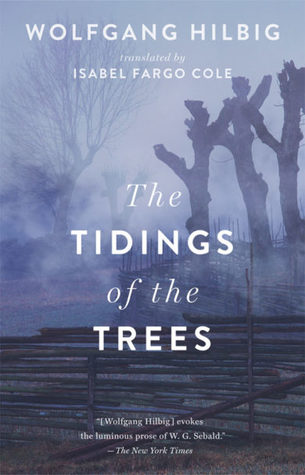
Wolfgang Hilbig, The Tidings of the Trees (trans. Isabel Fargo Cole)
Wolfgang Hilbig,
The Tidings of the Trees.
Translated by Isabel Fargo Cole.
Two Lines Press. $12.95.
Buy direct from the publisher.


Isabel Fargo Cole grew up in New York City and studied at the University of Chicago, but she has lived in Berlin as a writer and translator since 1995. In 2013 she received a PEN/Heim Translation Fund Award to translate Franz Fühmann’s At the Burning Abyss for Seagull Books, and in 2014 her translation of Fühmann’s The Jew Car was shortlisted for the Oxford-Weidenfeld Translation Prize. More recently, she has published several translations of the works of Wolfgang Hilbig, and she won this year’s Wolff Translator’s Prize from the Goethe Institut for her translation of Hilbig’s Old Rendering Plant, published by Two Lines Press.

Her latest Hilbig translation is The Tidings of the Trees. Reviewing the book for Splice, Joseph Schreiber praised it as “a tale rich with fantastic imagery that openly explores the ability of fiction to preserve the past, mediate the present, and offer hope for the future.” Concurrent with the publication of Trees, Isabel Fargo Cole generously gave her time to correspond with Joseph via email and offer her take on working with Hilbig’s words.


The Tidings of the Trees, newly released from Two Line Press, is your fourth published Wolfgang Hilbig translation. Would you mind taking a moment to frame this novella within his body of work? When was it released and where does it fit?

The German edition (Die Kunde von den Bäumen) first appeared in 1992. It’s the last of a number of novella-length works Hilbig wrote in the 1980s and early 1990s. In terms of subject matter, it fits into a broader complex of works, culminating in the story collection The Sleep of the Righteous (2015), which explore Hilbig’s home town of Meuselwitz and the industrial wasteland around it. Hilbig returns time and again to the same landscape to explore different aspects and develop different metaphorical images.

.

This novella is described as one of his most accessible works. On the surface, perhaps, relative to the very close, internalised monologue of Old Rendering Plant(2017), it might appear to be a more straightforward, less claustrophobic tale. It’s a multi-level narrative wherein the main character, Waller, is telling his story to an unidentified narrator who records the account. We can place him in time, we know how old he is, and we have passing outside observations of his actions and behaviour as he is speaking. However, as much as time, space, reality, and fantasy are blurred in both novels, Waller is less able to follow and make sense of his own memories, and seems as concerned with touching abstract truths as he is with tracking down his own lost time. Consequently, much is left unresolved, unresolvable even. 

Can you comment on the similarities and differences between these two novels with respect to the way reality is disrupted, and the challenges raised for yourself as translator?

Actually there’s just one narrator who sometimes refers to himself in the third person, as “Waller”. In many of Hilbig’s works — notably in ‘I’ (2015) — the author shifts between first and third person as a way of embodying how his narrators reflect on themselves or relate to their past, how writers observe and fictionalise themselves almost to the point of schizophrenia. In comparison with Old Rendering Plant, the landscape is more minimal, the language is a bit sparer; Hilbig is working with a more reduced and clear-cut palette of imagery and symbolism. This foregrounds the narrative structures, the interplay of perspectives and time frames. This is a story about storytelling, or rather its impossibility: the narrator tries to evoke the chopped-down cherry trees that once lined a road that led to a village that has vanished as well, swallowed by strip mines, and to describe the circumstances of these disappearances. This shifts to an effort to recall the taboo subject of Germany’s division and the disappearances it entailed.

On a number of levels, it’s about the difficulty of finding the right place to write from: “A place to sit! I’d lament, circling my empty chair.” Of course, the chair is just a metaphor or an alibi; the question is how to find the right perspective from which to reconstruct the memory or tell the story. And so the narrator shifts into the third person voice, as though that might help, or as though to watch himself writing; or he tries to adopt the perspective of the “garbagemen” who sift through the refuse of the past and seem to possess secret knowledge. Hilbig explores the question of adopting a persona or shifting personae to tell a story from, and the dangerous disorientation this can entail. And he explores how a writer devises and manipulates “figures” to act out his story: Figur in German is the standard word for a fictional character, but Hilbig exploits its literal sense of physical shapes that are seen from outside and remain rather alien, like puppets. Hilbig’s narrators find it difficult to relate to other people at all, and struggle with the sense that, in writing about them, they are producing mere simulations. In Trees, this takes physical form as the narrator arranges discarded store mannequins in tableaux in an attempt to communicate with the inscrutable garbagemen — an absurdist metaphor for storytelling.

These senses of simulation, unreality, dissociation, and an unstable “I” goes along with an unstable sense of time. Storytelling both asserts and complicates the notion of a linear timeline with a clear sequence of events bound by cause and effect — a story has to assume these things to some degree to have any coherence, but the very act of telling a story complicates the timeline and the causalities by situating a storyteller somewhere within or outside it. In Tidings of the Trees, Hilbig plays with the tension between the notion of a coherent “story” that exists out there, or within the memory, and simply needs to be recorded, and the teller’s actual struggle to grope toward this story and piece it together out of fragmented bits of time and space.

This is a struggle for the translator as well, as the often paradoxical-seeming tense shifts need to be attended to; the labyrinth of nested flashbacks and flashes of déja-vu is very much intended, and just as intentionally left without a resolution. In the end, the narrator comes to see the course of events as cyclical, narrated in “a language of return”, and he cedes the act of storytelling to the trees themselves: “storytelling without motive, a stream of story that followed only the slow rhythms at work in the place where the trees were.” The vanished trees write their story in their own ash upon the narrator’s empty page.

.

On a related note, I would like to ask you about the prose style in The Tidings of the Trees. In my reading, I sensed more variation in pace and tone than in some of Hilbig’s other stories and novels. There seems to be a more measured tone to much of Waller’s discourse; one finds more short sentences, less of the long, winding, stuttering flow of words. This is perhaps because the protagonist is trying to make himself understood to his audience. However, he has a hard time orienting himself within his own story and has an admitted disregard for reality. And there are many passages of exceptional urgency and poetic energy. How would you describe the differences in this narrative?

As you noted above, there is less of the intensely sensual, immediate, stream-of-consciousness style that you find in Old Rendering Plant or The Sleep of the Righteous. Perhaps the narrator of Trees is trying to access that more immediate mode of writing, but failing (at least until the very end, when he lets the trees speak). He has a greater detachment from the writing process; he’s reflecting on the act of writing, or rather his inability to perform that act: “But when storytelling reconstructs — or, in my case, manufactures — the problems of telling stories, it’s the pinnacle of self-circumscription. … I don’t know. Literature like that is unworthy of interest.” He’s ironising the postmodern irony of writing about writing — but taking it so far that irony turns into existential urgency. At the same time, Trees has more actual story, asserts more concrete, external goings-on (however fantastical and jumbled) than, say, Old Rendering Plant, which feels like a pure interior monologue.

.

Both Waller and the narrator of Old Rendering Plant are drawn to mysterious social outcasts, and, in each case, these elusive characters — the garbagemen who salvage goods from the ash heaps on the outskirts of town and the men who work in the depths of the rendering plant in the abandoned coal factory — are imagined in grotesque, surreal terms, and inspire some of the most exhilarating passages in each work. However, Waller’s identification with the garbagemen is more complicated, at once strange and enigmatic, and yet in their actions he sees a clear model for his intended act of preservation through storytelling. How do you see the roles, political and aesthetic, that these types of characters play in Hilbig’s work?

Hilbig was an outsider himself, as a self-taught non-conformist working-class writer in East Germany and as a working-class East German writer in West Germany. So it’s not surprising that he tended to write about outcasts — often his narrators are loners on the margins of society who become fascinated by people even more radically marginal than they are. Those marginal figures seem to represent, or have access to, things that society would prefer to forget, down to the crimes of the GDR and Nazi dictatorships. Interestingly, it’s hard to pin them down either as victims or perpetrators. In Old Rendering Plant, they might be war fugitives from Eastern Europe, or they might be old SS or Stasi men. In Trees, they seem to be in a state of exile from society, sifting through its detritus on the outskirts; on the other hand, they apparently act as an integral part of society’s digestive system, performing a function that remains constant across historical eras. They’re the people who quite literally do society’s dirty work.

.

Wolfgang Hilbig has a tendency to create narrators or protagonists who share basic biographical details very similar to his own, even if it is not made explicit. Their stories generally explore variations on a common theme — the search for identity in a society that enforces a rigid conformity of thought and action — and yet, each story or novel follows its own distinct path. Tidings is no exception, but this novel is also very explicitly about the responsibility of the writer and the enormity of his (or her) task. Waller’s twenty missing years form, in no small part, a severe case of writer’s block. Here he is, in mid-life, staring at the same sentence: “The cherry trees have vanished!” The question of the missing cherry trees that once lined the road to the nearby village, now also gone, represent a much larger, more vital story — about preserving memory, history, and hope. Would it be fair to say that this portrait of the writer’s task, if not his relative productivity, makes Waller an especially personal alter-ego for Hilbig?

I feel he’s actually a less personal and more abstract alter-ego: the Writer. There’s less of the texture of Hilbig’s own memories and biography, and he keeps stepping back from the narrator, referring to him in the third person, seeing him from the outside, actually spotting him in the distance, as a kind of doppelgänger. And he puts him in absurd situations that feel more consciously constructed, with more ironic detachment.

I think the cherry trees are in fact central: they are the story — or the storyteller, as the end hints. The cherry lane is one of Hilbig’s rare (but crucial) images of pure, innocent natural beauty, of a small paradise that existed within memory. It may have vanished, but it dominates the story, and in the end it prevails: the eternal, cyclical language of nature takes over the task of the writer.

.

Finally, you have recently been awarded the prestigious Helen & Kurt Wolff Prize for your translation of Old Rendering Plant. Congratulations! With another Hilbig translation, The Women, due later this year, the appetite for his work among Anglophone readers seems to be solid and growing stronger. There must be considerable satisfaction in this positive reception, and in being recognised for your intuitive and sensitive renderings. How do you feel about his reception? And more critically, in light of the disturbing political trends we’ve been witnessing in the West of late, do you think his message has a new relevance?

Thank you! I’m thrilled to see his work finally getting the English-language readership it deserves. I certainly think he has a lot to say to us about the cruel and unsavoury sides of social orders; about the way historical traumas are passed down and continue to do harm even (and especially) as they are denied and repressed; about the sheer mass of depression, anger, and hopelessness that can build up among people who feel alienated from their societies, from each other, and from their natural surroundings; about the (self-)destructiveness that results. I don’t think he has a “message” in the sense that he’s asking us to understand x so we can do y. But perhaps he asks us simply to recognise the dark shadows and the “garbage” on the outskirts of town as something integral to the human experience. Those strange sinister characters out there, whether they’re victims or perpetrators or both, aren’t “the other” — they’re alter-egos, reflections of ourselves and our own potentialities. Facing the darkness won’t perform some kind of therapeutic magic and automatically empower us to transcend it, but it could help us to proceed from a position of humility, a deeper understanding of our own and others’ limitations, absurdities, and burdens. At least that’s the best way I can think of to explain why I personally find his work moving and bracing, if not exactly comforting, at this particular time.

.


Joseph Schreiber is a writer based in Calgary, Canada. He is Criticism/Nonfiction editor at 3:AM Magazine. His reviews and essays have been published in a variety of literary sites and publications including Numéro Cinq, Quarterly Conversation, Minor Literature[s], and RIC Journal. He also maintains a literary site called Roughghosts and tweets @roughghosts.


Voices from the margins: Mundo Cruel by Luis Negrón

There seems to be considerable debate these days about where the line should be drawn between the literary license to imagine and the appropriation of  voices of those of different genders, sexualities, cultures, ethnicities and racial identities. What was once considered acceptable is now questioned. And, although race is often considered a boundary to be respected or only be crossed with exceptional care, in a highly stratified cultures, class or caste or ethnic heritage may also come in to play. The concern is that the dominant voice will not only be given more attention, but that others risk being reduced to stereotypes and caricatures.

I recently abandoned a book that, despite some very witty and engaging writing, seemed to be freely exploiting mental illness, poverty and family dysfunction as justification for a smart-assed narrator with all the warmth of a sociopath. Anyone who has been suicidal or lost a loved one to suicide will know it is no laughing matter. The charm quickly fizzled and turned to distaste for me. Apparently the poor and mentally ill are still fair game for slapstick humour and humiliation.

However, it is entirely different when the humour, social commentary or complex stories are owned from within a community, told by its members. That is, I would argue, the importance of supporting and encouraging contributions to literature, theatre, film and the arts from marginal voices.

Cue Mundo Cruel, a series of short, sharp stories that take you into the heart of a small community peopled with eccentric, mostly queer characters—a world that Puerto Rican writer Luis Negrón knows well. It is his own:

Santurce, Puerto Rico, once known as Cangrejos, meaning Crabs, but no longer. Santurce. Blocks and blocks full of doctor’s offices and temples—Catholic, Evangelical, Mormon, Rosicrucian, Espiritista, Jewish, and yoga-ist, if that’s what you call it. The stench of sewers 24/7. Unbearable heat. Reggaeton, old school salsa, boleros, bachatas, jukeboxes, pool halls, slot machines. Topless bars, Dominican bars, gay bars. Catholic schools, beauty schools, vocational schools, and schools where you can get a professional degree in just one year and without much homework.
.                       —from the “The Vampire of Moca”

A striking array of voices and personalities pass through the stories in this slender collection, and their lives are often disturbing, filled with misfortune, dark humour and an uncanny resilience. Most of the pieces are first person narratives, often presented as monologues or one-sided conversations, and, in one instance, as a series of increasingly desperate notes  without a reply. The opening piece “The Chosen One” will challenge a few readers with its precocious young narrator, gleefully recounting his very early initiation into sexual activity with boys and men, experiences bound, as he sees it, to his “special” role within the church. Crude, unnerving, and funny this is in its way a backhanded satire on the degree of sexual abuse that can and does occur. But our young narrator refuses to see himself as the victim. His story sets the stage for the hustlers and the heartache that re-emerges in later stories, but it is not typical. Truth be told there is no “typical” here at all.

What is remarkable about this collection is the variety—each story is different in style and tone. Negrón channels a wide range of characters with compassion and affection, even those who espouse homophobic and xenophobic views, allowing each to demonstrate his or her own narrowness or generosity. The one-side conversations and observed dialogues are particularly effective in this regard, allowing us to eavesdrop, without further comment. The infectious, campy energy of “La Edwin” offers a perfect example:

Ahá! . . . Listen, changing the subject, did La Edwin call you? . . . Yes, Edwin. The one who thinks she’s a man. Honey, the one from the support group . . . That’s weird because that little queen is calling everybody . . . Yeah, her, that’s the one . . . Oh I didn’t know they called her that. You’re bad, girl, bad, bad . . . Well she called me last night, drr-unk out of her mind . . . Saying that he felt all alone, that for him it was difficult to deal with all this shit, meaning gayness . . . I let her go on . . . So she could get it out of her system. Wait a second, I’m getting another call . . . Aló, aló. Aló, aló. How weird, they hung up . . . The thing is, a man left her . . . Yeah, girl, she got involved with one of those lefty fupistas who plant bombs and want the ROTC out of the university . . . Yeah, girl, since they can’t liberate the motherland, they’re going to liberate themselves sexually.

It’s a fun little romp, but the story it tells about queer identity and sexual insecurity is serious.

Most of the stories in Mundo Cruel are quite short, or rather, as long as they need to be. None feel like they are dragged out too far, preferring to offer snapshots of life in this marginalized community. As is typical, some are stronger than others. Likely each reader will have their own favourites. For me it is the sad, but beautiful, story, “The Garden”. Set in the late 1980s, it is the account of a love affair between a young man and his older lover who is dying of AIDS. Nestito’s boyfriend, Willie, shares a house with his sister Sharon who has a longstanding, secret love affair of her own. Together the three of them make an odd, but happy family. As Willie nears the end of his life they plan a party. Another indication of Negrón’s versatility, this is by far the tenderest, most heart-wrenching piece in the collection:

I lay down next to Willie. He had recently taken a bath. He had changed with me ever since he became bedridden. For months he ignored me as at the party where we had met. I wasn’t me, I was part of a duo with Sharon. “You two this, you guys that.” I looked closely at his body and passed my hand over his chest. His armpits were tender ground for little flowers. I hugged him gently. His bones felt fragile. Body, host. Orchard fed with alien nutrients. I sought his face, kissed the dry sores, brushed away an eyelash that rested on his cheek. I looked into his eyes and found, finally, after eight months and sixteen days, desire.

Only 91 pages long, Mundo Cruel offers a wonderful introduction to a skilled, sensitive storyteller and the strange, sometimes dark little corner of the world he knows and clearly loves.

Translated by Suzanne Jill Levine and published by Seven Stories, I read this book as part of the Spanish/Portuguese Literature  Month (and, to be fair, the tail end of Pride as well).

Of secrets and sacrifices: Don’t Let Him Know by Sandip Roy

The end of June is upon us and I have managed to get through Pride month with a minimal amount of stress and anxiety. In my city the official celebrations are not held until late August, but there is plenty of Pride around all the same. I have written before about my general sense of disconnect from the LGBTQ community, and the rejection and isolation I’ve experienced over the years. But to be honest, I look at Pride with some measure of envy. I wonder what it would feel like to be able to celebrate myself for who I am and not wish, after all these years, that my life had been different.

There is, in many a queer life, an inability to negotiate the public and the private, the secret and the shared, in a fluid wholistic way. Sacrifice becomes an element of existence in the world.

Time, place, and cultural considerations have long had an impact on queer lives lived. Set in Calcutta and California, Don’t Let Him Know by Sandip Roy is the kind of LGBTQ story that resonates with me, even if my own experience is very different. A queer life dominated by a need to hide and a failure to find release and connection the way one longs for is not simply a story of the past. This novel speaks to the choices we make in our attempts to salvage some normalcy when what we need or long for is denied or feared to be impossible—a reality that reaches beyond the constraints of culture or questions of sexuality or gender identity.

This warm and richly woven tale examines the shifting dynamics within a traditional Bengali family as values slowly change in response to influences from inside and outside India. Roy, a writer and journalist from Calcutta, who lived in the US for twenty years before returning to his native city, draws on his own experiences growing up in a protected, comfortable family as well as the challenges and freedoms afforded by moving to America, in this multi-faceted exploration of the conflicts between identity, honesty, and obligation.

Central to the story is Romola who, having agreed to a marriage negotiated by eager family members, finds herself in small town Illinois with Avinash Mitra, a quiet young man she hardly knows. When a letter from India arrives one day, the homesick bride tears it open without checking carefully and finds herself holding a letter from her husband’s lover who had hoped that they would be able to build a life for themselves in the US, away from the prohibitions of Indian society. This man, Sumit, wonders why Avinash did not wait. Romola, unable to begin to process the information, tucks the letter away. She does not confront her husband. His secret remains with him, her awareness of his secret remains with her. Years later, after his father’s death, their son, Amit, finds the second page of the letter and assumes he has uncovered a piece of his mother’s hidden past. Secrets multiply.

Moving back and forth in time, this novel traces the childhood and youth of both Avinash and Romola, their years together as a family back in Calcutta where they raise their child in a multi-generational household, and Amit’s eventual settlement in San Francisco where he marries an American woman and becomes a father himself. A fine example of classic, emotionally balanced storytelling, each chapter adds to a network of secrets, large and small, creating a rich and bittersweet tapestry. Roy resists the temptation to break open the fragile restraints that bind his main characters, and although not entirely without hope, there is a deep sadness at the heart of Don’t Let Him Know. For Romola this is often expressed in a degree of repressed bitterness, making her, at times, less than likeable. Avinash, by contrast, withdraws. He often appears to fade into the sidelines, something that anyone who has lived for a significant amount of time closeted or otherwise invisible will recognize. His first attempt, later in life, to connect with other gay men finds him awkwardly out of synch and results in an episode that is by turns humiliating, exciting, and potentially dangerous. As a reader, I longed to know him more, yet I admire Roy’s decision to tell this story, this way.

Many LGBTQ people exist in spaces defined by loss and longing.

There is more at play here, of course. Questions of class, race, tradition, and family honour also arise, but, as with the central conflict, these issues are woven into the texture of the story. Finally, this is a novel rich in sensual detail—light, scents, and sounds. Places, from the streets of Calcutta to suburban America neighbourhoods, are skillfully evoked. My recent stay in Calcutta enhanced my appreciation of that setting in particular, with the many small features I recognized adding an extra dimension to my enjoyment of this book. A more “conventional” read for me, perhaps, it turned out to be a perfect choice for Pride month,

Don’t Let Him Know by Sandip Roy is published by Bloomsbury.

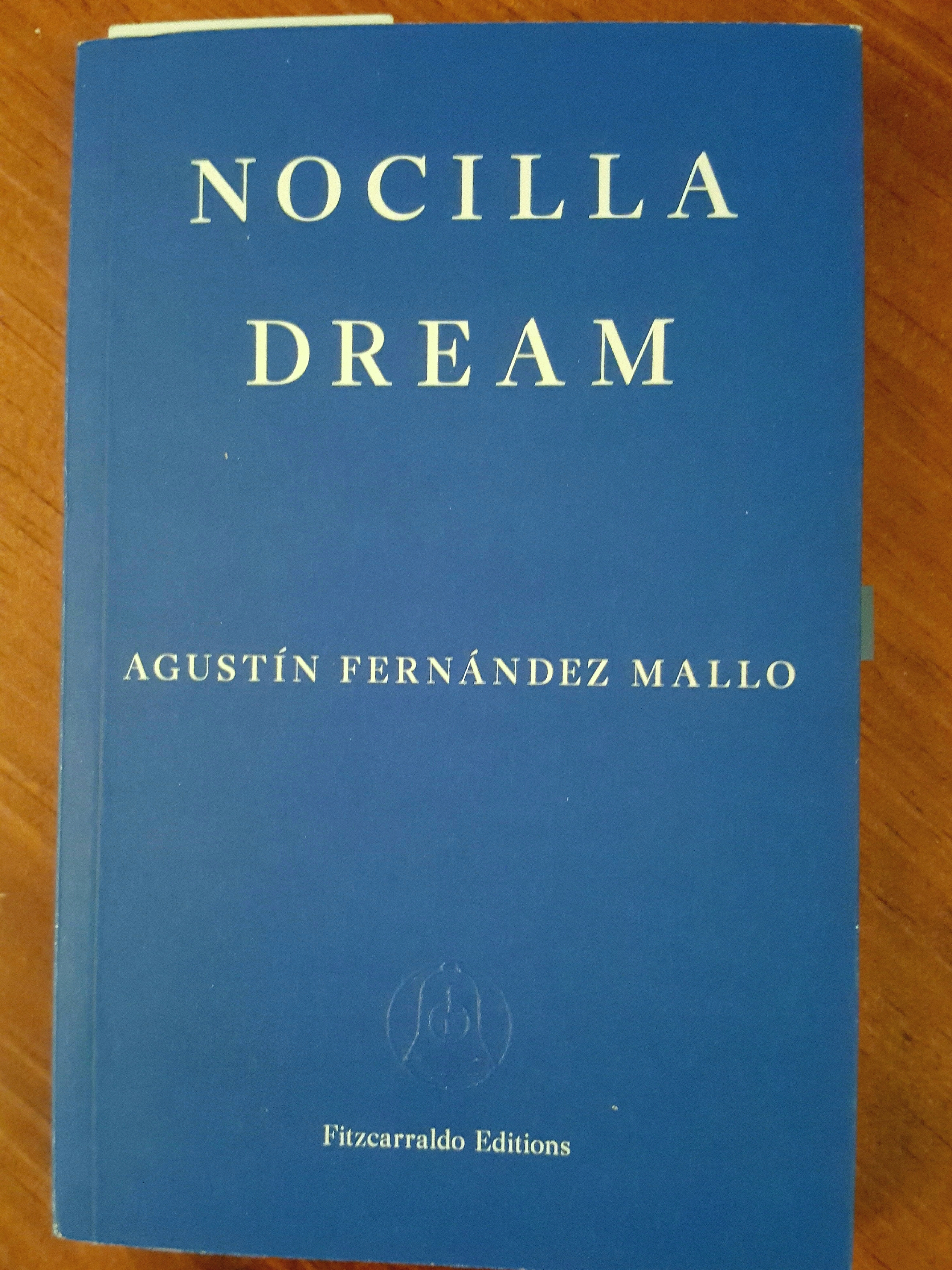
The interconnectedness of being in the world: Nocilla Dream by Agustín Fernández Mallo

One thing that struck me as I threaded my way through Agustín Fernández Mallo’s Nocilla Dream—the first part of his three-part Nocilla Project—in this second year of the Trump presidency is that a new level of unreality has descended on this sorry globe rendering some elements of this inventive blend of fiction and nonfiction decidedly quaint, like a relic of another time. In this exercise, fragments drawn from literary, scientific and technical sources form the web or framework around which a clutch of stories featuring eccentric characters circulate. The centre point is rooted in a distinctly European-imagined American west. But this web was woven in the early/mid-2000s (the original Spanish language release was published in 2006) and now, in 2018, we’re not in in the same American, let alone global, landscape anymore. Ours is one more bizarre than any Fernández Mallo imagined.

In an interview with 3:AM Magazine, the Spanish writer—and trained physicist—explains the philosophy underlying his approach to his work, something he describes as “complex realism”:

…what I’m suggesting is that the writer must be realist, always realist, but not realist in the sense we have usually used the term in literature. If reality today is different from the reality of 30 years ago, we can’t keep describing reality in the same way as we did 30 years ago. Today we understand that reality corresponds to a model — or, even better, the sum of various models — which in science are termed “complex systems” — not complicated or difficult, that’s a different thing! This complexity is what creates that which we all know — the World — is connected in a system of networks — and I’m not referring only to the internet but also to thousands of analog networks in which we are all immersed at every instant. Until a short time ago, we knew the world in parts, whereas now we know that those parts are all connected through a system of networks with a very concrete topology.

The fundamentals that hold this project together are still every bit as valid, but the consequences of interconnectedness are just that more unnerving in light of the disturbing, current state of the United States.

Nocilla Dream unfolds over a series of 113 segments. One encounters fragments drawn from computer science, physics, literature, filmography, and more woven into a series of stories, character sketches and narratives that diverge and dovetail to form one multifaceted, strangely cohesive whole. Even the most random pieces fit somewhere into a larger zone of interconnection, in time, place, or theme. It is, in a sense, a conceptual novelistic experience. And, rather than being showy and intertexually obscure, it is a highly readable book that becomes even more engaging the further you move into it, as odd connections are made, strange eccentric characters emerge and pass through, and the assorted references and reflections begin to add up to some logic of their own.

While in many respects Nocilla Dream is groundless—that is, it exists beyond the framework of any particular story, location or collection of facts—there are some central motifs and ideas that provide a degree of orientation and link, however loosely, a disparate set of solitary or peculiar souls spread across the globe. The primary one is a desolate stretch of road with a curious attraction:

Indeed, technically its name is US Route 50. It’s in Nevada and it’s the loneliest highway in North America. Passing through semi-mountainous desert, it links Carson City and the town of Ely. A highway in which, it ought to be stressed, there is precisely nothing. Nothing. A 260-mile stretch with a brothel at either end. In conceptual terms, only one thing on this entire route vaguely calls to mind the existence of humanity: a poplar tree, the only one that found water, with hundreds of pairs of trainers hanging from its branches.

The highway with this singular feature becomes the perfect centralizing image. One that could easily fall into cliché, or worse, a nod to magic realism, but it is not. This book is at once too imaginative and too pragmatic for that. Crossing the landscape we have an assortment of characters including a  wandering ex-boxer, lovelorn prostitutes, an Argentinian architect and devotee of Borges who suffers a crisis of faith, the self-proclaimed citizens of several scattered micronations, competitive surfers, expats in China, an elderly American artist who moves to Madrid where she secludes herself in her apartment  and, because the primary locus is America after all, an illegal immigrant who hopes to disappear in a remote place. No character takes on a leading role, if you will, though some have a greater presence than others. All are essentially portraits, photographs fleshed in a little more detail than the images in the suitcase abandoned by a dedicated collector of the photographs of strangers—but not much more. Some narrative pieces are replayed, spread out in fragments and vignettes, while others pass quickly. But in the end they stack up nicely. Meaning filters through.

Reflections, observations and quotes from articles, textbooks and literary works are woven into the flow of micro-narratives, providing a conceptual backdrop against which the novel’s construction can be understood.

If there isn’t any space there isn’t any light. The world is unthinkable without light [Heraclitus said it, Einstein said it, the A-Team in Episode 237 said it, and many others besides]. And yet, inside everyone’s bodies all is darkness, zones in the Universe never touched by light – or, if touched by light, only because of illness or decomposition. It’s unsettling to think you exist because this death exists inside you, this zone of endless night. It’s unsettling to consider that the inside of a PC is more alive than you are, that in there everything’s completely lit up.

Linking and playing with images and ideas like this, Fernández Mallo suggests, arises quite naturally from his background as a poet. He is comfortable with thinking on a symbolic level and yet “these metaphors and connections or modal links must be rich in meaning, rich in symbolism, and they must say things which haven’t been said before, they must truly ‘construct reality’.” This construction is neither forced nor superfluous. There is no obligation to fill in all the missing pieces, draw all the lines. Just the opposite. Nocilla  Dream is a novel which is richer for all its abstracted, empty space.

Of course, against the backdrop of the last few weeks of erratic policy issuing forth from the Twitter account-driven agenda of the US President, this book has an extra surreal tone. Prescient or nostalgic? Only time will tell.

Nocilla Dream by Agustín Fernández Mallo is translated by Thomas Bunstead and published by Fitzcarraldo Editions.

Searching for traces of the past with Wolfgang Hilbig: A few thoughts and a link to my review of The Tidings of the Trees

He may confound some readers, but for my money, the enigmatic East German writer Wolfgang Hilbig is fine company. His landscapes are evocative, filmic spaces, obscured by the mists of a troubled history of secrets and shame. His narratives are restless. His characters are misfits, unable and unwilling to conform.  Their tales explore the dynamics of loss from personal, social and political angles. And even within the scope of a novella, these stories expand far beyond the confines of the pages, haunting and reworking themselves within the reader’s mind long after the book is finished.

Or, at least, that has been my experience.

The most recent Hilbig release from Two Lines Press, The Tidings of the Trees, traverses a terrain at once familiar and yet quite distinct from the watery byways of Old Rendering Plant. This is a complex, magical tale that examines the importance of stories to hold onto and preserve the memories that the State is intent on erasing. As ever, translator Isabel Fargo Cole deftly  captures the unique rhythms and energies of this text, and Hilbig fans will be pleased to know another work, The Women, is forthcoming in November.

I wrote about this book for an online journal run by the UK publisher Splice. It seems to no longer be online, so I’ve reproduced the original page and review below.

In Search of Lost Time: Wolfgang Hilbig’s The Tidings of the Trees

by Splice

by Joseph Schreiber


Wolfgang Hilbig, The Tidings of the Trees (trans. Isabel Fargo Cole)
Wolfgang Hilbig,
The Tidings of the Trees.
Translated by Isabel Fargo Cole.
Two Lines Press. $12.95.
Buy direct from the publisher.


When the Berlin Wall was closed in August 1961, effectively sealing the final point of exit for East German citizens seeking asylum in the West, Wolfgang Hilbig was just shy of his twentieth birthday. With this action, the GDR became a completely contained state, isolated from the rest of the world. In The Tidings of the Trees (trans. Isabel Fargo Cole), the latest Hilbig translation to be released from Two Lines Press, this moment and its impact open a vortex around which the protagonist’s crisis of identity spins. Described as one of Hilbig’s most accessible works, Tidings proceeds on a somewhat different note than last year’s release, Old Rendering Plant, but ultimately it follows a route no less oblique or circuitous. Powerful and more overtly political perhaps, it is also a tale rich with fantastic imagery that openly explores the ability of fiction to preserve the past, mediate the present, and offer hope for the future.

Whereas Old Rendering Plant was a deeply immersive first-person monologue slipping at times into pure stream-of-consciousness, The Tidings of the Trees presents a multi-level narrative with an unidentified narrator who records the first-person account of the central character, Waller, occasionally breaking in to describe the actions and behaviours observed as the story is being related. It can be argued that Hilbig’s protagonists tend to be, to a greater or lesser extent, shadows of himself, and Waller is no exception. He is an aspiring writer of approximately the same age, who lives with his mother and grandmother in a small industrial town surrounded by forests and the physical legacy of strip mining. Like his cohorts he is apprenticed into work at a local factory after finishing school, but over time this work gradually loses its relevance as he becomes more deeply absorbed in a desperate effort to write — to secure his story on the page. At the time of this recorded account, one can assume the frustrated storyteller is about forty years old, an age by which Hilbig had already abandoned the factory for a writer’s life and relocated to East Berlin. Our hero in this novel is finding that transition much more agonising, and yet for Waller, as for his creator, writing is an act of defiance and self-preservation:

Write… write, I say to myself, or everything will whirl into forgetfulness. Write so the thread won’t be severed… a thousand stories are too few. So the flow won’t be broken, so the lamps over the desks won’t go out. Write or you’ll be without a past, without a future, nothing but a will-less plaything of bureaucracy.

However, no matter how long he sits hunched over a desk, the words fail to come. The empty pages and scratched-out lines drive the would-be writer out, night after night, in search of his own story.

Waller’s regular expeditions lead him to an area on the outskirts of town, where an expanding field of garbage and ash has encroached on a roadway once lined with cherry trees. It is an abiding groundlessness that draws him here; for twenty years he has felt he has had “no place to sit”, as he puts it, nowhere to belong. This desolate area holds an attraction and, he hopes, the key to his own nebulous history, now strangely distorted by his alienation from community engagement within a society where collective historical amnesia has long been encouraged. The expanse of refuse which had originated as a disused strip mine, filled in initially with the rubble of bombed-out buildings, then successive layers of garbage and ash, carries an aura of stagnation and weighted silence. In this Waller recognises the ghosts of the past, his own included. But more specifically he is fascinated by the garbagemen who scour the discarded remains to salvage whatever they can. First presented as wraith-like spectres moving over the landscape, they are depicted as outcasts, as scavengers who have formed their own inaccessible culture. Yet, as Waller’s account proceeds, he is pulled closer into their orbit.

The other focus of his habitual visits to this location at the edge of the ash heap is an ongoing search for the cherry trees that he remembers from an earlier time. He was searching for them, he advises us, even when they still existed, and he continues, having come to the conclusion that, in most instances, reality “has been debased to a worthless product of language.” It is as if Waller imagines his mission to find his own story — that is, to grasp sensible hold of his own memories — as part of a greater effort to preserve and capture the memories of a time and place nearly forgotten. To that end, the proud and beautiful cherry trees stand as symbols of everything he has lost — youth, promise, and hope in the future. They haunt him. And he is determined to attempt to write them back into existence:

And the story might tell of a time ten years ago, or might date back two or three decades; the sentence I set down at the top of the page — twenty years or two days ago — made no difference whatsoever: The trees of the cherry lane have vanished! There can exist, it seems to me, an infinite series of stories telling how this happened. … I can fit only a fraction of them beneath that opening sentence. Or perhaps a barely graspable shadow of ash, light as a breath… for the cherry trees to return, I’d have to tell all the stories about them.

This endeavour to tell even a handful of the possible stories of the trees, has, over time, become entwined in Waller’s memory and imagination with a series of possible stories about the garbagemen. His willingness to embrace uncertainty contributes to the magical and disorienting qualities of his tale. He is not simply laying out one story, unwinding one single thread, but rather telling multiple variations of his own stories to find, he hopes, some truth, and release the barrier that has blocked the flow of words onto the page.

The Tidings of the Trees is a tale of dislocation, in time and space. Waller struggles with temporal context, not only in writing, but in recounting his story. His account stalls several times. His interlocutor notes that it seems as if he is uncertain about what time frame he should follow. He frequently repeats his conviction that twenty years of his life seem to have lost their meaning, passing in a haze, one moment blurred into the next, leaving his memories and time confused. He continually attempts to re-enter the story at different points because his own internal chronology is unreliable. The only clear point of reference he can hold to is that fateful summer when the borders closed, the “summer of the Wall.” From that point, his life began to take on a fictional tone. His thoughts became confused as reality started to slip its moorings. While everyone else seemed to move forward and forget how life used to be, Waller found himself tangled in a grey zone. And it has continued to become greyer.

Once East Germany is firmly sealed off, he is struck with the disheartening sense that his future is fixed, pre-written. This is the initial trigger of his retreat from town and factory life. If one feels trapped in a rigid, scripted narrative, the only rebellion is to attempt to seize control of one’s own story. For Waller, the answer seems to lie in writing. Yet, as his fellow citizens settle into a pattern of State-dictated ideals, routines, and conventions, he realises that they defy his attempts to craft characters and build stories around them. Where can he take them? The GDR encouraged a form of worker’s literature, a celebration of Socialist norms and values, but for Waller, as for Hilbig, art cannot be thus constrained. “Normality was normal”, we are told, “because it had lost its stories… [and] only when the mask of normality was torn off did reasons for stories exist once again.”

Stories, then, in the context of this novella, serve multiple functions, individual and societal. In the garbagemen, our dispirited writer sees a metaphor for the process of the preservation and maintenance of the past. As these marginalised individuals dig through the ash to retrieve discarded objects — utensils, tools, clothing, and an unseemly number of mannequins — Waller imagines that they are essentially performing a communal act of remembering, of keeping alive a history that would otherwise be buried and lost. Afraid that he too is at a loss, that critical events have slipped from his memory’s grasp, he is drawn to these enigmatic characters who are, he believes, incapable of forgetting. He finds himself moving among them, slowly assuming a similar appearance, and ultimately taking refuge in their storage shed during a storm:

Here I was… I’d been here for a near-eternity, and already I was almost a ghost… a monster, shaped from the substance of eternity, a sculpture of ash muffled in ancient ghostly garments… and the garbagemen, who believed in mythical creatures, had long ago accepted me as their ghost, slinking around me breathlessly and on tiptoe; and they’d consigned the citizens from the shop windows to the garbage, for I was the true artwork of their time, I was the statue which alone fulfilled all their time’s aesthetic requirements, their time that was no time at all… the trees of the cherry lane have vanished; this single sentence, long since extinguished and grown cold, stood there upon the page, and they’d given me infinite time to write a second one.

In classic Hilbig fashion, the narrative regularly loops back on itself, images are revisited again and again, and a restless, searching energy courses through the prose. Yet unlike the fluid, meandering flow of Old Rendering Plant, there is a greater variation of pace and tone, and a distinctive urgency and poetic passion to Waller’s discourse. Place is also a vital presence, but with Tidings, an emptiness or absence dominates. The vast field of refuse, home to little more than coarse shrubs, is a denuded environment. However, as the resting ground of discarded objects with a link to the past, it contains an existential element. This is realised not only through the actions of the garbagemen, but in the accumulated ash that hangs in the air, and clings to Waller and his surroundings. And then, of course, there are the cherry trees, natural and spectral at once, imagined alive, destroyed, or gone wild, the lost messengers whose tidings our protagonist so anxiously pursues.

Finally, as the fourth Hilbig translation to be released in English, The Tidings of the Treesis a testament to translator Isabel Fargo Cole’s exceptional acuity to the nuances of the late German author’s idiosyncratic prose. Although Hilbig typically starts with a character in a setting that has roots in his own life experience, once set in motion, his narratives each follow their own unique course. Where a predictable sameness might be expected to settle in, Hilbig’s ability to create strangely engaging characters and evoke distinct environments of oppressive beauty, in concert with Cole’s sensitive translations, ensure that each encounter with his work feels fresh and vital.

.


Joseph Schreiber is a writer based in Calgary, Canada. He is Criticism/Nonfiction editor at 3:AM Magazine. His reviews and essays have been published in a variety of literary sites and publications including Numéro Cinq, Quarterly Conversation, Minor Literature[s], and RIC Journal. He also maintains a literary site called Roughghosts and tweets @roughghosts.

A little poetic musing: Three recent or current reads and a poem of my own

I haven’t posted much lately, in part because I have been focused on some writing and reviewing for other publications, and also, because I’ve decided to list my house, concentrated reading has been somewhat disrupted. In the midst of all this, however, there is always time for poetry. I find lately that poetry has become an increasingly important part of my reading routine. So, I thought I would take a little time to look at a recent read and a couple of the collections currently vying for my attention.

Unbearable Splendor by Sun Yung Shin (Coffee House Press, 2016)

The intersection of essay and poetry is of particular interest to me. This collection takes a wide-ranging approach to the confluence of the two forms and stands as an impressive example of what can be achieved by filtering essayistic meditations through a poetic lens.

Sun Yung Shin was born in Korea and adopted by an American family at the age of two. The weight of her dual identity pulls the explorations that comprise Unbearable Splendor together into a loosely spinning orbit. Along the way, she weaves in elements from cosmology, linguistics, Korean culture, Greek mythology, literature and futuristic visions of being. The result is dazzling and devastatingly beautiful. For my money, the most interesting pieces offer strange and unusual angles on the cellular, spiritual, and genetic implications of being an orphan, often referring to herself in the first person plural:

As we task our memory-organ to remember our life in Korea, we breed dream after dream. False dreams? Truthful dreams? Hanging? Phantom shaped? They drop like ripe fruit, then disappear before hitting the ground, preventing bruising, rotting. Dreams are ephemera and have no body to violate, no flesh, to decay. They can remain fresh as the wind, recycled like hot rising vapor from the ocean, into the frozen clouds, and eventually back into the crashing black water, the source of all dreams, the living body of our planet.

Kafka and Borges offer inspiration, a series of essay/poems feature Antigone, and toward the end, she draws on cyborg and cloning technology. The language is devastating. However, if I have any reservations, it would be that some of the pieces fall awkwardly in between the two forms—too much an essay to be a satisfying poem, but not developed enough as a nonfiction piece to really flesh out an idea.

*

Currently reading:

The Promised Land: Poems from an Itinerant Life by André Naffis-Sahely (Penguin Books, 2017)

This slender volume represents poet and translator André Naffis-Sahely’s first collection. Born in Venice to an Iranian father and Italian mother, he was raised in Abu Dhabi. The earlier poems in this collection deal with his childhood in the harshly surreal environment of a manufactured city, and his return visits in early adulthood. His shifting relationship with his parents, how he sees and understands them as their marriage crumbles and life in Abu Dhabi loses any lustre it may have had, provides the material for an strong series of poems. The second section, which is where I am currently biding my time, includes a number of poems that cross the globe and speak to a certain restlessness. Here, is a sample from the prose poem, “This Most Serene Republic” which opens with a description of Venice as his father experienced it when he first arrived in the 1960s and spent a cold damp winter huddling atop the wardrobes as water rose through holes in the floor of his flat. The son in his footsteps describes:

… Those old, porous palaces, whose upper floors housed the few penniless nobles whose hallowed ancestors once terrorized the Mare Nostrum. Those palaces, much like the one I’m sleeping in, smelt like Latin jungles: mahogany everywhere. I love this tiny room and its Franciscan sparseness. All my life, I’ve felt like a Jew, or a Gipsy, or some hapless scion of a lost wandering tribe, but they, at least, have Bar Mitzvahs, music… all I’ve left is this room. This was an empire ruled from rooms: chambers decorated for a single, specific purpose: to impress its numerous enemies. I can’t sleep. There’s a ghostly halo above my bed where a clock used to hang. One way, I suppose, to stake a claim on timelessness, if not serenity.

This is the type of collection I like to linger in, not to hurry through. A clear, authenticity shines through in Naffis-Sahely’s poetics, with a quiet reflective wisdom I am really enjoying.

*

Jonahwhale by Ranjit Hoskote (Hamish Hamilton/Penguin India, 2018)

This book seemed destined to prove more elusive than Ahab’s famous whale. I looked for it in Calcutta, a copy was sent to me in late February, and finally assuming that that one drowned somewhere along the way, I placed an order with an Indian distributor that ships by courier and the book made its way across the globe in four days. Sometimes you do get what you pay for.

Ranjit Hoskote is a poet, translator, curator and cultural critic based in Bombay. I’ve just started into this volume and I’m very excited to see where its currents will carry me. I’m expecting a lyrical adventure along fabled waterways, through literary and historical channels. Hoskote’s broad cultural perspective promises a timely exploration of the political and ecological realities that shape and threaten our world. This, again, is a text, that invites careful reading. No need to rush on this journey. Here is a taste  from a piece called “Ahab”:

Captain of castaways, the pilot calls out and his curse carries
                                         across docks, derricks, opium factories:
                                          a typhoon in the horse latitudes.
He’s hurled his ship after the whale
that swallowed him and spat him out.
.                                     The monster is the only system he’s known.
At the bridge, he’s drenched in the dark:
locked on target, silent, furrowed,
Saturned to stone.

I have, as ever, several other books close at hand. I’m finding that short, single author collections from contemporary poets  hold the most interest for me at the moment.

*

And, finally, this past week saw the publication at Burning House Press, of my own modest piece of poetry, a short prose poem called “Are We There Yet?” This is my first successful poem as far as I’m concerned, that is, something that came out as I intended. It was written in response to the theme “Liminal Spaces”, a perfect fit for a way of thinking about my own dual-gendered life experience. I did, coincidentally, advise the editor that he could consider it a poem or an essay, since I look at everything I write, no matter the form, to be nonfiction.

You can find my poem here.

Waxing lyrical and irritable: QWERTY Invectives by Éric Chevillard

French writer Éric Chevillard opens QWERTY Invectives, his contribution to the Cahier Series, with a short reflection on translation, its importance and its limitations. Although any text will invariably suffer certain mutations on its passage from one language to another, these changes need not be met with certain despair. The re-imagining required to facilitate the journey can offer, he suggests, a well-needed breath of fresh air. Case in point, the present text, derived from his book Le Désordre AZERTY, “a primer arranged according to the layout of the French keyboard.” Not only does this short, beautifully presented cahier, represent a “radical abridgement” of the original text, the sections selected necessarily reflect a new order—that determined by the Anglophone keyboard.

What follows then, are six short treatises inspired by words beginning with the first six letters of the keyboard with a little linguistic gymnastics, no doubt, to line up an English word with a word compatible with the exercise at hand. And, given the words, or rather themes that feature, one must wonder what other liberties were taken to extract six pieces from what one assumes was a selection of at least twenty-six offerings, not allowing for diacritics and accents. In this slender volume we are treated to Chevillard, or his fictional alter-ego, waxing lyrical and irritable on reaching the age of fifty (“Quinquagenarian”); the “Water Closet” (or more explicitly the product one deposits in such facilities); the nature of one’s metaphorical “Enemy”; the “Return” to home or, more exactly, to routine and fresh promise in the fall; the photographer’s art (“Technician of the Darkroom”); and finally, gross human anatomy—especially the foot—in the final installment that opens “You, Eyes!” (or, I would suspect “yeux” in the original).

The narrator is never afraid to examine a subject from a most unlikely angle, employing language that is colourful and inclined to hyperbole. This is evident from the opening offering, a meditation on the misery of attaining the ripe age of fifty, dished out with a healthy dose of melancholic satire:

‘Half a century!’ people say, all smiles, thumping me on my osteoporosis-ridden shoulder-blades.

A little respect would be welcome; a little consideration wouldn’t hurt. Balzac writes somewhere of a ‘fifty-year-old codger’. That’s Balzac for you, who died of exhaustion one year after celebrating the same sinister birthday. I tell myself: Times have changed, today’s fifty is the nineteenth century’s thirty. Thirty year-olds back then were eighteen, and ten-year-old urchins weren’t even born yet.

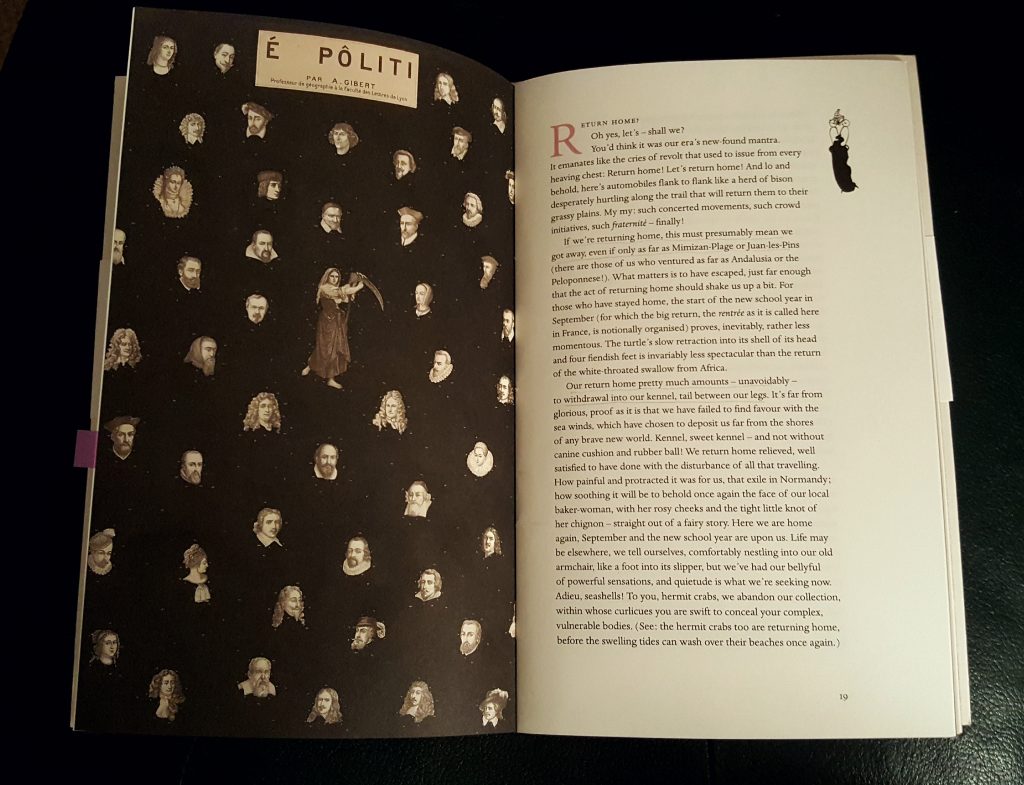
And more often than not, his starting point, or apparent subject, is rarely more than a launching pad that can potentially take him anywhere. R’s entry which opens “Return Home?” begins with a description of the end of the summer holiday and the beginning of the school year, but his dissertation soon wanders into speculation about the flood of new books that arrive each year with the publishing houses’ autumn offerings. Here our narrator’s cynicism is barely held in check:

Where once there was the book, now there is the public figure of the author, duly dramatized, whose only real use turns out to be to provide a caption for the photo of the artiste who is the one really being featured. All the author can hope for is a meagre compensation in a currency that is already so outdated that it works only in public payphones and slot machines.

Each year sees a glut of new releases, so what of the game, the publishing lottery, into which eager authors enter?

The author of the present lines, given he contributes to full-bloodedly to the current literary over production, may not be ideally placed to complain. But nonetheless: six hundred novels published between September and October? It’s a figure that must be far in excess of the thirst for reading displayed by our contemporaries; it’s akin to pouring an ocean onto a piece of blotting paper, then peeing on it for good measure. Booksellers will soon have to surround themselves with ramparts and equip themselves with flame-throwers in order to repulse writers—those supernumerary writers. No matter! it will surely be educed that the phenomenon serves to demonstrate the surprising vitality of the literary landscape in France!

It would be fair to say that Chevillard’s humour might not whet everyone’s whistle. As a reader who found Author & Me, his book-length diatribe against cauliflower gratin which served as the pretext for a greater meta-fictional reflection, an endlessly hilarious exercise, I find his wit with even the most unlikely of subjects to be a treat. And this Cahier, lavishly illustrated by French artist Philippe Favier, is a perfect introduction to this energetic, imaginative writer. As ever, woven into his literary escapades are some very astute observations about life, the world, and our uneasy navigation of all the joys and obstacles we encounter every day.

QWERTY Invectives by Éric Chevillard is translated by Peter Behrman de Sinéty. It is the 31st title in the Cahier Series, a joint project of the Center for Writers & Translators at The American University of Paris and Sylph Editions.

Speaking to poetry with poetry: The background to my experimental response to Third-Millennium Heart by Ursula Andkjær Olsen

I have, in recent months, been reading and responding to poetry with increasing frequency here on roughghosts. I hesitate to say review, perhaps because I lack the vocabulary to classify and analyze poetry in a learned fashion. That is, to speak to other poets about poetry—a task that tends to achieve little more than ensure that poetic appreciation remains a closed circle.

Do not pass Go, do not expect to enjoy poetry on its own terms alone. (Everyone knows collecting $200 is too much to hope for in this particular game.)

I have collected a few books about reading and writing poetry  with the thought that they might enhance my critical appreciation, but they remain unread, perhaps for the same reason that I decided not to study Literature at university. I am afraid of wringing all the pleasure out of the experience of reading with too much analysis.

And so, I have been content to respond, with a measure of innocent ignorance, to the work I read. Gut level. Which is fine, until I venture into the realm of experimental poetry where, in contrast to experimental literatures of other sorts, my response seems lacking. At least to me.

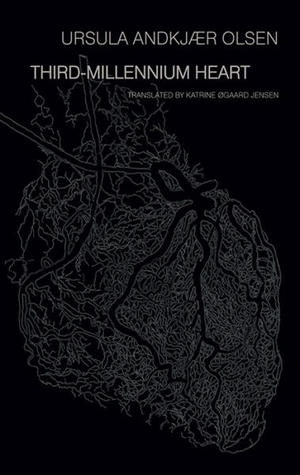
Enter Third-Millennium Heart, the ambitious epic cycle of poems by Danish poet Ursula Andkjær Olsen. This work which, in my reading, traces the evolution of a post-human cyborg being, or state of being, is a glorious evocation of the power of language. Through Katrine Øgaard Jensen’s inventive, sensitive translation, we are held captive by a demanding chimeric voice, witnesses to the realization of a possible future reality which, not unlike the mechanistic hive-mind typically associated with cyborg imagery, envisions a hive-heart existence.

Or, that’s how I think of it at the moment. It doesn’t really matter.  The true joy is in the experience of this series of poems. And when reading it, I simply knew I would want to respond. But prose analysis seemed inadequate, insufficient. I wanted to write in reaction to Olsen’s poetry. To answer poetry with poetry. Keep it minimal. Close to the heart, if you will.

Without question, the work of my friend Daniela Cascella, and in particular her recent book Singed, was essential to shaping my approach. It is unmediated, equivocal, open-ended.

Possibly the only way to fully respond to poetry.

My experimental review/response to Third-Millennium Heart can be found at Minor Literature[s]. The text opens as a PDF; I invite you to read it and welcome feedback.   Minor Literature[s] are currently repairing their archive so the PDF of my review is attached below.

Third Millennium Heart is a joint publication of Action Books and Broken Dimanche Press.

Third Millennium Heart review

Once in motion, an avalanche can’t be stopped: Fleeting Snow by Pavel Vilikovský

Here’s the thing: the avalanche has begun to roll. It can’t yet be seen, it is still a long way off, but I can hear the first mass of snow pushing its way down the slope, rumbling quietly.

It is fair to say that Fleeting Snow, by Pavel Vilikovský, the first Slovak translation to be released by Istros Books, begins on an unusual note. The narrator promptly informs us that his original name has lost meaning for him, rather he prefers his self-declared name, Čimborazka. However, it is clear that he also seems to have affected some alienation from his own identity. His appearance in the mirror is vaguely familiar, but he questions whether he is really himself or his own step-twin. Mail arrives addressed to a name he no longer chooses to recognize and yet he has informed no one of his selected appellation. And he refuses to have a character—or a reliable, consistent way of being—and that, in itself should be our first clue. He has adopted some kind of metaphorical armour. But why? And against what?

What follows, or rather plays out,  is an orchestrated discourse that meanders down assorted pathways, broken into in a series of short, fragmented chapters, each conveniently denoted with a number and letter according to theme or motive, echoing a musical score. Čimborazka, we quickly learn, is given to wide ranging philosophical musings about the relationship between the body and the soul, the nature of God, the meaning of love and the limitations of the Slovak language. His digressions are, at least initially, light-hearted and good humoured. His friend Štefan Kováč, who may or may not be a separate person or an alternate self, plays the logical, scientifically grounded foil to Čimborazka’s esoteric ramblings. He is a linguist, a specialist in an extinct native American language, who challenges his friend’s flights of fancy.

And then, there is the avalanche, a recurring image rolling through the narrative.

If the unconventional ordering of the chapters or fragments is disorienting, one soon falls into the flow. The various themes which, at the outset appear quite disparate, increasingly echo one another. Key to the narrative central to Fleeting Snow is Čimborazka’s notion of the soul and its relation to the body. Although he spends much time wondering about the nature of God, his is not a specifically religious inquiry. He seems curiously agnostic. The soul is a useful concept—it can mean anything one wants it to mean—and for our narrator, it is that essence, produced by the body, that makes a person or a being, who they are. The soul, gives the body meaning.

The soul can’t be seen because it is hidden inside the body. Strangely enough, we can’t see even our own soul, we just know it’s in there somewhere. What’s even more strange is that all of it fits into our body even though we sense that it’s somehow much bigger. That it transcends the body in every way.

Likewise, another prominent theme, that revolving around language—the demise of indigenous languages, the corruption and loss of traditional dialects in Central European languages—represents an analogous relationship. Language is the soul of a culture. In both cases, when the soul starts to change, when critical features begin to disappear, what happens to the person or the peoples left behind?

Playing the various motives in a fluctuating manner moving back and forth between themes, allows Čimborazka to work his way into the tale at the heart of the novel—the one that is most difficult for him to tell—with caution, in a roundabout way. He reflects on ID cards, asking: What do they, and the name thereon, signify, the soul or the body? The next segment opens with an explanation of the names he used to call his wife whose formal name, Magdalena, seemed too awkward. He opted for Duška as a pet name, and more commonly Lienka. But now he admits, he is at a loss as to what to call her. They had been, at one time, so intuitively suited to one another, or so he thought. He had loved her wholly, and yet, suddenly, he began to notice a curious change:

But at some point, not long ago, her face suddenly seemed to become more beautiful. The lines around her mouth and eyes vanished, the skin on her forehead and cheeks became tauter, had I not known her I would have thought she’d had a facelift. It happened gradually, not from one day to the next, and I also became aware of it only little by little – one day I felt that her smile lost its sarcastic edge and suddenly started to spill over like a puddle because there was nothing to hold it back; on another occasion I missed the contemplative furrows on her brow, but thought it was just a one-off rather than an ongoing process.

Soon he realized that the change was permanent, as if she was showing another face or, as he would begin to see in time, another soul. Strange behavioural shifts that signaled a loss of cognitive function, forgetfulness, disorientation, and anxiety became more frequent. But Čimborazka is reluctant to acknowledge the significance. He describes himself as self-focused person  and confesses that in the past there had been so much about her that he had not cared to appreciate. As she starts to slip away, he feels shame. And shame is a complicated emotion, eliciting a mix of guilt and defiance.

At first he is in denial. He tests her, more for his own comfort than her benefit, but it make her annoyed and proves nothing more than a steady decline. The avalanche is already burying her. As her illness progresses he is forced into a caregiving role. He tends to her body, washing her now as if she was a small child, but her soul is increasingly hidden as she retreats into a present and a past in which he no longer has a place. He struggles to redefine love against the pain of loss, trying to love what remains of her, but it is not easy:

The word love is so popular because anyone is free to make it mean whatever they like – some might see it as a fusion of bodies, others as a fusion of souls. It is the latter who usually end up disappointed… But there are moments when two souls, even if travelling in opposite directions, pass each other and exchange a friendly wave, like tram drivers who work the same route. Now I realise that all one can expect of love are these precious, fleeting moments of intimacy.

But what if one of the drivers is suddenly assigned a different route?

The avalanche, that unstoppable force of nature that he fears throughout is, of course, a metaphor for the loss of memory—individual or collective. In concert with the account of his wife’s illness, it becomes the metaphorical windmill against which our hero tilts. As he starts to fear the avalanche’s inevitable approach  he seeks a spiritual answers, wants to understand the nature of being, even tries yoga. His friend Štefan, of course, tries to provide the practical, scientific angle, yet he remains determined to find a way to buffer his own soul against the vagaries of time. Spiritual exercise, he hopes, will help him build resistance against “the disease called life.”

Pavel Vilikovský is recognized as one of the most prominent authors of post-Communist Central Europe. In this creatively structured short novel, he presents, in Čimborazka, a digressive, eccentric narrator, reminiscent of Bohumil Hrabal’s loquacious protagonists. The lighthearted tone at the opening belies the depth. The humour, the philosophical questing, the digressions about love and language, the pragmatic counterpoint offered by Štefan, and the metaphorical avalanche nest a complex of painful and difficult emotions that the loss of memory engenders. The result is a multi-layered story that raises many questions—the kinds without easy answers.

Fleeting Snow by Pavel Vilikovský is translated by Julia and Peter Sherwood, and published by Istros Books. An excerpt can be found at B O D Y.

The loneliness of the Norwegian writer: Bergeners by Tomas Espedal

During the day he knows nothing but dreams.

During the day he knows only the lethargy the white, billowing curtain and the humming fan give him as a kind of comfort.

At night he’s wakeful.

At night he knows only the loneliness that lies down beside him in the bed and keeps him awake.

It was not until I finished Bergeners, that I stopped to take a closer look at the biography of its author, Tomas Espedal. I had sensed we were close in age, this introspective Norwegian writer and I. The eponymous narrator of this novel is in his early fifties during the period that frames this wandering meditation which opens in Paris during the dying days of a serious love affair and closes two years later, in Berlin, where he is still carrying  a lingering, immersive heartache and loneliness that won’t abate. So deeply did I connect with the protagonist’s emotional exile, even though my own life and shades of loneliness take on different hues, I could not help but wonder how closely our timelines align. Rather closely, as it turns out, we are only a year apart.

There is, throughout this work, a certain vulnerability that permeates the narrator’s musings. He bemoans his losses; he knows well that he is wallowing. Yet, in contrast to Knausgaard, the friend and fellow countryman whose name is synonymous with intense navel gazing, Espedal’s autobiographical fiction is spectral. He is there and not there. More spare and varied in style, the narrative has an erratic quality, shifting in perspective from first person to second, third and back again, incorporating stories, poetry, fragments and a fair share of modest, self-deprecating humour. And for all the deeply personal emotional moments, the heart of this novel is occupied by Bergen and its residents. The narrator does travel, for work or pleasure, but at this mid-point in his life, suddenly abandoned by both his grown daughter and his girlfriend, he seems intent on staying put, on burrowing himself into the familiar haunts and securites of his family home and community.

Espedal has a sober affection for his native city that comes through in his wonderful observations, character studies, and anecdotes. He argues that the city is difficult to live in, that the persistent rain and dampness enforces a confinement that creates an urban existence conducted almost entirely indoors, or perhaps, in vehicles travelling from place to place. As such, he claims that one could “empty the city of all its inhabitants and fill it up with entirely new people, but the city would remain the same.” However he captures its interior and exterior spaces, and the characters who occupy them, so memorably:

Eerland O. Nødtvedt smokes like an athlete. He’s dressed in a white shirt, a light brown cashmere sweater, the jacket of a green-check suit and light trousers. Good shoes. At night, he plays pieces he’s composed himself on a pump organ which he got from Yngve Pedersen. During the day he writes poetry. In a small one-roomed flat in Lodin Leppsgate, he writes poetry that is bigger than the city he lives in but maybe not as big as the room he inhabits.

The central part of Bergeners reads like a series of entries in a scrapbook—portraits and sketches of a place that contains all that is rooted and central to his existence, except that now, as he walks its streets, plumbing his memories, it is absence rather than nostalgia that weighs on him, pushing him to retreat further into his small house. His narrative, as the book progresses, is freighted with a loneliness no words will write away.

That first evening I sat alone in the living room, both my daughter and my girlfriend had moved out of the house, almost simultaneously, and gone to Oslo, I sat with my head in my hands feeling sorry for myself. I wept, repeating out loud (there was no one who could hear me after all): How could both leave me like this? I, who’ve done my best for you all these years, I said, who’ve given you all my love and nearly all my time, and you just move out  and leave me sitting here all alone like this.

How can you, at the age of almost fifty, adapt to an empty house?

How can you adapt to your own loneliness, what can you fill it with?

On a trip to Albania, Tomas meets a German writer who, at one point, asks him what he writes about. He answers: “Monotony.” That is not quite accurate, but he does have a gift for capturing the ordinary and seeing in it the universal and the exceptional.  His loneliness is not unique, but it is caught in the prism of middle-age. His characters are often eccentric, settled into their habits, their singular lives. However, for our protagonist, the attempt to redefine himself without the two women who meant most to him is an uneasy process. He has lost his anchor and does not know where he belongs. He tries to adapt to his newly defined life, but finds that Bergen, which he knows so intimately, cannot assuage his restlessness. He tries to escape, but finds foreign locales too alien to his own nature:

You can’t anticipate growing old here
age was not formed in you as a child
and now it’s too late
to grow old

Bergeners is my first encounter with Tomas Espedal. There is something very attractive about his autobiographical fiction, a form that can be too claustrophobic at times. The varying perspectives, the passing portraits of people and places, the fragmentary fugues, brief stories and snatches of poetry that are worked into this wandering meditation make for an unusual and absorbing read.

Longlisted for the 2018 Best Translated Book Award, Bergeners is translated by James Anderson and published by Seagull Books.