Conversing in verse: Voice Over by Breyten Breytenbach

when you die, Mahmoud
when your aorta thrashing
all sluggish and crinkled
like a purple snake bursts
because the lines can no longer
slither the perfect metaphor.

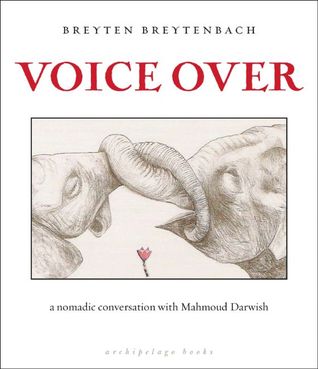
A selection of stunning new translations of the poems of Mahmoud Darwish posted today, March 13, on the blog Arabic Literature (in English) marking the late Palestinian poet’s birthday inspired me to take a little time to re-read Voice Over by Breyten Breytenbach. The South African writer and painter had last seen his friend and fellow poet in France only a few weeks prior to learning of Darwish’s death during open heart surgery in Houston, Texas, on August 9, 2008. He was on Gorée Island off the coast of Dakar in Senegal at the time and, as he travelled from there through Catalonia to Friesland to attend a literary festival, Breytenbach took the time to meditate on his friend’s passing and engage with his work reporting that it was “refreshing to be bathing in Mahmoud’s verses.” The twelve poems in this slender volume are a reflection on this time in the form of a poetic communion. As he notes in an afterword:

“MD had always been a prolific poet. One could interact with him forever. The present ‘collage’ touches upon transformed ‘variations’ of his work, at times plucked from different poems and then again by way of approaching a specific verse, with my own voice woven into the process. The images, and to an extent even the rhythms and the shaping, are his.”

voiceoverThe first poems play with images of death, burial and moving on, but the tone is not sombre. There is a distinct sense of a conversation not ended but continued beyond the grave, a call for a celebration of life – music, not weeping, and a glass raised high. Midway through the journey, the verses take a turn to the political with the plaintive call “we shall be a people” that echoes throughout the 6th piece and continues in the 7th where Breytenbach tells his friend:

identity is gospel talk. Mahmoud
when as in a dream you hear
what others tell
and imagine you understand/exist

to be is to move
through a spectrum of volcanoes
and the spectacle of wars
              and poetry in catastrophic times

blood
              and blood
                            and blood
in your homeland

Small but powerfully affecting, this collection of poetic engagements acts as a kindling of the spirit of a voice silenced too soon. My favourite piece in this collage, to use Breytenbach’s term, is the 8th and longest entry. Here the question of the possibility and validity of this communication across the boundaries of language, and of death itself, is explored. Here, for me, lies the heart of the grief and the expression of fellowship:

who is writing this poem face
by face      in black blood
neither raven’s ink nor voice
pressed from an errant tongue?
luck’s hand snatches everything from night

Mirage leads the wanderer through the wasting
so that he may continue hailing the holy crocodiles
Mirage seduces him with sweet words read
if you can       write if you can
read       water / water / water

and write this one line in the sand
that if it weren’t for Mirage
I’d long since have died    for it is
the traveler’s talisman that hope and despair
be twinned in the blood of poetry

Ah yes, twinned in the blood of poetry. A gift, verse to verse, this heartfelt collection is a treasure.

darwish1Voice Over: a nomadic conversation with Mahmoud Darwish by Breyten Breytenbach is published by Archipelago Books.


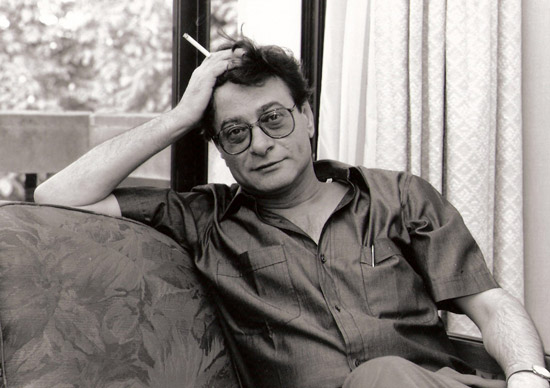
Mahmoud Darwish, March 13, 1941 – August 9, 2008

Thoughts on Among the Bieresch by Klaus Hoffer

Sometimes, when I am reading a book that I know I will want to write about, my thoughts about the work at hand take form in the process of reading in a manner that will later inform and direct my review. Other times, the route from reading to writing is more circuitous. I tend to take copious notes, underline and engage with my books, but, having said that, there is always the risk of failing to see the forest for the trees (or more explicitly, failing to appreciate the text for the words). Then, when I sit down to write, no matter how much I may love the work at hand, I look back over my notebook and face too many words to sift through.

BiereschAmong the Bieresch, the long-standing German cult classic by Austrian writer Klaus Hoffer is a book that threatened to undermine me, as a reviewer, with its words – words that are supercharged with meaning and reference to a broadly expanding literary and socio-economic landscape. The beauty of this book is that it works on so many levels and now, with its recent release from Seagull Books, in an animated translation by Isabel Fargo Cole, an English language audience has the opportunity to meet and explore the singular world of the Bieresch.

My review of Among the Bieresch has been published by 3:AM Magazine. I am most grateful to Tristan Foster for his wise and patient editorial guidance as I floundered, at times, in my own words.

Through my people you shall know me: I, City by Pavel Brycz

It could be argued that the celebrated cities of the world – Rome, Paris, Vienna and others – owe their mystique to words of the poets who have walked their streets. But what of the humble, disregarded metropolises, where are their voices to be found? For Czech writer Pavel Brycz, his own love/hate relationship with the city in which he grew up inspired him to wonder how he might access the beating heart of a place more associated with crime and unemployment than romance. He decided to give the voice to the city itself, allow the city to express its affection for the souls residing within its boundaries, and the result, I City, is a work of melancholy tenderness.

CityMost is a city with medieval roots in the northwest region of the Czech Republic. Situated in the middle of the lignite mining region of Northern Bohemia, this fated urban centre has, since the mid 20th century, been associated with industrial development, pollution, environmental degradation, and the social problems that often percolate in similar communities. During the 1960’s, under the Communist government of the day, the historical old town was demolished to allow greater access to the lignite deposits lying beneath its foundations. Remarkably to preserve the late Gothic Church of the Assumption of the Virgin Mary, dating from the 1500’s, the entire building was physically relocated 841 metres, a painstaking process involving 53 transport trucks set on special rails. Meanwhile, rows of uninspired housing constructed of prefabricated concrete panels were erected to house the relocated residents and the new workers who began to flood into the area. The personified city frames this event as indicative of its own nomadic spirit:

“Mine is a migratory soul. And one day you’ll wake up, and you’ll be somewhere totally different than you are today:
You’ve already experienced it once. Don’t you remember?
You looked on in astonishment as the church rode away.
Where does our faith ride? In which direction is our lack of faith headed?
To heaven or to hell, which is the destination of our future? Shhh…
Once before you watched the church slowly going, and the birds were off to the south.
You didn’t know what was behind it. Now, I’ll reveal it to you: I, city, unhappily, happy, hitched up invisible horses and dreamt of a promised land. And I dream about it still, incessantly.”

Through a series of “appearances” – short stories, fragments, prose poems – the city of Most tells its own history, through the stories of its children, young and old alike. And because it was leveled and rebuilt, these are timely, modern stories told with the magic of folktales. There are touching stories of love – kindled, sundered, missed by coincidence. There are the vagaries of youth – from the poetic angst of teenagers to the dreams of hockey glory in far off Canada. There are heartbreaking stories of the lost who return home, like that of the young woman who arrives on her parents’ doorstep after years of living rough in Prague and is welcomed without question; and of the lost who are lost for good, like the solemn lament for the young man whose mean life was cut short:

“He needed wings. He needed to wave at the world from high altitude. Now he’s gone. He sniffed Čikuli stain remover and flew off far away from me, though he lies dead on one of my streets. I, city, don’t know how to shed tears. Because of one boy, the rain won’t fall from the sky.”

The city, as narrator, loves its people, and, as such brings to life a place that is more than its industrial setting might reveal. Kafka, Pope John Paul II and other historical personages make fictional appearances, but it is the common person, the unadorned life, that gives the inanimate entity its pulse. Bohumil Hrabal, one of Brycz’s literary heroes comes to mind here, as his work likewise celebrated the lives of ordinary people.

For all the mixed emotions we often hold for the very places that shape us, Brycz has, in this unique novel, a created a city worth loving because it cares about its own, even if it is helpless to protect or change the fate of any one its citizens. It can only watch, listen and, at times, sit along side them:

“I am a city. I’m full of people. Nothing human is strange to me. I love people. But not because they are great.
I love them because they are small.
There are a lot of them, and they’re all lonesome.
Fettered, they yearn for freedom. They pray for immortality, and yet they don’t survive the touch of death, the Medusa jellyfish. They thought up money and they eternally lack it.
They explained their dreams and then they took sleeping pills.”

I, City, translated by Joshua Cohen and Markéta Hofmeisterová, is published by Twisted Spoon Press.

Weighing the power of words: The Crocodiles by Youssef Rakha

Lion that eats my mind now for a decade knowing only your hunger
Not the bliss of your satisfaction O roar of the Universe how am I chosen
In this life I have heard your promise I am ready to die I have served
Your starved and ancient Presence O Lord I wait in my room at your Mercy.
– Allen Ginsberg, The Lion for Real

A lion stalks the pages of Youssef Rakha’s intense, compelling novel, The Crocodiles. The fabled beast appears at the outset, waiting in Beat Poet Allen Ginsberg’s living room in the opening stanza of his magnificent poem, “The Lion for Real”, and wanders, in and out of the novel – a prose poem of simmering power – as it unwinds itself across 405 numbered paragraphs, tracing a torturous path from the first stirrings of poetic assurance within a trio of young men in the 1990s to the doomed protests of the Arab Spring.

crocodilesAs revolutionary fervor sweeps the the streets of Cairo in the first months of 2012, this ingenious work imagines an attempt to document the events that transformed the lives of the narrator and his two close friends, Paulo and Nayf, between 1997 and 2001 – more specifically, the years delineating the creation and eventual dissolution of The Crocodiles Group for Secret Poetry. The driving motivation is a desire to make sense of the forces that bound and ultimately destroyed the group, an attempt to place this “premature” endeavour within the broader context of the artistic and political currents of the Egyptian counterculture of the day, and draw connections, if any, to the events presently erupting in the streets. Obsessed with an apparent intersection of incidents and individuals, real and illusory, our narrator, the self-styled chronicler, now nearing 40, is intent on pulling together his recollections, to put ghosts to rest while, if possible, tapping into the emotional void he now carries inside.

His account begins with a startling image that has, over time, taken on mythological importance in his mind. As his poetic cohort, Nayf, celebrates his 21st birthday, just hours before birth of The Crocodiles is announced on June 20,1997; Radwa Adel, a poet and activist from an earlier generation, jumps to her death from the balcony of relative’s Cairo apartment. As the series of reflective paragraphs unfold, she and her life become a refrain, one of the pivot points around which the narrative turns, as it loops back and forth, weaving and winding its way through a tale of the disintegration of youthful intellectual ideals against a backdrop of sex, drugs, ill-fated love affairs, and translations and re-translations of the poets of the Beat Generation. At the heart of this relentlessly reflective exercise is the question of the power of literature to grasp at some truth, and its value, if any, in a world of in the throes of political upheaval.

In the years leading up to the official announcement of The Crocodiles Group, the core members are charged with reckless youthful enthusiasms. The fair-skinned photographer Paulo falls hopelessly in love with a manipulative married woman, handsome Nayf becomes enamoured with the poetry of Allen Ginsberg, and the narrator, known to his fellow Crocodiles by the appellation Gear Knob, is, if less ambitious in some ways, most dedicated to the spirit of Secret Poetry, and, as such, “most capable of following what was happening.”

Through the shifting lens of memory, infused with a bitter nostalgia, the narrator-poet, gathers his recollections, picking up threads with the benefit of hindsight or, as he describes it, his “hypothetical vantage point” – that perspective from which lines of confluence, elements of cause and effect, appear to crystallize. Looking back, he outlines probable connections but, rather than following them methodically from point A to point B, he brings up images, speculates, alludes to incidents and events, continually circling back in time to orchestrate a contextual panorama rich with writers, lovers, and friends. The fragmentary nature of the narrative creates a dreamy effect that can catch the reader off guard with moments of dark sensual ferocity and a tension that builds with increasing allusions to the event that will finally shatter the Crocodiles forever. And throughout it all, that lion – allegorical, symbolic and, in the end hauntingly, devastatingly real – is a persistent presence.

“It seems to me now – from my hypothetical vantage point in a future that dangled before us, unperceived, up until 2011 – that the lion was the supreme secret: the lion that appeared to Nayf. With a clarity unavailable at the time, it seems to me that its appearance was not the only mythical event to have occurred. And though it was for sure the only clearly supernatural event, I myself never for an instant doubted the reality of the lion. Just that, with distance, I’ve become convinced that it was not the only strange thing. Ghosts crouched atop our destinies all the while. At times they took the form of an idea or incident, just like the poem that comes from its author knows not where: vapors, risen from a vast number of life’s liquids mixed all together without rhyme or reason, and distilled into one rich drop.”

The Crocodiles is an exhortation on the power and legacy of words, the fragile volubility of meaning. As an extended prose poem it builds on repeated images, themes and refrains to create a rhythm and energy that is sustained and steadily heightened as it makes its way to an anguished, passionate close. Cairo – contemporary and vital, mystical and violent – comes alive on these pages even as a lion, the lion as revolution, roars in the streets. This a rewarding, remarkable read.

And, from my own western “hypothetical vantage point”, as Egyptian poets, writers and journalists increasingly fall under censorship, serious threat, charges and imprisonment, this novel seems ever more timely than when it was first published close on the heels of the Arab Spring. I can’t help wondering where the lion is, that is, the lion as God.

Youssef Rakha is a novelist, reporter, poet and photographer living in Cairo. He curates a website The Sultan’s Seal which features writing in both Arabic and English, along with photographic features. The Crocodiles is translated by Robin Moger and published by Seven Stories Press.

Illogical bicycle logic: The Third Policeman by Flann O’Brien

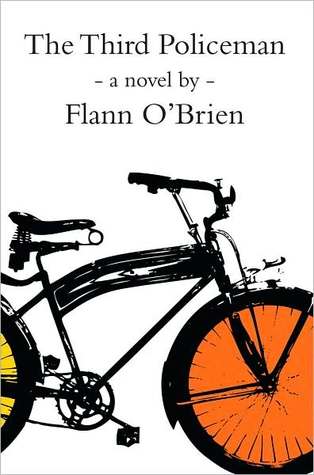
Flann O’Brien wrote to the American writer William Saroyan seventy-six years ago this Valentine’s Day – which is, as I write this, today’s tomorrow, today incidentally being, by equally timely reference, Hell’s Birthday according to Medieval scholars – to announce that he had completed a new novel. He briefly described the conceit of his inventive, unconventional, and, he hoped, humorous tale but, much to his dismay, his publisher declined to publish the work. He followed this rejection with an attempt to secure American interest, but despite the enthusiasm of a literary agent, a willing publisher could not be found. Rejected now on either side of the Atlantic, the Irish writer (whose real name was Brian Ó Nualláin) claimed that the manuscript had gone missing and let the matter lie. As a result The Third Policeman would not be published until 1967, a year after its author’s death.

policemanDelighting in a mischievous engagement with the English language, O’Brien’s dark comic novel sets out to tell the tale of a deeply self-focused young man who finds himself on a convoluted metaphysical journey through a strange land – one that seems to be a curiously stranger version than the one from which he originated, but, single minded as he is, he never fully realizes the true nature of this weird world of eccentric policemen, outlandish theories, and bicycle logic. Throughout it all our hero relies an even odder philosophical compass, the works of a scientific theorist named De Selby who posited a set of theorems about the nature of reality so outrageous that even his young acolyte and his most devoted commentators are frequently at a loss to explain them. The result is a brilliantly skewed meditation on the nature of existence: of life, death and the passage of time.

Quite simply, The Third Policeman begins with a murder and with our nameless narrator’s open admission of his full and active role in this brutal act. But, to put it in context, he will then step back in time to explain how he came to be on a rural road, spade in hand, smashing the skull of an old man. A mistake, he admits, but one for which he can never begin to accept moral responsibility. Our hero, likable as he is in his tribulations, is not a heroic man. Spooling back in time, we learn that the narrator was orphaned young. The farm and pub run by his parents is left to the care of a man named John Divney while the erstwhile heir is sent off to boarding school. It is at school that the protagonist first encounters the work of de Selby – the day he finds a tattered copy of the obscure wise man’s Golden Hours in the science master’s study is one that he remembers with more acuity than his own birthday. By the time he graduates a few years later, he has stolen the volume and packed it into his bags. Sourcing de Selby’s other works and those of his primary commentators occupies his immediate months and travels following his school years and on his journeys, he breaks his left leg in an accident (or as he famously puts it, has broken for him). Thus he arrives home to the farm with one wooden leg.

Divney, as it happens, stays on to work the farm and the manage the pub, taking to both tasks with little energy or honesty, while the narrator devotes himself to intense, obsessive study of de Selby. For him, the rest of the world holds little fascination, but Divney, who continually complains of a lack of funds, tires of the rural bachelor existence and fancies taking a wife. Ultimately he hatches a plan to rob and murder Mathers, a reclusive, retired cattleman who is known to carry a cashbox with him at all times. Playing into the narrator’s desire to be able to publish the results of his impassioned studies and, ultimately, make his name by elucidating hitherto misunderstood facets of the great man’s philosophy, Divney secures himself an accomplice.

In the aftermath of the murder, the stolen cash box disappears, Divney insisting that it has been secured in a safe place where it ought to remain until any fuss blows over. The narrator does not trust this explanation and for an entire year he adheres himself to his farmhand, barely letting him out of his sight for a minute. Finally he is assured that it would be safe to retrieve the box so, on Divney’s instructions, he sneaks into Mathers’ abandoned house, finds the loose floorboard that supposedly conceals the cashbox and no sooner does he grasp the box than it is pulled from his hand.

And that’s when things get weird.

Firstly our protagonist – who is now truly nameless, for even if asked he can no longer recall his name – becomes aware of the presence of the very man he helped dispatch from the world of the living, clearly alive if not especially well and sitting in the corner of the room. Then, as he tries to make sense of this ghostly gentleman, he suddenly encounters, from within himself, his own soul; an immediate and intimate companion he names “Joe”. From this point on, Joe takes on the often thankless task of playing the role of his host’s better angel and logical voice of reason.

Still intent on securing the whereabouts of the vanished cashbox, the narrator engages old man Mathers in an interrogation that, after a series of inquires that raise little more than a negative response, leads to an explication of colour and its relation to the length of an individual’s life. Hearing about a trio of intuitive policemen who are gifted with the ability to perceive the colour of the prevailing wind at the time of a person’s birth, our hero decides to seek out their assistance in his search for the cashbox. He spends the night in Mather’s house and the following morning he sets out down the road. Here the text, judiciously footnoted, turns to one of several interludes where the wisdom of de Selby is evoked:

“… de Selby makes the point that a good road will have character and a certain air of destiny, an indefinable intimation that it is going somewhere, be it east or west, and not coming back from there. If you go with such a road he thinks, it will give you a pleasant travelling, fine sights at every corner and a gentle ease of peregrination that will persuade you that you are walking forever on falling ground. But if you go east on a road that is on its way west, you will marvel at the unfailing bleakness of every prospect and the great number of sore-footed inclines that confront you to make you feel tired.”

When the narrator finally reaches his destination, he finds a building of the most peculiar dimensions, seemingly without depth. Inside this two dimensional barracks he encounters an odd looking fat man, Sergeant Pluck, who assumes that he has come about a missing bicycle. The officer expresses blatant disbelief that our hero is neither seeking a missing bicycle nor has he come by a similar mode of transport – a motorcycle, a tricycle, even. This simple truth will continue to be the most astounding point of fact for both Pluck and his fellow officer Policeman MacCruikseen, who busy themselves with montoring a bizarre and unbelievable assortment of realities. No bicycle! It is enough to make Pluck flustered and MacCruikseen apoplectic!

Over the few days that our narrator and his soul Joe spend in the company of the outlandish policemen (who include in their number a third officer, Policeman Fox, who apparently only comes by the station at night) he will witness a most unusual search for a missing bicycle and hear about the ravages of “Atomic Theory”, the principle which is causing the good people of the parish to absorb the atoms of their bicycles the more they utilize them, while the bicycles, in turn, become more human. To allow the trend to continue unchecked would be a travesty. Sergeant Pluck is so wary of his own bicycle that he keeps it, or rather “her”, locked in the lone jail cell.

With the discovery of another brutal murder during this time – our friend Mathers gets it again it seems – the narrator is named the guilty party, for no reason other than that he is handy. Never mind that he is not guilty, he is sentenced to hang for the crime. Our hero is devastated, even though he holds no guilt about the murder he actually did commit. Between his bouts of despair and dreams of escape, he endeavours to learn as much as he can about the mysteries behind the strange qualities of his surroundings including, as it happens, a visit to “eternity”, which is, he learns, just down the road. His curiosity vexes poor Joe:

You don’t mean to say that you believe in this eternity business?

What choice have I? It would be foolish to doubt anything after yesterday.

That is all very well but I think I can claim to be an authority on the subject of eternity. There must be a limit to this gentleman’s monkey-tricks.

I am certain there isn’t.

Nonsense. you are being demoralized.

I will be hung tomorrow.

That is doubtful but if it has to be faced we will make a brave show.

We?

Certainly. I will be there to the end. In the meantime let us make up our minds that eternity is not up a lane that is found by looking at the cracks in the ceiling of a country policeman’s bedroom.

Then what is up the lane?

I cannot say. If he said that eternity was up the lane and left it at that, I would not kick so hard. But when we are told that we are coming back from there in a lift – well I begin to think he is confusing night-clubs with heaven. A lift!

The Third Policeman is a comedy of absurd proportions with its extrapolations on physics and metaphysics; a fountain of fantastic ideas. Here the surreal layers of reality within which the policemen conduct their business begin to sound strangely sensible (a curious “pancake” indeed as the officers themselves would have it) when played out against the narrator’s own personal frame of reference – his beloved de Selby –  with his extremely idiosyncratic conceptions including his thoughts on the ideal house (either without a roof or without walls), his musings on the nature of darkness (due to the activity of volcanoes) and his conviction that life is an illusion. From beginning to end, the energy is high, the  language is wildly infectious, the imagery is wonderfully inventive, and our narrator is so stubbornly selfish and greedy for all his earnest soul’s attempts to intervene that he never even imagines where he has, in truth, found himself.

The Third Policeman by Flann O’Brien is published by Dalkey Archive Press.

All the world’s a stage: On the Edge by Rafael Chirbes – My review for Numéro Cinq

My latest review for Numéro Cinq is now live. On the Edge by the late Rafael Chirbes has just been released in North America (New Directions) with a UK release forthcoming from Harvill Secker in July. This is an unforgiving portrait of Spain in the aftermath of the 2008 economic crisis, through the eyes of one man who has lost everything:

On-the-edge

For the Spanish writer, Rafael Chirbes, there was no room in the creative process for an aesthetic devoid of ethics. As a documentarian of his native country, from the post-war years through the transition to democracy in the 1970’s, and on into the opening decade of the 21st century, the late author offered a defiant chronicle of the point where social, economic, and political dynamics intersect with the harsh realities of the human condition. He argued that if the artistic endeavour aims to stand at that intersection, no perspective could remain neutral:

A point of view situates you somewhere, in a location where potentialities—ways of being—battle one another. When you write, or paint, as when you read or look at something, you have to be conscious of the fact that the author wants to invite you to look where he’s looking. Your mission is to protect yourself. Know that they want to seduce you.

This advice, from a brief interview segment in A Thousand Forests in One Acorn: An Anthology of Spanish-Language Fiction (Valerie Miles, Open Letter Books, 2014), should serve as fair warning before one enters into the emotional labyrinth that is Chirbes’ lauded ninth novel, On the Edge. Recently released by New Directions, in a measured yet lyrical translation by Margaret Jull Costa, this book will serve as highly anticipated introduction for English language readers, to a writer at the height of his powers: a writer who has chosen, in this instance, to stand on the rapidly shifting ground of a country in the throes of economic collapse.

Find the rest of the review here

“I had a dream”: The Vegetarian by Han Kang

“Dark woods. No people. The sharp-pointed leaves on the trees, my torn feet. This place, almost remembered, but I’m lost now. Frightened. Cold. Across the frozen ravine, a red barn-like building. Straw matting flapping limp across the door. Roll it up and I’m inside. A long bamboo stick strung with great blood-red gashes of meat, blood still dripping down. Try to push past but the meat, there’s no end to the meat, and no exit. Blood in my mouth, blood-soaked clothes sucked into my skin.”

The Vegetarian, a novel by Korean author Han Kang, confidently translated by Deborah Smith, met with resounding critical praise when it was released in the UK early last year. Despite being available in Canada in the UK edition, the book has received relatively little attention on this side of the Atlantic. However, its American release from Hogarth in a slightly different translation, should encourage a new round of well deserved attention.

vegetarianThis haunting allegorical tale of a woman’s gradual descent into madness that cracks and shatters the carefully composed order around her, starts out with a certain clean, almost antiseptic atmosphere of emotional detachment. It passes through the lens of an eerie erotic account of artistic obsession and ends with the force of an unbridled mountain creek, crashing and rolling down a steep rocky channel to a wildly uncertain end.

The opening chapter, “The Vegetarian”, is narrated by the moderately ambitious Mr. Cheong, a Seoul businessman who sets the bar fairly low and is intent on a smooth life, devoid of excessive stress or excitement. He marries accordingly, choosing the perfectly average Yeong-hye. Not exceptionally attractive, her quiet resourcefulness, and competent housekeeping and cooking skills please him. Yet he is, once his measured existence takes a turn for the decidedly strange; a man who proves himself remarkably self-centred. In his world it is all about him, even as it becomes apparent that his wife is struggling with something dark and troubling.

One morning, without warning, Yeong-hye is discovered, by her husband, standing in the glow of the open refrigerator at 4:00 AM. She is oddly lost, curiously absorbed by whatever it is she sees there. Her only explanation, when pressed, is “I had a dream”. Later that day, Mr. Cheong arrives home to find his wife removing and discarding all of the meat in the fridge. From that point on she becomes a committed vegetarian, much to her husband’s horror, dismay and shame. But this is not an effort to embrace a health trend, she becomes thinner and more withdrawn over time. Still he rationalizes away her behaviour, preferring to maintain a facade of normalcy. As readers we are afforded brief glimpses into her horrific dreams and visions. However it is not clear whether she actually makes an effort to try to talk to her husband – or if he would listen.

Finally, more out of frustration for what she is doing to him than concern for Yeong-hye’s well-being, Mr. Cheong seeks the support of his in-laws. They respond with an attitude of extended shame. When an ill-conceived attempt to stage an intervention at a family gathering fails, Yeong-hye’s father resorts to force and violence. In response his defiant daughter turns the drama of violence on herself.

The second part, “Mongolian Mark” adopts a third person perspective. The video-artist husband of Yeong-hye’s older sister In-hye takes centre stage. Time has passed and Mr. Cheong has filed for divorce. The vegetarian is now on her own, but her brother-in-law has developed an erotic obsession inspired by the knowledge, gleaned from his own wife, that Yeong-hye has never lost her Mongolian Mark, a birthmark common to darker skinned babies that generally fades a few years after birth. He is haunted by images of naked men and women, their bodies painted with luscious flowers, engaging in sex and ultimately he reasons that the only way to purge his fixation is to realize his artistic vision. But who to paint and film? The true source of his obsession, of course. As this chapter unfolds it becomes apparent that Yeong-hye has moved beyond the realm of normal grounded emotion. To satisfy his growing need to permeate her implacable surface, her brother-in-law will ultimately risk his relationship with his wife and child.

“Slowly she turned to face him, and he saw her expression was as serene as that of a Buddhist monk. Such uncanny serenity actually frightened him, making him think that perhaps this was a surface impression left behind after any amount of unspeakable viciousness had been digested, or else settled down inside her as a kind of sediment.”

The final section of The Vegetarian, “Flaming Trees” follows In-hye several years on again, her own marriage now dissolved, on her way to visit Yeong-hye at a psychiatric hospital in a remote mountainous area. The demands of running a business, caring for her young son, and attending to the needs of her sister have taken a toll on her. She is haunted by doubts, regrets and voices. Meanwhile Yeong-hye, convinced that she wishes to become a tree and is therefore no longer in need of any nourishment beyond water, has been slowly wasting away. By this point the narrative, at once so controlled and self assured, spirals into a dark, increasingly surreal tunnel from which it is not clear if anyone will emerge intact. The threads that have led the two sisters to this point are spooled back to earlier moments in their lives; casting light on the insistent destructive power of obsession, pride, and shame arising from the rigid social strictures that confine and restrict the individuals caught within them.

There is no question that this is a powerful work. The structure of the shifting perspectives is interesting and effective. However, if there is a difficulty for me in this book, it is a lack of clear cultural context. Elements of Korean social expectation and custom play a significant role in the way that Yeoung-Hye’s family respond to her increasingly bizarre behaviour but I would have liked to have had that aspect fleshed out a little bit further. Too much seemed to rely on what is assumed. The environment, that is a sense of place – save for that of the final section – seems largely unremarkable, generic. This is my first experience of Korean literature, but I tend to find the same challenges for me, as a reader, with much Japanese writing, so this may be more a question of personal inclination on my part than a specific shortcoming in the work.

Finally, as a mental health advocate, I did find the depiction of mental illness a little too out of step within what is clearly an allegorical tale, as if it was trying to be both surreal and authentic at once. By the end I could not help but imagine it as a Korean version of Miriam Toews’ All My Puny Sorrows; in both books one sister is faced with coming to understand or at least respect her mentally ill sister’s desire to let go of life, albeit one with restrained horror and the other with humour. Both novels, at heart, confront a brutal reality that is difficult to forget.

Meditation on a poetic meditation: To Duration by Peter Handke

In a month during which reading proved to be a slow, at times disjointed enterprise, I feel it would be shortsighted to let January come to a close without calling attention to one of the simplest, most precious reading experiences I enjoyed over the past 31 days. It arrived, courtesy of the translator, on a morning when I was rushing out of the house on my way to an appointment across town. A slender, pocket sized volume, it proved perfect company for a busy day. Only 40 pages long I read it several times before the week was out. I am speaking of Peter Handke’s poetic meditation To Duration, translated from the German by Scott Abbott.

The author tells us in the opening stanza, that he has long wished to engage in the following personal quest, the exploration of a topic that he feels is best suited to the poetic medium. Perhaps it is only with a poem that language can circle around and come close to touching on a subject that is, by its very nature, difficult to pin down and describe. Words are almost too solid to capture an experience that dissolves as quickly as it arrives:

Time and again I have experienced duration,
in early spring at Fontaine Sainte-Marie,
in the night wind at the Porte d’Auteuil,
in the summer sun of the Karst,
on the way home before dawn after love.

This duration, what was it?
Was it an interval of time?
Something measurable? A certitude?
No duration was a feeling, the most fleeting of all feelings,
more swiftly past than the blink of an eye,
unpredictable, uncontrollable,
impalpable, immeasurable.

Duration, Handke tells us, is not fixed or prescribed; it cannot be scheduled or delayed. It can be approached, but it cannot be forced or guaranteed. I would wager that as our lives grow more stretched, weary, and fraught with the disillusion of time, duration becomes ever more elusive. I also wonder if, when we try to grasp at it through our memory of those moments when it seems we once met duration in passing, the more impossible it seems. And then, one day, when we are not expecting it, the feeling taps us on the shoulder, washes over us and moves on but leaves its trace, like frost on a bare branch or the hint of dew on the grass. One of the true gifts of this book, is that it inspires the reader to explore his or her own experience of duration. What is it for me,when is it, when was it, where? These are the questions that the reader is encouraged to meditate upon, as Handke reflects back upon his relationship with duration in his own life. His calm, measured, and sensitive introspection invites you to engage in the same.

At one point he talks about travel and journey as opportunities to open oneself to encounters with this feeling. There was a time when I was able to regularly visit certain parks and pathways in my hometown, typically with my camera in hand, focused on nature framed through the lens – a dried leaf here, a glimpse of a meandering stream there, the shifting pattern of clouds in the wide blue sky. At home, processing the files, I could almost revisit the moment – it was not the photograph that fixed the moment, in and of itself, it was rather an ability of the image to contain, for me alone, the experience of being in the moment. Is that duration? A variation on the theme? And why don’t I visit local parks as much as I used to?

In truth, I need a greater distance, at least right now.

23823656024_da6c196a78_b
Sea Point Promenade at sunset, July 2015 – Copyright JM Schreiber

Last summer I spent three weeks in South Africa. After a visit with a close friend in the Eastern Cape, I returned to Cape Town for a week on my own. I traveled on foot and by city bus, eschewing most of the tourist sites. I wanted to be in the city. I stayed in a small B&B in Sea Point and every day I walked the Promenade along the Atlantic. A popular pathway, no doubt, but there was, for me, an essential necessity to be close to the ocean. Sometimes I would stand at the salt-corroded railings and look out over the waves and find a deep peace at being so far from home and all of the complications left behind there. I could turn around and ground myself with the unmistakable landmarks of Signal Hill and Lion’s Head. It was the moment experienced and re-experienced each day that became the fulcrum of my stay in the city. No day was complete without it. If I lived in Cape Town I don’t think I could have touched duration like that, so intentionally. The measure of seven short days, coloured by an intention to be less a tourist than a presence in a city, not having to actually attempt to fit in like I do at home, I touched a peace of place I rarely experience. Travel can do that.

But physical travel,
the annual journeying and pilgrimages
for the jolt of duration,
the thrilling supplement,
is that really still necessary for me?

Handke acknowledges increasingly finding more instances of duration closer to home, even in his own garden. Restless as I am in my house and home, I likely frighten off duration, so fragile and fleeting a guest. Yet just the other night it caught me unaware. My elderly father, still seriously weakened and disoriented following his stroke, insisted on returning home from the hospital on Thursday against the recommendations of his doctors and the wishes of his family. I quickly gathered some clothing and personal items in one bag and tossed a handful of books from my priority pile into another and headed out the door for the two hour drive to the remote location where they live. That first evening, once my exhausted parents were safely tucked into bed, I sat in the delicious silence with my collection of books. I wasn’t actually expecting to have time to even start reading any of them – I just wanted to spend time with these relatively new acquisitions. Get to know them a little. Read a few pages. This unexpected moment, borne of a collision of unwelcome circumstances, opened the door to duration, inviting that unpredictable, immeasurable sensation, to wash over me, leaving a sense of contentment I hardly imagined I would encounter when I had headed for the highway only a few short hours earlier.

Perhaps then, if you watch for it, open yourself to it, maybe duration is not quite as elusive as it may seem.

scan-2


To Duration, Cannon Magazine No. 4, is published by The Last Books.

With infinite thanks to Scott Abbot.

January 2016: A slow start to my reading year (and why does that bother me?)

The first month of 2016 has almost slipped away and I am feeling overloaded. Too many stressors have collided to take a curious toll on my ability to read and blog. My reading continues to be fractured. Books are not the same refuge they were a few months ago. Not that they don’t keep arriving (or rather following me home) and haunting me as the stacks pile up, staring at me, daring me to read faster. But my reading is slow, and the books I had expected to venture into by month’s end have not yet been cracked.

And then there is life, the one that doesn’t exist in books, the one that can’t be shelved or put aside for a later date or, as much as I would love it sometimes, be tossed into a pile to go out to the next charity sale. It is hardly a surprise. Over the past month I have had to face some extraordinary challenges on the home front – some new, some long standing, and others simply arising from the financial reality of owning a car and a house, both of which are well past their prime. Some matters have been resolved – one mechanic and two plumbers later – I just have to figure out how to pay for them; others are less concrete, more emotionally corrosive and resolution is not in sight. If another well meaning person says, “This too shall pass,” my reaction may be less than generous.

Copyright JM Schreiber, 2013 The last time I had a month with two separate plumbing calls I took this shot to celebrate the joy of a clear drain that had been blocked for more than four weeks.
Copyright JM Schreiber, 2013
The last time I had a month with two separate plumbing calls I took this shot to celebrate the joy of a clear drain that had been blocked for more than four weeks.

Through it all I have been reading but by some weird twist of logic my attention has been drawn toward much more intensive review projects. Blogging is fine but for each review I write I spend 4-6 hours, so when I encounter an ambitious, complex, postmodern novel like Klaus Hoffer’s Among the Bieresch, forthcoming from Seagull Books; I can’t resist the desire to read into the varied subtextual materials, especially the works that I don’t know well and – with luck – explore the novel in a space with greater critical elbow room and a much wider audience than my blog commands. There’s a voice in my head that says “Are you out of your mind?” and, maybe I am but, at this moment, I seem to be most comfortable burying myself in demanding critical projects, losing myself I suppose. At the same time, I am also spending more time on my own writing: a personal essay I hope to enter in a contest and a piece of experimental prose.

Tell me then, what is with this book blogging pressure I feel? It’s not a numbers game. No one is going to disown me if I don’t read and review two books a week. Reading and writing about books is supposed to be fun. And, heaven knows, the spaces I that want to write for, on or off my blog, are literary acts of love and, as such, there’s typically no money involved.

So blog posts may be slower for a while. I am reading. I am writing. And I am dealing with all the messy business of living.

Words, the most vital gift: Translator’s Blues by Franco Nasi (The Cahier Series, #26)

Charged with the task of bringing a piece of text to life in another language, for another culture, and possibly also for another moment in time perhaps centuries after it was originally conceived and recorded, the translator stands armed with words alone: “imperfect, approximate, or a tad reductive”. But, employed with skill, sensitivity and creativity; words can facilitate a little literary magic.

2016-01-18 01.59.14Translator’s Blues, the latest addition to the Cahier Series of the American University of Paris (#26) is an imaginative discourse on the dilemma of translation – a meditation on the interplay between language and culture, facilitated through words; an elegy for what is gained and what is lost in the process. Italian translator Franco Nasi adopts the voice of a naive alter-ego who is, like his creator, a translator who hails from the province of Regio-Emilia where he was born and expects he will die. His home – with its mountains, Parmesan cheese factories, and cemeteries laid out like miniature cities behind high walls – is a place which makes sense to him, a world that is idiosyncratic but familiar. He is grounded there.

When he chances to befriend an American architect who is visiting his fabled region of Italy, he is offered an invitation to travel to the States in return. After a brief visit to Vermont, our translator finds himself in Chicago where his host is presently employed. As our erstwhile hero makes his way through the linguistic landscape of America he finds himself exploring of the boundaries of language that are blurred when one endeavors to navigate the tricky waters that lie between one culture and another. Through an account of his adventures and encounters he orchestrates, with insight and and a measure of impish delight, an argument that translation is, at its best, an inexact art form. However, rather than seeing that as a limitation, he celebrates the challenges, possibilities and rewards of bringing a piece of literature to new audiences that would otherwise be denied access by the borders of both language and culture.

Our narrator’s journey of discovery starts inauspiciously on a snowy Sunday morning in Chicago when he sets out to purchase non-alcoholic beer from a nearby shop. Bemused by his inability to procure alcohol of any description before 11:00 AM, he inquires of his host as to whether this is a daily reality or one confined only to the one day. He learns that it is, in fact, a law applying only to Sundays, to what are known as the “blue hours”. Blue. This is a word that has a special impact for our translator. He had just finished reading William H. Gass’ On Being Blue: A Philosophical Inquiry. He was given the book so that he could assess its suitability for translation. Thus it was with a translator’s eye that he read it, and he found himself rather out of his range. He was inclined to wonder if attempting to translate a book like this, with its multi-layered references to the significance of the colour blue, would be at all possible. References in some instances, such as those with sexual or potentially pornographic overtones, would likely be rendered nonsensical to a culture that tended to associate the same arena with the colour red. It would, he feared, surely induce in him a state of melancholy:

“… a malady that takes hold of you whenever, after a thousand false starts, you find yourself being invested by an overwhelming sense of inadequacy and impotence. This blue-tinged malady makes the translator wish that Babel and the multiplication of languages were only a legend, and that all the various languages in the world did not exist and had never existed. With melancholy comes nostalgia for an ur-language, in which all colours and all their meanings were the same for everyone, in which plants were identical for all and sundry; in which flowers, and sounds, and ceremonies, every object and sensation, and belief was expressed in a single, universal, manner, in which a rose was a rose was a rose.”

All the culturally and linguistically entrenched peculiarities of blue aside, Nasi allows the shade to colour, if you will, much of the exploration of the art of translation that follows. His translator is led, most immediately to a famous Chicago blues bar. As he soaks up the atmosphere and the music, he reflects on the translation of African traditional music to America, facilitated through the songs that black slaves brought with them. Typically based on a pentatonic scale, these songs are echoed in the adaptation of one musical “language” to instruments designed to the specifications and precision of the chromatic scale. As a consequence, notes tend to slip a little out of tune, to bend, and acquire the nostalgic, mournful tone, the blueness, that we associate with the blues. On his way home he contemplates the resonance between the music he has been enjoying and his craft:

“Could it be that any translation, if it seeks to be more than a cold and sterile transposition, must contain blue notes? A translation needs blue notes to hint at an elsewhere, at nostalgia, and with nostalgia the tension provoked by unappeased desire for whatever is distant and unreachable. As William Gass puts it, ‘So it’s true: Being without being is blue.’”

From this point on our hero chances to meet a well-known American poet who, it turns out, is seeking a tutor to help him improve his Italian. So the two begin to meet regularly. Over the course of their acquaintance the poet gives his new friend a volume of his poems. Seeing this as an opportunity to exercise his own English skills, with the added advantage of being able to check his success against the original author’s perceptions, the protagonist asks if he might translate some of the poems. The poet seems pleased with the resulting translations, even if they might at times be less than exacting. So talk of publishing the Italian versions arises and a publisher is sought. Suddenly the poet’s self-appointed “official” translator emerges and demands that a halt be put to the fledgling enterprise – after all, audiences are accustomed to one voice, to offer an alternative would certainly be disorienting.

Nasi’s translator backs down. But at the same time he wonders about the “versions” of writers such as Homer, Sappho or Aristophanes that already exist. He envisions the silence of the library where the respective translations must sit shoulder to shoulder on the shelves, to be broken once the lights are turned off and the key turned in the lock:

“Of a night, there must be some turbulence in the library stacks, what with all those competing voices. And it’s clear that the music does indeed change according to who is playing – and just as well too: what a bore it would be to hear over and over Beethoven’s ‘Eroica’ Symphony in the way it was played in public the first time, on 7 April 1805 in the Theater an der Wien. To translate is to betray – tradurre è tradire – and only through betrayal is a writer’s voice kept alive. To the liveliness of this voice in time will correspond the number of voices multiplying it, so permitting it to dialogue across the ages.”

Nasi goes on to expand on this fundamental idea. Looking at translation close to the source – that is, within the author’s lifetime – has a particular value, especially when the author is engaged in the translation process. However some authors, and Nasi points to a few of his fellow countrymen here, may run the risk of insisting on a degree of literal accuracy, as they perceive it, that could hinder an emotionally and culturally authentic transition to a foreign language. And to round out his argument he allows his alter-ego to experience the shock of receiving a copy of his own translated book, which is, in reality, the very book the reader happens to be reading. He fails to recognize it at first, his child released into the world now returning and standing at the doorstep – changed but somehow the same and possibly richer for the experience of immersion in another language and culture. Just as our Italian narrator returned from his own trip beyond the borders of Regio-Emilia informed and enlightened.

2016-01-18 01.57.27An essay within a most charming story, Translator’s Blues offers an entertaining, thoughtful reflection on the relationship between translators and the works they attempt to realize in another language and culture. With humour and a gentle wisdom, Nasi explores what can be preserved, what is lost, and the responsibilities that, he would argue, have to be surrendered in the process of translation.

Franco Nasi is a writer and translator who has taught Italian language and literature in the United States, and has translated into Italian a number of writers and poets including S.T. Coleridge, William Wordsworth, J.S. Mill, Billy Collins and Roger McGough. Translated by Dan Gunn and paired with illustrations taken from a notebook kept by Italian artist Massimo Antonaci, Translator’s Blues will be released in February, 2016.