Tracing hidden lines across the Americas: Counternarratives by John Keene

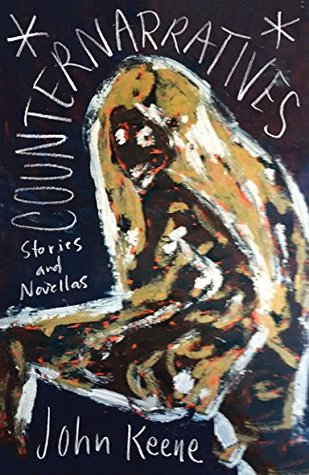
Stretching over a span of four centuries, Counternarratives is a collection of stories and novellas that defies simple description or classification. In just over 300 pages, John Keene manages to challenge and reinvent the way we think about historical fiction by subverting the conventional narratives again and again, peering into dark corners, and prying the lid off of stories not typically part of the grand narrative tradition that has dominated so much of contemporary American literature. First off, for Keene, America has a broader scope. This is the New World, primarily the United States and Brazil—the two countries most closely associated with the slave trade—but over the course of this book we also venture into Mexico, the Caribbean and across the ocean. The characters, primarily, though not exclusively, of Black African heritage, are drawn from history, the arts, and the imagination; and demonstrate a strong will to run against the currents of normative discourse within which they would have otherwise fallen under the radar or been rendered invisible. In allowing their lives to flourish on the page, Keene is effectively queering history. Many of his characters are either implicitly or explicitly queer with respect to sexuality or gender, but all of them through their stories, push up against accepted mythologies, inverting or “queering” them in the process.

CounternarrativesThe earliest narratives in this collection tend to keep some distance from the subject at hand, some even have an investigative documentary feel, complete with maps inserted into the text. Over the course of the book, the control of the voice shifts, as characters begin to take command of their own stories (mid-way through the powerful central piece, “Gloss, or the Strange History of Our Lady of the Sorrows” Carmel, the mute protagonist, starts to “speak” through the written word, abbreviated and phonetic at first, then increasingly fluid over time) until eventually, as the accounts draw closer to the present day, internalized, experimental stream of conscience narratives begin to come into play. With any collection of shorter works there is always the risk that the stories will begin to blur at the edges, losing distinction from one to another. Not so in this case. Although the themes and characters are not directly connected, this evolving style of storytelling—from the relatively dry historical reportage of the opening pieces, through more traditional narrative accounts to the disembodied, disturbing dialogue of the closing entry “The Lions”—provides a continuity that serves to create a cohesive work of astonishing depth.

Throughout, Keene demonstrates an enviable capacity to create vivid, memorable characters and breathe life into the vital cross currents of history. He does not allow himself to get bogged down in background detail but allows the time, place, and social dynamics to come to the surface through the wide range of individuals and the varied settings and styles that he allows his narratives, or rather counternarratives, to adopt. And although it may seem strange to speak about these short stories and novellas as if they almost have an agency of their own, that is what it feels like to engage with them. Due to extenuating personal circumstances, my reading of this collection actually extended over the course of three months, but whenever I was forced to put it aside for a time I never feared that I would not return, nor did I find it difficult to lose myself, once again, right where I left off.

counterThroughout this collection, customary beliefs are routinely challenged through the presentation of lives typically discarded or seen through the lens of the dominant power, in a manner that seeks to restore a level of dignity. Black, Native American and queer characters are granted a reprieve from the more conventional historical portrayal. However, that release, or escape if it comes, is often at a cost. Some of the narratives are abruptly truncated, ending partway through a sentence. In most instances a resolution is uncertain regardless of whether it signals promise or pain.

By way of offering a taste of this collection, I’ll touch on three pieces. The epistolary novella “A Letter on the Trials of the Counterreformation in New Lisbon” offers a report on the experiences of one Dom Joaquim D’Azevedo, sent in 1629, to attend to matters at an isolated monastery in Brazil where some disturbing occurrences had been reported. He arrives at this remote location, populated by two padres, one brother and their bondspeople, or slaves, to find himself facing what will reveal, in time, a veritable heart of darkness. The atmosphere is charged with an unusual energy from the outset, as the newcomer struggles to get his bearings in his new setting and size up his charges:

Resuming his comments about the monastery, Dom Gaspar could see that D’Azevedo was growing unsteady on his feet, and with a gesture summoned a stool, which a tiny man, dark as the soil they stood on, his florid eyes fluttering, brought out with dispatch. They continued on in this manner, Dom Gaspar speaking—Padre Pero very rarely interjecting a thought, Padre Barbarosa Pires mostly nodding or staring, with a gaze so intense it could polish marbles, at D’Azevedo—detailing a few of the House’s particulars: its schedule, its routines, its finances, its properties and holdings, its relationship with the neighboring town and villages, and with the Indians.

Before long, D’Azevedo settles into a rhythm, feels he is making progress and begins to tutor boys from the town. But strange noises and mysterious sightings inside the monastery begin to unsettle him while outside threats from encroaching Dutch forces escalate, creating an atmosphere in which an evil long brewing is brought to the surface. Dark secrets are revealed, D’Azevedo is forced to confront a truth he has long buried, and the identity of the small African servant who seems to be ever present comes to light. This piece is a strong example of evocative storytelling, reminiscent in mood of The Name of the Rose, but reframed within the context of the Catholic Church’s role in the Americas, the clash with tribal African traditions, warring colonial tensions, and questions of ethnic heritage, gender and sexuality.

By way of contrast, “Rivers” turns the tables on a classic of American literature, giving Jim Watson of Huckleberry Finn fame, an opportunity to flesh out the details of his life after the book ended. Jim, now a free man who has reclaimed his own name, James Rivers, is a tavern owner in Missouri when he chances to meet Huck and Tom on the street. Their conversation, is dominated by Tom’s racist jibes, but Jim remains circumspect. He thinks of what he could have told them but chooses not to (“I thought to say…/Instead I said…”), in this way sharing with the reader a full account of the women in his life, his children, his time in Chicago, and his return to his home state, while little is offered to his former acquaintances. There is no joyous reunion, rather the occasion is marked by arrogance on one side, bitterness and suspicion on the other. But as the Civil War looms, another chance meeting awaits.

Beyond this story, the narratives begin to take on an increasingly playful, experimental form in style and content. An especially affecting piece is Cold. Narrated from an internalized second person perspective, this short story takes us inside the troubled mind of Bob Cole, the composer, playwright and producer who co-created, with Billy Johnson, A Trip to Coontown in 1898, the first musical owned entirely by black showmen. It is now 1911, and the voice in his head taunts him, catalogs his losses, his failures, driving his desperate decision to take his life before the day is out. . .

For the last month or two, or five, has it been a year—why can you not remember?—these newest melodies you cannot flush from your head, like a player piano with an endless roll scrolling to infinity. Songs have always come, one by one or in pairs, dozens, you set them down, to paper, to poetry, like when you set the melody of the spiritual Rosamond was whistling as you walked up Broadway and in your head and later on musical paper clothed it in new robes. Then somewhere along the way after the first terrible blues struck you tried to hum a new tune, conjure one, you thought it was just exhaustion, your mind too tired to refresh itself as it always had, that’s why the old ones wouldn’t go away.

The pieces I have briefly touched on just graze the surface of this book. Its relatively short length can be deceiving. Counternarratives offers a demanding, immersive reading experience. It is, at the same time, compulsively engaging and deeply satisfying. I heard reverent talk of it long before I finally picked up my own copy earlier this year and I can fully understand the respect it has garnered even I find myself at a loss to do it justice. Bold and expansive, this is a haunting, unsettling, important work.

Counternarratives by John Keene is published by New Directions in North America and by Fitzcarraldo in the UK.

Poets, artists and other lost souls: Last Evenings on Earth by Roberto Bolaño

A poet can endure anything. Which amounts to saying that a human being can endure anything. But that’s not true: there are obviously limits to what a human being can endure. Really endure. A poet, on the other hand, can endure anything. We grew up with this conviction. The opening assertion is true, but that way lie ruin, madness, and death.

The individuals that populate the stories collected in Roberto Bolaño’s Last Evenings on Earth tend to be poets, writers, artists, and dreamers. Typically they are oddly groundless, restless beings who seem to drift through not only their own lives but through the lives of those they encounter. Most are either exiles or products of the Chilean diaspora, loosely set down or wandering between Mexico or Europe. As a result, their existences carry a ghostly aura, they are haunted by an otherness that is indefinable to themselves and obscures their relationships with others. The narrators or protagonists are unsure of their own memories, sometimes anxious and paranoid, sometimes bored and aloof–unwilling to trust, to fully engage with those around them.

eveningsIn this, my first encounter with Bolaño’s work, I found myself captivated by the misty melancholic mood, the affecting prose, and the characters, who are commonly struggling with the vagaries of what it means to be creative and to find value in life. Yet there is an underlying ambivalence, anxiety, and insecurity that lends the collection an atmosphere that can be unnerving and faintly depressing. And it can also tend to contribute to blurring of the edges of many of the stories so that a reader may, at the end, be left with a sense of appreciating the journey but losing track of the details that set many of the tales apart.

That is not to imply though that there are not stories that stand out. In my reading, my favourites were the ones that happened to strike me as especially sad, but then I read this book at the bedside of a dying parent. Sadness was the order of the day.

The title story follows a young man and his father on an ill fated holiday to Acapulco. Their days pass in relative calm, though a strain can be felt in the relationship between the two. The father wants to go out, have fun, while the son prefers more solitary outings and spends much of his time reading a book about surrealist poets and contemplating the fate of one particular poet, a minor writer who disappeared and was essentially forgotten by his peers. Father and son engage in aimless conversations that highlight their differing temperaments while the latter is haunted by a feeling of impending doom. For a time the imagined threat is held at bay:

Then the lull comes to an end, the forty-eight hours of grace in the course of which B and his father have visited various bars in Acapulco, lain on the beach and slept, eaten, even laughed, and an icy phase begins, a phase that appears to be normal but is ruled by the deities of ice (who do not, however, offer any relief from the heat that reigns in Acapulco), hours of what, in former days, when he was an adolescent perhaps, B would have called boredom, although he certainly would not use that word now, disaster he would say, a private disaster whose main effect is to drive a wedge between B and his father: part of the price they must pay for existing.

As the threat becomes real, the son’s passive reaction to all of the warnings that come his way add to a tension built on the very human ability to fail to act on one’s better instincts. Bolaño is a master at exploiting the ambivalence that erodes relationships. Again and again his characters prefer to observe rather than engage, things are left thought but unsaid until, very often, it is too late.

Another especially poignant story is ‘Mauricio (“The Eye”) Silva’. Here the narrator recounts the experiences of a fellow Chilean exile he meets in Mexico City. The Eye is described as a sensitive man, one who always tried to avoid violence, “even at the risk of being considered a coward.” He eventually finds work as a photographer and as his modest fortunes improve he develops a style of dress that sets him apart from other Chilean exiles and likely leads to the intimation that he is a homosexual–a designation received with considerable derision, even fear, by his fellow countrymen at that time.

One night the narrator encounters The Eye in a cafe. The description of his friend is striking. Bolaño’s characters seem to pay particular attention to the appearances of their friends and acquaintances, almost as if they are looking to read something lurking beneath the surface, an understanding, a message or an ulterior motive:

I sat down next to him and we talked for a while. He seemed translucent. That was the impression I had. The Eye seemed to be made of some vitreous material. His face and the glass of white coffee in front of him seemed to be exchanging signals: two incomprehensible phenomena whose paths had just crossed at that point in the vast universe, making valiant but probably vain attempts to find a common language.

On this evening, The Eye not only confirms his sexuality, but announces that he will be moving to Paris where he can live more openly and pursue the kind of photographic work he has always dreamed of. It will be years before they meet again. The narrator, now married with a child and published books to his credit, crosses paths with The Eye in Berlin and learns of the life altering, disturbing experiences his friend had in India. It seems that the man who had always tried to avoid violence has discovered, like other Latin Americans of his generation born in the 1950’s, that violence would ultimately find him, even on a distant continent.

The fourteen stories that comprise Last Evenings on Earth are imbued with a wistfulness that captures the spirit of dislocation of the exiled. But with his evocative, evenly paced prose Bolaño speaks to a borderlessness that many of us feel when we don’t fit in wherever we happen to be. It is, perhaps, the writer’s soul that responds, I don’t know. I feel at a loss to define it, in this, my first experience with his work, but I do know I will return for more.

Last Evenings on Earth is translated from the Spanish by Chris Andrews and published by New Directions.

Haunting fables for a modern world: Ninety-Nine Stories of God by Joy Williams

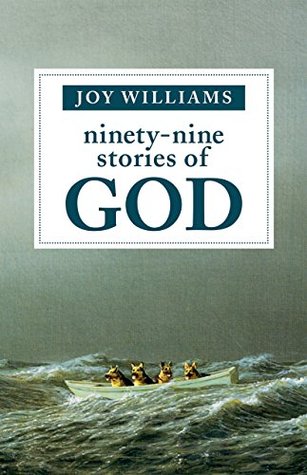
She was a writer on my radar, Joy Williams, somehow unknown to me until recently, but then, the world of literature is large and sometimes voices pass us by until fate or chance draws them to our attention. Or, if the rather ambivalent and perplexed Lord who appears in so many of the stories in her latest collection has His way, a little divine intervention is exercised. And so it happened that I found myself in the ER earlier this week, an advance reader’s copy of Ninety-Nine Stories of God on my phone. Between the tests and assessments to rule out any heart problems (my own private post cardiac arrest paranoia I’m afraid), I devoured a healthy measure of these bite-sized fictional treats. The true cause of my symptoms laid me under for a good 36 hours, but I emerged today to finish the collection, slowly only for the sake of savouring these deliciously dark, reflective, engagingly original tales.

99storiesA healthy dose of the unique joy of Joy Williams proved the perfect medicine.

The ninety-nine vignettes and mini stories that comprise this precious volume run the range from the brief and aphoristic to “longer” tales that run for a page or two. A cast of literary, philosophical and other assorted personalities make appearances, as characters or subjects. Williams delights in building fables that feature Kafka, Karl Jung, Simone Weil, or Philip K. Dick among others. At times she reduces her musing to the very simplest of terms, as in this one sentence micro-story which receives its context, as most of the stories do, by the title which is always placed at the end:

You should have changed if you wanted to remain yourself but you were afraid to change.

SARTRE TO CAMUS

The Lord Himself is a regular presence, as one might expect. He tends to appear in the most innocuous situations—He waits in a pharmacy line for His shingles shot, dreams of participating in a demolition derby, and expresses horror at the suggestion that He go to Home Depot to purchase supplies for a tortoise He wishes to adopt. Williams’ God is as curious and confused by His creations, especially those of the human form and He seems to have little control over the fate of His charges.

The Lord was asked if He believed in reincarnation.

I do, He said. It explains so much.

What does it explain, Sir? someone asked.

On your last Fourth of July festivities, I was invited to observe an annual hot-dog-eating contest, the Lord said, and it was the stupidest thing I’ve ever witnessed.

NEGLECT

Bemused and caring, lovingly benign, this is a God one can’t help liking. Good thing too, because the world of the ordinary people (and animals, for that matter) who feature in the majority of these stories is often marked by loss, despair and an odd isolation from others.

In his Numéro Cinq review of The Visiting Privilege, a recent compilation of her first three collections of short stories, Jason DeYoung describes her work as:

Strange and dark, her stories and novels make their foundation in realism, but then you never know quite where they will lead to. Most stay firmly planned in the “manifest world,” while others drift off toward the uncanny.

This description holds fast here too, even in abbreviated form. The humour is black, and a disturbing energy courses just below the surface. Nothing is spelled out beyond the most spare, necessary, imagery. So many stories pivot, or pack their punch, not in the ostensible actions recounted but in the reactions of the characters which are often counterintuitive. There is a suggestion that we cling to our dysfunction, our delusions, possibly as a stand in for faith, leaving the poor Lord Himself an awkward outsider in a world He designed.

The style and format of this collection is most strongly reminiscent of Thomas Bernhard’s The Voice Imitator. Of course, it would be remiss if the great writer did not make an appearance as he does in a story about a woman reading book reviews:

She was reading a broadside that reviewed a number of books. The reviews were extremely intelligent and gracefully presented. She read about a cluster of works by Thomas Bernhard, the cranky genius of Austrian literature, works that had been translated into English. She doubted that she would buy these books. She learned that he always referred to his lifelong companion, Hedwig Stavianicek, as his “aunt”. She was thirty-seven years older than Bernhard. She couldn’t imagine she had been his lifelong companion for long.

Given the condition I’ve been in over the last few days that, through a wicked case of the flu, I reveled in these ninety-nine gems. This story goes on in a way that most wonderfully spoke to my state and made me smile:

She had had a fever for several days and she was loafing around, drinking fluids and reading. With her fever, the act of reading became ever stranger to her. First the words were solid, sternly limiting her perception of them to what she already knew. Then they became more frighteningly expansive, tapping into twisting arteries of memory. Then they became transparent, rendering them invisible.

I can assure you this will not be my last encounter with Joy Williams. I would encourage anyone whose interest has been sparked to check the review I’ve linked above which contains a video of Williams reading an essay entitled “Why I Write.” Ninety-Nine Stories of God will be released in July by Tin House.

Goethe Dies by Thomas Bernhard – My Numéro Cinq review

I have written about Thomas Bernhard’s novels before, but faced with prospect of writing a longer critical review of a book containing four short stories I was faced with a dilemma: What does one say about Bernhard?

The question really is: How much familiarity with Bernhard should one assume? He is, most definitely, a singular writer. Those of us who count ourselves among the converted tend to have bulging bookshelves filled with a healthy supply of Bernhard’s novels, memoirs and poetry. Others are uncertain or fail to be immediately captivated. A bit of Bernhard primer is thus in order for those potential new readers, especially in this instance, because Goethe Dies, the collection at hand, offers a perfect opportunity to experience the magic of the master in miniature. A treat I argue for readers no matter their degree of prior acquaintance.

So in the following review published at Numéro Cinq earlier this week I tried to balance my general discussion of Bernhard’s prose style to provide a context for the appreciation of my analysis of the stories that would not be too redundant for the experienced or too vague for the novice.

Here’s a taste of the review, please click through the link at the end to read the rest. And while you’re there have a look around. There is another great issue shaping up at NC.

A Master Set Loose in a Small Space: Review of Thomas Bernhard’s Goethe Dies — Joseph Schreiber

Goethe Dies

Once acquainted with the work of the late Austrian writer, Thomas Bernhard, it is difficult to remain indifferent. One is either put off by his endlessly convoluted sentences, his bitter, misanthropic vision, and his fondness for digressive, contradictory and self-obsessed narratives; or one is swept up in the singular energetic flow of his darkly comic genius and never looks back. For those who find themselves in the latter camp, the announcement of a newly translated collection of four short stories originally published in periodicals in the early 1980’s is good news indeed.

Bernhard in short form may lack the unleashed full force intensity afforded when a single paragraph is allowed to unspool over one or two hundred pages or more; but these minor works, if you like, offer a valuable and entertaining opportunity to observe a master at play in a small, contained space. As with the early stories of Prose and the micro-fiction of The Voice Imitator, the short pieces collected in Goethe Dies, recently released by Seagull Books, highlight many of the essential elements that lend Bernhard’s work such a distinctive, infectious voice. Consequently, they may be best appreciated against a certain familiarity with the author and the idiosyncratic features that characterize his novels.

Continue reading here:

Closing out the old year with December by Alexander Kluge and Gerhard Richter

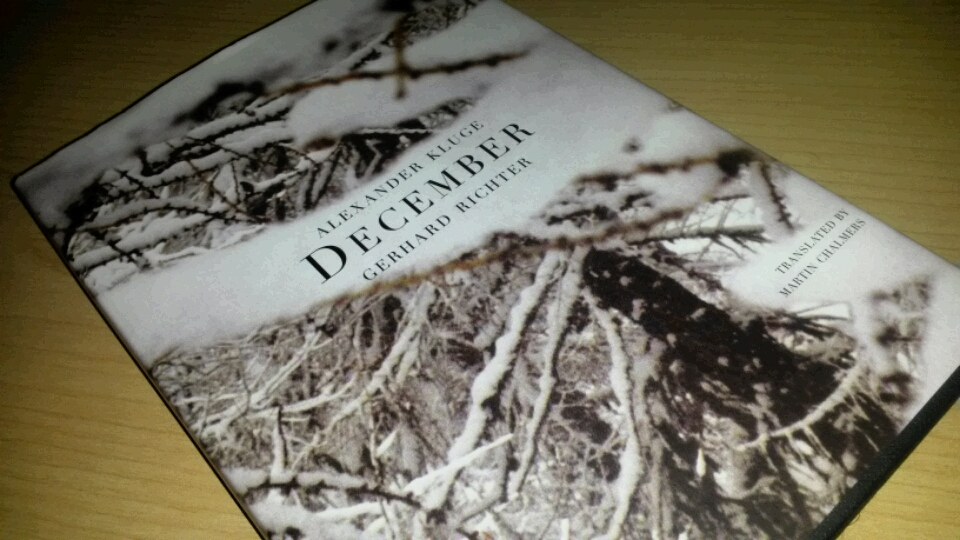
So, my first post of 2016 is a look at the last book I read in 2015. In truth I read it throughout the last month of the year, although not a little each day as intended, my father’s illness has interfered with all of my best laid reading plans of late. However I could not allow the year to draw to a close without finishing this book of calendar stories marking a passage through the month of December in the unique and inimitable style of Alexander Kluge, complemented by the haunting wintery forest scenes captured by Gerhard Richter.

2016-01-01 17.29.52This slim, elegant volume is my first encounter with the work of the German writer and film maker Alexander Kluge. The 39 stories, many less than a page long, are presented in a straightforward manner with a humour so subtle and wry that it simmers below the surface, blurring the perceptual line between history and speculation. Kluge offers a chronicle of an alternate reality so close to our own that it can catch you off guard. A flimic sensibility permeates each entry.

December is divided into two sections. The first part contains a series of dated entries, one story, or a cluster of stories, for each day. The years assigned to the dates vary. Many of the scenarios are set in or around the years of the Second World War. Others tend to be placed in the latter part of the first decade of the twenty-first century. But there are forays far back into prehistory and looking off to a distant future. Characters wander in and out from historical factual reality, war themes of conflict and destruction recur, as do images drawn from concerns about climate change and the fallout from the economic collapse of 2008. The ageless question of the nature of good and evil is a prevalent theme – “evil proves to be good displaced or straying in time” – as is the measure of the passage of time itself, whether measured on a global scale or at a much more personal, intimate level:

“The uncertainty, above all the lack of influence on whether and when someone will be struck down by the war, makes the soul bold. There is nothing to be lost any more.

So, after an air raid in 1944, which went on for hours, Gerda F. did not save herself up any longer. No thought of waiting for one of the returning warriors, whom she still knew and who would ask for her hand. She  didn’t want to get to know any better those left behind in the armament factories of the place. All were looking for closeness. She took a man who was passing through town up to her room. They never saw each other again. There was nothing about it that she regretted.”

The second, shorter section is titled “Calendars are Conservative”. They form a series of reflections on the way time – days, months and years – are recorded, calculated, and, as in certain situations such as during the height of the French Revolution, manipulated and distorted. The revolutions of the earth on its axis and the passage of the planet around the sun may be measurable with relative consistency, but that has not kept humankind from trying to understand, articulate and contain the progress of time, again in both the macro, political sphere and in the individual philosophical context:

“What manifests itself in my story, the story of a living person, is not COMPLETED PAST (what was, because it no longer is), also not the prefect tense of what has been in what I am but instead the OTHER of what I shall have been for what I am in the process of becoming.”

2016-01-01 17.32.15To spend a month, dipping in and out of the stories, anecdotes, and reflections Kluge has assembled to mark the end of the year is a treat. Although the images are often sombre, the atmosphere is contemplative. Gerhard Richter’s accompanying photographs enhance the measured tone. If you have ever experienced a day of heavy and unexpected snowfall, those days in the Northern Hemisphere that can bring all but the most essential services to a halt, granting a welcome reprieve from school or work for many; you will know how time can slow to a leisurely pace while the thick blanket of white muffles the day to day noise of the city. That is the sensation captured in the muted monochrome images of snow laden branches in silenced forests. This is the December we hope for but, caught up with the demands of year end and pressures of the holidays, frequently fail to achieve. A time to contemplate the past, for better or worse, speculate about the future and pull another calendar year to a close.

Translated from German by Martin Chalmers, December is published with the expected fine attention to detail by Seagull Books.

Winter solstice (again): 2015 – The year in review

I tend to run solstice to solstice, so this seems as good a time as any to pull together my thoughts about the year that was. I debated the conventional “best of” list affair, but somehow that is not reflective of the way I read or engaged with literature this year. I began the year still finding my footing as a book blogger, my earliest reviews tended to be less critical, more personal. By the end of the year I feel I have endeavoured to establish a more critical but, hopefully still accessible approach. Off my blog, it was an honour to cap off 2015 with my first review on Numéro Cinq where I have been invited to join the masthead. I am most thankful to Douglas Glover, the fine editor of this fine magazine, for having faith in my ability to write.

8294617299_b22c0cd186_z(1)I read and write about books as a an effort to strengthen my own skills both as a reader and a writer, but behind it all is a writing project of my own that has been struggling its way into being, seemingly with an infinite number of forays down paths leading to dead ends. So the following is a review of the year and, along the way, a nod to some of the books, new and not so new, that kept me company.

Reading in translation: I have typically read widely, but I never stopped to focus specifically on literature in translation, or, for that matter, to even think of much that I did read as being translated – sounds odd, I know, I think I just thought of myself as someone who tended to read internationally. Joining a shadow jury for the IFFP and then devouring as much of the BTBA long list as I could manage was, for me, a significant turning point in the way that I saw and focused my reading. My books are now shelved (or stacked) by original language. Apart from English I read books in 20 languages over the past year; German, French, Afrikaans, Czech and Spanish topped the list.

istrosIndependent and not-for-profit publishers: This year I became more conscious about looking to and supporting independent publishers. I was already well aware of Istros Books, a small UK publishing house dedicated to bringing Balkan and Central European writers to an English speaking audience, but this year I had the pleasure of meeting with publisher Susan Curtis, and visiting her closet sized office in the heart of London. She has been a most supportive influence in my development as a reviewer, and because I believe in their books and trust her instincts as an editor, I always look forward to their new releases. I also became conscious of other publishers including And Other Stories, Twisted Spoon, and Two Lines Press, just to name a few. I would reckon I bought few books from major publishers over the course of the past year, and trust me, I bought a lot of books!

2015-10-22 11.21.29Seagull Books: Here I have to credit (or blame?) Anthony of Times Flow Stemmed for bringing Calcutta based Seagull Books to my attention in recent months. I may be late to the party as they seem to have a core of passionate devotees. A book from Seagull is, quite simply, a finely crafted treasure, a reminder why books will never be supplanted by their electronic versions. They are also willing to take on authors or works that other publishers often balk at as witnessed by their impressive German, Swiss, French and African literary offerings, but any publisher who can transform a child’s tale by Thomas Bernhard into a huge, gorgeous picture book for all ages is alright by me!

23818667295_d1e4f92c94_zSouth Africa: I have had a significant interest in the literature of South Africa for a number of years but this spring, feeling especially isolated and unhappy in my present circumstances, I decided, rather suddenly, to visit the country for the first time. I aimed for the solstice, effectively trading what would have been summer solstice here in the north for winter solstice in the southern hemisphere. I spent time with a dear friend in the Eastern Cape, then kicked around Cape Town and dropped a small fortune on books.

An ending does not give a life meaning: On my last full day in Cape Town, I sat in the Company’s Gardens, took the notebook I had carried and scribbled in, back to front as is my habit, throughout my journey; opened it to the first page and began to write. I felt I had reached a point, perhaps of closure, a space in which to truly start to pull together my endless personal writing project. I was certain I could, from that vantage point, look back over the months to June of 2014 when I walked away from my job, wildly manic after a period of unbearable workplace stress, and finally begin to give shape to that story I had been trying to tell for so long. I was at an end, of sorts, so I thought, and now I could work back.

14344933323_66912ab5a8_zBut I was wrong: Just over two weeks after I returned home, a pulmonary embolism I had unknowingly developed, a souvenir most likely of my recklessly long flight back, triggered cardiac arrest – in my sleep. The quick response of my son, who happened to be home, saved my life. I nearly reached that “end”, not the one that I imagined would be the point at which I could render my particular life experience and write some meaning into it, but an end final and complete. One that would have left me mute, distorted in the memories of those who have known me. The story would no longer be mine.

So what of writing? That is most critically the end to which I read, seeking ways into a story, or stories, I that need to be able to explore – to ultimately put behind me. I can write easily about other people’s words but I choke up on my own. And so the following list of books are those which spoke to me this year as a reader and a writer. I read over 90 books and enjoyed many including: the long overlooked Hansen’s Children by Ognjen Spahic, Ivan Vladislavić’s Double Negative, While the Gods Were Sleeping by Erwin Mortier, Can Xue’s The Last Lover, Marlene van Niekerk’s monumental Agaat, not to mention her wonderful Swan Whisperer from the Cahier series, and  Primeval and Other Times by Olga Tokarczuk. I have, by the way, excluded from this accounting a host of writers I expect to like and therefore read regularly, often repeatedly, including Bernhard, Sebald, Borges, Coetzee, Damon Galgut, and, added to the group this year, Bohumil Hrabal.

But the following books were, for me, the most vital. Thbirdse order is chronological, as read:

The Alphabet of Birds (And Other Stories) S J Naudé (Afrikaans/tr. SJ Naudé)
* This debut collection, of long, simmering, often disturbing, stories is simply some of the most sensuous work I have ever encountered. The characters are typically groundless, searching South African ex-pats, uncertain residents trying to find their place, and or those suspended somewhere in between.

atavisms


Atavisms (Dalkey) – Maxime Raymond Bock (French/tr. Pablo Strauss)
* The thirteen stories that make up Atavisms reach back hundreds of years, stand in the present, and spin into the future to explore the Québécois experience – at the personal and the political level. Bock skillfully employs a variety of genres to create what reads, in the end, as a mulit-facetted yet cohesive whole. Most impressive.


The Elusive Moth (Open Letter) – Ingrid Winterbach (Afrikaans/tr. Iris Gouws & Ingrid Winterbach )
* This novel about an entomologist in search of some way to fill or heal an ache that even she is at pains to articulate becomes an evocative exploration of memory, loss and anxiety. The story unfolds through scenes that repeat motifs, imagery, and fragmented conversations; set against racial tensions building in the small town where she has come to conduct research. The result has an unforgettable cinematic, art film feel.

 On Wing (Dalkey) / Signs & Symptoms (Twisted gal_on-wingSpoon) – Róbert Gál (Slovak/tr. Mark Kanak/Madelaine Hron)
* As I have tossed my own writing goals between fiction and memoir, happy with neither, I had sensed that an experimental approach might be part of the mix. However I had been frustrated with many of the works I had encountered – at least in so far as they spoke to me in a meaningful constructive way. With On Wing and then Gal’s earlier Signs & Symptoms I finally encountered works that I could enter into with my own observations and begin to map out ways of talking about the essentially philosophical issues I want to address. Re-engaging with philosophy years after my formal studies in the field, has also been critical to framing the way I view the essentially ontological questions I wish to articulate. So I am most grateful to Róbert for both his writing and his encouragement.

A Sorrow Beyond Dreams (Farrar Straus and Giroux) – Peter Handke (German/tr. Ralph Manheim)
* This 69 page memoir, Handke’s finely wrought tribute to his mother written within months of her suicide at the age of 51, not only paints a careful and delicate portrait of a woman trapped by her circumstances, but offers reflections on the challenges of telling a true story – distilling an entire life to the essential elements – when it might be easier to simply make up stories, to, say, write a play. A whole life is messy to write about with elegance. Handke succeeds.

dreamhorsesA Dream of Horses & Other Stories (Roundfire Books) – Aashish Kaul
* This is a collection of dreamscapes populated by seekers of truths, purveyors of words, storytellers and readers. Most of the protagonists are writers, negotiating the fine balance between truth and imagination, struggling to capture the point of intersection in words. At least in my own experiences as a writer, or would-be-writer, that is what spoke to me throughout this melancholy, impressionistic book. And that is why it has to be on my list.

Vertigo (Dorothy Project) – Joanna Walsh
* Short story collections dominate my favourite books this year. It was an intentional focus, again with an eye to becoming more confident with medium. To that end, I recognize that the stories I am drawn to tend to have narrative arcs that are less pronounced, or more subtle, than some may like. The writing is typically more evocative, more ambiguous, more difficult to define and pin down. Like Vertigo – brutally sharp, spare and gorgeous, cutting to the quick of everyday life – an exquisite piece of work.

Dry Season (Istros Books) – Gabriela Babnik (Slovene / tr. Rawley Grau)
* I read many fine and challenging works from Istros Books this year, but the most stunning and devastatingly original has to be the EU Prize winning novel Dry Season. This tale of a love affair between a 62 year-old Slovenian woman and a 27 year-old man from Burkina Faso breaks every expectation, weaving African magical realism into a layered metafictional narrative that culminates in an ending so unexpected that it suddenly throws everything into a new light. Or does it?

sleepSleep of the Righteous (Two Lines Press) – Wolfgang Hilbig (German/tr. Isabel Fargo Cole)
* 2015 saw the release, for the first time in English, of two works by the late German author Wolfgang Hilbig – both championed and translated by Isabel Cole (The other, I, from Seagull Books is waiting on my shelf.) The magic of this collection, set in East Germany before and after re-unification, lies in the atmosphere created by the long sentences that flow, like a stream, back and forward again. Starting grounded in a harsh reality the narratives slip into a subtly surreal, gray-toned, world where reality blurs at the edges and memory takes on a haunting, dark quality.

Adventures in Immediate Irreality (New Drections) – Max Blecher (Romanian/tr. Michael Henry Heim)
* It may well be that my most memorable read of the entire year is one of the last – an impulse buy if I can be honest. A prisoner of the plaster body casts that were the standard treatment of spinal tuberculosis, Blecher’s creative imagination penetrates the experience of being in the world at the level of minute, intimate detail and manages to capture with acute sensitivity those moments of reality in flux and flow. I don’t know how unique this way of interacting with the world is, but as someone who has always had a discordant, dysphoric relationship with his own body, there is more for me, personally, in this book than I can begin to express. A fine closure to a year of excellent reading experiences.

Finally I am most grateful for the conversation and company of the book bloggers and twitter literary folk with whom I have been so fortunate to engage over the past year. I have a dearth of book lovers in my real life. I was at a Christmas party the other night and a game was played in which we were each to share our three worst Christmas gifts – two true and one lie. I was saddened how many people included books among their worst gifts ever. Breaks my heart. Bless you all for keeping me (somewhat) sane.

My Review of Mr Kafka & Other Tales from the Time of the Cult by Bohumil Hrabal at Numéro Cinq

I’m thrilled to announce that my first review for Numéro Cinq is now live. Here’s a taste and a link to the entire review, an excellent online magazine, and your chance to see what a rough ghost really looks like!

Mr KafkaMr. Kafka and Other Tales from the Time of the Cult, recently released by New Directions, represents the latest addition to the growing body of work by the late Czech author, Bohumil Hrabal, to be made available to an English speaking audience. Composed and set, for the most part, during the early years of Communist era Czechoslovakia, this collection of seven short stories is deeply informed by a time when Stalin’s larger-than-life cult of personality loomed over a country unwillingly caught up in the thrust of major social and economic reforms. Yet, as the author indicates in his preface, this book can be seen as both a representation of his society’s evolution, and as an expression of his own creative evolution. During this period there was no single experience more profound for Hrabal, the writer, than his recruitment, in 1949, as a “volunteer” manual labourer at the Poldi Steelworks in the town of Kladno near Prague.

Today the Koněv division of the steelworks where Hrabal worked stands in ruin. During his term of service though, it was a bustling operation devoted to turning the wreckage of war into the raw material required for, among other things, armaments for the forces of the Soviet Union. Although he studied law, Hrabal had worked at a variety of positions including railway dispatcher, insurance agent and salesman prior to finding himself on the factory floor of the steelworks. He arrived in the company of an assortment of other white-collar workers and professionals who suddenly found themselves engaged in unfamiliar work in a strange and dangerous environment alongside seasoned labourers, Party hacks, and prisoners.

Read the rest of the review here.


Honouring the unwritten: The Loss Library and Other Unfinished Stories by Ivan Vladislavić

“Not writing is always a relief and sometimes a pleasure. Writing about what cannot be written, by contrast, is the devil’s own job. Yet words on a page make all things possible.”

Central to this collection of brief odes to the fictional inspirations that once planted, failed to germinate, refused to take root and grow, or died off before even hitting the soil; is one full and essentially complete story – the magical titular “The Loss Library”. Surrounding this tale, to either side on the book shelf of South African author Ivan Vladislavić’s imagination lie a selection of meditations on the curious nature of the creative process and the many ways that an intriguing idea can lose its way on the path to realization, finding itself shelved in the place of the might-have-been, filed away in a writer’s own personal loss library. Looking back at the notes and outlines he explored during the late 1980’s and early 1990’s, the unsettling years of transition from apartheid to a democratic state, Vladislavić notes that his inspirations tended to arise from documentary sources – the past perhaps seeming more sound than the bloody history being made on the streets of his country at the time. Moving forward, within the scope of the “case studies” selected for this book, the pieces and fragments he gathers turn to dictionaries, reference materials and the “means to read and write – or not read and not write – books.”

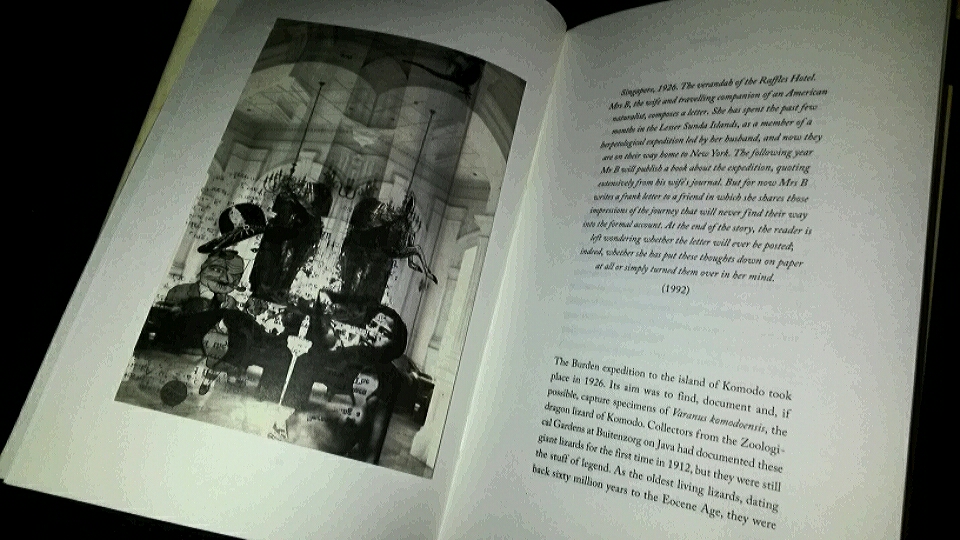
2015-12-09 15.08.34But let us begin in the middle, at “The Loss Library”. With a clear nod to Borges, the master of the library of the imagination, a young man arrives at a most unusual archive, a repository of the all of the unfinished works, possible and impossible of all the writers who have ever lived. He is greeted by an attractive librarian. Fit and tanned she is the antitheses of what he expects. As she guides him into the library she first steps into slippers and advises him to do the same. They literally glide across the polished floors of the rooms and corridors as she directs his personal tour of the premises. The first room contains a single glassed in cabinet containing the books that would have been written had their would-be authors not chanced to die young:

“‘Arranged alphabetically and classified by cause of death.’ A wave of her slender hand. ‘Accidental death. Booze, of course. Disease – those old standbys, consumption and syphilis, and the new one, AIDS, a growing collection. Duels – little sign of growth there. Motor accidents. Murder. Suicide. A disproportionate number of Russians and Japanese, as you’d expect, and quite a few of your countrymen and women too.’”

As our protagonist leans in for a closer look, he can recognize no words on the spines. He tells the librarian he is looking for Bruno Schulz. Filed down with the war dead, six little volumes are found but he is not allowed to see them… after all, opening such a book could have consequences in all the others, in essence I suppose, the way fiddling with the future given access to a time machine might. In this library of potential works, one can’t risk having people “talk them into being.”

2015-12-09 15.02.54Together they encounter a room filled with books that remain unwritten because their authors lost faith in them, and he is shown a collection of the books that lost their way or were talked out of existence before they had a chance to be realized. They pass through a room containing books that were destroyed, stop at a shelf of books that comes into being by evocation of the proper author’s name (any guesses?) and, finally, enter a room of floating, ghostly, ethereal books – those that presented themselves to their would-be writers in dreams. In the end, is this excursion through the Loss Library a fantasy, the beginning of book that the young man himself will write into being, or another story that might have been, relegated to the back of a notebook, the bottom of a drawer or, in this day and age, lost somewhere on a hard drive?

Returning now to the startling opening essay, Vladislavić describes his attraction to the famous photograph of Robert Walser lying dead in the snow on Christmas Day, 1956, and reflects upon the way that the isolated image fueled his imagination before had even read any of Walser’s work. He contemplates writing a story about the writer’s last days, about that fateful final walk, the curious absence of footsteps or bystanders around the body, the precision the photographer must have employed to capture this solemn record, and with particular fascination, the dead man’s hat lying in the snow. However, before he sits down to write, Vladislavić engages in a little research and finds another photograph, taken from a different angle. From this vantage point he can now see many footprints in the snow, two men off to the side, and realizes that even the hat has fallen differently than he imagined. The curious, romantic and uncomfortable questions – the necessary elements of the creative process – are shattered.

As he continues to rifle through the pages of his notebooks, Vladislavić explores a variety of mislaid ventures, the inspiration or ideas behind them and the reasons they fell off the rails or, perhaps, only flickered for a moment or two. “Gross”, an intended venture into the land of the OuLiPo in which he set for himself a series mathematical constraints within which he would construct a novel, proves unsuccessful. Along the way, the character he was creating to take centre stage, morphed into someone else who would, ultimately wander off to join the cast of another novel,The Restless Supermarket, but more critically, he found himself completely overwhelmed by the prospect of the challenge he had set and decided that this type of approach was best left to Perec, et al.

In a later example, he describes his fascination with an unassuming sign on the side of a building in his Johannesburg neighbourhood that simply reads “Gravity Addict” with a phone number. He begins to wonder what a gravity addict is and how that might be imagined in a story. He thinks about the post 9/11 performance artist in Don Delillo’s The Falling Man, contemplates the structural format of that novel, and eventually imagines a woman, an aspiring writer, sitting on her sofa watching endless episodes of old cartoons – the ones where characters repeatedly chase each other off the edge of cliffs – and then, when one day the innocuous meaning behind the mysterious appellation “gravity artist” is revealed to him, his interest in the story instantly dissolves and he can go no further.

Finally, in light of the recent re-release of Vladislavić’s first novel, The Folly, the story “The Acrobats” special attention. In this outline for a story we see a man in a library reading a book. At some point he closes that book and retrieves a copy of Tristram Shandy from the stacks. He seeks out a particular passage which in turn, is a lengthy quotation from Gragntua and Pantagruel by Rabelais, so he stops and wanders off to fetch that text and goes on to read from the original, or rather a translation of the original, the same quoted passage describing the wild acrobatic exploits of Gymnaste, performed on horseback, as he faces down an enemy combatant. As such, Vladislavić envisions a post-modern inversion of a book within a book within a book, the initial level being, of course, at once the book that both the man and his reader are reading. However, the idea is set aside, in part due to the complication of modern versus contemporary translations of the nested passages.

Several years later, in the writing of The Folly, Vladislavić sees his character Nieuwenhuizen, the eccentric stranger who arrives out of nowhere to take ownership of and build a house on a vacant lot, as a direct descendant of Gymnaste. As he marks out the foundation of the ephemeral house that he will ultimately construct out of imagination and thin air, Nieuwenhuizen engages in his own acrobatic measurements, leaping, somersaulting, and throwing himself around the lot. Could the earlier story now be revived, with The Folly as the third book in the line, he wonders, could he develop the idea that his “ostensibly post-modern novel stood in a pre-modern tradition”? Ah, but for the paradox that his outline for “The Acrobats” was written three to four years before The Folly, how could a story refer to a book that had yet to be written?

Yet Vladislavić was, it would seem, not quite done with his potential story. Several years later he encountered the 18th century French writer, Diderot, who was a contemporary of and acquainted with Laurence Sterne. Although the publication of Rameau’s Nephew would arise through a circuitous route, there was an indication apparently, that Diderot’s initial sketches for the eccentric, rambling character who engages the narrator of his novel could have roughly coincided with the publication of Tristram Shandy. Now he wants to fictionally trace the lineage of Nieuwenhuizen from Sterne via Rameau… except for a new paradox that arises. The Folly was written before his discovery of Rameau’s Nephew. How could his own novel be influenced by a work he had not read?

In his note at the end of this account of the stubborn death of a story idea, Vladislavić can look back and recognize that, as a young writer, he demonstrated too great a concern with precedent. Wiser now, he remarks:

“Every writer belongs to one bastard bloodline or another, and laying claim to one can be a liberating lesson in perspective. But standing on the shoulders of giants is a skill that comes from long practice. When you start out, you are more likely to get under their feet. Don’t be surprised if the giants – or their legitimate progeny – come stomping after you in the playground: ‘We walk straight so you better get out of the way!’”

And herein lies the true gift of this slender collection of artistic musings,and inspirational dead ends – the insertion throughout of the author’s updated reflections on his varied false starts. There is no writer or would-be writer who does not have an accumulated hoard of ideas, outlines and abandoned projects. If they don’t, one ought to be suspicious.

Wandering through The Loss Library and Other Unfinished Stories is a rare privilege to spend time in the company of a thoughtful, gifted writer who truly appears to be without pretensions. This journey, contained within the covers of a finely crafted hardcover from the singular Seagull Books and accompanied by the original collages of Sunandini Banerjee, is a wonderful way to spend an afternoon, and treasure to return to time and again. After all, there may well be, within these pages, the inspirational seeds of other stories just waiting for the right gardener to plant them and bring them to fruition.

For all the restless souls: The Sleep of the Righteous by Wolfgang Hilbig

The landscape haunting the seven intermeshed stories that make up The Sleep of the Righteous by the late German writer Wolfgang Hilbig, is decidedly bleak. The fulcrum around which these stories pivots is an industrial town south of Leipzig – run down, defined by its drabness, perpetually unfinished, bordered by mine pits, the ruins of munitions factories, a lake, marshes,and, beyond that, the forest. Before and after reunification, this town remains a place in which time exists on another plane of reality, at least as far as the narrators – all varying shades of the same man with more than a passing resemblance to Hilbig himself – experience or remember it:

“Time persisted here in dogged immutability; the autumnal fog banks that merged beneath an earth-colored sky appeared unlikely to pass for decades to come. And more and more smoke seemed to spill from the sodden lowlands into the flat clouds, which, even in the afternoon, were nocturnal.”

sleepThis powerful collection is divided into two parts. The first part focuses on childhood, coming of age or, as it often seems, waiting to come of age, to “rise at last from the state of useless, unfinished, in-between beings”. Set in the years immediately following the Second World War, the town is a place where men are in short supply. The majority of the children are fatherless, their mothers widowed, and few babies are born. Consequently, relationships and social dynamics are skewed. In the opening story, “The Place of Storms”, the young narrator endeavours to negotiate the murky waters between the realm of the “little children” and that of the “older children”. Rumours that his grandfather has a gun boost his status and potential for crossing the divide, while the horrific swim trunks his mother knits him complete with suspenders are a decided barrier. All of the awkward anxiety of youth is played out in the grimy pools of the abandoned mine pits at the end of the street where children wile away the summer hours divorced from the world of the suffering, lamenting adults in their lives.

The stories in the second part are set in the 1990’s, after the Wall has come down. The protagonists are all now grown men, writers, who have long since moved away from this small town, but find that they are unable to stay away. Restless, they regularly return to encounter ghosts, to visit an aging mother, or to escape a disintegrating relationship. No matter how long they may have been away, they never really leave the place behind. But they return to a town that is dying, industries and businesses that have been abandoned, and memories that cannot be escaped. In the final, and longest story, “The Dark Man”, the unnamed narrator is an established author who encounters, on the darkened streets of his old hometown, a stranger who has pursed him and now reveals that he was the Stasi agent responsible for intercepting and reading the writer’s correspondence. He claims to have a collection of letters originally intended for our hero’s former lover, a woman who presently lies near death. The narrator is disturbed, but determined not to let this curious relic of the GDR get the better of him – he denies any suggestion that he and his enemy have anything in common. Yet when he gets back to his mother’s apartment, the man in the bathroom mirror bears a haunting resemblance to what he could manage to make out of the stranger in the dark.

The Sleep of the Righteous is one of those books where you may well be inclined to stop and reread a paragraph several times before moving on, not because it is opaque or dense, but because the language is so captivating; the flow and rhythms, like eddies in a stream of water, swirling, reversing, and moving forward again. The brief title story is a sadly lyrical meditation on the cycle of guilt and recrimination that binds and defines the relationship between a boy and his grandfather who, in a reorganization of sleeping arrangements, end up sharing a bed following the death of the grandmother – a demise that one of them might have inadvertently caused. It opens:

“The dark divests us of our qualities. — Though we breathe more greedily, struggling for life, for some fleeting substance from the darkness… it is the darkness that forms a mute block above us: intangible matter our breaths cannot lighten… it seems to burst apart at each answer from the old man, each lament of breath, yet sinks in again swiftly to weigh down still closer, in the cohesive calm of myriad tiny black, gyrating viruses. And we rest one whole long night in this block of black viruses, we rest from the toils of the day: from the everyday toil of circling each other, still and hostile.”

Night after night, grandfather and grandson twist and turn to a nocturnal chorus of queries and accusations, in this poetic evocation of the tensions that underlie the fictions that families maintain to make sense of the very ordinary tragedies that strike close to home.

In his introduction to this volume, Hungarian writer László Krasznahorkai, writes that in focusing on the mundane, the everyday life in East Germany, Hilbig manages to heighten the oppressiveness of that existence, rendering it all the more horrific as a consequence: “He wrote his astounding novels about a world in which only the weak, the sensitive, those incapable of bargaining and in no way heroic, can sense the chaos and the surrealism.” However, the measured, heavily weighted quality that hangs over the stories in The Sleep of the Righteousness, is bouyed by the sheer beauty of the prose and the quiet resilience with which the protagonists respond to the circumstances that history has gifted them. This could be a depressing read but somehow it is not.

Translator Isabel Fargo Cole, in a recent interview in World Literature Today, indicates that this collection is one of Hilbig’s most autobiographical works. His narrators tend to share the same basic features of his background – his grandfather emigrated from Poland, his father disappeared at Stalingrad, and he grew up with his mother in a household dominated by women. The town he mythologizes in his tales is modeled after the same one where he was born and grew up. Yet, it does not feel liked these are connected as part of a continuous narrative so much as each protagonist seems to have a similar launching point from which he proceeds to tell his story. There are overlaps and divergences along the way.

The Sleep of the Righteous is published by Two Lines Press. Along with his earlier novel,  I, which was also translated by Isabel Fargo Cole and released by Seagull Books this summer, English speaking readers finally have a chance to experience the sombre magic of Wolfgang Hilbig. And, hopefully, look forward to more.

Listen closely now – The Voice Imitator: 104 Stories by Thomas Bernhard

[one love affair]

THIRTEEN INSTANCES OF LUNACY
TWENTY SURPRISES
FOUR DISAPPEARANCES
TWENTY-SIX MURDERS
TWO INSTANCES OF LIBEL
SIX PAINFUL DEATHS
THREE CHARACTER ATTACKS
FIVE EARLY DEATHS
ONE MEMORY LAPSE
FOUR COVER-UPS
EIGHTEEN SUICIDES

With the list above, the cover of the University of Chicago publication of The Voice Imitator offers a warning to the potential reader of the themes that feature in the 104 stories that lie ahead. For seasoned readers of Thomas Bernhard none are likely a surprise, though it is quite possible to emerge at the end thinking, “were there only 26 murders and 18 suicides?” Chances are it feels like there are more. But that’s okay. Would you really expect less?

VoiceIf the thought of encountering a volume containing 104 stories sounds intimidating, be assured that this collection spans all of 104 pages. This is Bernhard in microcosm, all of the acerbic wit and dark charm one could want from the Austrian playwright, poet and novelist distilled into brief anecdotal tales, each recounted within the space of one page.
The longest fill the page, the shortest are no more than a few lines.

Drawing on newspaper reports, rumour, and overheard conversations, Bernhard exploits this condensed form of fiction to tackle his favourite targets, including, of course, his native country. Even in a confined space, he finds room to explore the foibles of human nature and contemplate the bitter ironies of life. There is a healthy dose of death – murder, suicide, accident – some, tragic, some absurd; and no small measure of madness. Featuring a familiar retinue of philosophers and professors, craftsmen and woodcutters, musicians and artists, freaks and loners; the stars of these anecdotes and fables are driven by conviction, thwarted ambition, disillusion, and disappointment. Just like, well, the rest of us.

The least effective pieces are the very shortest. A few more lines are often in order to set the scene, to draw the drama, to pull the the punch. But even then, the emotional impact can be striking with less than half a page:

“Sitting in the early train, we happen to look out of the window just at the moment when we are passing the ravine into which our school group, with whom we had undertaken an excursion to the waterfall, had plunged fifteen years ago, and we think about how we were saved but the others were killed forever. The teacher who had been taking our group to the waterfall hanged herself immediately after a sentence of eight year’s imprisonment had been passed on her by the Salzburg Provincial Court. When the train passes the scene of the accident, we can hear our own cries intermingled with the cries of the whole group.”                        (Early Train)

The use of the first person plural in the majority of these stories lends an intimate tone. One can almost imagine the narrator as one of those inveterate storytellers who always has an entertaining morsel at hand: a family legend, a piece of wisdom, a mini tirade to share. Bernhard’s language plays on repetition, relies on qualifiers like “so-called” – one can almost see the air quotes – and, in this shortened format, he delights in throwing a punch at the end, leaving the reader with a gasp, a nod, or an ironic laugh.

Some might see this as an introduction to Bernhard for those uncomfortable diving into, say, a single-paragraph 200 page novel. But it works even better, one might argue, as a treat for those who are already acquainted with some of Bernhard’s classic works. Each little anecdotal story stands like a glimpse into the windows of Bernhard’s world… the themes, characters, and images that feature in his longer works shine, isolated for a moment, in the space of a single page or less. Contained in this way, his rhythm, his cynicism, and acerbic wit ring through. Bite-sized Bernhard to marvel at and enjoy.

glm_vThe Voice Imitator is translated by Kenneth J. Northcott. This stands as my first contribution for the German Literature Month reading challenge.