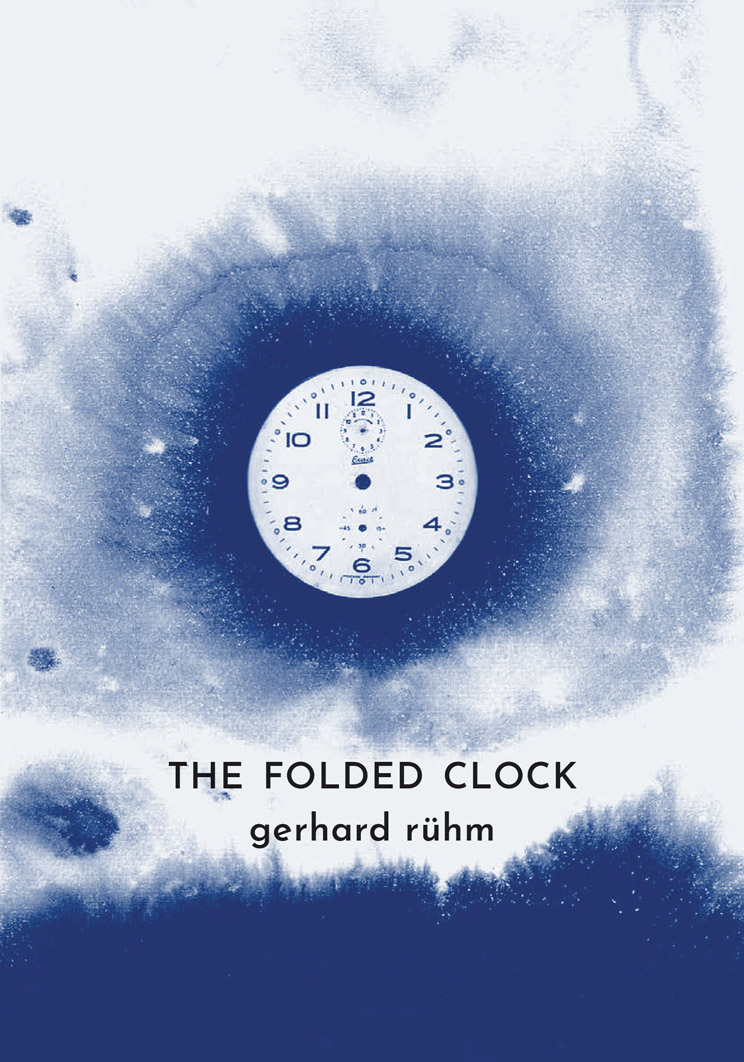
Counting, accounting and recounting: The Folded Clock by Gerhard Rühm

two!
one two  –
one two  –  three!
.        two
one two three  –   four
.       two

“a recounting,” the first number poem you encounter in Gerhard Rühm’s The Folded Clock, opens with a lengthy note explaining exactly how the piece should be recited—volume and intensity directed and measured—before erupting across the following five pages as numbers, spelled out, descend, rise, and repeat. Finding the flow and riding it (guided with a few more directives along the way) is not difficult, especially if you allow yourself to read aloud and, there are you are, from the very beginning, not simply reading but actively engaging with the poem.

And there are ninety-nine more, each one involving numerical elements in some shape or fashion. Some are sequential, others visual, still others are in verse form. Clever or funny or profound, it is amazing just how far numbers can take you.

Born in Vienna in 1930, Rühm, who recently celebrated his ninety-fifth birthday, is an author, composer and visual artist. His poems reflect all of these interests. He was an early practitioner of concrete poetry and an original member of the influential Wiener Gruppe. His interest in numbers as “the most pared-down and at the same time most universal element of design” goes back to the early 1950s. When he composed his first number poems in 1954 he was unaware of Dadaist Kurt Schwitters’ own explorations in this area, but he has continued to incorporate numerals and digits into his spoken and visual poetry, expanding the possibilities numbers offer. The Folded Clock, newly released from Twisted Spoon Press in Alexander Booth’s translation, gathers one hundred of these poems in a handsome volume.

Many of Rühm’s poems play with the rhythm and sound of numbers in various sequences and patterns. Others exploit visual qualities and double meanings that arise from the titles and the images or words they are paired with. And a sly humour surfaces throughout, as in “imperfect counting poem”:

one
two
three
four
five
six
seven
eight
nine
toes

one’s missing

Or “sixty-nine pairs of lovers” which depicts, inverted on their side, six rows of ten and one row of nine (sixty-nine) 69’s.

But, Rühm is also inclined to employ numbers and words to make thought provoking statements about the world. “time poem”—another piece that begins with a note on recitation—takes on cosmic dimensions starting with:

1 january, 12:am: bang!
2
3
4

And so on, counting down one calendar year, day by day, marking the significant events, from the Big Bang to the first moon landing. Given that fish don’t begin to swim in water until December 19, the final day of the year opens up, first by hours, then half hours, and by 11:30 pm, minutes, until the final minute opens up into seconds to allow human history from the first cave paintings to space exploration to fall int place. (You can read this poem online here.) Elsewhere he allows climate change, odd historical facts, and interesting news stories inspire poetic creations. Ruminations on living also fit well with the measurement of one’s personal relationship to time as in “sense of time”:

a week ago i was still a child
five days ago i  was an adult
four days ago was the time of the “vienna group”
three days ago i was living in berlin
for two days now i’ve been in cologne
everything since the turn of the millennium happened yesterday
since early this morning i haven’t aged at all

The variety of poems in this collection is wide and endlessly entertaining. They range in length from just a few numerals, to pieces that extend for several pages, to sketches and collages. Even if you fear you might be intimidated by avant-garde or experimental poetry (or poetry at all), this is a work that is not only intelligent and entertaining, but that contains many pieces that you could easily find yourself unable to resist reciting aloud.

The Folded Clock: 100 number poems by Gerhard Rühm is translated from the German by Alexander Booth and published by Twisted Spoon Press. (Excerpt and images can be seen at the publisher’s website.)

Dream follows dream: Ceilings by Zuzana Brabcová

Drink them up, swallow those clouds, gulp them down with all your might, because all you’ve got to look forward to now are ceilings.

As Ema, the fifty year-old protagonist of Zuzana Brabcová’s Ceilings, takes in her last view of the overcast skies over Prague before the ambulance attendant leads her into the Addiction Treatment Centre of the hospital, she knows that it will be months before she  sees them again—except, of course, in the strange, troubled, and fantastic dreams and psychotic episodes that will accompany her through the trials of detox. She’s been here before and is well aware of what lies ahead.

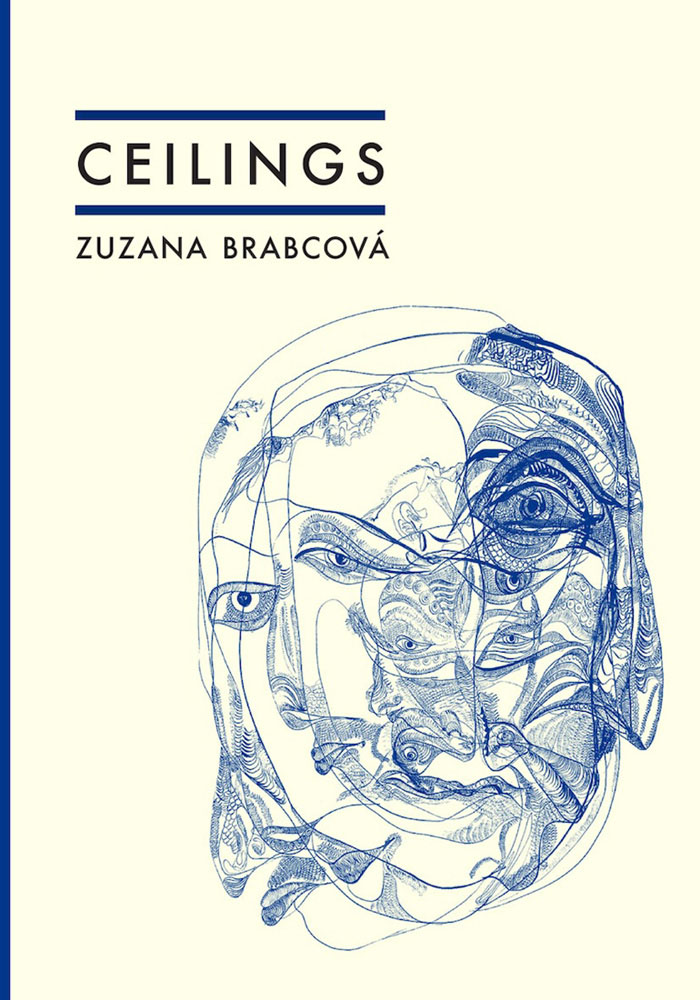
The daughter of two literary historians, Brabcová (1959–2015) was born in Prague. Under the Communist regime, she was denied the right to attend university so she worked as a librarian, a hospital attendant and a cleaner. Following the Velvet Revolution, she worked as an editor. Her first novel Far from the Tree, initially published abroad in 1987, won the inaugural Jiří Orten Prize. Ceilings (2012), recently released in Tereza Veverka Novická’s powerful English translation, was her fourth novel, a vivid, hypnotic account of one woman’s transit through drug rehab that clearly illustrates why she has been rightfully compared to Leonora Carrington and Unica Zurn (whose artwork graces the cover).

As soon as Ema enters the hospital, The Garden as it is known, she finds herself in a world that operates on its own set of rules and regulations. The clock is now set to institutional time, where order attempts to define but can never fully contain either the camaraderie or conflicts between an eccentric collection of women—druggie or alkie?—caught in an ever-swirling cascade of medications and madness. For Ema, navigating the neuroses and idiosyncrasies of her fellow inmates is as challenging as navigating her own, as delusions, paranoias, and troubled memories blur the fragile boundaries between reality and dream, external and internal existence.

This fluidity is reflected in a polyphonic narrative which moves smoothly between third and first person, often pulling in and out of Ema’s head in a single paragraph. Add to this, asides in second person, where Ema either addresses herself or directs her thoughts to her daughter Rybka, her lesbian partner Dita, or other family members. Finally, there is a second first person narrator, Ema’s brother—a “twin” although they were born one year apart—not an alter ego, but a distinct male gendered self. Ash. He emerges at an early age, perhaps to serve as a shield against the uncertain and frightening world both inside and outside the home, and inside and outside Ema’s own unstable emotional space. Ash comes into his own when they are very young, realizing he is different:

I said to myself this secret of mine must be something like chickenpox; okay, in that case an autovaccine was needed to reduce the most visible traces to a minimum. So I decided to become a normal little boy, if that’s what they wanted: I’d fight over toys in the sandbox and might even pee my pants in a temper tantrum, and I’d clap and giggle over my birthday cake; all this could be learned by observing other children. I methodically began to appropriate the behaviour of others, their expressions, emotions, and gestures, and chose from this panoply the ones I considered useful, purposefully aping them. It was glorious: one by one, every sensation sunk into the hollowed-out nutshell of nothingness.

My rebirth every morning soon became routine, and I put on my face like a prothesis.

Ema and Ash are not exactly like two manifestations of  a dissociative condition, nor do they represent a typical binary gender identity. Ema takes comfort in Ash’s existence, while he is both protective of and frustrated with his “sister,” yet cognizant of his own unreality, of the fact that he was not born and cannot die.

Confined to the hospital, Ema is forced to contend with various difficult personalities, while finding her place and forging alliances among the other patients and the nursing staff. Reality can be an anxious state. Meanwhile, dreams and episodes of delirium carry her back into her (or Ash’s) past, but the scenes are strange, distorted, and disturbing.  And she is haunted not only in her restless sleep; the ceilings that hang that above her are a constant reminder that she is trapped:

It’s come back after my body expelled, at least to some extent, the poisons that were competing with it. I’m in a room, I need to get out, I rise to the ceiling. I tear though it, really easily, because the walls and ceiling are made of cardboard, and I find myself in another room.  I escape through a chink into another room and so on and so forth, again and again, one room replaces another, always the ceiling, never the sky. But what if it’s not the dream that’s come back to me, but it’s me who’s come back to it? Maybe the waking life of Ema Černá is merely a sequence of pauses, brief interruptions of flight with no beginning and no end.

Ema’s dilemma, her inability to successfully integrate her internal and external reality, reflecting a lifetime of emotional and mental health challenges mediated by substance abuse, is the driving force of this intense, vulnerable, and moving novel, one that draws on Brabacová’s own experiences, including time in psychiatric rehab (and, one might imagine, the perspective afforded through her work as a hospital orderly). Its raw, unapologetic narrative slips seamlessly between voice and perspective, continually cross-referencing itself, to create a world—one woman’s world, past and present—that for all its surreal elements is cohesive, sympathetic and real.

Ceilings by Zuzana Brabcová is translated from the Czech by Tereza Veverka Novická and published by Twisted Spoon Press.

Seeking release in the séance: The Unfinished Life of Phoebe Hicks by Agnieszka Taborska

Was it something in the air? In the history of the seaside town? Providence, Rhode Island in the mid-nineteenth century was, this curious biography assures us, famous for its abundance of unsettled spirits:

It is true that other towns also have their ghosts — nowhere, however, are they so noisy and restless. So many phantoms live in Providence they fill up every nook and cranny. Saturated with their breath, the air grows oppressive and causes headaches. You don’t so much walk down the streets as fight your way through invisible throngs.
(from “The Female Presence”)

And a plethora of phantoms makes it easier for a medium to conduct a séance that will satisfy the spiritualists gathered in her parlour. For an attentive and innovative medium like Phoebe Hicks, a successful séance was almost guaranteed, night after night.

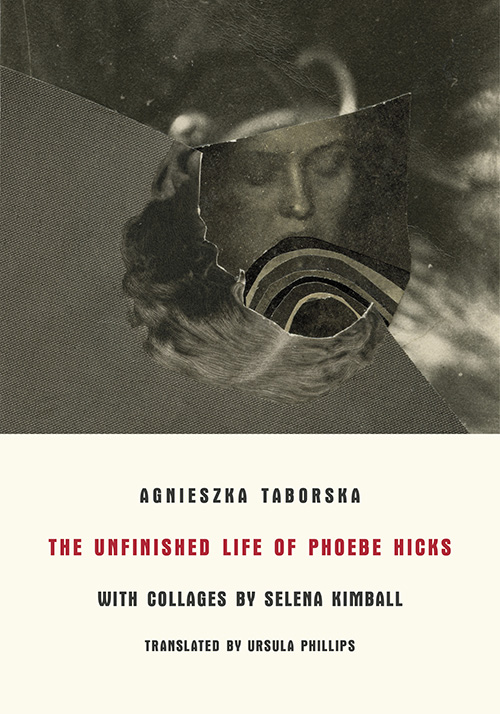
Her story, and that of the rise of Spiritualism in America, unfolds through a series of episodes recorded by Polish writer Agnieszka Taborska, and paired with stunning collages by Selena Kimball, in The Unfinished Life of Phoebe Hicks, new from the inimitable Twisted Spoon Press. If it seems odd that Taborska, an art historian specializing in French Surrealism has chosen to turn her attention to Rhode Island and placed her fictional heroine there, it shouldn’t be. She divides her time between Warsaw and Providence, and her affection for the town and its ghostly history comes through in this imaginative biographical endeavour.

Phoebe Hicks, medium extraordinaire, stumbled into her unlikely profession through the most peculiar circumstances. On November 1, 1847, she found herself violently ill with a bout of food poisoning triggered by a meal of clam fritters. Were it not for a nosey photographer who happened to peer into her window and catch her vomiting into the bowl on her washstand, the incident would have passed into Phoebe’s feverish memory and stayed there. But instead, the invasive images—coincidentally captured with a recently patented photographic method that allowed for an exposure of only three minutes—would be reproduced and widely interpreted as evidence of ectoplasm spewing from her mouth. Although ectoplasm, the manifestation of spiritual matter, would not be officially described until 1894, Phoebe would prove to be ahead of the curve in so many ways—so far ahead in fact that she would even entertain the ghost of Harry Houdini years before his birth—but for some reason her notable achievements have fallen from the records of the history of Spiritualism.

This book aims to rectify that oversight.

Phoebe’s first séance was awkward, but she quickly learned from her mistakes and as her gatherings grew in sophistication, her fame spread. Of course, as the interest in séances increased, so did the number of practitioners, both sincere and false. Yet, as ever, Phoebe was a class act. Her guests would be greeted by the cook’s son, and then ushered into the parlour by her maid, Miriam, a woman so dignified in manner and appearance that some would mistake her for the mistress. Others, however, mused that she may have been the true secret to Phoebe’s  success.

They accused her of practices employed by accomplices of other mediums to gain information about clients: bribing servants, placing “their people” in noisy inns where alcohol loosened tongues, studying gravestones — the most reliable sources of information about family relationships. They forgot that it sufficed to reside in Providence a little while to know enough about one’s neighbours to imagine the rest. For the inhabitants of the magic town were strangely alike.
(from “The Maid”)

Now, Phoebe was not content to simply summon the spirits of the locally departed, she also welcomed figures from history, and is reported to have performed a number of impressive feats during the course of her gatherings. But more critically, she established standards for the practice of conducting séances, strengthening the acceptance of the role of medium. For not only was Spiritualism a practice that held particular appeal for women, the profession of medium offered some of these same women an opportunity to support themselves outside of the traditional bonds of marriage. And for some that was a very worrying trend:

A few ill-disposed doctors claimed that Spiritualism was no more than a safety valve for madness and old-maidenhood, that participation in séances was conducive to hallucinations, that the fashion for the table turning, spreading at dizzying speeds, was responsible for madhouses bursting at the seams, that instead of a parlour with its round table a more fitting place for mediums was a hospital isolation ward.
(from “Something That Might Be Called Hysteria”)

Behind the accusations of madness, of course, lay the fear that in the communion with spirits might lead to emancipation.

Twisted Spoon publishes some of the most delightfully strange books and The Unfinished Life of Phoebe Hicks is no exception. Presented as a serious account—albeit with a healthy amount of wry humour—of the role of this somewhat mysterious medium in the early years of spiritualist practice, the portrait that emerges is of a woman for whom the boundary between the world of the spirit and the world of the flesh has become somewhat permeable. She ultimately disappears, not only from history, but from the town of Providence itself, her final whereabouts unknown. But the insinuation is that, unlike the many impostors and charlatans who flocked to the profession in its heyday, there was something uncanny about Phoebe. Something wise, practical, and well, just possibly, genuine. . .

The Unfinished Life of Phoebe Hicks by Agnieszka Taborska with illustrations by Selena Kimball is translated from the Polish by Ursula Phillips and published by Twisted Spoon Press. It is available now in the UK and Europe, and will be released in November 2024 in North America.

Remembering prewar Prague: House of the Nine Devils: Selected Bohemian Tales by Johannes Urzidil

This fine collection of stories by Prague native Johannes Urzidil, recently published in English translation by David Burnett, House of the Nine Devils, opens with—and takes its title from— a fantastic tale of a haunted house in the city’s Lesser Town that hides a dark mysterious past going back centuries. Although most of the stories that follow move away from this more explicitly gothic energy, they are filled with strange coincidences and unlikely adventures that lead their protagonists, all echoes of the author himself, into encounters that are coloured with the unique atmosphere of the capital of the Kingdom of Bohemia in the early twentieth century. As the narrator’s father story tells his son in the opening story:

“But this Prague, where you too were born, is an old city of magic. This is where the rabbis had their sorcerer’s apprentices and where the emperors kept their alchemists. Many things come together here — East and West, Jew and Christian, Czech and German, North and South — and where many essences converge, many wondrous, inconceivable things come to pass: things, words, characters and occurrences  that have never been seen before. It’s a breeding ground for spells and magic powers.”

And so it is. In the hands of a master storyteller, even a young boy can find himself encountering all kinds of unusual people and mysteries in this charmed city.

Johannes Urzidil (1896–1970) was the son of German nationalist and “passionate” railway official born in a rural part of western Bohemia, and a Jewish woman from Prague who died when he was just four years old. His father was a Catholic who never practiced his faith and believed in taking his son to various houses of worship to demonstrate that all religions were equal. Nonetheless, he insisted his boy practice Catholicism. His second wife, Johannes’ stepmother, was a staunch Czech nationalist, and their volatile marriage together Urzidil’s own fraught relationship with the woman he refers to as “ his step” adds much colour and humour to many of the stories collected here.

Urzidil published his first poems at age seventeen and began to associate with members of the so-called Prague Circle where he became friends with Kafka, Franz Werfel, Max Brod and others. In his Afterword, translator David Burnett, reports that he “had the honor of holding one of three funeral orations for Kafka in 1924, predicting his future fame.” Through the 1920s and early 30s, he worked as a translator and press attaché for the German Embassy while continuing to publish poetry, essays and criticism. He co-founded and managed the German Writers Union of Czechoslovakia until political tensions led to his resignation in 1933. By this time, despite his German background, his mother’s Jewish heritage and his marriage to the daughter of a rabbi, made it difficult for him to find work and, eventually, unsafe to remain in the city of his birth. He and his wife escaped in 1939, first to England, then to the US where they settled in New York City.

For Urzidil, fiction writing did not become a serious pursuit until later in life. His breakthrough work, The Last Beloved, a collection of autobiographical stories, was published in Munich in 1956 when he was sixty years-old.  His final decade of life, the 1960s, were very prolific. Of his seventy-odd stories, many blending elements of fiction, biography and essay, about a quarter were set in America, a handful in assorted European settings, but the majority of his best loved works take place in prewar Prague and Bohemia. It is from these stories across five German publications that the pieces in House of the Nine Devils are drawn. They are arranged in a roughly chronological order—by setting, not publication date—in an attempt to create a “more coherent whole” or a kind of fictional memoir, reflecting the degree to which Urzidil’s family and life experiences fed his writing.

Perhaps because he came to storytelling so late in life, Urzidil’s stories have the warmth and wry-humour of an older relative recounting tales of his youth, playing up the unexpected twists and turns. His narrators’ seemingly innocuous adventures—looking for a lost wallet, delivering messages, dropping in to visit with friends—put them in the paths of bored police officers late on New Year’s Eve, a fated opera singer, a suicidal railroad inspector, or a murderous fugitive. As he tells us in “The Last Tombola”:

People were always using me to drop things off. I was always running through streets and from floor to floor with notes, letters, and messages for other people. That’s pretty much my life. And whenever you have to drop something off, awful things always seem to happen.

This longer story begins with its young protagonist being charged to deliver a report to his father’s visiting superior with whom his family had dined the night before. He will soon learn that Herr Pernold has hung himself from his Grüss Gott suspenders, an event that sets off a richly complicated (and funny) tale of mystery, morality, concerns about renumeration, and ripe opportunities for humour at the boy’s step mother’s expense, something that first arises in the opening paragraph as the narrator notes that his delivery assignment will take him to The Imperial Hotel on Na Poříčí:

Na Poříčí is Czech for “on the riverbank,” which is fair enough for the Moldau flows nearby. Still, I had an instinctive aversion to this Prague street, its two chafing affricates reminding me of the sand-yellow paletot that hugged the hips of my stepmother around the time my father was courting her. I had witnessed this courtship and once heard her say, “It chafes me; I bought it on Na Poříčí.” “Good,” I remarked, because I felt this lady couldn’t be chafed enough. “Who asked you?” asked my father. “I asked me,” I answered. He was about to give me a royal smack in the face, which usually accompanied by the words, “When duty calls, feelings must be silent.” Yet this time he abstained from getting violent, not wanting to appear ungallant in front of the lady. He looked at me instead like Cronus before he ate his children.

This kind of sly, smart humour is one of the most wonderful features of Urzidil’s stories. And indicative of the relationship he, or rather his protagonist, has with his father with whom, for the cost of a slap in the face, he is allowed to voice what they both often think about his step’s moaning and complaining which only increase after the marriage. It is a recurring motif in many tales, one grounded in the author’s real life, as he reveals in the two, biographical essay-like pieces that round out the collection wherein he talks honestly about his beloved father and the difficult woman who became his second wife.

Prague in the first decade of the twentieth century is vividly evoked in so many of the tales in this collection, as are the social dynamics of the life of a lower middle-class family, the tensions that exist between Germans and Czechs, and the sense (at least to a young boy) that the Austro-Hungarian Empire is eternal. Then there are stories set during the First World War and, notably, “One Last Deed,” which depicts the dangerous environment in the city for men like Urzidil during Nazi occupation through an account that finds the protagonist taking refuge in the hovel of an eccentric former schoolmate.

The particular charm of Urzidil’s fiction lies in the warmth and charisma of his narrators, effortlessly spinning entertaining tales. Gathered together, the stories collected here do, as intended, read like a loose memoir recounted with a healthy measure of creative license. The boy, his railway official father, and his cantankerous stepmother provide the continuity. Like other natural story-tellers who regularly dip into the same well—perhaps a fictional community, or the life of a recurring alter ego—Urzidil has the ability to make each story feel fresh and unexpected. Hopefully more of his fiction will be translated in the future.

House of the Nine Devils: Selected Bohemian Tales by Johannes Urzidil is translated from the German by David Burnett and published in a handsome hardcover edition by Twisted Spoon Press.

Reading highlights of 2022: A baker’s dozen and then some…

It seems to me that last year I resisted the annual “best of” round-up right through December and then opened the new year with a post about some of my favourite reads of 2021 anyhow. This year I will give in, look back at some of my favourite reading experiences out of a year in which I had a wealth to choose from and aim to get some kind of list posted before friends start hanging up their 2023 calendars around the globe. In a year with war, floods, famine, storms and still no end in sight to Covid infections, books seemed more important than ever, as a respite, a record and a reminder that we, as human beings, have been here before and must learn from the past to face the increasing challenges of the future.

As ever, it is difficult to narrow down twelve months of reading to a few favourites. One’s choices are always personal and subjective, and many excellent books invariably get left out. This year especially—2022 was a productive and satisfying year for me as a reader and as a blogger. Not much for other writing, I’m afraid, but that’s okay.

This year I’m taking a thematic approach to my wrap-up, so here we go.

The most entertaining reading experiences I had this year:

Tomas Espedal’s The Year (translated from the Norwegian by James Anderson) was one of the first books I read in 2022. A novel in verse, it is wise, funny and, nearing the end, surprisingly tense as Espedal’s potentially auto-fictional protagonist careens toward what could be a very reckless act.

International Booker Prize-winning Tomb of Sand  by Geetanjali Shree (translated from the Hindi by Daisy Rockwell) looks like a weighty tome, but blessed with humour, magic and drama—plus a healthy amount of white space—it flies by. An absolute delight and worthy award winner!

Postcard from London, a collection of short stories by Hungarian writer Iván Mándy (translated by John Batki) was a complete surprise for me. In what turned out to be a year in which I read a number of terrific collections of short fiction, I was a little uncertain about this large hardcover volume some 330 pages long, but by the end of the first page I was hooked by the author’s distinct narrative voice and I would have happily read many more pages.

The most absorbing book I read this year (and its companions):

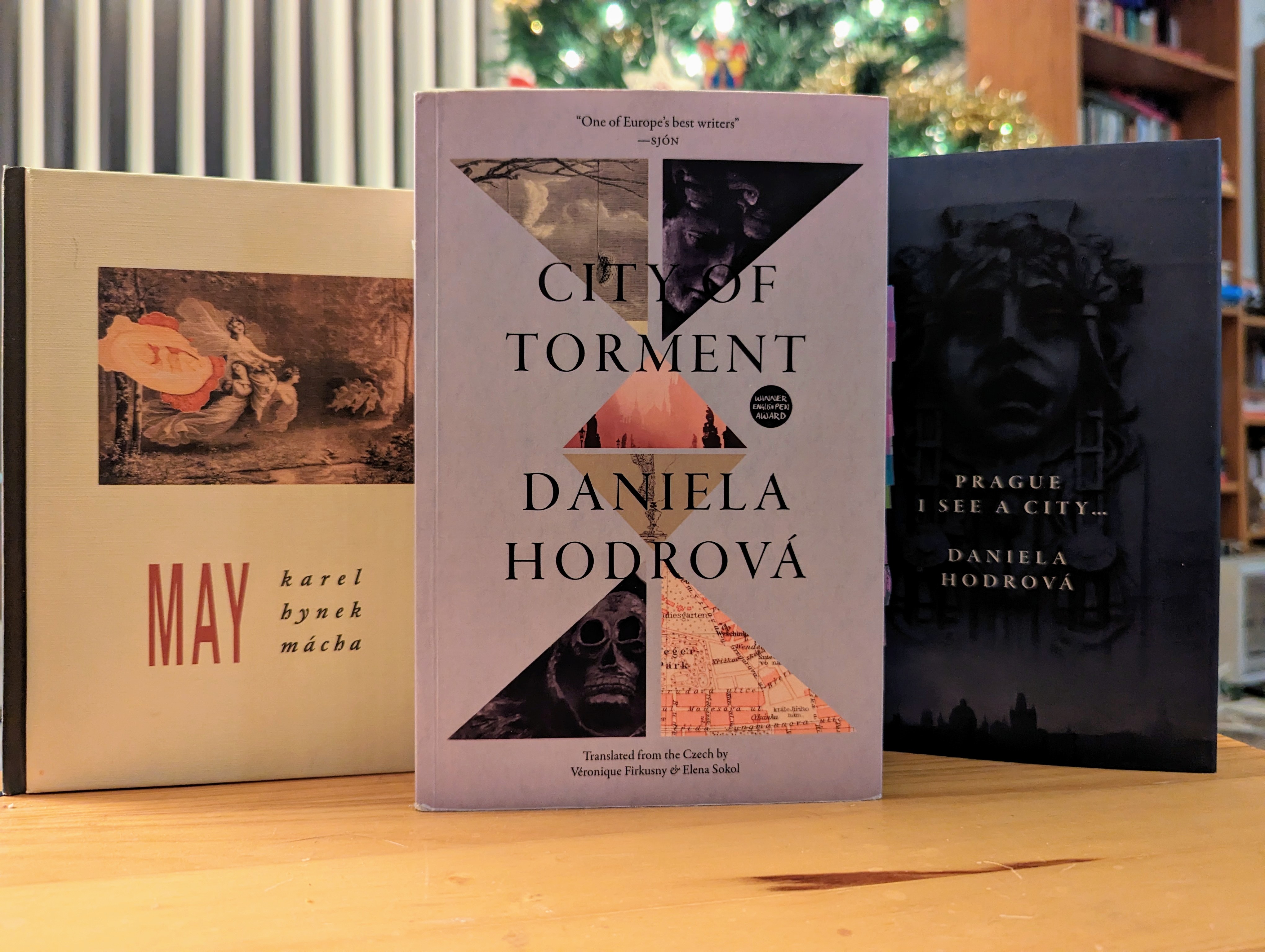
City of Torment – Daniela Hodrová’s monumental trilogy (translated from the Czech by Elena Sokol and others) is a complex, multi-faceted, experimental work that explores a Prague formed and deformed by literary, historical and political forces, haunted by ghosts and the author’s own personal past. After finishing the book, I sensed that I was missing much of the foundational structure—not that it effects the reading in itself—but I wanted to understand more. I read Hodrová’s own companion piece, Prague, I See a City… (translated by David Short) and more recently Karel Hanek Mácha’s epic poem May (translated by Marcela Malek Sulak), but I would love to have access to more of the related literary material, much of which is not yet available in English. I suspect that City of Torment is a text that will keep fueling my own reading for some time.

This year’s poetic treasures:

This is the most challenging category to narrow down. I read many wonderful collections, each so different, but three are particularly special.

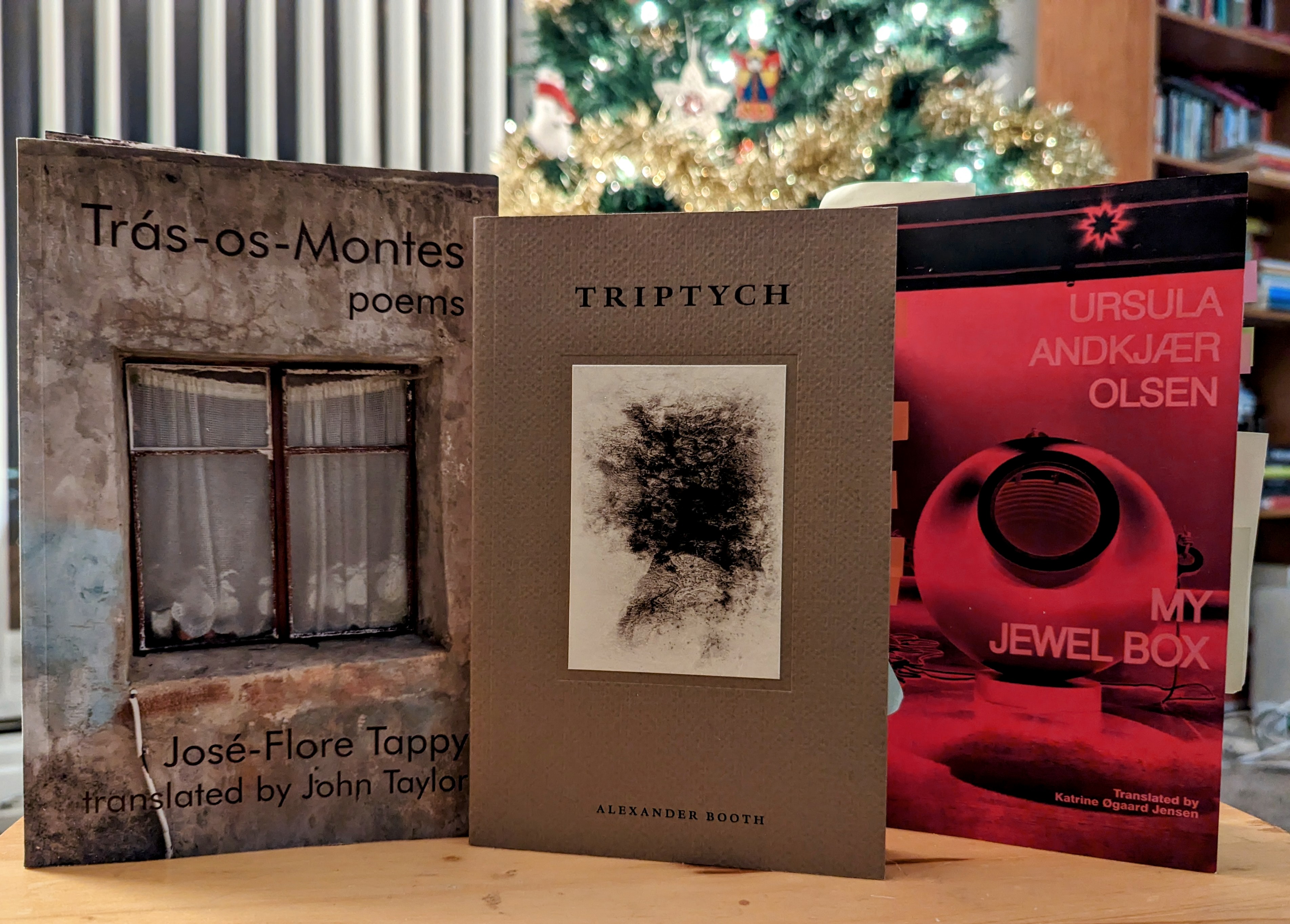
Translator John Taylor has introduced me to a number of excellent poets over the years and in 2022, it was his translation of French-language Swiss poet José-Flore Tappy’s Trás-os-Montes. I read this gorgeous book in August and it is still on my bedside table. It’s not likely to leave that space for a long time yet, and that’s all I need to say.  

I first came to know of Alexander Booth as a translator (and read a number of his translations this year) but his collection, Triptych, stands out not only for the delicate beauty of his poetry, but for the care and attention he put into this self-published volume. A joy to look at, to hold and to read.

Finally, My Jewel Box by Danish poet Ursual Andkjær Olsen is the conclusion of an organically evolving trilogy that began with one of my all-time favourite poetry books, Third-Millennium Heart. Not only is this a powerful work on its own, but I had the great pleasure to speak over Zoom with Olsen and her translator, Katrine Øgaard Jensen, for Brazos Bookstore in May. The perfect way to celebrate a reading experience that has meant so much to me.

Books that defied my expectations this year:

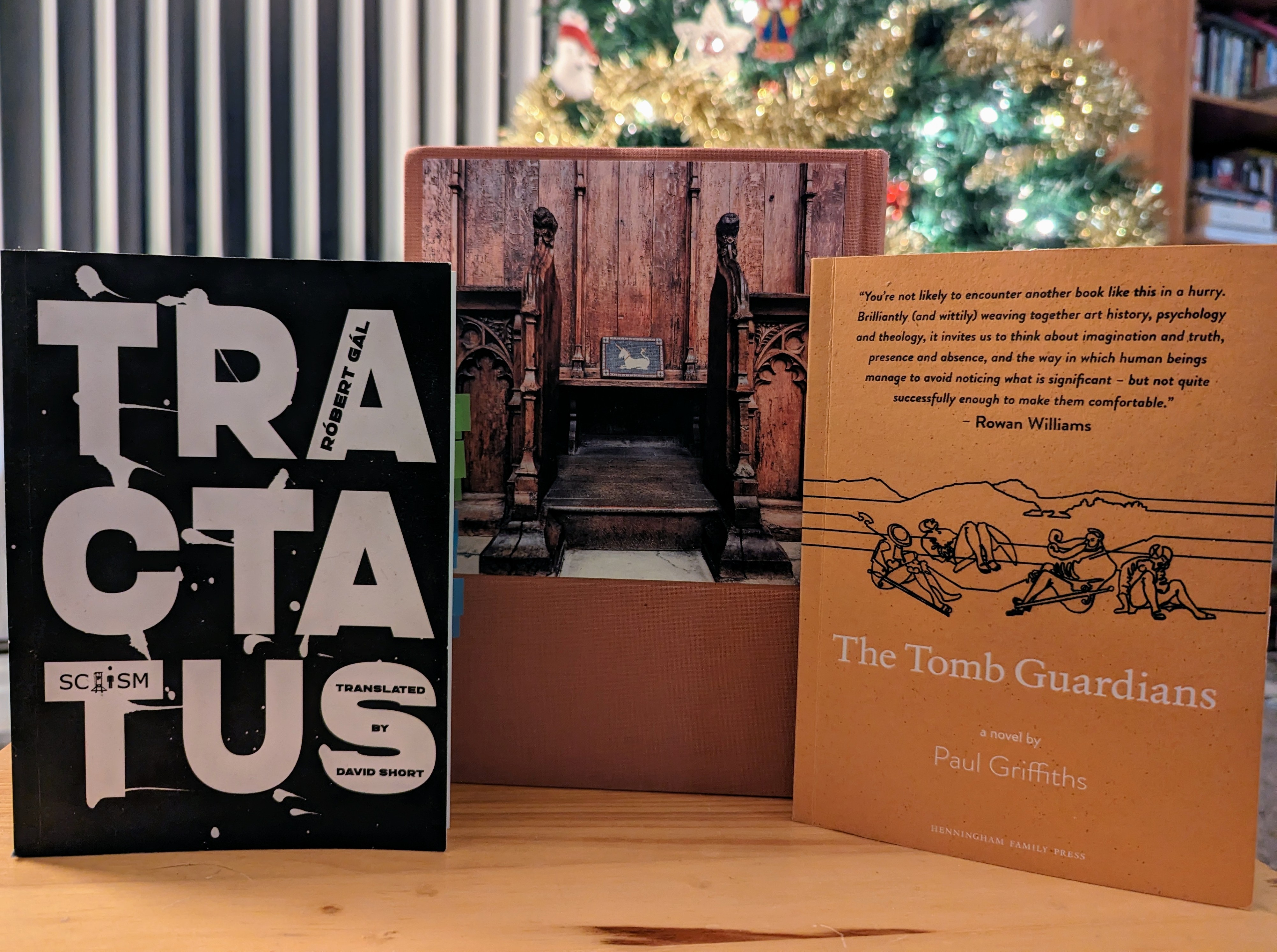
Prague-based writer Róbert Gál has produced books of philosophy, experimental fiction and aphorisms—each one taking a fresh and fluid approach to the realm of ideas and experience. His latest, Tractatus (translated from the Slovak by David Short) takes its inspiration from Wittgenstein’s famous tract to explore a series of epistemological and existential questions in a manner that is engaging, entertaining and provocative.

A Certain Logic of Expectations (you see the back cover here) by Mexican photographer and writer Arturo Soto is a look at the Oxford (yes, that Oxford) that exists a world apart from the grounds of the hallowed educational institution. Soto’s outsider’s perspective and appreciation of the ordinary offers a sharp contrast to the famed structures one associates with the city (and where he was a student himself) and what one typically expects from a photobook.

The third unexpected treat this year was The Tomb Guardians by Paul Griffiths. This short novel about the soldiers sent to guard the tomb where Jesus was buried is an inventive work that explores questions of faith, religion, and art history. Truly one of those boundary-defying works to use a term that seems to get used a little too often these days.

The best books I read in 2022:

Again, an entirely personal assessment.

I loved Esther Kinsky’s River, but Grove (translated from the German by Caroline Schmidt), confirmed for me that she is capable of doing something that other writers whose work skirts the territory occupied by memoir and autofiction rarely achieve, and that is to write from the depth of personal experience while maintaining a degree of opaqueness, if that’s the right word. One is not inundated with detail about the life or relationships of her narrators. Rather, she zeros in on select moments and memories, allowing landscape to carry the larger themes she is exploring. So inspiring to the writer in me.

Monsters Like Us, the debut novel by Ulrike Almut Sandig (translated from the German by Karen Leeder) deals with an extraordinarily difficult topic—childhood sexual abuse. It does not shy away from the very real damage inflicted by predatory family members, nor does it offer a magical happy ending, but it does hint at the possibility of rising above a traumatic past. As in her poetry where Sandig often draws on the darkness of traditional European fairy tales, she infuses this novel with elements and characters that embody the innocence, evil and heroic qualities of folktales within an entirely and vividly contemporary story. So much to think about here.

Hanne Ørstavik’s The Pastor (translated from the Norwegian by Martin Aitken) was my introduction to the work of a Norwegian writer I had a lot about over the years. This slow, melancholy novel set in the far north regions of Norway, beyond the Arctic Circle in the dead of winter, was a perfect fit for me as a reader, in style and subject matter. The story of a female pastor who takes a position in a remote village following a personal loss that she does not fully understand, explores emotional, historical and spiritual questions through a character who is literally stumbling in the dark.

So, what might lie ahead? This past year I embarked on two self-directed reading projects—one to focus on Norwegian literature for two months, the other to read and write about twenty Seagull Books to honour their fortieth anniversary. I found this very rewarding experience. Both projects were flexible enough to allow me freedom, varietyand plenthy of room for off-theme reading, but in each case I encountered authors and read books I might not have prioritized otherwise. For 2023 I would like to turn my attention to another publisher I really admire whose books are steadily piling up in my TBR stack—Archipelago. As with Seagull, they publish a wide range of translated and international literature that meshes well with my own tastes and interests. I don’t have a specific goal in mind, but already have a growing list of Archipelago titles I’d like to read. Other personal projects—public or private—may arise, perhaps more focused toward the personal writing I always promise to get back to, but time will tell. If the last few years have taught us anything, it’s that it’s a long uncertain road from January 1st to December 31st and it’s best not to try to outguess what the road might hold. Hope for the best and prepare for the worst once more.

Best wishes for the New Year and thank you for reading!

A romantic soul: May by Karel Hynek Mácha

A star has dropped from heaven’s height,
a dying star of dark blue light;
it falls through endless realms;
it dwells eternally in falling.
Its cry sounds from the grave of all,
a horrible shriek, a terrible scream.
“When will its falling end?”
Never—nowhere—there is no end.

There are many literary works that risk being ruined for readers simply because they are prescribed study in school, often presented in a rote manner that leaves its victims, er students, with few fond memories. No doubt, for generations of Czech students, Karel Hynek Mácha’s epic poem May might be remembered primarily as something they were required to read in school, old fashioned and difficult. But to come to this poem well into adulthood, without school-deadened experience and as someone whose first poetic passion was English Romantic poetry, this tale of romance, betrayal, patricide and brutal punishment is fascinating, as is the short, tragic life of its author.

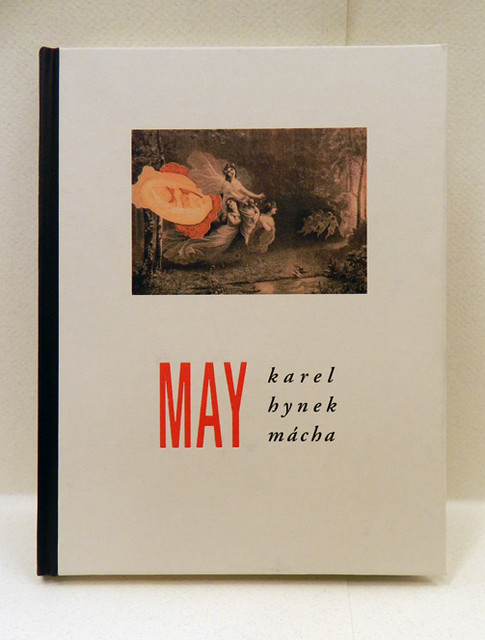
Image from Twisted Spoon Press on Flickr

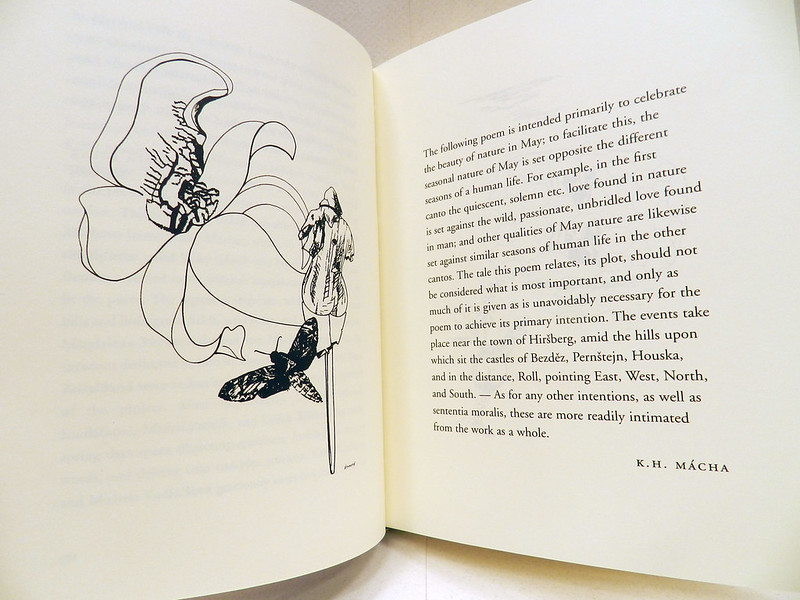
I was inspired to read this important Czech poem by my reading of Daniela Hodrova’s City of Torment earlier this year. Now recognized as the greatest Czech Romantic poet, Mácha is one of the many ghosts haunting this monumental trilogy and his story Márinka, which not yet available in English, forms an important part of the literary subtext of Hodrova’s work. May, however, has been published by Twisted Spoon Press in a handsome dual language volume translated by Marcela Malek Sulak with drawings by Jindřich Štyrský (1899–1942) that were specifically created for this poem.

Mácha was born in Prague on November 16, 1810 and educated in the two languages approved by the Hapsburg authorities, German and Latin. He would go on to study law at Prague University. Yet at heart he was a romantic who spent much of his time wandering the countryside, visiting castles and ruins, and embarking on extended walking tours across Moravia and Slovakia, even making his way to Venice on foot. His great inspiration was Byron.

Writing at a time when Czech poets were seeking to reclaim the Czech language from beneath to weight of two hundred years of imposed German, Mácha also chose Czech for his epic, but he rejected the current focus on folklore and myth as a means to define a new national identity and challenged the Czech language to stretch “to perform in innovative ways and borrowed from Italian landscape, Byronic themes, and local scandal” to fashion his tale of love and a passion denied by fate.

Image from Twisted Spoon Press on Flickr

The finished poem was not well received in Mácha’s circles, causing him to finance the publishing himself in 1836. He died of pneumonia later the same year, a few days shy of his twenty-sixth birthday and three days before he was to have married his lover, Lori, the mother of his child. He was buried in a pauper’s grave. His reputation grew over the decades following his death and a century later, in 1939, his remains were exhumed and he was granted a formal state funeral and buried in the Slavín Cemetery at Vyšehrad in Prague, his status as a national hero finally confirmed.

May consists of four cantos with two intermezzos. It relays the story of Vilém, the notorious “forest lord,” leader of a group of bandits, who is in love with Jarmila, a young girl who has been seduced by another man. In defense of his “wilted rose,” Vilém has killed her debaucher, unaware that his victim was his own father who had driven him out of his childhood home many years earlier. Sentenced to death, Vilém spends the night before his execution preparing to meet his fate:

“How long the night—how long the night—
A longer night yet comes for me!———
Perish the thought!”—The strength of terror
fells his thought.—
Profound silence.—A water drop,
falling, measures time once more.

The next morning, as a beautiful day dawns, the convict is led out to the hillock where a crowd has gathered. He surveys the landscape, bemoans that he will never see his beloved homeland again. The sword falls, and his head and broken limbs are left displayed on a pillar and wheel. Seven years later, a traveller, Hynek, encounters the site and Vilém’s remains. The following morning, the innkeeper in town tells him the tragic tale. Returning once more, many years later on the first of May, the traveller sits on the hillock until nightfall and sees his own and humanity’s fate reflected in Jarmila and Vilém’s story of love and betrayal.

Mácha’s attention to the beauty of nature in evident throughout this poem, from the opening lines of Canto I in which Jarmila waits in vain for Vilém to meet her:

It was late evening—first of May—
was evening May—the time for love.
The turtledove invited love
to where the pine grove’s fragrance lay.
The silent moss murmured of love,
the flowering tree belied love’s woe.
The nightingale sang rose-filled love,
the rose exhaled a sweet complaint.
The placid lake in shadowed thicket
resounded darkly secret pain,
embracing it within its shores;
the pristine suns of other worlds
were wandering through the sky’s blue band,
as fiery as a lover’s tears.

Holding close to his Romantic inspiration and instincts, nature reflects both the passion and the sorrow of his tale. The poem is well-paced and dramatic, speaking to particular style and time, of course, but with all the elements of an entertaining tragic romance. As Sulak explains in her Introduction, she tried to capture the exact meter of the original poem and, because Mácha paid close attention to sound when making language choices to capture his hero’s mental state, she tried approximate a similar affect with the words she used in Canto II, the prison sequence. Because Czech is a language with a much more flexible word order, an effort to reproduce the rhyming pattern was not made. These decisions help preserve the rhythm and flow, as well as the beauty and emotion that have made May such a well-loved poem.

May by Karel Hynek Mácha is translated from the Czech by Marcela Malek Sulak with drawings by Jindřich Štyrský and published  by Twisted Spoon Press.

A special type of perception: Responses · Kafka’s Prague by Jiří Kolář

I first encountered the work of Jiří Kolář (1914-2002), one of the most important poet/visual artists in post-war Europe—a man for whom the two descriptors very often went hand in hand—through A User’s Manual, first published in English translation in 2019. This intentional pairing of his so-called “action poems” written in the 1950s and 60s with collages from the series “Weekly 1967” was originally published together in 1969 and reproduced handsomely by excellent Prague-based indie press Twisted Spoon. Now, with the release of Responses · Kafka’s Prague, another of the Czech artist‘s idiosyncratic pairings, an intriguing overview of his opinions and reflections on the intersection of literature and art is set against a collection of his distinct “crumplages.” Again it makes for an unusual yet beautifully presented volume which also speaks to his creative processing as displayed in both this and A User’s Manual.

Responses is a sort of one-sided investigation, or what Kolář called an “imaginary interview,” a set of seventy-one answers without questions. Compiled in Prague and Paris in 1973, the topics covered include the development of his artistic sensibility, the writers, artists and movements that had an influence on him, and a discussion of technique. It has a thoughtful, conversational, musing-out-loud sort of feel and a sense of direction that is not explicit or artificial but gives the work a natural flow.

From the outset,  Kolář makes it clear that he sees art as part of the “general drive toward universal knowledge” and as such there can be nothing extrinsically new that is not a departure from that which is already innate to the practice. Art and literature are disciplines that do not create anything new so much as they create new ways of looking at (and using) what is already there, a “special type of perception.” As in science, artists are engaged in exploration and investigation, and those he admires, such as Mallarmé and those who followed in his footsteps, are those who become dissatisfied with the status quo. For Kolář this leads him to analyze and reflect upon what various poets were doing with language, and ultimately realize he had to dismantle language itself:

For me the destruction of poetic language followed the same path and the same type of perception as did a new and different perception in other disciplines. As I’ve already said, this is primarily the case in [modern] music and the visual arts. I was speaking about a type of perception — what I mean is that I couldn’t keep seeking poetry in the written word. I had to go beyond the written word. It meant finding another, living language.

There is a distinct restlessness to Kolář’s self-described poetic and artistic evolution, accentuated by the casual style of this particular discourse, but then he was working in trying times. Deemed publicly undesirable by the Communist government in Czechoslovakia he spent time in prison, saw the publication of much of his work delayed, and would eventually end up living in exile. Responses, however, is not concerned with political revolution, but rather with his artistic interests and endeavours, past and current. As translator Ryan Scott points out in his Translator’s Note, this work “should not be read as Kolář’s final word but as capturing a particular moment in time amid his creative flux.” Nonetheless, it makes for an interesting look into an original creative mind.

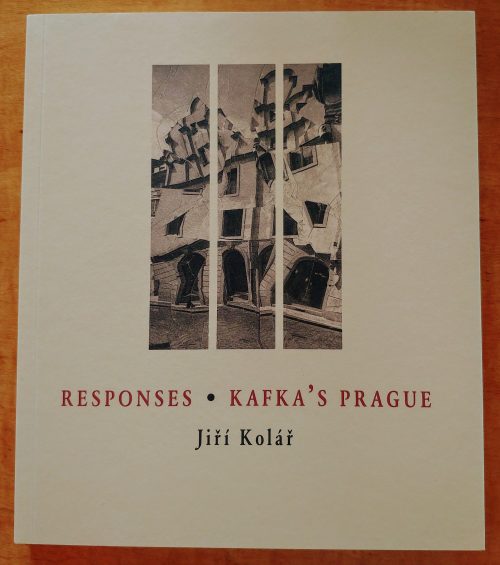
Kolář’s international reputation rests largely on his innovative collage techniques. He is so fond of printed materials—newspapers, letters, tickets, receipts—not only as raw materials but for the moment-in-timeness captured in them that one wonders how he would have adapted artistically to our increasingly digital environment. The present volume contains a series of “cumplages” constructed from photographs of buildings and landmarks in Prague, paired with brief quotes from Kafka’s writings. In these images, the shapes and angles of the structures are distorted, twisted and bent out of shape. The effect is quite striking and perfectly “Kafkaesque.” The process follows a specific routine, starting with moistened paper:

Crumpling must be done fast and carefully, and it’s difficult to predict results with this technique because it’s always the brother of chance. Because the moist paper is crumpled and the work has to be finished fast, hardly any adjusting can be done.

Later on he mentions that his “best crumplages were created from reproductions that readers had coloured themselves.” He delights in the touches human hands have left behind coming through in his art. Among the thirty-four images employed in Kafka’s Prague are buildings directly associated with the writer’s life, and other structures Kafka would have known well. (You can get a sense of the book here.) To have this work so beautifully reproduced in this book is a treat in itself, together with Responses it is an enriched experience.

Responses · Kafka’s Prague by Jiří Kolář is translated from the Czech by Ryan Scott and published by Twisted Spoon Press.

Instructions for interacting with the material world: A Users Manual by Jiři Kolář

You can always be assured that a hardcover release from Prague-based indie publisher Twisted Spoon Press will be something very special. All their books—dedicated to bringing both long neglected and contemporary writers to English audiences—offer work that is unique and engaging, but they really put a little extra effort into their beautifully presented, typically illustrated, hardcover texts.

Like Jiři Kolář‘s A User’s Manual.

One of the most important Central European poets/visual artists of the postwar era, Kolář (1914-2002) was best known internationally for his innovative collages, but within Czechoslovakia he was a aligned with other politically defiant artists. He was a member of the avant-garde Group 42 until it was disbanded after the Communists came to power and, when the police discovered the manuscript to his controversial collection Prometheus’ Liver, he was arrested and labelled an “enemy of the state.” His poetry and artwork reflects his view of the society he saw around him.

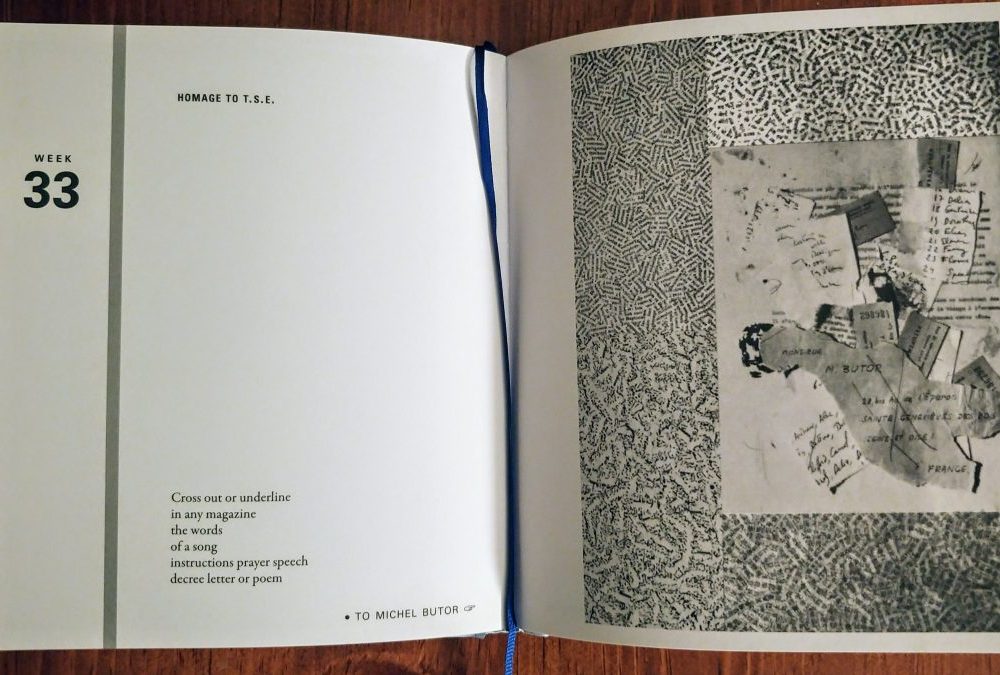
This most unusual—and handsome—volume pairs 52 “action poems”, written in the 1950s and 60s, with images from “Weekly 1967,” one of his  series of collages created as a running commentary on each week of a year. First published together in this form in 1969, the resulting book is not only very entertaining to look at, but characterized by a sly creative energy and a devious wit. Each poem in A User’s Manual presents itself a set of instructions, often nonsensical, that mimic the form of communist dicta. Week 13, “Path,” for example, directs the reader to:

Go
empty-handed
on foot or by train
to a town
where you know no one
and spend three days there
When hungry
ask for bread
when thirsty
ask for water
Spend the night where possible
and every day ask
nine people about a person
with the same name as yours
with the same destiny as yours

The collages that accompany each poem are constructed from newspaper clippings, documents, cut outs, patterns formed with words or musical notation. Some are dedicated to individuals (sometimes presented as a profile portrait), others have a stark political feel, and yet others are abstract patterns. Together with his instructional verses, the effect is an elevation of the everyday and an imagining of a specific way of reacting to the world. As Ryan Scott explains in his Translator’s Note, in this work, Kolář is explicitly engaging with the materiality of language. He is inviting direct interaction with the immediate surroundings by calling attention to “the locus of speech, action and things.”

“Homage to T. S. E.” opposite an image titled To Michel Butor

As unusual as they are, many of the poems are oddly practical enough that they could serve as inspiration triggers. The language is spare, reasons and explanations are not offered, but therein lies the charm. Some are even strangely beautiful. Like Week 47, for instance, “Poem of Silence: For Emil Juliš”:

Collect
a pile of pebbles
and from them compose
anywhere

and with a title
pebble by pebble
as word by word
line by line

as verse by verse
a poetry poem

Exiled to Paris in 1980, as were many artists of his generation, Kolář returned frequently to Prague  after the Velvet Revolution, and spent his final years in the city. But born of a response the restrictions imposed under Communist occupation, A User’s Manual stands as a creative act of rebelllion that seeks a certain dignity in absurdity.  It makes a wonderful read, a fascinating visual experience, and would be a fine gift for an artistic friend.

A User’s Manual by Jiři Kolář with illustrations by the author, is translated by Ryan Scott, and published by Twisted Spoon Press.

Another winter solstice is upon us: 2016 – The year in review

Winter solstice. The longest night of the year.

Moving forward, the days grow steadily longer and, in less than two weeks, we will leave a dark, disturbing year behind us.

But it would be reckless to imagine that 2017 will be brighter. However, with luck, we can be forewarned, forearmed, and determined not to relax our guard. We can stand together against the rising tides of hatred, and remember what is truly at stake.
11229294674_e5844929df_z1

Since I started this blog two and a half years ago, winter solstice has become my annual check-in point. Last December, I reflected on the key elements of a year that began with a move to writing seriously about books and culminated with my first review for Numéro Cinq. Against that trajectory, I wrote about my trip to South Africa, and the pulmonary embolism and cardiac arrest that followed within a few weeks of my return. I imagined that the eventful year I had experienced would not likely, for better or worse, be exceeded this year.

Cue 2016.

This has been a year of heartache, anger, and dismay. Around the world and close to home. I watched the violence in Syria, the outcome of the Brexit vote, and the spectacle of the American election, among the other tragic and unexpected events that have unfolded. And as economic uncertainty and anxiety has grown in my own hometown—a city that lives and dies with the price of oil—the crime and homicide rate has risen sharply this year. It does not feel like the same community any more.

Then there is the lengthy roll call of the writers, artists, and performers who have left us. But to be honest, I cannot say that I have felt these losses as acutely as many others… I’ve been distracted by the immediate, personal losses that marked this year. My mother, my father, and one of my closest friends, all gone within the span of two months. And my grief—that most fundamental human emotion—is complicated, inarticulate, and wearing.

It will take time.
11592010455_89917d80e3_z1

But, 2016 has also been a time of amazing growth and opportunity for me as a writer. I don’t know how often I resolved, with the dawn of a new year that: This year I will write. Last December, with that first critical review under my belt, I could not have imagined that I would have, in addition to regular contributions to Numéro Cinq, published reviews at 3:AM, Minor Literature[s], The Quarterly Conversation, and The Rusty Toque. And I would not have dared to dream that I would see my essays and prose pieces published on line and in print, or that I would be invited to join the editorial team of The Scofield. As 2017 approaches, I have a handful of reviews scheduled and several prose projects underway. I’m also feeling inspired to return to photography after a lengthy hiatus, and to see how I can incorporate photos into my written work.

I have much to look forward to, in spite of, or rather, against the new darkness that threatens.

Art and literature are more important than ever at times like this.

So, this seems to be an appropriate time to look back over this year’s reading, and highlight the books that stand out for me.

I’ve read about 50 books to date, a little more than half of what I read in 2015. I don’t even want to hazard a guess as to how many books I bought, received as review copies, or brought home from the library. I feel, as usual, like I fell short of my intentions. However, I have to remember that I was writing, working on critical reviews, and dealing with considerable life stresses over the past twelve months.

More than ever before, I read like a writer this year. That is, I was especially attuned to voice, structure and approach to storytelling. Consequently, the books that made my year-end list tend to reflect this focus. Of course, any “best-of list” leaves out many excellent books. I’ve managed a baker’s dozen here, and it’s probably a reflection of the increased number of off-blog reviews I wrote that this year’s list is predominately composed of new releases. I was surprised to see that once I’d made my selection.

In reverse chronological order, my top reads of 2016 include the following:

Story of Love in Solitude by Roger Lewinter (France), translated by Rachel Careau
I will write about this collection of three short stories once I have completed The Attraction of Things. My verdict is still out on that title, but this tiny book is simply wonderful.

The Inevitable Gift Shop by Will Eaves (UK)
Fragmentary, cross genre writing that works fascinates me. Billed as a “memoir by other means”, it is Eaves’ unique tone that makes this blend of memoir, literary criticism, and poetry so compelling. His thoughtful reflections on reading and writing made this an ideal meditation to turn to after a year of reading critically and exploring my own literary voice.
gravediggerThe Absolute Gravedigger by Vítěslav Nezval (Czech Republic), translated by Stephan Delbos & Tereza Novická)
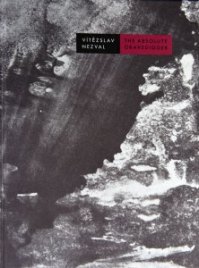
I have found myself turning to poetry more and more as the world seems increasingly unstable and, well, surreal. This newly translated collection of poetry by one of the best known Czech Surrealists should be essential reading at this time. Originally published in 1937, the darkness he could see on the horizon are all too familiar once again.

The Country Road by Regina Ullmann (Swiss), translated by Kurt Beals
I read this collection of short stories when I was in a very low mood. But in the spare, sombre prose of these tales I found a beauty that, rather than deepening my depression, brought strange comfort. Admired, in her lifetime, by the likes of Rilke, Mann, and Musil, Ullmann’s work is mostly forgotten today. This volume, released in English translation in 2015, is a rare treasure—one that I encountered at just the right moment.
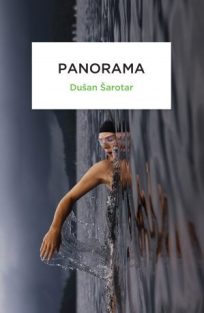
panorama-coverPanorama by Dušan Šarotar (Slovenia), translated by Rawley Grau
For me, as a reader and a writer, one of the most important books I read this year is this literary meditation on migration, language, landscape, and loss. This novel finally broke through my own stubborn determination to hold to a sharp delineation between fiction and nonfiction, and has made me re-evaluate potential approaches to themes I wish to examine. What Šarotar achieves here with his own unique take on what might be deemed a “Sebaldian” approach, is the creation of an atmospheric, captivating, and intelligent work.

The Passion According to G.H. by Clarice Lispector (Brazil), translated by Idra Novey
Oh wow! In a way, I am glad I didn’t read Lispector before writing and publishing my essay “Your Body Will Betray You,” because she is exploring the process of coming into being so beautifully that I might not have been able to write at all after reading this. Employing an unconventional narrative, Lispector’s G.H. experiences a vivid, metaphysical crisis triggered by the sight of a cockroach. The result is a remarkable, thoroughly engaging read. I have at least three more of her books waiting for the new year.

Proxies by Brian Blanchfield (US)
I bought a number of essay collections this year and currently have several on the go. This collection impressed me not only for the way the essays were composed—written without consulting outside sources—but for some of the ideas explored, and for reinforcing the value and possibilities of the personal essay/memoir form. I also greatly appreciated his guiding caveat: Permitting Shame, Error and Guilt, Myself the Single Source.
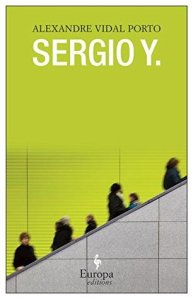
SergioSergio Y. by Alexandre Vidal Porto (Brazil), translated by Alex Ladd
This book is significant and important for dealing with gender identity and transition in a sensitive and original way. I am, as a transgender person, critical of much of what passes as literary writing on this subject. This is a most impressive work with a startling and unique approach. As I noted in my review, Sergio Y. is novel that approaches the transgender experience from the inside and the outside, allowing for the comfort with names and pronouns to vary, over time and from person to person, reflecting the complexities of relationships that others, even loving family members, can have when an accepted and assumed identity is challenged. That is the book’s greatest strength.
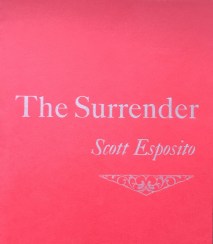
surrThe Surrender by Scott Esposito (US)
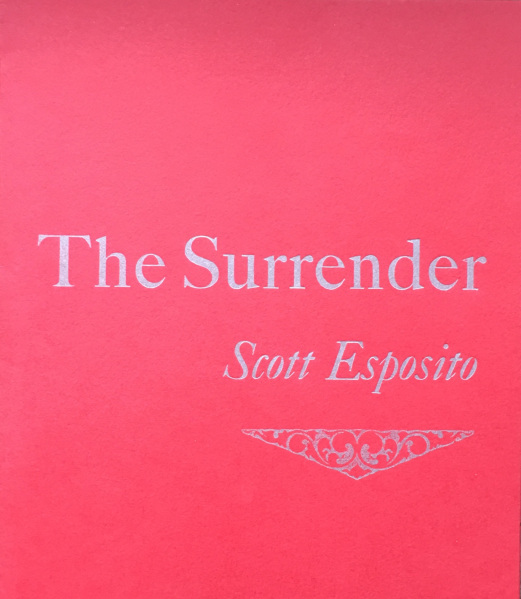
This book was on my radar from the moment I first heard of it. Again, despite my typical gender related skepticism, I was drawn to this transgender-themed memoir/film critique/literary diary. I wanted to know how Scott would present his story—one that is not commonly heard. Although his journey is very different than mine, we share a certain sensibility. This is a brave and most wonderful book by a man who has long been one of my heroes. He has since become one of the many literary friends I have come to know and cherish this year.
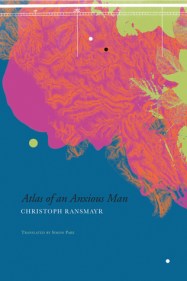
Layout 1

Atlas of an Anxious Man by Christoph Ransmayr (Austria), translated by Simon Pare
This book was a total surprise when it arrived courtesy of the good people at Seagull Books. This most unusual travelogue, a series of brief “encounters” across the globe, contains some of the most stunning descriptive language I have ever read. Each episode begins with the words “I saw…” and ends with a wise, evocative observation. From the North Pole, to South America, from deep inside the mountains of New Zealand, to a parking lot in San Diego, this is a journey that will not be easily forgotten. Highly recommended.

Quiet Creature on the Corner by João Gilberto Noll (Brazil), translated by Adam Morris
My third Brazilian book on this list is this enigmatic novella that led to one of the most entertaining literary discussions of the year. What is it about? Well that is the challenge. I had to read it three times before I could begin to get a handle on it. The narrator, a young man who finds himself in a strange situation that is rapidly growing stranger, is, in his oddly passive tone, almost more disturbing than whatever might be happening. Opaque and surreal, this book gets under your skin.

The Crocodiles by Youssef Rakha (Egypt), translated by Robin Moger
This novel still holds fast in my memory although I read it back in February. It is, as I described it in my review, a prose poem of simmering power, unwinding across 405 numbered paragraphs, tracing a torturous path from the first stirrings of poetic assurance within a trio of young men in the 1990s to the doomed protests of the Arab Spring. It is a dark, intense exploration of youthful political idealism, that builds on repeated images, themes and refrains to create a compelling narrative force as it moves toward its stunning conclusion. Again, this is another work that is increasingly relevant in today’s world.
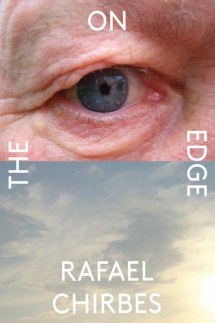
On-the-edgeOn the Edge by Rafael Chirbes (Spain), translated by Margaret Jull Costa
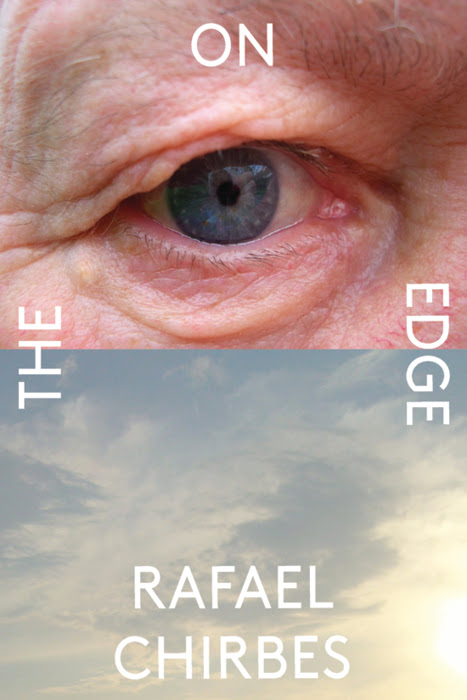
Finally, the very first book I read in 2016 is probably my favourite book of the year. I wrote about this novel at length for Numéro Cinq and I regret that it has not generated more discussion. In what is essentially an extended monologue with brief cameos from other characters, Chirbes creates a memorable, engaging, and tragic character in seventy-year-old Esteban, a man who has lost absolutely everything in the economic collapse of 2008.  Thoroughly human in his wisdom, his resolve, his shortcomings, and his despair; this is a powerful and important book that deals frankly with many of the critical issues—including migration, xenophobia, and economic decline—that are more vital than ever as we step into 2017.

Cold comfort: The Absolute Gravedigger by Vítěslav Nezval

That terrible fist swings the bell
The blasphemer
Is boxing
Hell-bent on knocking out the eye of heaven
That cynically floods desolate white-washed houses
With radial light
With an iron resolution to act
While the knuckles crack
This fist delivers bruises shaped like swallow nests to roofs
In the name of vengeance
(from “The Blacksmith”)

Upon my first read-through of this newly translated collection of poetry by prominent Czech Surrealist, Vítěslav Nezval, I was struck by an eerie sense that the poet was speaking to the present moment. Published in 1937, the poems gathered in The Absolute Gravedigger form a gallery of darkening, disturbing, and frequently grotesque images that capture the mood of the shifting landscape of the years leading up to the Second World War. Some are small, contained, and often bucolic scenes. But others depict expansive nightmarish vignettes of obsession, violence, corruption and decay—evoking imagery worthy of Bruegel, Arcimboldo or Bosch—and closely aligned with the spirit and sentiment associated with the more widely known French Surrealism.

Returning for a second reading, in the immediate aftermath of the election of Donald Trump, I cannot help but wonder how quickly the lessons of the last century have been forgotten—and shudder at the thought of what potentially lies ahead.

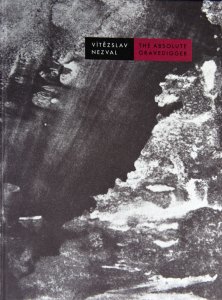
gravediggerBorn in 1900, Nezval began writing and publishing poetry in the 1920s, but by the early ’30s, he and a number of his fellow Czech writers and artists had fallen under the influence of the French avant-garde. He first met André Breton in Paris in 1933, and the following year he helped found the Surrealist Group of Czechoslovakia, the first such group to receive the Breton seal of approval, so to speak, outside of France. Yet, even though they made important contributions to the movement, the Czech Surrealists have remained relatively obscure, a situation further exacerbated by the artistic restrictions applied under the years of Communist occupation. The release of The Absolute Gravedigger from Twisted Spoon Press should help to ameliorate that situation, and spark further interest in the work of Nezval and his contemporaries.

In his poetry, as evidenced in this collection, Nezval was a stylist who drew widely from the Surrealist playbook. In an interview in The Bohemist, translators Stephan Delbos and Tereza Novická describe their decision to work together as follows:

Nezval was prolific and incredibly gifted, so the book is over 200 pages, and contains a range of styles from traditional rhymed quatrains to freewheeling litanies and dense, paranoiac prose. A challenge to translate, to say the least, so approaching it as a team seemed like a good idea.

The diversity of the poems in this collection is difficult to capture in the space of a short review. Suffice to say that they range from the relatively conventional to the decidedly bizarre. For example, “The Windmill” is a section comprised of a series of rural compositions featuring farm and small town scenes. However, the imagery is vivid, sometimes surprising in its unexpected shifts, and an unmistakable darkness seems to wait just over the horizon, as demonstrated in this portion of “The Reapers”:

The birds have flown off
Everything on the verge of tears
Huge carts haul off bales of straw
A cock crows
And wheels squeak
The landscape changes
Brown pitchers peak from under gladiolas
And confusion seized the horses
The mills clatter
From afar
As a signal
Like an imminent declaration of war
And suddenly the whole place is holiday empty

Similar bucolic settings return in the later “Shadowplays” section which features tightly rhyming, orderly quatrains which, to preserve the feel of the originals, the translators have chosen to carry into English with as much of the spirit and musicality intact as possible. Because these pieces stand out so sharply against the more open and, at times, unrestrained quality of the rest of the book, this seems to be a wise choice. Coming on the heels of the intense, fantastic and disturbing imagery of the poems in the “The Absolute Gravedigger” section— the title poem, “The Fetishist,” The Blacksmith,” “Milking,” and “The Plowman”—the sudden appearance of a traditional formality catches the reader off guard.

2016-10-27-16-12-40The author has also included several pieces of his own artwork and the poems they inspired framed by two prose pieces in which he talks about the process of decalomania (the creation of abstract images by laying a thick layer of paint on a surface and pressing a piece of paper or canvas against it) and its influence on, not only the directly referenced pieces but other key poems in the book. Nezval explains that the process gave rise to prototypes of “the hybrid creatures” that people his most surreal poems.

There is harsh brutality that runs through the most fantastic and, to put it simply, “surreal” of these Surrealist poems. The characters that are brought to life, resemble the denizens of an adult Grimm’s fairy tale—grotesquely featured, obscenely sexualized, dirty, decaying—and trapped, sentenced to their miserable fates. But the piece that is most profoundly political, and devastatingly timely once again is the final poem, “The Iberian Fly.” Here on the wings and body of a gigantic fly making its way through the skies, a terrifying spectacle is playing out, summoning imagery reaching back to the Spanish Inquisition, but zeroing in on the rising waves of fascist ideology sweeping Europe. Nezval’s original version was apparently more specific, naming names, but increasing censorship stayed his hand before the final version went to print. All the same, the message is clear:

[The Iberian fly’s] proboscis
Was gradually
Immersed
Into several drops of blood
Squeezed out
Of different races
And subjected these drops
To analytical chicanery
Whose fraudulent result manifested
As diagrams
Once these drops
Of blood
Hardened into a crust resembling sealing wax

As the drop
Of drying Aryan blood
Turned into a faux jewel
Spectrally depicting
Absolute nobility
In the form of Ionic columns
Under which reflected in miniature
The beguiling image of bathing women
On the sparkling left wing of the Iberian fly
The other drops
Drying
Transformed
Under the touch of the dirty finger
Of the little man with the Chaplin mustache
Into this pictorial relief

The relief that is depicted in the following stanzas incorporates African and Asian features—a chilling echo of the type of racist graffiti, propaganda and attacks that we have seen post Brexit and, now Trump. And these patterns know no borders. In Canada, where I live, the past week has seen a sharp upturn in the same trends. The immergence of this translation, at this time, is uncanny, there is a new chill to these words, almost eighty years after they were first published.

Plus ça change.

The Absolute Gravedigger is published, by Prague-based Twisted Spoon Press, in a handsome hardcover edition featuring Nezval’s own decalomania artwork on the cover.