Halfway through 2025: Less reading, but hope for the future beyond the page

Somewhere in the city last night there must have been fireworks, officially that is, I’m sure illegal sparklers were also fired. It was Canada Day, after all. July 1. This same holiday back in 1987, marks the day I finally quit smoking for good. I’m quietly hoping that this year July 1 will be remembered as the day my son quit drinking. We’ve stood at this precipice so any times before, I’m almost afraid to believe it might be true. I’ve said it before, I know, but this time really feels different.

The last few months have been especially difficult. In May my son’s computer was hacked. We stood in horror and disbelief, watching as the hacker systematically and openly carved his way through programs while outside no less than five firetrucks descended on the building next door. The excitement at the neighbours’ subsided, but in our home the damage was done. A text to my daughter, whose boyfriend is a computer tech, provided guidance for the initial security steps, and by the weekend the virus was isolated, the hard drive wiped, and rebuilding was underway. But for my son, a tidal wave of anxiety had been unleashed. And it continued to build. His preferred remedy, as it has been for the past fifteen years, was to drink more than ever. He is thirty-five.

Over the years, I’ve learned the hard way that it does no good to confront him or to overreact. Begging, bribing, and passive aggressive accusations are counterproductive. Or worse. Now that his other parent has been diagnosed with high blood pressure, diabetes and, after repeated small strokes, early onset dementia (and this without a history of alcoholism), the medical risks of his addiction have taken on a new intensity. But the thought of facing panic attacks “alone” and the very real nightmare of withdrawal have long stood in the way of any true desire to quit. Each time I’ve suggested he seek support (something that he has tried over the years, of course) I see that the legacy of his abysmal experiences in the child and adolescent mental health system run deep. And I cannot blame him at all, I’m still angry about the way he was mistreated.
However, something changed in the past few days. Suddenly beer no longer tasted good. No longer provided relief. Made him feel ill. Frightened by the symptoms, he finally agreed to call the public health nurse and after assessing his condition she recommended  he go to the hospital emergency. So that’s where we were when fireworks rang out, and where we were until after three o’clock in the morning. At one point my son insisted we leave as no one had been called in to see a doctor since our arrival, but I insisted he inform the triage nurse and when she saw him he was experiencing serious symptoms of detox. She convinced him to take some medication to help him relax and before long his name was called.

I stayed in the waiting room, hoping to finish the book I was reading. I only had about 20 pages to go when we arrived (in fact, I tucked several books in my pack figuring I would be moving on to something else before the night was out). But then a couple arrived and the woman started listening to an evangelical sermon aloud, on her phone. Stressed and tired, I could not shut it out. I thought, God gave us headphones, surely you could use them. Fortunately, it was not too long before I could go back and join my son.

Now, the road he has ahead will not be easy. He has been drinking so heavily on a daily basis it is no less than a miracle that his blood work came back as good as it did. He has been prescribed medications to reduce cravings and protect against seizures, but he doesn’t seem keen on the side effects (which unfortunately are not unlike the withdrawal symptoms). For someone who has admittedly self-medicated for so long, my son is skeptical about anything that comes from the pharmacy. All I can do is support him with patience and love. This is the first time he has sought medical support, fully and openly admitting to his circumstances, and I am so proud. And cautiously optimistic.

The strain of living with an alcoholic takes a toll. Over the last month and a half I have been distracted, stressed, irritable. I could see that things were escalating, that my son was not coping, but I knew that he had to be ready to take things into his own hands. Meanwhile, I’ve struggled to focus on reading and writing, moving through words at a glacial pace, picking up and putting down book after book after only a few pages. Funny, but only the dream-filled madness of Zuzana Brabcová’s novel of detox, Ceilings has consistently cut through my own anxiety. If I can see my son safely through the next few days of early detox, maybe things will finally be back on track for me—and on to a new future for him.

Note: I debated whether I should write this or not, but decided I needed to put it out there.
Looking back at a year of reading: 2024 edition

Each year when I review the list of books that I have read, I face the same challenge deciding what to include and what to leave out of a final accounting. As usual there are the books that I know, even as I am reading them, will be among my favourites for the year. Just as I know the ones I don’t like, the ones I won’t even mention or take the time to review. Basically, everything else that I have reviewed, was a good book.

This year, my count far exceeds a respectable “top ten” or “baker’s dozen” and there are some striking factors at play. One is that the ongoing  violence in Gaza has heightened my focus on Palestinian and Arabic language literature—long an area of interest and concern. Five of the Palestinian themed books I read made my year end list. As well, I have paired several titles, typically by the same author or otherwise connected, because the reading of one inspired and was enhanced by the reading of the other (not to mention that such pairings allow me to expand my list). Finally, as reflected by my top books, I read and loved more longer works of fiction this year than usual (for me). No 1000 page tomes yet, but perhaps I’m overcoming some of my long book anxiety.

And so on to the books.

Poetry:
I read far more poetry than I review, but this year I wanted to call attention to four titles.

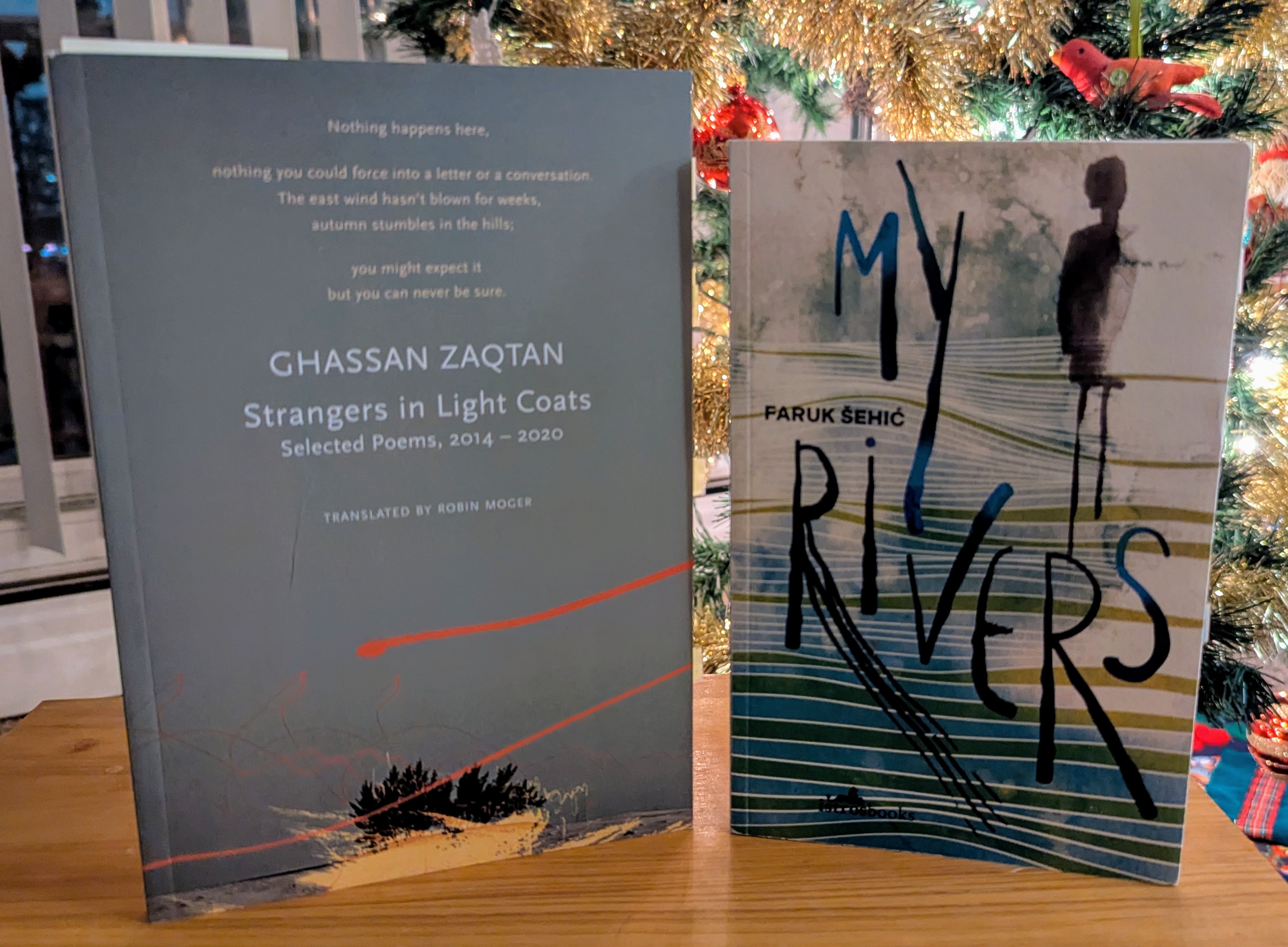
Strangers in Light Coatsevokes by Palestinian poet Ghassan Zaqtan (Arabic, translated by Robin Moger/Seagull Books) is, perhaps, a darker than his earlier collections. Comprised as it is, of poems from recent releases, it actively portrays a world shaped by the reality of decades of occupation and war.

My Rivers by Faruk Šehić (Bosnian, translated by S.D. Curtis/Istros Books) is a collection particularly powerful for its depiction of a legacy of wars in Bosnia/Herzegovina including the genocide in Srebrenica. His speakers carry the burden of history.

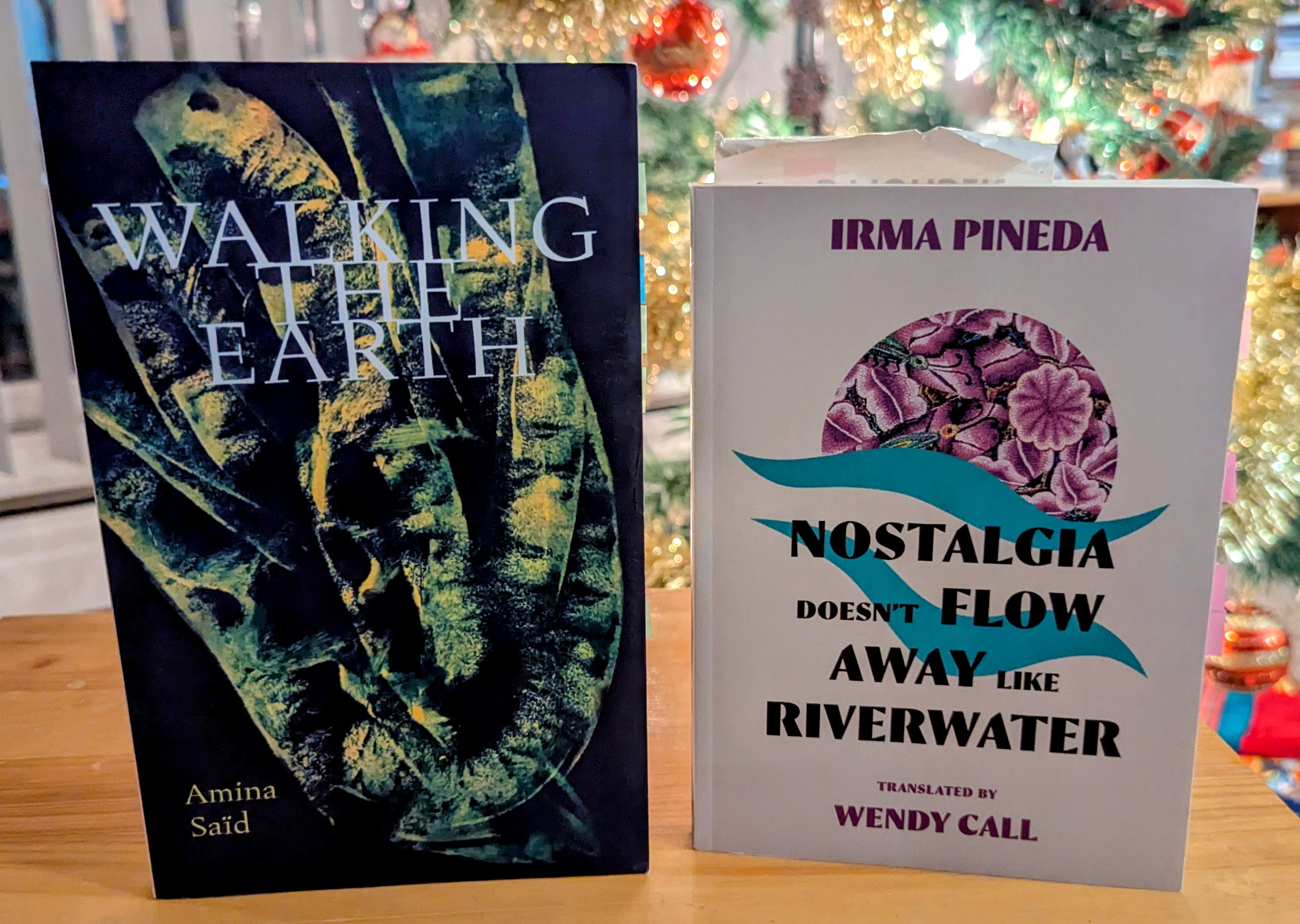
Walking the Earth by Tunisian-French poet Amina Saïd (French, translated by Peter Thompson/Contra Mundum) is such a haunting work of primal beauty that I can’t understand why more of her poetry has not been published in English. Perhaps that will change.

Nostalgia Doesn’t Flow Away Like Rainwater by Irma Pineda is one of a number of small Latin American poetry collection from poets and communities that have not been published in English before. This book, a trilingual collection in Didxazá (Isthmus Zapotec) and Spanish with English translations by Wendy Call (Deep Vellum & Phoneme Media) was particularly special.


Nonfiction:
This year, my favourites include a mix of memoir and essay and a couple of works that defy simple classification.

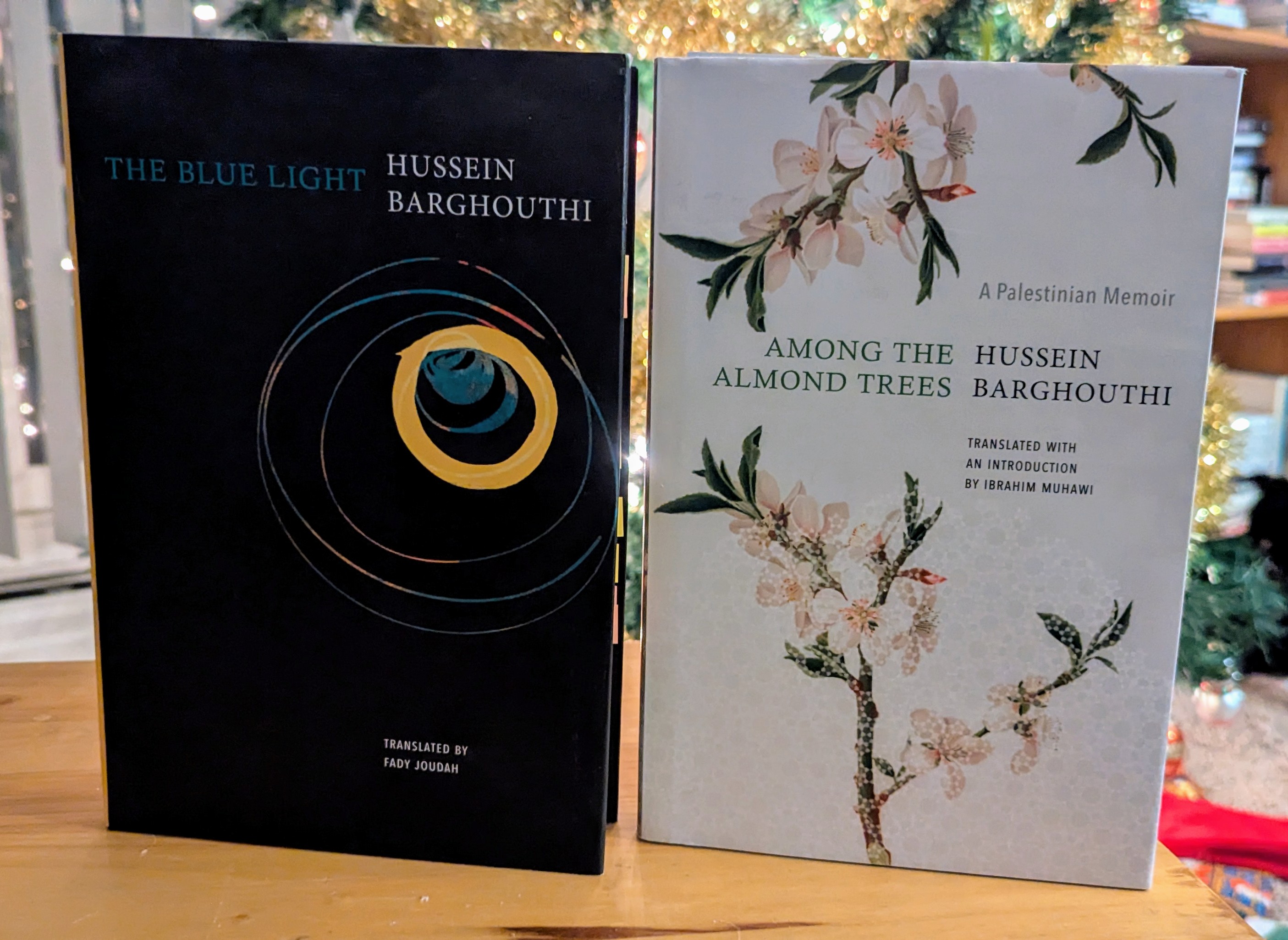
The Blue Light / Among the Almond Trees by Palestinian writer Hussein Barghouthi (Arabic, translated by Fady Joudah and Ibrahim Muhawi respectively/Seagull). Blue Light chronicles Barghouthi’s years in Seattle as a grad student and the eccentric circles he travelled in, whereas Among the Almond Trees is a much more sombre work written when he knew he was dying of cancer. The two books complement each other beautifully.

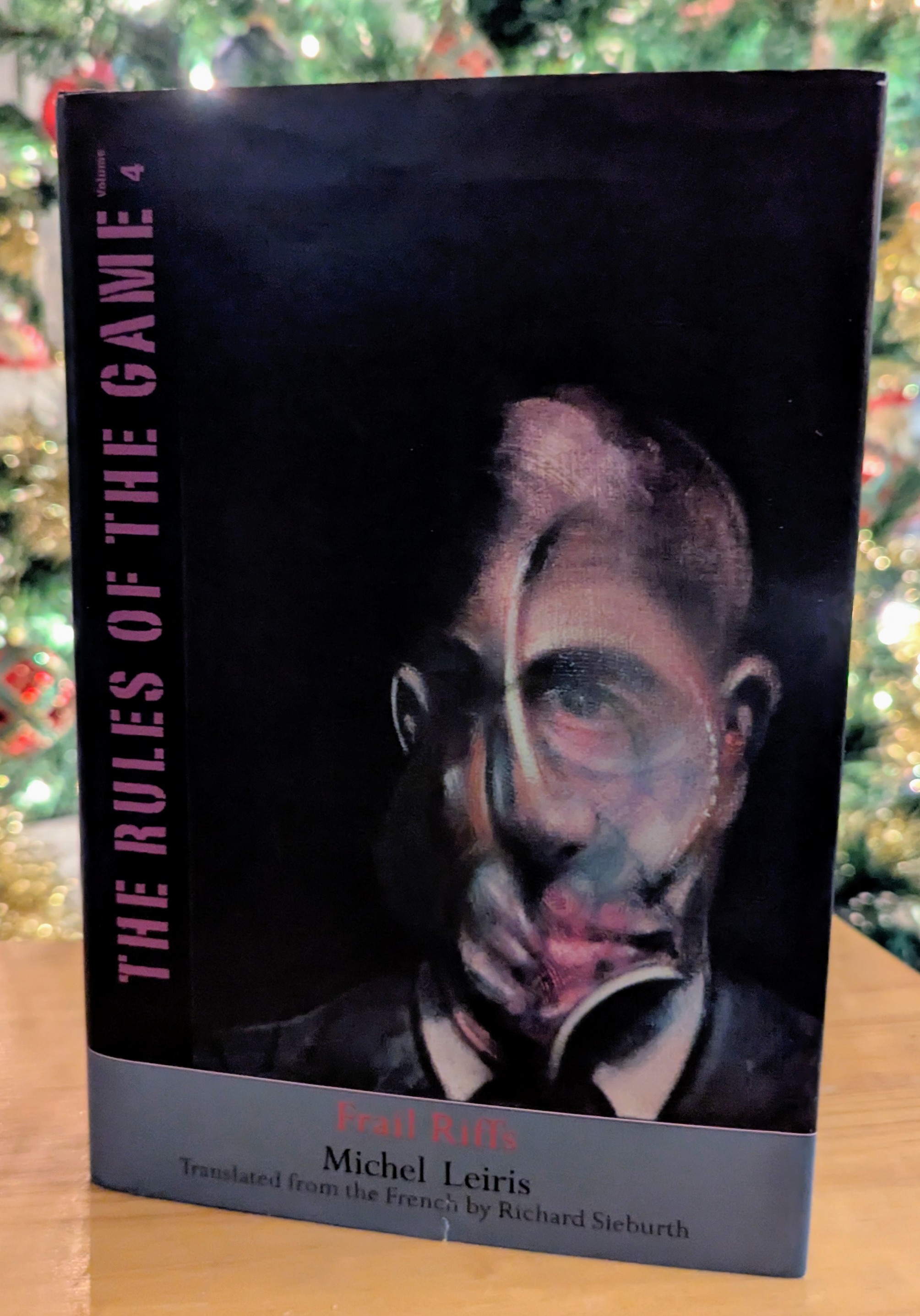
French intellectual, critic, ethnographer and autobiographical essayist Michel Leiris is a writer who means so much to me that the occasion of the release of Frail Riffs (Yale University), the fourth and final volume of his Rules of the Game in Richard Sieburth‘s translation, was not only an excuse to pitch a review but an invitation to revisit the earlier volumes. Definitely a highlight.

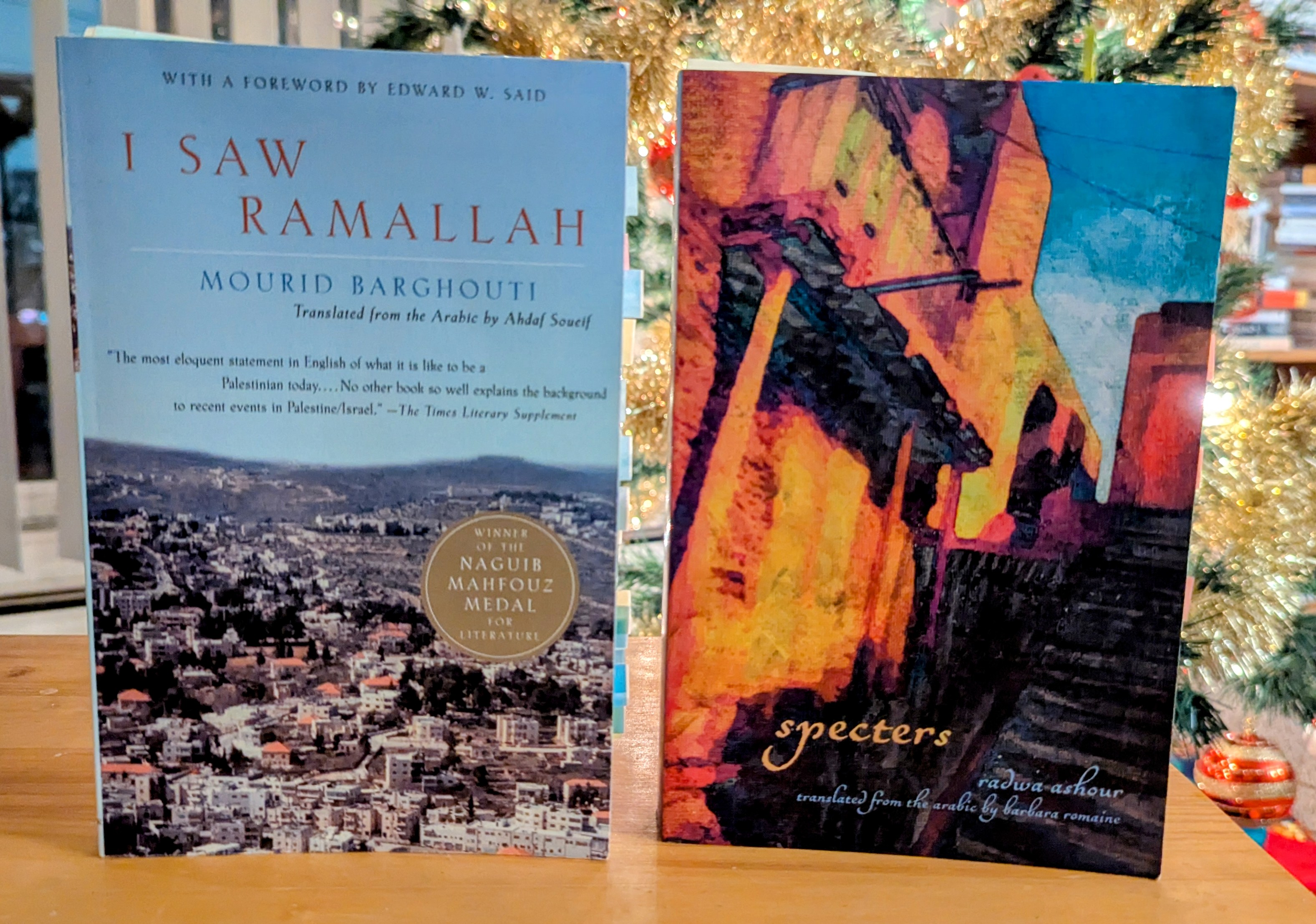
I Saw Ramallah by Mourid Barghouti (Palestinian/Arabic, translated by Ahdaf Soueif/Anchor Books) is a moving memoir detailing the author’s return to his homeland after thirty years of exile. Reading it reminded me that I had a copy of Scepters by his wife, Egyptian novelist Radwa Ashour (Arabic, translated by Barbara Romaine/Interlink Books). This ambitious work blends fiction, history, memoir, and metafiction and I absolutely loved it, but my decision to include it here, like this, rests on the memoir element which complements her husband’s in its account of the many years he was exiled from Egypt—a double exile for him—especially the years in which she travelled back and forth with their young son to visit him while he was living in Hungary.

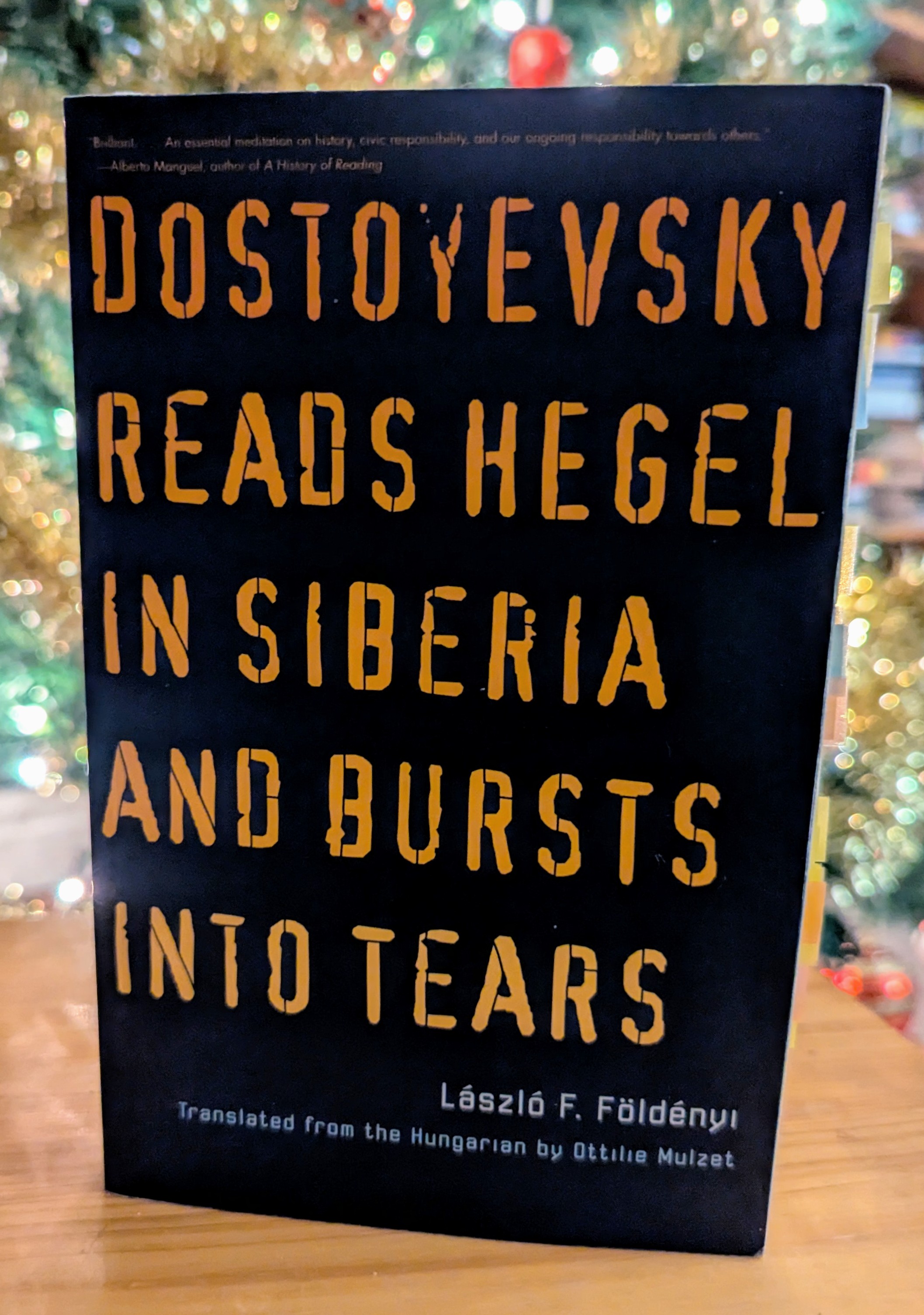
Candidate for the book with the best title, perhaps ever, Dostoyevsky Reads Hegel in Siberia and Bursts into Tears by Hungarian scholar  László Földényi (translated by Ottilie Mulzet/Yale University) was an endlessly fascinating collection of essays exploring the relationship between darkness and light (and similar dichotomies) through the ideas of a variety of writers, thinkers and artists.


Fiction:
As usual, fiction comprised the largest component of my reading and, as I’ve said, I read more relatively longer works than in the past. Normally I have a special fondness for the very spare novella and, of course, my list would not be complete without a few shorter works, including one more pair.

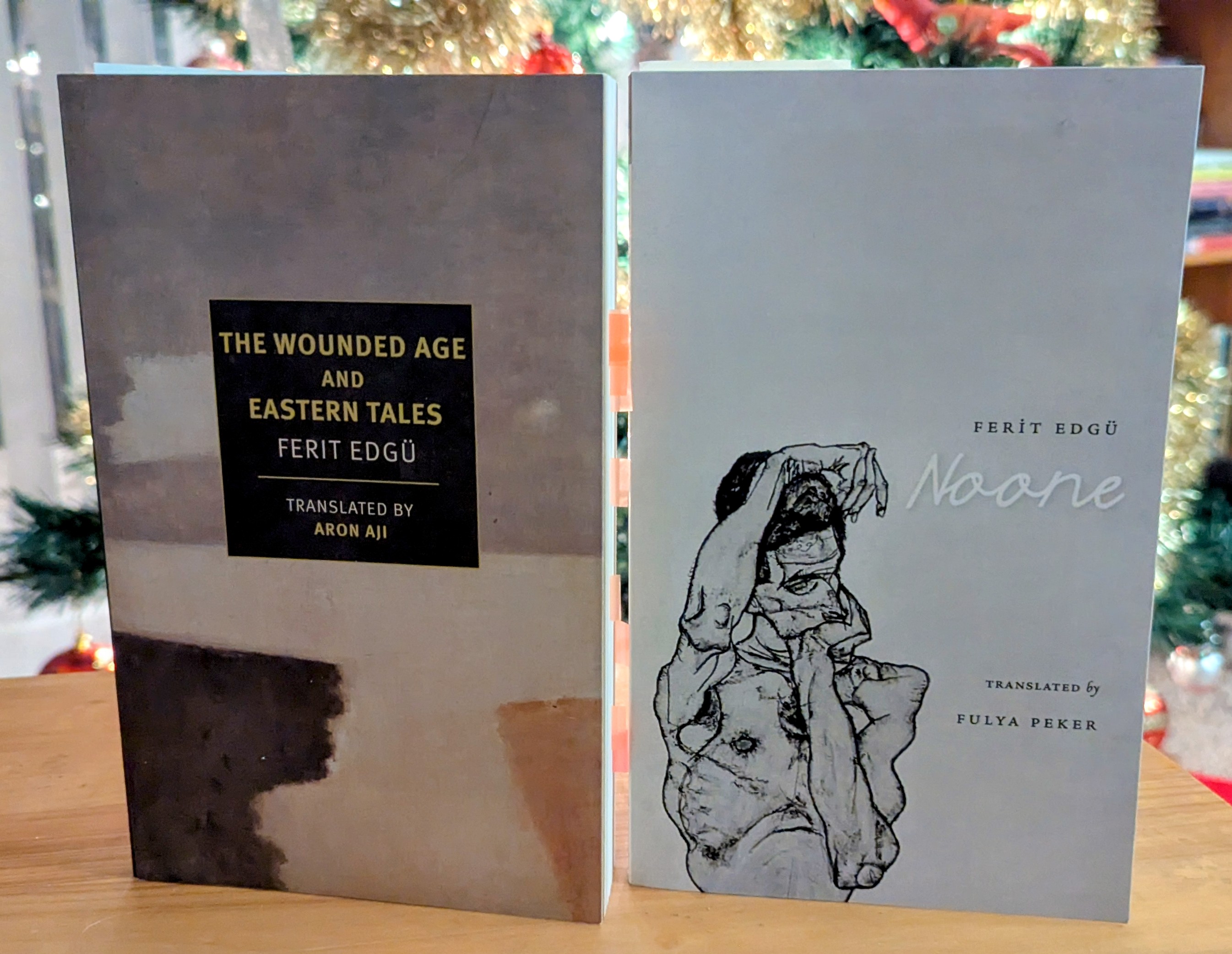
The Wounded Age and Eastern Tales  / Noone by Turkish writer Ferit Edgü—translated by Aron Aji (NYRB Classics) and Fulya Peker Cotra Mundum) respectively—who is sadly one of the writers we lost this year. His work, which draws on the time he spent teaching in the impoverished southeastern region of Turkey in lieu of military service, is filled with great compassion for the people of this troubled area. But his prose is stripped clean, bare, and remarkably powerful.

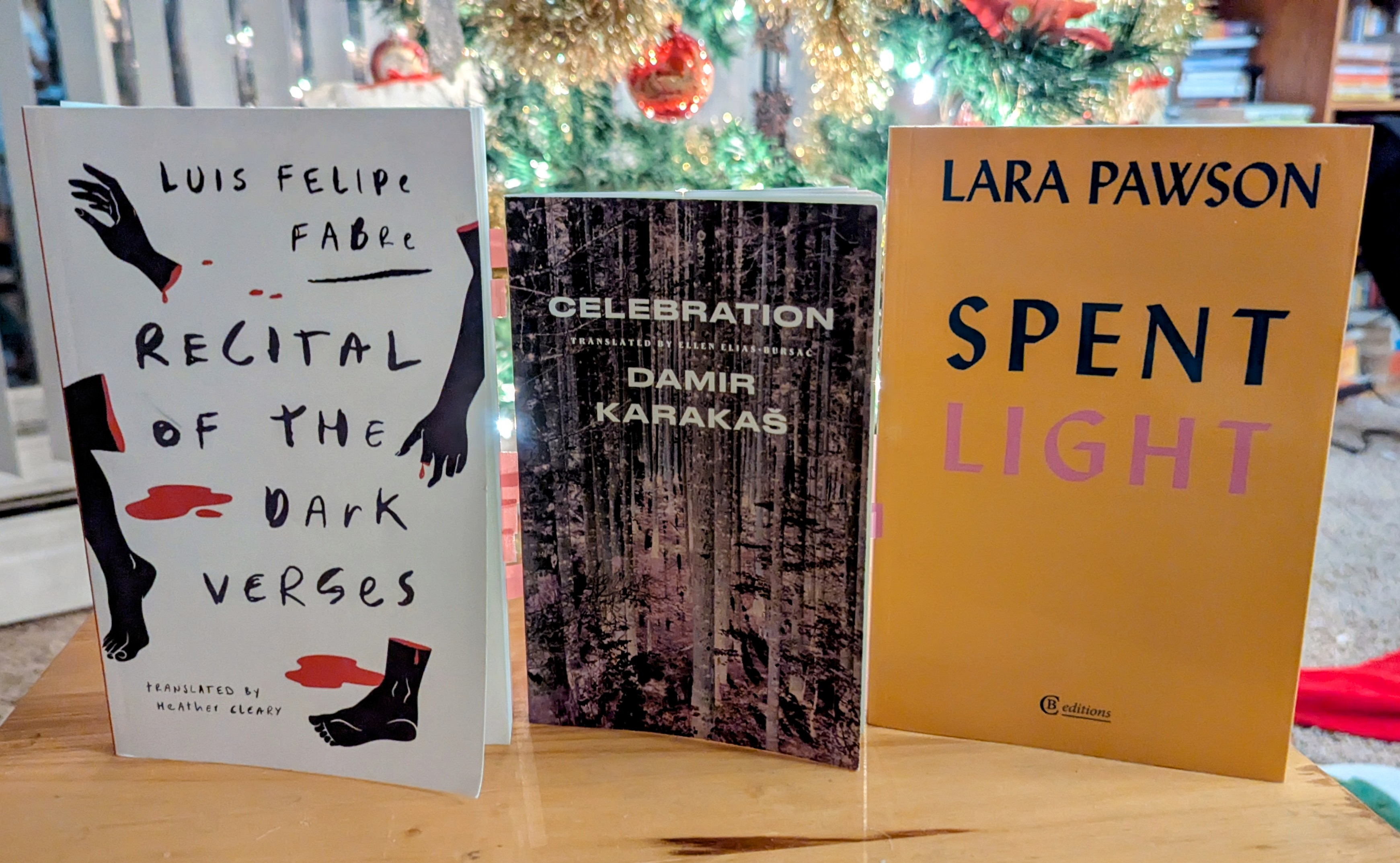
Recital of the Dark Verses by Luis Felipe Fabre (Mexico/Spanish, translated by Heather Cleary/Deep Vellum) is an award wining translation that seems to have garnered less attention than it deserves. This comic Golden Age road trip follows the misadventures of the body of John of the Cross on its clandestine voyage to Seville. Brilliant.

Celebration by Damir Karakaš (Croatian, translated by Ellen Elias-Bursać/ Two Lines Press) is an exceptionally spare, unsentimental novella about the historical forces that pulled the residents of Lika in central Croatia into World War II.

Spent Light by Lara Pawson (CB Editions) is a book I’d been anticipating since reading her This Is the Place to Be. Strange, at times disturbing, often hilarious and always thoughtful, this is one of those books that (thankfully) defies description.

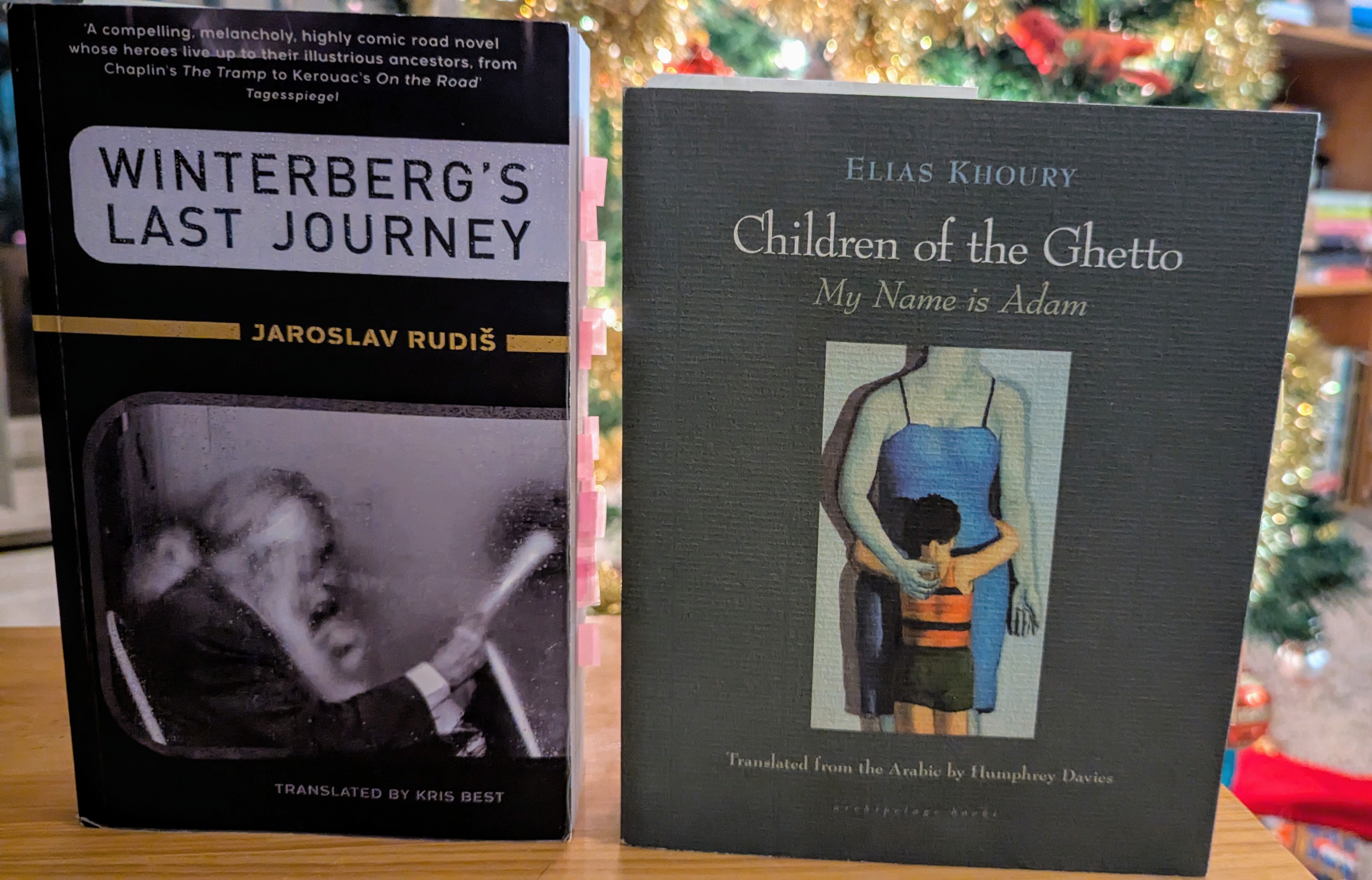
If Celebration is historical fiction at its most spare, Winterberg’s Last Journey by Czech writer Jaroslav Rudiš (German, translated by Kris Best/Jantar Publishing) is the exact opposite. Ambitious, eccentric, and filled with detail, it follows a 99 year-old man and his male nurse as they travel the railways with the aid of 1913 railway guide. What could possibly go wrong?

Children of the Ghetto I: My Name is Adam by Lebanese author Elias Khoury who also died this year (translated by Humphrey Davies/Archipelago Books) is the final Palestinian themed work on my list. This is a challenging and rewarding novel about a man born in the ghetto of Lydda during the Nakba that examines complex questions of identity.

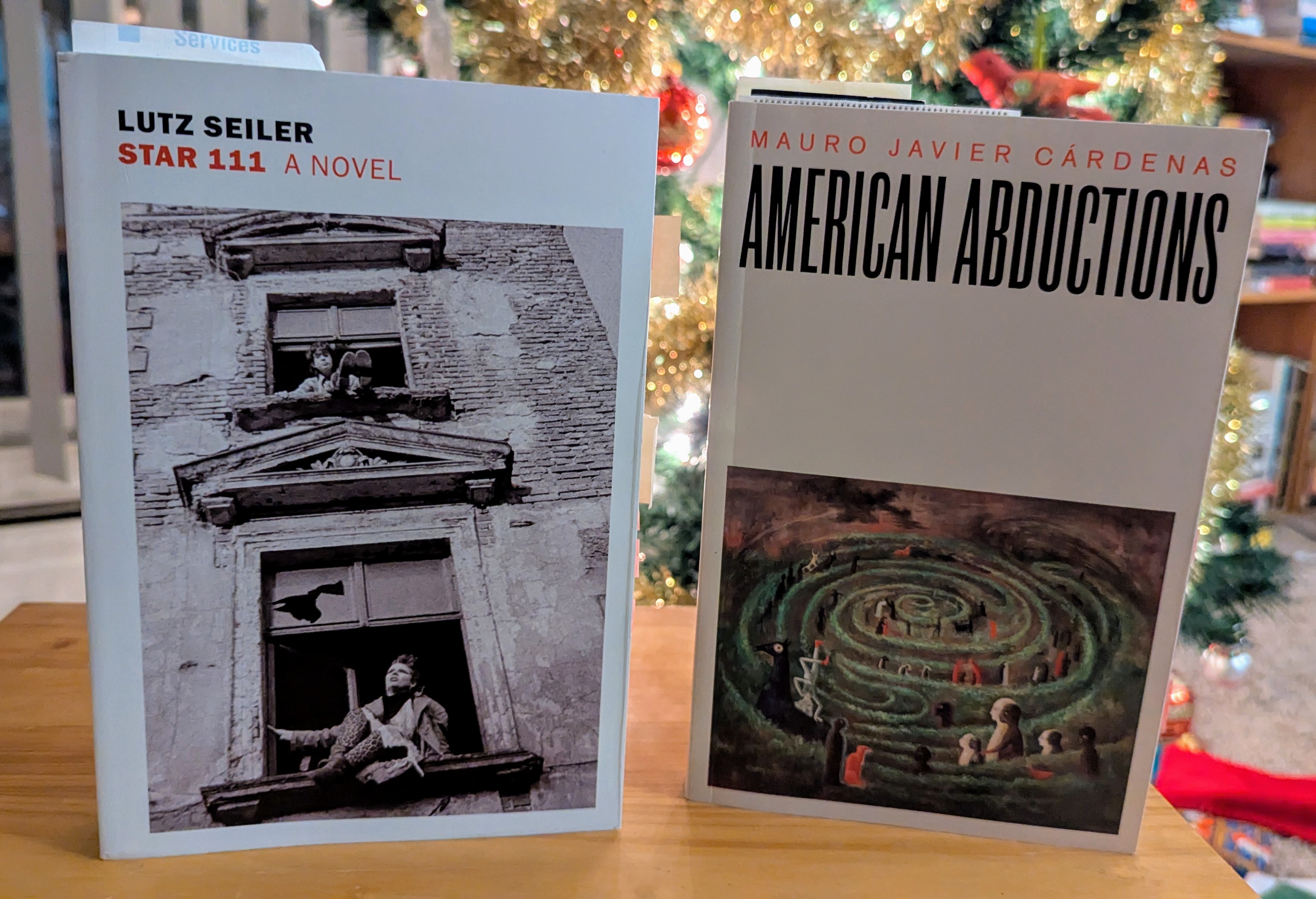
Star 111 by Lutz Seiler (German, translated by Tess Lewis/NYRB Imprints)is the autobiographically inspired story of a young East German would-be poet’s experiences among an eccentric group of idealists in Berlin in the immediate aftermath of the fall of the Wall. I was familiar with Seiler’s poetry before reading this, but I liked this novel so much that it lead me to follow up with his essays and the work of other poets important to him—the best kind of expanding reading experience.

Mauro Javier Cárdenas’ third novel American Abductions (Dalkey Archive) imagines the latest iteration of his hero Antonio in a future in which Latin American migrants are systematically sought out, separated from the children and deported. With a stream of single sentence chapters, he creates a tale that is both fun and uncomfortably too close for comfort. Quite an achievement!

Last but not least, my two favourite books this year are Hungarian:

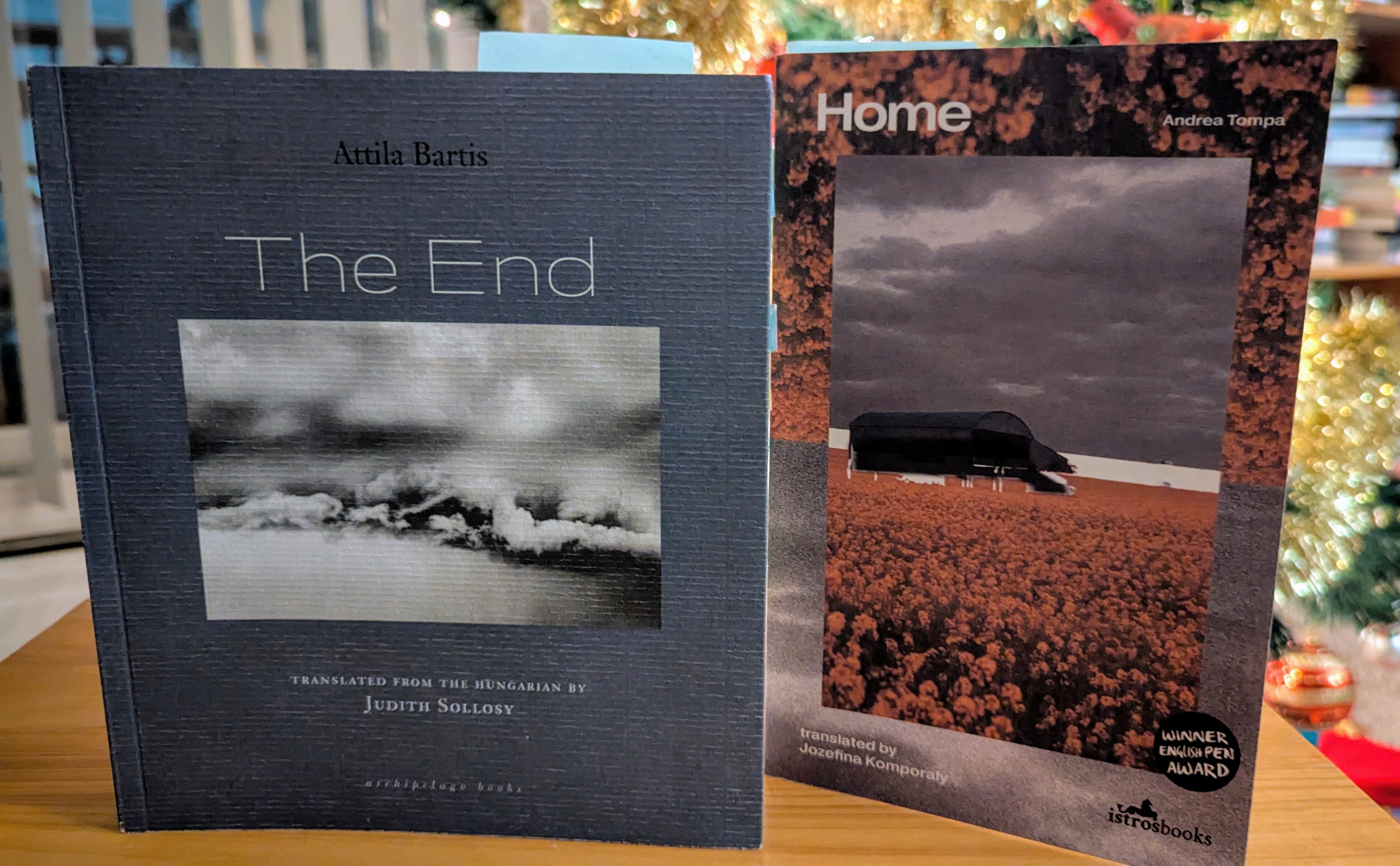
In The End by Attila Bartis (translated by Judith Sollosy/Archipelago Books), a fifty-two year old photographer looks back on his life—his successes and his failures. He reflects on his relationship with his mother, his move to Budapest with his father in the early 1960s following her death, life under Communism and the secrets held by those around him, and the role the camera played in his life. Presented in short chapters, like photographs in prose each with its “punctum,” the 600+ pages of this book just fly by.

Like Attila Bartis, Andrea Tompa also comes from the ethnically Hungarian community of Romania’s Transylvania region and now lives in Budapest. Her novel Home (translated by Jozefina Komporaly/Istros Books) follows a woman travelling to a school reunion, but it is much more. It is a novel about language, about what it means to belong, to have a home and a mother tongue. It’s probably not surprising that my two favourite novels involve protagonists in mid-life, looking at where they are and how they got there. As to why they’re both Hungarian—I suppose I’ll have to read more Hungarian literature in the new year to answer that.
So that is my 2024 wrap up. I’d like to think 2025 will be better than I fear it will, but at least I know there are countless good books to look forward to.

Happy New Year!

Some thoughts about living with mental illness and a few books that, in my experience, address the matter well

May is Mental Health Awareness Month, at least in Canada and the US, and this morning I awoke to find an essay in my inbox titled “The Last Great Stigma” by Pernille Yilmam. This Aeon article addresses the workplace discrimination that workers with mental illness experience  claiming that it “would be unthinkable for other health issues,” and asking if it can change. As the piece demonstrates, this issue is widespread and can take many forms. The author explores ways in which misconceptions and concerns might be addressed. For me it is far too late. Next year I will have been out of the workplace for ten years—more than ten years earlier than I ever anticipated—because even if you are open about your diagnosis, a serious breakdown on the job (no matter if dysfunction at the job itself was a significant factor) is something your career might never recover from.

I’ve been thinking about this a lot lately. And about how mental illness has shaped my life—as someone with bipolar, as the parent of an adult child living with serious anxiety and addiction, and as a former professional in the disability and mental health field. Yet, like so much in my many decades on this planet, I still don’t know how to make sense of it all. When I was first diagnosed back in my thirties I read all kinds of books about my condition (against the advice of the psychiatrist I saw just once after discharge who told me not to read anything or go to any support groups), but after a while I moved beyond books. Life was busy. I had two children and, before long, I was a single parent facing major personal changes. By the time I finally sought out peer support, I attended one group and by the next month I was co-facilitating! I ended up finding most of my real support through volunteering and in my professional positions.

Then it was suddenly over. With no closure. The subsequent years have been marked by great trauma, loss, and unexpected adventures. Also, lots of reading and, here and there, a little writing. But, truth be told, mental illness can be very isolating. It skews one’s ability to gauge social interaction—Did I say too much? Too little? Why am I so nervous?—and often makes it seem easier to avoid meeting up with others or trying to cultivate friendships. Alone is safer. And the longer one’s life becomes, the more entangled the varied threads that make us who we are become, and the more difficult it is to trace back through years and attempt to untie knots that have formed and reconnect fibres that have fallen loose along the way.

My first major episode of mania occurred in my mid-thirties. It was not disconnected from other things happening in my life at the time, so it crept up on me, gradually intensifying existing tensions and distorting my sense of reality. I was, by the time I was admitted to hospital, in full-blown psychosis. Oddly, I sensed that what I was experiencing was psychological in nature, but in true manic-depressive style I figured I could ride it out. And, of course, those around you also sense something is wrong but don’t know what to do. From the inside, your thought processes are so accelerated and obsessive that perspective is lost; it becomes a matter of survival and it can get ugly. When it’s over, some say that a kind of amnesia clears your memory, but that’s not exactly true. You are left with fragments, some very vivid, a great deal of shame, and no way of knowing how others saw you when you were at your very worst.

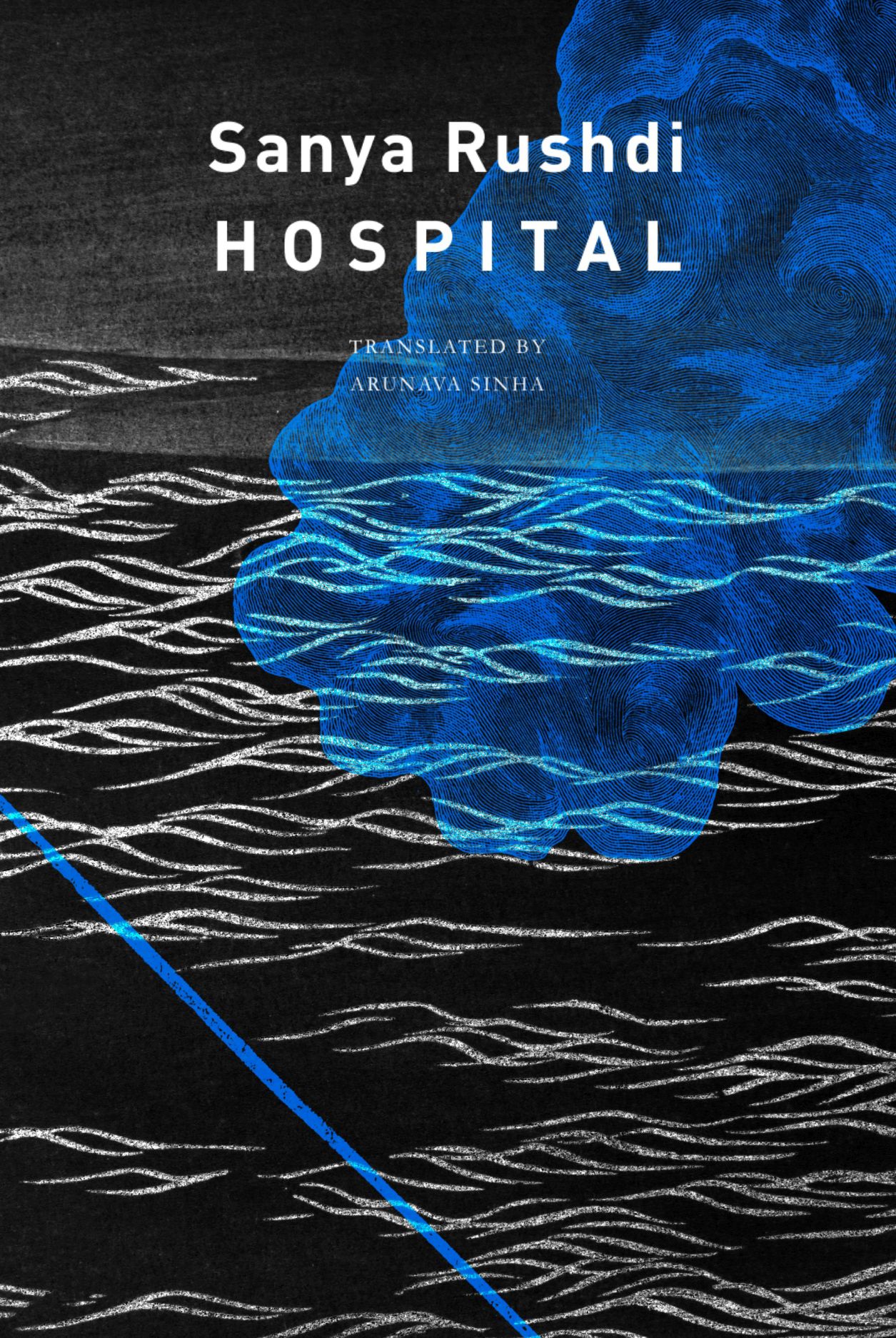
It’s a difficult thing to articulate, but this where we come to books. More than any fictionalized account of madness and psychosis, Hospital by Bengali-Australian writer Sanya Rushdi (translated by Arunava Sinha) manages to recount the experience of psychosis from the inside with a remarkable sense of self-awareness, arising, I can only imagine, from the author’s own multiple experiences with the condition. This critically acclaimed novel captures the strange internal boundaries that the protagonist (also named Sanya) tries to negotiate in a manner that resonated with me. As I noted in my review:

Sanya’s narrative is restrained and oddly lacking in affect, even when she describes her tears and outbursts. She is continually trying to observe herself and logically reason her way through whatever arises. However, her reasoning is often disjointed and confused. She is constantly seeking symbols of significance, spends a lot of time trying to figure out the secrets behind the thoughts and actions of others, questions why certain song lyrics keep coming to mind, and fitfully attempts to draw strength from her faith.

I recognize this well. The thing is, whether one is manic or depressed, psychotic or not, the tendency is to assume that whatever is happening to you is you, not a physical illness that is directly affecting your mood and your perceptions of the world.

When it comes to poetry, it is well-known that many famous poets have, over the years, struggled with mental illness, often writing from within the depths of madness and, sadly, frequently ending their own lives. I am drawn to such poetry but admit to finding much of it painfully difficult to read. Too close, too unfiltered at times, it must be read slowly. And then there is the genius of madness question that comforts some of us and angers others, but in the interest of understanding mental illness I wanted to call attention to a poetry collection I read several years ago that I think of often.

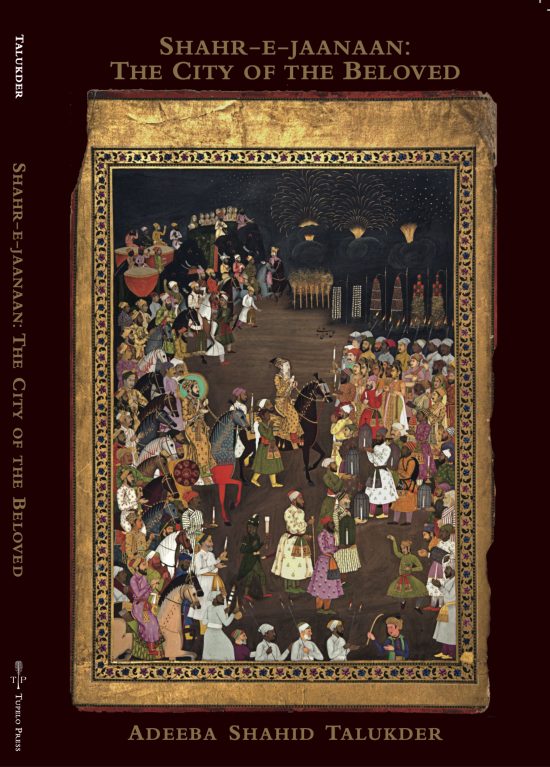
Shahr-E-Jaanaan: The City of the Beloved by Pakistani-American poet, translator and ghazal singer Adeeba Shahid Talukder was a book that came to my attention in the early months of the pandemic, a background that coloured my reading. I was intrigued by this young woman who draws inspiration from the greats of Persian and Urdu poetry and the late Kashmiri-American poet Agha Shahid Ali to explore traditional and contemporary themes alike, from the conflicts between an American raised daughter and her immigrant family to the poignant drama of Laila and Manjoon. Yet, in spite of a clear reference to a hospital in an earlier poem, it was not until I hit the title sequence, that I began to sense something more might be at play. In my review I report that the sequence begins:

At December’s end Benazir died
in a suicide attack.

.                              Men burned

tires, cars, banks,
petrol pumps and factories

Perhaps in grief.

The nights in New York
were clear, cold

and I read Faiz
in a way I never would

again. In Washington Square,
the benches were empty.

What follows is a harrowing account of the speaker’s descent into madness, accompanied in her mania, by God and her poetic saints, culminating eventually in hospitalization and echoing back to the poem I quoted above. It’s devastating, horrifying and strangely familiar, but on my first encounter I did not recognize it for what it really is.

Although I was unaware of Talukder’s own bipolar history when I first read her collection, I did have the feeling that she knew an experience I had also had. An interview with the poet confirmed it, along with her desire to address some of the misunderstanding and stigma she has faced. My response to learning this and a link to said interview can be found in my review of this excellent collection.

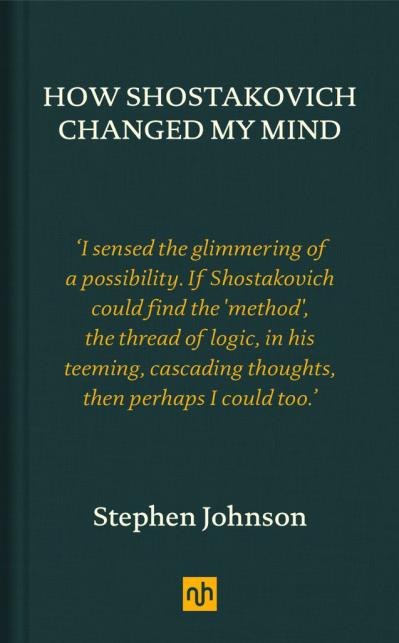
Finally, when it comes to mental health memoirs I am perhaps even more cautious than I am about fictional or poetic works. However, within Stephen Johnson’s How Shostakovich Changed My Mind, I found moments that spoke to me so clearly in relation to my own experience of mental illness before and in the long years following diagnosis. That is possibly because it is not your standard mental illness memoir. A blend of musical biography, memoir, psychology and philosophy, this fascinating book-length essay draws its greatest strength from the author’s passionate affection for and deep connection to the music of Dimitri Shostakovich. As I note in my review:

As one might imagine, given the unusual title, How Shostakovich Changed My Mind is an intimate account of the intersection of music with the personal drama, and trauma, of life lived. Johnson draws on literary, philosophical, neurological and psychological resources as he explores the connection between music and the brain, an area of growing interest and investigation, but he anchors his inquiry in the story of Shostakovich’s life and work during some of the most tumultuous events of the twentieth century—a thoroughly fascinating account in its own right—while tracing out his own particular relationship to this music and the role it played, not only in adolescence, but in his own adult challenges with bipolar disorder.

As such, Johnson’s work is not only a powerful exploration of the ability of music to provide expression and meaning in times of joy and sorrow, but a moving personal memoir of how music can serve as a means to navigate madness, especially in those times when, from inside, all one knows is that something is not right, even if one does not know why.

So, three books for Mental Health Awareness Month, or any time, because it is important to continue to work towards increasing understanding and reducing stigma around mental illness year round—and around the world.

Hospital by Sanya Rushdi is translated from the Bengali by Arunava Sinha and published by Giramondo in Australia and Seagull Books everywhere else.

Shahr-E-Jaanaan: The City of the Beloved by Adeeba Shahid Talukder is published by Tupelo Press.

How Shostakovich Changed My Mind by Stephen Johnson is published by Nottinghill Editions in the UK and distributed by NYRB in North America.

A reflection for Winter Solstice 2023

As soon as we pass the longest night of the year, there is a noticeable change in the quality of light. The afternoons immediately seem brighter as the days begin to lengthen, minute by minute, week by week. I can remember more than a few winter solstices that found me mired in a darkness that was soul-black and heavy. But this year, as the world, at home and afar, is facing so many serious threats, it feels essential to remain focused on what needs to be addressed—war, climate change, increasing polarization, a pandemic that is still causing illness and disability, and so much more. Heaven knows there is much to worry about, many reasons to be angry, ample cause for despair, but, at the moment, as someone who has known deep depression borne of chemistry rather than circumstance, what I tend to feel is a positive anger, that is, an emotion that fuels a desire to be more active in my speech and action as the new solar season dawns. There is an opening up to the other that, after years of relative isolation, has been reignited in me in recent months and I hope I can keep that energy in motion.

This past year was one of connection and reconnection. In mid-September I returned to India for the first time in four years—my first trip anywhere since 2019. As I made my way from Bangalore to Calcutta, Delhi, Pune, Mumbai, Jaipur and back to Bangalore, I enjoyed so many long and meaningful conversations over coffee and meals, and in cars, autos and trains, with friends old and new. I was looking for the inspiration and confidence to write again after a prolonged period of silence, and by the time I was getting ready to fly home I was beginning to feel a renewed creative drive. And then, the outbreak of conflict in the Middle East diverted my attention, shifted my reading, left me distressed and found me treading words with caution, shocked by the ability of apparently reasonable people to rationalize the massive destruction of infrastructure and indiscriminate killing of innocent children, women and men that we have witnessed these past two and a half months. Even now I know that whatever I say or don’t say, someone will take offense. This is the deeply fractured world we now inhabit.

Here in the northern hemisphere, the days grow longer as a new calendar year approaches; in the south, summer solstice marks the longest day of the year. What will we do with this light, that we either presently have or are eagerly anticipating? There is no condition—conflict, climate or clinical—that we cannot resolve, but, as human beings, we have to be able to do the one thing that seems to drive us apart over and over again: we have to recognize that every person is of equal value and deserving of dignity and life and commit to working together toward that end.

I will let you decide for yourself if that is a dream worth holding on to or justification for accepting that our problems are impossible to solve.

Photo by Joseph Schreiber

India update: Catching up with old friends, finally meeting others

Four years is a long time. Much has happened since I last visited this country. Since I last travelled anywhere as fate and pandemic would have it. Two-thirds into my stay and it feels like it has been a hectic time—not that I haven’t had free time, but I seem to find it hard to stay put on an empty day when a busy vibrant world awaits outside the door. And one doesn’t want to miss the chance to catch up with friends who are normally but a virtual prescience in one’s life. So, less reading and writing has been accomplished than I had anticipated to date.

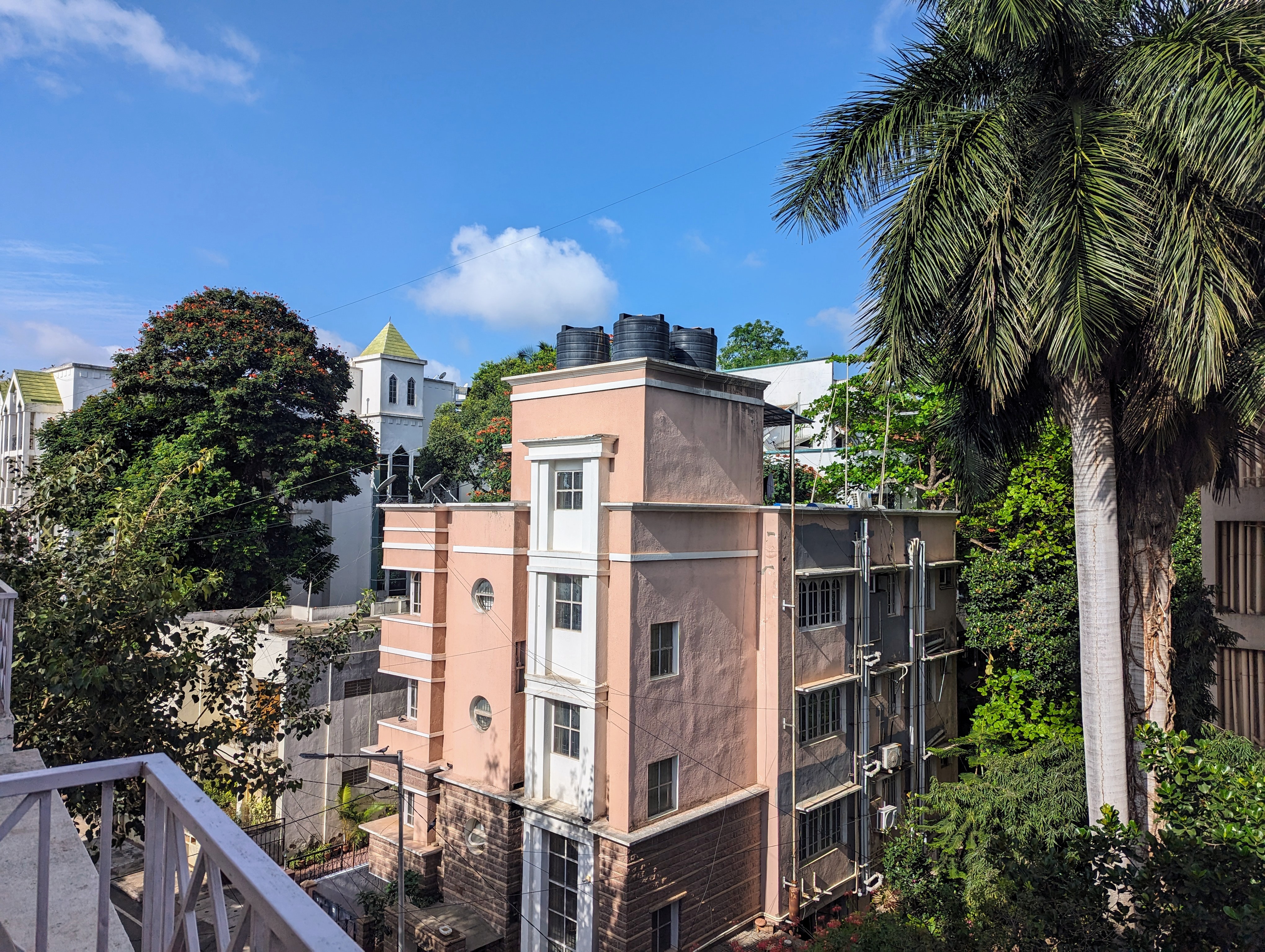
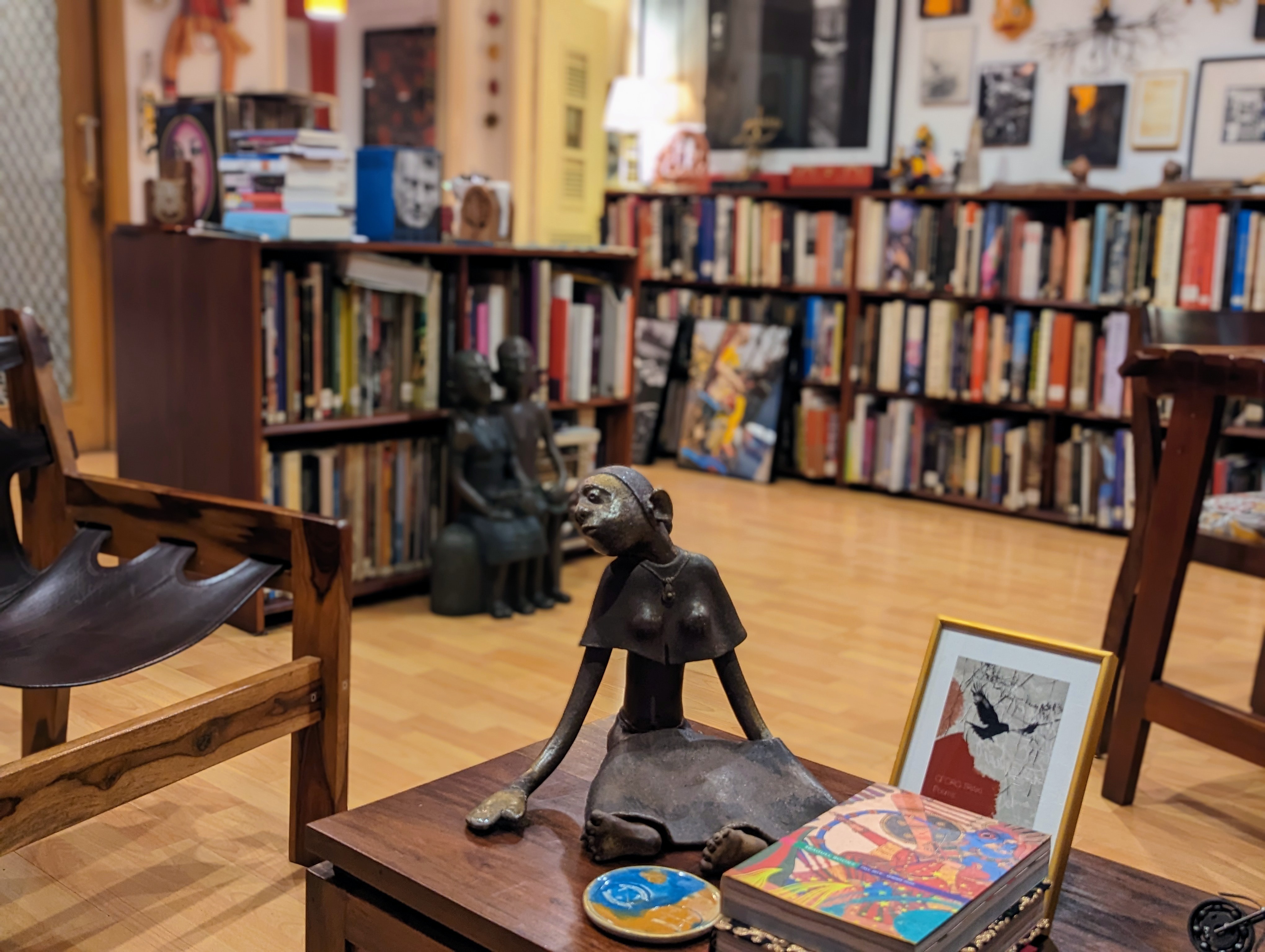
I started my trip in Bangalore, a city I will return to before flying home to stock up on books. Weight restrictions on internal flights have meant that if I buy books, I risk not being able to get to my next destination. It surprises me how just a few slim volumes will tip the scales! And it’s always a pleasure to spend time with my very dear friends here at either end of my India sojourn.

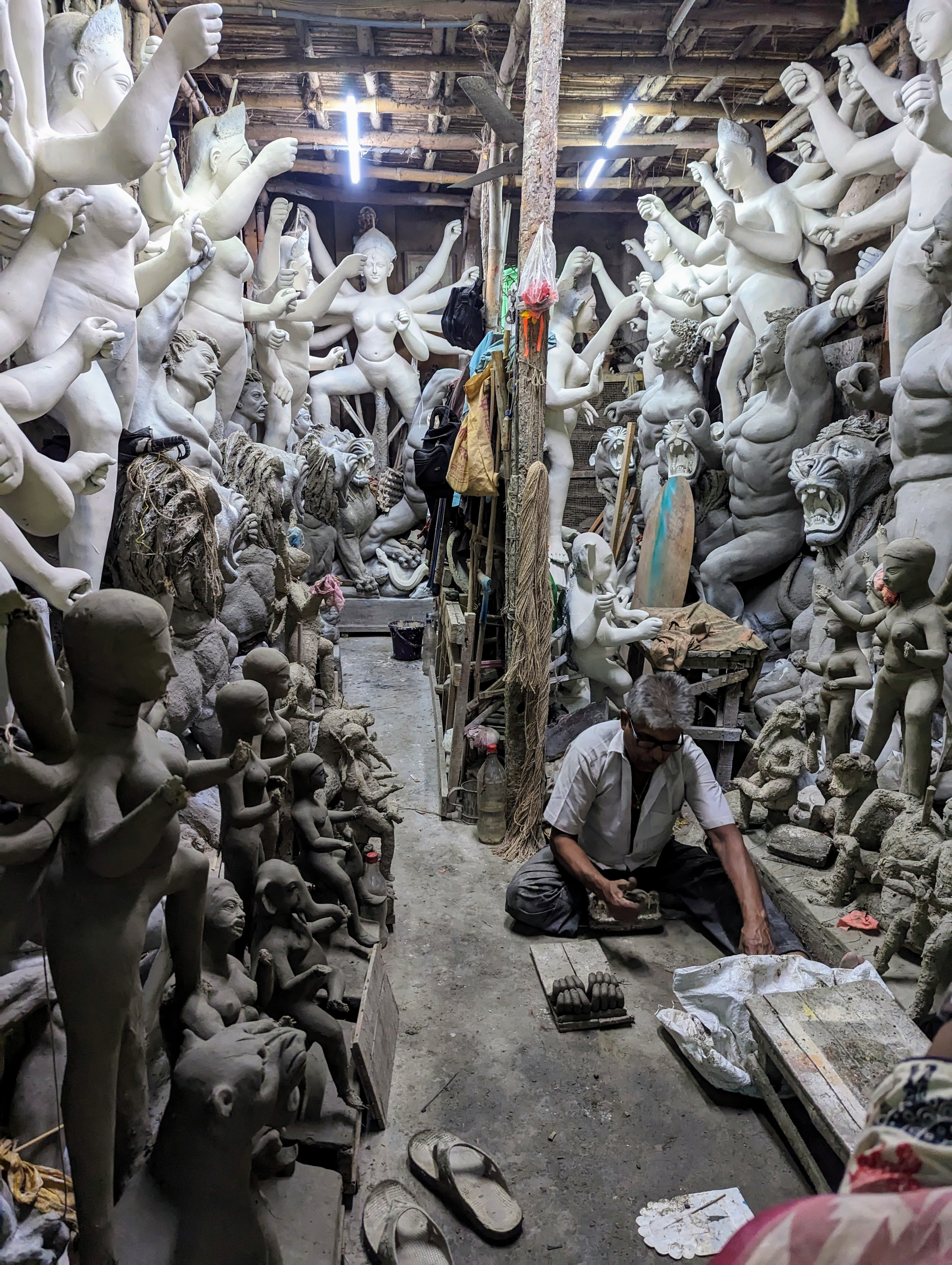
From Bangalore, I was off to the City of Joy, Calcutta or Kolkata, to the place (and the publisher) that first drew me to the subcontinent. Wet and humid beyond measure, it was my first visit outside the drier winter/spring months. But it was wonderful to see my dear friends at Seagull Books where I was able to play a small role in the creation of what will be another spectacular catalogue—this one tackling a vital theme for the times. I also had coffee with the couple who were my first tour guides in the city, this time meeting up with them in an area further south than I had been to date. I also made a pilgrimage to Kumartuli, the potters’ colony where craftsmen are busy making idols for the upcoming Durga Puja, Kolkata’s most important festival.

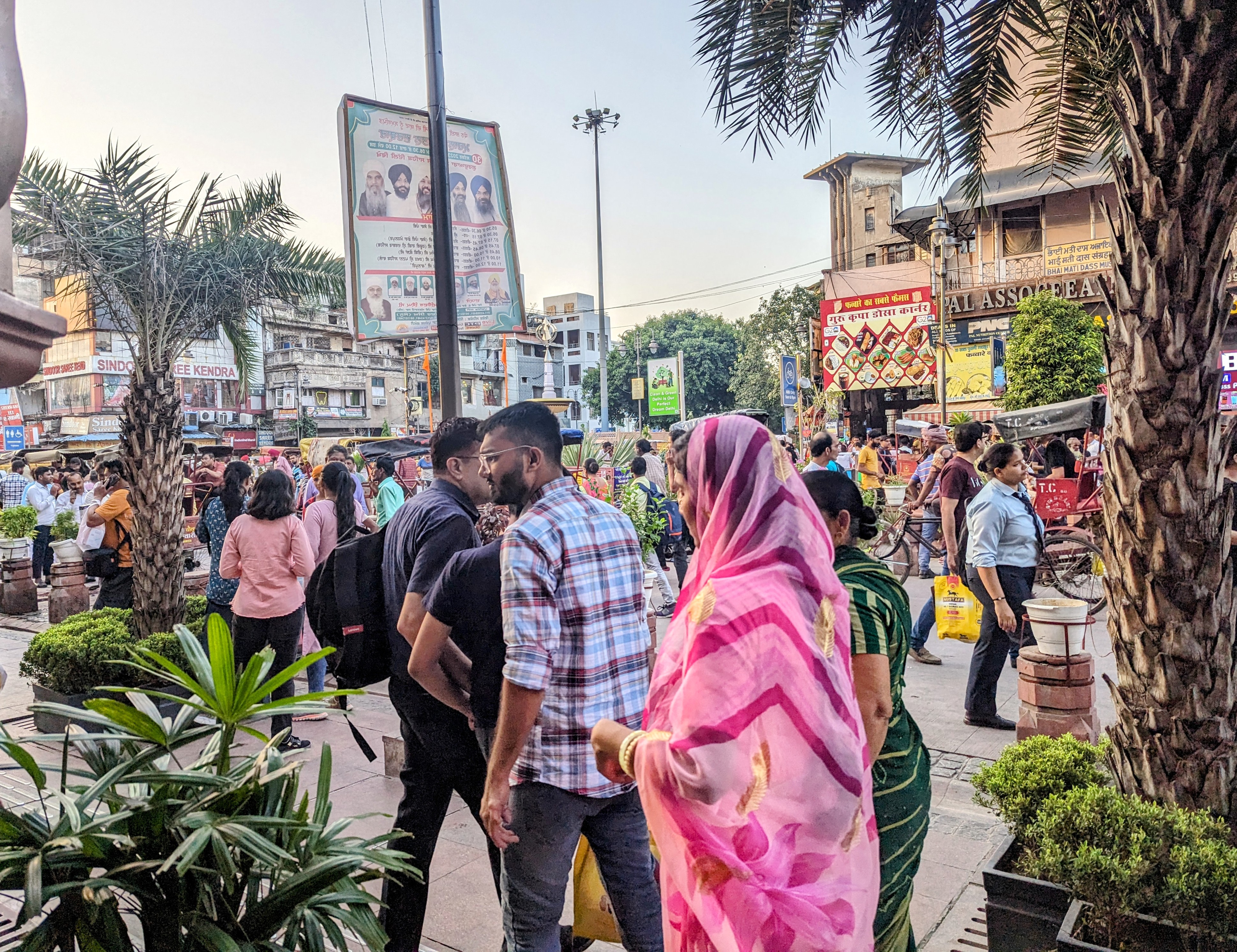
The next stop was Delhi, a short stay, but my first in the nation’s capital. I was met at the airport by a friend which was fortuitous because it proved difficult to get a cab willing to go into the congested area where I was staying. Subsequent forays in and out were facilitated by the Metro. On my first day in the city, the same friend escorted me to the university where he teaches and I gave a talk about writing book reviews. It was a very rewarding experience. The second day another friend took me into central Delhi where we had lunch, walked around, visited temples and enjoyed a most awesome lassi!

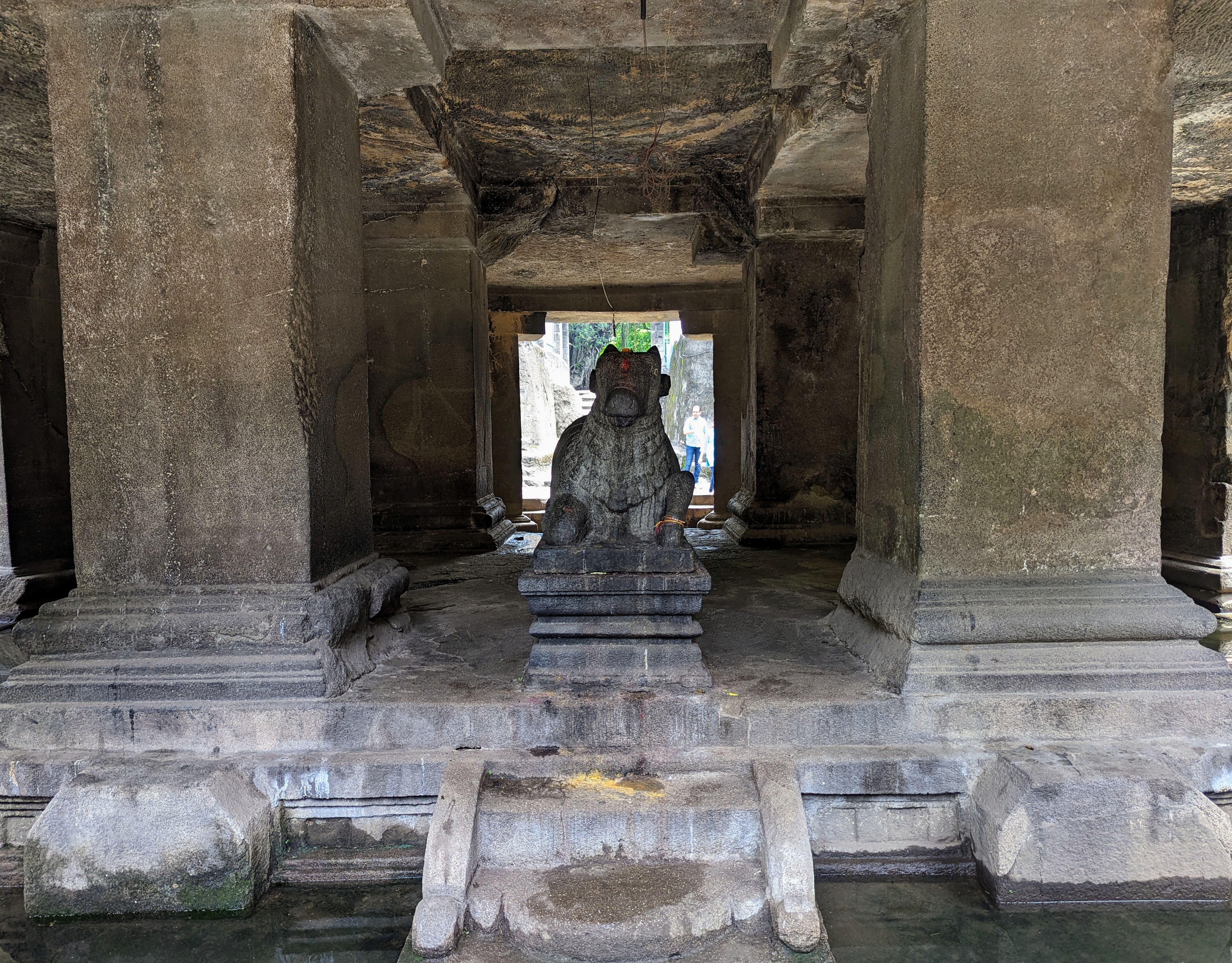
Then on to Pune, where I’m writing this on the final hour of my birthday. Here I caught up with dear literary friends and had a chance to finally meet someone whose friendship has offered solace during these long years of pandemic isolation. I also walked down to see the Pataleshwar Caves, the site of an eighth century Hindu temple carved out of the rock—a sanctuary within a busy city.

Tomorrow I fly to Mumbai for a brief stay then on to Jaipur where I hope to dry out a little after all the humidity of this extended wet season before returning to Bangalore. Whew!

It is good to be back in this hectic, vibrant country, even if I have arrived at a time of some diplomatic discord between my own country and India. I have never felt anything but welcome here.

Roughghosts is nine years old today

It seems I skipped the annual anniversary post last year, but since I’m not writing the review I should be working on, I thought I’d stop and acknowledge this small achievement and thank everyone who has stopped by this literary space since I first recklessly launched it while I was unknowingly spiraling into a manic crisis that would ultimately end my career back in 2014. If nothing else, it has provided me a place to talk about books and writing, and make the acquaintance of many wonderful readers, writers, translators and publishers around the world. Roughghosts would be nothing without the company of others who also cherish literature.

In its early days, my blog was filled with much of my frustration about chronic mental illness and the stigma that has never been overcome. The subject still arises here on occasion but many of angriest posts have been made private. I try to stick to books, sometimes the subject of writing, and only when I am really down, do I open up a little more. (Of course, those are the posts that tend to get the strongest immediate response—always supportive—but I try not to complain about the world too often.)

The past year has been pretty smooth, if quiet. I have stayed close to home, tracing the same beloved trails and trying, with some difficulty, to regain the level of fitness I had prior to breaking my leg last year. I am, I suppose, at the age when it takes longer to get back to where I used to be. The weather—prolonged cold through the winter and unexpected heat early in May—has been one factor, but a new respect for caution has slowed me down a little. I rarely go out without my trekking poles and (wisely) take fewer risks than I once did. I’m also looking forward to travelling for the first time since 2019, hoping to return to India in September.

As I look back over the last twelve months, I’m pleased with the number and quality of the reviews I’ve published. I’m a slow reader and a slow writer and, aside from a post like this, I rarely ever compose online—every piece is typically written over several days on a Word document and uploaded to WordPress. For now this is still a satisfying activity for me; I have yet to feel a strong desire to pitch essays or reviews for publication elsewhere. To be honest, I do like being able to track the amount of attention my reviews get, at publication and over time. It’s a window into the varying interest certain books generate. And because this is my blog, I am not tied to reading only new releases. That is, I believe, the true beauty of the book blog, or when I’m being fancy, “literary site.” Over the past year, for example, my most popular post—over 4500 views since last September—is a review of Mahsweta Devi’s classic Mother of 1084. I can only assume it has been on the school curriculum in India (and wonder how many suspiciously similar reports teachers have received).

I have no special objectives for the next year of roughghosts. I read and write about books for myself first and foremost—that is, as an exercise in both reading and writing—and I am ever grateful for everyone who has stopped by (even those who, judging by their bizarre search terms, must have been sorely disappointed by what they found). Here’s to another year of great books and excellent company!

Reading highlights of 2022: A baker’s dozen and then some…

It seems to me that last year I resisted the annual “best of” round-up right through December and then opened the new year with a post about some of my favourite reads of 2021 anyhow. This year I will give in, look back at some of my favourite reading experiences out of a year in which I had a wealth to choose from and aim to get some kind of list posted before friends start hanging up their 2023 calendars around the globe. In a year with war, floods, famine, storms and still no end in sight to Covid infections, books seemed more important than ever, as a respite, a record and a reminder that we, as human beings, have been here before and must learn from the past to face the increasing challenges of the future.

As ever, it is difficult to narrow down twelve months of reading to a few favourites. One’s choices are always personal and subjective, and many excellent books invariably get left out. This year especially—2022 was a productive and satisfying year for me as a reader and as a blogger. Not much for other writing, I’m afraid, but that’s okay.

This year I’m taking a thematic approach to my wrap-up, so here we go.

The most entertaining reading experiences I had this year:

Tomas Espedal’s The Year (translated from the Norwegian by James Anderson) was one of the first books I read in 2022. A novel in verse, it is wise, funny and, nearing the end, surprisingly tense as Espedal’s potentially auto-fictional protagonist careens toward what could be a very reckless act.

International Booker Prize-winning Tomb of Sand  by Geetanjali Shree (translated from the Hindi by Daisy Rockwell) looks like a weighty tome, but blessed with humour, magic and drama—plus a healthy amount of white space—it flies by. An absolute delight and worthy award winner!

Postcard from London, a collection of short stories by Hungarian writer Iván Mándy (translated by John Batki) was a complete surprise for me. In what turned out to be a year in which I read a number of terrific collections of short fiction, I was a little uncertain about this large hardcover volume some 330 pages long, but by the end of the first page I was hooked by the author’s distinct narrative voice and I would have happily read many more pages.

The most absorbing book I read this year (and its companions):

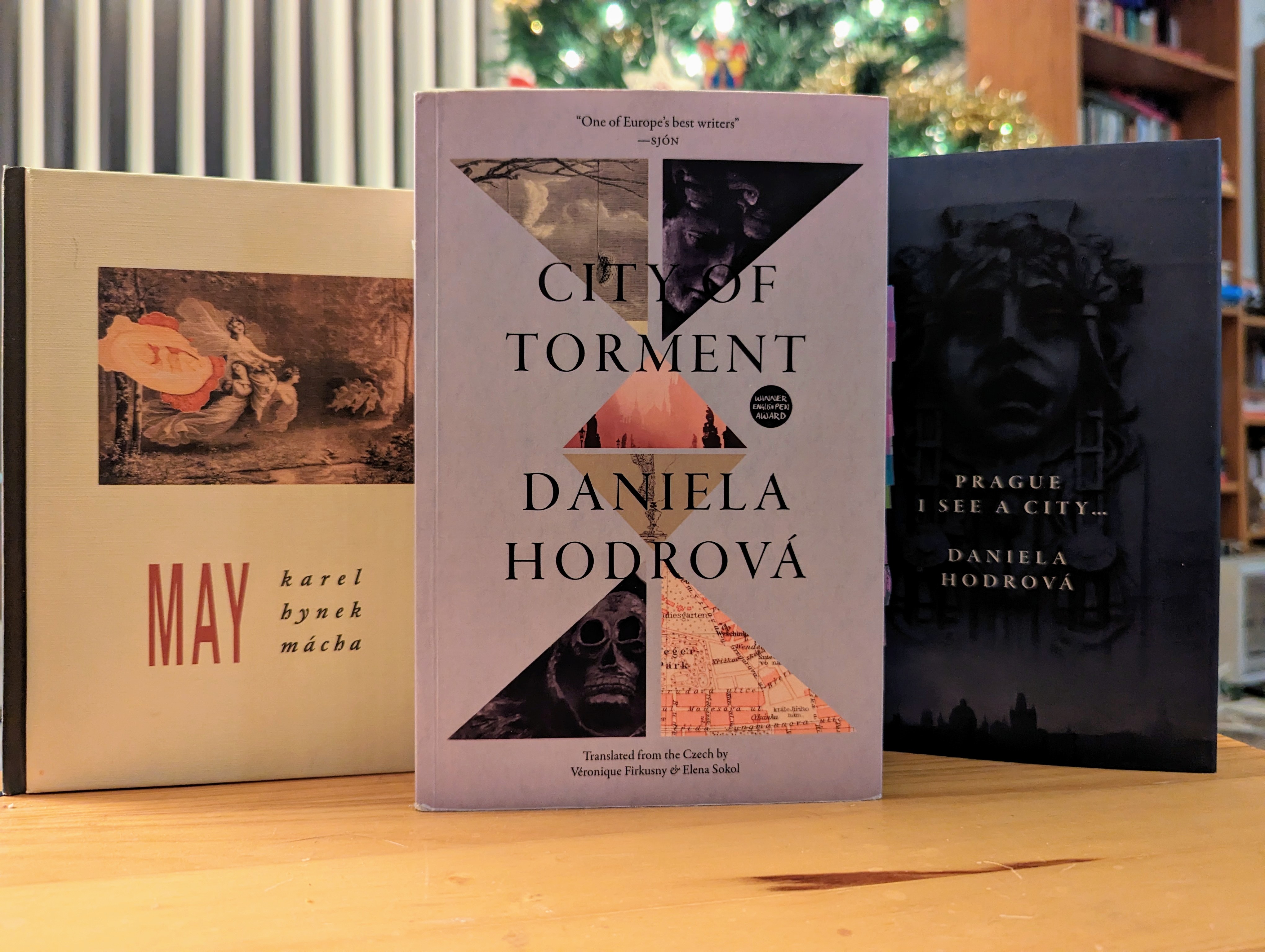
City of Torment – Daniela Hodrová’s monumental trilogy (translated from the Czech by Elena Sokol and others) is a complex, multi-faceted, experimental work that explores a Prague formed and deformed by literary, historical and political forces, haunted by ghosts and the author’s own personal past. After finishing the book, I sensed that I was missing much of the foundational structure—not that it effects the reading in itself—but I wanted to understand more. I read Hodrová’s own companion piece, Prague, I See a City… (translated by David Short) and more recently Karel Hanek Mácha’s epic poem May (translated by Marcela Malek Sulak), but I would love to have access to more of the related literary material, much of which is not yet available in English. I suspect that City of Torment is a text that will keep fueling my own reading for some time.

This year’s poetic treasures:

This is the most challenging category to narrow down. I read many wonderful collections, each so different, but three are particularly special.

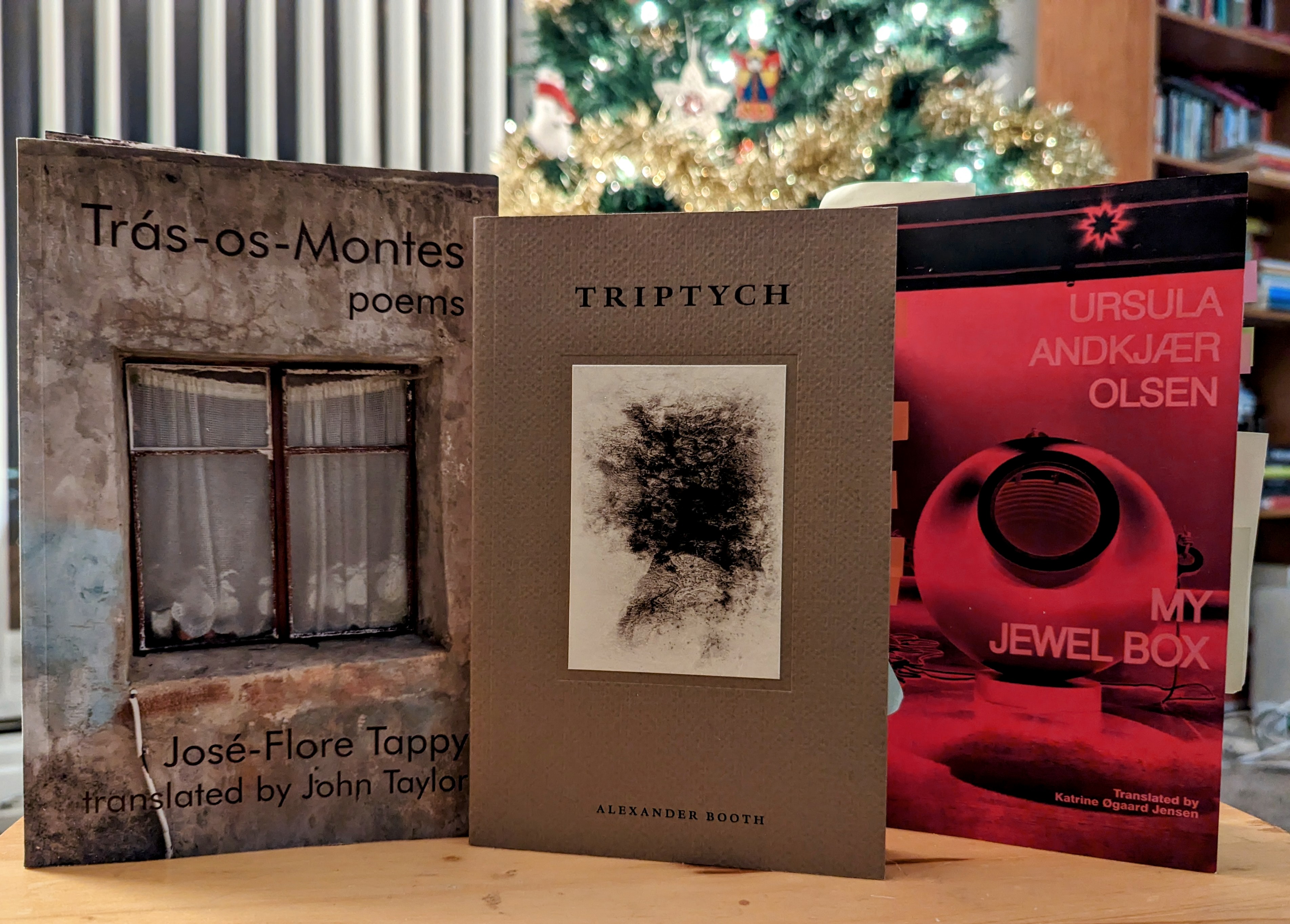
Translator John Taylor has introduced me to a number of excellent poets over the years and in 2022, it was his translation of French-language Swiss poet José-Flore Tappy’s Trás-os-Montes. I read this gorgeous book in August and it is still on my bedside table. It’s not likely to leave that space for a long time yet, and that’s all I need to say.  

I first came to know of Alexander Booth as a translator (and read a number of his translations this year) but his collection, Triptych, stands out not only for the delicate beauty of his poetry, but for the care and attention he put into this self-published volume. A joy to look at, to hold and to read.

Finally, My Jewel Box by Danish poet Ursual Andkjær Olsen is the conclusion of an organically evolving trilogy that began with one of my all-time favourite poetry books, Third-Millennium Heart. Not only is this a powerful work on its own, but I had the great pleasure to speak over Zoom with Olsen and her translator, Katrine Øgaard Jensen, for Brazos Bookstore in May. The perfect way to celebrate a reading experience that has meant so much to me.

Books that defied my expectations this year:

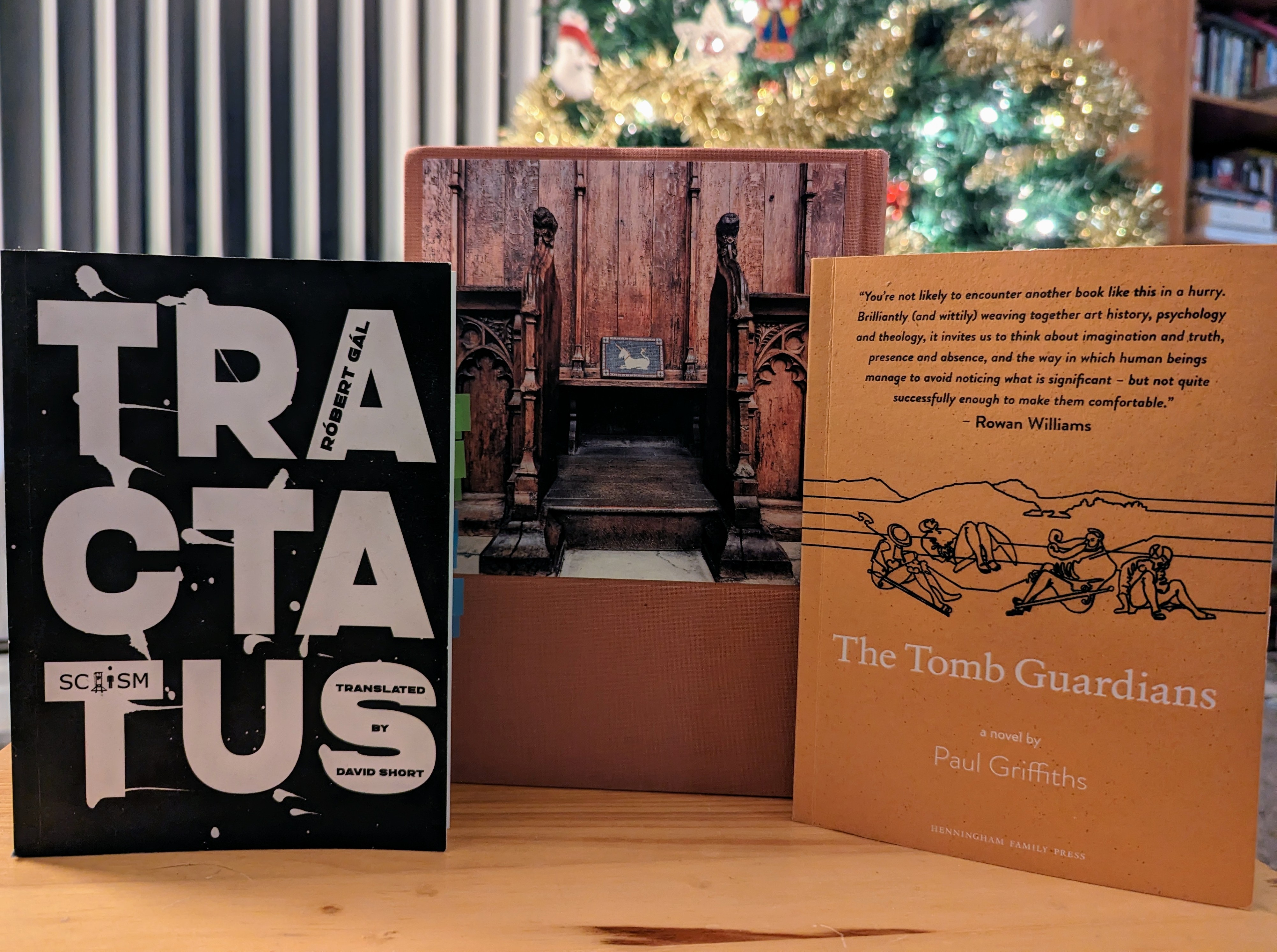
Prague-based writer Róbert Gál has produced books of philosophy, experimental fiction and aphorisms—each one taking a fresh and fluid approach to the realm of ideas and experience. His latest, Tractatus (translated from the Slovak by David Short) takes its inspiration from Wittgenstein’s famous tract to explore a series of epistemological and existential questions in a manner that is engaging, entertaining and provocative.

A Certain Logic of Expectations (you see the back cover here) by Mexican photographer and writer Arturo Soto is a look at the Oxford (yes, that Oxford) that exists a world apart from the grounds of the hallowed educational institution. Soto’s outsider’s perspective and appreciation of the ordinary offers a sharp contrast to the famed structures one associates with the city (and where he was a student himself) and what one typically expects from a photobook.

The third unexpected treat this year was The Tomb Guardians by Paul Griffiths. This short novel about the soldiers sent to guard the tomb where Jesus was buried is an inventive work that explores questions of faith, religion, and art history. Truly one of those boundary-defying works to use a term that seems to get used a little too often these days.

The best books I read in 2022:

Again, an entirely personal assessment.

I loved Esther Kinsky’s River, but Grove (translated from the German by Caroline Schmidt), confirmed for me that she is capable of doing something that other writers whose work skirts the territory occupied by memoir and autofiction rarely achieve, and that is to write from the depth of personal experience while maintaining a degree of opaqueness, if that’s the right word. One is not inundated with detail about the life or relationships of her narrators. Rather, she zeros in on select moments and memories, allowing landscape to carry the larger themes she is exploring. So inspiring to the writer in me.

Monsters Like Us, the debut novel by Ulrike Almut Sandig (translated from the German by Karen Leeder) deals with an extraordinarily difficult topic—childhood sexual abuse. It does not shy away from the very real damage inflicted by predatory family members, nor does it offer a magical happy ending, but it does hint at the possibility of rising above a traumatic past. As in her poetry where Sandig often draws on the darkness of traditional European fairy tales, she infuses this novel with elements and characters that embody the innocence, evil and heroic qualities of folktales within an entirely and vividly contemporary story. So much to think about here.

Hanne Ørstavik’s The Pastor (translated from the Norwegian by Martin Aitken) was my introduction to the work of a Norwegian writer I had a lot about over the years. This slow, melancholy novel set in the far north regions of Norway, beyond the Arctic Circle in the dead of winter, was a perfect fit for me as a reader, in style and subject matter. The story of a female pastor who takes a position in a remote village following a personal loss that she does not fully understand, explores emotional, historical and spiritual questions through a character who is literally stumbling in the dark.

So, what might lie ahead? This past year I embarked on two self-directed reading projects—one to focus on Norwegian literature for two months, the other to read and write about twenty Seagull Books to honour their fortieth anniversary. I found this very rewarding experience. Both projects were flexible enough to allow me freedom, varietyand plenthy of room for off-theme reading, but in each case I encountered authors and read books I might not have prioritized otherwise. For 2023 I would like to turn my attention to another publisher I really admire whose books are steadily piling up in my TBR stack—Archipelago. As with Seagull, they publish a wide range of translated and international literature that meshes well with my own tastes and interests. I don’t have a specific goal in mind, but already have a growing list of Archipelago titles I’d like to read. Other personal projects—public or private—may arise, perhaps more focused toward the personal writing I always promise to get back to, but time will tell. If the last few years have taught us anything, it’s that it’s a long uncertain road from January 1st to December 31st and it’s best not to try to outguess what the road might hold. Hope for the best and prepare for the worst once more.

Best wishes for the New Year and thank you for reading!

Changes: Ever in search of balance – A reflection

I don’t know when I ceased to exist, or how I fell off the face of the earth. 

I wrote this line in my journal on July 15 of this year. I’d been plagued by a persistent emotional heaviness for months, but over the summer that weight seemed to intensify. I began to look to the future with anxiety, to wonder how to find the will to keep existing. I had not written a single creative piece in the better part of the year. I struggled to read. I had given up editing because the necessary focus was gone. The only thing I could manage consistently was to put on my shoes, head out the door, and walk and run.

I have not missed a day.

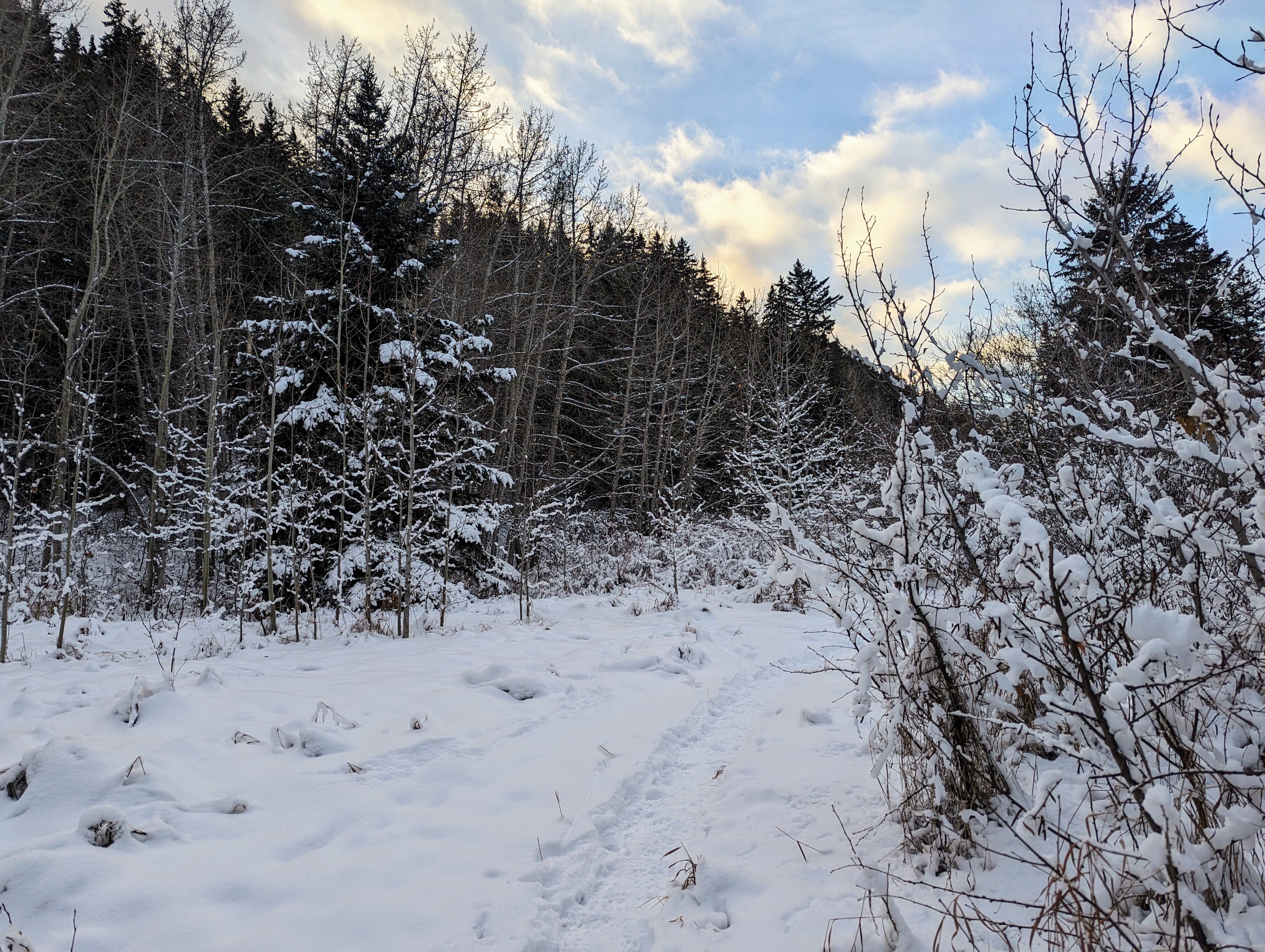
Calgary, Alberta: Bow River Pathway

Of course, these days everything  is tinted by the pandemic. Normal is a nebulous concept. Where I live, our fourth wave is rising fast, we are once again leading the country in all metrics except vaccinations. Hospitals are beyond capacity and those who work the frontlines are exhausted and demoralized. All for lack of political will. The situation fuels stress, anger and concern. But I’m not alone in my reaction—in fact to feel less would be worrying.

My own condition has held firm no matter.

Calgary, Alberta: Bow River Pathway

A few weeks ago I made two decisions. One after extensive consideration, the other under relentless pressure. First I decided to go back onto the medication I went off a year ago last July following a diagnosis with bone loss. I’d taken that drug for twenty years and it seemed that a change might be good. But the transition onto the new (to me) treatment was extended, difficult, and, as I discovered, cost a vital aspect of my creative spirit.

Second, the day after beginning to add the target med, I agreed to take on a supervisor role at our unnecessary federal election—on the first day of confusing new COVID restrictions. When I expressed my concern about side effects and a sixteen hour day requiring some ability to focus, my worries were waved off. I made it through the day but it was blur. Somehow it seems that if you have a mental illness but can still tie your own shoes and drive a car, your symptoms are disregarded either at the beginning or during treatment. And it seems like this medication change is shaping up to be another. I was so excited when I finally decided to return to my old treatment. I was looking forward to catching up on reading and reviews. I had not factored in letters that would appear to dance across the page  or the associated nausea and instability.

I sure hope I can still read when I get to the other side. And run too.

Calgary, Alberta: Douglas Fir Trail

Meanwhile autumn has settled in around here. There’s a chill in the air and the trees are bursting with colour but a certain sadness lurks in the vibrant leaves. All those branches will soon be bare. Life is but one change after another, seasons tumbling down the years.

All photos by Joseph Schreiber

Seven years of roughghosts, now on to the eighth

May 31st, 2021. roughghosts is seven years old today. This space did not begin as a book blog, as I’ve said many times. I’m not sure what it began as other than a wildly impulsive fit of increasing mania. About three weeks after I posted my first sketchy musings, I crashed out completely, bipolar disorder effectively destroying my professional career and reputation. Much has passed since that time—cardiac arrest, my parents’ deaths, a dear friend’s suicide, travel to South Africa, Australia and India, depression, mixed moods, and diagnosis of bone loss. Oh yeah, and a global pandemic.

The only constant is the existence of this little blog which seems to sputter along and even grow in followers and visitors regardless of whether I add regular fuel to the fire.

I will confess that the creation of this space seemed to offer me an avenue to writing. I wrote poetry and stories all through my teens, but as I reached my twenties I became aware that I had little to say. I needed to live a little first. Then as I got older, I accumulated life experiences as we all do, yet the more I lived, the less I could channel any of it into writing. I could no more steal from my clients who all had fascinating stories than I could draw on my own. I discovered that I am not the kind of person who can violate the boundaries of others for the sake of writing, nor could I afford to push my own limits. By my forties I had found myself a closeted single parent whose gendered past had to remain a secret. It was not a space my twenty year-old self would ever have expected to be in, but I had a job, two children to support and no way out.

Except madness.

When I lost my job, my kids were in their twenties and I was in my fifties, I had this internet space and, well, I no longer had an excuse. On one level, writing was easy enough. My blog evolved into a bookish space rather quickly, my first essay submission for a queer themed book was accepted, and eventually I was writing critical reviews, occasional essays, and had been invited (recruited?) to edit for online publications. A scant few of these literary ventures paid but I didn’t care. I was writing.

And I was as out as possible under the circumstances.

Over the years I’ve chronicled my attempts to find a space within an LGBTQ identity and my increasing frustrations with the effort. During that period I became increasingly aware that I was stale dated. The trans man I know myself to be is not welcome by today’s trans community. Too old. Too old school. The essays and work I was creating fell on uncomfortably deafened ears when I shared them with people I had assumed were my peers. Not so when I reached beyond the LGBTQ world, but my fear of being either censored or misinterpreted has impacted my freedom to write. It’s like being closeted on the outside. I have, over time, shed all manner of identification with a space where I only nominally belong.

So, over the past few years, my literary ambitions have withered. My critical energies have, under the weight of intense editing responsibilities, all but disappeared. A medication change last summer affected my physical ability to read, a situation which is now slowly recovering. And although this blog has, in recent years, expanded my world and led to wonderful travel opportunities, the pandemic has taken its toll on my hopes for the future.

Now, having run myself into the ground on this, the beginning of the eighth year of roughghosts, there is probably nothing better to do than to start afresh. Find out, once again, where this blog might take me. Coincidentally, this is also the beginning of Pride Month. Something that no longer fills me with guilt and anxiety. It simply is.

So, going forward, I will set no goals, make no promises, and simply see where the next year takes me. Thank you to everyone who has kept me company thus far.

* All the images taken today on the Douglas Fir Trail, my favourite space.

Vernal Equinox 2021: Spring at last, let the thaw begin

According to the calendar, spring is here. It will be some time before leaves bud, blossoms appear and migrating birds return from their winter retreats. In the meantime, the trails are a mix of dry ground, thick mud, slushy snow and dangerous stretches of ice, their surfaces slick with the wet promise of passages opening up once again. But not yet. Yesterday on the Bow River pathway I was forced to turn back. Ahead of me I could see a couple, clinging to a tree, clearly considering their options. Through the forest rising behind them, I counted no less than three frozen streams inching their way downward. I called to them to find out how far this temporary glacial formation extended. Too far. I don’t remember ever seeing so many ice flows on the upper and lower trails. All along the escarpment underground streams emerge and make their way down to the river. In the summer most of them are little more than muddy passages to cross on logs or stones. In the winter, expanding, shifting patches of ice are common. This year it seems that all the water—like time itself—had seized and slowed to an icy crawl.

Today, on the Vernal Equinox, one of two days each year when day matches night for length, I am again surprised to see how much the trails have transformed themselves. Less snow and more mud here, less mud and more dry ground there. I look forward to the time when I run along the pathways with ease, watching only for roots and rocks and the usual tricky passages because, well, there are always a few rough spots. Kind of like life. The anticipation of spring is, this year more than ever, an analogy for the anticipation of a return to some measure of normal—here at home and across the globe. Of course, where only the tiniest buds are beginning to dot the bare winter branches of the pandemic scarred trees, blooms are yet a long way off.
On Monday I am due to have my first shot of a Covid vaccine. In my Canadian province I would not be eligible for vaccination until May but the country acquired a shipment of the AstraZeneca vaccine with a looming expiry date. Where I live it was decided to offer it to those aged 60-64 and I signed up in spite of the recent flurry of concern about side effects, efficacy and general lack of sexiness relative to the vanguard mRNA doses. Frankly I would rather be a step toward full immunization now rather than wait… an ounce of prevention and all that. Besides, the vials on hand are the Covishield vaccine manufactured in India and I’m just fine with that.

So, does this season (at least in the Northern Hemisphere), one that arrives with a promise of hope and new life, offer something for a pandemic weary soul? I’d like to think so. I’ve found myself feeling reduced lately, disconnected from the world, growing old in isolation. I don’t think I have ever felt more anxious for green leaves and fields, early blooms, and fresh birdsong in the trees. I’m hungry for spring and everything that it means—practically and symbolically. I’ve found it too easy to dig down into the darkness these past few months. Bring back the light! Who knows, maybe I will finally be able to celebrate Christmas with my daughter by the time summer arrives. If Covid allows…

Happy Vernal Equinox.