“Dignity is the heaviest thing in a man”: Slipping by Mohamed Kheir

Alexandria’s aging buildings sagged into one another, yellowed and peeling. They were set back from the road on ether side, and between them lay a great network of streetcar lines, crossing and recrossing like a tracery of veins. Bahr picked up a path through the tracks, and cautiously I followed. I followed him over rail after rail, while he kept his gaze fixed on the ground as though trying to marry a memory to what he saw.

Suddenly, he stopped, whispered, “Here!” and tugged at me so that I was standing upright, directly behind him. Then I heard it, the distant but distinctive metallic tick of streetcar wheels approaching, and as that grew louder, an identical ticking, echoing the first, started to close in from somewhere behind us.

The most important thing you need to know before entering the slippery, shifting world of Mohamed Kheir’s novel Slipping—his second published but first translated into English—is that it is, in the words of translator Robin Moger, “a book about not knowing what’s going on.” If you are the type of reader who feels most comfortable when you have, or at least believe you have, a firm grasp on what is happening and where you are going beware that, in the world Kheir invites you into, reality is an uncertain quantity from the opening pages through to the final chapters where some threads are picked up in unexpected ways while others, even the ones that felt most secure, are loosened, untied, rewound. But if you are open to a book that, to quote Moger again, “teaches you how to read it,” Slipping is an exhilarating journey into a fragmented, dreamlike vision of Egypt in the wake of the Arab Spring.

The opening chapters unfold like a series of unfinished vignettes as new characters and scenarios are introduced only to disappear, not resurfacing until much later as the narrative is building toward a close. The overall effect is similar to a nested narrative, but with an amorphous, magical quality that burs the edges of the experience throughout. I was inclined to take careful notes at the beginning, like leaving a trail of bread crumbs, a practice I soon abandoned. Likewise I have noticed that other reviewers have taken pains to sketch the initial “unfinished” stories, only to slip ahead to the end to indicate how the thread is picked up. That creates a spoiler effect of sorts, in so much as one can “spoil” a book that leaves many questions unanswered even after the final page is finished. But for a novel filled with ghosts, disappearances, magic and mystery it is strangely fitting—especially because painfully real circumstances like protests that turn into riots, police brutality, mass migration and exile, ground this alternate-Egypt in the harsh realities of a recent past.

The core narrative driving Slipping is revealed gradually. The first chapter introduces Ahmed, a young man whose deceased father holds a commanding presence over his household from beyond the grave, informing his wife and son how he wants things done—even what he wants to have prepared for dinner. Other early chapters entertain the unusual predicaments of a waylaid bridegroom, a doctor, a singer and other individuals and communities. The only recurring figures are Bahr, an old, almost ageless man who has returned to Egypt after many years of exile with a mission to revisit a number of mysterious locations, and Seif, the journalist who has been assigned to accompany him and report on his observations. Their adventures, as narrated by Seif, first appear as alternate chapters before coming to carry the flow of the central portion of the book.

Together they visit spaces where reality intersects with the unexpected, such as the “safe point” in the railyard described above where two ancient streetcars pass within inches of where they are standing or a location where for a brief time each day the level of the Nile drops to a few inches, allowing transit from one side to another, or a neighbourhood in Cairo where the risk of falling corpse flowers keeps the streets quiet or an abandoned village emptied when the residents decided to travel north by boat in search of a better life on another continent. Seif’s account is not chronological or even entirely clear or consistent. Amid the details of the strange places his companion leads him to, he weaves memories of his lost lover, Alya, an enigmatic and gifted woman with an uncanny ability to sing any sound—the sea, the rain, the wind—and Bahr’s own stories of his life in Egypt and abroad.

Both men’s lives have been personally impacted by protests and political violence and their country is, as they piece their way through it, distorted in the aftermath of the Arab Spring. Likewise, the protagonists of the other various storylines also find themselves in a world at once peopled by ghosts and caught within an increasingly surreal bureaucratic nightmare. As the book’s final sections near, earlier stories approach apparent conclusions that seem to raise further possibilities, while what we think we understand of Seif and Bahr’s journey becomes less clear. Slipping, is a work that seamlessly slips between tales, weaving a mesmerizing blend of magic and mystery to craft a fable resting on a foundation of unpleasant truths that leaves much to ponder.

Slipping by Mohamed Kheir is translated from the Arabic by Robin Moger and published by Two Line Press.

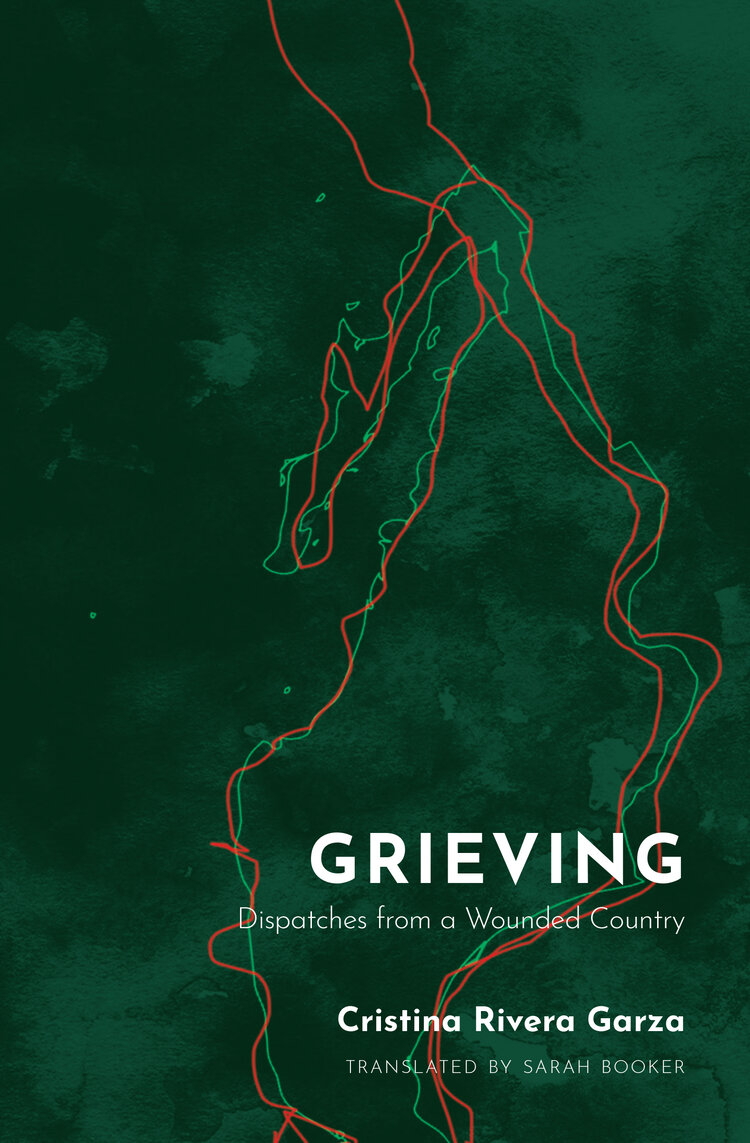
We mourn us: Grieving: Dispatches from a Wounded Country by Cristina Rivera Garza

I don’t quite know where to begin to attempt to write about this book. The historical roots and global and economic crosscurrents that course through the so-called War on Drugs that has openly threatened the fabric of Mexican society since 2006 go back much further. Yet, as I understand it, when President Felipe Calderón sent troops to his home state in a bid to end the longstanding drug violence there, the action initiated the ongoing conflict between the government and the drug cartels, that has effectively brought an unspeakable brutality out of the margins and into the daily lives of the country’s citizens. It has become a war against the Mexican people, and a war against women.

Cristina Rivera Garza’s hybrid essay collection Grieving: Dispatches from a Wounded Country gathers twenty-eight pieces—some personal, some journalistic, some literary—as a tribute to the power of language in the face of unrelenting fear and violence, and at times her words leave you gasping for breath. It is not a comfortable read. She writes about the barrage of visceral attacks that reduce human beings to unrecognizable bodies, tortured and mutilated, and of the killings, targeted and incidental, that rob mothers of their children, communities of their respected members, families of loved ones. And she writes about femicide, the murder of women, that too often goes unpunished. Like that of her own sister.

But what to do? How to address this accumulating pain, the pain of an entire people? Grieving in this context is not a mere process of coming to terms, to peace with a loss. There is no peace, the losing is relentless, the grief exponential. In Rivera Garza’s passionate, gut wrenching Introduction she speaks of the importance of recognizing the shared experience, the shared voice:

When everything falls silent, when the gravity of the facts far surpasses our understanding and even our imagination, then there it is—ready, open, stammering, injured, babbling—the language of pain, the pain we share with others.

And this is the importance of suffering, for where suffering lies, so, too, does grieving: the deep sorrow that binds us within emotional communities willing and able to face life anew, even if it means, or especially when it means, radically revising and altering the world we share. There, where suffering lies, so, too, does the political imperative to say, You pain me, I suffer with you, I grieve myself with you. We mourn us.

The texts that follow include published and unpublished essays, poems and crónicas, Spanish pieces translated Sarah Booker along with some originally written in English. For admirers of her enigmatic, dark novels like The Iliac Crest and the Taiga Syndrome, Grieving offers an opportunity to hear the acclaimed Mexican author speak directly to the tragic state of her country with painful honesty, strength and hope.

The works that comprise this collection are varied and relatively short, but the intensity of the material may be best processed and appreciated by taking a few pieces at a time. As someone with little understanding of the political reality of present day Mexico—awareness of the gruesome violence and the dangers to citizens and, at times, visitors, yes, but limited comprehension of the dynamics at play—I was continually faced with my own instinctive reaction to the idea of living under the conditions in which so many Mexicans find themselves on a daily basis. Rivera Garza’s language is powerful, poetic, but so much of what she touches on is grim, raw and heartbreaking. A central unifying construct is her notion of The Visceraless State—one that lacks political acknowledgement of the human body and its individual subjectivity—arguing that by engaging in this mis-named Drug War, the Mexican government has placed maximum profits above its obligations and responsibilities to its own citizens.

Essay collections are sometimes weighed down by a degree of sameness, a feeling that the same or similar themes are being rehashed, rather than viewed anew as the work progresses. Although Grieving is an attempt to articulate the present situation in Mexico, it is not an explicitly historical or journalistic effort. It is, rather, a human response, from a woman who is not just a reader and a writer, but  “a mother and a daughter and a sister. A grieving sister.” Rivera Garza is writing from within her personal experiences, offering astute intellectual observances only as needed. The result is an eclectic, thematically focused exploration, yet one that picks up refrains, images and stories, calling on them again and again through the course of the book.

This is, then, a work that cannot be easily summarized. I was fascinated by several of the pieces that spoke about books not yet translated into English and their authors’ perspectives and contributions to an understanding of forces at play—not just in Mexico but in other analogous situations in social and political history. Cruelty and inhumanity is not the sole domain of any particular time or place. But there are a few key pieces that I found especially powerful. “I Won’t Let Anyone Say Those Are the Best Years of Your Life” examines the impact of drug based violence on youth through testimonies contained in a volume called Estos últimos años en Ciudad Juárez (2020) which looks at the recent period in Ciudad Juarez, a city on the Rio Grande, south of El Paso, Texas, and the price paid by the people there. Rivera Garza frames the lived reality:

No survives a war unscathed. Just as rivers feed nearby land by virtue of their mere existence, wounds run deep and pain seeps through every inch of the body. No action, no word, no gesture is unconnected to war. Similarly, actions and words and gestures remain linked to a growing alertness, a critical consciousness, about the sources of tragedy and loss. There are laments in the book, but they are never disassociated from the rage and indignation against a Visceraless State and the profit-making cartels. Wounded and on their toes at the same time, the people who remember their youth in a war-ravaged Ciudad Juárez, while still, in many cases, confronting the damage brought upon them by forces larger than their own, speak directly and to the point: We were robbed, many testify. They robbed us of our youth, indeed, but more importantly, they robbed us of our future.

Another especially powerful entry that again takes us back to Ciudad Juárez is “The Longest Sunday.” This essay recounts, in 13 brief numbered segments or chapters, a day Rivera Garza spent in the city. She is heading there to meet a woman whose testimony was included in the volume discussed in the piece mentioned above (which appears in any earlier part of Grieving). Luz Mariá Dávila had lost her only two sons in a violent massacre in 2010. Their meeting is sensitively portrayed. But this visit also brings to the surface the author’s own anxiety before arriving in a city that occupies “a sadly privileged place in our geographies of contemporary horror” to which increasing reports of femicides had also been added:

I remember the wide streets, empty of people, the string of abandoned houses that lined the road all the way from the airport to the hotel. A black hole in the very heart of the city. An immovable immobility. That way of repeatedly looking over your shoulder like you were expecting the worst, sure it would come at any second.

Her account unfolds under the quiet burden of grief, of pain, carried not simply in the story of one grieving mother’s sorrow and stubborn resolve, but in the complex emotions that Rivera Garza wrestles with under the “overwhelmingly blue sky” on that Sunday in Ciudad Juárez.

This is just a very brief sampling of this vital collection. For a taste of the intensity and insight, Rivera Garza brings to her essay writing, I can point you to a slightly different edit of the second last piece in this work which I had the great honour to publish in the spring of 2020 when I was an editor with 3:AM Magazine. Written in the early days of the pandemic when Trump was still President, “Touching is a Verb: The Hands of the Pandemic and Its Inescapable Questions” is not only an ever relevant meditation on the impact of COVID-19 on our relationships but a cautiously optimistic look ahead to the possibility of a Visceral State. It can be found here. Only time will tell what more questions and answers the pandemic will bring, but hope must be maintained, against all odds.

Grieving: Dispatches from a Wounded Country by Cristina Rivera Garza is translated by Sarah Booker and published by Feminist Press.

To fall with grace and compassion: A Net to Catch My Body in its Weaving by Katie Farris

I know people who shy away from poetry for fear that they will not know what it means, as if a prerequisite of appreciating poetry is an intimacy with style and form and an inexhaustible knowledge of that which came before lest an influence be mistaken or missed in the reading. So, here is a collection to assuage that fear, a small book that can be met by anyone. Paradoxically it is accessible precisely because it chronicles an experience, a reality, that we all fear—a diagnosis that so many of us have known, if not intimately, then in a friend or loved one.

In the miraculously titled A Net to Catch My Body in its Weaving, Katie Farris invites us to walk alongside her, as she ventures into hell, so that we can know, as she is determined to believe, that even in the midst of hell, there are things that are not hell. Her words, lines, poems, bruised against the flesh of living, become an offering, an answer to a terrifying uncertainty, a string of songs that speak to her journey, expose her joys, and catch her falling body in their shadows. Love poetry to a burning world.

Here’s a shot between
the eyes: Six days before
my thirty-seventh birthday,
a stranger called and said,
You have cancer. Unfortunately.
Then hung up the phone.
– from “Tell It Slant”

This slender chapbook is her response to the third stage breast cancer that is staking a claim on her body, tracing the shock of diagnosis, the invasion of surgery, the toll of treatment. Unflinching and honest, this collection of poems speaks with an awareness only illness can heighten.

For Farris the experience of cancer seems less of an inward looking process, but rather one of looking and extending outward, into the world. Which might, appear at first glance, counter-intuitive. She turns to her husband, wondering about the balance of intimacy and caregiving, if a “slow / sweet collapse into / oneness” has its limits, and yet discovering, to her surprise, that mid-chemotherapy she wants sex:

Philosexical, soft and
Gentle, a real
Straight fucking, rhymed
Or metrical—whatever
You’ve got, I’ll take it.
Just so long as we’re naked.

Poetry itself is also a comfort, a companion, as one might expect and, at this time, it is Emily Dickinson with whom she develops a special friendship, if you like. Echoes of her idiosyncratic spirit may be heard. “Emiloma: A Riddle & an Answer” playfully addresses Dickinson, alternately with questions directed to her own condition and treatment. The kind of questions that evade comforting responses:

Will you be
my death, Emily?
Today I placed
your collected poems
over my breast, my heart
knocking fast
on your front cover.

*

Will you be
my death, chemo?
The shell of my self
in the sphere of time
plucking, plucking
the wool of my hair
from its branches.

But, perhaps one of the most powerful elements in this collection, one that speaks to me in particular in relation to illness and healing, is her engagement with the natural world, with images of trees and birds. In front of the Atlanta Cancer Center she ponders whether we arose in imitation of trees, longing for roots and raising our arms like branches, while another poem contemplates the strangeness of survival, of standing “in the forest of being alive.” It is, however, in the closing poem, “What Would Root” that she finally gives herself to that forest, a reconnecting with a vivid, corporeal recognition of being one with nature—the water, the soil, the roots and branches—however tenuous or complete the journey is. In just 37 pages, this chapbook, is evidence that when the world is falling apart, writing love poetry may just be the best defense.

A Net to Catch My Body in its Weaving by Katie Farris is the winner of the 2021 Chad Walsh Chapbook Prize and published by Beloit Poetry Journal.

I want to be ordinary: Special Needs by Lada Vukić

On the surface, Special Needs by Croatian writer, Lada Vukić, appears to be a simple and straightforward story, told by a boy who does not engage with the world the way others do. He knows he is different. Special. And he does not like it. His classmates taunt him, his teacher barely tolerates him, and his aunt suffers him without affection. His single mother struggles to support the two of them by working as a seamstress for a manipulative, abusive boss, their nosy neighbour is alert to any sign of possible dysfunction, and a small-time drug dealer turns him into an unlikely accomplice. Lots of room for misunderstandings, the wisdom of the innocent, and maybe, if we’re lucky, a happy ending. Except that luck is in short supply for our hero and his mother, intimations of tragedy lie beneath the surface in an intriguing novel that succeeds on the uncommon strength of the perspective through which it unfolds.

I tend to be skeptical about child narrators who can veer too far toward the irritating or be exceptionally precocious. I am equally wary about narrators with some obvious emotional/cognitive impairment which often is imagined somewhere on the autism spectrum—which, in reality, is a very wide range. Put both together and the results can be a voice that is overly naive or unrealistically charmed. As the parent of two children with learning disabilities, one of whom also has mental health concerns, and as someone who has worked extensively with disabled populations from extreme physical and developmental disabilities to mental illness to a great variety of adult acquired brain injuries, I opened Special Needs with curious caution. And was immediately drawn to the narrative voice.

Born with an unspecified disability that others allude to but never name in his presence, ten year-old Emil is a selectively mute child with some deformation or inflexibility in his hands and feet. His reasoning is highly logical but on his own unique scale of understanding, to the point that he appears to others far less intelligent and intuitive than he is. The fact that words so often freeze in his mouth, adds to this perception. He believes he has problems with abstract thinking but rather he seems to lack a certain flexibility in some areas and an idiosyncratic frame of reference in others, often linked to his love of nature programing on television and an almost magical level of auditory acuity only his mother understands. He engages in some ritualistic behaviours and has an aversion to being touched. This cluster of qualities may or may not conform to any typical diagnosis but, if you work or live with disability, you know that there is no such thing as “typical,” or rather typically atypical. From Emil’s point of view, he is used to people failing to understand him, it’s a frustration he is quite capable of articulating if not verbally expressing. But what he really longs to do more than anything is shed the heavy corrective shoes he is forced to wear, get a pair of trainers, and run. That is the dream he holds to.

You can’t buy my shoes in a shop. They’re not displayed in the shop window like other shoes. And they don’t have the logo of a famous brand. I get them from Uncle Mario. So, no Nikes, no Adidas, just – Uncle Mario. Who wants shoes called Uncle Mario? I mean, nobody normal. And I’m normal, though sometimes they say I’m not. First, he makes an imprint of my feet, which are then used to make the shoes. I’ve seen that he does the same with others, so I’m not the only one. There are others like me, with special feet. But that doesn’t mean anything to me because I don’t like being special. I want to be ordinary.

Life is difficult for Emil and his mother. He is teased at school and unable to perform as expected by his teacher. The only subject he really enjoys and in which he demonstrates an uncanny, if pragmatic, understanding is religious studies—a class he is only allowed to attend as a viewer. His mother is a woman whose faith, if she ever had any, has been tried and found wanting. She colourfully expresses her anger at the school’s lack of patience and appreciation of her son, but she is unable to afford any supports for him, has lost the natural social network she once enjoyed, and gets no empathy from her bitter, intolerant sister:

Auntie Zrinka told mum that she had only herself to blame for the situation she found herself in. No, nobody else was to blame, just her! What was happening to her now was the consequences of past mistakes. What mistakes? Clearly, those when she should have gotten rid of me in time. (?!) Alright, she saw that the words “get rid of” were too strong, what she meant was some sort of institution for children like me. (?!) And yes, how many times did she have to tell her that she was stupid because she wasn’t even asking the boy’s father for child support. (!?)

Emil’s super hearing allows him to eavesdrop on conversations he is not meant to hear, nor fully equipped to understand. He tries to connect the nonsensical facts as best he can. The larger implications are apparent to us as readers, but many details are left out. An incompleteness is allowed. Emil draws his conclusions, we draw ours. He is also granted, by virtue of his hypersensitive ears, an ability to hear the hearts of others crashing around in their chests in times of fear or excitement, and when he confesses that he has detected a second faint heartbeat in both his mother and his teacher, he inadvertently tosses a wrench into several lives at once. Emil’s extra-special special needs add an important quality that enhances the appeal of the story without reducing the reality of challenging circumstances and disadvantages that he and his mother face. Nor will it help avert tragedy.

Special Needs’ true strength is the tightly controlled narrative, preserved beautifully in Christina Pribichevich-Zorić’s confident translation. Vukić never loses the voice of her young protagonist, maintaining the authenticity and appeal of Emil and his uniquely matter-of-fact worldview, while letting his self-awareness to begin to slowly evolve as the story turns in an unexpected direction. This work, her first, which won the V.B.Z. award as the best unpublished novel of 2016, is steady, strong, and a subtly different take on the exceptional child narrator, one that may be of particular interest to those who have spent time with the extraordinary ordinary people who see the world in a way that exposes truths we so often pretend to ignore.

Special Needs by Lada Vukić is translated from the Croatian by Christina Pribichevich-Zorić and published by Istros Books.

Departure is Liberation: All the Roads Are Open by Annemarie Schwarzenbach

On a journey the face of reality changes with the mountains and rivers, with the architecture of the buildings, the layout of the gardens, with the language, the skin colour. And yesterday’s reality burns on in the pain of parting; the day before yesterday’s is a finished episode, never to return; what happened a month ago is a dream, a past life. (“The Steppe”)

Swiss writer, photographer and journalist, Annemarie Schwarzenbach, remains, coming up on eighty years after her untimely death at the age of thirty-four, an enigma. A striking androgynous beauty, she grew up in luxury, and was dressed as a boy by her bisexual mother with whom her relationship remained complex and codependent.  Yet, a certain estrangement with her family began when she befriended Thomas Mann’s children, Erika and Klaus, both of whom were homosexual and politically engaged in anti-fascist movements. They introduced her to an intellectual environment in which she could express her own attraction to women, but they also introduced her to morphine, leading to an addiction that would haunt the rest of her life. When Hitler came to power in 1933, Annemarie began to travel, frequently on her own, through the countries of the Middle East, forays that would establish her career as a photojournalist. Over the course of her lifetime she would make return trips to Persia, two trips to America, travels through the Baltic States and up to Moscow, but it is perhaps her journey in a Ford, overland from Geneva to Afghanistan in 1939, with ethnologist and filmmaker Ella Maillart, that has become synonymous with the reputation as an adventurous early  LGBT icon that she has acquired since her relatively recent “rediscovery.”

Ella Maillart’s account of their trip, The Cruel Way, was published in 1947, five years after Schwarzenbach’s death from a brain injury caused by a fall from her bicycle. It is considered a classic of travel literature, but the name of her troubled and transcendent companion was changed to Christina, presumably at the intervention of Annemarie’s family. Although Schwarzenbach herself was a widely published author in her time and did manage to place some of her own Afghan-related material while the Second World War consumed journalistic attention, it was not until a curated selection of her essays and reflections on the experience was published in Germany in 2000, that her own version of their journey was given full voice. All the Roads Are Open: An Afghan Journey 1939 – 1940, published in 2011 by Seagull Books, in Isabel Fargo Cole’s lucid translation, offers a mix of automotive adventure and a lyrical, passionate account of a land and the people that enchanted her.

Although I didn’t realize it when I started reading, All the Roads Are Open is not intended as a single cohesive piece, but as a thematic, roughly chronological assemblage of short pieces written largely as Schwarzenbach made her way by steamship back to Europe from Bombay. As such the “chapters” have a quality not seen in more typical travel writing—these are descriptive passages tied to communities, encounters, and landscapes, and the images which hold most vividly in her memory drive her account and are revisited in several pieces. Thus it is clear which experiences had a profound impact on her. At the same time, there is little about the deterioration of her relationship with Maillart, and no mention of her romantic attractions or resumed drug use (if such material exists at all as much of her work was destroyed by her mother after her death), but a kind of sadness and isolation does rest beneath the surface in some passages. As well, certain described episodes seem to be the possible product of poetic license, but none of this matters; Schwarzenbach leaves us with a memorable, exciting and insightful look at a way of life in Afghanistan that was on the verge of disappearing—in more profound ways that she could have imagined.

The journey, two women travelling alone across a rugged, lonely terrain on roads that could fade into rough tracks, was met with concern and skepticism by many. Schwarzenbach revelled in the independence and their decisions to take the more challenging routes—confident in her ability to make basic repairs on the road or, if needed, secure assistance from the rare individuals in the communities they passed through who might have any experience with cars. Her description of Mount Ararat is moving, her evocation of desolate landscapes graphic, her account of three passages over the Hindu Kush invigorating, and her remembered belief that they never had to worry where they would stay, or how they manage is admirable. She speaks regularly of the warmth and hospitality of the Afghan people, be they nomads on the plains, or leaders in towns and villages. It is, again and again, her most cherished memory. Her writing, at times punctuated with a plethora of exclamation marks, is neither idealistic nor romanticized, nor condescending. But, by contrast, she has a few choice comments for some of the British and European expats they live among in Kabul or others who display their prejudice:

Recently, a Swiss man asked me whether the natives’ food was even edible and whether I hadn’t been afraid to sleep in these people’s midst without any protection. The good man really had no idea of Afghan hospitality! Despite the various mentions here of rich, spicy pilaf meals, it must be said that by far not all the inhabitants are able to afford rice and mutton. In the nomads’ tents, there is often nothing but sour milk and a little bread. And in many villages the poor people don’t even have that. In Turkistan, where the gardens and bazaar stalls brim with fruits in the summer, a few months later I saw the relentless winter loom. Then the same landscape was reduced to a wasteland scourged by the icy wind and cloaked in dense swaths of dust, and life in the farmers’ clay huts was quite spartan. But despite these worries, it was at this very time that laughing, waving women met me in the last village on the desert’s edge. (“Two Women Alone”)

One thing that does regularly concern Schwarzenbach, however, is the life of the girls and women in the communities they pass through. As an emancipated woman, the sight of another woman encased from head to toe in some regions is disturbing. But even in other towns and villages, a visible absence of women is noted—they are not seen. However, when invited into the inner garden of one home where their host’s wife and daughters greet them without head coverings, the travellers are able to enjoy a precious interaction afforded to them because they themselves are female. For Schwarzenbach there seems to be great satisfaction in engaging with women and, at the same time, being included with the men on hunting outings, as she is during a period when she works temporarily on an archaeological dig.

Once war is declared, the political climate in the world starts to shift, and Schwarzenbach’s restlessness grows. As the end of 1939 draws closer she prepares  for another departure, anticipating climbing the Khyber Pass in her beloved Ford and passing into India, on the first stage of a journey home. But, even as the steamer pulls out of Bombay, it is evident that Afghanistan has touched her deeply. More than she anticipated, perhaps. One of the most poetic essays, placed at the end of the penultimate section of the book, is “Chehel Sotum,” in which she recalls an experience years earlier at a small palace in the Persian city of Isfahan.

The palace, whose name means “Forty Pillars”—a reference to its twenty pillars and their corresponding reflections in its pool—inspires an Afghan friend to inform her that in his homeland there are forty kinds of grapes:

Overcome by memory and homesickness, he spoke of nothing but the bewitching forty-fold profusion of the grapes of Herat and Kandahar. But though I listened to him and these words about the forty kinds of grapes lingered in my mind, tied to the vision of a promised land, at the time I did not even desire to set foot there. You cannot love what you have not embraced and seen with your own eyes; longing itself is never anything but loneliness surging and bleeding away.

Once she had herself embraced Afghanistan, she understood. One can only imagine how she would be heartbroken by the tragic condition of the country today.

All the Roads Are Open by Annemarie Schwarzenbach is translated by Isabel Fargo Cole, and published by Seagull Books.

A different kind of time made visible: The Desert of Lop by Raoul Schrott

Many things are contained within others, and not only in names; in the north there is also a south and a west. The Badrain Jaran desert is indeed to be found within the Gobi desert. But it too contains within it the Takla Makan. And within that again, somewhere there, even if not precisely there and now, lies the untouched centre of the earth, the Desert of Lop.

What is the meaning of home? Is it a place, a person, a state of mind? Some know without question. For others it is an idea that is impossible to hold on to—like a handful of sand, it slips through your fingers. That is the essential spirit that comes through in Raoul Schrott’s delicate, spare novella, The Desert of Lop. Over the course of 101 very short chapters, almost prose poems but not quite, it traces one man’s relationships with three women, the places those relationships take him and the way they became undone. Detail is scant, connections are sketched and filled in with images of sand—dunes, storms, waves of shifting sand.

Schrott, an Austrian poet raised in Tunis, has an interesting background. He studied philology, had a strong interest in Dada and surrealism, has translated and adapted Homer and Gilgamesh in German and speaks a number of languages including Breton, Basque, Corsican and Gaelic. I first encountered him through his extraordinary, sensual unclassifiable work The Sex of the Angels, The Saints in their Heaven, a collaboration with Italian artist Arnold Mario Dall’O which was published by Seagull Books in 2018. Loving it, I immediately sought out any other available works in English. The Desert of Lop, written in the same general time as Sex of the Angels, but published in 2004 (and likewise translated by Karen Leeder), was all I could find and, even then, it took some time to track down a copy.

In simple terms is about a man named Raoul Louper who is living in a village near Alexandria in a simply furnished room. The only described decorations are three objects in the window—a pine cone, a gree-gree (an African charm) and a stone—mementos of three women he once loved. Francesca, Arlette and Elif. Each week he takes the bus to Cairo. He meets with Török, a Hungarian professor with whom he visits geological formations in the area. They share an obsession with sand. Sometimes he joins the professor and the Egyptian woman he lives with for supper. As his story unfolds, they offer a solid counterpoint to Raoul’s restlessness. They have created a home, the very ideal Raoul seems to long for and yet cannot realize. They listen to him, challenge him, and all though his wandering carry him around the globe, it is in their kitchen that his life seems to have any tangible form at all.

His first wife he met near Grosseto on the Mediterranean. Francesca, is a free spirit when he they meet; he is equally ungrounded. Once he has made enough money he leaves for Japan—images from the country punctuate the text but his stay is not described—and when he returns he and Francesca make an effort to make a life together. Without success.

His second wife, Arlette, he meets in a bar in Quimper, a city in Brittany in northwest France. He finds work on a trawler out of the French islands of St Pierre and Miquelon off the coast of Newfoundland, across the Atlantic. With his pay he drives across the US to see the western edge of the Pacific and slowly makes his way back to Quimper where, before long, the walls close in on his relationship with Arlette.

In Raoul Louper’s love for Arlette there was always something that was still waiting to change shape. It was like one of the drawings of a Necker cube that one finds in magazines sometimes; its upper edges can only be held in the foreground if one concentrates hard.

He sometimes looked at Arlette absent-mindedly. She did not know what to make of it; she thought when he looked at her it was always with questions.

Raoul avoided giving an answer; there are some things one does not say to a woman if one wants to love her.

The third woman, Elif, comes in to Raoul’s life in Iquito, Peru. Twice abandoned by love, he has accepted a job offer from a man who, having won the lottery, left Naples to set up a hotel in South America. Elif is working as a guide in the National Park, but it turns out that she grew up in Toulon, Raoul’s birthplace, and that they share a birthday. Despite being very different, these unlikely similarities lead, in time, to love. This, is the relationship that will cover the most mileage, first back to France when Elif’s job ends and eventually on a  journey into the desertified heart of China where too much togetherness threatens to push them apart.

Like Sex of the Angels, this is a very sensual work, not just in the remembered intimacies of love, but in the description of sand, deserts and the dunes that rise and fall across the landscape. Scientific descriptions are woven into the overall narrative, at times directly, at other times in the observations of Török or others, but always with such a light, poetic touch, that it never feels contrived. Sand, sculpted by wind and time, is an essential element of this tale, a story that builds layer by layer, but retains a haunting sense of instability and incompleteness.

Is a sand dune ever a finished object?

A dried-up riverbed, or the arms of a delta, drought; a bush, some pebble or other, even a termite mound, sometimes: it’s all the wind needs.

In the wind cornices line up and grow into dunes; they form chains and banks, they take on the shape of an egg, a heart or a star.

The suspended load of the wind; it blows each grain of sand from the windward, hardly higher than a foot or two off the ground, until they are pressed together on the crest, only to slip down the steep face in its lee; it is just the same as with waves.

The Desert of Lop maintains its inherent spaciousness through its narrative voice. The elusive narrator speaks of Raoul in third person, telling his story for him from an uncertain vantage point—sometimes slipping into a scene or adding a comment in first person, as if a companion on some outing or otherwise present—but the exact connection is unknown. Yet the haziness of the boundary is acknowledged: “It is no longer me telling this story. It has long since grown beyond the evenings in Cairo, the table with its chessboard pattern of tiles.”

As spare as it may be, especially for readers unaccustomed to checking a map or slipping down rabbit holes, this is not a directionless narrative. China is on the horizon throughout. Elif and Raoul embark on a journey to Dun Huang, the ancient city on the edge of the Gobi desert with its Caves of the Thousand Buddhas. With their guides they travel through distant provinces—Kamul, Tangut—in the footsteps of Marco Polo, following after Genghis Kahn, moving inexorably toward the extinguishing of anything that might hold them together against the shifting sands of time. Along the way: Lop Desert. Barren. Flat. Once the likely location of a lake, and of life more plentiful and diverse than that which remains, it became, as many other desolate locations have, ideal testing grounds for nuclear weapons. For we allow imitations of our destructive potential to proceed in the natural spaces we consider empty enough to bear the weight of our sins. As the desert will test Elif and Raoul. And his longing for some vestige of home.

The Desert of Lop by Raoul Schrott is translated from the German by Karen Leeder and published by Picador.

Rumors, riddles and other stories: Anecdotes by Heinrich von Kleist

Sublunary Editions, the humble publishing venture started by Joshua Rothes in Seattle, Washington in 2019 has, over the past few years, expanded from a simple monthly newsletter featuring new works and/or translations, to a quarterly journal called Firmament, the Empyrean series of obscure/hard-to-find literary treasures, revived, researched and restored, and a growing catalogue of original and translated novellas, stories, poems and hybrid works. Best of all, the books are all small, shorter volumes easily tucked into a bag or jacket pocket to read on the go.

Their most recent offering, Anecdotes by Heinrich von Kleist is a perfect example of the kind of work that sets this small publisher apart. In his tragically short life, Kleist packed a lot of living—writer, dramatist, soldier, possible spy, and during his final year, newspaperman. When he died by suicide at the age of thirty-four, he left behind a profoundly influential body of work. This collection of short stories and anecdotes originally published on the pages of the Berliner Abendblätter, were written over the course of one year, between 1810 and 1811, the span of time from the daily newsheet’s inaugural issue to their author’s death. As such they represent the first extensive collection of Kleist’s short work in English translation and an important, exciting addition to the Sublunary line-up.

Born in Frankfurt an der Oder in 1777, Kleist lived during a particularly unstable era in European history. Conflict with France was the major political concern for the German states throughout his adult years, and he served in the Prussian Army, spent some time in prison, and became an early supporter of German nationalism. He would come to be known as one of the finest literary stylists of his time, but during his lifetime he realized little of that acclaim. His daily compositions for the Abendblätter, from which the pieces in Anecdotes are drawn, provide a somewhat different insight into his gift for wit, satire and social commentary. Kleist was the editor and chief contributor to this publication and, as translator Matthew Spencer notes in his Introduction, this forum shows him to be “studiously evenhanded” taking aim at his subjects from all sides. At least while he was at its helm, the paper showed great promise. But it would not last long and might well have disappeared from memory altogether if not for a fortunate circumstance:

while Kleist began, through his plays and novellas, his posthumous ascent into the literary canon, the anecdotes remained largely underread, out of print. Much of the Abendblätter would have been lost if not for the Brothers Grimm, who collected issues specifically for the anecdotes, considering them small masterpieces of vernacular literature.

Although the critical value of these stories, witticisms and anecdotes, was debated by many, future admirers like Franz Kafka and Robert Walser, found in them an inspiring comic spirit to treasure.

The works collected in this volume run from the absurd to the tragic to the ribald, and are at times, remarkably timely. Some read as historical accounts, some as mock news items, and others as entertainments. Healthy doses of sarcasm drive home subtle and not so subtle attacks on military culture and the art of war. Folk tales and fables take clever turns. A few may miss the mark (or may have not survived the distance from their original context), but most of his tales are quite funny—even if darkly so. Where a little extra background is needed, Spencer includes brief historical or linguistic footnotes.

The pieces gathered here range from very short amusing accounts, bizarre Ripley’s Believe-it-or-Not type reports, to imagined news stories and, even, in one instance, a letter to the editor (crafted by Kleist himself of course) responding to a “reported” proposal for a cannonball postal delivery service. The postal system, it seems, is a an ongoing concern going back centuries. Another anecdote echoed almost a century and a half later with the play Twelve Angry Men, is “A Strange Case in England” which records the debate among a dozen jurors in a murder case but which ends with an unexpected twist.

As much as I enjoyed the anecdotes, my favourite pieces were the last two, somewhat longer stories, “A Ghostly Apparition” and “Saint Cecilia or the Power of Music.” Both are more along the lines of gothic tales but demonstrate Kleist’s ability to tell a solid, entertaining story. While the original issues of the Abendblätter would have included more conventional “news” and “information”, the selection for this project was guided by literary interest. As such, Anecdotes provides either an excellent first introduction to Kleist or a welcome treat for English language readers who already know him well.

Anecdotes by Heinrich von Kleist is translated by Matthew Spenser and published by Sublunary Editions.

Station to station: The Interim by Wolfgang Hilbig

Will we survive this century? asked the lonely reader in his train compartment. Yes, surely we will survive this one last century.

East German author Wolfgang Hilbig was not the kind of writer one associates with sunshine and bucolic scenery. His skies seem to be forever suffused with pale white winter sun, his landscapes marked by the residue of post-war industrial expansion, his urban streets draped in shadow lit only by dim pools of artificial light. His characters typically wander through this environment, never certain where they came from, where they are going and who they are meant to be—pulling and chafing against the constraints of a life they cannot fit into. Their situations and circumstances vary, but they are all lost in some kind of provisional existence.

The Interim, the most recent Hilbig release from Two Lines Press, takes, as the name implies, this sense of impermanence and makes it explicit. This novel, originally published in 2000, is, as with previous translations, rendered into fluid, incisive English by Isabel Fargo Cole. It follows the emotional and physical restlessness of C., an acclaimed writer from the GDR who is afforded the tenuous “freedom” of life in the West in the years immediately leading up to reunification. It is a time of shifting energies on both side of the Wall and C. finds himself completely adrift, caught between the crumbling social infrastructure of his homeland and the hollow promise of Western capitalism. He endeavours to perform the part of the celebrated author, often without either ease or grace, while he struggles with writer’s block and resists committing to the woman he genuinely feels he cannot live without. Trapped in a cycle of relentless anxiety, depression, and addiction, his only refuge is the train with its familiar chain of stations carrying him back and forth across the border, between an equally elusive past and future.

To be honest, I was apprehensive about this book, afraid somehow that it would be a 300-page pilgrimage through one man’s dark and decaying life, claustrophobic and bleak. And, in a way, it is most of those things except that Hilbig is an exceptional writer. Even if he is, as ever, narrating from the edge of his own existence, he has, in this novel, wisely stepped back into a more conventional third person perspective to examine his protagonist from the distance necessary to be honest—to his character and to himself. The result is an engaging narrative tracing loss, displacement, creative struggles and romantic failures washed down with too much alcohol and self-loathing. There are unpleasant moments—wandering about drunk in strange cities, taking in pay-per-view porn with an almost clinical sense of disconnect, mopping up vomit with a book from the “Holocaust & Gulag” section of his personal book collection—but the main thrust of the narrative is fueled by real human longing, stark humour, and much of the kind of mesmerizing existential questioning that drives the dreamlike, meandering narratives more typical of his work.

C. is, by the time we encounter him, living in Nuremberg. He has been in West Germany, for several years—how many, he is never sure—with an expired visa, living in a small apartment near that of his girlfriend Hedda who is losing patience with his constant insecurities and consistent unreliability. Back in Leipzig there is another girlfriend, Mona, whom he has avoided on visits home but has never properly broken off with. Both women are aware of and challenge his insistence on holding to a series of “interim solutions” as an excuse to never have to accept any tangible solution to the existential restlessness that haunts him. But there is a sense, for C. that his entire identity is false, lacking, provisional. Especially as a writer in the increasingly forced ecosystem of the literary world around him where authors use their miseries justify their writings:

in some convoluted way he believed in the creative power of tormenting experiences (while Hedda disputed it, claim­ing that pain merely silenced people), and he’d always sus­pected himself of lacking that experience. – In fact he’d always written offhandedly, looking away from his words, which had flowed from him effortlessly. In his life he’d never done a stroke of real work, he’d done everything in passing, for the interim, as it were. The real thing is yet to come, he’d always thought, as though he had infinite time at his disposal. Now he was pushing fifty—just three years left to go—it was high time for the “real thing”…and suddenly nothing was coming at all!

If The Interim never expanded its focus beyond C.’s self-recriminations, sodden or sober, it would run the risk of becoming weighed down by its own protagonist, spinning through a circuitous, non-chronological narrative that turns in on itself to travel wide but get nowhere. But C.’s inability to find himself reflected in his own country’s marginal, backward declining state, or the West’s flashy commercialized culture of consumption, allows Hilbig to make sharp, cynical observations on the state of the world as the twentieth century is nearing its end. A century of lies, as C. describes it. Technology has fostered progress and destruction, looking back to the horrors of the Holocaust and the Gulag, and ahead to the escalation of depersonalization and commercialism under the force of Capitalism. Is the latter a saviour from the godlessness of the former or simply a new God? C. is not so sure as, from the window of a West German train, he observes cars racing along the autobahn:

Disciplined and united in close-massed squadrons, united for one minute, identical lobotomized brows behind the windshields, bodies perching their death-packed asses on a power that wasn’t theirs, fused to a steering wheel that mastered their fists, they’d flee onward as if set in motion by the lash of a great herd-driver’s whip. And that great shepherd was Capital…he said to himself each time he looked out the window of the train at the inter­twined chains of dimmed headlights, a light-suffused gas-cloud over them, a cloud of sweet Arabian perfumes as of burning pipelines, a cloud of colored miasmas that drifted along with them as they rushed down the course in formation, gigantic glittering automobile hives, and the shepherd whipped them on from one gas station to the next, where they filled themselves with their manna, tanked up on their divine gas. – Stick it to them! cried the shepherd, their God, who had long since grown weary of his flock.

If C. can never quite decide which side of the border he belongs to, within West Germany itself he is equally unsettled. He moves several times and travels for readings, tracing a network of cities through their train stations, their hotels and their seedy bars. He convinces himself that Hedda is the reason he stays at all, but he cannot understand why he seems destined to sabotage what they have. Whether it is a fear of failure or a fear of commitment, Hedda is certain that the problem, not only in their relationship but in his inability to write, lies in an unwillingness to address his childhood fears.

One of the later sections of The Interim takes C. back to memories of his childhood and youth, to an early secret love of writing through his lonely apprenticeship in a machine shop. His writing remains a hidden activity for many years, while conflicts between what he longs to be and what others expect him to be grows wider, more fraught, echoing themes that course through the pages of Hilbig’s strange and wonderful novellas. This book is essentially about becoming a writer and coming apart as a writer, while clinging to a transitional existence during a transitional time in history. In turning C.’s trauma into literature, Hilbig accomplishes the one thing the novel’s protagonist is presently unable to do.I have read, and written about, almost all of Hilbig’s work translated to date and have had the opportunity to discuss it at length with Isabel Fargo Cole who has done so much to help bring his writings to an English language audience. I loved this book. But I am not certain if I would recommend it as an introduction to his idiosyncratic writing. I feel somehow that if one has read and enjoyed other titles, especially Tidings of the Trees, Old Rendering Plant and his short story collection, Sleep of the Righteous, The Interim will feel like an opportunity to see the “Hilbig protagonist” and his creator in what might be his most true-to-life work—gritty at times, melancholy and dark, but filled with powerful language and insightful observations. Be warned, though, C. is an anti-hero unlikely to find redemption or accept it if offered.

The Interim by Wolfgang Hilbig is translated by Isabel Fargo Cole and published by Two Lines Press.

“Imagination is resistance against life and nature”: Wolves by Bhuwaneshwar

In the course of a human life, a stage arrives when even change is conquered. When the rise and fall of our life doesn’t mean anything to us, and neither does it interest others. When we live only to remain alive, and death arrives yet doesn’t.
(from “Aunty”)

Some writers appear, seemingly from nowhere, burn brightly for a short time before disappearing into disarray and obscurity. Hindi writer Bhuwaneshwar is one such author. Neither end of his life can be firmly dated—born in Shahjahanpur, Uttar Pradesh between 1910 and 1915, he ended his days sometime in 1957, in Varanasi, where he was last seen ill and living among beggars. In the years that intervened there was a moment when this man with an exceptional gift for words appeared poised to lead Hindi literature into the future. His promise—and his pessimism—was recognized by Premchand, the prominent Indian writer known for his dedication to social realism. By contrast, his young protégée was more subversive in his approach, intent on shattering society’s myths and illusions to reveal its underlying darkness, a vision that won him both attention and distrust in the literary community. Yet, although his career was short, bookended by poverty and neglect, he left behind an important collection of stories and plays, along with Hindi translations of Gogol and Oscar Wilde—a body of work that has tended to remain largely forgotten in his homeland and essentially unknown in the English-speaking world. Now, with the release of Wolves and Other Stories—a slender volume containing twelve of Bhuwaneshar’s melancholy tales—translator Saudamini Deo has rekindled the voice and spirit of a man whose work captures a sense of ambiguity and anxiety that seems especially timely now, the better part of a century later.

The stories that comprise Wolves were originally published between 1935 and 1941, the majority in Hans, the literary magazine established by Premchand. The Indian Independence Movement was in its final stages, as reflected in an atmosphere of uncertainty that pervades these tales. But Bhuwaneshwar is not explicitly political in his writings. He is asking more philosophical questions about what it means to be alive in a world that is increasingly inhumane and unforgiving. His mood is grim, death is a regular presence, but his characters manage to salvage some measure of humanity, against the odds.

These stories tend to feature lonely, isolated people—even if they are not necessarily alone—unmarried women, abandoned children, students, soldiers, doctors, drifters and others who, for some reason or another, have found themselves at odds with their families, communities or societies. Some of my favourite stories are centred around women. In “Aunty” Bibbo is a poor woman, old “as if she’d originated old in the womb and turned immortal for a never-ending, unthinkable period,” has been seen as ever solitary and ancient by her neighbours. But she had, in her life, given her love and attention twice over, first to her nephew, abandoned to her care when her sister died. After that child grew up and moved away, he returned years later with his own son, now motherless, and begged his aunty to take care of the child. Again Bibbo consented, at great financial and emotional cost. She has her revenge though, in the end, in a small attempt to hold on to her dignity.

The dying woman at the heart of “Mothers and Sons” is also being exploited, on her death bed as her family gather around. Seen from her perspective, she revisits her dismay and disappointment in her sons and daughter-in-law’s as they imagine her clinging to more noble thoughts and argue about medical options. As death approaches, Bhuwaneshwar captures her shifting emotional state with remarkable intimacy:

At midnight, everyone was sleeping on mattresses on the floor, only Amma was awake and, as if drowning. Wondrously, even her troubles were drowning. She started thinking of faraway things. Meaningless, unparalleled. Some house, some man, once glimpsed somewhere, she started hearing strange sounds. But this state didn’t last long. She started feeling nervous, as if she was frightened of being alone on a dark road. There was no energy in the body, she had known for a while, she had grown used to it, but she was ready to fight for that energy now. Everyone was sleeping. She could hear their breaths, she recognized them, but what is all this to her when she has no more energy?

A wide range of voices emerge throughout this collection and the settings of the tales are varied, sometimes grounded in ordinary settings—hill station, post office, train compartment—others incorporating ghostly or somewhat surreal circumstances such as “Sun Worship” which follows a doctor and a raving madman on a strange urban journey. But the crowning entry is the title story, one of his best known, which closes this volume.

“Wolves” is presented as the reported account of an old gypsy of a horrific adventure from his youth. He and his father were making their way along in their family caravan which was heavily laden with pots and pans and three fifteen year-old acrobats when they were set upon by an unruly, insatiable pack of wolves. Forced to lighten the load, first with objects, then with passengers, the wolves just keep coming, consuming everything in their way. Relentless and unyielding, the story offers little respite. But its wolves are familiar—in our world today and no doubt to a man who saw beyond the façade of his own society and turned his visions into stories, stories he would come to imitate in his own life. He was pursued by wolves himself. Bhuwaneshwar’s later years were marked by mental illness—first his brother was committed to an asylum, and then he too was lost to madness and homelessness, like a character in his final unwritten tale.

Wolves and Other Stories by Bhuwaneshwar is translated by Saudamini Deo and published by Seagull Books as the first in a new series featuring Hindi literature.

My heart struggles for voice: Sing of Life – Revisioning Tagore’s Gitanjali by Priya Sarukkai Chabria

Around the world, many so-called literary classics are worked into educational curricula long before most students have the depth of life experience to fully appreciate them. How often have we heard (or said) I was put off this author or that work because we were forced to read it in school? But years later a revisit can open new doors, allow new light to enter. Even a piece of literature remembered as well received when one is young, will be met  with entirely new eyes decades later. Living informs the reading, alters the experience.

For countless students growing up in India, Rabindranath Tagore is one of those authors who might well be met with a mix of youthful admiration and obligation. I could not help but smile, then, when I read Priya Sarukkai Chabria’s account of her unexpected reunion with Tagore’s classic Gitanjali (Song Offering) when her husband picked it up off a bookshelf in a café in the village of Bir in the northern Indian state of Himachal Pradesh. Before long, as she describes it, the small book was “spreadeagled” between the two of them on the table. With the Himalayas rising in the distance, she felt the words rise off the page and enter into her mind. Now, I must admit that I do know Priya and her husband, and that privilege that makes this image that much more endearing—the vision of a shared rediscovery, that will, in time, lead to the very text I now hold in my hands, her thoughtful and spirited new book Sing of Life: Revisioning Tagore’s Gitanjali.

The original text, subtitled A Collection of Prose Translations Made by the Author from the Original Bengali with an Introduction by W.B.Yeats, was first published in 1913. It is comprised of 103 short pieces adapted from a longer version originally composed in verse. The Indian poet, writer, composer, painter and social reformer is, as are many great figures, a complex and cherished individual. In her Introduction, Chabria provides a succinct overview of his political/historical context, offering a key to understanding his philosophical and artistic importance before examining some of the key poetic and spiritual features that come through, for her, in Gitanjali:

To my mind, Tagore is a modernist bhakti/devotional poet. Cosmic harmonies ring through the love that souses this collection, at once familiar and mysterious as the changing lines on one’s palm. A blessed geography of space is summoned from within the body’s cells and outside, and in every time, whether recollected, in the present, or yet to come.

There is an inherent intimacy and longing in these prose poems combined with imagery and voicing—including an “osmosis of gendering”—that draws on a long tradition of Indian devotional love poetry. To someone unfamiliar with the genre such as myself, it feels exotic and mysterious. Are they to be understood as love songs or prayers? To whom are we listening? My own modest Dover edition copy of Gitanjali, read rather haphazardly without guidance, could hardly be said to have put me on familiar terms with its magic. However, in moving between the haunting revisions and the original songs, I found myself drawn into a sort of conversation of echoes, bridging a century, through which I was free to discover the songs that most clearly and personally spoke to me.

Enter my heart unbidden
even unknown to me

The steps I heard
in my room are

the same that echo
from star to star (from #43, Sing of Life)

It is clear from the Introduction that although the desire to engage, notebook in hand, was an almost immediate response to her chance reencounter with a classic, this was not a project entered into lightly. Chabria details her approach, her reasoning and her own reassurance that Tagore would not have been at odds with her intention and her desire to reimagine his poems, to pull the essence to the surface while remaining faithful to the intent, beauty and spirit of each piece. Her touch is spare, delicate. Key images and phrases are held, perhaps moved, gently rearranged or opened up, inviting space and silence into the telling. Tagore’s appeal to the Beloved, his lord, through his speakers—male, female, young, old—is an intimate one. They are filled with longing, gratitude, grief, peace. The energy and imagery is allowed to breathe fully in the revised imaginings, but they are not altered or lost. It is a remarkable feat.

To offer a taste, #39 reads:

When the heart is hard
come with a shower

When grace is lost
come with song

When work raises its din
come with peace

When my heart crouches
come with light & thunder

– –

lord

of silence

break

open

the door

For point of reference, the first two lines of the original prose version reads: WHEN the heart is hard and parched up, come upon me with a shower of mercy. / When grace is lost from life, come with burst of song.

Chabria notes that she was first encouraged to publish an excerpt as an erasure poem, but she felt that particular form did not apply “for mine is a tribute.” Great poems, she says, often serve as a spark or inspiration for another poet. She was not attempting to update Tagore either, for the original meditations still contain their fire for her and for us, as anyone turning to the text reproduced in the back of this book can instantly see and feel for themselves. The rhythms, images and moods shift throughout the course of Tagore’s Gitanjali, moving through joy and shame, anticipation and longing, darkness and light. As the sequence nears its close, an awareness of death holds more and more of the poet’s attention. In the revisioned songs of Sing of Life, images and phrases are distilled, sometimes reorganized, and visually spread across the page (each poem contains two sections, with the first sentences offered in verse form and the final sentence strung out across several lines). One senses that Chabria has listened closely, carefully, so her responses may honour the elements that seem most essential, highlighting their beauty and emotional depth.

Ever the mark of rewarding read, my copy of Priya’s latest book is now decorated with notes and sprouting coloured tabs. As a friend, her voice accompanied through my reading (and I resisted watching one of the readings or interviews she has recorded—many available on YouTube) before gathering my thoughts here. I have never known her to engage with any subject, be it over coffee or in the pages of her own books, without a passionate and heartfelt intensity (Yeats was wrong in this regard, by the way, sometimes the best are filled with a passionate intensity). With Sing of Life, this singular energy again comes through, pulling the reader into a double-stranded engagement with Tagore’s classic work. As today’s poet invites you in to her own essential revisioning of these rich prose pieces, be it for the first or the fiftieth time, where the encounter takes you—perhaps back to the original and forward again, or on some other tangent altogether—is your journey.

Sing of Life: Revisioning Tagore’s Gitanjali by Priya Sarukkai Chabria is published by Context, an imprint of Westland Publications in India, and widely available internationally.