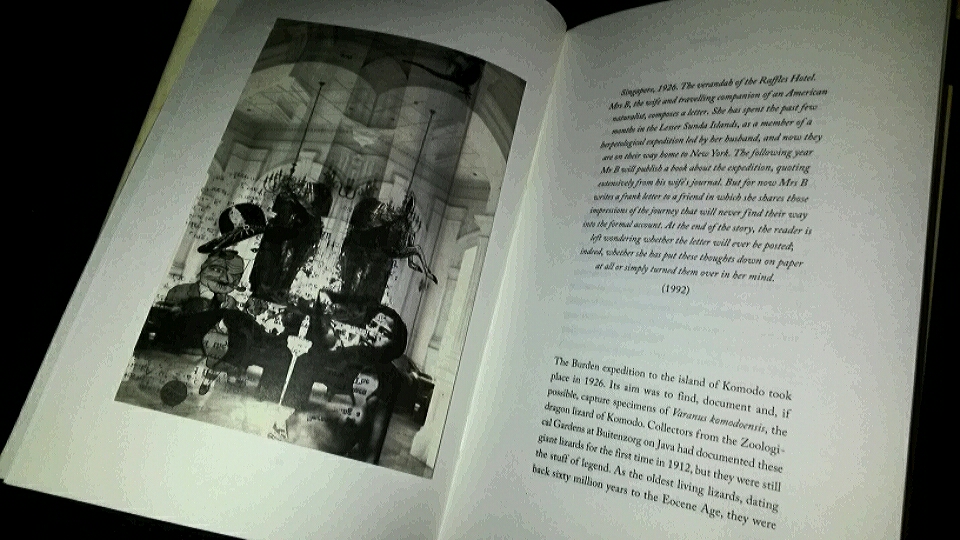
Theatre on the page: 50 Drawings to Murder Magic by Antonin Artaud

They are 50 drawings

taken from exercise books

containing notes

       literary

       poetic

       psychological

       Physiological

       magical

especially magical

magical first and foremost.

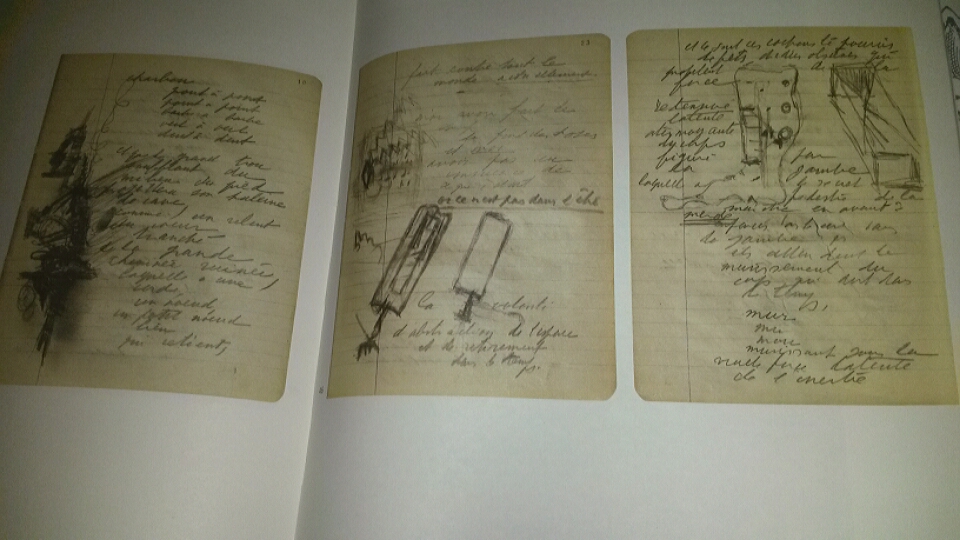
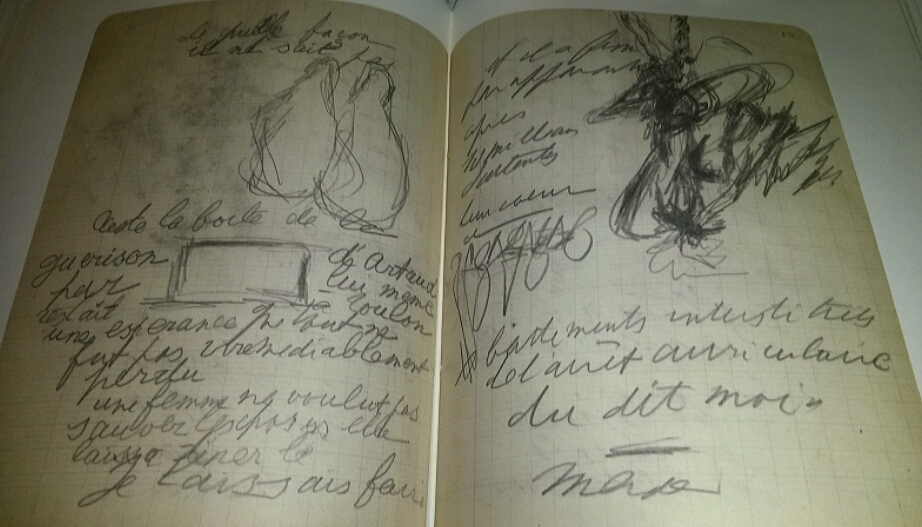
Thus ends the first page of Antonin Artaud’s last piece of writing, 50 Drawings to Murder Magic. Scrawled on notebook pages, this piece was written as a text to accompany a selection of sketches and fragmentary notations that he had been collecting for several years in small school exercise books. The sketches are frantic, the paper intentionally stabbed and tattered, the missives angry and disjointed. The ultimate design of this project, which was initiated at the request of art dealer Pierre Loeb, will never be known. It was interrupted by Artaud’s death in March 1948, two months after it was begun.

50drawingsArtaud was a poet, dramatist, actor and theoretician, best known for his notion of the “Theatre of Cruelty”—an approach to experimental theatre that envisioned the removal of the barrier of the stage between the audience and the performers, and the transformation of the theatrical experience into a primal, mythic spectacle involving groans, screams and verbal incantations. In her preface to the Seagull Books edition of 50 Drawings, the editor, Évelyne Grossman, suggests that his drawings reflect Artaud’s preference, in his later years, for the “restricted framework of the small format.” His feverish drawings of faces, torsos, hands, totems, spikes and other undefinable shapes and scratches may be seen as a form of dynamic performance on paper:

“This is not to say that his intention is to breach the frame of the page, to escape its confines; rather he is seeking to break out within the sheet: to raise the paper surface, to dig down into it, to lend it volume, to open up its unsuspected depths and thicknesses. The pages dimensions are thus exploded. Writing and drawing alike are set in motion.”

2016-10-25-02-39-30Originally associated with the Surrealist movement, Artaud had a deep interest in magic and the occult that extended far beyond that of his peers. He saw magic not only as a very powerful form of communication, but, he hoped, as a means to heal the deep rifts in his own troubled psyche. Plagued by mental health concerns, Artaud would spend much of his life in and out of asylums. Increasingly he was haunted by the demons of his own imagination and, as a result, it is intriguing to turn to his intense, often seemingly angry notebook drawings as an effort, as he puts it himself “to murder magic.”

2016-10-25-02-36-23In entering this gloriously reproduced edition of 50 Drawings to Murder Magic, I turned first to the facsimiles of the drawings themselves—selected from notebooks dating from 1946 to 1948, and presented in the order chosen by Artaud himself—before turning to the poetic introduction (also reproduced with the accompanying facsimile). That approach seemed to suit my mood at the moment and rendered an extra impact to his words. Even though I was only able to recognize and understand about half of the text accompanying the drawings, the intensity of the imagery is undeniable.

Artaud himself insists that his images:

…are not drawings

they figure nothing,

disfigure nothing,

are not there

to construct

build

institute

a world

even an abstract one.

He proposes an interactive engagement with the words he has captured and illuminated on the pages of these notebooks. In and of themselves, he claims that they have no meaning:

To understand these drawings

fully

       you must

       (1) leave the written page

             and enter

             the real

             but also

leave the real

             and enter

                         the surreal

                         the extra-real

                         the supernatural

                         the suprasensible

                         into which these drawings

                         continually

                         plunge

                         because they come from there

and because they are in fact

merely commentary

on action that

has really occurred…

There is, I sense, in this commentary created to accompany these sketches a prescription that applies to the dynamics between words or images on the page and the reader or viewer that also applies to the creator. There is something in this text that speaks to the creative process—especially to the degree to which so much of what the writer or artist commits to the page (or canvass) extends from a place beyond conscious attention, to be received actively but without specific intention.

When I write and a reader finds their own answer in the work, to a question I may not have even asked, that is when magic happens. Artaud may have imagined that is drawings murdered magic, but his accompanying text indicates that the magic he believed to be the mediation between artist and audience was alive right to the end.

50 Drawings to Murder Magic is published by Seagull Books and translated from the French by Donald Nicholson-Smith.

Goethe Dies by Thomas Bernhard – My Numéro Cinq review

I have written about Thomas Bernhard’s novels before, but faced with prospect of writing a longer critical review of a book containing four short stories I was faced with a dilemma: What does one say about Bernhard?

The question really is: How much familiarity with Bernhard should one assume? He is, most definitely, a singular writer. Those of us who count ourselves among the converted tend to have bulging bookshelves filled with a healthy supply of Bernhard’s novels, memoirs and poetry. Others are uncertain or fail to be immediately captivated. A bit of Bernhard primer is thus in order for those potential new readers, especially in this instance, because Goethe Dies, the collection at hand, offers a perfect opportunity to experience the magic of the master in miniature. A treat I argue for readers no matter their degree of prior acquaintance.

So in the following review published at Numéro Cinq earlier this week I tried to balance my general discussion of Bernhard’s prose style to provide a context for the appreciation of my analysis of the stories that would not be too redundant for the experienced or too vague for the novice.

Here’s a taste of the review, please click through the link at the end to read the rest. And while you’re there have a look around. There is another great issue shaping up at NC.

A Master Set Loose in a Small Space: Review of Thomas Bernhard’s Goethe Dies — Joseph Schreiber

Goethe Dies

Once acquainted with the work of the late Austrian writer, Thomas Bernhard, it is difficult to remain indifferent. One is either put off by his endlessly convoluted sentences, his bitter, misanthropic vision, and his fondness for digressive, contradictory and self-obsessed narratives; or one is swept up in the singular energetic flow of his darkly comic genius and never looks back. For those who find themselves in the latter camp, the announcement of a newly translated collection of four short stories originally published in periodicals in the early 1980’s is good news indeed.

Bernhard in short form may lack the unleashed full force intensity afforded when a single paragraph is allowed to unspool over one or two hundred pages or more; but these minor works, if you like, offer a valuable and entertaining opportunity to observe a master at play in a small, contained space. As with the early stories of Prose and the micro-fiction of The Voice Imitator, the short pieces collected in Goethe Dies, recently released by Seagull Books, highlight many of the essential elements that lend Bernhard’s work such a distinctive, infectious voice. Consequently, they may be best appreciated against a certain familiarity with the author and the idiosyncratic features that characterize his novels.

Continue reading here:

Immersed in the moment: Incidents by Roland Barthes

In his Publisher’s Note to the French edition of Roland Barthes’ Incidents, a collection of essays published shortly after the theorist’s death in 1980, François Wahl suggests that the four very different texts assembled form a coherent whole because each piece “strives to grasp the immediate”. These are not theoretical or critical investigations in any sense, rather, in each text, Barthes is immersed in the moment, observing, reflecting, and recording his reactions. There is an unchecked flow and intimacy, by turns nostalgic, sensual, and melancholic but always tuned to the instance of occurrence: to the incident.

2016-05-19 21.38.01These are works that invite the reader to engage with all five senses, mediated through words and memory–they are not formal pieces but rather take the form of journal entries, diary writing, and fragmented travelogue. Barthes writes people and he writes place, never really entirely at ease with too much of either. Delight, boredom, and sadness filter through his reflections creating an immediacy that is at times startling. He is not writing for posterity, he is writing for himself.

The collection opens with “The Light of the South West”, an evocative essay/memoir, a personal tribute to the south west region of France. He writes about the experience of traveling south from Paris. Passing Angoulème he becomes aware that he is on the “threshold” of the land of his childhood. It is the quality of light that defines the place:

. . . noble and subtle at the same time; it is never grey, never gloomy (even when the sun isn’t shining); it is light-space, defined less by the altered colours of things . . . than by the eminently inhabitable quality it gives to the earth. I can think of no other way to say it: it is a luminous light. You have to see this light (I almost want to say: you have to hear it, hear its musical quality). In autumn, the most glorious season in this land, the light is liquid, radiant, heartbreaking since it is the final beautiful light of the year, illuminating and distinguishing everything it touches. . .

He goes on to turn his attention to the elements of the south west that resonate with different aspects of his childhood, to reflect on the way that memories formed in childhood inform way we remember the places associated with that time, the magical spaces and the difficult times will each carry their own tone, their own qualities.

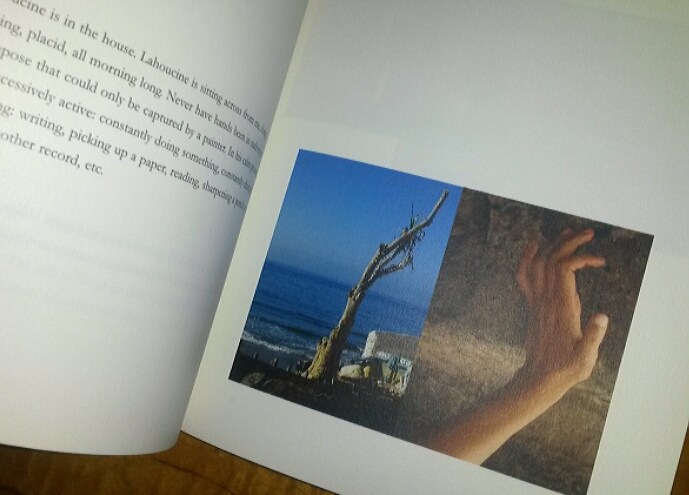
2016-05-19 21.41.06The title piece is the earliest in the book. Recorded in 1969 when the author was in his mid-50s, “Incidents”, as the name implies, captures moments from an extended stay in Morocco through an incidental series of fragmented encounters and experiences. Here, people form the scenery; with a special attention reserved for young men. Barthes demonstrates a a particular eye for detail (and somewhat of an obsession with hands) in these passing observations, combined with an acute sensitivity for scents and colours. The vibrancy, shades and contrasts of the country come alive. As a reader you become aware of the blinding light, the dark shadows–they are not described, you sense them in the background.

A young black man, wearing a crème de menthe-coloured shirt, almond green pants, orange socks and, obviously, very soft red shoes.

A handsome, mature looking young man, well dressed in a grey suit and a gold bracelt, with delicate clean hands, smoking red Olympic cigarettes, drinking tea, is speaking quite earnestly (some sort of civil servant? One of those who track down files?), and a tiny thread of saliva drips onto his knee. His companion points it out to him.

Some young Moroccans–with girlfriends they can show off in front of–pretending to speak English with exaggerated French accents (a way of hiding the fact without losing face that they will never have a good accent).

The art of living in Marrakesh: a fleeting conversation from open carriage to bicycle; a cigarette given, a meeting arranged, the bicycle turns the corner and slowly disappears.

The Marrakesh soul: wild roses in the mountains of mint.

The third essay, “At Le Palace Tonight . . .” is a tribute to a Paris club in a converted theatre. He describes the ornate detail, the mood and the atmosphere of this place where he seems to almost prefer to be an observer, watching the dancers and the human interactions rather than taking part. And as in the first essay, we find once again a wonderful evocation of light, this time light as informed by the interior of a structure:

Isn’t it the material of modern art today, of daily art, light? In ordinary theatres, the light originates at a distance, directed onto the stage. At Le Palace, the entire theatre is the stage; the light takes up all the space there, inside of which it is alive and plays like one of the actors: an intelligent laser, with a complicated and refined mind, like an exhibitor of abstract figurines, it produces enigmatic shapes, with abrupt changes: circles, rectangles, ellipses, lines, ropes, galaxies, twists.

This collection closes with “Evenings in Paris” a series of journal entries from 1979 that open with words Schopenhauer wrote on a piece of paper before he died: “Well, we’ve escaped very nicely.” The Barthes who comes through in this selection is tired, often impatient with colleagues and irritated by noise. A certain loneliness and dissatisfaction underscore his descriptions of dinners with friends, failed attempts to win the affections of the younger men he covets, and an unresolved mourning for his beloved mother. Most nights he finds himself heading home alone, half despairing, half relieved, to settle into bed in the company of Pascal, Chateaubriand, Dante, or the echoing ghost of Proust. Although he still enjoys longingly watching attractive men, he has little patience for crowds or social functions. This is a heavier, more emotionally intense offering, the intimacy of “the immediate” weighs heavily as Barthes commits his thoughts to paper, unaware in the writing as we are in the reading, that he is nearing the end of his life.

2016-05-20 02.33.11And, because he is recording the ordinariness of the daily encounter of the self with the world, there is the possibility of shock waves that ring down the years with a new intensity in light of the incidents (that word again) that have unsettled Paris in recent years:

The guy who sells Charlie-Hebdo walks by; on the cover in the publication’s idiotic style, there’s a basket of greenish heads that look like lettuces: ‘2 francs the head of a Cambodian’; and, right then, a young Cambodian rushes into the café, sees the cover, is visibly shocked, concerned, and buys a copy: the head of a Cambodian!

Not without a little social commentary, even in a deeply personal journal, Roland Barthes, remains ever relevant down the years.

Reading Incidents is, in itself, a sensuous experience, it is doubly so in this edition from Seagull Books. With a sparkling fresh translation by Teresa Lavender Fagan and illustrated with the evocative photographic images of Bishan Samaddar, this collection of writings becomes one that can, as Barthes himself would have intended, be savoured.

Peace for the soul: Sebastian Dreaming by Georg Trakl

Mother bore the babe in the white moon,
In the shadow of the walnuts, ancient elderberry,
Drunk on poppy juice, the lament of the thrush;
And silently
A bearded face bows with compassion over her

Quietly in the dark of the window; and the old chattel
Of ancestors
Lay broken up; love and autumn reverie.

Layout 1So begins “Sebastian Dreaming”, the centre piece of the second and final collection of poems prepared for publication by Georg Trakl during his lifetime. His first collection, Poems (Gedichte) had been published to warm reception in 1913, but, one year later as he was awaiting the release of this volume, he received word that the war would indefinitely delay all further publications. It is thought that this news, in conjunction with the mental and emotional stress he suffered working in the dire conditions of a wartime military hospital, contributed to his early demise. On November 3, 1914, he was found dead of a cocaine overdose. He was twenty-seven years old.

Sebastian Dreaming (Sebastian im Traum), represents the second book of Our Trakl, a three part series of new translations of Trakl’s complete works by American poet and translator James Reidel. Recently released by Seagull Books, this volume joins Poems, which was published in 2015. True to form it is finely crafted and beautifully presented. Although the poems here have appeared in other compilations, and editions of selected works, Reidel contends that this book deserves to be read, as Trakl intended, as a single volume. As with Poems, the reader is invited to spend time with the work as a whole, to engage with Trakl’s fractured, dream-like vision.

In an earlier review of the first volume of this series, I traced an overview of Trakl’s life and included links to Reidel’s essay about this project in the journal Mudlark. The elements of Trakl’s poetry, and the challenges facing the translator, are perhaps even more strikingly evident in this book. The motifs that dominate his first collection – rural landscape, nature, colour, signs of life, images of death and the abiding presence of his beloved sister Grete – are all here, but there is a more restrained and disjointed feel to many of the pieces. This reflects, according to Reidel, Trakl’s continuous efforts to try to pluck poems out of his experience, efforts that fall apart and lead him to return to the same images and motifs repeatedly:

“Indeed, translating him is like finding ones footing on the blue glass mountain of fairy tales—with Grete the princess within. The great irony, for me, is that the constant improvements, revisions, and corrections are in keeping with Trakl’s method, with all his obsessive autumns, black birds, neologisms—and in that same spirit—his Schwesterei, his sistering his poems, his madness, decay, and constant sense of downfall and sunset and the like. There is in Trakl a constant reworking, a constant revisit to the same forest, to see the same blue deer, and so on, to the same working poems to see them in the right light, or, more often, the right gloom.”

As a reader coming to this work, I am neither inclined nor qualified to enter into a critical assessment of Sebastian Dreaming or the translation at hand. Other translations of Trakl’s poetry are available and I do not believe that any one translation is superior to another, especially with poetry, although readers, with or without an ability to approach the work in the original, are bound to have preferences. The first version of a piece encountered? The one that sounds most pleasing in English? The translation that is most exacting in content and form to the German?

As noted in my earlier review of Poems, Reidel indicated in his introduction to that volume that his intention is to try to capture Trakl in a sense that would be as close as possible to the experience of the original reading, keeping in mind the time and the influences that would have shaped his work. As he explains, “I want to actually channel Trakl, his craft (with its implicit painterliness) and work ethic, to have him, so to speak, absorbed in the right dosages he – as a poet, pharmacist and addict – intended.” The care and sensitivity Reidel has brought to his work comes through, touching the reader across the century that has passed since the poet’s death.

Sebastian Dreaming is divided into five sections. The final part, consisting of one longer, magnificent prose poem, “Dream and Benightment” (previously translated as “Dream and Derangement”) stands as my personal favourite, given my current fondness and attraction to the form. It is an intense and powerful piece:

Hate scorched his heart, lust. Then he stepped into the green of the summer garden in the guise of a silent child, in whom he recognized his benighted face shining. Woe the evening at the window, when a grey skeleton emerged from crimson flowers, death. O, you towers and bells; and the shadows of the night fell upon him as a stone.

The poems in this book are charged, if possible, with a more sombre atmosphere than his earlier collection. The sadness comes through clearly and lingers. The recurring themes are visited from varying angles and directions. One can sense the poet trying to focus his vision while over it all hangs the eerie premonition of death that will soon be freed from the pages and realized by the increasingly discouraged and depressed writer.

I will leave you with a complete taste from this collection, in the form of this striking, spare poem:

Peace and Silence

Shepherds buried the sun in the leafless forest.
A fisherman pulled
The moon from the freezing pond in a net of hair.

In the blue crystal
Lives the pale man whose cheek rests against his stars;
Or he nods his head in crimson sleep.

Yet the black flight of the birds always stirs
The beholder, the saint of blue flowers,
The stillness near recalls forgotten things, extinguished angels.

Once more the brow nights over the lunar stone;
A shining boy
The sister appears in autumn and black corruption.

Georg Trakl’s Sebastian Dreaming: Book Two of Our Trakl, translated by James Reidel, is now available from Seagull Books.

Painting the world with words: Atlas of an Anxious Man by Christoph Ransmayr

“I saw a jet-black darkness tattooed with countless dots of light above me, an apparently boundless firmament stretching out to the deepest universe, while I lay on the bottom of a rowing boat that a Maori ferryman pushed through the night with the strokes of his oar.”

Layout 1Thus begins “In Space” one of the 70 episodes collected by Austrian writer Christoph Ransmayr in his unconventional and utterly captivating Atlas of an Anxious Man, newly released from Seagull Books in a translation by Simon Pare. Seemingly caught in a dreamscape somewhere between travelogue and memoir, he leads the reader on an unforgettable journey that stretches across the globe in a series of evocative vignettes. Such as the one quoted above which, we soon learn, is an account of a tour into a system of caves deep within mountains on New Zealand’s South Island. The night sky Ransmayr is lying beneath is an illusion created by the luminous larvae of a gnat species clinging to the cave ceiling. Insects that mistakenly fly up toward the false heavens are soon snared in a web of sticky silken threads and become nourishment for the growing larvae. Nestled securely within the bottom of the boat, the author goes on to recount a frightening experience from earlier that same day as he made his way through a high mountain pass to reach this site:

“After snow had begun to fall in large flakes just before the top of the pass, my rental car, not equipped for wintry conditions, began to slide backwards – backwards! – with churning wheels down an already snow swept rise towards the edge of the road and a rocky slope. The slope was so steep that my car seemed destined to somersault over and over down to a mountain stream far below, running black and silent towards the valley bottom.”

He is about to jump and let the car go on without him when it comes to a stop perilously close to the edge where passing trekkers find him and tow him to safety with their jeep. In four pages we are treated to both the wonders and the terrors of nature, narrated with the skill and confidence of a gifted storyteller.

Each episode begins with an observation: “I saw an open grave in the shade of a huge araucaria pine” or “I saw a fisherman cursing as he steered for Baltimore harbour in the south-west of Ireland” or “I saw a three-toed sloth on the veranda of blue wooden house on Costa Rica’s Pacific coast” or “I saw a naked man through binoculars from my cover behind dusty firethorn bushes.” Even a tale that seems to begin with a most ordinary descriptive passage becomes, before you know it, an engaging portrait of a place, an experience, a character. Ransmayr has an uncanny ability to focus his lens on the small details to bring a location, a time, an event to life.

The 70 entries follow neither chronological nor geographical order, and occasionally he even slips back in time to capture experiences from his own life in Austria, reaching as far as the age of three with the account of a storm that lifted the roof off his house when he was watching his mother hang wet laundry across the attic room. Whether he is observing a bird on a remote rock face, watching a man tee off at the North Pole, describing a bullfight in Spain, or trekking through the Himalayas; he is never a disinterested observer. His engagement with the people, creatures, and landscapes he encounters is always curious but respectful. In the waters of the Dominican Caribbean for example, he floats among the waves watching a humpback whale cow and her young sleeping far below. When the calf suddenly breaks free from its mother’s protective shadow and heads up for the surface, Ransmayr panics as the parent rushes up towards him in pursuit. She comes close enough that he can see the iris of her eye:

“The giant looked at me. No, she brushed me with her gaze and altered her course by a hair’s breadth, just enough that we didn’t touch each other. Yet although she avoided me with this hint of a deviation, and therefore recognized and acknowledged my existence, I discerned a complete indifference in her look – akin to the mountain’s toward someone climbing it, or the sky’s toward someone flying through it – that I was overcome by a feeling that I would dissolve into nothing before these eyes, disappear before them as though I had never lived. Maybe this Atlantic giant in black had actually swept up from its realm in the deep to convey to an Atlantic swimmer how rich and varied, unchanged and natural the world was without him.”

His travels typically take him to the far reaches, off the beaten track, to locations accessed on foot, or by bicycle, assorted boats, tour buses, rental vehicles and more. He explores history, lifts his telescope to the heavens, and encounters politically tense environments. No two entries are the same, few extend beyond 6 to 8 pages, some are only 2 or 3 pages long. I found it best to take my time with this book, reading a few entries a day and allowing the awe to linger. This is not an ordinary travelogue by any means, but it is a shimmering example of what makes the best travel writing sparkle. The theme, if there is one, that unites and drives the narrative from beginning to end is possibly simply wonder. Not that Ransmayr is blind to the poverty, suffering and threats he encounters. His immediate reactions are sometimes frustration, even fear, but he manages, remarkably to find a glimmer, an image, a thought that affirms life, no matter how small or seemingly insignificant.

However, what really makes this book such a joy to read is the sheer beauty of the language and the author’s ability to weave his experiences and observations into stories that are moving and original, time and again. I’ll leave you with end one of my favourites in which he tells of emerging from mangrove swamps in Sumatra to encounter, in a clearing, a building on stilts. On the patio a man is singing with a karaoke machine, but his only audience is composed of the geckos clinging to the roof. Ransmayr takes a seat and as he listens to the singer perform the Rolling Stones’ “Love in Vain” he is transported back to a snowy night in Austria, a wedding and corduroy suits. Suddenly a lightening strike from an approaching storm knocks the power out. Oddly, the singer fiddles with the controls, seemingly determined to try to turn the machine back on until a thin man in a sarong appears and calls to him:

“The singer laughed. And then the thin man was beside him, took him by the hand and led him carefully down the stage steps and between the empty chairs and tables to one of the walkways, and I realized that the singer, who was groping for obstacles with his free hand, could not have seen the lightening and could not have seen how the neon tubes and control lamps had gone out, nor how night had fallen so suddenly over the mangroves, swallowing up swarms of insects and a tin sky with hundreds of geckos stuck to it. Karaoke. A blind man had sung to me out of the mangroves of Sumatra back to the village of my birth.”

Thank you to Seagull Books for kindly sending me on this journey.

Thoughts on Among the Bieresch by Klaus Hoffer

Sometimes, when I am reading a book that I know I will want to write about, my thoughts about the work at hand take form in the process of reading in a manner that will later inform and direct my review. Other times, the route from reading to writing is more circuitous. I tend to take copious notes, underline and engage with my books, but, having said that, there is always the risk of failing to see the forest for the trees (or more explicitly, failing to appreciate the text for the words). Then, when I sit down to write, no matter how much I may love the work at hand, I look back over my notebook and face too many words to sift through.

BiereschAmong the Bieresch, the long-standing German cult classic by Austrian writer Klaus Hoffer is a book that threatened to undermine me, as a reviewer, with its words – words that are supercharged with meaning and reference to a broadly expanding literary and socio-economic landscape. The beauty of this book is that it works on so many levels and now, with its recent release from Seagull Books, in an animated translation by Isabel Fargo Cole, an English language audience has the opportunity to meet and explore the singular world of the Bieresch.

My review of Among the Bieresch has been published by 3:AM Magazine. I am most grateful to Tristan Foster for his wise and patient editorial guidance as I floundered, at times, in my own words.

Closing out the old year with December by Alexander Kluge and Gerhard Richter

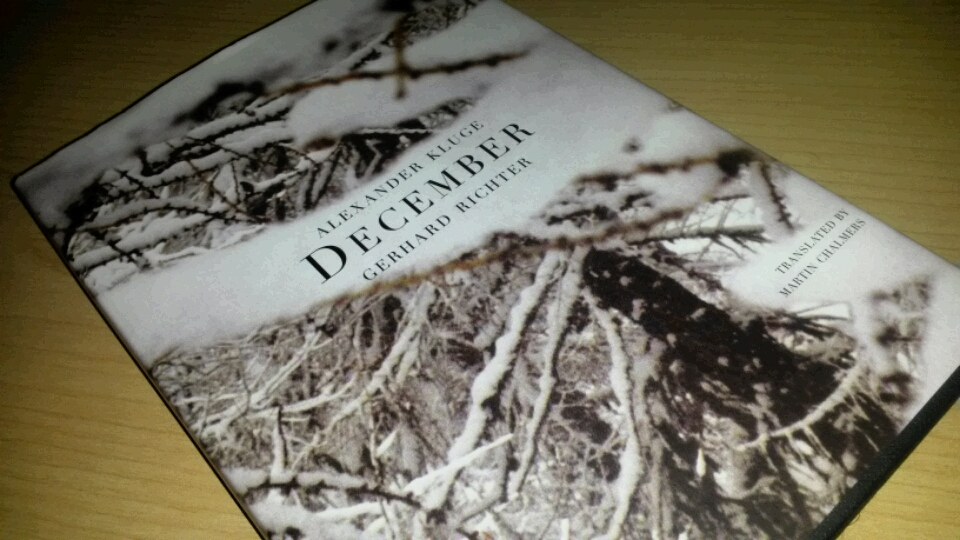
So, my first post of 2016 is a look at the last book I read in 2015. In truth I read it throughout the last month of the year, although not a little each day as intended, my father’s illness has interfered with all of my best laid reading plans of late. However I could not allow the year to draw to a close without finishing this book of calendar stories marking a passage through the month of December in the unique and inimitable style of Alexander Kluge, complemented by the haunting wintery forest scenes captured by Gerhard Richter.

2016-01-01 17.29.52This slim, elegant volume is my first encounter with the work of the German writer and film maker Alexander Kluge. The 39 stories, many less than a page long, are presented in a straightforward manner with a humour so subtle and wry that it simmers below the surface, blurring the perceptual line between history and speculation. Kluge offers a chronicle of an alternate reality so close to our own that it can catch you off guard. A flimic sensibility permeates each entry.

December is divided into two sections. The first part contains a series of dated entries, one story, or a cluster of stories, for each day. The years assigned to the dates vary. Many of the scenarios are set in or around the years of the Second World War. Others tend to be placed in the latter part of the first decade of the twenty-first century. But there are forays far back into prehistory and looking off to a distant future. Characters wander in and out from historical factual reality, war themes of conflict and destruction recur, as do images drawn from concerns about climate change and the fallout from the economic collapse of 2008. The ageless question of the nature of good and evil is a prevalent theme – “evil proves to be good displaced or straying in time” – as is the measure of the passage of time itself, whether measured on a global scale or at a much more personal, intimate level:

“The uncertainty, above all the lack of influence on whether and when someone will be struck down by the war, makes the soul bold. There is nothing to be lost any more.

So, after an air raid in 1944, which went on for hours, Gerda F. did not save herself up any longer. No thought of waiting for one of the returning warriors, whom she still knew and who would ask for her hand. She  didn’t want to get to know any better those left behind in the armament factories of the place. All were looking for closeness. She took a man who was passing through town up to her room. They never saw each other again. There was nothing about it that she regretted.”

The second, shorter section is titled “Calendars are Conservative”. They form a series of reflections on the way time – days, months and years – are recorded, calculated, and, as in certain situations such as during the height of the French Revolution, manipulated and distorted. The revolutions of the earth on its axis and the passage of the planet around the sun may be measurable with relative consistency, but that has not kept humankind from trying to understand, articulate and contain the progress of time, again in both the macro, political sphere and in the individual philosophical context:

“What manifests itself in my story, the story of a living person, is not COMPLETED PAST (what was, because it no longer is), also not the prefect tense of what has been in what I am but instead the OTHER of what I shall have been for what I am in the process of becoming.”

2016-01-01 17.32.15To spend a month, dipping in and out of the stories, anecdotes, and reflections Kluge has assembled to mark the end of the year is a treat. Although the images are often sombre, the atmosphere is contemplative. Gerhard Richter’s accompanying photographs enhance the measured tone. If you have ever experienced a day of heavy and unexpected snowfall, those days in the Northern Hemisphere that can bring all but the most essential services to a halt, granting a welcome reprieve from school or work for many; you will know how time can slow to a leisurely pace while the thick blanket of white muffles the day to day noise of the city. That is the sensation captured in the muted monochrome images of snow laden branches in silenced forests. This is the December we hope for but, caught up with the demands of year end and pressures of the holidays, frequently fail to achieve. A time to contemplate the past, for better or worse, speculate about the future and pull another calendar year to a close.

Translated from German by Martin Chalmers, December is published with the expected fine attention to detail by Seagull Books.

Winter solstice (again): 2015 – The year in review

I tend to run solstice to solstice, so this seems as good a time as any to pull together my thoughts about the year that was. I debated the conventional “best of” list affair, but somehow that is not reflective of the way I read or engaged with literature this year. I began the year still finding my footing as a book blogger, my earliest reviews tended to be less critical, more personal. By the end of the year I feel I have endeavoured to establish a more critical but, hopefully still accessible approach. Off my blog, it was an honour to cap off 2015 with my first review on Numéro Cinq where I have been invited to join the masthead. I am most thankful to Douglas Glover, the fine editor of this fine magazine, for having faith in my ability to write.

8294617299_b22c0cd186_z(1)I read and write about books as a an effort to strengthen my own skills both as a reader and a writer, but behind it all is a writing project of my own that has been struggling its way into being, seemingly with an infinite number of forays down paths leading to dead ends. So the following is a review of the year and, along the way, a nod to some of the books, new and not so new, that kept me company.

Reading in translation: I have typically read widely, but I never stopped to focus specifically on literature in translation, or, for that matter, to even think of much that I did read as being translated – sounds odd, I know, I think I just thought of myself as someone who tended to read internationally. Joining a shadow jury for the IFFP and then devouring as much of the BTBA long list as I could manage was, for me, a significant turning point in the way that I saw and focused my reading. My books are now shelved (or stacked) by original language. Apart from English I read books in 20 languages over the past year; German, French, Afrikaans, Czech and Spanish topped the list.

istrosIndependent and not-for-profit publishers: This year I became more conscious about looking to and supporting independent publishers. I was already well aware of Istros Books, a small UK publishing house dedicated to bringing Balkan and Central European writers to an English speaking audience, but this year I had the pleasure of meeting with publisher Susan Curtis, and visiting her closet sized office in the heart of London. She has been a most supportive influence in my development as a reviewer, and because I believe in their books and trust her instincts as an editor, I always look forward to their new releases. I also became conscious of other publishers including And Other Stories, Twisted Spoon, and Two Lines Press, just to name a few. I would reckon I bought few books from major publishers over the course of the past year, and trust me, I bought a lot of books!

2015-10-22 11.21.29Seagull Books: Here I have to credit (or blame?) Anthony of Times Flow Stemmed for bringing Calcutta based Seagull Books to my attention in recent months. I may be late to the party as they seem to have a core of passionate devotees. A book from Seagull is, quite simply, a finely crafted treasure, a reminder why books will never be supplanted by their electronic versions. They are also willing to take on authors or works that other publishers often balk at as witnessed by their impressive German, Swiss, French and African literary offerings, but any publisher who can transform a child’s tale by Thomas Bernhard into a huge, gorgeous picture book for all ages is alright by me!

23818667295_d1e4f92c94_zSouth Africa: I have had a significant interest in the literature of South Africa for a number of years but this spring, feeling especially isolated and unhappy in my present circumstances, I decided, rather suddenly, to visit the country for the first time. I aimed for the solstice, effectively trading what would have been summer solstice here in the north for winter solstice in the southern hemisphere. I spent time with a dear friend in the Eastern Cape, then kicked around Cape Town and dropped a small fortune on books.

An ending does not give a life meaning: On my last full day in Cape Town, I sat in the Company’s Gardens, took the notebook I had carried and scribbled in, back to front as is my habit, throughout my journey; opened it to the first page and began to write. I felt I had reached a point, perhaps of closure, a space in which to truly start to pull together my endless personal writing project. I was certain I could, from that vantage point, look back over the months to June of 2014 when I walked away from my job, wildly manic after a period of unbearable workplace stress, and finally begin to give shape to that story I had been trying to tell for so long. I was at an end, of sorts, so I thought, and now I could work back.

14344933323_66912ab5a8_zBut I was wrong: Just over two weeks after I returned home, a pulmonary embolism I had unknowingly developed, a souvenir most likely of my recklessly long flight back, triggered cardiac arrest – in my sleep. The quick response of my son, who happened to be home, saved my life. I nearly reached that “end”, not the one that I imagined would be the point at which I could render my particular life experience and write some meaning into it, but an end final and complete. One that would have left me mute, distorted in the memories of those who have known me. The story would no longer be mine.

So what of writing? That is most critically the end to which I read, seeking ways into a story, or stories, I that need to be able to explore – to ultimately put behind me. I can write easily about other people’s words but I choke up on my own. And so the following list of books are those which spoke to me this year as a reader and a writer. I read over 90 books and enjoyed many including: the long overlooked Hansen’s Children by Ognjen Spahic, Ivan Vladislavić’s Double Negative, While the Gods Were Sleeping by Erwin Mortier, Can Xue’s The Last Lover, Marlene van Niekerk’s monumental Agaat, not to mention her wonderful Swan Whisperer from the Cahier series, and  Primeval and Other Times by Olga Tokarczuk. I have, by the way, excluded from this accounting a host of writers I expect to like and therefore read regularly, often repeatedly, including Bernhard, Sebald, Borges, Coetzee, Damon Galgut, and, added to the group this year, Bohumil Hrabal.

But the following books were, for me, the most vital. Thbirdse order is chronological, as read:

The Alphabet of Birds (And Other Stories) S J Naudé (Afrikaans/tr. SJ Naudé)
* This debut collection, of long, simmering, often disturbing, stories is simply some of the most sensuous work I have ever encountered. The characters are typically groundless, searching South African ex-pats, uncertain residents trying to find their place, and or those suspended somewhere in between.

atavisms


Atavisms (Dalkey) – Maxime Raymond Bock (French/tr. Pablo Strauss)
* The thirteen stories that make up Atavisms reach back hundreds of years, stand in the present, and spin into the future to explore the Québécois experience – at the personal and the political level. Bock skillfully employs a variety of genres to create what reads, in the end, as a mulit-facetted yet cohesive whole. Most impressive.


The Elusive Moth (Open Letter) – Ingrid Winterbach (Afrikaans/tr. Iris Gouws & Ingrid Winterbach )
* This novel about an entomologist in search of some way to fill or heal an ache that even she is at pains to articulate becomes an evocative exploration of memory, loss and anxiety. The story unfolds through scenes that repeat motifs, imagery, and fragmented conversations; set against racial tensions building in the small town where she has come to conduct research. The result has an unforgettable cinematic, art film feel.

 On Wing (Dalkey) / Signs & Symptoms (Twisted gal_on-wingSpoon) – Róbert Gál (Slovak/tr. Mark Kanak/Madelaine Hron)
* As I have tossed my own writing goals between fiction and memoir, happy with neither, I had sensed that an experimental approach might be part of the mix. However I had been frustrated with many of the works I had encountered – at least in so far as they spoke to me in a meaningful constructive way. With On Wing and then Gal’s earlier Signs & Symptoms I finally encountered works that I could enter into with my own observations and begin to map out ways of talking about the essentially philosophical issues I want to address. Re-engaging with philosophy years after my formal studies in the field, has also been critical to framing the way I view the essentially ontological questions I wish to articulate. So I am most grateful to Róbert for both his writing and his encouragement.

A Sorrow Beyond Dreams (Farrar Straus and Giroux) – Peter Handke (German/tr. Ralph Manheim)
* This 69 page memoir, Handke’s finely wrought tribute to his mother written within months of her suicide at the age of 51, not only paints a careful and delicate portrait of a woman trapped by her circumstances, but offers reflections on the challenges of telling a true story – distilling an entire life to the essential elements – when it might be easier to simply make up stories, to, say, write a play. A whole life is messy to write about with elegance. Handke succeeds.

dreamhorsesA Dream of Horses & Other Stories (Roundfire Books) – Aashish Kaul
* This is a collection of dreamscapes populated by seekers of truths, purveyors of words, storytellers and readers. Most of the protagonists are writers, negotiating the fine balance between truth and imagination, struggling to capture the point of intersection in words. At least in my own experiences as a writer, or would-be-writer, that is what spoke to me throughout this melancholy, impressionistic book. And that is why it has to be on my list.

Vertigo (Dorothy Project) – Joanna Walsh
* Short story collections dominate my favourite books this year. It was an intentional focus, again with an eye to becoming more confident with medium. To that end, I recognize that the stories I am drawn to tend to have narrative arcs that are less pronounced, or more subtle, than some may like. The writing is typically more evocative, more ambiguous, more difficult to define and pin down. Like Vertigo – brutally sharp, spare and gorgeous, cutting to the quick of everyday life – an exquisite piece of work.

Dry Season (Istros Books) – Gabriela Babnik (Slovene / tr. Rawley Grau)
* I read many fine and challenging works from Istros Books this year, but the most stunning and devastatingly original has to be the EU Prize winning novel Dry Season. This tale of a love affair between a 62 year-old Slovenian woman and a 27 year-old man from Burkina Faso breaks every expectation, weaving African magical realism into a layered metafictional narrative that culminates in an ending so unexpected that it suddenly throws everything into a new light. Or does it?

sleepSleep of the Righteous (Two Lines Press) – Wolfgang Hilbig (German/tr. Isabel Fargo Cole)
* 2015 saw the release, for the first time in English, of two works by the late German author Wolfgang Hilbig – both championed and translated by Isabel Cole (The other, I, from Seagull Books is waiting on my shelf.) The magic of this collection, set in East Germany before and after re-unification, lies in the atmosphere created by the long sentences that flow, like a stream, back and forward again. Starting grounded in a harsh reality the narratives slip into a subtly surreal, gray-toned, world where reality blurs at the edges and memory takes on a haunting, dark quality.

Adventures in Immediate Irreality (New Drections) – Max Blecher (Romanian/tr. Michael Henry Heim)
* It may well be that my most memorable read of the entire year is one of the last – an impulse buy if I can be honest. A prisoner of the plaster body casts that were the standard treatment of spinal tuberculosis, Blecher’s creative imagination penetrates the experience of being in the world at the level of minute, intimate detail and manages to capture with acute sensitivity those moments of reality in flux and flow. I don’t know how unique this way of interacting with the world is, but as someone who has always had a discordant, dysphoric relationship with his own body, there is more for me, personally, in this book than I can begin to express. A fine closure to a year of excellent reading experiences.

Finally I am most grateful for the conversation and company of the book bloggers and twitter literary folk with whom I have been so fortunate to engage over the past year. I have a dearth of book lovers in my real life. I was at a Christmas party the other night and a game was played in which we were each to share our three worst Christmas gifts – two true and one lie. I was saddened how many people included books among their worst gifts ever. Breaks my heart. Bless you all for keeping me (somewhat) sane.

Honouring the unwritten: The Loss Library and Other Unfinished Stories by Ivan Vladislavić

“Not writing is always a relief and sometimes a pleasure. Writing about what cannot be written, by contrast, is the devil’s own job. Yet words on a page make all things possible.”

Central to this collection of brief odes to the fictional inspirations that once planted, failed to germinate, refused to take root and grow, or died off before even hitting the soil; is one full and essentially complete story – the magical titular “The Loss Library”. Surrounding this tale, to either side on the book shelf of South African author Ivan Vladislavić’s imagination lie a selection of meditations on the curious nature of the creative process and the many ways that an intriguing idea can lose its way on the path to realization, finding itself shelved in the place of the might-have-been, filed away in a writer’s own personal loss library. Looking back at the notes and outlines he explored during the late 1980’s and early 1990’s, the unsettling years of transition from apartheid to a democratic state, Vladislavić notes that his inspirations tended to arise from documentary sources – the past perhaps seeming more sound than the bloody history being made on the streets of his country at the time. Moving forward, within the scope of the “case studies” selected for this book, the pieces and fragments he gathers turn to dictionaries, reference materials and the “means to read and write – or not read and not write – books.”

2015-12-09 15.08.34But let us begin in the middle, at “The Loss Library”. With a clear nod to Borges, the master of the library of the imagination, a young man arrives at a most unusual archive, a repository of the all of the unfinished works, possible and impossible of all the writers who have ever lived. He is greeted by an attractive librarian. Fit and tanned she is the antitheses of what he expects. As she guides him into the library she first steps into slippers and advises him to do the same. They literally glide across the polished floors of the rooms and corridors as she directs his personal tour of the premises. The first room contains a single glassed in cabinet containing the books that would have been written had their would-be authors not chanced to die young:

“‘Arranged alphabetically and classified by cause of death.’ A wave of her slender hand. ‘Accidental death. Booze, of course. Disease – those old standbys, consumption and syphilis, and the new one, AIDS, a growing collection. Duels – little sign of growth there. Motor accidents. Murder. Suicide. A disproportionate number of Russians and Japanese, as you’d expect, and quite a few of your countrymen and women too.’”

As our protagonist leans in for a closer look, he can recognize no words on the spines. He tells the librarian he is looking for Bruno Schulz. Filed down with the war dead, six little volumes are found but he is not allowed to see them… after all, opening such a book could have consequences in all the others, in essence I suppose, the way fiddling with the future given access to a time machine might. In this library of potential works, one can’t risk having people “talk them into being.”

2015-12-09 15.02.54Together they encounter a room filled with books that remain unwritten because their authors lost faith in them, and he is shown a collection of the books that lost their way or were talked out of existence before they had a chance to be realized. They pass through a room containing books that were destroyed, stop at a shelf of books that comes into being by evocation of the proper author’s name (any guesses?) and, finally, enter a room of floating, ghostly, ethereal books – those that presented themselves to their would-be writers in dreams. In the end, is this excursion through the Loss Library a fantasy, the beginning of book that the young man himself will write into being, or another story that might have been, relegated to the back of a notebook, the bottom of a drawer or, in this day and age, lost somewhere on a hard drive?

Returning now to the startling opening essay, Vladislavić describes his attraction to the famous photograph of Robert Walser lying dead in the snow on Christmas Day, 1956, and reflects upon the way that the isolated image fueled his imagination before had even read any of Walser’s work. He contemplates writing a story about the writer’s last days, about that fateful final walk, the curious absence of footsteps or bystanders around the body, the precision the photographer must have employed to capture this solemn record, and with particular fascination, the dead man’s hat lying in the snow. However, before he sits down to write, Vladislavić engages in a little research and finds another photograph, taken from a different angle. From this vantage point he can now see many footprints in the snow, two men off to the side, and realizes that even the hat has fallen differently than he imagined. The curious, romantic and uncomfortable questions – the necessary elements of the creative process – are shattered.

As he continues to rifle through the pages of his notebooks, Vladislavić explores a variety of mislaid ventures, the inspiration or ideas behind them and the reasons they fell off the rails or, perhaps, only flickered for a moment or two. “Gross”, an intended venture into the land of the OuLiPo in which he set for himself a series mathematical constraints within which he would construct a novel, proves unsuccessful. Along the way, the character he was creating to take centre stage, morphed into someone else who would, ultimately wander off to join the cast of another novel,The Restless Supermarket, but more critically, he found himself completely overwhelmed by the prospect of the challenge he had set and decided that this type of approach was best left to Perec, et al.

In a later example, he describes his fascination with an unassuming sign on the side of a building in his Johannesburg neighbourhood that simply reads “Gravity Addict” with a phone number. He begins to wonder what a gravity addict is and how that might be imagined in a story. He thinks about the post 9/11 performance artist in Don Delillo’s The Falling Man, contemplates the structural format of that novel, and eventually imagines a woman, an aspiring writer, sitting on her sofa watching endless episodes of old cartoons – the ones where characters repeatedly chase each other off the edge of cliffs – and then, when one day the innocuous meaning behind the mysterious appellation “gravity artist” is revealed to him, his interest in the story instantly dissolves and he can go no further.

Finally, in light of the recent re-release of Vladislavić’s first novel, The Folly, the story “The Acrobats” special attention. In this outline for a story we see a man in a library reading a book. At some point he closes that book and retrieves a copy of Tristram Shandy from the stacks. He seeks out a particular passage which in turn, is a lengthy quotation from Gragntua and Pantagruel by Rabelais, so he stops and wanders off to fetch that text and goes on to read from the original, or rather a translation of the original, the same quoted passage describing the wild acrobatic exploits of Gymnaste, performed on horseback, as he faces down an enemy combatant. As such, Vladislavić envisions a post-modern inversion of a book within a book within a book, the initial level being, of course, at once the book that both the man and his reader are reading. However, the idea is set aside, in part due to the complication of modern versus contemporary translations of the nested passages.

Several years later, in the writing of The Folly, Vladislavić sees his character Nieuwenhuizen, the eccentric stranger who arrives out of nowhere to take ownership of and build a house on a vacant lot, as a direct descendant of Gymnaste. As he marks out the foundation of the ephemeral house that he will ultimately construct out of imagination and thin air, Nieuwenhuizen engages in his own acrobatic measurements, leaping, somersaulting, and throwing himself around the lot. Could the earlier story now be revived, with The Folly as the third book in the line, he wonders, could he develop the idea that his “ostensibly post-modern novel stood in a pre-modern tradition”? Ah, but for the paradox that his outline for “The Acrobats” was written three to four years before The Folly, how could a story refer to a book that had yet to be written?

Yet Vladislavić was, it would seem, not quite done with his potential story. Several years later he encountered the 18th century French writer, Diderot, who was a contemporary of and acquainted with Laurence Sterne. Although the publication of Rameau’s Nephew would arise through a circuitous route, there was an indication apparently, that Diderot’s initial sketches for the eccentric, rambling character who engages the narrator of his novel could have roughly coincided with the publication of Tristram Shandy. Now he wants to fictionally trace the lineage of Nieuwenhuizen from Sterne via Rameau… except for a new paradox that arises. The Folly was written before his discovery of Rameau’s Nephew. How could his own novel be influenced by a work he had not read?

In his note at the end of this account of the stubborn death of a story idea, Vladislavić can look back and recognize that, as a young writer, he demonstrated too great a concern with precedent. Wiser now, he remarks:

“Every writer belongs to one bastard bloodline or another, and laying claim to one can be a liberating lesson in perspective. But standing on the shoulders of giants is a skill that comes from long practice. When you start out, you are more likely to get under their feet. Don’t be surprised if the giants – or their legitimate progeny – come stomping after you in the playground: ‘We walk straight so you better get out of the way!’”

And herein lies the true gift of this slender collection of artistic musings,and inspirational dead ends – the insertion throughout of the author’s updated reflections on his varied false starts. There is no writer or would-be writer who does not have an accumulated hoard of ideas, outlines and abandoned projects. If they don’t, one ought to be suspicious.

Wandering through The Loss Library and Other Unfinished Stories is a rare privilege to spend time in the company of a thoughtful, gifted writer who truly appears to be without pretensions. This journey, contained within the covers of a finely crafted hardcover from the singular Seagull Books and accompanied by the original collages of Sunandini Banerjee, is a wonderful way to spend an afternoon, and treasure to return to time and again. After all, there may well be, within these pages, the inspirational seeds of other stories just waiting for the right gardener to plant them and bring them to fruition.

A look at two winter treasures from Seagull Books

It may not be winter by the calendar (yet), but here, where I sit, north of the 49th Parallel and west of the Rocky Mountains, it is a perfect wintery day. The snow has been falling, no too much to be fair, but the wind has been playing with it, sweeping it into drifts and coating the roads with ice. A good day for a good book.

2015-11-24 20.04.02

In recognition of the German Literature Month reading project that is drawing to a close this week (a growing list of over 120 reviews contributed by participating bloggers can be found here) I wanted to call attention to two very special books that not only feature German authors, but celebrate the book as a work of art. Both have winter themes and are published by Calcutta based Seagull Books.

Victor Halfwit: A Winter’s Tale by Thomas Bernhard is a short fable lavishly illustrated by Sunandini Banerjee. Listed in the Seagull catalog as “Children’s Literature”, I would suggest that this is, aside from being an opportunity to introduce a child to Bernhard early (and who would not want to do that?), a book to speak to the child inside. The story is essentially classic Bernhard. On a cold winter’s night, a physician crossing through the forest on his way to see a patient, stumbles, quite literally over a man lying in the snow. This man with the improbable name of Victor Halfwit is legless as the result of an accident and now, most unfortunately, his wooden legs have “snapped in the middle, as wooden legs do”, leaving him helpless and facing a miserable end. He had been on an ill-conceived attempt to win a bet with a miller who had wagered that he, Mr. Halfwit, would be unable to make his way from Traich to Föding, through the snowy forest, in just one hour, on his wooden legs. The faint chance of winning 800 schillings – the price of the finest pair Russian leather boots, something he had long desired – was too tempting, so Victor took the bet and nearly proved the miller right. Almost. But then, even a happy ending would not be without it’s bitter dark irony. This is Bernhard after all.

Taking a sentence or two at a time, this tale is presented in the company of rich, glorious collages. Drawing inspiration from famous artworks, medical illustrations, Indian imagery, playful designs and so much more, each page turned presents a new, original background to compliment the passage in quite unexpected and infinitely wonderful ways. I will confess that I ordered this book without paying much attention to the description. I knew it was Bernhard, I knew it was illustrated, but I was completely – and happily – caught off guard by this large, most gorgeous book when it arrived in the mail. I had expected something special, but honestly I had imagined something more modest. As a gift for a Bernhard fan or a lover of visual arts, or for yourself, let’s be honest, I would heartily recommend this book.

December is a take on the tradition of calendar stories that pairs 39 short texts by German writer, film director and critic, Alexander Kluge, with 39 haunting photographs of wintery forest scenes by Gerhard Richter. Included in this collection is a story for every day in December. Some are set during the war years, others in the 2000’s; some appear to have a straight forward historical tone, others seem more experimental in form. I can’t actually say because I intend to read this book throughout the month of December. Each entry is short, no more than a couple of pages at most. I bought this book with a gift card my daughter gave me for my birthday, thinking that it would be a welcome companion for the dark days – in a practical and an emotional sense – of December. Like many, I find it to be one of the most difficult times of the year and I look forward to exploring this work as the month unfolds.

Victor Halfwit: A Winter’s Tale and December are both translated from the German by Martin Chalmers and published by Seagull Books.