Each person has their own star: The Fiancée Rode in on a Donkey by Vénus Khoury-Ghata

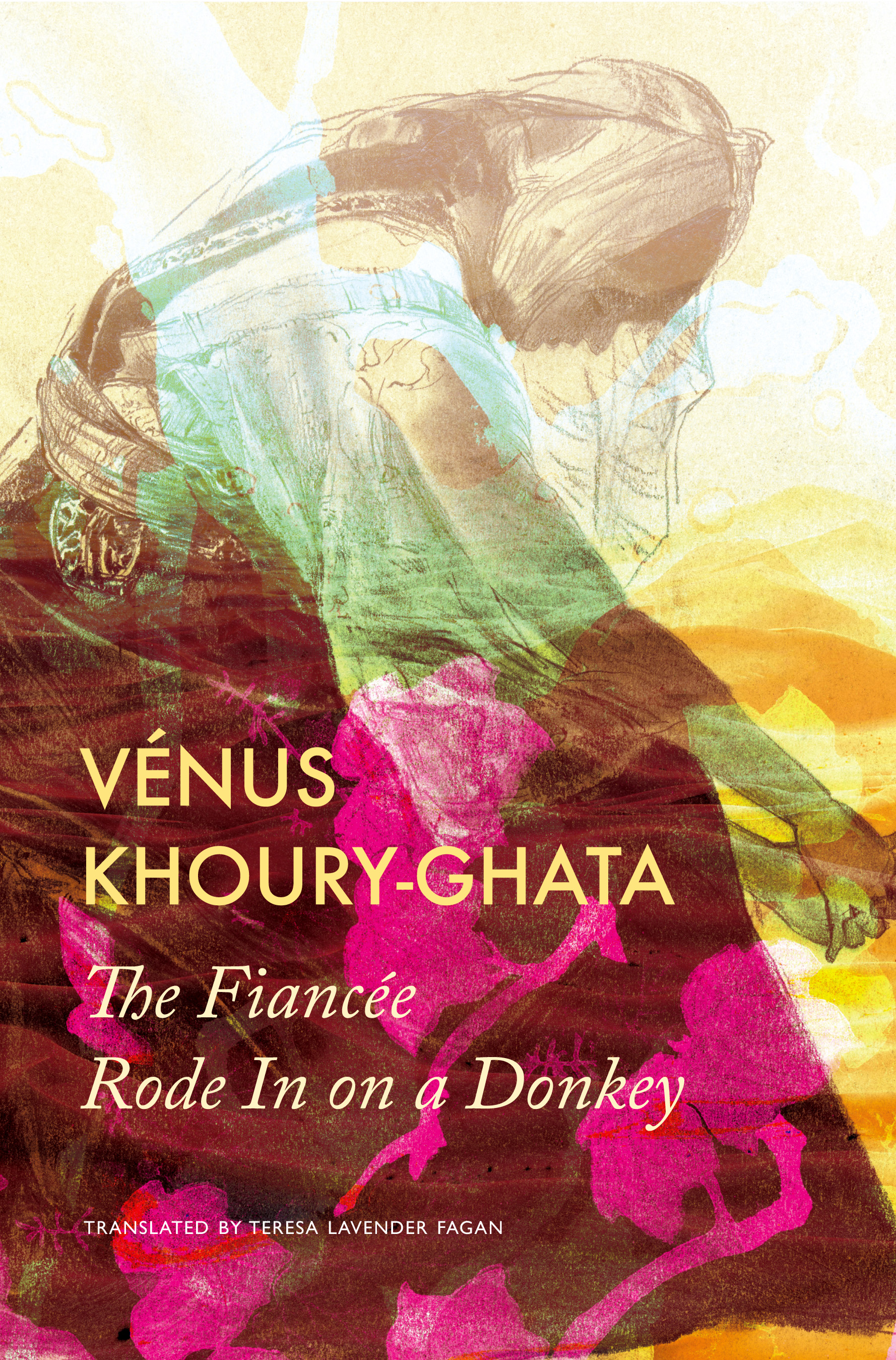
Deep in the desert, excitement is building. Among the Qurayza, a Jewish nomadic tribe, young girls are being readied for the arrival of a special visitor. An important rabbi is coming to select a bride for the great Algerian military and religious leader Emir Abdelkader. He has wives already, of course, but another, a Jewish girl, is to be offered to secure protection for her people.  For the girls, scrubbed and polished and hennaed, to be chosen would mean a chance to escape a prison of sand for a better life. Or so everyone believes.

Just one look around is enough for the rabbi to find the chosen one. He picks Yudah for her name, a contraction of Yahuda, and for her eyes which she lowers when he looks at her. Every woman is beautiful to the rabbi as long as she isn’t one-armed or one-eyed.

Each one of Khoury-Ghata’s spare novellas is different, exploring a different time and place, and The Fiancée Rode in on a Donkey is no exception. Set in the mid-1800s, this tale follows Yudah, the promised fiancée, from her desert home to the streets of Paris in a year rocked by revolution. Although, if time frames are correct, her journey lasts little more than ten or twelve months at the most, it will test the courage and resolve of this young heroine.

When Yudah arrives on the back of the rabbi’s weary old donkey, she is dismayed to discover that Abdelkader’s entourage is not housed in town, but in an encampment nearby. She realizes that she has traded one kind of tent life for another, but the welcome she might have anticipated is not forthcoming. The Emir is away on campaign, engaged in a battle that he will not win, and no one seems to know what to make of this scrawny teenager who claims she is his bride-to-be, destined for his bed. An outsider trying to find a small corner in the camp or wandering around town alone, she begins to mourn the desert community she has left and the boy, her cousin, to whom she had given her heart. It is but the first of a series of displacements to follow.

Before Yudah has a chance to meet the man she has been led to believe would become her husband, Abdelkader is forced to surrender and exiled to France with his family. Yudah, with no formal connection to him, is taken to Île Sainte-Marguerite with the great man’s followers—hundreds of men, women and children, few of whom will survive the winter on the island. But here, too, the young daughter of the desert is still an outcast. She does find refuge in a convent where she is, for a time, renamed Judith, until her stubborn nature and—at least to the eyes and ears of the nuns—cultural coarseness disrupts the strict order of religious life. She is forced to move on several more times until she eventually finds herself in Paris in the spring of 1848.

Alone and forced to repeatedly adapt to circumstances and customs that her fifteen years of life have in now way prepared her for, Yudah clings to the superstitions of her tribe:

The Qurayzas say that the sound of a badly oiled drum can unleash a war, but who among all these people has ever heard of the Qurayzas? Do they know that the inhabitants of the desert see farther than life? That their gaze goes beyond the horizon that separates the living from the dead? That the parched camel drivers who dream of wells and rain drown in the sand as in the sea? That the palm tree at arm’s length is only a mirage and that what they think is a galloping horse coming to meet them is only the slow steps of the evil spirits crying between the dunes? Female spirits, they point out, the only ones authorized to accompany the lost at the time of their death.

Her conviction that a special destiny awaits her, born less out of any sense of superiority than out of a belief that the well-being and security of her people depend on it, keep her from losing all hope even when she falls into thinking that she is insignificant and could disappear from life without anyone ever noticing. Uneducated and illiterate, Yudah carries a traditional wisdom that belies her age, one that intersects with French society at such a distinctly foreign angle that it allows her to see and measure things differently. This otherworldly charm will lead her into the most unlikely situations, both fortunate and tragic.

What allows this historical, yet slightly magical, tale to work so well is the light touch with which it is told. As a poet, Khoury-Ghata is capable of creating memorable characters, and capturing settings and interactions with a devastating economy of words, whether she is working with well-known figures like Osip Mandelstam or Marina Tsvetaeva, or someone like this young Jewish girl from the Algerian desert. In tracing the fate, not only of Yudah but of the other young men and women she meets, this novella offers an unexpected view of a well-known period of French history, highlighting the challenges endured and the damage that can be done to ordinary people caught up circumstances they cannot control.

The Fiancée Rode in on a Donkey by Vénus Khoury-Ghata is translated from the French by Teresa Lavender Fagan and published by Seagull Books.

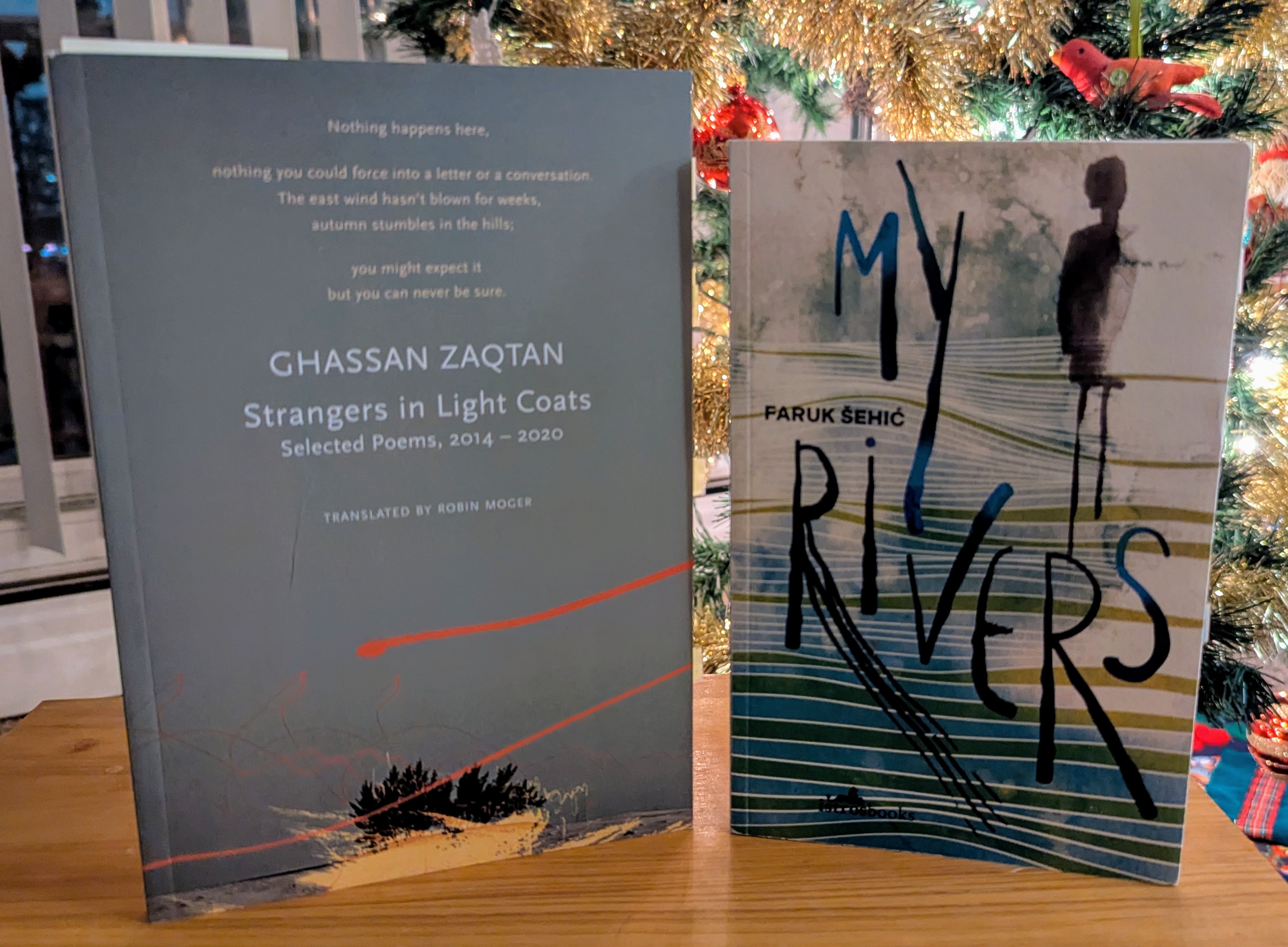
“There is something priming itself in these shadows” Strangers in Light Coats: Selected Poems, 2014 – 2020 by Ghassan Zaqtan

The wooden bell that hangs in the dark is struck.
Is struck.
No one sees it
but it is struck.
No one is there
and the bell is struck.

It is struck on the front porch of the dream and in its shadowed corridors.

There is something priming itself in these shadows.

There is someone waiting.

Natures that never made it past the line are being shaped in vain.

A blind creature walks on air and collides with butterflies.

(from “The wooden bell”)

The poetry of Ghassan Zaqtan elicits images that seem to emerge, take shape, shift, and evaporate on the page. As if deeply rooted in the soil, yet present only in passing, and in the memories they inspire.  His poems are home to rivers, birds, strangers, and ghosts of the dead. A chorus of voices rise and fall away. The Palestinian poet bears witness. To the spirit of his people, the beauty of his homeland, and the long history of displacement and conflict. But he does so with the same folkloric melancholy that characterizes his prose, the novellas that address political and personal loss through characters and settings that blur, to a greater or lesser extent, the boundary between fact and fable, myth and materiality.

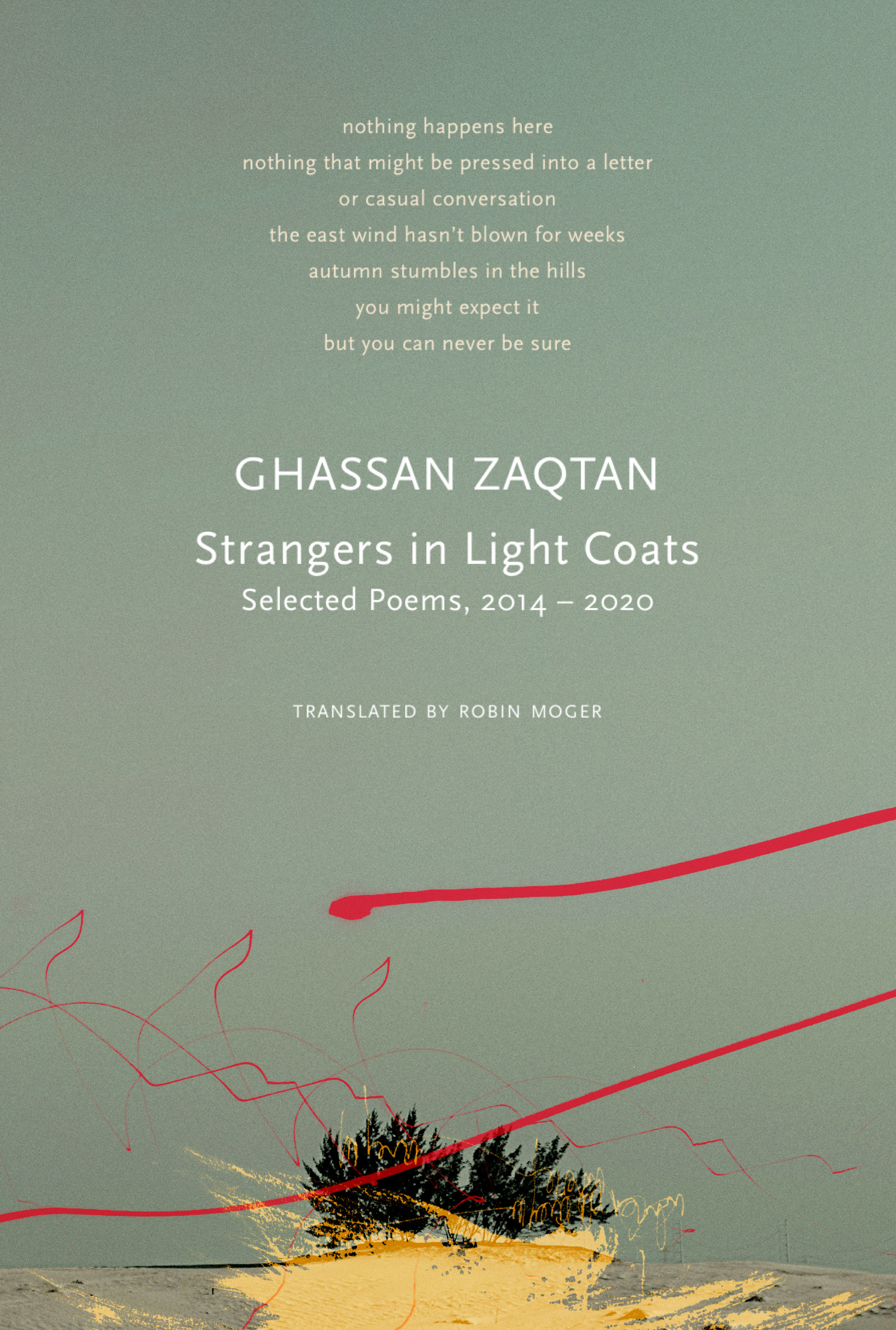
Strangers in Light Coats, his latest collection to be published in English, gathers a selection of poems written between 2014 and 2020. Although drawn from work originally published in four volumes, Robin Moger’s sensitive translation presents the selected poems as a cohesive work divided into six sections. Together, they unfold against a backdrop of mountains and valleys, in a melancholic world shaped by memories, dreams, and the painful reality of occupation and war. His poems speak to lost lovers, reimagine a collective history that is fading, wonder about the fate of exiles, conjure up djinns, and call out to the forces of nature:

River, river,
soften your breeze
as the daughters wade the fords into the twin darknesses
of temptation and patience;
be still as the muezzin’s daughter crosses at the ford, be
as a carpet laid out for her by the birds
.  as she steps down, out of his voice,
    into the prayers and the dawn.

(from “The river hymn”)   (30)

War is an ever present motif, both as a remembered event, and as a possibility that is never far away. In the lull there is an abiding unease, the silence of waiting for something to happen or the inability to find silence at all, as in “It happened during the mountain war,” which tells of a man who is haunted by a memory that carries with it sounds, smells, and the sensation of the weight on his shoulders of “the body of a young man heavy with death”:

This happened in autumn,
during the mountain war that no one wants to remember,
the war in which many were killed
before it was covered over by other, more senseless wars,
the war which they, whenever they dug to bury it,
would find another war down there taking shape,
the war which was dropped from memories
like an eighth daughter who should have been a son.
In his solitude, even he would forget those weeks and push them aside.

This is a strangely beautiful and deeply unsettling collection. One that raises questions about what history and territoriality mean under occupation, in migration, in exile. Memory, imagined and reimagined through a mythic and elegiac landscape reaches for possible answers at a time when Palestine and the Palestinian people are facing ever increasing uncertainty.

Strangers in Light Coats: Selected Poems, 2014 – 2020 by Ghassan Zaqtan is translated from the Arabic by Robin Moger and published by Seagull Books.

Exploring the uncomfortable corners of human existence: The Birth of Emma K. and Other Stories by Zsolt Láng

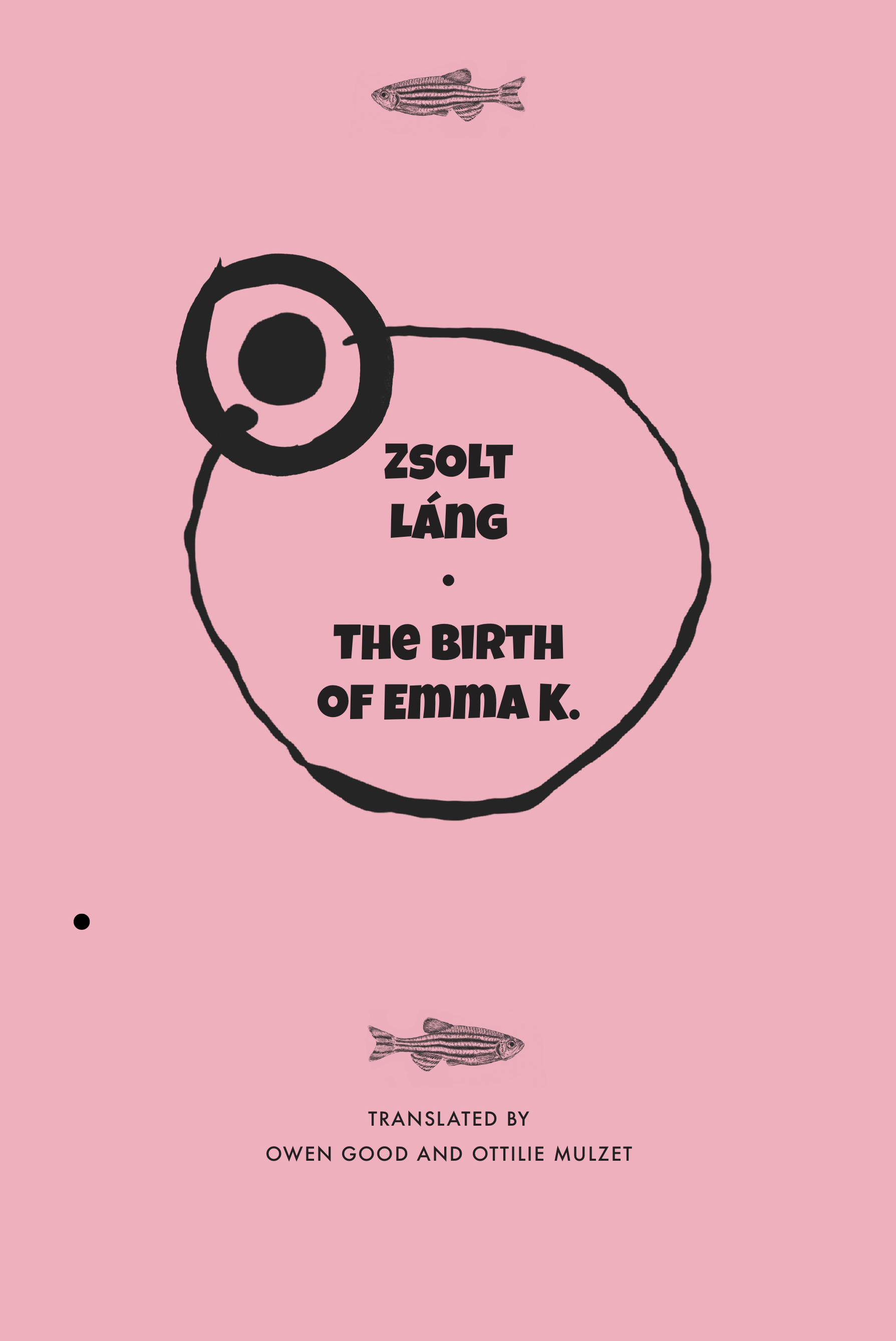
The fiction of Zsolt Láng inhabits a slippery space where time, genre, and realities shift and bend, where history shapes and distorts the landscape, and where characters are driven by conflicted passions and paranoias. Think of Flann O’Brien with a side order of Beckett, born and raised in Transylvania, charting his own course to become one of the premier postmodernist Hungarian language writers of our time and you have a hint of what you might find in Láng. And now, for the first time, we can sample that strange brew in English through the stories collected in The Birth of Emma K., translated by Owen Good and Ottilie Mulzet, but, be prepared, it is a delightfully odd journey during which one can lose one’s bearings from time to time.

The collection opens with “God on Gellért Hill,” set in Budapest, which finds “Our Lord” standing or floating above the city, intent on setting right the fragmenting relationship between two rather unattractive lovers. But to His dismay, God—and here the narrator reasons that we are witnessing neither the Father nor the Holy Spirit, but the Son—has been blessed with all kinds of powers, none of which are absolute. And, of course, under the often muddled efforts of their heavenly benefactor, the former lovers, Ida and Tamás, experience intensely swinging emotions that they are each at a loss to understand.

Our Lord followed them, as long as he’s here, he wants to see it through to the end. There’s still no guarantee he’ll intervene. Creation is like throwing a stone: There’s that ballistic arc from taking aim until reaching the target, and then there are the changes caused by gravity and wind; to intervene meant to retroactively meddle with time, at least that’s what a philosopher claimed with whom Our Lord didn’t agree (hence he never read the philosopher’s thoughts, though he could see into them). Our Lord is Our Lord because he sees things differently, his reasoning is different from man’s. But let’s not get mixed up in the difficulties of creation. (Good)

Determined as he is to try grant his subjects a happy ending they may not even want and are bound to undo, the burden of not-quite-absolute power weighs heavily on our heavenly hero, but in this clever opening piece there is a hint of the author’s own inability (or rather, wilful unwillingness) to exercise absolute control over his own characters—he’s happy to let them, and their stories, slip into strange territories, sometimes dark, sometimes light, and, more often than not, somewhere in between.

Láng , born in 1958, studied engineering at university in Cluj. Since 1990 he has lived in Marosvásárhely / Târgu Mureș, Romania, where he is an editor of the literary journal Látó. He has published close twenty volumes including short stories, novels, essays and plays. His work is deeply rooted in his Transylvanian homeland with its complex historical, multicultural, and multilinguistic  dynamics, but also reaches beyond to other European settings. His stories not only exhibit a broad range of characters and conundrums, they have a tendency to transform in style and form as they unfold. As translator Owen Good describes in an informative essay for Hungarian Literature Online:

Zsolt Láng’s is a nonconformist oeuvre. A story turns on a dime from a jovial satire to a poignant coming-of-age tale, from autofiction to metanovel to crime, leaving the reader forever playing catchup. Worlds blur and fantasy simmers to the surface.

If Láng is happy to allow his stories change without warning, he is also content to allow the reader to fumble their way into a tale for a while, or craft anachronistic realities in which, say, a preference for horse and buggy transportation exists alongside an internet café. Likewise, he does not feel inclined to bring all of his stories to a clear and defined conclusion, nor does he need sympathetic characters—some of his most unfortunate protagonists are driven by their own selfish or self-destructive motivations.

Consider “Like a Shaggy Ink-Cap Mushroom,” the tale of a depressed Inspector obsessed with death—his own. He sits at his desk surrounded by, but estranged from, the Beat Cops and the File Desk Girls, and feeling pressure from the powers above. He visits a gravestone with his own name on it, drinking in the sense of relief that comes with the thought of lying beneath it. And, when his former partner reaches out to him for personal assistance, a request that will begin to initiate a change in the Inspector’s sorry trajectory, his initial reaction is rather comically tragic:

He was surprised when his partner called. He didn’t recognize his voice. Hence, maybe, he was filled with the cool, soft promise of the hope for happiness. The tranquility of promise. A deep and hoarse voice. Slowly pronounced sounds. Containing an impossible amount of pain. He shuddered. Furthermore, the ring of the phone had electrified him. He jumped up and almost fell on the handset. The voice’s lumpy sadness. A fine, floury, lumpy sadness. Immediately he thought of Death. Death was calling. Or he was about to hear news of someone else’s death. He wouldn’t be surprised if it was his own. There could be no greater gift. Inspector, sir, I have to relay some really sad news. You’ve passed away, sir . . .  (Good)

In many stories Láng drills directly into his protagonists’ deep (and often dark) desires and fixations—two homeopathic doctors that each share a visceral hatred of the other, a lonely actress past her prime, or an inmate in an asylum conducting his own “research” and engaging the resident intern with his experimental theories. In others, like the longest piece, “The Cloister of Sanctuary” set in a monastery in Moldova, he works across wider canvas to craft an horrific folktale of mystery, manipulation, and cruelty. And then there is the final piece, the title story, which follows the metaphysical musings of an embryo, not exactly desired by her young would-be parents, from conception through a vigorous campaign to dislodge her from her watery accommodation, to her defiant arrival months later. It offers a fresh, insightful embryo-eyed perspective on the world she imagines versus the one she’s potentially heading towards.

With a touch of magic  and a measure of absurdity, the stories collected in The Birth of Emma K. offer an entertaining exploration of the virtues and foibles of human nature and an excellent introduction to another fine Hungarian language writer.

The Birth of Emma K. and Other Stories by Zsolt Láng is translated by Owen Good and Ottilie Mulzet and published by Seagull Books.

Some thoughts about living with mental illness and a few books that, in my experience, address the matter well

May is Mental Health Awareness Month, at least in Canada and the US, and this morning I awoke to find an essay in my inbox titled “The Last Great Stigma” by Pernille Yilmam. This Aeon article addresses the workplace discrimination that workers with mental illness experience  claiming that it “would be unthinkable for other health issues,” and asking if it can change. As the piece demonstrates, this issue is widespread and can take many forms. The author explores ways in which misconceptions and concerns might be addressed. For me it is far too late. Next year I will have been out of the workplace for ten years—more than ten years earlier than I ever anticipated—because even if you are open about your diagnosis, a serious breakdown on the job (no matter if dysfunction at the job itself was a significant factor) is something your career might never recover from.

I’ve been thinking about this a lot lately. And about how mental illness has shaped my life—as someone with bipolar, as the parent of an adult child living with serious anxiety and addiction, and as a former professional in the disability and mental health field. Yet, like so much in my many decades on this planet, I still don’t know how to make sense of it all. When I was first diagnosed back in my thirties I read all kinds of books about my condition (against the advice of the psychiatrist I saw just once after discharge who told me not to read anything or go to any support groups), but after a while I moved beyond books. Life was busy. I had two children and, before long, I was a single parent facing major personal changes. By the time I finally sought out peer support, I attended one group and by the next month I was co-facilitating! I ended up finding most of my real support through volunteering and in my professional positions.

Then it was suddenly over. With no closure. The subsequent years have been marked by great trauma, loss, and unexpected adventures. Also, lots of reading and, here and there, a little writing. But, truth be told, mental illness can be very isolating. It skews one’s ability to gauge social interaction—Did I say too much? Too little? Why am I so nervous?—and often makes it seem easier to avoid meeting up with others or trying to cultivate friendships. Alone is safer. And the longer one’s life becomes, the more entangled the varied threads that make us who we are become, and the more difficult it is to trace back through years and attempt to untie knots that have formed and reconnect fibres that have fallen loose along the way.

My first major episode of mania occurred in my mid-thirties. It was not disconnected from other things happening in my life at the time, so it crept up on me, gradually intensifying existing tensions and distorting my sense of reality. I was, by the time I was admitted to hospital, in full-blown psychosis. Oddly, I sensed that what I was experiencing was psychological in nature, but in true manic-depressive style I figured I could ride it out. And, of course, those around you also sense something is wrong but don’t know what to do. From the inside, your thought processes are so accelerated and obsessive that perspective is lost; it becomes a matter of survival and it can get ugly. When it’s over, some say that a kind of amnesia clears your memory, but that’s not exactly true. You are left with fragments, some very vivid, a great deal of shame, and no way of knowing how others saw you when you were at your very worst.

It’s a difficult thing to articulate, but this where we come to books. More than any fictionalized account of madness and psychosis, Hospital by Bengali-Australian writer Sanya Rushdi (translated by Arunava Sinha) manages to recount the experience of psychosis from the inside with a remarkable sense of self-awareness, arising, I can only imagine, from the author’s own multiple experiences with the condition. This critically acclaimed novel captures the strange internal boundaries that the protagonist (also named Sanya) tries to negotiate in a manner that resonated with me. As I noted in my review:

Sanya’s narrative is restrained and oddly lacking in affect, even when she describes her tears and outbursts. She is continually trying to observe herself and logically reason her way through whatever arises. However, her reasoning is often disjointed and confused. She is constantly seeking symbols of significance, spends a lot of time trying to figure out the secrets behind the thoughts and actions of others, questions why certain song lyrics keep coming to mind, and fitfully attempts to draw strength from her faith.

I recognize this well. The thing is, whether one is manic or depressed, psychotic or not, the tendency is to assume that whatever is happening to you is you, not a physical illness that is directly affecting your mood and your perceptions of the world.

When it comes to poetry, it is well-known that many famous poets have, over the years, struggled with mental illness, often writing from within the depths of madness and, sadly, frequently ending their own lives. I am drawn to such poetry but admit to finding much of it painfully difficult to read. Too close, too unfiltered at times, it must be read slowly. And then there is the genius of madness question that comforts some of us and angers others, but in the interest of understanding mental illness I wanted to call attention to a poetry collection I read several years ago that I think of often.

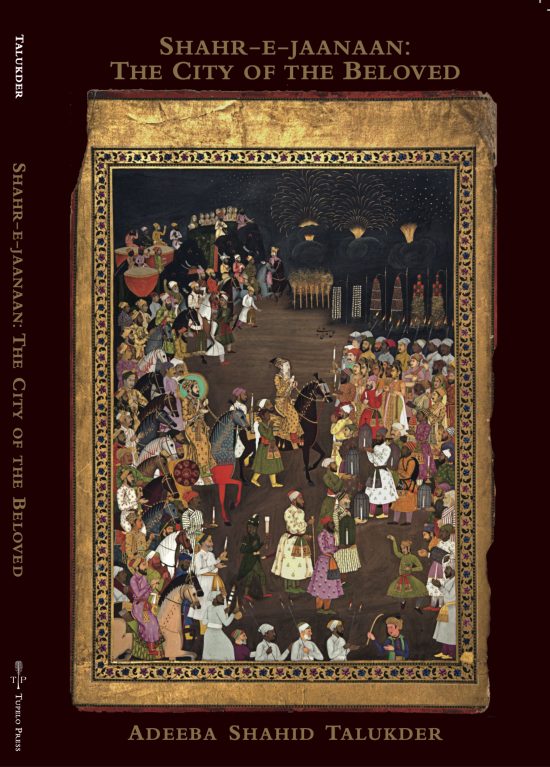
Shahr-E-Jaanaan: The City of the Beloved by Pakistani-American poet, translator and ghazal singer Adeeba Shahid Talukder was a book that came to my attention in the early months of the pandemic, a background that coloured my reading. I was intrigued by this young woman who draws inspiration from the greats of Persian and Urdu poetry and the late Kashmiri-American poet Agha Shahid Ali to explore traditional and contemporary themes alike, from the conflicts between an American raised daughter and her immigrant family to the poignant drama of Laila and Manjoon. Yet, in spite of a clear reference to a hospital in an earlier poem, it was not until I hit the title sequence, that I began to sense something more might be at play. In my review I report that the sequence begins:

At December’s end Benazir died
in a suicide attack.

.                              Men burned

tires, cars, banks,
petrol pumps and factories

Perhaps in grief.

The nights in New York
were clear, cold

and I read Faiz
in a way I never would

again. In Washington Square,
the benches were empty.

What follows is a harrowing account of the speaker’s descent into madness, accompanied in her mania, by God and her poetic saints, culminating eventually in hospitalization and echoing back to the poem I quoted above. It’s devastating, horrifying and strangely familiar, but on my first encounter I did not recognize it for what it really is.

Although I was unaware of Talukder’s own bipolar history when I first read her collection, I did have the feeling that she knew an experience I had also had. An interview with the poet confirmed it, along with her desire to address some of the misunderstanding and stigma she has faced. My response to learning this and a link to said interview can be found in my review of this excellent collection.

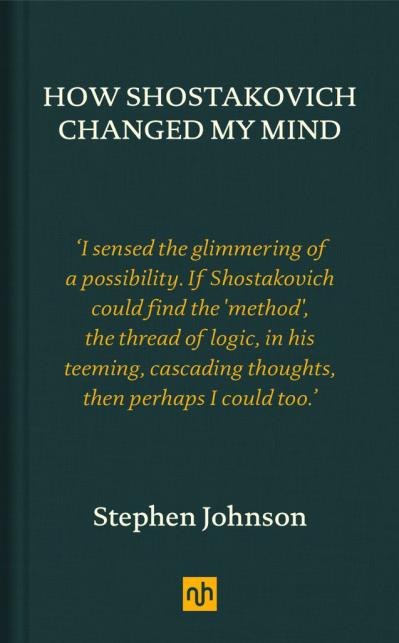
Finally, when it comes to mental health memoirs I am perhaps even more cautious than I am about fictional or poetic works. However, within Stephen Johnson’s How Shostakovich Changed My Mind, I found moments that spoke to me so clearly in relation to my own experience of mental illness before and in the long years following diagnosis. That is possibly because it is not your standard mental illness memoir. A blend of musical biography, memoir, psychology and philosophy, this fascinating book-length essay draws its greatest strength from the author’s passionate affection for and deep connection to the music of Dimitri Shostakovich. As I note in my review:

As one might imagine, given the unusual title, How Shostakovich Changed My Mind is an intimate account of the intersection of music with the personal drama, and trauma, of life lived. Johnson draws on literary, philosophical, neurological and psychological resources as he explores the connection between music and the brain, an area of growing interest and investigation, but he anchors his inquiry in the story of Shostakovich’s life and work during some of the most tumultuous events of the twentieth century—a thoroughly fascinating account in its own right—while tracing out his own particular relationship to this music and the role it played, not only in adolescence, but in his own adult challenges with bipolar disorder.

As such, Johnson’s work is not only a powerful exploration of the ability of music to provide expression and meaning in times of joy and sorrow, but a moving personal memoir of how music can serve as a means to navigate madness, especially in those times when, from inside, all one knows is that something is not right, even if one does not know why.

So, three books for Mental Health Awareness Month, or any time, because it is important to continue to work towards increasing understanding and reducing stigma around mental illness year round—and around the world.

Hospital by Sanya Rushdi is translated from the Bengali by Arunava Sinha and published by Giramondo in Australia and Seagull Books everywhere else.

Shahr-E-Jaanaan: The City of the Beloved by Adeeba Shahid Talukder is published by Tupelo Press.

How Shostakovich Changed My Mind by Stephen Johnson is published by Nottinghill Editions in the UK and distributed by NYRB in North America.

“keep turning forever, circling round”: Shining Sheep by Ulrike Almut Sandig

.   i have the same number of words inside me
as all of you have words, the exact same number

but how many times can they be combined? you
keep finding words that no one sang before you.

.  your godhead made you after his own image
.   stark naked, blind—wild things that you are.

– from “The Silent Songs of the Walls: l”

German poet Ulrike Almut Sandig’s latest poetry collection, recently released in Karen Leeder’s translation, is the modestly titled Shining Sheep—modest, that is after her 2016 offering, which appeared in English in 2020 as I Am A Field Full of Rapeseed, Give Cover to Deer and Shine Like Thirteen Oil Paintings Laid One on Top of the Other— but it is by no means a more restrained effort. Rather, this new collection, originally published in German in 2022, is an especially dynamic, ambitious affair.

Several of the pieces here were commissioned for performances, films, or arose out of collaborations with fellow artists and musicians. This has been a hallmark of Sandig’s approach to poetry ever since her early days posting poems to lampposts and handing them out as flyers. But that collaborative, multi-instrumental quality is now more pronounced, not only through the visual presentation of the poems, often incorporating shaped or concrete poetry, but with the inclusion of links, where appropriate, to recordings and video performances that bring her poems to life off the page.

Opening with a single word, alone on a black page—“Lumière!”—Sandig’s poetry is a call to light, but one that resonates with a dark exuberance. She draws on a wide range of influences—German folk songs, writers, and history—to address political and social issues, never turning away from difficult subjects, like maternal depression and alcoholism, living with Covid, migration, and climate change.

just let that melt on your tongue:
shining sheep, genetically modified
as night storage for the dark hours

visible in satellite images as little ghosts
their delicate shimmer on the radar
seems to be made to lull

the oppressive darkness between
the great golden bulls of the cities
into a comforting gleam. 

– from “Climate change is here, now. But we are also here, now. And if we don’t act, who will?”

Along with poems that arise out of commissions and direct collaborations with other artists, Sandig is also at times writing in response to, or in conversation with the work of late German authors, filmmakers and poets, including Friedrich Hölderlin’s “Wie wenn am Feiertage” (“As When on Holidays,” 1800). Other pieces have their genesis in more immediate encounters outside the artistic community, past or present.

A particularly moving sequence, “Lamentations in VI Rounds,” arose, poet tells us, out of a chance connection with a young man from Afghanistan who contacted her after she accidentally left her bank card in a ticket machine on the Berlin underground. He and his large family were living in the city as failed asylum seekers. She stayed in contact with them and, from their stories, wrote a piece she called “Five Lamentations,” adding a sixth round for this final version after the Taliban took control of Kabul in 2021.

the little man inside my head, he had
a daughter. he loved the way she boiled
minced beef, the way she answered back.
he loved the wonder of her eftertherain in Omid.

Omid sold his daughter in exchange for the value
of a ticket to Germany. today she called him up.
she sounded like she was sitting in his ear.
the pear tree in the yard was doing fine.

Shining Sheep is Sandig’s third poetry collection to be released in English, and the most inventive and experimental to date. Her long-time translator, Karen Leeder, is well attuned to the nuances of her uniquely playful, yet melancholic verse, bringing this energy and adventurousness to the forefront here. For a taste Sandig’s poetry and performances(with Leeder’s subtitles where available), her YouTube channel is well worth a visit.

Shining Sheep by Ulrike Almut Sandig is translated from the German by Karen Leeder and published by Seagull Books.

The vanished railway station: An Old Carriage with Curtains by Ghassan Zaqtan

In the western foothills of the Hebron Mountains, about forty kilometres southwest of Jerusalem, lies what remains of Zakariyya, a village with a history stretching back millennia. It was the birthplace of the parents of Palestinian poet and writer Ghassan Zaqtan. When the community was occupied and depopulated by Israeli forces following the Nakba, they were forced flee to Beit Jala near Bethlehem. That is where Zaqtan was born in 1954. Seven years later, in 1961, circumstances compelled his family to move again, this time to Karameh refugee camp in the Jordan Valley, across the river from Jericho. Though the settlement was destroyed during the 1968 War of Attrition, Zaqtan would return to it as the setting for his 1995 novella Describing the Past (published in English in 2016), the tale of three teenagers coming of age and dealing with love and loss in a world haunted by war, death, and dislocation. With Where The Bird Disappeared (2015), Zaqtan’s second prose work to appear in translation in 2018, the village of Zakariyya comes into central focus. This lyrical, almost fable-like story follows the fate of two boys, Zakariyya and Yahya, who grow up in the village. They are both in love with Sara. However, the arrival of “armed Jewish forces” changes everything.

Now, with the English release of Zaqtan’s 2011 novella, An Old Carriage with Curtains, the three works—all translated by Samuel Wilder—can be seen as a loosely linked trilogy, or as being in conversation with one another. Each is different, and, as such, not need be read in any particular sequence, but they are bound by a common spare, poetic, dreamlike narrative style, and by echoing images and motifs. Yet, this third book seems closer to the author’s own life, suggesting that it is somewhat more autobiographical. Here the protagonist is an unnamed middle-aged man living in Ramallah. His aging mother, who lives in Jordan, longs to see her birthplace again for the first time since the “migration.” It is the place that has always loomed large in his family’s history, its existence nearly mythical, its sudden loss impossible to put into perspective:

He arrived late to Zakariyya, his village, occupied since 1948, where his father and mother were born. Somewhere in a drawer inside the house there was a faded, tormented picture that redeemed nothing, but which kept in place the stories that amassed in the family home. The picture showed a distant spectre of forest trees, and the ghosts of houses at the far-right edge of the frame. This was all it contained. It looked tired, faded, closed; nonetheless, it asserted some incredible forbearance. Under the pressure of the cruel importance placed on it, it could hardly go on existing, pressed down by the dependence of all those contradictory memories, all the longing that pervaded their stories.

By the time of the key events traced in this novel, the protagonist has passed through or near the abandoned townsite a number of times, but he has resisted sending his mother any photographs, as he had promised. Now, as her anticipated visit nears, her descriptive recollections of Zakariyya take on new dimensions and details. For the first time, she talks of a railway station and a Palestinian Jewish friend she used to meet there as a child, but her son has seen no sign of a station or tracks. This disconnect causes him to feel that the images and memories he has been trying to preserve for her are hollow, “not convincingly alive, because the railway station was gone. Its absence diffused through life, evaporating everything.”

Absence, the mutability of memory, and the importance of stories to sustain individual and collective identity are common elements of Zaqtan’s fiction. In An Old Carriage with Curtains, the nonlinear narrative proceeds through short scenes that move between a number of themes or threads. Some are conceptual, others more practical. Because movement is restricted, there is the matter of obtaining the required permits, a frustrating, complicated and time-consuming process that becomes, for many Palestinians, a fruitless life-long ritual. For the protagonist, his current application for a Visitor’s Permit that will allow him to travel to see his mother in Ammam has taken three tries; his efforts to secure one to allow her to visit her homeland just once has taken much longer. But, what he does finally manage to obtain for her, sadly, does not include either Jerusalem where she had hoped to pray, or Zakariyya; nor is it the prize she had long dreamed of, the right to return for good.

Permit in hand, there is then the question of making the passage between the West Bank and Jordan across the Allenby Bridge. The protagonist’s somewhat surreal experiences on his way to see his mother form one of the novel’s central threads. Broken down into snapshot vignettes, there are the queues, the restless waiting travellers, an old man who makes repeated and increasingly desperate attempts to pass through a mechanized gate, and a woman soldier who, when checking his documents, betrays the recognized agreement he maintains between himself, a Palestinian, and them. She simply asks him a question: Do you like to travel? Innocent enough in any other reality of human interaction, her unexpected transgression unnerves him.

Another thread that appears throughout the narrative features Hind, an actress friend with whom he has a relationship he does not fully understand, though he senses that his role is primarily be that of a listener, an audience. Thus, her voice enters his narrative directly, in first person, as he recalls stories she has told him about her own life or family, even if he is not always certain whether he has remembered them accurately or added his own embellishment. She seems to carry an anger that she accuses him of lacking whereas, by contrast, he tends to exhibit a more contained, thoughtful, and melancholic perspective.

Finally, as a tale of journeys—across borders and into the past—passages, landscapes, and the idea of home play an important role. The novel opens with the protagonist making his way along the Wadi Qelt , following the ancient path between Jerusalem and Jericho, aware that he is walking in “the valley of the shadow of death,” en route  to the Monastery of Saint George which he had visited as a young school boy. Yet, when he reaches it, he finds it closed to visitors for the day, and he is denied a chance to reclaim his memories. Later, an intellectual detour will take him on an exploration of the exile literature of Naim Kattan, Emile Habibi, Imre Kertész, and Muhammad al-Qaysi. And, more than once, his thoughts turn back to the first time he returned to his homeland in 1994, to the trip by road from Gaza to Ramallah, past Zakariyya and nearing, but not passing through, his own birthplace near Bethlehem. He knows that any specific location, a house or community, can be emptied, reoccupied or left to fall into decay, but a history inextricable from the landscape—its hills, valleys and roads—cannot be destroyed:

The story of Palestine was hidden inside the roads, he thought, where the depth and necessity of things appear, where cold description was overturned, yielding to a depth found in trails that connect, vectors passing through the mountains and strange wadis. It was not the quest for exaggerated aesthetics of poets and romantic novelists, but a scene of painful, violent, uncontrolled energy, cold and bitter directions that course through astonishing, contradictory forms, forging ways through the alloy of fear, belief, rebellion, contentment and self-annihilation. The lote tree of the lowlands connected to the olive tree the hills. All this confusion, he thought, was like some rough draft of wisdom thrown on the shoulders of this country.

The story of Palestine is still being written, in defiance of the forces that have escalated the attack on its right to exist. This novel, with its maze of checkpoints, permits, and restrictions is only more relevant now than it was a dozen years earlier. In fact, in one scene the protagonist says to Hind, “I didn’t sleep well. They are bombing Gaza.” Thus, on its own or in concert with Describing the Past and Where the Bird Disappeared, An Old Carriage with Curtains evokes a contemporary portrait of a world attuned to the voices of the past, facing an uncertain future, where the preservation of the spirit of memory against its inevitable tendency to shift and transform itself may be the only way to move forward. And, if one continues to listen to the stories of others, that vanished railway station might even be found.

An Old Carriage with Curtains by Ghassan Zaqtan is translated from the Arabic by Samuel Wilder and published by Seagull Books.

Snakes and ladders: Traces of Boots on Tongue and Other Stories by Rajkamal Chaudhary

There is a deep darkness in all directions, and we are sitting on the naked floor, awaiting light. When will the light come? Dipu unwraps the sheet from her body and lays it on the ground. She feels along the wall and keeps the bottle and the glass in a corner. Then asks—Who else is here? Chandravati, are you here? Nothing is visible in the dark. Not even one’s limbs. And in this darkness, Dipu’s voice shimmers like a white silver sword—Why don’t you say something? The sounds from here can’t be heard upstairs. And by now the owner must have paid off the police. Now why are you scared? Why not say something? Who else is here?

(from “Some People in a Burning House”)

A police raid has sent an assortment of women and their customers—a salesman, a student, an engineer, an old man—to the cold, bare basement of a brothel. By matchlight they try to sort out their situation. And then they realize, it’s not a raid but a fire. The building is aflame and no one knows what might be happening upstairs.

Welcome to the world of Rajkamal Chaudhary. This world is one that is in transition. The mid-twentieth century is a time of upheaval. The aftermath of World War Two sees the Cold War, and various conflicts and revolutions on the rise. In India, the newly independent nation is trying to define itself after the end of British colonial rule. Following a long struggle for freedom and the disruption of Partition, there is displacement, dissolution, and wide-spread poverty. The future looks less certain and less rosy than that which might have been imagined. Chaudhary, as perhaps the first avant-garde Hindi-language writer, drew inspiration directly from this unstable period, and, eschewing the moralistic literary traditions, painted a vivid, often vulgar, portrait of his time.

Born in northern Bihar in 1929, Chaudhary had strict religious upbringing, but his childhood was marked by the death of his mother when he was young, and his father’s subsequent remarriage to woman close to his own age. After high school he moved to Patna to attend college where he eventually graduated with a degree in Commerce, but by then he was already drawn to literary pursuits. His earliest works, poetry and prose, were published in Maithili, but Hindi soon proved a more productive and lucrative language. Much of his Hindi work was produced during the six years he lived in Calcutta in the late fifties and early sixties where he also came into contact with the young avant-garde poets of the Hungryalist movement. When he died in 1967, at the age of thirty-seven, he had written eleven novels, seven short story collections and hundreds of poems in Hindi and Maithili. Twelve of his Hindi stories are gathered in the collection Traces of Boots on Tongue, published last year by Seagull Books. In her Introduction, translator Saudamini Deo writes of his idiosyncratic style:

The stories in this collection are montages, flashes, almost documentary-like glimpses of the past that no longer feels like the past. Much like the novelle vague cinema that broke down boundaries between realty and fiction, Chaudhary’s stories seem to reject the characteristic formality of earlier Hindi literature and embrace a newer, more modern cadence of a world where there is no longer either god or morality, not even the desire for it. He is a writer writing not in a closed room but on the streets, in plein-air.

These stories are populated with unsettled individuals from all social classes, disillusioned artists and writers, unhappy husbands and wives, angry widows and widowers, lost madmen and madwomen. And a curious abundance of snakes, real and allegorical. As a man whose adult life was characterized by complicated relationships with women—two marriages and multiple affairs—Chaudhary tackled sex and sexuality with an openness that was unconventional for his times, to say the least. Some of that is reflected in the selections here, such as “Sisters-in-law” in which one of two women, widowed young, who support themselves servicing their local community’s healthy supply of “rascals,” has an disturbing experience. In another story, a boy befriends an effeminate classmate and finds himself in the terrifying clutches of his sexually aggressive mother.

Anger, bitterness, and anxiety fuel many of his characters and their interactions. Others are lost and confused, often struggling with reality, be it due to illness or intoxication. In “Veni Sanhar,” a young second wife and new mother, recently recovered from typhoid, suffers from periodic hallucinations. While her older husband attends to his business indoors, the servant and her stepson try to look after her and the baby. “Warriors Don’t Worry About the Right Time,” revolves around a man who insists he sees his dead wife coming to the well. His is a refusal to accept the truth, a refusal to move on:

Uncle spends his time on the veranda, and in the evening, after drinking bhang, reflects on what has and has not happened. There is no worry about the present. There is no hope or wish to turn or shape the present to one’s will. Stories and tales about what has passed please the mind. What has passed was better, appropriate, preferable. And, by thinking about what has not passed, the present remains forgotten and lost.

Some of Chaudhary’s stories are gritty, others melancholy. The shorter tales are more likely to have more internal coherence, but the longer, more intricate ones tend to unfold slowly through film-like scenes and vignettes. What is happening is not always immediately clear, and the endings hang in the air. One of the most intricate stories, “Like a Wall of Glass,” features a commercial artist, Kapoor, who wishes to transcend the constraints of money and produce a true work of art. He has his heart set on painting the wife of a well-known folk-art specialist—a man intent on preserving the past glories of Indian culture—but his inspiration personal is the abstract modernist Henry Moore. Yet, he realizes the absurdity of his ambitions:

Art! Culture! Creation! Expression! Beauty! How pointless and futile these words have become! But then, what possesses meaning after all? Money? An evening with a woman? Falling ill? Going mad? Committing suicide after writing a letter to friends? What is truth? What is sin? What is man himself? Morality? The point of life? The point of creation? What is man himself? Why doesn’t he die? Then, again, Kapoor starts smiling at the emptiness of his questions.

The anxious artist swings from confidence to disappointment and back as he pursues his goal. But even producing a brilliant painting, an ideal work of art, cannot achieve whatever he thinks he might be aiming for.

Chaudhary’s particular vivid, if often uncomfortable, portrayal of mid-twentieth century India in flux had trouble finding an audience outside of the literary journals of his day as it was deemed too indecent and immoral for the literary mainstream. Now that a selection of his stories is finally available in English, his work may well surprise and appeal to contemporary readers comfortable with more unconventional or less structured narratives. His characters and the situations in which they find themselves are troubled with unanswered questions that are still valid in our own volatile world. But understand that his stories, like life itself, offer no easy solutions.

Traces of Boots on Tongue and Other Stories by Rajkamal Chaudhary is translated from the Hindi by Saudamini Deo and published by Seagull Books.

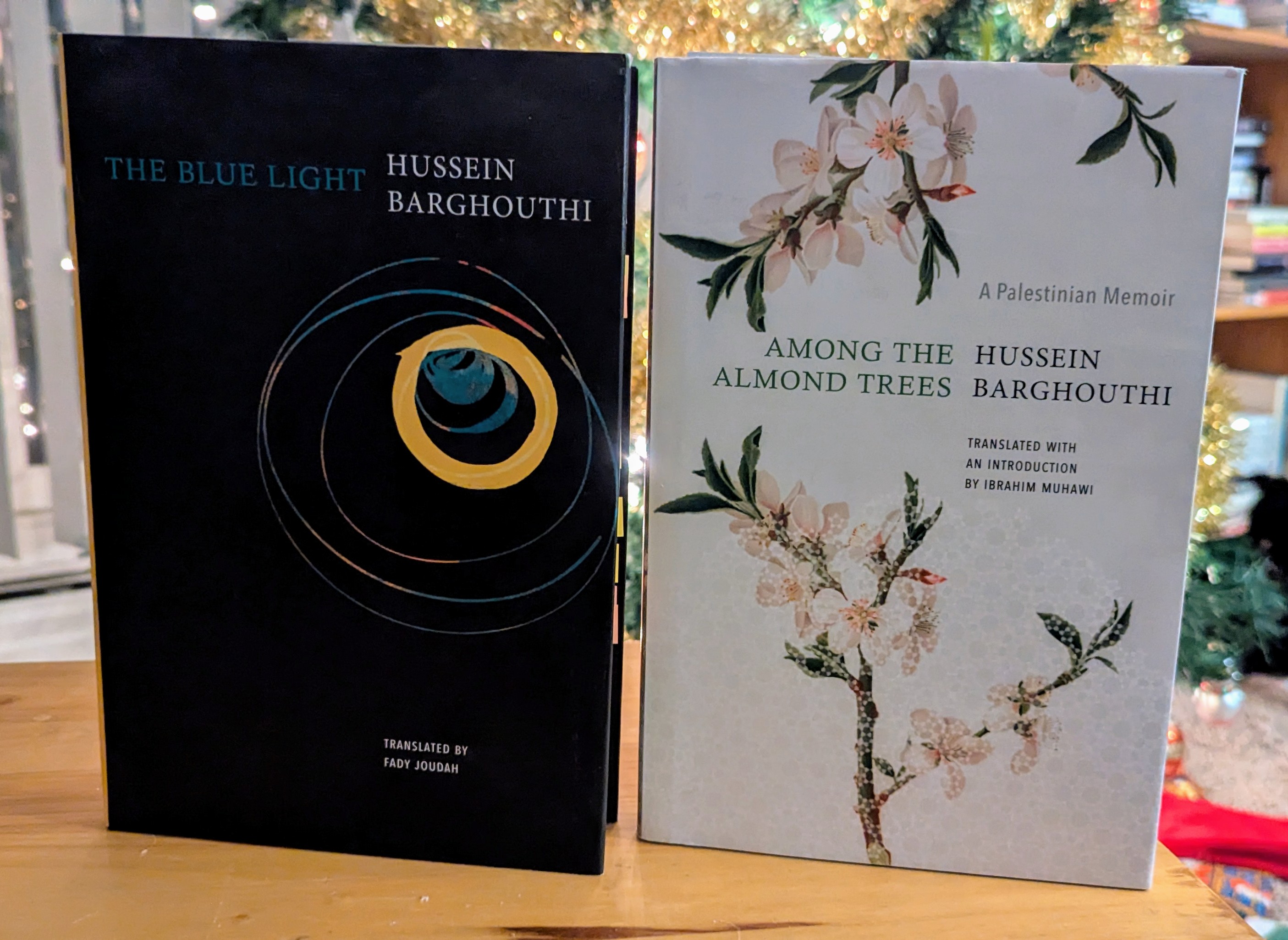
The wisdom of madness: The Blue Light by Hussein Barghouthi

Blue is a colour with multiple manifestations and meanings in various contexts and traditions—the light of the sinful self for the Sufis, the colour of creative energy in Tibetan Buddhism, the destructive enemy of the God of Wisdom for Zoroastrian Persians. Blue is also said to be an antidote to sexual excitation and it is said to calm the nerves. That may explain some of the hold that the colour has on Hussein, the narrator of The Blue Light and a man beset by questions about his own sanity, but the roots of his attraction run much deeper:

For me, blue is the color of estrangement, the unknown, and of the childhood sky. And there is, also, blueness to all my ill wishes. When I learned to play the piano, I composed a short magical piece, played it for a while, day after day, without knowing the secret of my love for it, until one day I read a book by a Black musician who claimed that each note has a specific color to it. And each composition, too. One of Mozart’s sonatas arouses in the listener green or blue or . . . anyway, I looked around for the color of that magical note of mine and was astonished to find that it was blue.

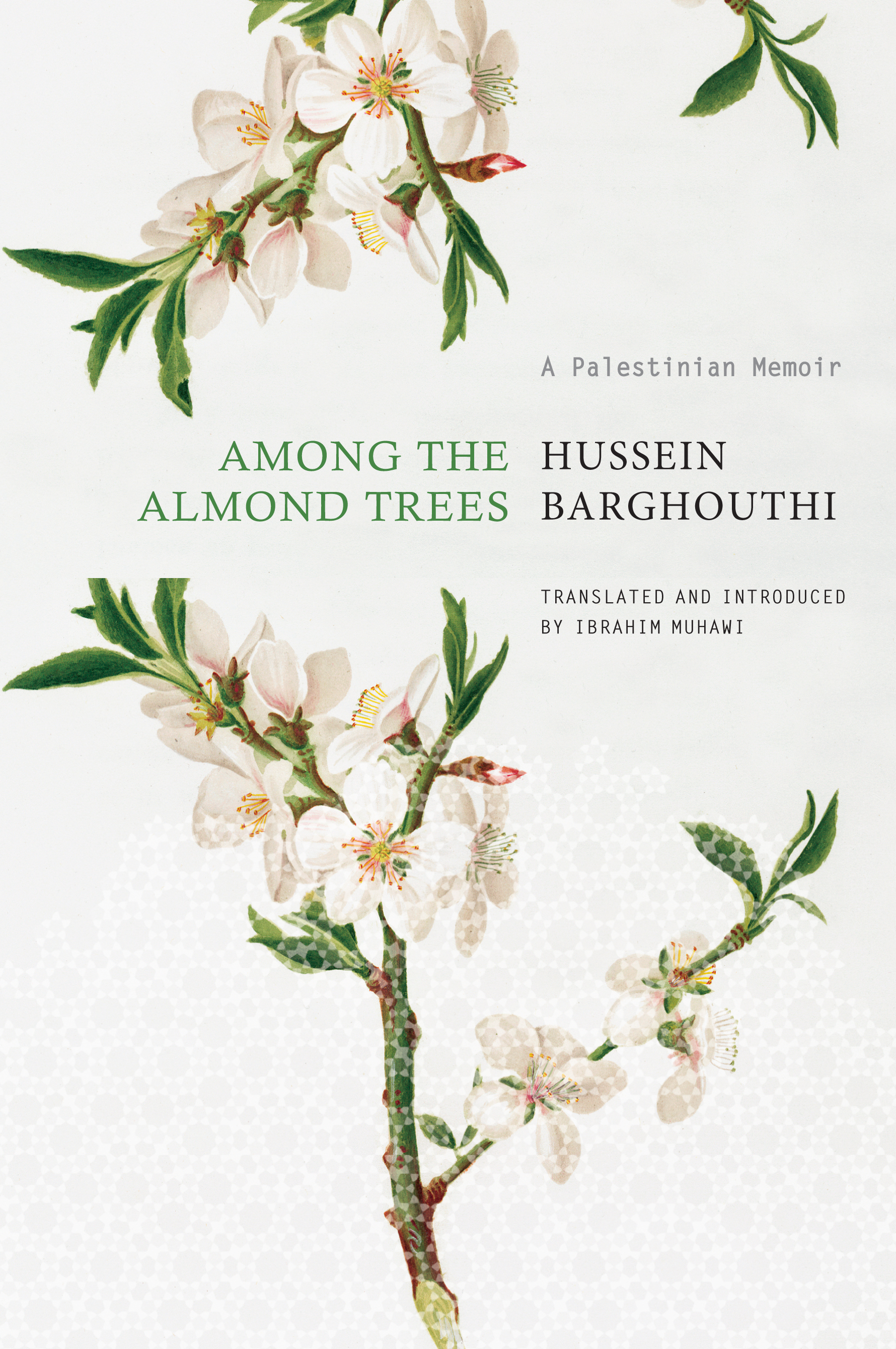
This posthumously published novel by Palestinian poet, writer and essayist, Hussein Barghouthi (1954 – 2002) walks along that troubled path between fiction and autobiography, arriving at what might best be described as a memoir with hallucinations. It is a delirious account of a man desperate to make sense of himself and his unusual way of thinking. Or, as Mahmoud Darwish says, on the blurb on the back cover: “[a] peculiar mix of confession and contemplation, hallucination and mythology, reality and the unrevealed. A mix of personal stories and mystic leaps, of madness that claims wisdom, and wisdom that only madness can transubstantiate.”

The Blue Light is inspired by Barghouthi’s time in Seattle, Washington where he pursued graduate studies in Comparative Literature in the late 1980s and early 1990s. As someone who had long felt different from others, he finds himself, in this foreign land, frequenting three establishments—Grand Illusion Cinema, Last Exit Café and Blue Moon Tavern—attracted by their names and by the company of the mad, eccentric and disenfranchised characters he finds there:

Strange how a place seems like a ruse, sometimes. I found myself wandering these three joints looking for myself, not among books, I was sick of books, but among the shady and the crazy, the homosexuals and the punks, where maps are clearer, more precise, and more exciting, or where at least I, as one of them, didn’t have to talk to anyone. For a whole nine months I talked to no one. I knew no one.

Terrified of madness and hiding his fears beneath a mask of sanity, Hussein does begin to engage with some of the offbeat, often homeless, regulars and even falls, briefly and cynically, into the bizarre world of the Church of Dianetics, but his search for his real identity changes course dramatically when he meets Bari, a Turkish-American Sufi from Konya. Introduced through a mutual friend, he is dynamic and given to loud laughter, strange stories and odd mannerisms. From their first encounter, Bari’s intensity and sea deep voice, “free as a roar,” reminds Hussein of an early experience of  his near drowning that birthed a recurring dream of being chased by a giant wave from a beach in Beruit to his childhood mountains in Ramallah. Among other memories, the Sufi’s laughter woke up the sea.

But Bari is elusive. He responds indifferently to Hussein’s questions and speaks little about his past. The two men often play chess at Last Exit Café, an environment where most of the patrons are mentally ill and he is thought to be just another “space case.” Yet Hussein becomes convinced that his madness “was something more than the usual madness.” He is drawn into Bari’s world even if, or perhaps because, it seems inaccessible. The secret he thinks is one of language, reasoning that: “Words meant something entirely different for him than they did for me.” So, he dedicates himself to deciphering Bari’s meanings and falls into a strange project to create a dictionary. For example, one day Hussein is confronted by the Sufi who says: “Man, your blue bird came to me last night. Stop him.” Caught off guard, Hussein fashions a response that appears to satisfy him, but the question remains—what does blue mean to Bari? What about his odd chants and expressions?

After much reading and exploration, an endeavour tinged with as much madness as those of anyone else around him, Hussein discovers what he believes is a key, a phrase he’d heard from the Sufi before. Waiting until the right moment presents itself at the end of a chess game he exclaims: “Return the blue light naked to its house.” The arrow strikes its target. Bari demands to know what he wants. Hussein holds his own, and in response confesses that he is afraid of losing his mind. The door is opened, Bari invites him in.

Thus begins a closer relationship. One damaged soul to another, Hussein seeks answers from the enigmatic, often volatile, Turkish American through what unfolds very much like a game of riddles that forces Hussein into a closer examination of his own past and a dissection of the history of his own fear of madness. Memory, mythology and cultural heritage merge as he engages with and responds to Bari’s mystic pronouncements. His Palestinian identity and experiences living under occupation have only heightened the estrangement and alienation he cannot escape, no matter where he has lived. In Seattle, this Sufi who proudly claims to belong nowhere, may finally trigger Hussein to loosen the tangled threads of thoughts threatening the clarity of his mind. Consider an early discussion about physical bodies and the mental bodies—spirits—that can visit one over great distance, during life or after death. This reminds Hussein of the culture of the dead in Palestine where death is so readily at hand. The ghosts or mental bodies of the dead are frequent household guests:

These spirits visit me long after their bones had turned to eyeliner dust in a land where the dead dominate the living, the past governs the future. That’s the authority of memory in a region whose depth is measured not by centuries but by millennia. Memory is a dangerous thing, a laboratory of ghosts. Didn’t Ishtar, a few thousand years ago, in the epic of Gilgamesh, didn’t she threaten to “open the gates to the underworld” and let the dead share their meals with the living? We can’t live with this kind of deep memory and can’t live without memory either, so what’s the solution?

The community of outcasts and assorted spiritual personalities, Bari included, that Barghouthi brings to life in The Blue Light, a rich, sometimes wild, creation of fiction and memoir, is a brilliant backdrop against which he, through his narrator, is able to navigate a personal crisis of identity within the cultural and historical crisises of his people. In a foreign country, with a foreign language, and a sage with a vocabulary of mysterious provocations and commands, he inches toward self-understanding. Along the way, there’s a plenitude of wisdom and insight for anyone travelling alongside him.

The Blue Light by Hussein Barghouthi is translated from the Arabic by Fady Joudah and published by Seagull Books.

And something went terribly wrong: Truth/Untruth by Mahasweta Devi

Arjun Chakravarty has everything under control. As a successful contractor, skilled in the necessary art of greasing the right palms, business is booming, and finally, after ten years of marriage he and his wife are expecting their first child. Kolkata in the 1980s is booming. A determined project of gentrification is underway; everywhere high-rise buildings are sprouting up, even in neighbourhoods long considered derelict and undesirable. Like Khidirpur, a well-known den of crime and smuggling. Denying the odds, towering housing societies boasting spacious flats equipped with all the latest appliances stand proud, like Barnamala where our unfortunate hero resides and the setting of Bengali writer Mahasweta Devi’s Truth/Untruth.

A self-named man, Arjun came into the world as Sanatan Pushilal. But Sanatan was a moniker unworthy of the man he wanted to be. Orphaned young and impoverished, his uncle found him student lodgings with a noted karibaj, an Ayurvedic practitioner, and this fortunate placement was his first step toward a new identity. That is:

How Sanatan became Arjun. And how, erasing the past, Arjun slowly rode the lift of high aspirations all the way to the twelfth floor of society . . . all that is but ancient history now.

With his old landlord long gone, only his son Keshtokali, likewise a karibaj, knows the truth about Arjun’s past. Fortunately, even his wife Kumkum, the daughter of a retired Supreme Court judge, has no interest in either Ayurveda or her prosperous husband’s history. Yes, Arjun-babu has it made. Until something goes terribly wrong.

You see, his wife, now eight months pregnant, has been staying with her parents where she can be pampered and protected while she awaits the arrival of their precious bundle—at thirty-five no one wants to see anything go awry. Thus, left to his own devices, Arjun-babu has been able to indulge his passion for Jamuna, the pretty young maid who comes by daily to clean the flat. Imagine his dismay, then, when she arrives to inform him that she is pregnant with his child. Something must be done, he must make the problem go away. Jamuna’s own husband left when he lost his job, but she still believes he will return. Arjun will arrange for a proper doctor to take care of the unwanted pregnancy, pay her off and hope she leaves, but before he can see his plans through, he comes home to find her dead on the bed in his guestroom.

He knows he didn’t kill her, but he can’t exactly go to the police. If he had killed her, well, that would be a different matter. For the right amount of money the police could take care of anything. But, if word gets out that she was found in his flat, his reputation, his business, his wonderful life—all would be ruined. Even a rumour of murder would do him in; after all she would hardly be the first “murdered” maid to be found in his building . . . Ah, but Jamuna also worked in two other adjacent flats, one belonging to an old man named Desai and his crazy wife, the other owned by a tobacco company and cared for by Mohsin, a local Muslim man. Maybe Arjun could shift the blame, simply by moving the body.

This farcical and fast-paced thriller unfolds over little more than forty-eight hours, and features a cast of vibrant characters from the silly Kumkum and her over-protective family, to a host of servants and building staff, to petty thugs and mysterious “bosses.” The complicated power dynamics between the established rich, the nouveau riche and the slum dwellers who provide necessary labour and services, legal and otherwise, for the residents of the new buildings is clearly exposed. However, we observe most of these people indirectly, as the narrative is driven almost exclusively by dialogue and by the internal monologues of the central male figures—the three men in the building who directly or indirectly employed Jamuna. By this approach, Devi is able to reveal the very different natures of each of these individuals, but her primary attention falls on Arjun who is the most incredibly hollow and self-centred creature, continually twisting his line of reasoning into pretzels to absolve himself of the slightest responsibility for anything that has happened. Jamuna might be dead, but he is the real victim as far as he is concerned—everyone else is to blame.

Arjun divides the blame up in his mind. The astrologer is to blame, he’d never once warned him that bad times lay ahead. Keshtokali is to blame, he gave him such a stimulant that his mind was always full of . . . and Jamuna, isn’t she to blame too? Why did she have such a body, such a way of walking and talking?

He is, by turns, irritating, hilarious and tragic.

Mahasweta Devi (1926–2016) was one of India’s most prominent writers and  social activists. If somewhat different in tone from much of her more openly political, feminist work, her dry humour and ability to highlight insincerity and hypocrisy is in full play in this dark satire. Her prose is rich with insider street slang and allusions to popular movies and songs of the day (necessary references are explained in the endnotes). She is assuming a certain familiarity with the time and place she’s writing from, but is not concerned about making her more genteel readers work to sort through the common language many of her characters employ. In her afterword, translator Anjum Katyal acknowledges the challenges involved in trying to capture the different registers of spoken language—critical in a narrative so dependent on dialogue—without falling into unacceptably “twee” English variants. She does give Jamuna and her close friends a coarser and cruder vocabulary which contrasts nicely with the sometimes overly-affected language that Kumkum and her family use in private settings. Arjun, being the most eccentric and erratic of the cast, is granted a range of emotional expression from the obsessive to the absurd.

A rollicking urban tale, terrifically fun to read, Truth/Untruth blurs the line between murder, mystery and crime novel but from beginning to end, amid the tension and comic mishaps, it remains a sharp piece of social commentary.

Truth/Untruth by Mahasweta Devi is translated from the Bengali by Anjum Katyal and published by Seagull Books.

What is important is to love: The Worst Thing of All is the Light by José Luis Serrano

The worst thing of all is the light because it’s always the same, but we are not ever the same, and then that light reminds us of the others we were before, once, those others who did things that now we would not do, that we don’t admit to having done. In spring, the light of a clear, bright day, when the wind has left the air clean and pure, leads us to clearer days, days of youth, of holidays. Or that yellow light of autumn, also clean, sharp at the final hours of the afternoon.

Light, light, light. Such is the thread along which the thoughts of Edorta, a middle-aged man, run through the course of his free-flowing poetic reflections, a diary of sorts, addressed to, but not meant to be read by, his long-time friend Koldo. As he reaches for a way to understand and articulate his tangled and conflicted feelings, light serves as a mechanism of memory, sometimes consoling, at other times cruel. But Edorta’s musings are only half of The Worst Thing of All is the Light, an inventive, metafictional novel that sets an exploration of the boundaries between friendship and desire against a parallel examination of the relationship between imagination and reality.

Edorta and Koldo are the creations of Spanish writer José Luis Serrano, but within this double stranded novel, they are also the evolving characters taking shape in the mind of an “author” who is, presumably, a fictionalized representation of Serrano himself. In a series of journal entries, the author/narrator records the activities and conversations that mark each day of a vacation he and his husband are spending in Bilbao. His report, which details where they go, what they eat and what they talk about, is addressed to his husband directly, with the all familiarity two decades together has wrought. These dated entries, each illustrated with a scenic photograph, occur over the course of ten days in August of 2014 and appear to set up the proposed novel the author is planning to write: the story of a very close friendship—one that might even be described as love—between two heterosexual men. He’s not sure if he will be able to pull it off (his husband is even more skeptical) but he knows it will require an inventive approach, perhaps one that plays a fragmented diary of some kind against an author’s journal within which the potential narrative structure and details are formulated and debated. His husband plays the foil, devil’s advocate and, sometimes, the anxious spouse:

“But then, aren’t you going to write a normal novel?”

“I never write a normal novel. What’s more, I’ve always made it clear that I’m unable to tell a story, There will just be snippets, bits of what could have been the novel. Perhaps a diary by Edorta.”

“And these dialogues.”

“That’s right. Perhaps not these, but others I make up based on these.”

“And will I be myself? I’m worried about being myself in your novel, worried that you’ll put me in your novel.”

With chapters that alternate between the author’s journal and Edorta’s diary, the novel that exists is the one that the author is planning to write—the final project and a self-conscious analysis of that project in its formative state. This is where the metafictional game lies, where the boundary between literature and reality blurs and where questions about the “fictional” characters, their relationship, and the nature of love and attraction arise. As the author and his husband debate the possibility of platonic desire between men from the outside in so far as they can intellectualize beyond their own homosexuality, Edorta explores the matter from within, in trying to articulate the quality of his affection for Koldo while holding to an assumption of his own heterosexuality.

Edorta’s diary offerings are undated; each one is named after a song released by the Bristol-based UK independent Sarah Records(1987–1995), and opens with the artist name, catalog number, and a few lines of lyric. These sections resemble a form of stream of consciousness, admittedly composed in writing, but unfolding without clear direction or specific chronology as if Edorta is trying to sort out his feelings on the page. Consequently, allusions—to the light in particular—and scenes from the past are revisited repeatedly. Where he is writing from, temporally speaking, is intentionally vague, though he does often correct himself, pulling out of his revery to recall that adult life, relationships, and children have made the endless days of youth but a memory. Their occasions to actually be together are now few and time-constrained. His longing is palpable, his prose dense with fervid imagery:

Today I lug the grief of not being able to say the unsayable, fighting with the anguish of being and not wanting to be, of sinking into oblivion forever or of turning back, before even being, before myself, where there is not even oblivion. Life breaks loose from the poplars in tatters, and the branches, outlined in green-black shadows, shrink inward in their extinction of dying rapture, paralysed, surprised by the cold of November, overwhelmed in its frozen casket of gargoyles and waits.

The confluence of a grown man’s sense of loss with an adolescent ardor enhances the interrupted, unstructured memories and reflections that the novel’s “author” seems to want to capture with Edorta’s diary passages.

The two alternating streams form an intriguing novel that presents itself—openly—as a meditation on the nature of attraction, love, and memory within a discussion of the questions that arise in the process of formulating a story that a writer wishes to tell. But does it work as a cohesive whole? Certainly neither half of the equation—the author’s descriptive vacation diary or Edorta’s endless poetic entreaties to Koldo—would hold as a sufficiently interesting narrative on its own. Yet together they complicate one another, less to provide one complete story (even with the metafictional reshuffling of expectations that occurs as the novel nears a close) than to continually raise questions about the exercise of creating and inhabiting characters to flesh out a story that an author may or may not be able to realize. As such, much hinges on the idea of platonic love and the degree to which sexuality influences the way one conceives of and is able to realistically depict an attraction that differs from one’s own.

Are Edorta’s feelings for Koldo of a different order than anything his friend can ever return? On several occasions he tries to reassure himself that they are not. Certainly he recalls and cherishes moments of intimacy that seemed to have distressed and embarrassed Koldo. But he is unable to let go of the need to define and claim his love, whatever it may be, even if he would not be the first person, regardless of orientation, to be hopelessly attracted to someone who, shall we say, plays for “the other team.” Of course, as the author’s creation, one has to ask, who exactly—Edorta or his creator—is unable to accept that their affection for the other might just be of a different order? The author’s admitted obsession from the very beginning of the novel is: “What is important is to love whether or not it’s reciprocated.” However, if, at the end of the day, to love truly is enough is a question that may prove easier to ask than to answer.

The Worst Thing of All is the Light by José Luis Serrano is translated from the Spanish by Lawrence Schimel and published by Seagull Books as part of the Pride List.