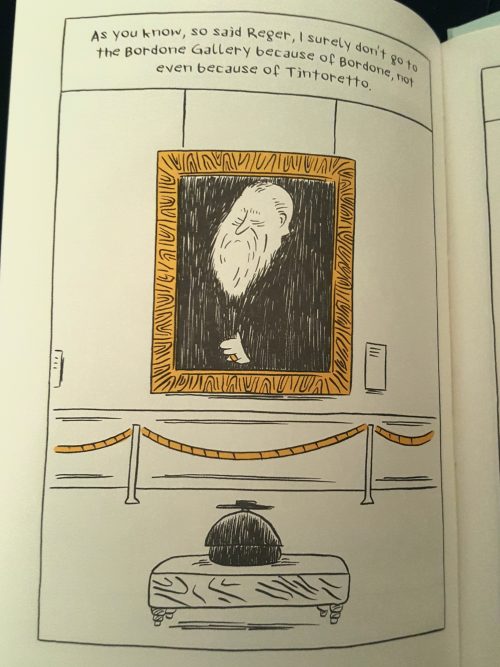
Anyone familiar with the unbroken, single paragraph monologues that characterize the typical novel by late Austrian writer, Thomas Bernhard, might find it hard to imagine how his work could be realized in the medium of the graphic novel. I mean wouldn’t there be too many words to corral on the blank page? How could the intensity of the original be translated? For Austrian cartoonist and animator Nicolas Mahler it’s simply a matter of focusing on the essentials of the story and letting his quirky illustrations and creative use of space do the rest. As a result, his graphic interpretation of Bernhard’s Old Masters: A Comedy is, well, something of a small masterpiece. One suspects that the author himself, and his alter ego characters, Reger and Atzbacher, would secretly agree, despite their shared conviction that a true artistic masterpiece is impossible to achieve, let alone imagine.
Rendered in stark black and white drawings playing on extremes—massive architectural details, characters who are tiny and squat, elongated and thin, or large and corpulent, often grotesque, appear against golden yellow highlights (a distant echo of the artwork in Ludwig Bemelmans’ Madeline series)—Mahler allows his images to complement and amplify the ridicule, humour and disgust so intrinsic to this and the majority of Bernhard’s idiosyncratic prose. Frequently recurring of images—the museum security guard, Irrsigler, seems to spend an inordinate amount of time disappearing into the men’s room—visually mimic Bernhard’s fondness for repeating phrases and motifs. As the blurb on the back of the newly released English language translation of this comic-book take on a comic classic states: “The Master of Overstatement meets the Master of Understatement.”
And it’s a match made in, well, the Art History Museum in Vienna.
There is precious little action in Old Masters and little obvious plot. It is, however, a spirited takedown of Bernhard’s favourite targets: the Catholic Church, the State, the arts and artists—his characteristically dark, satirical look at the world in general and Viennese society in particular. But it is also, in the end, a touching, sad and surprisingly romantic tale.
The story unfolds, if you will, at the musem, on a bench in the “so-called Bordone Gallery” directly across from Tintoretto’s White-Bearded Man. Here sits Reger, as he is wont to do every other day. Meanwhile, the narrator, his long-time friend Atbacher, observes him, just out of sight, from the “so-called Sebastiano Gallery” waiting for exactly eleven thirty, the time at which the two men have agreed to meet. Reger’s invitation is out of character because the they had met there just the day before and this second consecutive rendezvous was not in keeping with the typical pattern of either man. Curious as to the reason for Reger’s invitation to break from habit, Atbacher has arrived an hour early so as to watch his friend undetected. Naturally, this provides him the opportunity to launch into a lengthy account of Reger’s family history, his opinionated views, and his predilection to spend every other day at the museum, seated across from Tintoretto’s White-Bearded Man. In the novel this monologue consumes the bulk of the text. The same is true in this version which contains roughly the same number of pages, but much, much fewer words!We learn that Reger, the museum regular, has been visiting the Art History Museum for over three decades. Yet his attitude toward great art, the work of the “so-called” old masters, is one of disdain. Philosophically, he muses that a detail might be perfected, but the whole of any painting, sculpture, or other artwork ultimately leaves us appalled:
There is no perfect painting and there is no perfect book and there is no perfect piece of music, said Reger, that is the truth.
None of these world-famous masterpieces, no matter who did them, is actually something whole and perfect. That reassures me, he said. In essence, this makes me happy.
Only when we unswervingly come to the realization that there isn’t this whole or perfect thing do we have a possibility of survival.
And that has been the reason why I have gone to the Art History Museum for over thirty years…
As one might a expect, a number of artists, writers, and thinkers are subject harsh, and often hilarious, criticism as Reger, speaking through Atbacher’s account, expresses his unbridled opinions. Nineteenth century Austrian author, Adalbert Stifter, for example, is written off as a “kitsch master” with “enough kitsch on any random page to satisfy more than one generation of poetry-thirsty nuns and nurses” and then, strangely, compared to Heidegger, that “National Socialist, knickerbocker-wearing Philistine.” No one tosses out an insult like a cranky Bernhard character!There is, of course, much more below the surface than insults and irritation. That is where his peculiar wisdom lies. And, in this story, we learn that our irascible main character Reger’s antipathy to the old masters, and artists in general, has its roots in an emptiness they cannot fill. One that speaks to his, and our, need for love.One does not need to be familiar with Old Masters in its original form to enjoy this book (I wasn’t), but exposure to Bernhard in his full verbal intensity probably is. The satire, the heartbreaking warmth of the ending, and the sheer feat of rendering the mood and spirit of the Austrian writer’s pessimism and bleak humour into a graphic novel is not likely to be fully appreciated otherwise. I am a huge admirer of Bernhard, but I confess I’ve never really been drawn to graphic novels (pardon the pun). But the other night, when my son found this book on the doorstep of my old house where it had been left by a courier, I was immediately captivated. It has been a difficult few weeks and Bernhard’s misanthropic humour, oddly, is always strange comfort at such times. The beauty of this book is that it is not only a delight to read and look at, but I can imagine myself returning to it and rereading it many times (after all it doesn’t take very long—it’s akin to an instant hit of Bernhard relief).
Thomas Bernhard’s Old Masters, illustrated by Nicolas Mahler, is translated from the German by James Reidel, and published by Seagull Books. Essential medicine for any Bernhard fan, I’d say.
Before it came to an end one hundred years ago this November, The Great War, that rapidly escalating clash of empires—the Austro-Hungarian, Ottoman and Russian—would not only reshape the map of Europe and impact the distribution of power on a global scale, but fuel a new sense of national purpose and identity among the citizens of the countries pulled into the conflict either directly or by virtue of pre-existing alliances and obligations. It also unleashed, in very short order, the potential for destruction and violence on a scale previously unknown. With Austria’s declaration of war against Serbia on July 28, 1914, nations started to line up with their allies and declare war against one another. By the end of August, Germany, Russia, Britain, France and Japan were drawn in to a battle that was immediate, bloody and exhausting. And, as everyone soon realized, it was only just beginning.
It is easy to look back with hindsight, knowing the costs of this war and the ones that have followed, but in the opening moments of, and well into, what would become known as the First World War, the fervor of patriotism and passion to fight for God and country ran high. And this was well reflected within a realm one wants to imagine associated with “higher” ideals:
Despite its unparalleled horrors, the war had already produced something of immense value to humanity: namely, unforgettable poetry. This, at least, was one rather amoral commonplace from the early months of war. If poets had all too often been shut in their ivory towers, they were now quick to see that they could and must speak with the voice of the people. As Europe’s nations rediscovered their souls, they also rediscovered poetry. [1]
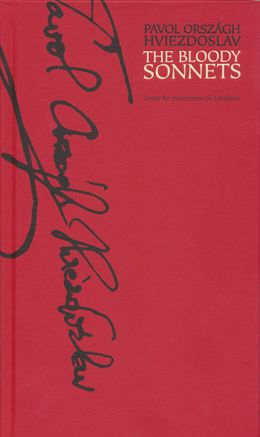
With few, cautiously voiced exceptions, the poets who responded to the unfolding drama of war, many of whom were themselves conscripted, were aroused with a new sense of purpose. Much has, of course, been written about this literary movement. Many collections and anthologies have been published over the years. However, one prominent, remarkably prescient poetic voice was raised against the prevailing sentiment, and his name is curiously absent from most of the annals and assessments of World War I poetry, such as the relatively recent text quoted above. In August and September of 1914, Slovak poet Pavol Országh Hviezdoslav composed a sequence of thirty-two poems, The Bloody Sonnets, expressing his passionate response to the growing hostilities into which his native country, as part of the Austro-Hungarian Empire, was bound. It has been largely overlooked. Now, a handsomely presented volume, published by the Centre for Information on Literature in Bratislava, seeks to bring renewed attention to this important collection of anti-war poetry as the centenary of Armistice approaches.
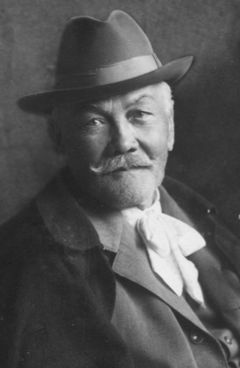
Born in 1849, Hviezdoslav (a pseudonym appended to his birth name) worked as a lawyer and banker in Dolný Kubín in northern Slovakia before leaving his administrative career behind to devote himself entirely to poetry and translating. Writing in his native, endangered language, he was formally and thematically ambitious, exploring questions of Slovak society and culture, while weaving neologisms and elements of dialect into his work. At the outbreak of the First World War, he was sixty-five years old. While the poets and artists of Europe turned their attentions to creations charged with nationalistic rhetoric, his reaction was decidedly different. As one who aspired to a feeling of shared kinship between Slavic nations, the notion that Slovak and Czech soldiers would be called into action against Russia was deeply upsetting. With The Bloody Sonnets he set out first to decry the mounting bloodshed, and then to venture beyond that to imagine how the conflict might end.
In his introduction to this special edition, translator John Minahane marvels at the acuity of Hviezdoslav’s vision and his willingness to engage in a polemic against the prevailing poetic climate:
Hviezdoslav has such a powerful sense of the war’s scale and destructiveness that at first I found it difficult to believe that the Bloody Sonnets could have been written in August and September 1914. Surely, in their final version at least, they must be from 1916 or even 1917, when the full horrors had unfolded? Today when we read that “the human slaughterhouse is [everywhere: / on earth, upon the ocean,] in the air”, we are bound to think of how World War I introduced the most appalling form of modern warfare, aerial bombing. Already by 1916 there were signs of its potential: at least twice airmen killed almost one hundred people in single missions. But the aerial campaigns, though long-prepared, got underway only in 1915.
In reading The Bloody Sonnets, one is continually impressed by the vivid images painted, at this early juncture, of the blood-drenched reality of warfare. The first seventeen sonnets resound with an angry, at times despairing, evocation of the brutality, agony and immorality of this escalating tragedy—one so fundamentally at odds with the Christian values its perpetrators and champions are claiming to profess. The poet’s contempt is palpable, heightened by his adherence to a formal structure. The sonnets follow course, each one building on the intensity of the one before. His view is strikingly, terrifyingly universal. Take, for example, “Sonnet 13” where Hviezdoslav asks:
What caused this wreck, this brutal and ignoble
collapse of morals? What provoked the breach?
What led mankind, in spirit grand and noble,
to plunge in the mud? What vampire? Oh, what leech,
sucking the sap of life out of the breast,
constantly thirsting bloody parasite?
Ah, selfishness! — and to destroy this pest
today we have no troops, no heroes to fight.
Yes, it will twist and tear and rend, and fall,
a tyrant, on the weak and innocent;
although the world is wide enough for all,
it would have sole control of earth’s extent
and even possess the universe, no less,
pitching the other into emptiness —
Leading into “Sonnet 14”, his imagery, and his scorn, is unambiguous:
This puffed-up arrogance that’s dressed in iron
and, armed with lethal weapons, lurks in wait;
that bulks like stormy clouds on the horizon,
each move a threat, with wide eyes full of hate;
that hangs above the earth like punishment
and keeps peace powerless: it coarsely swears
that it fears God alone! — But this is meant
contemptuously: in truth it does not care…
Then, midway through the sequence the tone and energy shifts as Hviezdoslav turns his attention to the possibility of peace and the role that his own people, the Slavs, and most specifically his disadvantaged Slovaks, might have, in days to come, as a voice for justice. “Sonnet 17” marks the transition, as the poet wonders aloud if there is anyone who will stand up and call for ceasefire:
Whether your wisdom comes of silver years
or you’re a man in bloom, cry to them all,
“Enough!” — and you’ll be a champion of the world.
Offer your enemy a brother’s hand,
a white flag over red ruin unfurled!
Or… must the violence constantly be fanned
till it burns out?
It is not a question easily resolved, in real life or in verse. From this point onward, Hviezdoslav directs his queries to the Lord, looking to God for answers and guidance. These poems are filled with a Biblical humility that stands in direct contrast to the self-righteousness he challenges in the first half of The Bloody Sonnets. Cautiously he ventures to question whether lessons may be learned from this legacy of conflict and carnage. Yet, however sceptical he is about the salvation progress and civilization might offer, he wants to believe that God has higher plans:
— forever save the Slavs (Lord, hear my prayer!)
from being nothing but a heap of dung
on foreign fields, where the thin native layer,
craving fertility would have them flung. (“Sonnet 27”)
The fate of Slavdom, and of Slovaks in particular, is of abiding concern. He belonged to a tradition that had, during long years of cultural suffocation under Austro-Hungarian occupation, looked to Russia as their hope for liberation. But, because Russia had never committed itself to justice, he feared that smaller Slavic populations would be absorbed and lost within the larger entity. Ideally Hviezdoslav wants to see a Slavic Europe emerge in which each of the nations is allowed to maintain its uniqueness while benefiting from the association afforded by their shared kinship—a future in which the Slavic streams are allowed to follow their own courses without, as Pushkin envisioned, necessarily being merged into the Russian sea.
This powerful sequence comes to an emotional climax as, in “Sonnet 32”, as the poet bids his own bloody cycle of songs good-bye with the wish that that they may be “read by many a tearful eye”. As much a patriot as his fellow poets who were at this time still trumpeting the glories of war, his own desire is simple:
I too have had my inward battleground,
I too am wounded, and my heart’s pierced through;
just once to see my people and feel proud:
redress for all their injuries long due
As an opponent of the war, Hviezdoslav was at risk of being branded as pro-Russian and, thus treasonous. Consequently, The Bloody Sonnets existed only in limited manuscript and presented as performance pieces during wartime. It was not until 1919, two years before his death, that the sequence was finally made available in print. However, in the decades that followed, his work fell out of fashion and was forgotten. It is only in more recent years that Hviezdoslav’s rightful position of respect has been restored in his homeland.
This English edition of The Bloody Sonnets will hopefully go a long way to ensuring this important Slovak poet is finally recognized for his contribution to anti-war poetry more than one hundred years after he poured his heart into this cycle—his last great poetic project. Translator John Minahane has taken on a formidable challenge here. Hviezdoslav, working within the constraints of the Petrarchan sonnet, was trying to express the intense emotions welling up inside. Rhymes are never easy to accommodate across linguistic borders but the results sing with overwhelming power, energy, and passion.
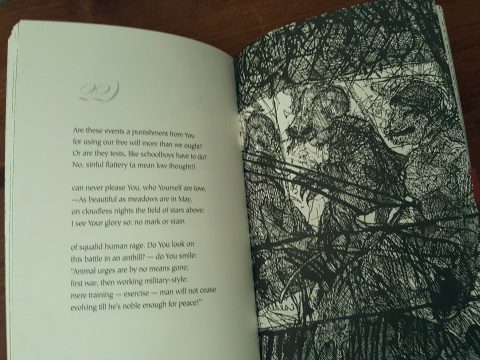
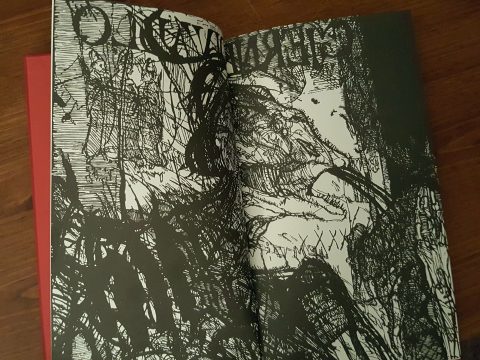
And then there are the illustrations. Artist Dušan Kállay’s black and white drawings practically burst with violence and depictions of evil. They speak to the senseless destruction of war without uttering a word—a perfect complement to a cycle of poems unjustly silenced for so long.
This title can be obtained through the Martinus online bookstore in Slovakia. The site is in Slovak but they are able to communicate in English and ship anywhere.
[1] Geert Buelens. (2015) Everything to Nothing: The Poetry of the Great War, Revolution and the Transformation of Europe. (Trans, David McKay) London: Verso Books
Cairo can be an inspiring city, especially in winter. So I think to myself as I come home one evening. The microbus stops where the overpass descends to the street, rain pouring, Road 10 running beneath, the taste of a damp cigarette. Winter is, even so, like religion: both fit spaces for expressing emotion, sadness above all. A whistle lengthening then broken off: a soundtrack to the scene; a perfect summons to tender feeling for a tableau that has been generated thousands of times before and embedded in memory and which, when tickled by the tune, comes back to life.
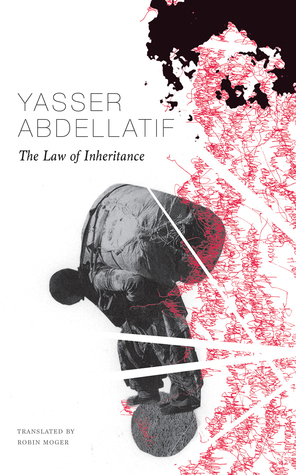
The Law of Inheritance, by Egyptian poet and writer, Yasser Abdellatif, originally published in Arabic in 2002, and now available in Robin Moger’s crystalline translation, is a delicate, filmic ode to emerging adulthood set against the tumultuous political environment of Egypt in the 1990s. Drawing on his own memories and on mythically-toned stories from his Nubian family history, Abdellatif manages to spin, in a mere 94 spare pages, a richly textured tale.
The opening section, “Introductions,” sets the stage, sketching in fragmentary, third person passages, images of a young man, at various ages from childhood through adolescence, from grade school to high school, from cigarettes to hashish, to the University of Cairo where both creative and Leftist political energies will be sparked. His father is absent, forced abroad to find work, his mother fragile, and the weight of being the older brother rests uneasily on his small shoulders. This brief, cinematic prelude paints a minimalist portrait of the narrator who will soon step out of the shadows to carry forth his own account, framed within a multi-stranded evocation of contemporary Egyptian identity distilled to its most elegiac essentials.
The narrative is moody and melancholic, evocative of time and place, infused with memory and family lore. Architecture and addresses serve as conduits to a personal past—the Lycée the narrator attended as a child, the University of Cairo where he studied Philosophy and finds himself swept up in the fervor of political protests in the early 1990s, the roads and byways where he and his friends lingered, listening to rock and roll and experimenting with pharmaceuticals. One has the sense of a slow, directionless drifting toward adulthood, which echoes and reverberates with stories drawn from his ancestral past and woven into the tapestry of this lyrical novella. As the narrator unspools his tale, he traces his family’s intersection with the city, with its streets and neighbourhoods. Relatives, pushed into exile from their native Nubia, arrive as social outcasts in the early decades of the twentieth century. Some find the promise of a better future; others find it more difficult to adjust. Yet for all of them, even the narrator and his father who are born there, Cairo seems to be a somewhat uneasy fit.
His grandfather does well. By virtue of his education, he chances to rise from a barman to an office worker, a transition that affords his family a move up in both social standing and neighbourhood. However, it also loosens the restraints he’d previously maintained against his own religious inclinations, an enthusiasm accompanied by periodic bouts of depression. By contrast, Fathi, a nephew to whom he is very close, has quite a different experience. Given to the pursuit of carnal pleasures, he embarks on an affair with an Italian girl in the mid-1930s. This enrages her budding Fascist countrymen who chase him through the streets and eventually force him into retreat in Rhodes. Another distant relation will fall into religious fanaticism and madness, and will ultimately retreat back to the Nubian countryside.
The Law of Inheritance is a novel of exile—from a homeland, a city, a neighbourhood—that succeeds through its lyrical precision and its measured humility. The narrator warns against vanity early on, and he is, in his own transition to adulthood, neither hero or victim. Likewise, the men in his family whose stories are told without glory or pity. The result is a powerful, moving exploration of what it means to belong in a world that is ever shifting and changing shape.
The Law of Inheritance by Yasser Abdellatif is translated by Robin Moger and published by Seagull Books.
Since I finished Esther Kinsky’s magnificent novel River, it has been difficult for me to contain my enthusiasm for this work, and yet, with a major review on the way, I wanted to refrain from talking at length about my reading of this languid, mesmerizing meditation on the relationships we have with place—those we live in, pass through, or linger in uncertainly during points of transition. That review is now live, and yet Kinsky’s book is still working its way through my system.
River is a slow read; immersive, poetic, attentive to detail. It creates an atmosphere of intimacy with the spaces the unnamed narrator traverses during a time of restless displacement in a community on the edge of London; a time of gathering and preparation for leaving the city where she has lived for a number of years. Some of these spaces are immediate, defined by the course of the river Lea. Others exist in the distance, temporally and physically. And yet, although there are clear parallels between Kinsky’s own life history and the locations her narrator visits, River occupies an intentionally indistinct borderland between fiction and memoir, focusing on experience in the moment over biographical background and detail, resulting in a narrative that flows, organically, like the rivers than run through it.
My review of River can be found at the online site of the singular journal Music& Literature. The opening passages are reproduced below, you can read the rest of it here.
A mood, an atmosphere, rises up from the opening pages of Esther Kinsky’s River—a melancholy that unfolds so softly, so insistently that I repeatedly had to remind myself that I was reading words that originally existed in German. I found myself wondering: What would the German feel like in my hands? How would its texture taste, guttural tones against the back of my throat? These are questions that, in their asking, underscore how River is a text to linger in, to touch, to absorb, and recognize one’s self in. We follow the narrator as she temporarily suspends her life, settling for a time in a marginal community on the edge of London, so she can slowly disengage herself from a number of years spent in the city, and prepare, mentally and emotionally, to take her final leave. The process she details seems to be one we, too, undergo in reading River.
Under a pale sun and in the whitish, shadowless light peculiar to this place and these seasons, I took to following tracks which, time and again, led me back through the alder grove. This partly mutilated wetland wood with its childhood flowers and wild birds secretly appealing to my memory was my gateway to the lower reaches, to the path downstream that gradually taught me, during the final months of my stay, to find my own names for a city I had already spent many years labouring to decipher—names only walking and looking could force me to extract and reassemble from a web of trickling memories, a debris of stored images and sounds, a tissue of tangled words.
River by Esther Kinsky is translated from the German by Iain Galbraith and published by Fitzcarraldo Editions in the UK and Transit Books in North America.
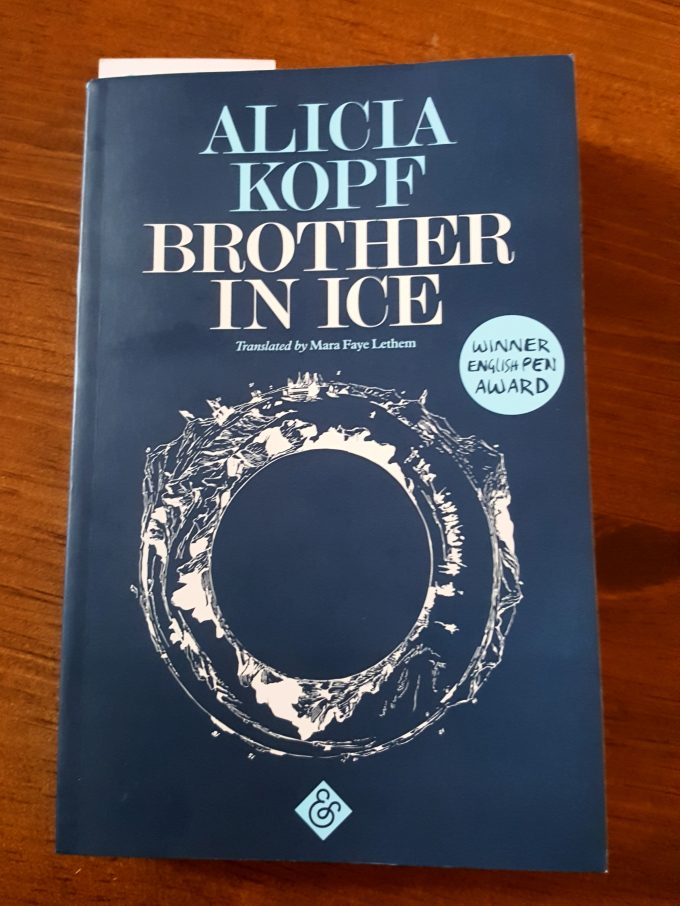
Brother In Ice is an exercise in trust—a risky venture, not unlike the expeditions into the blank canvas of the polar regions that Alicia Kopf traces in the early chapters of her ambitious hybrid novel. There is a distinct sense that the Catalan artist and writer is thinking out loud, mapping her own haphazard journey across the page. She could have lost her way, slipped into a crevasse and disappeared beneath the weight of her own icebound mission. But no. What she has produced, in the end, through an eclectic and inventive blend of autobiographical fiction, arctic-inspired scientific detours, and historical diversions, is a thoughtful meditation about identity, family, and the challenges of trying to explore one’s self through art.
To dissect Brother In Ice is to risk making it sound strange, possibly unreadable, but Kopf’s balance and restraint hold its often disparate pieces together. The opening section of the book, “Frozen Heroes”, reflects the narrator’s obsession with all things polar: shipwrecks, penguins, the anatomy of snowflakes, and, above all, the heroic, often reckless, rush to explore the furthermost regions of the globe and endure extreme conditions, all with the desire to lay claim to undefined spaces, explain mysteries and achieve impossible goals. To be the first. Grainy black and white archival photographs add to the accounts, but what allows such brief, nonfictional excursions to work is the author’s light hand and thoughtful voice. In these early pages we are also offered our first glimpse into the narrator’s family and personal life. In particular we are introduced to her autistic older brother:
My brother is a man trapped in ice. He looks at us through it; he is there and he is not there. Or more precisely, there is a fissure inside him that periodically freezes over. When he is present, his outline is more clearly defined; other times he’s submerged for a while.
He is interested in planes, trains, cars, cats, dogs and birds, inclined to watch them carefully and intently, but he is consistently unable to carry out ordinary tasks without being cued or asking what he should do. His presence, in what is ultimately a broken family, is significant.
The scientific diversions continue into the second section, “Library Atop an Iceberg” but gradually the autobiographically toned fiction moves to center stage. After a rather defiant adolescence, complicated by negotiating the rough terrain between her divorced parents, the narrator makes her way to university where she persists in studying art and literature, worrying about the practicality of pursuing endeavours that are likely to be less than self-sustaining. She supports herself, first in retail and then with odd teaching jobs, has her first serious romance, and ultimately, her first art show. She travels, struggles to get along with her mother, and worries about what will become of her brother and her responsibility for him as he ages. The chapters, if you can call them that, are short, vignettes and reflections, played out against glacial motifs.
Finally, in the third section, she visits Iceland.
Throughout this unusual novel, the narrator herself is on a quest. She is not even certain what it is that she is searching for. Like the polar explorers, in pursuit of a shifting point on the ice, in a vast white terrain, she is writing in an effort to render the invisible visible. This is the artist’s quest—one in which the question may be as elusive and ill-defined as the answer. Near the end of the first part, the narrator admits:
I often find myself getting stuck in this project. I see nothing before me, just white. Yet beneath there are many things. The shrieking of seals. Was it the poles I wanted to talk about? Or is it just the image of the snow that fascinates me? Instability, confusion, cold (it’s hot), determination. Sensations that were the constant companions of the polar explorers, as well as those of us who work with the blank white page. Because I’m not interested in the polar explorers in and of themselves, but rather in the idea of investigation, of seeking out something in an unstable space. I’d like to talk about all of that as a metaphor, because what interests me is the possibility of an epic, a new epic, without foes or enemies; an epic involving oneself and an idea. Like the epic that artists and writers undertake.
Hers is a journey that resonated deeply with me. Especially as a writer working in the uneasy territory of memoir, I loved the openness, the questioning, the self-doubt Kopf allows her narrator (and presumably herself) as this odd creation takes shape. As her own questions and explanations start to come into focus, the layers of inspiration that preceded her quest, finally start to make sense. The beauty of this book is not simply that it is an intriguing and original account of one woman’s coming to terms with some of the unresolved fractures in her own history, it is a challenge to other explorers who venture forth with pen or paintbrush in hand to forge their own paths as they seek to tell their stories.
Brother In Ice by Alicia Kopf is translated from Catalan by Mara Faye Lethem, and published by And Other Stories.
“Everyone who knows anything of history also knows that great social revolutions are impossible without the feminine ferment.” . MARX
So begins Blood of the Dawn, the devastating debut novel by Peruvian author Claudia Salazar Jiménez. This slender volume that captures, at gut level, the horror of the “Time of Fear”, the years when the Shining Path insurgency was at its most intense is tightly bound to the intimate feminine experience. It is an exercise with little narrative distance—one that takes three women from very different backgrounds, closes in on their unique perspectives, backgrounds, and motivations, and weaves back and forth between their stories. When their disparate trajectories intersect, their individual fates, at least in that time and place, become shockingly similar.
In 1980, a fringe group of Maoist terrorists stole ballot boxes and burned them in the public square of the town of Chuschi, setting off a time of fear and violence that would, over the next twenty years, leave 70,000 dead. Set primarily during the first decade of this “People’s War,” Salazar Jiménez’s novel is a bold attempt to give voice to those not often heard. On both sides of the conflict.
There is Marcela, a disillusioned, yet idealistic teacher who is seduced by the message of the Shining Path and its charismatic leaders. Abandoning her husband and young daughter, she joins the battle. Her first person account is reported from prison, where she looks back at her childhood, early adulthood and her time with the guerilla group. In the face of regular interrogation she is still defiant, still holding on to a loyalty that cannot quite be dissolved despite the atrocities she has observed, participated in and experienced. Hers is a complicated narrative that takes the reader right into the conflicted reasoning, force of conviction, and group dynamics that shape a terrorist.
The women advance, marching along the gray patio. The first of them holds a banner with the image of Comrade Leader. Honor and glory to the proletariat and the people of Peru. Hair trained under green caps. Red blouses. Aquamarine skirts to the knee. Marching in formation. Educated in the shining trenches of combat. Jail others call it; prison. All at the same pace. Give one’s life for the party and the revolution. Banners of red flags with a yellow star. Torches in hand. Rhythm. Rhythm. Rhythm. Drum one. Drum two. Drum three. The feminine ferment rising. We travel a shining path. We struggle without truce to the end.
The second character is Melanie, a young photojournalist in love with a female artist who has moved to Paris. She imagines that the conflict in the mountains holds the story she is meant to record. A city dweller, she is quite unprepared for the harsh realities she finds. Her story is told in a first person present that highlights both her passions and her naivete. She will discover that her camera is neither welcomed by the villagers she meets, nor does it provide a shield against the sights, sounds and smells that will come to permeate her very being.
The next hamlet is a cloud of smoke. It’s hard to make out anything clearly. My camera feels heavier than usual. That’s fine; its weight anchors me to reality in this spectral place. What’s left when everything is done? Nothing. Where should I go look now? What should my lens focus on?
Finally, the truly innocent victim in the situation is the Indigenous peasant woman Modesta, who will lose everything as insurgents and soldiers repeatedly cross through her village, leaving a trail of rape, torture and murder. Her account is reported in the second person—a startling powerful perspective—until, toward the end when she finds her own voice and picks up her own thread. By then we see her slowly finding a resilience and strength that is fragile and determined at once, caught in war that makes no sense to her.
Every day at exactly four in the afternoon, new words parade into your ears just like the terrorists parade every morning. That if the class, they say, that if the proletariat, they say; that if the revolution, they say, that if the people’s war, they say, are saying, say. You only nod in agreement, already tuning out. They speak of people you don’t know, a certain Marx, a certain Lenin, a certain Mao, and a certain President Leader who is boss of them all. We’re all going to be equal, they say.
The atmosphere is claustrophobic. Wound through the plaited threads of the women’s stories are episodes of unattributed stream of consciousness and short quotes from political and philosophical sources. Repetition is employed to reinforce the relentlessness of the savage violence, and the point at which the narratives of the three protagonists blur in identical experiences of excruciating violation. The anonymity of the moment is in sharp contrast to the differing paths that lead each woman to that point, and the diverging courses their lives follow afterward. In an interesting Translator’s Note, Elizabeth Bryer brings to light some of the challenges of reflecting, in English, the different voices through use of rhythm, ideological focus and cultural references as appropriate to each woman.
In the end, Blood of the Dawn comes very close to risking losing its impact with the bludgeoning effect of the brutal tableau that unfolds. Fortunately this a spare, tightly controlled work and, to its credit, one that raises more questions than it answers, even leaving its own characters uncertain. A brave debut, indeed.
Blood of the Dawn by Claudia Salazar Jiménez is translated by Elizabeth Bryer and published by Deep Vellum.
It’s summertime, somewhere in the vast Hungarian plain, and this one’s a scorcher. The heat presses down on the residents of an unnamed village and threatens to reduce the river—the refuge and solace toward which the winter weary turn to enjoy what little holidays they can scavenge—into a fetid stream. But at the nearby üdülő, the local holiday site with its beach and bar and holiday homes on stilts, seasonal activities will not be curtailed:
On weekdays it was still quiet in the üdülő, but the bar already smelt of what had been left behind from the weekend: spilt beer, sweat, the girls’ summer perfumes, the exhaust clouds of the motorcyclists and helpless chlorine bleach with urine. Around midday clouds appeared over the bend in the river. The sky turned white, the river dark, the heat did not abate, became dense, bright, the poplar leaves rustled, sounded like whirring metal scarecrow strips. The small boats lay pale grey by the bank, motionless, congealed into a river panorama, from which only a powerful gust of wind or the hand of a wrangler or rower could awake them.
On the beach and back in town this will be a summer filled with drama, heartache, and melancholy—business as usual, but with a twist. This year there is a stranger in their midst, the New Woman, who has arrived from afar and settled in with Antal, the mason, who has in turn abandoned his wife and son. Such is the basic outline of Esther Kinsky’s first prose work, the novella, Summer Resort, a short, playfully poetic fable filled with a seemingly endless cast of tragicomic characters and bursting at the seams with striking and delightful wordplay.
With the attention that has come with the publication of River (see my review at Music & Lietrature), Kinsky’s only other translated work to date is likely to attract renewed interest. Compared to River, this earlier novel lacks the emotional resonance and meditative depth that one looking backward might hope for, but what it does offer deserves to be appreciated in its own terms, as an exuberant display of highly-charged linguistic energy, and a clear indication of the animated imagination, attentiveness to nature and the astute eye for detail that will characterize the prose in her longer, more serious work.
Summer Resort is an exercise in tight, contained story telling peopled with eccentric characters. Many exist almost as caricatures, like the Kozac boys who maintain a certain status in town and at the beach—admired, tolerated and resented in turn—the Onion Men, and the generic Marikas and Zsuzsas in their bikinis and glitter sandals. Others fall into closer focus. Lacibácsi the scrap yard dealer who runs the bar at the üdülő each summer aspiring to be a “manbytheriver, a poplarshadowman, a confidant of drunks,” his wife Éva (christened Ruthwoman by the New Woman) and Krisztí, the leather-clad woman who settles herself at the bar, a welcome if uninvited assistant. But at the heart of the story are Antal, his ex-wife Ildi, and son Miklós who each take a brief turn directly narrating pieces of their lives, now forever changed by the insertion of the mysterious New Woman into their midst.
More than anything though, this village and its inhabitants serves as a broad tapestry for Kinsky to weave her poetic magic. Her characters are the ordinary folk, the policeman, the railwayman, the small-time hustlers, the day labourers and the farm workers. Victims of shifting economies, closing industries and faded hopes. The üdülő is a place to lose themselves, to play and dream, but this year of heat and drought, is marked by fires, a shrinking river, and restless bodies tossing between sweat soaked sheets. There is an affectionate sadness that rolls across the surface of the narrative, and a quiet resignation that seeps into the dialogue. But the language is fierce, the imagery vivid: “Katica’s mouth was rose red with lipstick, there was so much red on it that it stood out in the üdülő like a wound.”
This is a startlingly sensual work. Here we find the elements that will later become so essential to the absorbing intensity of River. Kinsky has an unwavering awareness of detail, colour, scents, and sounds. Nature contains both the beautiful and the bleak, the lighthearted and the devastating. As is the case with the river that here, on this flat, unforgiving landscape, is a primal force:
What belongs to the river, what to the land? The floods come swiftly and silently. The river swells up, in the course of a night it casts of the sham cloak of gentleness, bursts its banks, spills over tops of embankments, carries off objects, animals, people. The undertow and thrust of the water changes the landscape. Sky, water, destroyed treetops, helpless house roofs as far as the eye can see. Then the river creeps back into its gentle course, trickles sweetly between the devastated rampant undergrowth of the bank which sticks this way and that, reflects the sky and sun, has long ago secretly discarded in the bushes what it has snatched away, where it is transformed, missing persons first become foul impediments, the vermin of the riverbank and water meadows gathering around them in great clouds, then pale, hollow bodies, through which the wind blows the quiet music of melancholy, which always lurks here in the undergrowth.
Esther Kinsky is a German poet, writer and translator. She has translated literature from English, Russian and Polish, including works by Olga Tokarczuk and Magdalena Tulli. Folkloric tones, reminiscent of some of their work come through here, perhaps, as does a pure poetic sensibility. A restless incantation for the loves and lives that collide in the course of one brittle, unrelenting summer, Summer Resort is a work well worth visiting for anyone interested in tracing the headwaters of River. And anyone else who simply enjoys a good tale.
Summer Resort is translated by Kinsky’s late husband, Martin Chalmers, and published by Seagull Books.
One week into Women in Translation Month and I’ve yet to jump into the conversation. I’ve been reading German author Esther Kinsky, her novel River for review and Summer Resort for background. However, since the North American release of River is not until early September, I don’t know if my review will actually run this month. But then, if it isn’t possible to pack August with translations of female writers, it is a consideration that can be worked into one’s reading year round. To that end I thought I’d share some of the posts I’ve written about works by women in translation that I’ve enjoyed since last August:
A Working Woman — Elvira Navarro (Spain, tr. Christina MacSweeney) The Iliac Crest — Cristina Rivera Garza (Mexico, tr. Sarah Booker) Malina — Ingeborg Bachmann (Austria/German, tr. Philip Boehm) Hair Everywhere — Tea Tulić (Croatia, tr. Coral Petkovich) Endless Summer —Madame Nielsen (Denmark, tr. Gaye Kynoch) – linked to external review SS Proleterka — Fleur Jaeggy (Italy, tr. Alistair McEwen)
Poetry: Before Lyricism — Eleni Vakalo (Greece, tr. Karen Emmerich) Third-Millenium Heart — Ursula Andkjær Olsen (Denmark, tr. Katrine Øgaard Jensen) – linked to an external review
This year I’ve gathered a stack of possibilities—not that I expect to get through even half of them, but I like to have choice. And, because there is a lot going on in my life these days and a handful of other English language titles vying for my attention, I’ve selected relatively slender fare. Finally, because it is still Spanish and Portuguese Literature Months, this collection includes five Spanish, one Portuguese,one Bengali, two French, and three German language books.
And because poetry occupies more of my readerly attention these days, I’ve pulled out two poetic contenders:
Negative Space is translated from Albanian, Hospital Series from Italian. Both titles are from New Directions.
It was Wolfgang Hilbig’s story collection The Sleep of the Righteous, published in 2015 by Two Lines Press, that brought the late German author and his translator, Isabel Fargo Cole, to my attention. It might seem as if they arrived hand-in-hand, after all her translation of his novel I (Ich) appeared from Seagull Books around the same time, but of course, she has translated works by a variety of German language authors before and since those two titles emerged. But it would be fair to say that her efforts to champion Hilbig, her deep appreciation of his work, and her ability to be able to bring his convoluted sentences and filmic imagery to life in English continue to win him more admirers with each subsequent release. Most recently, she was awarded the Helen & Kurt Wolff Prize for her translation of Old Rendering Plant.
Photo credit: Emma Braslavsky
I have had the pleasure of interviewing this gifted translator twice now, and both times, when her generous responses to my questions arrived in my email, I read them with excitement and renewed appreciation. The latest interview was published at Splice this past week. In this piece, we talk about the most recent Hilbig release, The Tidings of the Trees, and the ways in which this work differs from last fall’s Old Rendering Plant. My questions were derived from my own reading of the book and were not sent until my review had been submitted for publication.
In the years since our first contact, I have read and reviewed Isabel’s translations of Klaus Hoffer and Franz Fühmann, and have added the works of several other authors she has translated to my library as well. But Hilbig remains central. So I am thrilled and honoured to be speaking with her in person in San Francisco on Tuesday night, July 24, as the Center for the Art of Translation celebrates her work, her recent award, and the release The Tidings of the Trees.
UPDATE:
The online journal Splice was hosting no longer appears to exist, so I have reproduced the original interview with Isabel as it first appeared below:
Wolfgang Hilbig, The Tidings of the Trees.
Translated by Isabel Fargo Cole.
Two Lines Press. $12.95. Buy direct from the publisher.
Isabel Fargo Cole grew up in New York City and studied at the University of Chicago, but she has lived in Berlin as a writer and translator since 1995. In 2013 she received a PEN/Heim Translation Fund Award to translate Franz Fühmann’s At the Burning Abyss for Seagull Books, and in 2014 her translation of Fühmann’s The Jew Car was shortlisted for the Oxford-Weidenfeld Translation Prize. More recently, she has published several translations of the works of Wolfgang Hilbig, and she won this year’s Wolff Translator’s Prize from the Goethe Institut for her translation of Hilbig’s Old Rendering Plant, published by Two Lines Press.
Her latest Hilbig translation is The Tidings of the Trees. Reviewing the book for Splice, Joseph Schreiber praised it as “a tale rich with fantastic imagery that openly explores the ability of fiction to preserve the past, mediate the present, and offer hope for the future.” Concurrent with the publication of Trees, Isabel Fargo Cole generously gave her time to correspond with Joseph via email and offer her take on working with Hilbig’s words.
TheTidings of the Trees, newly released from Two Line Press, is your fourth published Wolfgang Hilbig translation. Would you mind taking a moment to frame this novella within his body of work? When was it released and where does it fit?
The German edition (Die Kunde von den Bäumen) first appeared in 1992. It’s the last of a number of novella-length works Hilbig wrote in the 1980s and early 1990s. In terms of subject matter, it fits into a broader complex of works, culminating in the story collection The Sleep of the Righteous (2015), which explore Hilbig’s home town of Meuselwitz and the industrial wasteland around it. Hilbig returns time and again to the same landscape to explore different aspects and develop different metaphorical images.
.
This novella is described as one of his most accessible works. On the surface, perhaps, relative to the very close, internalised monologue of Old Rendering Plant(2017), it might appear to be a more straightforward, less claustrophobic tale. It’s a multi-level narrative wherein the main character, Waller, is telling his story to an unidentified narrator who records the account. We can place him in time, we know how old he is, and we have passing outside observations of his actions and behaviour as he is speaking. However, as much as time, space, reality, and fantasy are blurred in both novels, Waller is less able to follow and make sense of his own memories, and seems as concerned with touching abstract truths as he is with tracking down his own lost time. Consequently, much is left unresolved, unresolvable even.
Can you comment on the similarities and differences between these two novels with respect to the way reality is disrupted, and the challenges raised for yourself as translator?
Actually there’s just one narrator who sometimes refers to himself in the third person, as “Waller”. In many of Hilbig’s works — notably in ‘I’ (2015) — the author shifts between first and third person as a way of embodying how his narrators reflect on themselves or relate to their past, how writers observe and fictionalise themselves almost to the point of schizophrenia. In comparison with Old Rendering Plant, the landscape is more minimal, the language is a bit sparer; Hilbig is working with a more reduced and clear-cut palette of imagery and symbolism. This foregrounds the narrative structures, the interplay of perspectives and time frames. This is a story about storytelling, or rather its impossibility: the narrator tries to evoke the chopped-down cherry trees that once lined a road that led to a village that has vanished as well, swallowed by strip mines, and to describe the circumstances of these disappearances. This shifts to an effort to recall the taboo subject of Germany’s division and the disappearances it entailed.
On a number of levels, it’s about the difficulty of finding the right place to write from: “A place to sit! I’d lament, circling my empty chair.” Of course, the chair is just a metaphor or an alibi; the question is how to find the right perspective from which to reconstruct the memory or tell the story. And so the narrator shifts into the third person voice, as though that might help, or as though to watch himself writing; or he tries to adopt the perspective of the “garbagemen” who sift through the refuse of the past and seem to possess secret knowledge. Hilbig explores the question of adopting a persona or shifting personae to tell a story from, and the dangerous disorientation this can entail. And he explores how a writer devises and manipulates “figures” to act out his story: Figur in German is the standard word for a fictional character, but Hilbig exploits its literal sense of physical shapes that are seen from outside and remain rather alien, like puppets. Hilbig’s narrators find it difficult to relate to other people at all, and struggle with the sense that, in writing about them, they are producing mere simulations. In Trees, this takes physical form as the narrator arranges discarded store mannequins in tableaux in an attempt to communicate with the inscrutable garbagemen — an absurdist metaphor for storytelling.
These senses of simulation, unreality, dissociation, and an unstable “I” goes along with an unstable sense of time. Storytelling both asserts and complicates the notion of a linear timeline with a clear sequence of events bound by cause and effect — a story has to assume these things to some degree to have any coherence, but the very act of telling a story complicates the timeline and the causalities by situating a storyteller somewhere within or outside it. In Tidings of the Trees, Hilbig plays with the tension between the notion of a coherent “story” that exists out there, or within the memory, and simply needs to be recorded, and the teller’s actual struggle to grope toward this story and piece it together out of fragmented bits of time and space.
This is a struggle for the translator as well, as the often paradoxical-seeming tense shifts need to be attended to; the labyrinth of nested flashbacks and flashes of déja-vu is very much intended, and just as intentionally left without a resolution. In the end, the narrator comes to see the course of events as cyclical, narrated in “a language of return”, and he cedes the act of storytelling to the trees themselves: “storytelling without motive, a stream of story that followed only the slow rhythms at work in the place where the trees were.” The vanished trees write their story in their own ash upon the narrator’s empty page.
.
On a related note, I would like to ask you about the prose style in The Tidings of the Trees. In my reading, I sensed more variation in pace and tone than in some of Hilbig’s other stories and novels. There seems to be a more measured tone to much of Waller’s discourse; one finds more short sentences, less of the long, winding, stuttering flow of words. This is perhaps because the protagonist is trying to make himself understood to his audience. However, he has a hard time orienting himself within his own story and has an admitted disregard for reality. And there are many passages of exceptional urgency and poetic energy. How would you describe the differences in this narrative?
As you noted above, there is less of the intensely sensual, immediate, stream-of-consciousness style that you find in Old Rendering Plant or The Sleep of the Righteous. Perhaps the narrator of Trees is trying to access that more immediate mode of writing, but failing (at least until the very end, when he lets the trees speak). He has a greater detachment from the writing process; he’s reflecting on the act of writing, or rather his inability to perform that act: “But when storytelling reconstructs — or, in my case, manufactures — the problems of telling stories, it’s the pinnacle of self-circumscription. … I don’t know. Literature like that is unworthy of interest.” He’s ironising the postmodern irony of writing about writing — but taking it so far that irony turns into existential urgency. At the same time, Trees has more actual story, asserts more concrete, external goings-on (however fantastical and jumbled) than, say, Old Rendering Plant, which feels like a pure interior monologue.
.
Both Waller and the narrator of Old Rendering Plant are drawn to mysterious social outcasts, and, in each case, these elusive characters — the garbagemen who salvage goods from the ash heaps on the outskirts of town and the men who work in the depths of the rendering plant in the abandoned coal factory — are imagined in grotesque, surreal terms, and inspire some of the most exhilarating passages in each work. However, Waller’s identification with the garbagemen is more complicated, at once strange and enigmatic, and yet in their actions he sees a clear model for his intended act of preservation through storytelling. How do you see the roles, political and aesthetic, that these types of characters play in Hilbig’s work?
Hilbig was an outsider himself, as a self-taught non-conformist working-class writer in East Germany and as a working-class East German writer in West Germany. So it’s not surprising that he tended to write about outcasts — often his narrators are loners on the margins of society who become fascinated by people even more radically marginal than they are. Those marginal figures seem to represent, or have access to, things that society would prefer to forget, down to the crimes of the GDR and Nazi dictatorships. Interestingly, it’s hard to pin them down either as victims or perpetrators. In Old Rendering Plant, they might be war fugitives from Eastern Europe, or they might be old SS or Stasi men. In Trees, they seem to be in a state of exile from society, sifting through its detritus on the outskirts; on the other hand, they apparently act as an integral part of society’s digestive system, performing a function that remains constant across historical eras. They’re the people who quite literally do society’s dirty work.
.
Wolfgang Hilbig has a tendency to create narrators or protagonists who share basic biographical details very similar to his own, even if it is not made explicit. Their stories generally explore variations on a common theme — the search for identity in a society that enforces a rigid conformity of thought and action — and yet, each story or novel follows its own distinct path. Tidings is no exception, but this novel is also very explicitly about the responsibility of the writer and the enormity of his (or her) task. Waller’s twenty missing years form, in no small part, a severe case of writer’s block. Here he is, in mid-life, staring at the same sentence: “The cherry trees have vanished!” The question of the missing cherry trees that once lined the road to the nearby village, now also gone, represent a much larger, more vital story — about preserving memory, history, and hope. Would it be fair to say that this portrait of the writer’s task, if not his relative productivity, makes Waller an especially personal alter-ego for Hilbig?
I feel he’s actually a less personal and more abstract alter-ego: the Writer. There’s less of the texture of Hilbig’s own memories and biography, and he keeps stepping back from the narrator, referring to him in the third person, seeing him from the outside, actually spotting him in the distance, as a kind of doppelgänger. And he puts him in absurd situations that feel more consciously constructed, with more ironic detachment.
I think the cherry trees are in fact central: they are the story — or the storyteller, as the end hints. The cherry lane is one of Hilbig’s rare (but crucial) images of pure, innocent natural beauty, of a small paradise that existed within memory. It may have vanished, but it dominates the story, and in the end it prevails: the eternal, cyclical language of nature takes over the task of the writer.
.
Finally, you have recently been awarded the prestigious Helen & Kurt Wolff Prize for your translation of Old Rendering Plant. Congratulations! With another Hilbig translation, The Women, due later this year, the appetite for his work among Anglophone readers seems to be solid and growing stronger. There must be considerable satisfaction in this positive reception, and in being recognised for your intuitive and sensitive renderings. How do you feel about his reception? And more critically, in light of the disturbing political trends we’ve been witnessing in the West of late, do you think his message has a new relevance?
Thank you! I’m thrilled to see his work finally getting the English-language readership it deserves. I certainly think he has a lot to say to us about the cruel and unsavoury sides of social orders; about the way historical traumas are passed down and continue to do harm even (and especially) as they are denied and repressed; about the sheer mass of depression, anger, and hopelessness that can build up among people who feel alienated from their societies, from each other, and from their natural surroundings; about the (self-)destructiveness that results. I don’t think he has a “message” in the sense that he’s asking us to understand x so we can do y. But perhaps he asks us simply to recognise the dark shadows and the “garbage” on the outskirts of town as something integral to the human experience. Those strange sinister characters out there, whether they’re victims or perpetrators or both, aren’t “the other” — they’re alter-egos, reflections of ourselves and our own potentialities. Facing the darkness won’t perform some kind of therapeutic magic and automatically empower us to transcend it, but it could help us to proceed from a position of humility, a deeper understanding of our own and others’ limitations, absurdities, and burdens. At least that’s the best way I can think of to explain why I personally find his work moving and bracing, if not exactly comforting, at this particular time.
.
Joseph Schreiber is a writer based in Calgary, Canada. He is Criticism/Nonfiction editor at 3:AM Magazine. His reviews and essays have been published in a variety of literary sites and publications including Numéro Cinq, Quarterly Conversation, Minor Literature[s], and RIC Journal. He also maintains a literary site called Roughghosts and tweets @roughghosts.
There seems to be considerable debate these days about where the line should be drawn between the literary license to imagine and the appropriation of voices of those of different genders, sexualities, cultures, ethnicities and racial identities. What was once considered acceptable is now questioned. And, although race is often considered a boundary to be respected or only be crossed with exceptional care, in a highly stratified cultures, class or caste or ethnic heritage may also come in to play. The concern is that the dominant voice will not only be given more attention, but that others risk being reduced to stereotypes and caricatures.
I recently abandoned a book that, despite some very witty and engaging writing, seemed to be freely exploiting mental illness, poverty and family dysfunction as justification for a smart-assed narrator with all the warmth of a sociopath. Anyone who has been suicidal or lost a loved one to suicide will know it is no laughing matter. The charm quickly fizzled and turned to distaste for me. Apparently the poor and mentally ill are still fair game for slapstick humour and humiliation.
However, it is entirely different when the humour, social commentary or complex stories are owned from within a community, told by its members. That is, I would argue, the importance of supporting and encouraging contributions to literature, theatre, film and the arts from marginal voices.
Cue Mundo Cruel, a series of short, sharp stories that take you into the heart of a small community peopled with eccentric, mostly queer characters—a world that Puerto Rican writer Luis Negrón knows well. It is his own:
Santurce, Puerto Rico, once known as Cangrejos, meaning Crabs, but no longer. Santurce. Blocks and blocks full of doctor’s offices and temples—Catholic, Evangelical, Mormon, Rosicrucian, Espiritista, Jewish, and yoga-ist, if that’s what you call it. The stench of sewers 24/7. Unbearable heat. Reggaeton, old school salsa, boleros, bachatas, jukeboxes, pool halls, slot machines. Topless bars, Dominican bars, gay bars. Catholic schools, beauty schools, vocational schools, and schools where you can get a professional degree in just one year and without much homework. . —from the “The Vampire of Moca”
A striking array of voices and personalities pass through the stories in this slender collection, and their lives are often disturbing, filled with misfortune, dark humour and an uncanny resilience. Most of the pieces are first person narratives, often presented as monologues or one-sided conversations, and, in one instance, as a series of increasingly desperate notes without a reply. The opening piece “The Chosen One” will challenge a few readers with its precocious young narrator, gleefully recounting his very early initiation into sexual activity with boys and men, experiences bound, as he sees it, to his “special” role within the church. Crude, unnerving, and funny this is in its way a backhanded satire on the degree of sexual abuse that can and does occur. But our young narrator refuses to see himself as the victim. His story sets the stage for the hustlers and the heartache that re-emerges in later stories, but it is not typical. Truth be told there is no “typical” here at all.
What is remarkable about this collection is the variety—each story is different in style and tone. Negrón channels a wide range of characters with compassion and affection, even those who espouse homophobic and xenophobic views, allowing each to demonstrate his or her own narrowness or generosity. The one-side conversations and observed dialogues are particularly effective in this regard, allowing us to eavesdrop, without further comment. The infectious, campy energy of “La Edwin” offers a perfect example:
Ahá! . . . Listen, changing the subject, did La Edwin call you? . . . Yes, Edwin. The one who thinks she’s a man. Honey, the one from the support group . . . That’s weird because that little queen is calling everybody . . . Yeah, her, that’s the one . . . Oh I didn’t know they called her that. You’re bad, girl, bad, bad . . . Well she called me last night, drr-unk out of her mind . . . Saying that he felt all alone, that for him it was difficult to deal with all this shit, meaning gayness . . . I let her go on . . . So she could get it out of her system. Wait a second, I’m getting another call . . . Aló, aló. Aló, aló. How weird, they hung up . . . The thing is, a man left her . . . Yeah, girl, she got involved with one of those lefty fupistas who plant bombs and want the ROTC out of the university . . . Yeah, girl, since they can’t liberate the motherland, they’re going to liberate themselves sexually.
It’s a fun little romp, but the story it tells about queer identity and sexual insecurity is serious.
Most of the stories in Mundo Cruel are quite short, or rather, as long as they need to be. None feel like they are dragged out too far, preferring to offer snapshots of life in this marginalized community. As is typical, some are stronger than others. Likely each reader will have their own favourites. For me it is the sad, but beautiful, story, “The Garden”. Set in the late 1980s, it is the account of a love affair between a young man and his older lover who is dying of AIDS. Nestito’s boyfriend, Willie, shares a house with his sister Sharon who has a longstanding, secret love affair of her own. Together the three of them make an odd, but happy family. As Willie nears the end of his life they plan a party. Another indication of Negrón’s versatility, this is by far the tenderest, most heart-wrenching piece in the collection:
I lay down next to Willie. He had recently taken a bath. He had changed with me ever since he became bedridden. For months he ignored me as at the party where we had met. I wasn’t me, I was part of a duo with Sharon. “You two this, you guys that.” I looked closely at his body and passed my hand over his chest. His armpits were tender ground for little flowers. I hugged him gently. His bones felt fragile. Body, host. Orchard fed with alien nutrients. I sought his face, kissed the dry sores, brushed away an eyelash that rested on his cheek. I looked into his eyes and found, finally, after eight months and sixteen days, desire.
Only 91 pages long, Mundo Cruel offers a wonderful introduction to a skilled, sensitive storyteller and the strange, sometimes dark little corner of the world he knows and clearly loves.
Translated by Suzanne Jill Levine and published by Seven Stories, I read this book as part of the Spanish/Portuguese Literature Month (and, to be fair, the tail end of Pride as well).