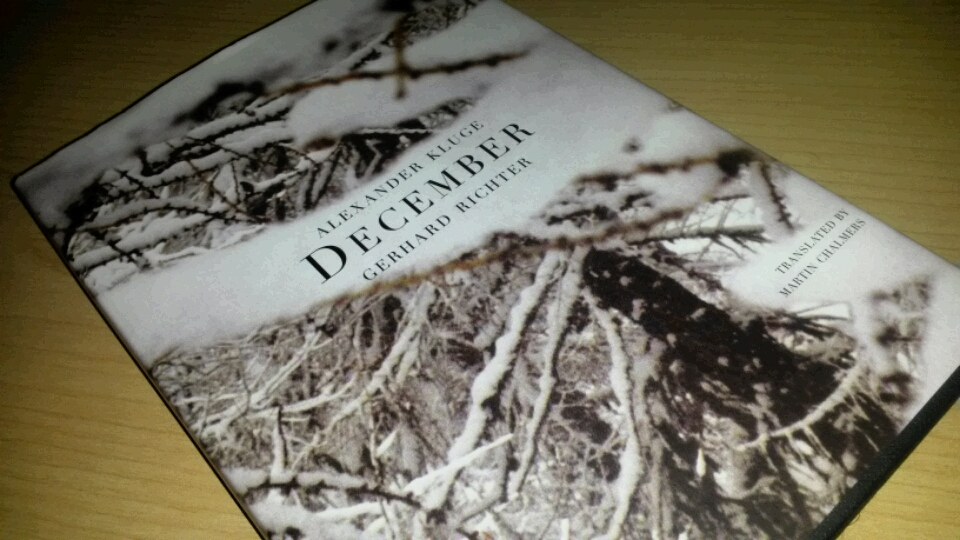
Closing out the old year with December by Alexander Kluge and Gerhard Richter

So, my first post of 2016 is a look at the last book I read in 2015. In truth I read it throughout the last month of the year, although not a little each day as intended, my father’s illness has interfered with all of my best laid reading plans of late. However I could not allow the year to draw to a close without finishing this book of calendar stories marking a passage through the month of December in the unique and inimitable style of Alexander Kluge, complemented by the haunting wintery forest scenes captured by Gerhard Richter.

2016-01-01 17.29.52This slim, elegant volume is my first encounter with the work of the German writer and film maker Alexander Kluge. The 39 stories, many less than a page long, are presented in a straightforward manner with a humour so subtle and wry that it simmers below the surface, blurring the perceptual line between history and speculation. Kluge offers a chronicle of an alternate reality so close to our own that it can catch you off guard. A flimic sensibility permeates each entry.

December is divided into two sections. The first part contains a series of dated entries, one story, or a cluster of stories, for each day. The years assigned to the dates vary. Many of the scenarios are set in or around the years of the Second World War. Others tend to be placed in the latter part of the first decade of the twenty-first century. But there are forays far back into prehistory and looking off to a distant future. Characters wander in and out from historical factual reality, war themes of conflict and destruction recur, as do images drawn from concerns about climate change and the fallout from the economic collapse of 2008. The ageless question of the nature of good and evil is a prevalent theme – “evil proves to be good displaced or straying in time” – as is the measure of the passage of time itself, whether measured on a global scale or at a much more personal, intimate level:

“The uncertainty, above all the lack of influence on whether and when someone will be struck down by the war, makes the soul bold. There is nothing to be lost any more.

So, after an air raid in 1944, which went on for hours, Gerda F. did not save herself up any longer. No thought of waiting for one of the returning warriors, whom she still knew and who would ask for her hand. She  didn’t want to get to know any better those left behind in the armament factories of the place. All were looking for closeness. She took a man who was passing through town up to her room. They never saw each other again. There was nothing about it that she regretted.”

The second, shorter section is titled “Calendars are Conservative”. They form a series of reflections on the way time – days, months and years – are recorded, calculated, and, as in certain situations such as during the height of the French Revolution, manipulated and distorted. The revolutions of the earth on its axis and the passage of the planet around the sun may be measurable with relative consistency, but that has not kept humankind from trying to understand, articulate and contain the progress of time, again in both the macro, political sphere and in the individual philosophical context:

“What manifests itself in my story, the story of a living person, is not COMPLETED PAST (what was, because it no longer is), also not the prefect tense of what has been in what I am but instead the OTHER of what I shall have been for what I am in the process of becoming.”

2016-01-01 17.32.15To spend a month, dipping in and out of the stories, anecdotes, and reflections Kluge has assembled to mark the end of the year is a treat. Although the images are often sombre, the atmosphere is contemplative. Gerhard Richter’s accompanying photographs enhance the measured tone. If you have ever experienced a day of heavy and unexpected snowfall, those days in the Northern Hemisphere that can bring all but the most essential services to a halt, granting a welcome reprieve from school or work for many; you will know how time can slow to a leisurely pace while the thick blanket of white muffles the day to day noise of the city. That is the sensation captured in the muted monochrome images of snow laden branches in silenced forests. This is the December we hope for but, caught up with the demands of year end and pressures of the holidays, frequently fail to achieve. A time to contemplate the past, for better or worse, speculate about the future and pull another calendar year to a close.

Translated from German by Martin Chalmers, December is published with the expected fine attention to detail by Seagull Books.

Winter solstice (again): 2015 – The year in review

I tend to run solstice to solstice, so this seems as good a time as any to pull together my thoughts about the year that was. I debated the conventional “best of” list affair, but somehow that is not reflective of the way I read or engaged with literature this year. I began the year still finding my footing as a book blogger, my earliest reviews tended to be less critical, more personal. By the end of the year I feel I have endeavoured to establish a more critical but, hopefully still accessible approach. Off my blog, it was an honour to cap off 2015 with my first review on Numéro Cinq where I have been invited to join the masthead. I am most thankful to Douglas Glover, the fine editor of this fine magazine, for having faith in my ability to write.
8294617299_b22c0cd186_z(1)I read and write about books as a an effort to strengthen my own skills both as a reader and a writer, but behind it all is a writing project of my own that has been struggling its way into being, seemingly with an infinite number of forays down paths leading to dead ends. So the following is a review of the year and, along the way, a nod to some of the books, new and not so new, that kept me company.

Reading in translation: I have typically read widely, but I never stopped to focus specifically on literature in translation, or, for that matter, to even think of much that I did read as being translated – sounds odd, I know, I think I just thought of myself as someone who tended to read internationally. Joining a shadow jury for the IFFP and then devouring as much of the BTBA long list as I could manage was, for me, a significant turning point in the way that I saw and focused my reading. My books are now shelved (or stacked) by original language. Apart from English I read books in 20 languages over the past year; German, French, Afrikaans, Czech and Spanish topped the list.
istrosIndependent and not-for-profit publishers: This year I became more conscious about looking to and supporting independent publishers. I was already well aware of Istros Books, a small UK publishing house dedicated to bringing Balkan and Central European writers to an English speaking audience, but this year I had the pleasure of meeting with publisher Susan Curtis, and visiting her closet sized office in the heart of London. She has been a most supportive influence in my development as a reviewer, and because I believe in their books and trust her instincts as an editor, I always look forward to their new releases. I also became conscious of other publishers including And Other Stories, Twisted Spoon, and Two Lines Press, just to name a few. I would reckon I bought few books from major publishers over the course of the past year, and trust me, I bought a lot of books!

2015-10-22 11.21.29Seagull Books: Here I have to credit (or blame?) Anthony of Times Flow Stemmed for bringing Calcutta based Seagull Books to my attention in recent months. I may be late to the party as they seem to have a core of passionate devotees. A book from Seagull is, quite simply, a finely crafted treasure, a reminder why books will never be supplanted by their electronic versions. They are also willing to take on authors or works that other publishers often balk at as witnessed by their impressive German, Swiss, French and African literary offerings, but any publisher who can transform a child’s tale by Thomas Bernhard into a huge, gorgeous picture book for all ages is alright by me!
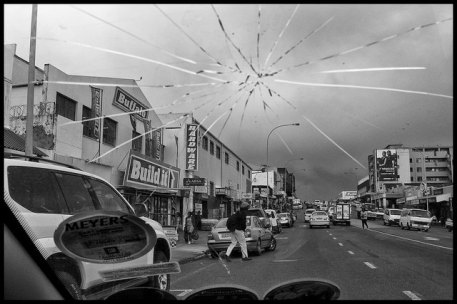
23818667295_d1e4f92c94_zSouth Africa: I have had a significant interest in the literature of South Africa for a number of years but this spring, feeling especially isolated and unhappy in my present circumstances, I decided, rather suddenly, to visit the country for the first time. I aimed for the solstice, effectively trading what would have been summer solstice here in the north for winter solstice in the southern hemisphere. I spent time with a dear friend in the Eastern Cape, then kicked around Cape Town and dropped a small fortune on books.

An ending does not give a life meaning: On my last full day in Cape Town, I sat in the Company’s Gardens, took the notebook I had carried and scribbled in, back to front as is my habit, throughout my journey; opened it to the first page and began to write. I felt I had reached a point, perhaps of closure, a space in which to truly start to pull together my endless personal writing project. I was certain I could, from that vantage point, look back over the months to June of 2014 when I walked away from my job, wildly manic after a period of unbearable workplace stress, and finally begin to give shape to that story I had been trying to tell for so long. I was at an end, of sorts, so I thought, and now I could work back.

14344933323_66912ab5a8_zBut I was wrong: Just over two weeks after I returned home, a pulmonary embolism I had unknowingly developed, a souvenir most likely of my recklessly long flight back, triggered cardiac arrest – in my sleep. The quick response of my son, who happened to be home, saved my life. I nearly reached that “end”, not the one that I imagined would be the point at which I could render my particular life experience and write some meaning into it, but an end final and complete. One that would have left me mute, distorted in the memories of those who have known me. The story would no longer be mine.

So what of writing? That is most critically the end to which I read, seeking ways into a story, or stories, I that need to be able to explore – to ultimately put behind me. I can write easily about other people’s words but I choke up on my own. And so the following list of books are those which spoke to me this year as a reader and a writer. I read over 90 books and enjoyed many including: the long overlooked Hansen’s Children by Ognjen Spahic, Ivan Vladislavić’s Double Negative, While the Gods Were Sleeping by Erwin Mortier, Can Xue’s The Last Lover, Marlene van Niekerk’s monumental Agaat, not to mention her wonderful Swan Whisperer from the Cahier series, and  Primeval and Other Times by Olga Tokarczuk. I have, by the way, excluded from this accounting a host of writers I expect to like and therefore read regularly, often repeatedly, including Bernhard, Sebald, Borges, Coetzee, Damon Galgut, and, added to the group this year, Bohumil Hrabal.

But the following books were, for me, the most vital. Thbirdse order is chronological, as read:
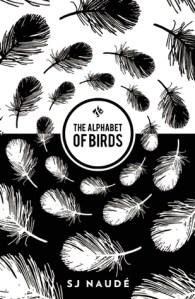
The Alphabet of Birds (And Other Stories) S J Naudé (Afrikaans/tr. SJ Naudé)
* This debut collection, of long, simmering, often disturbing, stories is simply some of the most sensuous work I have ever encountered. The characters are typically groundless, searching South African ex-pats, uncertain residents trying to find their place, and or those suspended somewhere in between.

atavisms


Atavisms (Dalkey) – Maxime Raymond Bock (French/tr. Pablo Strauss)
* The thirteen stories that make up Atavisms reach back hundreds of years, stand in the present, and spin into the future to explore the Québécois experience – at the personal and the political level. Bock skillfully employs a variety of genres to create what reads, in the end, as a mulit-facetted yet cohesive whole. Most impressive.


The Elusive Moth (Open Letter) – Ingrid Winterbach (Afrikaans/tr. Iris Gouws & Ingrid Winterbach )
* This novel about an entomologist in search of some way to fill or heal an ache that even she is at pains to articulate becomes an evocative exploration of memory, loss and anxiety. The story unfolds through scenes that repeat motifs, imagery, and fragmented conversations; set against racial tensions building in the small town where she has come to conduct research. The result has an unforgettable cinematic, art film feel.

 On Wing (Dalkey) / Signs & Symptoms (Twisted gal_on-wingSpoon) – Róbert Gál (Slovak/tr. Mark Kanak/Madelaine Hron)
* As I have tossed my own writing goals between fiction and memoir, happy with neither, I had sensed that an experimental approach might be part of the mix. However I had been frustrated with many of the works I had encountered – at least in so far as they spoke to me in a meaningful constructive way. With On Wing and then Gal’s earlier Signs & Symptoms I finally encountered works that I could enter into with my own observations and begin to map out ways of talking about the essentially philosophical issues I want to address. Re-engaging with philosophy years after my formal studies in the field, has also been critical to framing the way I view the essentially ontological questions I wish to articulate. So I am most grateful to Róbert for both his writing and his encouragement.

A Sorrow Beyond Dreams (Farrar Straus and Giroux) – Peter Handke (German/tr. Ralph Manheim)
* This 69 page memoir, Handke’s finely wrought tribute to his mother written within months of her suicide at the age of 51, not only paints a careful and delicate portrait of a woman trapped by her circumstances, but offers reflections on the challenges of telling a true story – distilling an entire life to the essential elements – when it might be easier to simply make up stories, to, say, write a play. A whole life is messy to write about with elegance. Handke succeeds.
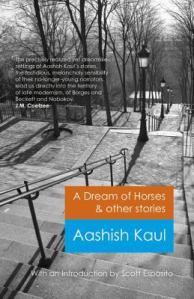
dreamhorsesA Dream of Horses & Other Stories (Roundfire Books) – Aashish Kaul
* This is a collection of dreamscapes populated by seekers of truths, purveyors of words, storytellers and readers. Most of the protagonists are writers, negotiating the fine balance between truth and imagination, struggling to capture the point of intersection in words. At least in my own experiences as a writer, or would-be-writer, that is what spoke to me throughout this melancholy, impressionistic book. And that is why it has to be on my list.

Vertigo (Dorothy Project) – Joanna Walsh
* Short story collections dominate my favourite books this year. It was an intentional focus, again with an eye to becoming more confident with medium. To that end, I recognize that the stories I am drawn to tend to have narrative arcs that are less pronounced, or more subtle, than some may like. The writing is typically more evocative, more ambiguous, more difficult to define and pin down. Like Vertigo – brutally sharp, spare and gorgeous, cutting to the quick of everyday life – an exquisite piece of work.

Dry Season (Istros Books) – Gabriela Babnik (Slovene / tr. Rawley Grau)
* I read many fine and challenging works from Istros Books this year, but the most stunning and devastatingly original has to be the EU Prize winning novel Dry Season. This tale of a love affair between a 62 year-old Slovenian woman and a 27 year-old man from Burkina Faso breaks every expectation, weaving African magical realism into a layered metafictional narrative that culminates in an ending so unexpected that it suddenly throws everything into a new light. Or does it?
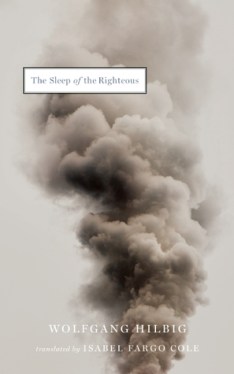
sleepSleep of the Righteous (Two Lines Press) – Wolfgang Hilbig (German/tr. Isabel Fargo Cole)
* 2015 saw the release, for the first time in English, of two works by the late German author Wolfgang Hilbig – both championed and translated by Isabel Cole (The other, I, from Seagull Books is waiting on my shelf.) The magic of this collection, set in East Germany before and after re-unification, lies in the atmosphere created by the long sentences that flow, like a stream, back and forward again. Starting grounded in a harsh reality the narratives slip into a subtly surreal, gray-toned, world where reality blurs at the edges and memory takes on a haunting, dark quality.

Adventures in Immediate Irreality (New Drections) – Max Blecher (Romanian/tr. Michael Henry Heim)
* It may well be that my most memorable read of the entire year is one of the last – an impulse buy if I can be honest. A prisoner of the plaster body casts that were the standard treatment of spinal tuberculosis, Blecher’s creative imagination penetrates the experience of being in the world at the level of minute, intimate detail and manages to capture with acute sensitivity those moments of reality in flux and flow. I don’t know how unique this way of interacting with the world is, but as someone who has always had a discordant, dysphoric relationship with his own body, there is more for me, personally, in this book than I can begin to express. A fine closure to a year of excellent reading experiences.

Finally I am most grateful for the conversation and company of the book bloggers and twitter literary folk with whom I have been so fortunate to engage over the past year. I have a dearth of book lovers in my real life. I was at a Christmas party the other night and a game was played in which we were each to share our three worst Christmas gifts – two true and one lie. I was saddened how many people included books among their worst gifts ever. Breaks my heart. Bless you all for keeping me (somewhat) sane.

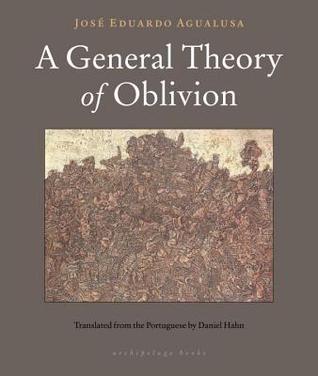
Never forgetting, not forgotten: A General Theory of Oblivion by José Eduardo Agualusa

“Our capital is full of mysteries. I’ve seen things in this city that would be too much even in a dream.”

The pages of A General Theory of Oblivion, by Angolan writer José Eduardo Agualusa, are populated by a colourful array of characters who, for the most, seem to be intent on forgetting, or being forgotten. None succeed. Their seemingly disparate life stories will turn, twist and eventually intersect as threads are dropped, picked up, retraced and woven into a tale that teems with magic against the backdrop of decades of brutal conflict and corruption that marked Angola’s painful emergence from colonialism.

oblivionAt the heart of this story is Ludo, a painfully agoraphobic Portuguese woman who, following the death of her parents, is cared for by her sister, Odette. When Odette marries a mining engineer, Ludo moves, along with the newlyweds to Luanda, the capital city of Angola. On the streets, the struggle for Independence is already underway, but Ludo does not venture out, she even shirks away from the windows and views the sky with terror. The cause of her nearly life-long fear of open spaces is finally explained in the final chapters of the book, but until that time her retreat from human contact and her obsessive, paranoid exile provides an anchor to the violent political drama that swirls, directly and indirectly, around her.

When Ludo’s sister and brother-in-law suddenly disappear, the anxious woman is left alone in their luxury apartment with the sole company of an albino dog named Phantom. Before long, a threatening incident leads to a man’s death on her doorstep, filling Ludo with both horror and guilt. She responds by constructing a wall across the hallway outside her apartment door, effectively barricading herself off from the outside world where Independence is about to be declared. She embarks on a bizarre hermetic existence that will last for 30 years. Over the course of that time, she will eat everything she can grow or get her hands on. She will burn the furniture, floorboards and the better part of the extensive library for fuel and heat, and start scribbling her thoughts on the walls when she runs out of journals and paper. Her eyesight will fade and, eventually, her beloved dog will die. But remarkably, stubbornly, she survives, passing a seemingly endless flow of days and nights:

“The city asleep, and her struggling to remember names. A patch of sun still burning. And the night, bit by bit, and time stretching out aimlessly. Body weary, and the night turning from blue to blue … But there was no one, not anywhere in the world, waiting for her. The city falling asleep and the birds like waves, and the waves like birds, and the women like women, and her not at all sure that women are the future of Man.”

Beyond the walls of Ludo’s dwelling, Agualusa traces the criss-crossing adventures of a number of people caught up in the ongoing conflicts that mark the unstable years following Independence. We have, among others, a Portuguese missionary who miraculously escapes fatal injury in an intended execution, an intelligence officer turned detective, a journalist who specializes in investigating disappearances, and a former prisoner who becomes a successful business man. Toss in a second life among a tribe of wandering shepherds, street kids, merciful nurses and a dancing hippo and you have a rich, magical tapestry that ultimately merges back at Ludo’s door where the elderly woman, is, by this time, living with a young orphaned boy who had arrived as a thief and ended up staying, providing a human companionship and support she had rarely known in her life.

A General Theory of Oblivion reads with an element of allegory or fairytale – the fateful intersections may seem too neat, too coincidental. The number of competing characters required to facilitate the convergence of the story lines can seem complicated; there may be a tendency – especially if one is interrupted in the reading as I was by an inopportune winter head cold – to lose track of who’s who for a moment. But the energy is so infectious, the woman at the core is so endearing, despite or perhaps because of her extreme neurotic behaviour, that the book succeeds in creating awe where, in the hands of another author, it might simply feel false and contrived.

Of course, it is essential to remember that magic is not a device as much as a way of being in the world for many authors from Africa. Last year I listened to the recording of a delightful interview from the Blue Metropolis Festival in Montreal with the young Angolan writer Ondjaki, who spoke about his cultural worldview, arguing that his own magic realism isn’t imaginary, rather it is intrinsic to how people think and how they tell stories in his country: “Fiction doesn’t happen to me. Fiction happens to Angola… no one will say ‘what a powerful imagination!’ You’ll get, ‘what neighbourhood did it happen in?’ ”

That kind of approach to storytelling drives this novel. The horror of the era it covers is not downplayed or ignored but it is met with tremendous spirit and resilience, and in a world obsessed with threats and fear, that cannot help but feel magical, even unreal.

Translated by Daniel Hahn, A General Theory of Oblivion is published in North America by Archipelago Books.

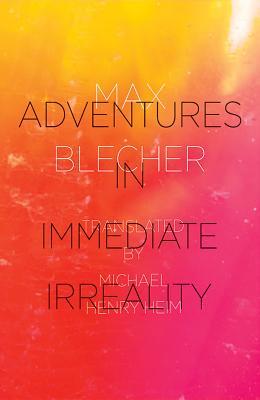
Chronicler of sensation: Adventures in Immediate Irreality by Max Blecher

“Brute matter – in the deep, heavy masses of earth, stone, sky or water, or in its least understood forms: mirrors, paper flowers, painted statues, glass marbles with their enigmatic internal spirals – has always kept me a prisoner bumping painfully against its walls, yet spurred me on to share in the strange and senseless adventure of being human.”

Confined to bed for the last decade of his short life, Max Blecher’s masterful Adventures in Immediate Irreality is nothing short of an intimate exploration of the ineffable question of what it means to exist in, and of, the world of matter and emotion. The boundaries between body and spirit are, for Blecher and his unnamed young protagonist, unfixed, shifting, and nebulous – sometimes seemingly just out of reach, sometimes oppressively sharp and painful. This is a luminous, original work that slips between the acutely hyper-real and the hallucinatory surreal, leaving in its wake a trail of vivid, sensuous imagery.

And that, superlatives notwithstanding, is the simple description. As the narrator himself would admit: “Ordinary words lose their validity at certain depths of the soul.”

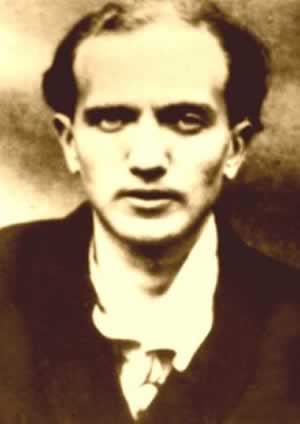
irrealityBorn in 1909 into a Romanian Jewish family, Blecher grew up in the town of Roman. In 1928, shortly after moving to Paris to study medicine, he was diagnosed with spinal tuberculosis and would spend the rest of his life in sanatoria, virtually immobilized in body, if not in spirit. During these years he would produce two novels, a book of poetry, and a number of articles and translations before he finally succumbed to his illness in 1938, when he was 28 years-old. His work has been variously compared to that of Proust, Kafka, Bruno Schultz and others, but to pigeonhole him would be to do a disservice to his singular vision which, in no small part, might be thought to be unique to his youth, his circumstances, and his acute sensitivity and innate ability to capture the most essential elements of being alive – his memory heightened by the harsh reality of being captive to a painful, disabling disease. It is not a work of surrealism, although there are dreams, visions, and elements of fantasy; but these aspects are set against the very real passion, anxiety, and disillusionment of adolescence.

So, with death an abiding presence in his own life, Blecher sets out to chronicle, with precision and attention to detail, in the flood of real and unreal experiences that his young protagonist encounters in his various “adventures” at home and around town. Beset from an early age by episodes, or “crises” as he call them, our narrator begins with an account of the way his perception of his surroundings and his sense of self within them – his identity – periodically dissipates and then resolves again. He emerges from these episodes with a recharged clarity, but he worries it won’t last.

“The feeling of distance and solitude during the moments when my everyday person has dissolved into amorphousness differs from all other feelings. When it persists, it turns into a fear, a dread of never finding myself again. A vague silhouette of myself surrounded by a large luminous halo looms somewhere in the distance like an object lost in fog.

Then the terrible question of who I actually am comes alive in me like a totally new body with unfamiliar skin and organs.”

This “terrible question” is what he sets out to try to answer by recounting, with an immediate, almost confessional tone, experiences that he hopes will lead to a clearer understanding of himself. Not surprisingly, his emerging sexual attractions direct much of his energies. He recalls his first intimate experiences with Clara in the back room of the sewing machine shop she runs with her brother. Later he will obsess and fantasize about Edda, the wife of the son of a family he regularly visits. In each circumstance, he agonizes over his insecurity, his inability to express himself with the confidence and grace he assumes that everyone else posses without question. In some respects, he is likely no different than most other adolescent boys exploring the dark and mysterious depths of sexuality, but he is so painfully introspective that he can’t help dissecting his physical and emotional reactions at the microscopic level, and the closer he looks, the more uncertain he feels.

Blecher’s protagonist acknowledges that he exists in a porous, sensuous relationship with the world of nature and matter. The moments of crisis that haunt his early years, the instances when the thin veil of reality is pulled aside, have formed and defined his relationship to the world of objects. Perception is eroticized, as Herta Müller describes in her introduction, leading to the “constant comparison of one thing with a hitherto unimaginable other.” Consequently his descriptions lean toward the vivid, often extreme and grotesque, as in his early morning observation of men unloading a delivery in the marketplace “their arms laden with sides of red meat and purple beasts glistening with blood, as tall and proud as dead princesses”. Lined up along the wall of the butcher shop, the carcasses are described:

“…like scarlet sculptures carved from the most diverse and delicate material. They had the watery, iridescent shimmer of silk and the murky limpidity of gelatin. The gaping stomachs were edged with the lace of muscles and the weighty necklaces of beads of fat. The butchers stuck their red hands in and extracted the precious innards – round, rubbery gobbets of hot flesh – which they spread out on a table. The fresh meat had the velvety sheen of a monstrous, hypertrophic rose.”

Coming of age in the 1920‘s, our hero is also fascinated with the technologically facilitated representations of life that were becoming ever more prominent in the still new 20th century. It is as if, one step removed, the world can be contained, engaged with in a way that seems to be more real than reality itself. Thus he is drawn to mirrors, to photographs, to cinema and, most passionately, to wax museums. He describes the tendency to lose himself in his imagination and slip vicariously into the worlds he sees portrayed or reflected. Even when the image he confronts is, in truth his own, as he once chances to find in a display outside a photographer’s booth at the fair grounds. The encounter triggers his existential musings:

“I would suddenly find my own life, the life of the person standing in flesh and blood outside the display case, indifferent and insignificant, just as the living person inside the display case regarded the travels of his photographic self from town to town as absurd. And just as my picture traveled from place to place contemplating new vistas through the dirty, dust-laden glass, so I myself went from one place to the next, constantly seeing new things, yet never understanding them. The fact that I could move, that I was alive, was merely a matter of chance, a senseless adventure, because just as I existed inside the display case I could exist outside it and with the same pale cheeks, the same eyes, the same lackluster hair that made such a sketchy, bizarre, unfathomable image in the mirror.”

Always hyper-aware and self-conscious, Blecher’s protagonist recognizes and makes note of his own oddness, his ritualistic behaviours and paranoias, and his compulsion to engage in what he knows is unseemly (at least with respect to the constraints of his “proper” upbringing). He takes, for example, to following women on the street and one evening, once the unaware object of his pursuit has disappeared into her home, he decides to open her gate and take up a position kneeling in her front yard. Another time, on the edge of town, he cannot resist losing himself to the sensual and tactile sensations of a field of mud and manure, an adventure that nearly has very dire consequences.

The matter-of fact delivery that carries this remarkable novel, is one of its most devastating qualities. Our narrator is attentive to detail – sights and sounds, scents, textures and tastes – but he is so completely self-focused that he observes and interprets the actions of others with a naive and curious absence of empathy. Or maybe he feels too much. He senses the world imposing itself upon his very being in a way that makes it difficult for him to comfortably negotiate his way in a material space and, as such, he seems to inhabit a plane of existence just off the axis of that which other people and things inhabit. That dissonance, more than any of his surreal dreams or startling descriptions, creates the measure of irreality that is sustained throughout, culminating with the narrator’s last desperate pleas, and leaving the reader with a unique, indelible experience that is not easily forgotten.

Blecher_MOriginally published in 1936 as Întâmplări în irealitatea imediată, Blecher’s Adventures in Immediate Irreality initially garnered little attention. Translations began to emerge in the 1970s, but again, the world was not quite ready. This new translation by the late Michael Henry Heim, was prepared when Heim himself was critically ill. He even learned Romanian in order to dedicate himself to the task. Romanian-American writer Andrei Codrescu remarks, in his preface, on the “mysterious filmanets of death” connecting the author and his translator that truly set this translation apart from other previous fine efforts. Released in February 2015 by New Directions, Adventures in Immediate Reality comes complete with a preface by Codrescu and a translation of Herta Müller’s introduction from the German edition.

My Review of Mr Kafka & Other Tales from the Time of the Cult by Bohumil Hrabal at Numéro Cinq

I’m thrilled to announce that my first review for Numéro Cinq is now live. Here’s a taste and a link to the entire review, an excellent online magazine, and your chance to see what a rough ghost really looks like!

Mr KafkaMr. Kafka and Other Tales from the Time of the Cult, recently released by New Directions, represents the latest addition to the growing body of work by the late Czech author, Bohumil Hrabal, to be made available to an English speaking audience. Composed and set, for the most part, during the early years of Communist era Czechoslovakia, this collection of seven short stories is deeply informed by a time when Stalin’s larger-than-life cult of personality loomed over a country unwillingly caught up in the thrust of major social and economic reforms. Yet, as the author indicates in his preface, this book can be seen as both a representation of his society’s evolution, and as an expression of his own creative evolution. During this period there was no single experience more profound for Hrabal, the writer, than his recruitment, in 1949, as a “volunteer” manual labourer at the Poldi Steelworks in the town of Kladno near Prague.

Today the Koněv division of the steelworks where Hrabal worked stands in ruin. During his term of service though, it was a bustling operation devoted to turning the wreckage of war into the raw material required for, among other things, armaments for the forces of the Soviet Union. Although he studied law, Hrabal had worked at a variety of positions including railway dispatcher, insurance agent and salesman prior to finding himself on the factory floor of the steelworks. He arrived in the company of an assortment of other white-collar workers and professionals who suddenly found themselves engaged in unfamiliar work in a strange and dangerous environment alongside seasoned labourers, Party hacks, and prisoners.

Read the rest of the review here.


Some memory I’ve got, eh, young ladies? Dancing Lessons for the Advanced in Age by Bohumil Hrabal

“…yes, tragedy rules the world and writers always have something to write about…”

The passionate interlocutor who commandeers the pages of Bohumil Hrabal’s breathlessly intense monologue/novella, Dancing Lessons for the Advanced in Age, is perhaps one of the most absurdly memorable narrators one could want to meet. For a little over 100 pages he entertains a group of sunbathing young women, engaging them with rapturous tales – the taller the better – peppered with endless asides, diversions and commentaries. Apart from commas and the occasional question or exclamation marks, there are no real sentence breaks; no full stops, not even at the very end of this glorious single sentence verbal escapade.

Dancing-Lessons-for-the-Advanced-in-Age_1024x1024The genesis of this early, experimental work lay in a series of texts Hrabal transcribed in 1949, at the elbow of his Uncle Pepin, an inveterate raconteur who will, himself, feature as character in his nephew’s later works. These tales were originally gathered as a collection titled The Sufferings of Old Werther which, as it turned out, was never published. But, as any decent storyteller in possession of a goldmine knows, no good tale dare go untold. So these stories were dismantled, literally cut and pasted, reworked, and recycled into the present novel which was originally released in 1964 – one of a number of diverse works that Hrabal would publish in the early 1960’s.

The narrator at the centre of Dancing Lessons, is what Hrabal called a pábitel (typically translated into English as “palaverer”), a dreamer caught up in his own world of memory, spilling forth an endless stream of anecdotes, tragic-comic observations, and beer hall philosophy. Here we have an old man who, without unnecessary delay, launches straight into an account of his past exploits as a soldier, cobbler, brewmaster and, in his own mind at least, legendary womanizer. His narrative spins off into so many diversions and asides that his audience has no option but to submit to the whirlwind:

“… here I am pushing seventy and having the time of my life with you like the emperor with that Schratt lady, promising you red leather pumps like the ones I made for Doctor Karafiát’s sister, who was a beauty, but had one glass eye, which is a problem, because you never know what it’s going to do next, a hatter from Prostějov once told me he took a woman with a glass eye to the pictures and she sneezed and it flew out and during the break they had to go crawling under the seats for it, but she found it wiped it off, pulled up her eyelid, and pop! in it went, by the way, baking is as much of an art as shoemaking, my brother Adolph was a trained baker…”

And on he goes. You get the idea. His asides are often as brutal as they are hilarious. With suitably ribald and absurd black humour, they are just as frequently both at once. Characters surface briefly, generally to either amorous or unfortunate ends, but, throughout the monologue, his banter does tend to revolve around themes – his experiences at the front during the war, the qualities of well fashioned footwear, the technical aspects of brewing beer, or the unlikelihood of achieving marital bliss. Eventually, in true beer hall fashion, the narrative becomes dominated by a series of pissing contests toward the end. After all, a lot of beer is consumed in the course of these tales, it has to go somewhere!

An admirer of the “European Renaissance”, his euphemism for sex, our hero is guided by the wisdom of two essential texts that resurface repeatedly throughout the course of his monologue and add to a sense of continuity. One is a handbook on sexual hygiene ascribed to a Mr. Batista who warns, for instance, “men against giving in to their passions, no more than three times an afternoon or four times for Catholics, to prevent sinful thoughts from taking shape”. The other guidebook from which he quotes regularly is Anna Nováková’s book of dreams that conveniently offers explanations – even handy excuses – to be gleaned from nocturnal imagery: “holding a dead man’s watch means a wedding and being locked in an insane asylum means a great fortune awaits you!” or how repeatedly dreaming about canaries in cages would mean one “would always long for freedom”.

When it comes to the ladies, our narrator has an insatiable appetite and no shortage of offers that tumble, often one into another, in his recollections. Even in the hospital recovering from surgery, while his rugged blacksmith roommate succumbs to pneumonia, he confesses that :

“… I was the only one who came out on top, a pretty nurse served me pheasant and asked me why I wasn’t married, why I let so fine a body go to waste, and for an answer I slipped out from under the covers and was about to give her a dancing lesson when they chased me back to bed because after a hernia operation they make you lie there like a corpse, a giant of a girl, but beautiful, once called to me from the Elbe, Come in to the water and I’ll give you a kiss, so in I went – neck deep, clothes and all – and got my prize, a hero once more, back on land I had to wring out more than my clothes, I’d just picked up my pay in ten-crown notes, and there I stood in my underpants, the women rushing down to the river to have a look at me, the whole town on its feet, yes…”

The ineffable character of Hrabal’s unstoppable narrator lends an infectious momentum to this novella. It also allows him to blend in a backhanded social and political commentary, often in the manner of an unreserved sentimentality for a bygone era. As Adam Thirlwell indicates in his introduction, Hrabal’s fiction simultaneously lingers on and evades what it is trying to say. One sentence can easily be contradicted by the that follows.

“But Hrabal’s technique is so moving, finally, because the world historical past is only an element of our universal nostalgia. For ‘in the days of the monarchy shoemaking was more chemistry than craft,’ laments our hero, ‘ today it’s all conveyor belts, I was a shoemaker, but I wore a pince-nez and carried a stick with a silver mounting because back then everyone wanted to look like a composer or a poet’…”  (Introduction)

In his joy for the “good old days”, there is a melancholy need to preserve proof of the trauma, not only of the past, but presumably of the present circumstances as well. Hrabal and his fellow artists were, at the time this book was published, working under the restrictions of the Communist government, a situation that would become more oppressive in the years to come.

But as his erstwhile rogue – at once grandiose, hysterical and fatalistic – wishes to remind the reader, worthwhile literature should cut sharply:

“… which must be why Bondy the poet says that real poetry must hurt, as if you’d forgotten you wrapped a razor blade in your handkerchief and you blow your nose, no book worth its salt is meant to put you to sleep, it’s meant to make you jump out of bed in your underwear and run and beat the author’s brains out…”

Oh yes.

* Translated by Michael Henry Heim, with an introduction by Adam Thirlwell, Dancing Lessons for the Advanced in Age is available from NYRB Classics.

In the era of the great ‘still’: The Room by Andreas Maier

“Venturing in there during the time of the stench would have been hell. I would have died of disgust. But I wasn’t scared of the room: given that setting a foot in there was completely inconceivable, its existence, so to speak, fell completely under the threshold of my perception. It was there, and yet at the same time it wasn’t.”

Set in the Wetterau, the fertile agricultural region north of Frankfurt, The Room by Andreas Maier marks the beginning of a proposed series of eleven memoir/novels exploring small town life in post war Germany. The reference point that launches this ambitious project is modest – the room that was once the private, darkened domain of the narrator’s uncle J. It may sound rather claustrophobic to begin with such a confined and specific space, but the spirit of this small novel as is expansive as the unfettered and innocent imagination of the simple minded anti-hero at its centre:

“This is the beginning that everything else stems from. The room, the house, the street, the towns, my life, my family, the Wetterau and everything else beyond it. My uncle, the only human being without guilt I have ever known. On his way into the real world, but with one foot still in paradise.”

As a consequence of a difficult forceps delivery, J would never shed the wonder and fleeting frustrations of a willful child as he grew into an adult. If it made him vulnerable, he didn’t notice. Incapable of feeling pain and always eager to fit in, he was unaware of the cruelty, physical and emotional, directed at him by his peers and by his own father. He lived in a world of fantasy – peopled with war heroes, mountain climbers, stone masons, crane operators, policemen, hunters. He loved to walk in the woods, could identify different birds, and seemed to have a special affinity for plants and animals.

RoomBut perhaps, more than anything, he was deeply attached to his brown VW Type 3 Variant and, quite remarkably, he had a drivers license. Driving, for J, was a huge production which he took very proudly and seriously. He was a simple man living in a simpler time, but at a moment when the world was poised to enter a new global reality. In his experience, J existed at a time when workers still routinely drank before work, on the job and, of course afterwards; when smoking three packs of cigarettes a day, though as deadly then as now, was not discouraged; and when no one commented if you scooped five teaspoons of sugar into your cup of coffee.

“My uncle didn’t live a healthy life, that’s for sure, but then again it wasn’t really the fashion to live healthily back then – you could pretty much choose the way you would die, and it was usually the way you had lived.”

The narrative around which the The Room is constructed, with many segues and asides, is the imagined description of a typical day in the life of J, at some point during the year of the moon landing, 1969. The narrator himself is only two years old at the time, so he does not pretend to remember anything that he sets out to recreate. Rather, he builds on what he has heard of his uncle’s life, filtered through his own childhood memories of a foul smelling man who frequently annoyed him or made him uncomfortable, and the adult understanding and compassion that, sadly, came too late.

J’s day begins early with a walk to the train station. From there he catches a train to Frankfurt where he works at the postal depot, a job his brother-in-law, a lawyer, had secured for him after his father’s death. What he thinks of his job and how he fits in there is not known. After work he is pictured considering the advances of a prostitute in the Red Light district near the Frankfurt Train Station. Does he enter the brothel or hurry home? His nephew sketches out varied scenarios but, in the end, he does not know what goes on in J’s mind.

“In my uncle, therefore, you could alternately see either the triumph of nature over the law or the triumph the law over nature. In reality, though, he was positioned between the two, and presumably at the complete mercy of both, and that’s why the former Frankfurt Kaiserstrasse district offered the best opportunity to get to the heart of the matter. Germany the land of secrets. My uncle, the man of secrets.”

Upon returning home, Uncle J disappears for a nap, and then emerges to a list of errands that his family has devised for him… refreshing the flowers on the graves in the family plot, picking up his sister, delivering his mother to the hairdresser’s. He tries to resist his mother’s insistence that he shower, or a least clean himself up, a task that he pays less and less attention to as he ages. In the end he complies, driven by his ultimate goal – the hope that he will later be able to spend a few hours at the Forsthaus Winterstein in the company of the hunters he so admires. Every step of this recreated day is measured out within the framework and idiosyncratic order that J appeared to impose on his own life, imagined from the inside, but ultimately unknowable.

The narrative tone of this inventive balance of fiction and memoir is reminiscent of the filling and emptying of a time capsule. The narrator places himself into the scenery, his two year-old, pre-language self as speculative as his uncle’s world and possible mindset. Maier extends and condenses time – bringing a mythical quality to a world in flux, blending the simple man’s worldview with the adult narrator’s knowledge of how his uncle’s life will continue to unfold, and the way that the Wetterau itself will be transformed over the four decades that come to pass between 1969 and the present moment when he sits, in his uncle’s former room, now converted to an office, to commit this tale to paper.

The Room, translated by Jamie Lee Searle, is available from Frisch & Co, a publisher of electronic books based in Berlin. The next two installments in Andreas Maier’s series, The House and The Street are due to be released in the the spring of 2016.

A look at two winter treasures from Seagull Books

It may not be winter by the calendar (yet), but here, where I sit, north of the 49th Parallel and west of the Rocky Mountains, it is a perfect wintery day. The snow has been falling, no too much to be fair, but the wind has been playing with it, sweeping it into drifts and coating the roads with ice. A good day for a good book.

2015-11-24 20.04.02

In recognition of the German Literature Month reading project that is drawing to a close this week (a growing list of over 120 reviews contributed by participating bloggers can be found here) I wanted to call attention to two very special books that not only feature German authors, but celebrate the book as a work of art. Both have winter themes and are published by Calcutta based Seagull Books.

Victor Halfwit: A Winter’s Tale by Thomas Bernhard is a short fable lavishly illustrated by Sunandini Banerjee. Listed in the Seagull catalog as “Children’s Literature”, I would suggest that this is, aside from being an opportunity to introduce a child to Bernhard early (and who would not want to do that?), a book to speak to the child inside. The story is essentially classic Bernhard. On a cold winter’s night, a physician crossing through the forest on his way to see a patient, stumbles, quite literally over a man lying in the snow. This man with the improbable name of Victor Halfwit is legless as the result of an accident and now, most unfortunately, his wooden legs have “snapped in the middle, as wooden legs do”, leaving him helpless and facing a miserable end. He had been on an ill-conceived attempt to win a bet with a miller who had wagered that he, Mr. Halfwit, would be unable to make his way from Traich to Föding, through the snowy forest, in just one hour, on his wooden legs. The faint chance of winning 800 schillings – the price of the finest pair Russian leather boots, something he had long desired – was too tempting, so Victor took the bet and nearly proved the miller right. Almost. But then, even a happy ending would not be without it’s bitter dark irony. This is Bernhard after all.

Taking a sentence or two at a time, this tale is presented in the company of rich, glorious collages. Drawing inspiration from famous artworks, medical illustrations, Indian imagery, playful designs and so much more, each page turned presents a new, original background to compliment the passage in quite unexpected and infinitely wonderful ways. I will confess that I ordered this book without paying much attention to the description. I knew it was Bernhard, I knew it was illustrated, but I was completely – and happily – caught off guard by this large, most gorgeous book when it arrived in the mail. I had expected something special, but honestly I had imagined something more modest. As a gift for a Bernhard fan or a lover of visual arts, or for yourself, let’s be honest, I would heartily recommend this book.

December is a take on the tradition of calendar stories that pairs 39 short texts by German writer, film director and critic, Alexander Kluge, with 39 haunting photographs of wintery forest scenes by Gerhard Richter. Included in this collection is a story for every day in December. Some are set during the war years, others in the 2000’s; some appear to have a straight forward historical tone, others seem more experimental in form. I can’t actually say because I intend to read this book throughout the month of December. Each entry is short, no more than a couple of pages at most. I bought this book with a gift card my daughter gave me for my birthday, thinking that it would be a welcome companion for the dark days – in a practical and an emotional sense – of December. Like many, I find it to be one of the most difficult times of the year and I look forward to exploring this work as the month unfolds.

Victor Halfwit: A Winter’s Tale and December are both translated from the German by Martin Chalmers and published by Seagull Books.

The dying gold of ruined stars – Poems: Book One of Our Trakl by Georg Trakl

“Sun, autumnal, thin and shy,
And the fruit falls from the trees.
Stillness dwells within its blue rooms
During a long afternoon.”

– from “Whispered during the Afternoon”, Georg Trakl, translation by James Reidel

Many years ago when I was in school, poetry, in so far as we were introduced to it, was almost exclusively the works of English language poets. In high school I fell under the spell of the English Romantic writers and that was the beginning. Over the years though, I would be inclined to think that most of the poets I have become obsessed with wrote in English, that is, until I began to read more translated fiction. With that my attention shifted, or to be more precise, my horizons became broader.

TraklThis year, a German book enthusiast I have come to know through the “internet of book discussions”, the corner of the web I inhabit, introduced me to Austrian poet Georg Trakl. Somehow he had escaped my attention before. Of course, when you come to read poetry in translation, the question of the translation itself becomes critical. Typically, when more than one translation of a poet’s work exists I try to access and compare a few. But when Seagull Books released the first installment of a three part series of Trakl’s poetry, I did not hesitate to order a copy, sight unseen.

Poems: Book One of Our Trakl is a new translation, by American poet and translator James Reidel, of the poet’s first collection, simply titled Poems (Gedichte), which was originally published in 1913. In his note at the opening of this volume, Reidel recounts that he has endeavoured to preserve the same concentrated mania that marks the works of the 19th century poets Trakl would have read: Baudelaire, Rimbaud, Verlaine, Hölderlin and Poe. He says:

“I want to actually channel Trakl, his craft (with its implicit painterliness) and work ethic, to have him, so to speak, absorbed in the right dosages he – as a poet, pharmacist and addict – intended.”

Reidel does go on to add that to emulate Trakl’s delivery in English, the rhyme scheme of the original poems is often necessarily sacrificed, but the contortions required to retain  rhyme can trivialize a poet’s spirit and tone.

In an essay in the online poetry journal Mudlark, Reidel expands on his Trakl translation project. He provides an overview of Trakl’s short and tragic life, as well a discussion of his approach to the translation, and a selection of his translations presented with the original German. A poet himself, Reidel brings a sensitivity and insight to his reading and approach that I, as reader, value:

“I have found that when you read Trakl in the original German, you get a snapshot of what is there. When you go back, you get another view. It may be sharper or less so, and with the feeling that it is intentionally less so. This can be frustrating for those who speak and think in English, that lawyer of languages. There is no fixed point to reading him or rendering him. This makes any book of translations simply a collection of snapshots of a particular reading at any point in time. Another way of rendering/reading a Trakl poem is through the barrel of a kaleidoscope, where one can only fix on a view when one stops or when the glass bits sometimes jam. I do this.”

Born in 1887, into a prosperous Salzburg family, Trakl was a precocious child, creative and intelligent – by his early teens he was experimenting with lyric verse that showed great promise. He could, however, be withdrawn and prone to depression. He was exceptionally close to his sister Margarete (Grete), a musical prodigy with whom he is thought to have engaged in an incestuous relationship. He began publishing poems in 1908, in Vienna where he had gone to study pharmacology, a tempting profession for one who already had a tendency towards addiction. As a budding poet, he enjoyed early success and mentorship during the following years, ultimately attracting the discreet patronage of Ludwig Wittgenstein. But the outbreak of war forced him into military service. Relying on his training as a pharmacist he hoped to avoid direct combat, but the trauma of trying to attend to desperately wounded troops without adequate supplies would drive him to attempt suicide. He was sent to a military hospital in Kraków for observation, but suffered a relapse and was found dead of a cocaine overdose on November 3, 1914. He was 27 years old.

                Patterns of Decay  (c) JM Schreiber, 2011
Patterns of Decay , Copyright JM Schreiber, 2011

This first volume of Trackl’s poetry, beautifully bound and presented by Seagull books, readily lends itself to an immersive reading from beginning to end. The autumnal themes that feature so strongly make it an even more evocative read for someone like myself at this time – that is, in November in the northern hemisphere – but autumn is rendered almost metaphorical in his verses. Nature figures in his work, rendered through rural and religious imagery; however nature, for Trakl, is one which couches death and decay as an intrinsic element of its stark beauty and haunting appeal:

In the evening, when the bells toll of peace,
I follow the birds in their glorious flights,
Long multitudes, like pious trains of pilgrims,
Disappearing into autumn’s clear breadths.

Wandering through the twilight-filled garden
I dream following their brighter destinies
And feel the sundials barely move any more.
So I follow their journeys above the clouds.

There a blast of decay makes me start to tremble.
The blackbird laments in the leafless branches.
The red vine totters on rusting trellises.

While like a dance of death of pale children
Around the dark weathered rim of the fountain
The blue asters toss shivering in the wind.

– “Decay”

These are quiet, brooding poems that show a clear obsession with decline. They speak to a young poet struggling to capture the gloom in his own soul, consequently the poems have a very immediate and personal feel. Are they depressing? As someone who has had his own lifelong challenges with mood dysregulation, I find his words oddly comforting. I am not equipped to offer a critique of poetry, I am afraid I can, in this case, only speak to what I feel. And I don’t believe I am alone in registering a profound personal response to Trackl’s poetry. In his short life he produced a small, but vital, body of work that would have an important influence on other German language poets including Paul Celan, Thomas Bernhard and Peter Handke; and draw the ongoing interest of poets, translators and readers outside of German speaking countries that continues to this day, just over one hundred years after his death.

For my part, I can only eagerly look forward to the upcoming additions to Our Trakl.

For all the restless souls: The Sleep of the Righteous by Wolfgang Hilbig

The landscape haunting the seven intermeshed stories that make up The Sleep of the Righteous by the late German writer Wolfgang Hilbig, is decidedly bleak. The fulcrum around which these stories pivots is an industrial town south of Leipzig – run down, defined by its drabness, perpetually unfinished, bordered by mine pits, the ruins of munitions factories, a lake, marshes,and, beyond that, the forest. Before and after reunification, this town remains a place in which time exists on another plane of reality, at least as far as the narrators – all varying shades of the same man with more than a passing resemblance to Hilbig himself – experience or remember it:

“Time persisted here in dogged immutability; the autumnal fog banks that merged beneath an earth-colored sky appeared unlikely to pass for decades to come. And more and more smoke seemed to spill from the sodden lowlands into the flat clouds, which, even in the afternoon, were nocturnal.”

sleepThis powerful collection is divided into two parts. The first part focuses on childhood, coming of age or, as it often seems, waiting to come of age, to “rise at last from the state of useless, unfinished, in-between beings”. Set in the years immediately following the Second World War, the town is a place where men are in short supply. The majority of the children are fatherless, their mothers widowed, and few babies are born. Consequently, relationships and social dynamics are skewed. In the opening story, “The Place of Storms”, the young narrator endeavours to negotiate the murky waters between the realm of the “little children” and that of the “older children”. Rumours that his grandfather has a gun boost his status and potential for crossing the divide, while the horrific swim trunks his mother knits him complete with suspenders are a decided barrier. All of the awkward anxiety of youth is played out in the grimy pools of the abandoned mine pits at the end of the street where children wile away the summer hours divorced from the world of the suffering, lamenting adults in their lives.

The stories in the second part are set in the 1990’s, after the Wall has come down. The protagonists are all now grown men, writers, who have long since moved away from this small town, but find that they are unable to stay away. Restless, they regularly return to encounter ghosts, to visit an aging mother, or to escape a disintegrating relationship. No matter how long they may have been away, they never really leave the place behind. But they return to a town that is dying, industries and businesses that have been abandoned, and memories that cannot be escaped. In the final, and longest story, “The Dark Man”, the unnamed narrator is an established author who encounters, on the darkened streets of his old hometown, a stranger who has pursed him and now reveals that he was the Stasi agent responsible for intercepting and reading the writer’s correspondence. He claims to have a collection of letters originally intended for our hero’s former lover, a woman who presently lies near death. The narrator is disturbed, but determined not to let this curious relic of the GDR get the better of him – he denies any suggestion that he and his enemy have anything in common. Yet when he gets back to his mother’s apartment, the man in the bathroom mirror bears a haunting resemblance to what he could manage to make out of the stranger in the dark.

The Sleep of the Righteous is one of those books where you may well be inclined to stop and reread a paragraph several times before moving on, not because it is opaque or dense, but because the language is so captivating; the flow and rhythms, like eddies in a stream of water, swirling, reversing, and moving forward again. The brief title story is a sadly lyrical meditation on the cycle of guilt and recrimination that binds and defines the relationship between a boy and his grandfather who, in a reorganization of sleeping arrangements, end up sharing a bed following the death of the grandmother – a demise that one of them might have inadvertently caused. It opens:

“The dark divests us of our qualities. — Though we breathe more greedily, struggling for life, for some fleeting substance from the darkness… it is the darkness that forms a mute block above us: intangible matter our breaths cannot lighten… it seems to burst apart at each answer from the old man, each lament of breath, yet sinks in again swiftly to weigh down still closer, in the cohesive calm of myriad tiny black, gyrating viruses. And we rest one whole long night in this block of black viruses, we rest from the toils of the day: from the everyday toil of circling each other, still and hostile.”

Night after night, grandfather and grandson twist and turn to a nocturnal chorus of queries and accusations, in this poetic evocation of the tensions that underlie the fictions that families maintain to make sense of the very ordinary tragedies that strike close to home.

In his introduction to this volume, Hungarian writer László Krasznahorkai, writes that in focusing on the mundane, the everyday life in East Germany, Hilbig manages to heighten the oppressiveness of that existence, rendering it all the more horrific as a consequence: “He wrote his astounding novels about a world in which only the weak, the sensitive, those incapable of bargaining and in no way heroic, can sense the chaos and the surrealism.” However, the measured, heavily weighted quality that hangs over the stories in The Sleep of the Righteousness, is bouyed by the sheer beauty of the prose and the quiet resilience with which the protagonists respond to the circumstances that history has gifted them. This could be a depressing read but somehow it is not.

Translator Isabel Fargo Cole, in a recent interview in World Literature Today, indicates that this collection is one of Hilbig’s most autobiographical works. His narrators tend to share the same basic features of his background – his grandfather emigrated from Poland, his father disappeared at Stalingrad, and he grew up with his mother in a household dominated by women. The town he mythologizes in his tales is modeled after the same one where he was born and grew up. Yet, it does not feel liked these are connected as part of a continuous narrative so much as each protagonist seems to have a similar launching point from which he proceeds to tell his story. There are overlaps and divergences along the way.

The Sleep of the Righteous is published by Two Lines Press. Along with his earlier novel,  I, which was also translated by Isabel Fargo Cole and released by Seagull Books this summer, English speaking readers finally have a chance to experience the sombre magic of Wolfgang Hilbig. And, hopefully, look forward to more.